Sanjha Morcha

Capt Kundu was to be back home on b’day, Feb 10

Capt Kundu was to be back home on b’day, Feb 10
Capt Kapil Kundu (Gurugram)

Chandigarh, February 5

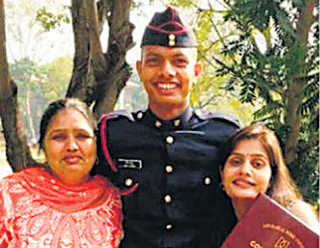
Captain Kapil Kundu, who was killed in Pakistani shelling along the LoC in Rajouri district of Jammu and Kashmir yesterday, was to visit home on his 23rd birthday on February 10.Capt Kundu was a resident of Ransika village near Pataudi in Haryana’s Gururgram district.His mother, Sunita, 52, who was struggling to hold back her tears, said her son loved an adventurous life. “Kapil was to visit us on his birthday. He always used to surprise me and tell his sisters first about his visit,” she said. He had visited the family in November.Sunita Kundu lost her husband Lala Ram Kundu when Kapil Kundu was just 15. Now pain and anger rage inside her heart at having lost her son.Family members said Capt Kundu believed in life that was larger in stature and not in length. “He loved nature. He was a great patriot. He used to write poetry to express his feelings for the country. He used to say the country is supreme,” she said. — PTI


Games under a nuclear shadow by Sandeep Dikshit

It is curious that security considerations have evaporated for the Seoul Winter Olympics. The West has forfeited events for a lesser excuse than an unbalanced man controlling N-weapons.

Games under a nuclear shadow
North Korea”s ice hockey players arrive at the inter-Korea transit office on January 25 for the Winter Olympics. AFP

Sandeep Dikshit

THE world has grappled with international games being held under the shadow of terrorism or an extremely divisive moment in world politics. The western bloc boycotted the 1980 summer Olympics over the Soviet military intervention in Afghanistan. The Warsaw Pact countries retaliated at the Los Angeles Olympics in 1984 but their boycott didn’t have the bite. It was evident that the one who controls the media also sets the narrative. The 2008 summer Olympics in Beijing came to painted as tainted by human rights abuses. The Olympic Torch was repeatedly intercepted by inspired as well as spontaneous protestors as it went through member nations on its way to Beijing.But never has the world hosted an Olympics, 50 kms away from an adversary depicted by repurted western publications as deranged, unstable and a megalomaniac. Unsurprisingly, ticket sales are lukewarm.The west has boycotted international sports events for far weaker reasons than the possibility of all the athletes at the Winter Olympics facing a nuclear apocalypse. England forfeited its match against Zimbabwe in the 2003 cricket world cup because of a mere political unrest after its media whipped up a fanciful figure of 70 lakh starving Zimbabweans. It didn’t agree with the International Cricket Council that had sensibly reasoned about the impossibility of starving people disrupting a cricket match being under the security gaze of a regime that wanted nothing to go wrong.A legendary Zimbabwean cricketer later let the cat out of the bag. Politics and not security was the consideration of the boycott. Seven years earlier, the Australians turned churlish by refusing to play in Sri Lanka because of a Tamil Tiger bombing a few weeks before their arrival. . Australia abandoned its test series in Pakistan in 2003 because a few gunmen were on the loose.Why isn’t the same consideration at play in case of the Seoul Winter Olympics? Why aren’t we reading or watching about the dangers of hosting an international event close to a neighbor who just two months back was being painted as homicidal and a psychopath? And aren’t those who blanched at the thought of playing at venues where bombs had gone off in the past, now happily acquiescing to play under the shadow of nuclear missiles?Perhaps there is a lesson in it for inveterate enemies like India and Pakistan. After the west had exhausted itself into helplessness by imposing sanctions and threatening North Korea with a massive nuclear wipeout, the turnaround came because of a new President in the neighbouring South Korea. During the days when North Korea was pressing ahead with missile tests and refusing to walk back, the South Korean President Moon Jae-in did not give up. He persisted even when the strategic chatteratti thumbed its nose at the possibility of rapprochement and felt North Korea will not miss the opportunity of disrupting an international event being staged 80 kms from its border.We will know this weekend which side was right: the conciliators led by the South Korean President or the partisans from Pentagon and Langley. But it is still strange that countries are preparing to send their athletes to South Korea with flimsy security guarantees that cannot stand the storm of a nuclear attack. 

Doomsday scenarios

  • North Korea conducts missile or nuclear tests to demonstrate its strength to the world.
  • North Korea starts skirmishes in the Yellow Sea or the demilitarized zone.
  • North Korea infiltrates special commandos to sabotage transportation hubs

sandeep4731@gmail.com


Pakistan Army supplied military equipment to LeT in Kashmir: Afghan envoy to the US

HIGHLIGHTS

  • The allegation was made following an attack on the Afghan Military Academy in Kabul by a group of suicide bombers earlier today
  • The claims bolster India’s contention that terror in the state is being fomented by the Pakistani establishment

NEW DELHI: Pakistan Army has been supplying military equipment to Lashkar-e-Taiba in Kashmir and Taliban in Afghanistan, claimed Afghanistan envoy to the US Majeed Qarar, today.

The allegation was made following an attack on the Afghan Military Academy in Kabul by a group of suicide bombers earlier today. At least five soldiers were killed in the attack and 10 wounded.

“The night vision goggles found with Taliban attackers in Maiwand’s ANA base were military grade goggles (not sold to the public) procured by Pakistan Army from a British company and supplied to Lashkar-e-Tayyeba in Kashmir and Taliban in Afghanistan. Lashkar-e-Tayyeba is an international terrorist organisation”, Qarar tweeted.


7th Pay Commission: Defence Minister Nirmala Sitharaman Requests Finance Minister Arun Jaitley to Remove Education Fee Cap For Martyrs’ Children

The savings have been reported to be Rs 3.20 crore approximately. The highest amount drawn has been reported to be Rs 18.95 lakh per annum per student,” said Bhamre.
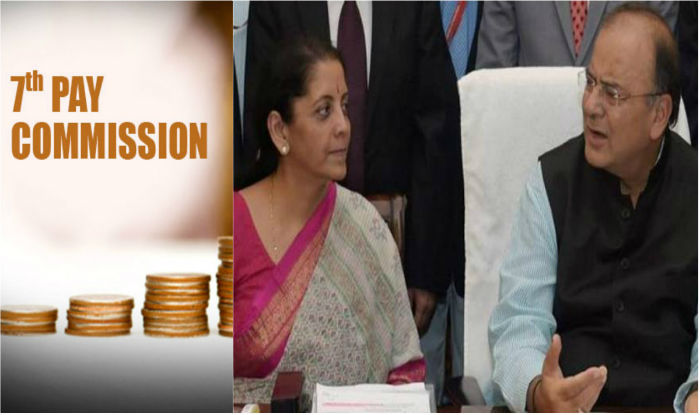
New Delhi, February 10: Defence Minister Nirmala Sitharaman on Saturday requested Finance Minister Arun Jaitley to remove the education fee cap under 7th Pay Commission for children of soldiers who lost their lives while serving the country.

Earlier in January, the government made it clear that there will be no immediate review of its decision to put a cap of Rs 10,000 per month on educational assistance given to children of martyrs or of those disabled in action.

Replying to a question in the Rajya Sabha, Minister of State for Defence Subhash Bhamre said the educational assistance has been capped as per the recommendations of the 7th Pay Commission and those demanding its review have been communicated about the government’s position on it.

Indian Navy Chief Admiral Sunil Lanba wrote to Defence Minister Nirmala Sitharaman requesting the government to look into it s prior order that limits education reimbursement to the children.

“Reply has been sent (to them) stating that the combined amount of tuition fee and hostel charges has been capped at Rs 10,000 per month in accordance with the recommendations of the 7th Central Pay Commission as accepted by the government,” Bhamre said.

Under the scheme, rolled out in 1972, tuition fee of children of martyrs or those disabled in action were completely waived in schools, colleges and other professional educational institutions.

However, on July 1, the government had issued an order capping the amount to Rs 10,000 per month, triggering discontentment among all the three services.

The Chiefs of Staff Committee (CoSC), comprising the Army, Navy and the Air Force chiefs, had written to the defence ministry requesting the issue to remove the cap.

Approximately 250 students have been reported to be affected during current financial year following the government’s decision to cap the assistance, Bhamre said, adding that “the allowance shall go up by 25 percent each time DA rises by 50 per cent.”

He said that out of a total 2,679 students during the year 2017-18 (up to December 27, 2017), 193 students have been reported to be drawing more than the capped amount.

“The savings have been reported to be Rs 3.20 crore approximately. The highest amount drawn has been reported to be Rs 18.95 lakh per annum per student,” said Bhamre.



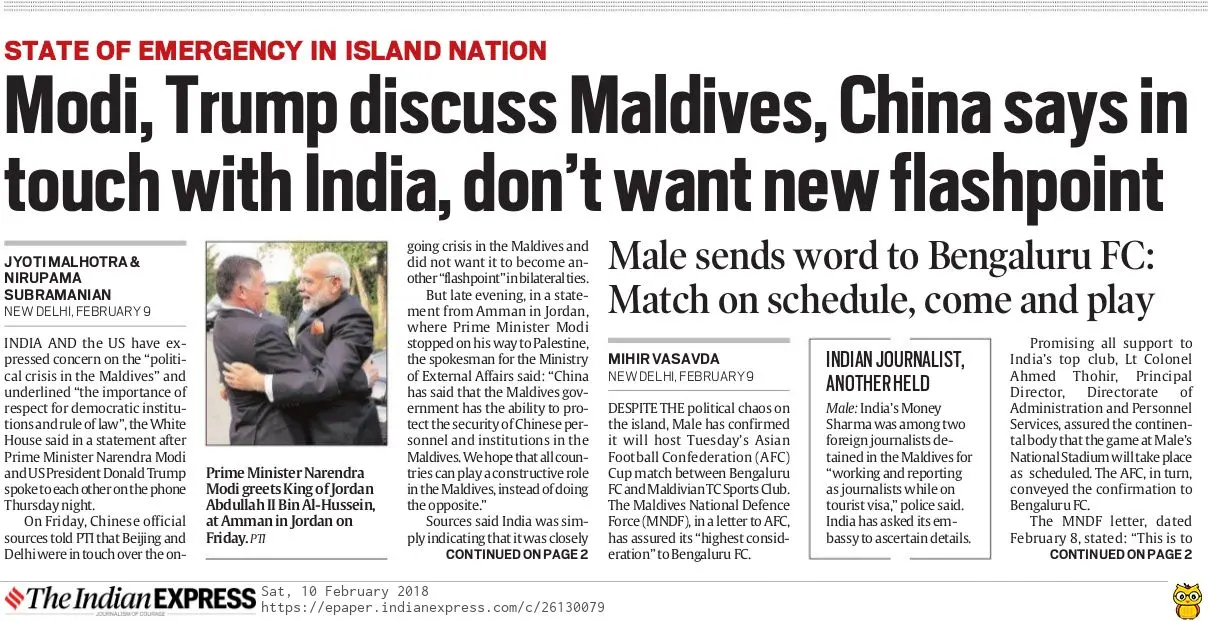
Modi, Trump talk Maldives turmoil

Island nation should fix crisis on its own’

WASHINGTON: Prime Minister Narendra Modi and President Donald Trump have “expressed concern” over the political turmoil in the Maldives during a phone call that appeared to signal to the Indian Ocean nation that it needs to fix the crisis without involving other countries.

PTI FILEPrime Minister Narendra Modi and US President Donald Trump pledged to continue cooperation on the Indo­Pacific region.

The two leaders’ discussions about the Maldives seemed to be the point of the call on Thursday given President Abdulla Yameen’s decision, taken in a desperate bid to save his embattled government, to rope in other actors by sending special envoys to China, Pakistan and Saudi Arabia. The Maldives has insisted it had no intention of cutting out India from its outreach though a proposal to send an envoy to New Delhi was cancelled at the request of the Indian government.

“Both leaders expressed concern about the political crisis in the Maldives and the importance of respect for democratic institutions and rule of law,” the White House said in a readout of the phone call, the first between Modi and Trump this year.

The Indian Ocean archipelago was plunged into turmoil last week after Yameen, who has tilted towards China to shore up his position, refused to implement a Supreme Court order freeing imprisoned political leaders. Yameen instead imposed a state of emergency and detained two top judges. Modi and Trump also “pledged to continue working together to enhance security and prosperity in the Indo-Pacific region” .


clip


3 soldiers killed in Machil avalanche

3 soldiers killed in Machil avalanche
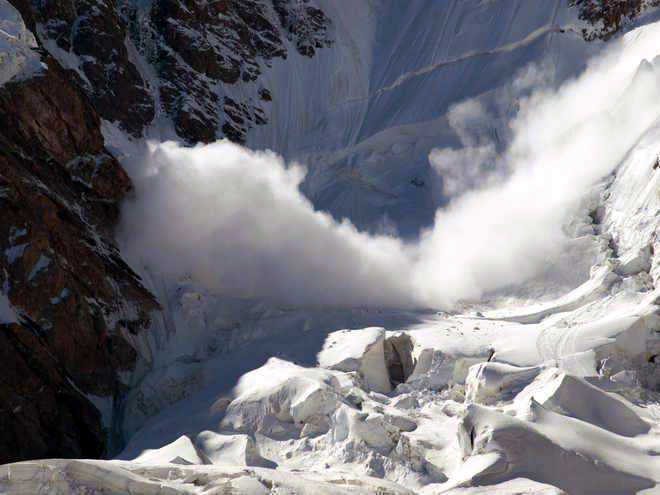
Photo for representational purpose only. Thinkstock

Majid Jahangir

Tribune News Service

Srinagar, February 2

Three soldiers were killed and another injured when an avalanche hit an Army post in Machil sector of north Kashmir’s Kupwara district on Friday afternoon. Sources said the avalanche struck the post of 21 Rajput in the Sonapindi Gali area along the Line of Control (LoC). The authorities had issued a medium avalanche warning earlier this week.(Follow The Tribune on Facebook; and Twitter @thetribunechd)“Four soldiers went missing after the avalanche, triggering a rescue operation in the area by a quick reaction team. The rescuers retrieved the soldiers, who were still breathing. However, one of them died immediately and two others succumbed to their injuries on way to a medical facility,” a defence source said. The deceased, all from Rajasthan, are Havildar Kamlesh Singh (Jhunjhunu), Naik Balveer (Bharatpur) and Sepoy Rajinder (Alwar).This is the second major avalanche-linked tragedy the Army has suffered in north Kashmir in two months. On December 12, five soldiers were killed when two avalanches hit the LoC in Bandipora and Kupwara. In the first week of January, 11 persons, including a BRO officer, died in two avalanches in Tangdhar area of Kupwara.

Two Pak-trained LeT militants arrested

Srinagar, February 3

Security forces have arrested two Lashkar-e-Taiba (LeT) militants, who had gone to Pakistan on valid visas to obtain arms training, the police said.They have been identified as Abdul Majeed Bhat of Mughalpora, Saloora Kreeri and Mohammad Ashraf Mir of Nilla Palpora, Pattan.“The militants were nabbed immediately after returning via the Wagah-Attari border before they could formally join the militant ranks here in Kashmir,” a police spokesperson said.On questioning, the duo revealed that “they were trained along with large number of Pakistani boys, most of them from Balochistan and as young as 10 years old”.“The said terrorist training camps are located near Burma Town, Islamabad, and being run by a terrorist commander operating under code names Hanzala, Adanan and Omar. The arrested militants have been given Pakistani visas by the Pakistan High Commission in New Delhi,” he said.The spokesperson said for the past couple of years, the police had unearthed several such modules where in youths had gone to Pakistan on valid passports for arms training. “In the past, several such boys have been arrested and some of them killed in encounters,” he claimed. — TNS3 injured in Tral grenade attackAnantnag: A CRPF man and two civilians were injured after militants hurled a grenade at a paramilitary patrol party at Tral in Pulwama district on Saturday. The explosion took place around noon in the Batgund area of Tral town. Police sources said the grenade was aimed at a CRPF patrol party. “It fortunately exploded some distance away. Three persons received minor injuries in the explosion,” a senior police officer said. He said the injured were rushed to a hospital. Following the attack, the area was cordoned off and a search operation was carried out. However, it triggered clashes. oc

2 CRPF personnel among 4 injured in grenade attack in Pulwama


2 CRPF personnel among 4 injured in grenade attack in Pulwama
Militants lobbed a grenade at a CRPF party in Batagund area of Tral, a police official said. Tribune file

Srinagar, February 3

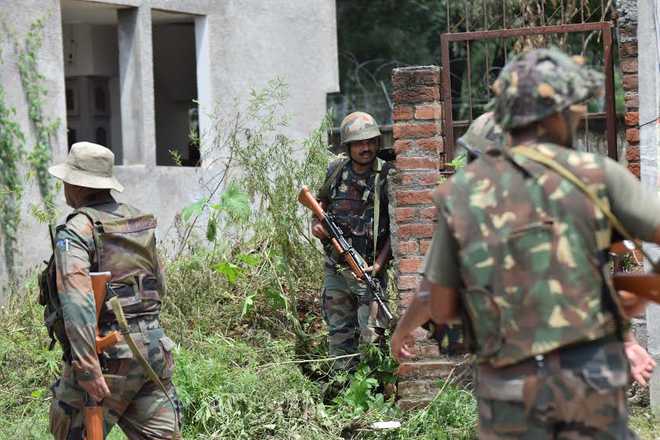
Four people, including two CRPF personnel, were injured in a grenade attack in Pulwama district of south Kashmir on Saturday, police said.Militants lobbed a grenade at a CRPF party in Batagund area of Tral, a police official said.

(Follow The Tribune on Facebook; and Twitter @thetribunechd)

Four people, including two CRPF jawans, were injured in the incident, he said.The area had been cordoned off and a search operation was under way, the official said. PTI


Plaint by fauji kids: MoD report sought by NHRC Violation of Army personnel’s rights alleged

Plaint by fauji kids: MoD report sought by NHRC

New Delhi, February 9

The NHRC has taken cognisance of a complaint filed by three children of Army officers alleging violation of human rights of the force’s personnel in recent incidents of stone-pelting in Jammu and Kashmir.The National Human Rights Commission said the complainants have also sought its “intervention for an appropriate inquiry into the incident of stone-pelting and assault by an unruly and disruptive mob on Army personnel in Shopian district on January 27”.(Follow The Tribune on Facebook; and Twitter @thetribunechd)In their complaint, the children have said they were “disturbed” by the recent incidents of stone-pelting and assaults by mobs on security forces.The NHRC observed that in view of the facts narrated and allegations levelled, “it will be appropriate to call for a report from the Ministry of Defence to know the status of the situation and steps taken by the Centre on the points raised by the complainants regarding alleged humiliation and violation of human rights of the Army personnel in Jammu and Kashmir”.A communication has been sent to the defence secretary, seeking a report in four weeks, it said. — PTI


Families bid farewell to bravehearts killed in Pak shelling

GURGAON: After spending a day waiting for the body of her son, martyred in Kashmir on Sunday evening, to return home, Sunita, the mother of Captain Kapil Kundu, was infuriated and she burst into tears when she was told that his remains may arrive only on Tuesday morning. Her anger and frustration was reflected in her response as she scoffed at the delay that has was made in returning a soldier to his family.

PTI & NITIN KANOTRA/HT“I have lost a child, he died yesterday, it has already been 24 hours, why should I have to wait for another 24?” she said, before becoming unconscious, even as a group of women attempted to calm her down.

Kundu was among the four army men who were martyred in Jammu and Kashmir’s Rajouri area on Sunday, following shelling by Pakistani forces.

It was a little after 9.15 pm that the 22-year-old finally returned to his village, for the first time since his trip during Diwali. In the time that has elapsed since, he had managed to secure a promotion, and would have, for the first time, met his family as “Captain Kapil Kundu”. He was, however, martyred only a week shy of the meeting.

“He had been promoted to the rank of captain only recently, on January 26, and had been transferred to Rajouri after that. He was earlier posted in Poonch.” Said Sachin Chillar, his cousin.

In his village, Kundu was revered since he was the first person to hold a rank of an army officer.

Even as the cries of ‘vande matram’ and ‘bharat mata ki jai’ filled the air, his body was carried outside his single storey home, located near the entrance to the village, where his family got their last few minutes with him, even as a crowd of hundreds watched on, screaming anti-Pakistani slogans from time to time.

Around 9.45 pm, Kundu left his village for the last time, as mourners accompanied his body to the cremation ground – located only metres away from the village, behind the campus of a Government School – leaving behind a heartbroken mother, two distraught sisters, and a village that promises to remember him as a “source of inspiration”.

SLAIN JAWAN’S LAST ADVICE FOR KIDS

JAMMU: “Study seriously for exams”. Havildar Roshan Lal, one of the four Indian Army soldiers killed in Pakistan shelling in Rajouri district on Sunday night, had this advice for his children when he spoke to his son in the morning.

Lal, 42, hailed from Nichla village in Ghagwal tehsil of Samba district in Jammu. As his family mourns his death and people console them, there was anger and talk of settling scores.

“He died in a proxy war,” said Darshan Kumar about his older brother Lal as mourners gathered at the family home in Nichla.

“Let’s settle it once and for all,” said Kumar, who works with the paramilitary Central Industrial Security Force.

Lal, who joined the army in 1995, is survived by his father, Des Raj, wife Asha Devi and two children.

“My father talked to me [over the phone] on Sunday morning and asked both of us to study seriously for the final exams,” said Abhinandan, a Class 10 student at the Army School in Samba. His sister, Artika, is in Class 8.

The other two soldiers killed in Pakistan action were identified as riflemen Ram Avtar and Shubam Singh.


The very crude oil war by Sushma Ramachandran

The very crude oil war
Slippery road: A $10 price rise will affect GDP growth by nearly 0.3 percentage points.

Sushma Ramachandran

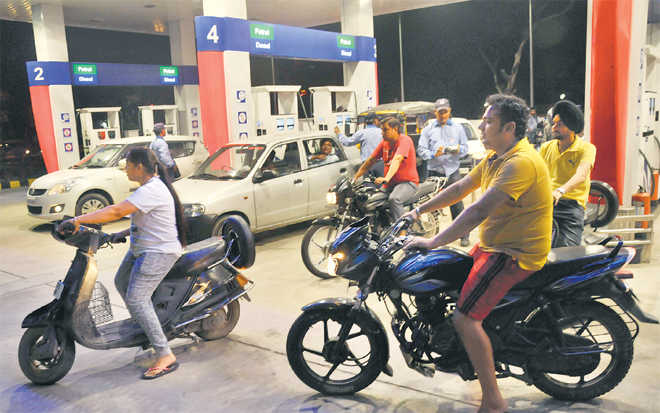
THE NDA government has been lucky for much of its term as far as global oil prices are concerned. These crashed from a peak of $140 a barrel to around $40 per barrel within six months of it coming to power. The luck seems to have run out. International prices are currently hovering at nearly $70 per barrel and agencies like Goldman Sachs are projecting it will reach $80 dollars within six months. Finance Minister Arun Jaitley has said in post-Budget interviews that oil prices crossing the $70 mark will be a worry for the next fiscal.The reason for rising world prices becoming a headache for policy makers is that India imports over 80 per cent of its crude oil requirements. The oil import bill for the current financial year, 2017-18, is expected to reach $81 billion, $10 billion higher than in 2016-17. This is despite the fact that the volume of crude oil imports will be roughly the same, at 213 million tonnes. The trade deficit is also widening as a result of higher oil imports. The net result is that the government is left helplessly monitoring the situation in the international oil markets.In this arena, the short-term outlook depends a great deal on the global economic and political scenario. The two most important issues will be whether the oil cartel, the Organisation of Petroleum Exporting Countries (OPEC) is able to maintain production cuts laid down a year ago and also whether US shale oil companies will be able to raise their output levels. On the first issue,  there has been surprising unanimity in maintaining these production quotas by OPEC members till now. Saudi Arabia, as the largest exporter, has been the main motivator in this regard. However, there may be some glitches in future as output from Venezuela has crashed owing to political developments there. The role of Russia will also be crucial as it has been cooperating with OPEC for production cuts since January 2017. It is this combination of OPEC and Russia that became the big driver for the hardening of world oil prices in 2017.As for US shale oil production, it is rising rapidly once again with the aid of improved technology. In addition, US crude inventories are being built up yet again. It must be recalled that it was primarily the entry of shale oil supplies produced through the technique of fracking that led to the softening of world oil prices in 2014. In case shale oil production is ramped up in coming months and inventory buildup continues, there is a distinct possibility that global prices can be contained around the $70 mark, despite pessismistic predictions by financial agencies.Geopolitical developments will also cast their shadow on world oil markets. The tensions between the US and North Korea will have an impact in case these continue to remain at the high level that has been witnessed over the past year. Similarly, the fate of the conflict in Syria and Iraq will play a role in maintaining the stability of the markets.As far as India is concerned, the issue of high fuel prices has several ramifications. Firstly, a large oil import bill will be a huge burden on the exchequer.  Raising resources just to meet the country’s essential and critical oil needs is unavoidable, but will make it difficult to meet the fiscal deficit target, even though it has been pegged at a more achievable 3.2 per cent for next year. Besides, it has been estimated that a $10 rise in oil prices will affect GDP growth by nearly 0.3 percentage points. Secondly, it will lead to a rise in the subsidy on petroleum products. The subsidy has been pegged at Rs 24,933 crore for 2018-19, marginally higher than the previous year. The bulk of the subsidy, as much as Rs 20,377 crores is on account of LPG and the balance for kerosene. This is mainly due to launch of the Ujjwala free LPG scheme for rural women. Higher world prices will lead to a substantial increase in subsidy.  Finally, it will hurt consumers as prices of most petroleum products  will rise steeply unless the burden is mitigated in some way. The simplest method is to cut Central and state excise levies on petroleum products. The Budget has marginally cut excise duties but, strangely enough, brought in a road cess so prices will not fall for the general public. In fact, the heavy taxation on products like petrol and diesel and the resulting revenue bonanza is the main reason these have been kept out of the purview of the GST. What really needs to be done is to bring petroleum into the GST net, so that the tax can be capped at 28 per cent. Keeping such a major commodity out of the GST ambit makes it a rather unrealistic system. But states are strenuously resisting this move, given their reliance on the big revenues garnered from these products.The issue of high oil prices is thus a complex one. On the plus side, imports may not be cheaper than expected owing to rupee appreciation that has been taking place for some time now. This may be bad news for exports, but it makes imports cheaper.On the minus side, Mr Jaitley has little leeway to act on world prices. But he can and should give relief to consumers by cutting the new road cess and pushing the GST Council to include petroleum under its regime. In the long run, the government thus needs to try and find more oil in onland and offshore areas by making a more attractive oil exploration policy. Even more important is the need to finalise a long-term energy policy by examining all the options available, including natural gas, nuclear power and renewable energy. This should ensure that the country is not largely dependent for essential energy needs on petroleum. If it does not evolve such a policy rapidly, the country will have no option but to rely on the vagaries of world markets for its critical fuel requirements.