Sanjha Morcha

Exemption hike for seniors on interest income

Exemption hike for seniors on interest income
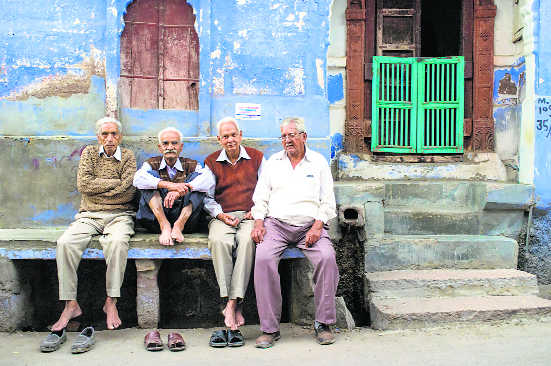
For senior citizens, the exemption limit on income from interest has been raised five times to Rs 50,000 per year

New Delhi, February 1

Announcing a series of benefits for senior citizens, Finance Minister Arun Jaitley today said the exemption limit on income from interest for them has been raised five times to Rs 50,000 per year.At the same time, the Finance Minister raised limit of deduction for health insurance premium and medical expenditure to Rs 50,000 from Rs 30,000 under section 80D.“All senior citizens will now be able to claim benefit of deduction up to Rs 50,000 per annum in respect of any health insurance premium and/or any general medical expenditure incurred,” he said while presenting the Budget for 2018-19.Besides, the Budget has increased the limit of deduction for medical expenditure in respect of certain critical illness to Rs 1 lakh in respect of all senior citizens, under section 80DDB.“In addition to tax concessions, I propose to extend the Pradhan Mantri Vaya Vandana Yojana up to March, 2020 under which an assured return of 8 per cent is given by Life Insurance Corporation of India,” he said.The existing limit on investment of Rs 7.5 lakh per senior citizen under this scheme is also being doubled to Rs 15 lakh, he added.Noting that a life with dignity is a right of every individual in general, more so for the senior citizens, he said, “to care of those who cared for us is one of the highest honours…these concessions will give extra tax benefit of Rs 4,000 crore to senior citizens.” — PTI 


Fallen soldiers’ kin wait for bodies

Fallen soldiers’ kin wait for bodies
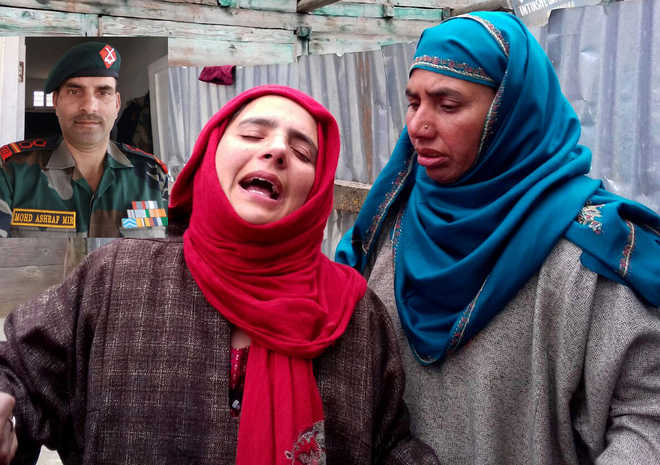
The grieving family members of Subedar Mohammad Ashraf Mir at Maidanpora on Sunday. Tribune Photo: Amin War

Majid Jahangir

Tribune News Service

Srinagar, February 11

A pall of gloom has descended on the villages of four Kashmiri soldiers who were martyred in a fidayeen attack at the Sunjuwan Army camp in Jammu.Subedar Mohammad Ashraf Mir of Maidanpora, Lolab, and Havildar Habibullah Qureshi of Batapora Hyhama, both from the frontier Kupwara district in north Kashmir; Lance Naik Mohammmad Iqbal Sheikh from Nageenpora, Tral, Pulwama, and Lance Naik Manzoor Ahmed from Kulgam district, were killed in the gunfight. Lance Naik Iqbal’s father was also killed in the attack.As the families waited for the bodies of the soldiers, residents of adjacent areas rushed to the villages of the martyrs.At Maidanpora, over 110 km from Srinagar, villagers started visiting the Mir family after the news about his death in the Jammu attack spread.“We came to know that he died on Saturday,” Subedar Mir’s father Ghulam Mohideen Mir said, adding that he was the only bread-earner of the family.Mir pitched for dialogue between India and Pakistan to stop the bloodshed in J&K.“Innocent people are getting killed each day and this should stop. They should talk and resolve issues,” Mohideen said.Subedar Mir, 43, was home when fidayeen barged into his quarter. A family member said militants shot him dead as he was preparing for pre-dawn prayers. His three children and wife, too, were at the quarter when he was shot dead on Saturday.The family of Havildar Qureshi at Batapora in Kupwara is also in mourning. A few family members were upset with the Army for not disclosing them about the death of the soldiers.“We came to know about (the death) through the media on Saturday. There was no news from the Army even today,” said another relative.In Tral, the Sheikh family was waiting for two bodies. Lance Naik Iqbal, 32, and his father were killed in the gunfight. He is survived by his wife and an infant son.


CM enquires about injured in hospital Jammu: Chief Minister Mehbooba Mufti visited Army Hospital, Satwari, on Saturday evening and enquired about the condition of those injured in the Sunjuwan Army camp attack. The Chief Minister met the injured and wished them speedy recovery. She also interacted with the doctors attending to the injured. She promised the injured all support of the government. TNS


Air force officers apprise mayor of issues, assured of timely resolution

WASTE OUTSIDE AIR FORCE OFFICERS’ HOUSE, WILD GROWTH OF GRASS, AMONG OTHER ISSUES WERE RAISED AT THE MEET

CHANDIGARH: A joint meeting was held on Friday between the officers of the Air Force and mayor Davesh Moudgil in the office of Air Officer commanding in chief (AOC) 3 Base Reserve Depot (BRD), Chandigarh.

The problems being faced by Air Force were discussed in the meeting.

The Air Force authorities informed the mayor that there are huge quantity of malba in Air Force houses in Sector 31 and 3BRD Station. Davesh Moudgil directed Ankur Bansal, sub divisional officer, MC, to co-ordinate with the Air Force authorities and intimate them about designated places for lifting the malba.

The Air Force authorities requested the mayor for cleaning the vegetation in the Air Force Houses in Sector 31.

The mayor directed MC chief engineer and XEN, horticulture, MC, to take requisite action.

The mayor assured the Air Force authorities that an open air gym will be started in Sector 31 within 6-8 months.

On the request of the Air Force officers, mayor directed the chief engineer and director and executive engineer, horticulture, that horticulture waste be lifted from the affected areas. The mayor also directed the concerned officers to ensure proper water supply in the area and also to take care of the open drain opposite main gate of Behlana village.

The mayor also directed the officers to look into the other problems of the residents of Sector 31, who are mostly Air Force employees, on a priority basis.


Pakistan has killed the LoC ceasefire, India’s response shouldn’t be half-baked by LT GEN SYED ATA HASNAIN (RETD)

Ceasefire violations on LoC
Representational image of an Indian Army soldier | Commons

There is enough space for us to innovate between regular pinprick-type LoC actions and a low-intensity conflict limited to J&K.

Four Indian soldiers of 15 Jammu and Kashmir Light Infantry have been martyred, including a young officer. On 4 February 2018, the Line of Control (LoC) in the Bhimbar Gali sub-sector of Rajouri erupted with gunfire between the Indian and Pakistan army troops.

We retaliated with vigour and in a few days, we will hear of a possible trans-LoC operation or heavy fire assault which will lay low a couple of Pakistani soldiers in the vicinity of BG.

This has routinely been our response ever since Pakistan chose to brazenly breach the unwritten ceasefire accord of November 2003. That response by us is essentially tactical in nature. Tactical operations have a local and temporary effect and are good only for quid pro quo; they give a chance to flex muscles and rhetoric.

In the prevailing environment, anyone experienced in the complex dynamics of LoC operations will tell you that unless tactical operations are innovative, and planned for a larger effect, the strategic outcome is questionable.

To have a strategic effect, we need clarity on just what Pakistan is intending to achieve by keeping the LoC alive.

It’s been explained many times that for Pakistan, turbulence in the Kashmir hinterland or the LoC is a part of its strategy to keep the pot boiling and remind the international community of the existence of the Jammu and Kashmir issue. Since the Indian Army manages time and again to restore stability in the hinterland, and negates Pakistan’s ability to calibrate terrorist operations at will, the LoC remains the only location where Pakistan can exercise a degree of higher initiative.

After all, its operations are launched from across the LoC, from an area under its own control. The heat along the LoC with ceasefire violations and targeting of Indian patrols is also Pakistan’s way of messaging its support to the people of Kashmir.

Fresh thinking must emerge on the basis of experience so that the damage inflicted on the adversary becomes difficult for them to absorb. We must ensure that the adversary can no longer keep its losses under wraps. The cost of misadventure must be made unacceptable.

It is clear that General Pervez Musharraf’s ceasefire of November 2003 never met the approval of his corps commanders. The policy is now completely in reverse since 2014. In the ten-odd years when the ceasefire became less effective since 2008, our emphasis and focus should have been on hardening defensive infrastructure along with necessary countering of terrorist infiltration. However, the former was comparatively ignored.

The fine art of LoC operations was also partially compromised. The institutional knowledge which existed since 1971, and included that indefinable notion—’moral ascendancy’—as a battle-winning factor, somehow eroded as the Army was on an overdrive of sub-conventional operations outside the domain of the LoC.

Most experienced veterans are unified in their opinion that graduated response to Pakistan’s continuing misdemeanor only contributes towards keeping our strategy tactical. To escalate it to the operational-strategic domain the following specifics are almost mandatory.

  • An acceptance that the ceasefire has now ceased to exist.
  • Vertical escalation through employment of coordinated fire assaults over extended periods employing heavy weapons without remorse. This would involve an escalation many notches higher.
  • Horizontal escalation to extend the scope to different areas along the LoC, especially in areas where we exercise total domination such as the entire Neelam Valley. Let the threat to Pakistan’s defences escalate enough for it to majorly consider a hurried redeployment of its internal security formations. It can even escalate to Kargil.
  • Sufficient trained resources to strike at will at multiple targets beyond the LoC.
  • Adequate preparation for adversary response, including caution against border action teams targeting patrols and logistics.
  • Immediate infusion of funds for transformational execution of hardening of defensive infrastructure, including the fast track construction of civilian bunkers for border villages. Such management was done by the NDA government in 2003 too. LoC infrastructure must become impregnable. It has been ignored over the years.

There will surely be differing opinions with doubts on India’s ability to keep a tight control over the possibility of escalation into a possible full blown war. But Pakistan is neither wanting a war, nor is it prepared for it. Its ploy about tactical nukes must be taken as a bluff and our nuclear response must be spoken about more often.

There is enough space for us to innovate between regular pinprick-type LoC actions and a low intensity conflict limited to Jammu and Kashmir. Without a well-considered response, a half-baked quid pro quo will keep the situation in Pakistan’s advantage. There is an opinion that DGMO talks should be held at the earliest to de-escalate the situation. Such talks in the past have produced temporary reprieve and must be looked upon as a parallel response if they do materialise. The window towards engagement can always be open but from a position of strength and not weakness.

Lt. Gen. Syed Ata Hasnain (Retd), a former GOC of Srinagar-based 15 Corps, is associated with the Vivekanand International Foundation and the Institute of Peace and Conflict Studies.


Over 14,000 bunkers to come up for civilians along border

Tribune News Service

New Delhi, February 6Amid flare-up along the western border with continued firing from the Pakistani side, the Central government today announced that it had approved the construction of as many as 14,460 bunkers for the civilians living in forward areas along the Indo-Pak border in J&K.Union Minister of State (MoS) for Home Hansraj Ahir said the Ministry of Home Affairs (MHA) had approved a proposal for the construction of 14,460 bunkers to mitigate the hardships of the people living along the International Border and the Line of Control due to cross-border firing.“These include 1,431 large community bunkers and 13,029 individual bunkers in the districts of Samba, Jammu, Kathua, Poonch and Rajouri. The project is being implemented by the J&K Government,” he said in a written reply to a question in the Lok Sabha.Pakistani troops have been repetitively violating the ceasefire since the beginning of 2018. At least four BSF personnel were killed in cross-border firing by Pakistan last month.Responding to a question in the Lok Sabha, another junior minister in the MHA Kiren Rijiju said in all, 515 infiltration cases from across the border into J&K had been reported in 2017, in which 75 militants were killed. In 2016, the number of such cases was 454, in which 45 militants were killed, he added.Rijiju said security forces had taken appropriate measures by strengthening the overall security, including operational grid with enhanced human intelligence and use of technical intelligence grid, at the borders as well as in hinterlands to deal with such insurgency activities.


400 security men killed in 3 years Were fighting militancy, Left-wing extremists | 111 fell victim to communal violence

400 security men killed in 3 years
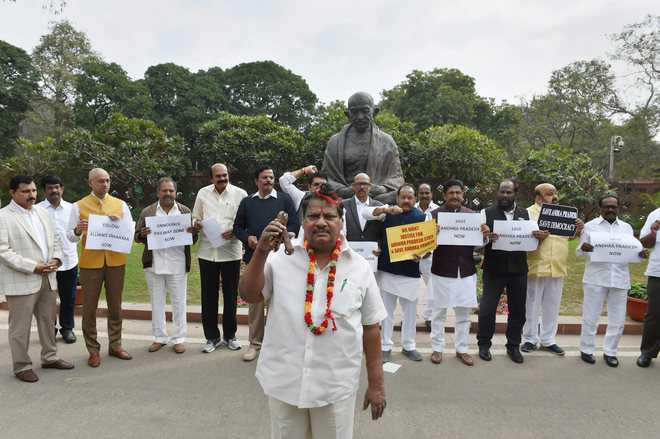
TDP MP from Chittoor N Sivaprasad (foreground), with other members from Andhra Pradesh, at a protest demanding special package for the state, in New Delhi on Tuesday. PTI

Tribune News Service

New Delhi, February 6

The government today informed the Lok Sabha that 400 security personnel were killed fighting militancy in Jammu and Kashmir and Left-Wing extremists in Naxal-affected areas in the past three years, while 111 persons were killed in 822 communal incidents in the country in 2017 with UP registering the highest number of such incidents.Responding to a question, Minister of State (MoS) for Home Hansraj Ahir placed before the House the figures, saying: “A total of 400 security personnel were killed fighting militancy in Jammu and Kashmir and Maoists in Left Wing Extremism-hit areas in the past three years.”In the written reply, Ahir said 72 civilians and 201 security personnel were killed in terrorist violence in Jammu and Kashmir in 2015-17. In case of Left Wing Extremism (LWE) areas, 572 civilians lost their lives and 199 security forces personnel were killed in the past three years, he added.Replying to another question, Ahir said there were 342 incidents of violence in Jammu and Kashmir in 2017, in which 80 security personnel were killed. As many as 213 terrorists were also killed. He said there were 133 encounters in 2017 and 97 terrorists were arrested. “In 2018, so far, there have been 28 incidents of violence in Jammu and Kashmir in which four security personnel and eight militants have been killed,” he said.Meanwhile, answering a question on communal violence in the country, the minister said 111 persons were killed and 2,384 injured in 822 such incidents in the country in 2017. He went on to add that the highest number (195) of such incidents were reported in Uttar Pradesh where 44 persons were killed and 542 injured.Giving details about poll-bound Karnataka, he said the state reported 100 communal incidents last year in which nine persons were killed and 229 injured while there were 91 incidents of riots in Rajasthan in which 12 persons were killed and 175 injured.

Govt tells Lok Sabha

  • The government on Tuesday informed the Lok Sabha that in 2017, 342 incidents of violence occurred in J&K, claiming lives of 80 security personnel; 213 terrorists were also killed
  • 111 persons were killed in 822 communal incidents in the country in 2017 with UP registering the highest number of such incidents.

New Delhi could buy 3,000 anti-tank guided Spike missiles from Israel

THE TALKS FOLLOW THE GOVT’S CANCELLATION THIS JAN OF A US $900­MILLION ORDER TO MAKE SPIKE MISSILES IN INDIA THROUGH FULL TRANSFER OF TECH

NEW DELHI: The Narendra Modi government will begin talks to buy Israeli anti-tank guided missile Spike, with a meeting between Israel’s visiting defence secretary Major General (retired) Udi Adam and his Indian counterpart Sanjay Mitra on Monday.

Adam’s two-day visit beginning Monday is set to be significant as South Block officials said the defence ministry will negotiate to buy at least 3,000 Spike missiles manufactured by Rafael Advanced Defense Systems through a government-to-government (G2G) route.

This will meet the army’s urgent requirements and fill the gap before the indigenous Nag anti-tank missile system is inducted.

The talks follow the government’s cancellation this January of a US $900-million order to make Spike missiles in India through full transfer of technology.

The defence ministry hopes to buy the Israeli missile at a cheaper price as the tech transfer clause will not exist now.

The Defence Research and Development Organisation (DRDO), which is developing the Nag, has no objection to the government’s plans to buy the Israeli missile so long as the tech transfer term is not applied.

The Nag’s heat-seeker guidance system is at a test stage and the missile’s commercial production is likely to take some time.


Lt-Gen Mohan calls on CM

Tribune News Service

Dharamsala, January 31

Lieutenant General YVK Mohan, General Officer Commanding (GOC), 9 Corps, today met Chief Minister Jai Ram Thakur at the Circuit House here and discussed issues of mutual concern.An Army spokesperson said General Mohan took over as the GOC, 9 Corps, on January 18.Among others who attended the meeting were Health and Family Welfare Minister Vipin Parmar, Industries Minister Bikram Singh, Food, Civil and Consumer Affairs Minister Kishan Kapoor and government officials. They discussed the current security situation, land lease cases and the Dharamsala War Memorial renovation and infrastructure development. Both sides highlighted the joint achievements of civil and military forces in the fields of security and disaster relief. General Mohan thanked the state government for its support to the armed forces, its veterans and war widows.


Living under shadow of death on border

The Tribune visits homes of soldiers and civilians killed in Pakistani shelling in the Jammu region. In most cases, the state government hasn’t provided succour, monetary or otherwise, to the affected families

The Tribune visits homes of soldiers and civilians who became victims of Pakistani shelling in the Jammu region. In most cases, the state government has not provided succour, monetary or otherwise, to the affected familiesLife on the border in Jammu and Kashmir is like a conflict zone with death staring people in the face 24×7. Dependent on peace between the Indian and Pakistani forces, the residents look towards an uncertain future as there seems no end to the hostility between the two neighbours.Besides the threat to their lives, their livelihood has also been hit as farming and cattle rearing, the two major sources of income for 90 per cent of the border people, have become difficult amid shelling. Their houses have become unsafe for living as mortar shells land any time. When Pakistan rains mortar shells, residents have limited options — to migrate to relief camps established by the government, move in with their relatives in the hinterland or look for bunkers, if any.The state and the Central governments have not constructed many bunkers in border areas. The demand for five-marla plots in safer places, as committed by both governments, has also not been met.Children living in border areas are the worst sufferers as schools in the zero to 5-km radius from the border, are shut at the time of shelling.The situation for the soldiers is no less difficult as they are always in the line of fire. They have to be continuously on guard and ensure that no infiltration takes place.Since January 1, 2018, 21 persons, including nine Army personnel, three BSF men and nine civilians, have lost their lives in shelling and firing on the Line of Control and the International Border.The intensity of border shelling and firing increased following the September 18, 2016, terror attack when Pakistani-sponsored fidayeen attacked a Brigade headquarters in Uri and killed 20 soldiers.

Martyred soldiers

Havildar Roshan Lal, 43, Nichlah village, Samba districtDied in a missile attack on a forward post in the Bhimber Gali sector on February 4, 2018.Incident: Havildar Roshan Lal along with Captain Kapil Kundu and three other soldiers were manning their forward post in the Bhimber Gali sector of Rajouri district when the Pakistan army resorted to small-range anti-tank guided missile attack on their post and killed all four of them. Survived by his ailing father, wife and two children, Havildar Roshan Lal was the sole breadwinner of his family.Compensation: When Havildar Roshan Lal’s mortal remains were brought to his native village on February 5, hundreds of people, including Army officers and soldiers, reached there to pay their last respects to him and cremate the body with full military honours. The very next day, a couple of soldiers from Roshan Lal’s unit visited his house to complete the formalities so that the family would get the compensation from the Army on time. There has, however, been no communication from the government and no minister has visited them to offer support.Rifleman Satish Bhagat, 21, Gurasinghu village, Shamachak, JammuKilled in the Keran sector of north Kashmir’s Kupwara district on July 12, 2017.Incident: Rifleman Satish Bhagat, the only son of Jeet Lal and Kamlesh Kumari who had joined the Army by following in the footsteps of his soldier father, was killed in the Keran sector when the Pakistani army resorted to sniper fire on July 12, 2017. His death shattered the entire family, parents and three sisters, two of whom are married. The younger sister studies in Class II.Compensation: After Rifleman Satish Bhagat’s death, his father Jeet Lal again started to work to support his family. At present, he is in Gujarat to earn a livelihood while his wife and younger daughter are alone in the village. Nobody visits them anymore. A few soldiers from Satish’s unit occasionally come to meet the family. Even after seven months of Rifleman Bhagat’s death, the state government is yet to pay compensation to the family.Subham Singh, 23, Mukandpur Choudharian village, Kathua districtKilled in a Pakistani missile attack in the Bhimber Gali sector of Rajouri on February 4, 2018.Incident: Rifleman Subham Singh became the victim of a Pakistani missile attack on a forward post in the Bhimber Gali sector of Rajouri district on February 4 while he was defending the borders by keeping the enemy at bay. Rifleman Subham Singh along with four other soldiers were given the task not to allow anyone close to the fence. For seven months, they were able to keep the infiltrators at bay. A missile attack by the Pakistani army on February 4 killed Subham Singh. He is survived by his father, a marginal farmer, mother, three sisters, two of whom are unmarried, and a younger brother.Compensation: Two ministers in the state Cabinet are from Kathua district, including Deputy Chief Minister Nirmal Singh, but none of them has visited the family to provide relief or even express condolences. The family lived in a mud house before Rifleman Subham Singh joined the Army. Life had improved but the family has been shattered by Subham’s death. The Army is still completing the documental formalities for the compensation but the government has made no efforts to provide them any relief.Havildar Ravi Paul, 42, Sarwa village, Samba districtKilled on September 18, 2016 during the Uri terror attack.Incident: In one of the deadliest terror attacks on an Army installation in Jammu and Kashmir, fidayeen from Pakistan carried out an attack on the Brigade headquarters at Uri on September 18. Eighteen soldiers were killed in the attack while two soldiers succumbed to their injuries later, taking the toll to 20. Havildar Ravi Paul, who was also killed in the attack, is survived by his wife and two sons.Compensation: When the mortal remains of Havildar Ravi Paul had reached his home in Sarwa village, ministers, local leaders, Army and police officers and officials of the district administration had joined his funeral procession. After Havildar Paul’s death, his wife Geeta Rani got a job at the Deputy Commissioner’s office. The family has received the first instalment of the compensation by the Army.

Helpless civilians

Gopal Dass, 43, Kanachak village, Jammu districtKilled in Pakistani shelling on January 21, 2018, at the Kanachak area along the International Border in Jammu.Incident: Gopal Dass, the binding force of the family, was killed when a mortar shell fired by Pakistan exploded in a lane near his home in Kanachak on January 21 evening when he and his elder brother Ram Dass (46) were returning home. Gopal succumbed to his injuries while being taken to a hospital in Jammu, while Ram Dass is recovering. Gopal is survived by his wife Manju Devi, son Abhimanyu and daughter Akshara.Compensation: After Gopal Dass’s death, local BJP MLA Sukhnandan Choudhary and Jammu-Poonch Lok Sabha MP Jugal Kishore assured full support to the family, which included a job to Manju Devi, admission to Abhimanyu in Sainik School and quality education for Akshara. But even after 17 days of Gopal’s death, they have not received any help. The Red Cross Society donated Rs 1 lakh to the family. Apart from that, the family has not received a single penny from the government. Being a civilian, Gopal Dass’s family will not receive any compensation from the armed forces.Gahar Singh, 50, Bera village, Suchetgarh, Jammu districtKilled in Pakistani shelling on the International Border in the RS Pura sector on January 20, 2018.Incident: Gahar Singh along with his family was at his home when a shell landed inside and he was hit by splinters. He was rushed to a nearby hospital and then to Government Medical College and Hospital, Jammu, where he was declared brought dead. He was the main earning hand in the family and is survived by his wife Sukhanaya Devi and three sons, who have no source of income.Compensation: With the help of villagers, Sukhanaya Devi performed the last rites of her husband at a cremation ground in RS Pura town while she continued to live in a relief camp. Suchetgarh MLA Sham Choudhary, who is a minister in the state government, provided some money to the family for performing the last rites and managing their stay in the relief camp. Apart from that, the family has received no compensation from the state government. Though the district administration has noted down the details, the family has received no relief.Ravinder Kour, 19, Jerda village, SambaKilled in Pakistani shelling on November 1, 2016.Incident: Ravinder Kour from Jerda village of Samba district was cooking at her home when a mortar shell fired by the Pakistan army landed in the kitchen and killed her on the spot. A total of eight persons were killed on that day at various locations on the International Border when the Pakistan Rangers targeted civilian areas. Her house was severely damaged in the incident.Compensation: Ravinder Kour’s father Zorawar Singh has been moving from pillar to post to get compensation to repair his damaged house and Rs 5-lakh ex gratia promised by the state government.Marha Ram, 60, Anju Devi, 29, Rishab, 6, and Abhi, 4, residents of Rangoor Camp and Kairali villageKilled in Pakistani shelling on November 1, 2016, at Rangoor camp village of Samba district’s Ramgarh sector.Incident: On November 1, 2016, Anju Devi, a resident of Kairali village in RS Pura, along with her son Rishab had gone to her maternal home in Rangoor Camp village of Samba to celebrate Bhai Dooj when a shell landed inside the house killing four persons and injuring three others. Anju Devi, her father Marha Ram, son Rishab and nephew Abhi were killed in the incident while her brother, sister-in-law and niece were injured. Villagers were angry with the government and demanded justice.Compensation: The family suffered a huge loss in terms of lives and property. The government has paid them only Rs 5 lakh as ex gratia. Though two members of the family were killed in Pakistani shelling, the administration is yet to give compensation for the other member. Anju Devi’s family has got some ex gratia in RS Pura.Inputs from Amir Karim Tantray in Jammu, Vishal Jasrotia in Samba and Sanjay Pathak in Kathua. Compiled by Amir Karim Tantray)


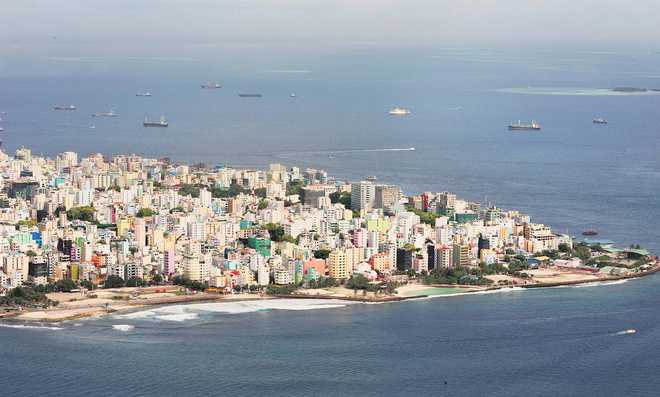
Understanding Maldives by Sandeep Dikshit

Understanding Maldives
GRAB THE MOMENT: China may have extended an olive branch all but in name when it spoke against making Maldives a flashpoint with India.

Sandeep Dikshit

THE state of affairs inside the Maldives does give a bad odour: A President locks up all his political opponents; then goes ahead and arrests the Supreme Court Chief Justice when he tries to set them free. And while the `democracy loving corner’ has itself in a twist, President Yameen caps his indiscretions by shuttering TV stations and imposing a state of emergency.Yameen has a different version where he casts himself as a victim of a willful and spiteful Supreme Court Chief Justice: The order releasing the nine individuals was given in the Chamber and not at a hearing; some of the convicted have exhausted the three tiers of court and a few cases were in appeal; the Chief Justice also tried to remove the President and the Attorney General but was overruled by a majority on both occasions. Despite being a honeymooner’s paradise, Maldives has had a very brief, four-year dalliance, with universal franchise. The fairness of all elections before and after the 2008 polls is a question mark. India saw no competition for Maldives’ affections till five years ago. But the fading years of the first democratically elected headed by Mohamed Nasheed saw him and the opposition bringing other countries into the equation.And today, India is no longer an option for all the parties involved in the scrimmage for power in Maldives. Nasheed, a EU favourite, is India’s designated man after Donald Trump phoned Narendra Modi and made common cause on the Maldives President’s disobedience of the Supreme Court’s orders. Then when South Block refused to host the Special Envoy of the Maldives President, it was clear that India had jettisoned its past tactic of maintaining ambiguity and preserving its options.Maldives, in the eyes of New Delhi-centred military-security experts, has recently turned unruly. But dissonance with almost all of India’s neighbours surfaced within a few months to a few years of emergence of post-colonial nation-states as they sought to resist India’s assumption of being the inheritor of the British colonial mandate for the region.In the early years, India could pull its weight in the region but not because of its military muscle. Barring Pakistan, other neighbours felt a sense of shared destiny with India in overcoming the handicaps of colonialism. Once the concept of nonalignment began losing its lustre, India began finding it difficult to manage its big brother pretensions.But the recent bad blood with so many neighbours has just one precedent. It recalls a similar security-heavy response in the neighbourhood by the Rajiv Gandhi government, another dispensation like the current one that was heady with its parliamentary majority. There was an armed confrontation with China, a simmering defence scandal, hair trigger alert with Pakistan, on the losing side in Afghanistan and more than a finger in a raging militancy in Sri Lanka. All these attempts at donning the hard hat with not much in the cupboard by way of trading muscle or long-range military capabilities to back the pretensions had a catastrophic impact on the country’s social fabric. The economic discontent provided the mobs for the disruptions caused by the Mandal and Ram Janmabhoomi agitations and finally we had the 1991 economic crises. It must be galling for the Indian security-military establishment to adjust itself to a new power discourse because of rise of Chinese influence in a region where mainland Indian civilisation’s historic cultural advantages were overlaid by two centuries of British India’s dominance. But China is increasingly coming into conversations on India’s security-related apprehensions in the neighourhood because the overlap of their strategic space has increased to now cover Afghanistan, and, of late, Maldives and Sri Lanka as well.But instead of focusing on creating dialogue and interaction architectures that support regionalism and economics, the Modi government has opted for the excitement of playing the Great Game against China in concert with mostly extra regional powers. The potential threat from India has not been lost on China. The consequence is that both are attempting a military encirclement of the other. The Indian proclivity to play a new Great Game may be influenced by notions of its influence and size. But it also reflects the Modi Government’s disinterest in reworking the grammar of dealing with neighbours.  Modi hasn’t had a decent conversation with most of the neighbours. While it is imperative to strengthen the bonds of technology, energy and security with distant countries, the Maldives setback should make the PMO think-tank realise that soon the Modi Government will no longer be able to politically gift-wrap tactically bold actions as strategic masterstrokes. The space for presenting tactical symbolism as strategic coherence may be narrowing. One example is the Lok Sabha Speaker calling off a meeting of the Parliamentary Standing Committee on Defence which was to examine the claims made by a retired army officer about irreversible fortification of Chinese army positions on the Doklam plateau. That claim, if proven, will run counter to the Modi Government’s spin that India had emerged with honours intact after last year’s eye- ball to eye- ball security confrontation with China at the same site. China has now declared that Gwadar port in Pakistan will also function as a forward base for its navy. In due course, Hambantota port in Sri Lanka could follow suit. The Modi Government appears more immersed in aligning itself with the military-security objectives of outside powers. On Maldives, South Block was buoyed by the conversation between Trump and Modi. But the Trump administration does not play a zero sum game. On the same day, China’s main pointsman for foreign policy (and the gentleman who holds border talks with NSA Ajit Doval) was in Washington for in-depth discussions with his American counterpart. The Modi Government has been found wanting in making a calculated walk back from foreign policy positions that no longer yield any dividend. An opportunity may have just risen after Beijing offered a thinly disguised olive branch on Maldives. An  inability to change the grammar of dealing with neighbours is preventing us from accumulating the required power to make India tranquil, content, peaceful and happy. 

sandeep4731@gmail.com