Sanjha Morcha

HEADLINE :: 12 JAN 2018

  • GOVT PROMISES RS90 LAKH, JOB TO MARTYR’S FAMILY
  • NITIN GADKARI’S EARFUL FOR NAVAL TOP BRASS FOR ‘OBSTRUCTING DEVELOPMENT’
  • WHY IN MUMBAI, GO GUARD BORDER: GADKARI TO NAVY
  • HIGH TIME, JUSTICE BE DONE IN ANTI-SIKH RIOT CASES: CAPT AMARINDER
  • CAPT HAILS SC ORDER ON SIT
  • INDIA-ISRAEL TIES ARE ALL SET TO TOUCH NEW HIGHS BY LT GEN BHOPINDER SINGH
  • FIELD IN FOCUS: ARMED FORCES WOMEN IN COMBAT MODE
  • HOW INDIA LOST NEPAL TO CHINA BY MAJ-GEN ASHOK K MEHTA (RETD)
  • IAF’S AIR WARRIORS SUMMIT 7 MAJOR PEAKS ACROSS 7 CONTINENTS
  • TIBETAN PM-IN-EXILE CAUTIONS INDIA AGAINST CHINA
  • US HOPES PAKISTAN WOULD ‘TURN OVER’ TERRORISTS
  • NO EASY, QUICK SOLUTIONS TO INDO-PAK ISSUES: EX-DIPLOMAT
  • 2 DAYS AFTER MISHAP, ‘SLITHERING OPS’ FROM DHRUV HELICOPTER OFF

The Tribune Editor-in-Chief’s statement on Aadhaar FIR

The Tribune Editor-in-Chief’s statement on Aadhaar FIRMy colleagues and I are grateful for expressions of support and solidarity from media organisations and journalists.

We at The Tribune believe that our stories were in the nature of a legitimate journalistic exercise.

Our stories are in the best traditions of responsible journalism.

Our story was in response to a very genuine concern among the citizens on a matter of great public interest.

We regret very much that the authorities have misconceived an honest journalistic enterprise and have proceeded to institute criminal proceedings against the whistleblower.

We shall explore all legal options open to us to defend our freedom to undertake serious investigative journalism.

Harish Khare,

Editor-in-Chief,

The Tribune


Ready for talks with India to resolve CPEC differences: China

  • China today said it is ready to hold talks with India to resolve differences over the USD 50 billion China-Pakistan Economic Corridor that passes through Pakistan-occupied Kashmir, days after India’s envoy here said the issue should not be swept under the carpet.
India has objected to the CPEC which is the biggest project of the Belt and Road Initiative (BRI) – as it traverses through Pakistan-occupied Kashmir (PoK) and has become a contentious issue in India-China relations.

Asked about Indian Ambassador to China Gautam Bambawale’s interview to state-run Global Times in which he had said that differences over CPEC should not be brushed aside, Chinese foreign ministry spokeswoman Hua Chunying said China is willing to hold talks with India in this regard.

In his interview last week, Bambawale had said “CPEC passes through Indian-claimed territory and hence violates our territorial integrity. This is a major problem for us. We need to talk about it, not push it under the carpet”.

“I believe, the more we talk to each other, the easier it will become to resolve problems,” he said.

Reacting to the envoy’s comments, Hua said China is willing to hold talks with India on the issue.

“I the noted relevant report. Regarding the CPEC, China has repeatedly reiterated its position. As to the differences between China and India, China stands ready to communicate and hold talks with India to seek a proper solution so that these differences will not affect our general national interests. This best serves the interests of the two countries,” she said.

China in the past also evinced interest to resolve it through talks and even its envoy in New Delhi has said Beijing is willing to change the project’s name to make it more acceptable to India.

Hua also praised Pakistan Prime Minister Shahid Khaqan Abbasi’s remarks at the World Economic Forum in Davos where he said BRI is much more than just an infrastructure partnership and would go a long way in creating a shared future in a fractured world.

The BRI in the past five years has been built in a smooth way providing a large number of job opportunities and improved space and room for development, which is why it was welcomed by people in the region, Hua said.

Beijing has also been clarifying that the project, which provides a strategic connection from its Xinjiang province to Pakistan’s Gwadar port in Balochistan province on the Arabian Sea opposite India’s west coast, will not alter its stand on Kashmir which it said should be resolved bilaterally by India and Pakistan through talks.

Hua said any differences between India and China can be resolved with sincerity and mutual respect.

The parties can seek proper solution for management of the differences, she said.

“We should not ask one party alone to solve this problem. We are willing to work with India to work with dialogue and communication for a better solution,” she said.

“CPEC is merely an economic cooperation project. It has not targeted any third party. We hope the Indian side can put this in perspective and we stand ready to strengthen cooperation with the Indian side,” she said.


‘India, China should resolve border differences calmly’

‘India, China should resolve border differences calmly’
Besides a mechanism to discuss border tensions, India and China also have special representative-level border talks to resolve the differences over the disputed border.

Beijing, January 29

India and China should look at their border differences, including over Dokalam, in a “calm way” and resolve them through existing mechanisms, the Chinese foreign ministry said on Monday.Reacting to Indian Ambassador to China Gautam Bambawale’s interview to Chinese daily, the Global Times, where he said the status quo should not be changed along the sensitive areas of the 3,488-km border, Chinese foreign ministry spokesperson Hua Chunying said here that differences could be addressed through existing mechanisms.“Indeed we have noted that the ambassador talked about it while addressing the issue,” she said.

(Follow The Tribune on Facebook; and Twitter @thetribunechd)

“I should say the two sides should look at border issues in a calm way and resolve relevant issues through the existing border-related mechanisms so that we can create conditions and enabling environment to properly solve our differences,” she said.Besides a mechanism to discuss border tensions, India and China also have special representative-level border talks to resolve the differences over the disputed border.About the new satellite imagery showing buildup by both sides, Hua reiterated that Dokalam, over which Bhutan also claims sovereignty, is Chinese territory and said China is building facilities in the area.She referred to the 1890 treaty between the UK and China and said “the Sikkim section of the China-India boundary has been demarcated by historic treaty and treaty under effective jurisdiction of China”.“China has always upheld our sovereignty along the border area including (Dokalam) Donglang,” she said.About the satellite imagery, she said, “I should stress it (area) falls within China’s sovereignty that we conduct facility building in Donglang area.”“Some Indian media have carried reports about the military buildup and infrastructure building in the area. They are very excited about it,” she said.India and China ended a tense 73-day standoff on August 28 last year at Dokalam area after the People’s Liberation Army (PLA) stopped building a strategic road close to India’s narrow Chicken’s Neck area connecting the northeastern states.
Bhutan also claims the Dokalam area to be its part.About the local commanders’ meeting held on Republic Day during which they exchanged pleasantries, Hua said, “The local military personnel and border troops of the two sides held a meeting on India’s Republic Day.”“We think this is conducive to enhancing mutual trust and upholding peace stability along the border areas. We are also willing to enhance our communication and cooperation to better safeguard the security there and to create a better environment in this regard,” she said.About the ambassador’s comments that India and China are partners, not rivals, and both sides should carry out dialogue at all levels, she said “the Chinese government’s position remains consistent”.As two neighbours in Asia and major developing countries, the two sides should treat each other as an opportunity for development, she said.“It is also a consensus reached by the leaders of the two countries. We will surely treat India as our cooperation partner and we hope to enhance people-to-people ties and friendship through such communication exchanges and to enhance our mutual trust so that we can lay more solid foundation and public support for our bilateral relations. In this we can create better conditions to resolve our differences,” she said. PTI


India is in a now-or-never situation BY RN Malik

The most threatening crisis facing India is that of population explosion. But how many MPs have raised this issue in Parliament? We also lag in areas of poverty, sanitation, infrastructure development and economic reforms.

India is in a now-or-never situation

RN Malik

Retired engineer-in-chief, Public Health Department, HaryanaOn this Republic Day, roughly 260 million people are living below the poverty line under very dehumanising conditions. An equal number, called marginally poor, live just above that line. Their progeny is born sick and suffer from nutritional problems throughout their lives. The life of people falling in the lower middle income group is also not free from miseries and struggles. Now rich are getting richer and the poor poorer. Insanitation and corruption have become omnipresent. The purpose of demonetisation stands defeated because anybody can draw any amount from the bank to use it for bribery. In fact, it was done to remove the tag of ‘Soot-boot Ki Sarkar’. Business in Sadar-Bazars is still being conducted in ‘Number-2′. Healthcare is on the verge of collapse. Major cities have become virtual gas chambers. Indices for Human Development Index and Ease of Doing Business are very low (134 and 90, respectively). Farmers are committing suicides. Progress in hydro power and water resources development (the backbone of agriculture) is notional. Infrastructure development is tardy. The amount of non-recoverable loans has gone up to Rs 10 lakh crore. The amount of stressed loans may be even more. The quality of engineering and medical education has touched a new low. All states are debt-ridden. The FDRI Bill will create trust deficit among depositors. The GDP growth of 7 to 8 per cent is putative and jobless. When asked to bend, the media chooses to crawl, with few exceptions. The poll bonds scheme is glossed with opacity. POSCO is sitting idle in Orissa for 13 years to set up a big iron plant. Air India and power utilities are under heavy debts. Insanitation and financial crunch mar the Railways. Damage to the reputation of judiciary is now beyond redemption after the press conference of the four Supreme Court judges. These are all clear signs of a failed nation.Look at the developed nations. They were ravaged during the World War II. Poland was annihilated. Japan was bombed and burnt. But these countries were able to stand on their own feet within 15 years. China was raped and ravaged by Japanese forces for 10 years. Then the Cultural Revolution of Mao killed 70 million people in 1950. Its economy was in a shambles till 1978 and GDP growth in 1961 was -27.2%. Then the doughty Deng Xiaoping came and transformed China into the third largest economy in the world.On the other hand, people in under-developed countries are struggling with abject poverty because they are reeling under a corrupt and rotten political system. Rot in India’s body politic started in 1966 after the death of LB Shastri. The usurping and corrupt political class gradually polluted the bureaucracy and destroyed meritocracy. The political class is flushed with time-servers, sycophants and power-hungry people. As many as 33 per cent legislators are tinged with criminal records. It is operating like some kind of a mafia and is busy practising divisive, disruptive, dynastic and vote bank politics to rule and befool the people. The main avocation of ruling parties has been to throw crumbs to the poor in the form of freebies. High hopes were raised when Narendra Modi came on the national scene in 2014. Now his 42-month rule has belied all such hopes. Rhetorics like Skill India or New India do not enchant people anymore. The PM has become more pompous than a pragmatic doer. The Gujarat model was deflated recently when it was revealed that farmers’ community was in dire straits. Only projects of national highways, coal mining, freight corridors, metro and providing sanitary toilets to make India open defecation-free are making good progress. But this is not enough, considering the demands of the time. A strong impression is building up that the BJP rules India and the RSS rules the BJP. Buses and buildings are being given a saffron coat.  The job of a visionary prime minister is to draw a precise roadmap to ensure eradication of poverty and remove the ‘under-developed’ tag in the least possible time. No PM has followed this cardinal principle  after Nehru. Instead of raising the slogan of “Garibi Mukt Bharat “, Modi raised “Congress Mukt Bharat” which speaks of an attitude of the worst kind of demagoguery. According to Jeffrey Sachh, the four keys to open the doors of prosperity for a nation are strict population control, sanitation, infrastructure development and administrative and economic reforms. China did that and transformed itself into an economic powerhouse. It completed its 18,200-MW Three Gorges Dam in just six years. (Total installed capacity of NHPC since 1982 is 6,500 MW). The most threatening crisis facing India is of population explosion. Now it is 132 crore. We are adding one Australia every year and, at this rate, it will be 150 crore in 2027 and thoroughly unmanageable. But, how many MPs have raised the issue of the looming demographic disaster in Parliament or waging war against poverty? The PM has never called a meeting of the CMs to discuss the strategy of economic development.  The CMs are treating the states as their fiefs. The Parliament has become an exhibition of mudslinging matches among different parties, bedlam and adjournments. The MPs and MLAs behave like brothers only when it comes to enhancing their own emoluments.Communal flare-ups like the one in Pune and violent reservation movements are only a trailer of the anarchy waiting to happen. The country is in a now-or-never situation. This is the only time to take up radical  measures. But unfortunately, there is a famine of visionary leaders like Sardar Patel or Xiaoping or Lee Kuan Yiew who can steer the country out of the mess. 




Shortfall in BRO targets: Audit

Shortfall in BRO targets: Audit
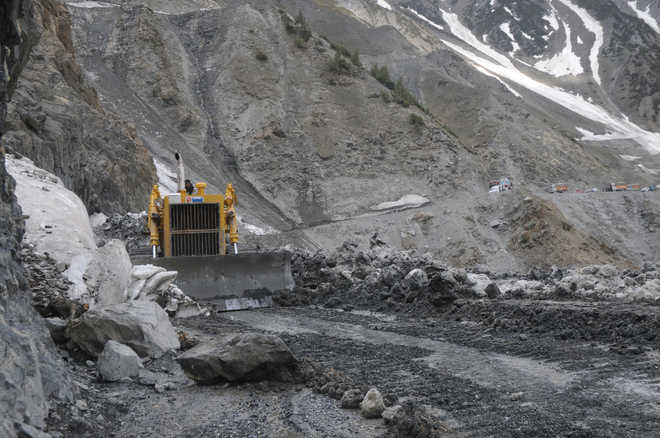
The Border Roads Organisation clears a road in Srinagar. File photo

Vijay Mohan

Tribune News Service

Chandigarh, January 21

There have been significant shortfalls in achievement of targets in the execution of various projects during the past two fiscal years by tasks forces of the Border Roads Organisation (BRO) deployed in the volatile Kashmir valley.While allocated funds have been spent by 97.71 per cent and 93.32 per cent during the 2015-16 and 2016-17 fiscals, respectively, the target achieved was as low as 14.32 per cent in some of the categories of works, an audit report finalised this month has revealed.“It is quite evident that the targets assigned by the Headquarters Director General, Border Roads, has not been achieved by 760 Task Force, in spite of expenditure to the tune of Rs 10,952.64 lakh against the allotment of Rs 11,208.79 lakh in 2015-16 and Rs 10,220.20 lakh against the allotment of Rs 10,951.04 lakh in 2016-17,” the report states. The 760 Border Roads Task Force functions under BRO’s Project Beacon in Jammu and Kashmir.While the Task Force exceeded its bridge construction target in 2016-17, which amounted to 122.80 per cent, it was just 19.85 in the preceding fiscal. The performance in resurfacing works also flip-flopped from 99.99 per cent in 2015-16 to just 29.43 per cent in 2016-17.The report also pointed out that in one instance of road formation works, 66.20 per cent of the allocated funds had been spent, but the physical progress had been only 38.53 per cent. The contractor asked for an extension which was more than the original time period.An infructuous expenditure to the tune of Rs 3,094.98 lakh due to foreclosure of jobs has also been flagged. Further, the audit also revealed that a total of 14 jobs amounting to Rs 843.49 lakh are still lying unsanctioned since 2007. Noticeably, these are those which were to be commenced urgently before the issue of administrative approval, where local engineering authorities opine that delay in works may endanger life and property.


Unmet objectives  

  • While allocated funds have been spent by 97.71 per cent and 93.32 per cent during the 2015-16 and 2016-17 fiscals, respectively, the target achieved was as low as 14.32 per cent in some of the categories of works, an audit report finalised this month has revealed.
  • While the Task Force exceeded its bridge construction target in 2016-17, which amounted to 122.80 per cent, it was just 19.85 in the preceding fiscal. The performance in resurfacing works also flip-flopped from 99.99 per cent in 2015-16 to just 29.43 per cent in 2016-17.


Sangrur village mourns death ‘Mandeep motivated village youths’

Sangrur village mourns death
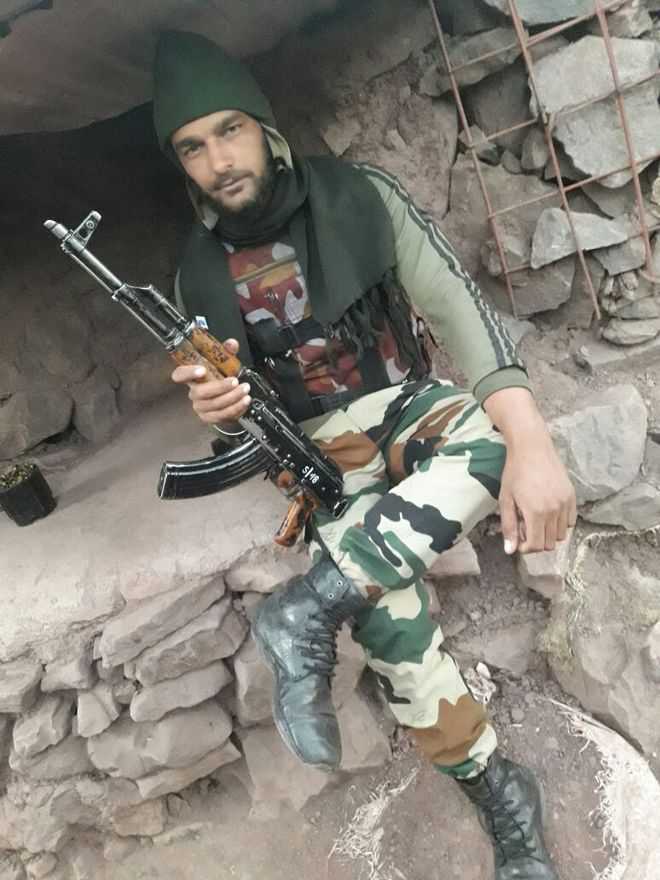
Sepoy Mandeep Singh

Tribune News Service

Sangrur, January 20

A pall of gloom descended on Alampur village in the district after the arrival of the news of death of Army Sepoy Mandeep Singh (23) in a ceasefire violation by Pakistan Rangers in Jammu and Kashmir’s Krishna Ghati sector this morning.“We were expecting that he would come on vacation in February. But the family got the news of his death today around 11.30 am. Since then, all villagers have been sitting at the house of my brother,” said Kewal Singh, uncle of the deceased soldier.As per media reports, the Pakistan army started firing this morning and Sepoy Mandeep Singh was grievously injured and later succumbed to injuries. He is survived by his father Gurnam Singh, mother Baljit Kaur, brother Jagsir Singh and sister Kuldeep Kaur.“After completing senior secondary, he joined the Army in 2015 and it was his first posting. He motivated village youngsters also to join the Army during his last vacation in October last year,” said Jagmale Singh, an ex-serviceman from the village.Sardara Singh, former leader of the ex-servicemen league, said they were in touch with the Army authorities and the body would reach the village on Sunday.


Separatists hit out at Army Chief

Tribune News Service

Srinagar, January 18

Separatist leaders today hit out at Army Chief Gen Bipin Rawat saying his recent assertions about J&K are “open admission of occupation.”“The Army Chief’s statement is admission of what people of Kashmir want and how military force is and will be used to prevent them from doing so. It is an open admission of occupation,” moderate Hurriyat chairman Mirwaiz Umar Farooq said at a joint press conference in Srinagar.General Rawat was recently quoted as having said that people of J&K had realised that “they cannot get what they want” and “let me tell you, to seek independence from a country where we have strong armed forces and very strong government, you cannot secede from India.” “This shows that the Army has been always using military might to crush the genuine struggle,” Mirwaiz said. Meanwhile, the joint separatist leadership has also called for a shutdown on January 26.

8 trainees of Army Youth Centre get jobs

Srinagar: Eight trainees of the Army’s Youth Centre at Boniyar in Uri sector have been selected by food chain Onesta in the latest online interviews. They have proceeded to Bengaluru for their employment. The youth centre at Boniyar had facilitated jobs for 58 trainees outside the state and 23 students within the state, besides facilitating self-employment for about 60 young girls in the domain of cutting and tailoring. An Army spokesman in Srinagar said the youth centre had been at the forefront of skill development to enable the youth of the area to compete and acquire jobs, including in the hospitality sector and fashion designing. The effort has started bearing fruit, leading to increase in the popularity of the centre, the spokesman said. tns


Should ex-Prez, PM get govt houses, asks SC

Tribune News Service

New Delhi, January 17Should former Presidents, Prime Ministers, Governors and Chief Ministers be given government bungalows for accommodation?The Supreme Court on Wednesday sought to know the views of the Centre and states on the suggestions made by senior advocate Gopal Subramanium, who is assisting the court as amicus curiae in a case against such a law in Uttar Pradesh.In his submission before the top court, Subramanium had on January 4 suggested that the UP law was arbitrary and liable to be struck down. Ministers who demitted office did not require public property. “A large number of bungalows have also been given to trusts,” he had submitted.Subramanium had said if the court wanted to expand the scope of the PIL, then it will have to hear the states and the Centre.However, instead of issuing formal notice to the government, a Bench headed by Justice Ranjan Gogoi on Wednesday asked Subramanium to give copies of his suggestions to Attorney General KK Venugopal and Advocates General of states, having laws similar to the one in Uttar Pradesh, which is under challenge. It posted the matter for further hearing on March 13.The Bench is seized of a PIL filed by Lok Prahari, an NGO, challenging the 2016 amendments to the Uttar Pradesh Ministers (Salaries, Allowances and Miscellaneous) Provisions Act, 1981, during the then Akhilesh Singh Yadav government.The amendment was introduced following the top court’s August 1, 2016, verdict ordering eviction of official bungalows allotted to six former chief ministers of the state in two months after it concluded that the 1997 rules on allotment brought in by the state government were in contravention of the existing UP Ministers (Salaries, Allowances and Miscellaneous Provisions) Act 1981.The UP Government had earlier defended it saying the facility given to former CMs was in line with similar facility given to former Presidents, PMs and Vice Presidents.


Muktsar memorials in state of neglect

Muktsar memorials in state of neglect
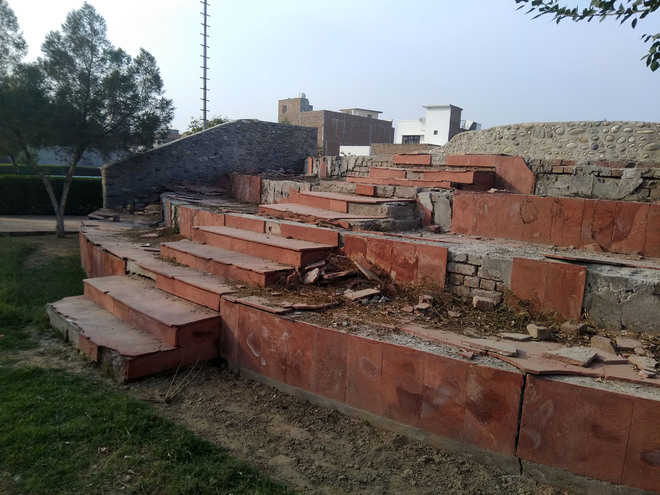
The damaged staircase of the Mai Bhago Park in Muktsar. Tribune photo

Archit Watts

Tribune News Service

Muktsar, January 7

Just a few days are left for the festival of Maghi and the mela has already started, but the careless attitude of the authorities concerned can be gauged from the fact that the memorials built in the memory of 40 Muktas (liberated ones) and Mai Bhago are not repaired yet.These monuments are crying for immediate repair and presenting a picture of neglect. A large number of devotees come to the town from faraway places to pay obeisance at local historic gurdwaras and a take a holy dip in the sarowar (holy pond).A random visit to the town revealed that the situation was worst at the Mai Bhago park, built near the fire brigade office. The staircase and some statues placed there, depicting the war scene, are damaged. Further, the gates built at the entrance of the town and dedicated to 40 Muktas, too, need repair.This is not the first time when the administration has not paid attention towards these monuments. Earlier, the condition of Mukt-e-Minar, having a tall “khanda” (double-edged sword) with girdled rings was in a poor shape.The Shiromani Gurdwara Parbandhak Committee (SGPC), which had laid the foundation stone of Martyrs’ Memorial (dedicated to Mai Bhago and 40 Muktas) on the Tibbi Sahib road here on May 4, 2005, has also failed to start the construction work till date. Shockingly, the foundation stone too has been vandalised by some miscreants.Gurmeet Singh, a local resident, said, “The authorities concerned should pay some attention and without wasting any time should start the repair work. Further, they should print some pamphlets to inform the devotees coming to the town about all the places to visit.”Meanwhile, the Northern Railway Passengers Samiti has demanded to run some special trains for a few days during the Maghi Mela.Meanwhile, members of the Dhan Dhan Shri Guru Granth Sahib Satkar Committee on Wednesday gathered at Bhai Maha Singh Hall here in the town, took out a march on roads and submitted a memorandum to the district administration saying that the Maghi Mela should be observed as a religious affair and no political conference should be allowed. Notably, both the SAD (Badal) and SAD (Amritsar) have announced to hold political conferences on January 14 here. They said if any political party held a political conference, they would lodge a protest.