Sanjha Morcha

5 militants killed in 2 gunfights in Valley

RINAGAR: Five militants were killed in two different encounters in Kashmir Valley on Thursday, army said.

AP PHOTOSecurity officials during a gunbattle at Pakharpore village on Thursday.

Defence ministry spokesman Colonel Rajesh Kalia said four terrorists were killed in a gunfight with security forces in Budgam’s Futlipora.

In another gunfight that erupted in north Kashmir Sagipora village of Sopore area in Baramulla, police said one militant has been killed so far while a para commando of the army was injured. Earlier in the morning, police said four militants were trapped in the raging gun battle.

“Encounter is going on at Fotlipora Pakerpora Charishrief area of Budgam. According to preliminary reports, four militants are trapped,” a district police officer had told HT.

A teenager was injured when a mob clashed with the army in Pakherpora Chowk. The mob attacked the army convoy carrying reinforcements to Futlipora village, the police officer said.

Sinar Ahmad, 15, was injured when the army resorted to aerial firing after the mob attack. Ahmad was shifted to hospital in Srinagar, he added.

The police officer while confirming the clashes termed them as “minor” incidents.

Eyewitnesses from the encounter site said that a house in which the militants were believed to be hiding has been blasted by forces. Authorities have also suspended Internet services in the district.

Over 200 militants killed in J&K in 2017, says DGP Vaid

SRINAGAR: For the first time in seven years, the number of militants killed in counter-insurgency operations in Jammu and Kashmir has crossed 200, according to the state police.

“Today by the collective effort of @JmuKmrPolice, Indian Army, @crpfindia, CAPF and people of Kashmir have led to neutralisation of more than 200 terrorists in the year of 2017 alone,” Director General of Police (DGP) S P Vaid tweeted.

“This marks a huge landmark for establishing peace and stability in the state of J&K and our country,” the DGP added in another tweet.

According to official figures, 200 militants have been killed by the security forces during counter-insurgency operations from 1 January till date this year, which is the highest since 2010.

In 2010, 270 militants were killed.

However the number dropped to around 100 per year by 2015.

In 2016, 165 militants were killed by the security forces along the Line of Control.

There has been an increase in civilian killings in militancy-related violence with 54 civilians getting killed this year.

The number of security forces killed in militancy-related incidents this year was 77.


Bloodshed on the border A militaristic policy has its limits

Bloodshed on the border

Pakistan can be counted upon to provide New Delhi with ample opportunities to divert attention from other challenges and embarrassments as well as reinforce its muscular nationalist credentials. Three days after a cross-border strike killed four Indian soldiers, Army commandoes evened the score by crossing into Pakistan; this claim of surgical strike Lite, although made by anonymous Army officials, has to be taken at face value. This approach, in effect, suggests the government will henceforth bank on strong armed means to bring Pakistan to heel or the negotiating table. The hand of the partisan crowd in South Block would have been strengthened by their weak hand in the Jadhav case.The government’s spin masters have performed wonderfully in turning a tactical blunder in the Jadhav case around into one of wounded national pride: Pakistan had set an impossibly short deadline for New Delhi to decide whether it would allow Jadhav’s mother and wife to meet him in Islamabad; once the duo was in Pakistan, its authorities controlled the narrative for the benefit of its domestic audience as well as show up India as an abettor of terrorism. Islamabad can be depended upon to extract the maximum mileage from the jailed Indian as well as keep the border hot. New Delhi will have to fall back on the only option left in its quiver — match each Pakistani military misadventure with one of its own. This strategy will keep the hawks in India contented — just like the verbal skirmishing over Jadhav’s mulakat activated their counterparts in Pakistan — but is hardly an end in itself.On the other hand, this all-consuming entanglement with the neighbour is not raising India’s profile. The lesson from the Doklam standoff with China is salutary: no neighbour was awed by India’s military “resolve”; in fact, some exhibit a more independent streak since then. They will be less impressed by India’s inability to manage its ties with Pakistan. The lopsidedness in India’s strategic outlook needs urgent correction: a much-sought ally by the big powers for its market and military potential but with an overbearing image of a schoolyard bully in the immediate neighbourhood.


India, China try to put Doklam behind them

India, China try to put Doklam behind them
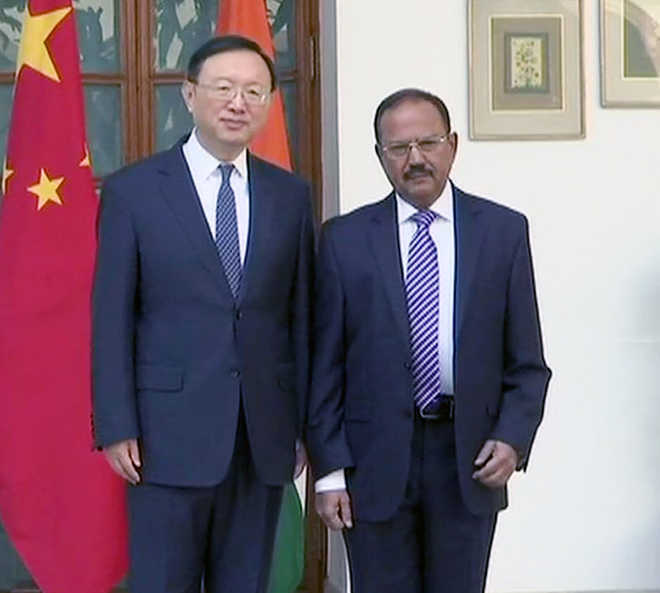
China’s State Councillor Yang Jiechi and National Security Adviser Ajit Doval

Tribune News Service & PTI

New Delhi, December 22

India and China today agreed that pending the final resolution of the boundary issue, it is necessary to maintain peace and tranquility in border areas, and exchanged ideas on various confidence-building measures (CBMs) in that regard as the two sides tried to put behind them the Doklam episode.After a meeting between the special representatives (SRs) — India’s National Security Adviser Ajit Doval and Chinese State Councillor Yang Jiechi — the External Affairs ministry said the talks were “positive”.(Follow The Tribune on Facebook; and Twitter @thetribunechd)“The special representatives undertook a comprehensive review of earlier rounds of talks and agreed that an early settlement of the boundary question serves the fundamental interests of both countries. They reemphasised their commitment to achieve a fair, reasonable and mutually acceptable solution to the India-China boundary question at an early date,” said an MEA press release.Today’s border talks were the first since the 73-day military standoff at Doklam.While the MEA statement did not say whether the Doklam issue was discussed, in Beijing, a spokesperson in the Chinese foreign ministry skirted a question on whether it figured during the talks and instead said: “This mechanism is not only a high-level channel for dialogue on border issues, but also an important platform for strategic communication.”Doval and Yang also called on PM Narendra Modi.The Chinese foreign ministry spokesperson said the SR mechanism was operating very well. 


Laser fence along Nepal, Bhutan borders soon

Prateek Chauhan

Tribune News Service

New Delhi, December 20Laser fencing will be installed along India’s open borders with Nepal and Bhutan to curb infiltration and smuggling of FICN and drugs, said Sashastra Seema Bal (SSB) Director General Rajni Kant Mishra.The force today celebrated its 54th Raising Day and 15 Nepalese Armed Police Force officers witnessed the parade.The DG said the force was running two laser fencing pilot projects. It has established and operationalised 635 border outposts along the Indo-Nepal and Indo-Bhutan borders to fulfil its mandated duties of securing the people living in border areas and to prevent trans-border crimes.He said five battalions were deployed for counter-insurgency in J&K, seven in Naxal-hit areas in Bihar, Jharkhand and Chhattisgarh and two in Assam for counter-insurgency operations and law and order duties.In J&K, the existing Bomb Detection and Disposal Squads have been doubled to six by raising three additional BDDS teams, he said.However, the DG denied any type of Chinese influence on the Indo-Bhutan border, but added that the SSB had increased force deployment along the Indo-Bhutan border on the Sikkim front.


India, Pakistan ‘surprised’ each other in 1965

Ajay Banerjee

Tribune News Service

Chandigarh, December 9

India and Pakistan both surprised each other during the 1965 war and the developments in India, Pakistan and Jammu and Kashmir were possibly responsible for the clash that occurred in August-September that year.Speaking at a session “Indo-Pak War 1965”, Lt Gen TS Shergill (retd) said: “Pakistan’s Operation Grand Slam in Chammb (J&K) was a surprise and India’s response was a surprise too. Pakistan decided to send its armoured (tank) troops through Khemkaran (near Amritsar) instead of Suleiman-ke (just west of Fazilka), which worked in India’s favour.” Suleiman-ke was the shortest route to Delhi with no major water body on way to check the advancing troops, he said.(Follow The Tribune on Facebook; and Twitter @thetribunechd)Had Pakistan simultaneously coordinated the armoured attack through both the fronts, it could have dealt India a bigger surprise, said Lt Gen Shergill who, as a young officer, was a troop leader of the Indian Army’s Deccan Horse Regiment at Khemkaran during the war.Lt Gen JS Cheema, who retired as the Army’s Deputy Chief on November 30 this year, cited developments in India and Pakistan as plausible reasons for the war and described these as “turning points”. “Within Jammu and Kashmir, fissures were there for the adversary to exploit,” he said, citing the theft of the holy relic from the Hazratbal Shrine in 1963 and the release of Sheikh Abdullah from prison in 1964 and his subsequent speeches seeking self-determination for J&K.In India, he said, Article 356 of the Constitution was extended to Jammu and Kashmir on December 1, 1964. Article 356 gives the Centre the power to dismiss a state government. The Government of India then changed the names of Sadar-e-Riyasat and Prime Minister to Governor and Chief Minister, respectively.In 1960, the jurisdiction of the Indian Supreme Court was extended to the state of J&K. On the military front, India was raising new units in 1963 and those could not be launched into war. On the political side, Jawaharlal Nehru died in May 1964. In Pakistan, Iskander Mirza, the then president, abrogated the Constitution in 1958 and declared martial law only to be deposed by Gen Ayub Khan. In early 1965, Ayub Khan defeated Fatima Jinnah, sister of Mohd Ali Jinnah, in an unfairly conducted election.Punjab Finance Minister Manpreet Badal, who was among the speakers, narrated an interesting anecdote: “General Ayub Khan (Pakistan army chief who went on to become the president), as a child, was taught the ‘mool mantra’ (of Sikhism) by an elderly Sikh. And at the Army house when he became the chief, he had the mool mantra written in Urdu.”Gen Ayub Khan was suspended and almost court-martialled for cowardice during the Burma campaign under General William Slims. The now Army house in Rawalpindi was owned by an Indian, Gurbachan Singh. One of Ayub Khan’s sons-in-law, Aurangzeb, also an Army officer, was a pass-out of the Doon School and he often visited India.


‘Engage Valley youth and keep pressure on militants’

ARMY OFFICERS SAID SITUATION WAS BETTER BUT SENIOR SCRIBES POINTED OUT THAT THE GROUND REALITY WAS NOT AS GOOD AS IT WAS BEING MADE OUT TO BE

CHANDIGARH: Advocating “an iron fist in a velvet glove” strategy to tackle insurgency in Kashmir, former top-ranking army officers on Friday underlined the need of engaging Valley’s youth positively to end the cycle of violence.

With his sharp views on the hot-button topic ‘Counter insurgency operations in Jammu and Kashmir’ during a session at the Military Literature Festival, former chief of the northern command Lt Gen BS Jaswal (retd) set the ball rolling to what turned out to be an engaging and educative session despite a thin audience.

Other veterans who were in the panel included Lt Gen JS Cheema, Lt Gen AC Suneja, Maj Gen Dilawar Singh, besides senior journalists Nirupama Subramanian and Vikramjit Singh.

While the army officers said the situation was better in Kashmir and stressed the need of keeping pressure on the militants, the senior scribes pointed out that the ground reality in the Valley was not as good as it was being made out to be.

“When one Kashmiri militant is killed, there are 6-7 youth ready to fill his place,” Nirupama said, pointing out that of the near 250 militants operating in Kashmir, about 117 are locals.

“There is a belief that you cannot keep on killing people,” she said.

Endorsing her views, Vikramjit said it was a fallacy being propagated by politicians that Kashmir is on the threshold of peace.

Earlier, Lt Gen Jaswal said radicalisation of the youth was taking roots as Pakistan wanted to keep the Kashmir pot boiling.

Lt Gen Suneja added that during search operations, the Army must deal with women and other people with respect.

Despite different views on how to deal with insurgency notwithstanding, the panellists were unanimous in the view that engaging with the people, especially the youth in the Kashmir valley, is important.


China’s double-think by Lt Gen BHOPINDER SINGH

China’s double-think

With its veto power in the United Nations Security Council, China has repeatedly blocked attempts to designate the Jaish-e-Mohammed chief, Masood Azhar as a global “terrorist” under the Council’s Al Qaida Sanctions Committee.. Even though the other members, notably the US, France and UK have backed the proposal, the Chinese have incredously maintained a “lack of consensus”, and “technically” stonewalled the application for the last couple of years. This Chinese leniency towards terror is rooted in its “all-weather-friendship” with Pakistan, one that is based on realpolitik.

Islamabad’s equation with Beijing has no civilizational, cultural or even ideological alignment. Such double standards are consistent with China’s expansionist designs that can often lead to questionable patronage of its other rogue clients, notably Kim Jong-un of North Korea, Omar al-Bashir of Sudan, and till very recently, Robert Mugabe in Zimbabwe.

Despite the fact that the International Criminal Court (ICC) has indicted Omar al-Bashir for war crimes against humanity and on charges of genocide during the conflict in the Darfur region, China regards the Sudanese warlord as an, “old friend of the Chinese people.”

The liberal Chinese recipe of managing its external affairs is in sharp contrast to its crackdown on Islamic insurgency ~ specifically the Uyghurs ~ in the Xinjian province. The Muslim Uyghurs are ethnically close to the cultures of the contiguous Central Asia, rather than that of the majority Han Chinese culture.  The memories of the short-lived independence of the Uyghur nation in the 1940s as the ‘Second East Turkestan Republic’ have lapsed in the limbo of history, the relative opening up and increased interaction of the Chinese people with the outside world coincided with the global resurgence and assertion of Pan-Islamism. This reignited the dormant “Uyghuristan” insurgency. The Urumqi bombings in 1992, the bus bombings in 1997, the Aksu bombing in 2010, the Hotan attack in 2011 and the Urumqui attack in 2014 were condemned by the government in Beijing as the “Three Evils” ~ terrorism, separatism and religious extremism.

Today, the Chinese hyper-sensitivity towards any stirring of Islamic insurgency by the Uyghurs can yield a measure of paranoia, a trend that is almost unprecedented. Anyone under the age of 16 can be ordered to effect a name-change if that name sounds somewhat similar to such Islamic words as Mecca, Quran, Saddam, Jihad, Imam, Arafat, Hajj, Medina or even Islam (deemed to be “overly religious”)! At another remove, a move to compel the hapless Uyghurs to attend party rallies and express their loyalty to the Communist party is on the anvil.

Even the Quran, as published before 2012, was declared illegal for ostensibly carrying “extremist content”. Indeed, religion and religious practices are considered to be regressive and regarded as impediments to economic growth. Therefore, there is increasing attention to such matters as the construction of a mosque. It thus comes about that the traditional Chinese pagoda-style mosques are giving way to the Arabian-style shrines, the official line being that mosques “should not be luxurious or oversized” and “have to be in line” with China’s socialist values. Even basic adherence to cultural-religious identity, such as the fast in the holy month of Ramadan, was banned for Chinese civil servants. Religious ceremonies in marriages were discouraged in favour of bureaucratic-legal paperwork. There has also been a clampdown on “using the name of Halal to meddle in the secular life of others.”

The other ostensibly “extremist behaviours” include the ban on head scarves, veils and long beards from boarding public transport. Beyond the crackdown on such totems of one’s faith, the measures include the surrender of passports, mandatory GPS in cars, enforcement of family planning policies and rejection of state products and services that include radio and television programming. This culture of surveillance on the Uyghurs is part of what the Chinese President Xi Jinping calls the, “great wall of iron”, to safeguard Xinjiang.

Indeed there is an underground “East Turkestan Islamic Movement” (ETIM, or now called “Turkistan Islamic Movement”), which was rightfully declared as a terrorist organisation by the US State Department. More than 100 Uyghurs are estimated to have gone abroad to fight the ISIS. ETIM is said to be allied with Tehreek-e-Taliban Pakistan, and therefore Beijing has constantly urged Islamabad to take action against the group, given the threat of the terror organisation to specifically target components of the strategic China-Pakistan-Economic-Corridor (CPEC) investments, including the ultra-sensitive and Chinese-funded port of Gwadar.

Recently, the Chinese Government asked Pakistan to step up security for its newly-appointed ambassador in Islamabad in the wake of threats to his life, by the ETIM. Although Pakistan has been selectively ambivalent about its relationship with various terrorist groups (e.g. the China-Pakistan agreement on routinely bailing out Masood Azhar), Islamabad was unequivocal on ETIM after it conducted the Operation Zarb-e-Azb. Its Defence Minister had stated, “We believe they (ETIM) have all been eliminated.

The fight against ETIM is our own fight. It’s not only China’s fight. It’s a joint fight against ETIM, between Pakistan and China, so there is absolutely no difference of opinion on the elimination of ETIM from our tribal areas.”

While China betrays   extreme intolerance towards any form of religious assertion or call for freedom on its own soil, and actively seeks regional and global support for targeting Uyghur separatists, it shows no such sensitivity or urgency when it comes to backing India’s efforts to weaken the terror groups such the Jaish-e-Mohammed (JeM) and Lashkar-e-Taiba (LeT), both based in Pakistan. Despite incontrovertible evidence of the complicity of Masood Azhar and his group in the terrorist outrages in India, China naïvely urges, “more deliberation”, while India can only allude to the inherent, consistent and patent duplicity in the Chinese behaviour.

Away from the media glare  of Western journals, the Chinese government’s comprehension of the Islamic terror network, its funding from the Sheikhdoms and rogue agencies like the ISI, training centres in places like Pakistan and the impact of pussyfooting on technicalities (as in the case of Masood Azhar) are instances of double-think, almost deliberate. However, since the Chinese government is not answerable to anyone, including its own citizens, for any moral conundrum in retaining two very different recipes with the same ingredients, China betrays contrasting behaviour, with utter impunity.

(The writer IS Lt Gen PVSM, AVSM (Retd), Former Lt Governor of Andaman & Nicobar Islands & Puducherry)


Scholar Warrior :ExpertiseAndKnowledge Sharing by Armed Forces Training Establishments by Lt Gen Ata Husnain

It’s a pleasure and an honour to be a regular invitee to Armed Forces training establishments to participate in seminars or deliver guest lectures. The quality of awareness of members of various courses is so high these days that one had better be well prepared for the interactive sessions. This is not alone the opinion of a hard core Army loyalist but of the numerous veteran diplomats, bureaucrats, intelligence specialists and corporate personalities who form part of seminar panels and deliver standalone lectures. Without a doubt,  the quality of knowledge I have come across in civilian training institutions matches that of our service  institutions.

The Lal  BahadurShastri National Academy of Administration (LBSNAA) or Sardar Vallabh Bhai Patel National Police Academy (SVPNPA) are both outstanding institutions  I regularly visit and never fail to be impressed with. I even have post event discussions and guidance sessions with some course members, through email. A recent visit to Naval Academy, Ezhimala gave me an excellent insight into the new generation which will execute India’s future maritime security. The quality of questions I received at National Defence Academy (NDA), Khadakvasla and Indian Military Academy, Dehradun augurs well for the nation. Army War College (AWC), College of Air Warfare (CAW) and Defence Services Staff College (DSSC), all which I recently visited displayed extremely high intellect. In fact at DSSC I had the opportunity to conduct a dissertation guidance session and came away truly impressed.

While all these institutions are doing yeoman service in preparing the next generation of leaders I am not so sure how much they are being exploited towards research, problem solving and innovative thinking. Knowledge appears to being an individual domain and not institutional. High quality individuals who pass through these institutions go on to contribute in their individual capacity to the appointments they hold and that’s about all. What they research and write at these institutions remains in their personal luggage or these days in their PCs or laptops where it languishes. A good six month effort is utilised only by a single individual, the one who did the research. The need is to share and share liberally as most of the research projects are unclassified.

If knowledge has to be institutionalised the first thing we need to look at is the concept of sharing. We need training institutions to have regular websites on the World Wide Web where the finer dissertations and area study papers are uploaded as distinct subject wise groups. We need links to all websites of other important training institutions embedded here and perhaps prize winning dissertations could be uploaded on the websites of all such institutions. I find institutions such as Centre for Land Warfare Studies (CLAWS) and Centre for Air Power Studies (CAPS), which are doing such great work, insufficiently using the work of course members of different institutions. While so many seminars are conducted based on the work of research scholars within CLAWS and CAPS never do we find the winner of the Army Commanders Gold Medal from the Higher Command Course of AWC ever being invited to present his paper. I wonder if HQ ARTRAC has ever bothered to invite the medal winners of long courses to present their papers at any institution.

There is no end to the ways knowledge sharing can be done in today’s world. However I must share my idea and concept of knowledge exploitation too. As the Military Secretary of the Army I realised that we were posting officers from long courses without any consideration for the research work they were undertaking. These are the random ways that the Branch was infamous for. I wanted to kill that perception through demonstrated examples. We convinced the institutions through our most proactive GOC IN C ARTRAC of those times that they needed to share only the title and a one line statement on the dissertation being written by each member of the Higher Command Course at AWC and Army members at DSSC. Based upon that we could make a humble beginning in posting officers to appointments in which they could do justice on the basis of some element of their research work. As an example I can quote the case of an Armour officer who wrote on Employment of Light Tanks; we posted him as the GSO 1 to a brigade in North Sikkim. An officer of Higher Command Course who wrote on Water Wars was posted to the division in Rest of Arunachal Pradesh (RALP). More experimentation and refinement can make this system work beyond just demonstration.

As a follow up to the above the dissertation title of the research done by each officer at the training institutions was captured in his personal data recorded by MS Branch. This would allow an officer who can followed a common thread of subjects through the courses to become a reasonable expert in that field.

Ideally, the system by which College of Defence Management is tasked to conduct management study on a subject thrown up by the environment is a fine basic model for application in all other institutions so that studies and research conducted by the members of courses and programs are result oriented and based on the needs of the organisation.

The last issue which I am flagging only briefly relates to institutional research. Each training establishment has a core competence and a fine Faculty of Studies posted for the purpose of taking forward research in that field. The AWC is perhaps the best institution geared to lead the way and establish itself as a centre of excellence. Its studies and research should be such as to be virtually quoted as authority. Perhaps infusion of an academic element in the Faculty should be experimented with.


2 yrs ,75 proposals of defence panel, only one implemented

Vijay Mohan

Tribune News Service

Chandigarh, December 20

Over two years after a committee of experts had suggested far-reaching measures to reduce litigation in the Ministry of Defence and strengthen the mechanism for redressing grievances of defence personnel, only one out of 75 recommendations has been implemented.Sixteen recommendations have been accepted for implementation and another 16 have been accepted in-principle, according to information placed before Parliament by the Defence Ministry during the ongoing session. “The Department of Ex-Servicemen Welfare has implemented one recommendation out of 16 accepted for implementation,” the ministry’s said.The five-member committee, convened by then Defence Minister Manohar Parrikar had submitted its 509-page report in November 2015. In August 2016, the Defence Minister issued orders that action be taken on the recommendations within 45 days.Sources said the accepted recommendations include abrogation of sudden changes in policy and fresh polices to be introduced after discussions with stakeholders, mandatory time-bound response to veterans’ grievances, high-level study group for recommending legislative changes in military law, restoration of medical facilities to short-service officers, not filing appeals on issues that have already been decided by high courts and the Supreme Court and all administrative orders to be speaking orders.Other accepted recommendations are that issues related to women officers be decide in consultation with the stakeholders, including women representatives, and review of the system to grant maintenance allowance to wives.


Arrest them all A serious breach of national security

Arrest them all

EVEN though an election platform permits considerable rhetorical latitude, yet when the Prime Minister chooses to allege a “foreign hand” in an ongoing state-level poll battle the matter acquires a serious dimension. Prime Minister Narendra Modi has accused the Congress, particularly its suspended leader Mani Shankar Aiyar, of colluding with Pakistan to affect the outcome of the Gujarat election. It must be presumed that the Prime Minister has sufficiently credible information to make the charge. National security interests demand that stern penal action be taken against Mr Aiyar for hosting a meeting at his residence for visiting Pakistani interlocutors; among those who attended the meeting include a former prime minister, a former vice-president, a former chief of the Indian Army and a number of retired distinguished diplomats. A message should go out that India is not a banana republic that foreigners can meddle in its internal affairs; nor is India a United States where the Russians could wantonly interfere in the presidential electoral process.If there is even an iota of credibility in the Prime Minister’s fusillade  against Mani Shankar Aiyar, then it invites very serious questions about the management of our national security on Modi’s watch. Questions need to be asked as to when did the Prime Minister or his national security team come to a conclusion that Pakistan was becoming an active source of interference in our internal political affairs; and, why has the government so far failed in its duty to act against those who attended this “anti-national” gathering. To keep this serious breach of security under wraps and use it as a “smoking gun” in an assembly election, raises doubts about the competence and commitment of those entrusted with our national security. No keen observer of the Gujarat scene would be surprised that Pakistan has been weaved into the election rhetoric. Faced with the heavy baggage of a 22-year-old anti-incumbency, the BJP leadership feels desperate enough to invoke, once again, Pakistan, as an “election issue”.  The sub-text of this sales pitch, sadly enough, is introduction of the old Hindu-Muslim divide. The poor, old “Gujarat model of development” stands totally forgotten and abandoned.