Sanjha Morcha

AFPI achievers feted for making it to NDA, IMA

AFPI achievers feted for making it to NDA, IMA
The best cadet trophy being presented to Arunav Laroiya by Lt Gen TS Shergill (retd), senior adviser to Punjab CM, at the MAFPI in Mohali on Thursday. Tribune photo

Tribune News Service

Chandigarh, December 14

As many as 26 former cadets of Maharaja Ranjit Singh Armed Forces Preparatory Institute (AFPI), Mohali, who joined the National Defence Academy (NDA) and the Indian Military Academy (IMA) during the current year, were honoured and presented with “Achiever Award” by Lt Gen TS Shergill, senior adviser to the Punjab Chief Minister, during a function held at the institute today.Special prizes were given to cadets who excelled in various fields.Neerpreet Singh won the Academics Trophy, Shashank Sharma the Best Officer-Like Qualities Trophy and Loveneet Singh the Sports Trophy.Shashank had stood first in the all-India merit list for entrance to NDA’s 138th Course. The Best All-Round Cadet of the fifth AFPI course was Arunav Laroiya.Appreciating the ebullient spirit displayed by cadets as well as the AFPI’s outstanding results, Lt Gen Shergill advised the cadets to continue to work hard and bring more laurels to their alma mater. He narrated incidents from military history to highlight leadership qualities required in leaders in uniform and briefed the cadets about the Code of the Warrior.The AFPI was set up by the Punjab Government to train selected young men for a commission into the armed forces through the NDA. The first batch completed its two-year training in 2013.The institute has so far sent 83 cadets to the armed forces. This is a marked improvement over the previous years when the entire state of Punjab was contributing a mere 6-8 cadets in a batch of over 300.Maj Gen BS Grewal (retd), Director General, AFPI, said the institute had on two occasions — in January 2015 and in June this year — produced an all-India merit list topper.This year, the institute has sent as many as 26 cadets to various service academies.Further, nine cadets are expected to join NDA in Jan 2018. At present, 30 cadets of the institute are undergoing training for SSB interview after having cleared the NDA entrance examination.Maj Gen Grewal also spoke about the new venture being undertaken by the AFPI for training students in selected schools under a scheme, Cadet Training Wings (CTW). AFPI trainers would visit such schools where CTWs would be established and impart training akin to what is being given at the AFPI.


China handled Doklam with restraint: Wang

Beijing, December 11

Foreign Minister Wang Yi has said China handled the Indian troops’ “trespass” into Doklam area with “restraint” and through diplomacy, demonstrating the “value and emphasis” Beijing attaches to its ties with India.Ahead of his visit to India, Wang said China always values the good-neighbourliness and friendship with India “as we are each other’s big neighbours and ancient civilisations.” “In the meantime, China is also firm in upholding its sovereign rights and interests and territorial integrity,” Wang told a symposium here on Saturday.“We handled the Indian border troops’ trespass into China’s Dong Lang (Doklam) area in our national interest, on just grounds and with restraint,” Wang was quoted as saying by the Foreign Ministry, which posted an English version of his speech on its website. “Through diplomatic means, we engaged with the Indian side and it withdrew its equipment and personnel,” Wang said for the first-time outlining China’s approach to ties with India post Doklam standoff. — PTI


If there’s B’desh, it’s due to Lt Gen Sagat’

‘If there’s B’desh, it’s due to Lt Gen Sagat’
(From left) Brig OS Goraya (retd), Maj Gen VK Singh (retd), Maj Gen Rajendra Nath (retd) and Gp Capt CS Sandhu (retd) at a session on Lt Gen Sagat Singh.

Bhartesh Singh Thakur

Tribune News Service

Chandigarh, December 9

Lt Gen Sagat Singh was brought alive today at the Military Literature Festival when his audio recording was played at a session where he talked about his role in transporting nearly 2,500 men across Meghna river to the gate of Dhaka in helicopters.“…I was commander of para-brigade and I had full experience in the use of helicopters in offensive role… the directive was issued that helicopter could carry one company only and they also asked for my firm plans… I told them I couldn’t give firm plans…” said Lt Gen Sagat, in an audio recording of 1974.Maj Gen Rajendra Nath (retd), who fought the 1971 war on the eastern front, said Dhaka was well defended by rivers on two sides, so crossing over in helicopters was decisive. “Lt Gen Sagat was the best commander the world has ever seen. Had he not been commanding 4 Corps in the 1971 war and Group Captain CS Sandhu (retd) not been there, Bangladesh would still have been East Pakistan. He had the courage to say no to his superiors,” said Major Chandrakant Singh (retd), who was part of the first sortie of helicopters that flew across the Meghna. He won the Vir Chakra for his role in the war.Major Singh said Lt Gen Sagat crossed the Meghna without any orders as he wanted to capture Dhaka. Defying orders, Lt Gen Sagat had opened artillery fire on the Chinese to defend Nathu La in 1967. Thereafter, he was sidelined and given an administrative post. Group Captain Sandhu said they only had five Mi-4 helicopters that carried 17 troops each, five more than their capacity. Hundreds of sorties had to be carried out despite the copters being hit by small firearms. Group Captain Sandhu, squadron leader during the war, also got the Vir Chakra. Pakistan surrendered on December 16, 1971.Maj Gen VK Singh (retd), who has written biography of Lt Gen Sagat, said, “He was the best combat leader who never got any gallantry award.” About his plans to airlift troops, he said, “The Air Force Headquarters said they wouldn’t take the risk of landing at an unknown place. Group Captain Chandan Singh told them that the biggest boots had left his footprint there. He was referring to Lt Gen Sagat. So, without permission, they landed at an unknown location.”Lt Gen GS Sihota (retd), former Army Commander of the Southern Command, who too was part of the 1971 war, said, “None of us dared to say no to him. He never showed he was worried.”


Tales of battlefields create aura of amazement

Focus now shifts to festival starting Dec 7, which will see seminars on India’s defence literature, art, music, photography, among others

CHANDIGARH: Stories of hair-raising battles and humorous anecdotes from on and off the battle grounds marked the second and final day of the military parley, ahead of the inaugural Military Literature Festival.

The Government Museum and Art Gallery auditorium was abuzz on Wednesday as well with the war veterans sharing their tales. The festival will be held from December 7 to 9.

Lieutenant General JL Malhotra in the inaugural speech narrated the fearless tales of Sikh soldiers in Nagaland and Poonch sector of Jammu and Kashmir. His descriptive portrayal of the soldiers’ brush with artillery firing and their courageous retaliation, despite being wounded amazed the audience.

The Vir Chakra and Vashisht Sewa Medal (VSM) recipient, Colonel Gurmukh Singh lauded the role of Punjab Chief Minister Captain Amarinder Singh and his government for holding the Military Literature Festival and said such functions should be made an annual event. He shared his personal experiences and revealed the importance of discipline and hard work during his postings across India.

Speaking on the role of communication skills in the Indian Army, Colonel RD Singh said an army officer lacking in confidence and in-depth knowledge fails to imbibe the fighting spirit in the soldiers. He gave many tips to the children from YPS School, Mohali, on polishing the communication skills.

Colonel Singh thrilled the children with questions on general aptitude and gave chocolates to those who gave the right answers. To a query on how to become a good speaker, he said, “You can speak well if your tongue can deliver the message of your heart.”

Touching an important aspect of the Indian Army — Bridging The Gap, Colonel Avnish Sharma cited common perceptions about the Indian ‘Fauji’ in the eyes of the civilians, in contrast with the reality.

HUMOUR IN LIFE-THREATENING SITUATIONS

“A true soldier is known for his ‘short appearance and quick disappearance,’ he said, apprising the audience about several unknown facts about the soldiers by narrating incidents of humour even in life-threatening situations. He also spoke about transparency, fighting against corruption, behaviour of Pakistani soldiers in war and peace, and filling gaps between the civil society and army personnel.

Captain Amarjeet Kumar talked of his experiences in the 1971 War and the role played by the Mukti Bahini, as well as the conflict sparked by the armed liberation struggle in erstwhile East Pakistan.

He also spoke extensively about the Sikh soldiers’ bravery during this war and how the recipients of the highest gallantry awards fought for the nation without caring for their lives.

INNOVATION IN ARMY The need and role of innovation in the Indian Army was highlighted by Major General Surjit Singh, who made the audience aware of many innovative and economical techniques, swiftly adopted by the Indian Army.

He took the audience through a slideshow about how a ropeway helped in transporting material as heavy as 150 kg between Gangtok and North Sikkim after the bridge was washed away in an avalanche.

Among the speakers who enlightened and enlivened the event were Flt Lt G S Jawanda, Colonel JDS Jind, Brigadier Harwant Singh, Colonel Krishan Yadav, Major General HC Sachdev, Captain Renu Aggarwal, Major General BS Grewal, Brigadier IS Jakhal and Lt Gen PN Hoon.

Concluding the ceremony, senior adviser to Punjab CM, Lieutenant General TS Shergill thanked the organisers and Captain Amarinder Singh.

Saying that nearly 1,200 children would get the chance to interact with the recipients of the Param Vir Chakra during the festival, he said this would be an experience of a lifetime for them. He further disclosed that modalities were being worked out to conduct the military parley in the form of a book in the future.


On the road to bankruptcy G Parthasarathy

On the road to bankruptcy
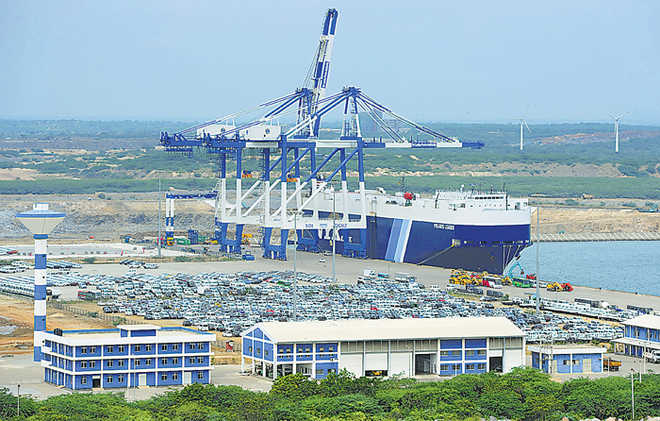
The catch: Sri Lanka has been forced to give China partial ownership of Hambantota.

G Parthasarathy

CHINA’S much-touted “Silk Roads” and “Maritime Silk Routes” trace their origin historically to its trade across Central Asia and the Indian Ocean. Interestingly, silk constituted a relatively small portion of Chinese trade, though it gave an exotic content to what was primarily commercial activity, in which China was the principal beneficiary. The Maritime Silk Route across the Indian Ocean was first set during the course of seven expeditions between 1404 and 1433 by a Chinese naval fleet headed by Admiral Zheng He, a Mongolian Muslim eunuch, appointed by Ming emperor Yongle. During the course of these expeditions to Indonesia, Malaysia, Sri Lanka and Calicut, Zheng brought back kings and princes to “kowtow” (genuflect) before the Ming emperor. Indonesia has ensured that it responds cautiously to Chinese inducements and avoids getting closely drawn into a Chinese embrace. Beijing, however, seems to have drawn Sri Lanka into its spiders’ web, taking advantage of the island’s economic vulnerabilities. One has to recall what Admiral Zheng did to the hapless island-nation after a visit to Calicut in 1406, to “get the Buddha’s tooth relic”. He returned to Sri Lanka in 1411 with a large army to take revenge for an earlier perceived insult. Parts of the island were plundered and the Sri Lankan king, Vira Alakeswara, taken back to Nanjing to kowtow before the emperor, together with the holy relic. The king was replaced by a “malleable” ruler. While the humiliated king was returned to his people a few years later, the relic was returned six centuries later in 1960, by PM Chou en Lai, as a gesture of “goodwill”, Chinese style. Chinese trade was historically as exploitative as trade by the British East India Company! Colombo is, nowadays, full of hoardings of China’s “magnanimity”, manifested in its “assistance” in infrastructure, industrial and construction projects. Beyond the Galle Main Road in Colombo is the $1.4 billion Port City Project to be filled with Chinese built, owned, or managed, luxury apartments, golf course, theme park, hotels and office buildings. All these projects will soon become part of Sri Lanka’s mounting official debt burdens and accentuate the already unbearable debt burden Colombo has accumulated, from earlier Chinese “aid”. The main instruments of this aid and plunder of natural resources are the China Communications Construction Company and its subsidiary, the China Harbour Engineering Company. World Bank has blacklisted both these companies across the world because of their corrupt practices, including bribery. The only well executed and profitable Chinese-built project in Sri Lanka is the Container Terminal in Colombo.Apart from the crushing debt burden of the Colombo Port City Project, Chinese projects located in President Rajapakse’s own constituency, Hambantota, have imposed an unsustainable debt burden on Sri Lanka. Given Western aversion for his regime and Indian doubts about the project’s viability, President Rajapakse welcomed Chinese “assistance” to develop his constituency. He sought and obtained Chinese “support” to heavily finance projects ranging from the Hambantota Port to a power plant, an airport, an industrial park, a cricket stadium and a sports complex. All these investments have proved uneconomical. Hardly any ships visit Hambantota Port, barely one aircraft lands at the airport daily and the sports facilities remain unutilised, even as local opinion was outraged by the proposed construction of an industrial park. Sri Lanka has been spending 90 per cent of government revenues to service debts. Unable to repay its debts to China, Sri Lanka has been forced to convert Chinese investments into equity in Hambantota, giving the Chinese partial ownership of the port. Following discreet Indian expressions of concern, Sri Lanka has retained operational control of the port, ensuring that Chinese submarines and warships do not freely berth there. Some pre-emptive action has also been taken to ensure that the eastern port of Trincomalee does not become the next port of interest for Chinese strategic ambitions, thanks to a timely initiative of Petroleum Minister Dharmendra Pradhan. The Indian Oil Corporation has established a business presence in Sri Lanka for progressive involvement in the use of Trincomalee for import and processing of petroleum products. It is imperative to build on this by constructing a modern petroleum refinery on equitable terms in Trincomalee. China’s Belt and Road Initiative in Myanmar is primarily concentrated on developing the Bay of Bengal port of Kyaukpyu and connecting it to its neighbouring Yunnan province by oil and gas pipelines and road and rail networks. But, Myanmar is wary of overdependence on China, among other reasons, because of Beijing’s insatiable quest for environmentally damaging energy projects and its yearning for access to precious metals and stones. Myanmar may, however, find it difficult to resist Chinese pressures on such projects unless India, Japan, South Korea, the US, the EU and neighbouring ASEAN countries make a coordinated effort to strengthen economic relations with it. A similar approach would be needed to China’s approach to construction projects in Nepal and Bangladesh. China’s “all-weather friend” Pakistan is also facing problems in implementing the much-touted CPEC. Despite high-level meetings, important projects like the Diamer-Bhasha Dam located in Gilgit-Baltistan, in POK, are stalled because of disagreements on financial terms set by the Chinese. There are also differences on implementing the railway projects based out of Peshawar and Karachi, apart from a series of road projects. Moreover, there is very little transfer of technology and knowhow, and minimal local participation in Chinese construction projects. Beijing has, after all, to utilise its vast surplus labour force and construction machinery and materials, abroad as its unprecedented domestic construction projects at home are completed.Questions are now being raised in Pakistan about where resources will come from to repay the over $50 billion debt that will accrue from CPEC projects, where local participation is minimal. Moreover, Pakistan will soon be unable to credibly claim that it exercises its sovereignty in places like the Gwadar Port, which is all set to become a Chinese-run military base, close to the strategic Straits of Hormuz. Writing in the respected Dawn newspaper, columnist Khurram Hussein perceptively observes: “In reality, the China-Pakistan Economic Corridor is about allowing Chinese enterprises to assume dominant positions in all dynamic sectors of Pakistan’s economy, as well as a ‘strategic’ direction that is often hinted at, but never fleshed out.”



Terrorists lob two petrol bombs at CRPF post in Srinagar

Terrorists lob two petrol bombs at CRPF post in Srinagar
No injuries were reported. File photo

Srinagar, December 23

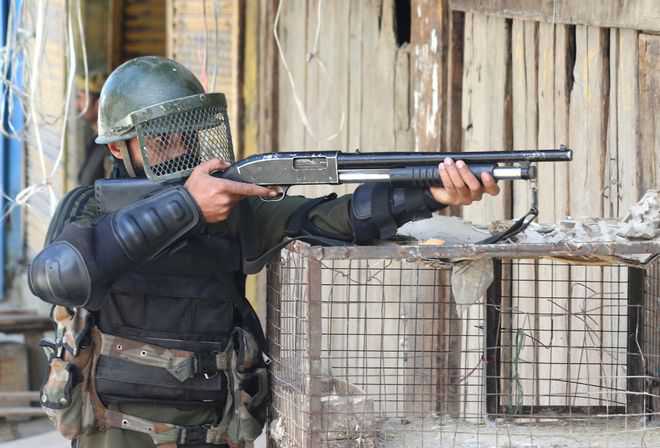
Terrorists lobbed two petrol bombs at a Central Reserve Police Force (CRPF) post here on Friday.The CRPF post is located at Nawakadal’s Bari Pora here.

(Follow The Tribune on Facebook; and Twitter @thetribunechd)

No injuries were reported.

Further details are awaited. ANI


Lok Sabha passes Immovable Property (Amendment) Bill

Lok Sabha passes Immovable Property (Amendment) Bill
File photo for representation only.

New Delhi, December 20  

A Bill to amend the regulations governing compensation payable for acquisition of immovable property by the Centre for defence and security purposes, was passed by the Lok Sabha on Wednesday.The Immovable Property (Amendment) Bill, which was moved by Urban Development Minister Hardeep Singh Puri, was adopted by a voice vote.Replying to the debate on the Bill, Puri said the law has been amended eleven times earlier. “This is the 12th amendment and the amendment has been brought for limited and specific purpose,” the minister said.The Bill seeks to amend a provision to allow the Centre to re-issue the notice of acquisition in order to ensure that the property’s owner gets an opportunity to be heard.“State has the obligation that relates to compensation. The states want to pay compensation which is fair and just compensation,” the minister said.Putting at rest the apprehensions of the members of the House, the minister said the compensation was meant for an interim period and solely for the purpose of determining the date of compensation to be computed.According to the government, there could be situations resulting in prolonged litigations and if the apex court quashes the notice of acquisition, there might be astronomical hike in compensation amount on account of market value appreciation.Against this backdrop, the Bill seeks to amend a section of the Requisitioning and Acquisition of Immovable Property Act to “enable the Central Government to re-issue the notice of acquisition to the owner or such other person interested in the property, for the purpose of giving an opportunity of being heard”.Puri also clarified that the government had no intention to open up those cases where the compensation has already been provided.Participating in the debate, CPI(M) leader Mohammad Salim said the government was trying to bring in “piecemeal” legislations to acquire land at a time when the Right to Fair Compensation and Transparency in Land Acquisition, Rehabilitation and Resettlement (Amendment) Bill, 2015 was pending with the joint parliamentary committee.BJP MP Gopal Shetty was critical of the defence officials for acquiring civilian land unnecessarily.“Sometimes the enemy does not trouble (the civilians) but these (defence) officials do. The Bill will help get justice to those whose land has been taken,” he said.AP Jithender Reddy (TRS) said the prime minister has often talked about cooperative federalism and if the land is taken by the Centre for national security, it should also take steps to take the state governments into confidence.Asserting that the payment should be more generous for the marginalised people, Varaprasad Rao (YSRC) said the government “has a lot of land which was lying waste. Barren land should be put to use, rather than taking away the land of the poor people.” — PTI


Army Chief meets students, says Quran teaches peace

Army Chief meets students, says Quran teaches peace
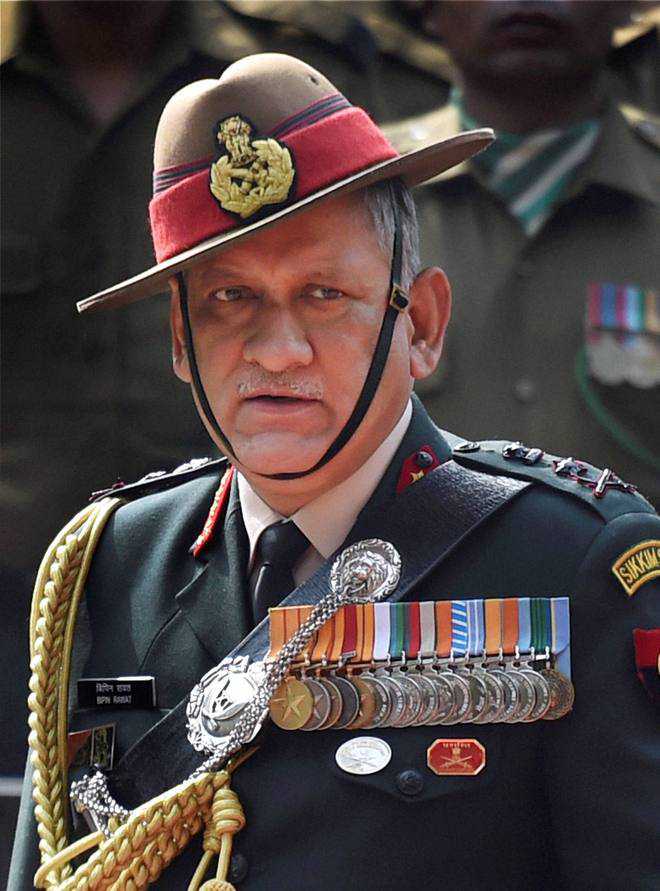
General Bipin Rawat, Army Chief

New Delhi, December 14The message of peace and harmony is “beautifully portrayed” in the holy Quran and people often do not understand its essence, Army Chief Gen Bipin Rawat told a group of students from J&Ktoday, adding it does not propagate violence.Interacting with the group of madrassa students at his office here, General Rawat also asked them to take to sports, such as cricket and football, and work towards containing terrorism so that the Valley flourishes again.“How many of you have read the holy Quran?” General Rawat asked the 25-member group which is here as part of a national integration tour being conducted by the Army. “I will tell you what is the message in it. It is the message of peace and harmony (‘Aman ka paigam hai’). And, it has been beautifully portrayed in it. And, all the noise being made by the Islamic State, is nowhere mentioned in Quran,” he said.“So, you must follow the message embedded in the holy text. You think people understand the message. We do not properly understand it. In simple ways, the Quran has given the lessons (on human values),” the Army chief asserted.The students, aged 13-22, arrived here on December 12 and many of them are visiting Delhi for the first time.Various militant outfits have been trying to radicalise the youth in the Valley by using different means, including online propaganda. A number of people were arrested in the Valley in the past few months on charges of raising IS flags.The Army chief warmly shook hands with all students and accompanying teachers and asked them what difference they found between Delhi and Kashmir.“Unlike Kashmir, you do not see bunkers here, people roam at night in peace. We want the same peaceful environment in J&Ktoo so that you can fearlessly go to schools and madrassas.“The Valley is equated with the heaven, and if you want that land to flourish, we must stop terrorism,” General Rawat said. He suggested that they engage themselves in constructive activities. “Play cricket and football, but I hear that the youth there play hide-and-seek with weapons,” he said.Abdul Hameed, 13, from Panjgram village in Jammu, said, “I am very happy to be in Delhi. I have never travelled out of Jammu.” — PTI


All Air Force exams set to go online

Tribune News Service

New Delhi, December 11

All examinations of the Indian Air Force will now be conducted online. The Raksha Rajya Mantri Subhash Bhamre inaugurated the online examination web portal of Indian Air Force.Online testing, or examination, will commence from January 2018 for Air Force Common Admission Test (AFCAT) for Officer’s cadre and scheduled test for Airmen Recruitment (STAR). Online registration commences on December 15.Earlier, the Air Force had hundred plus centres across India for officer-cadre exam and 14 centres for airmen selection exams. Certain states and UTs did not have any such centre.Consequently, candidates had to spend considerable time and resources on travelling to the test centres.In the new system, there would be about 760 examination centre’s all over the country and the maximum distance a candidate would be required to travel now will be considerably less from the place of his/her residence.It will enable approximately four lakh candidates for Airmen selection and two lakh candidates for officer’s selection, to appear in the exam every six months. The existing system had restrictions of geographical reach.The Air Force is the first amongst the three services to take up Information Technology-enabled online examination. The C-DAC, a Government of India agency, has developed the software for it.


Brits would have lost to Sikhs, ‘but for treachery by 2 Gens’

Brits would have lost to Sikhs, ‘but for treachery by 2 Gens’
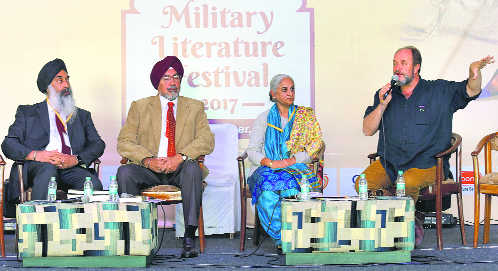
William Dalrymple (right) speaks as (L-R) Amar Pal Sidhu, Mandeep Rai and Dr Sukhmani Riar look on at the Military Literature Festival in Chandigarh on Saturday. TRIBUNE PHOTO: RAVI KUMAR

Ajay Banerjee

Tribune News Service

Chandigarh, December 9

Adept in Indo-British history, two leading historians today differed on what could have been the British Empire’s future after the First Anglo-Sikh War in 1846, but both agreed that the East India Company-led army had almost lost the war had the Sikhs — surprisingly or prompted by the treachery of two Generals — not surrendered.(Follow The Tribune on Facebook; and Twitter @thetribunechd)Speaking on ‘Anglo-Sikh wars’ at the Military Literature Festival here, London-based historian Amar Pal Sidhu argued: “The British lacked ammunition, had no water and were, thus, incapable of fighting. Then Governor General Lord Henry Hardinge was in the battlefield and he would have had to surrender. The entire British Raj could have collapsed.” Sidhu, who has authored separate books on the first and the Second Anglo-Sikh War (1848-49), said: “Had the Sikh army not surrendered, the British Empire’s history in India would have been different. It would have been a seminal moment resembling the one at Waterloo (where Napoleon Bonaparte of France lost).”The treachery by Generals Tej Singh and Lal Singh changed the course of history. The two owed their positions to Maharani Jindan, one of the queens of Maharaja Ranjit Singh. “Punjab probably would have been united and would still be united,” said Sidhu.  William Dalrymple, author of “Return of a King: The Battle for Afghanistan”, accepted that the military edge in the First Anglo-Sikh War was with the Sikhs. He, however, differed on the outcome of the British Empire had they (Sikhs) won the first war. “At that point, it was easy to defeat the Company-led army, though they could have used their backup of vast resources and men,” he averred. They had resources much bigger than Punjab’s. Between 1790 and the early 1800s, the company was earning hugely from Bengal. The private army of the East India Company was twice the size of the British army.Mandeep Rai, who was moderating the session, said: “Historians have not realised that had the Sikh army not surrendered, the Lahore durbar would have survived and the state of Pakistan would not have come into being.” Dr Sukhmani Riar, Professor of history at PU, asserted that “the creation of the Dogra state (now J&K) after the First Anglo-Sikh War was still a mystery.  How the Sikh kingdom collapsed within a few years of the death of Ranjit Singh (in 1839) is a matter of study”.The First Anglo-Sikh War led to signing of the ‘Treaty of Umritsar’ (Amritsar) and carving out a separate Dogra kingdom. It meant partial subjugation. Three years later, the Second Anglo-Sikh War led to total defeat of the Sikh army and the subsequent collapse of the Sikh kingdom.