Sanjha Morcha

Writings on military history in Punjabi language are scarce’

CHANDIGARH: Military history is a genre that is scarcely written about in Punjabi, said Gurinderpal S Josan, author of the book ‘The Epic Battle of Saragarhi’.

Speaking at the Military Literature Festival here on Saturday he rued the fact that the interest in writing in Punjabi is decreasing.

Other panellist speaking in the session on ‘Military writing in Punjabi’ agreed that most military books in India are being written in English at the cost of vernaculars.

The session began with a recital of ‘Jangnama’ by Babbu Tir.

Speaking at the festival, Brig JS Arora (retd) said Josan wrote a book in Punjabi sitting in New York but the Battle of Saragarhi does not find mention in the schools in Punjab.

“You can see how many officer have written on military affairs in Punjabi in the past 70 years.”

Brig OS Goraya (retd) recounted that when he wrote an eyewitness account of Operation Bluestar in Punjabi, he was dismayed when a publisher told him that it would be better if he published it in English.

“Now is the time when I want it to be published in Punjabi so that people know what we saw,” he said.

Referring to the decline of Punjabi, Brigadier KS Kahlon (retd) said, “The concept of military writing in Punjabi hasn’t developed yet. The language is under threat and it is for this reason that Surjit Patar had to pen the poem ‘Mar rahi hai meri bhasha’ (my language is dying).”


hHEADLINES ::: MILITARY FEST :::09 DEC 2017

65 WAR WITH PAK WAS A DRAW: CAPT

HENDERSON BROOKS REPORT NOT BEING DECLASSIFIED TO SAVE POLITICAL SKIN: CAPT

SIKH BATTALION SUBEDAR’S ADVICE SAVED VALLEY IN ’47

BRIG WALKED ACROSS TO WARN CHINESE AT DOKLAM: BAKSHI EX-GOC-IN-C: DIDN’T MOVE INCH THEREAFTER

WARFARE NOT ALL ABOUT FIGHTING: BADNORE

MILITARY LITERATURE FESTIVAL KARGIL TOOK MILITARY BY SURPRISE: RETD OFFICERS RECALL HOW ARMY CHIEF WAS TOLD NOT TO SET TIMELINE

A FIRST: CELEBRATING VALOUR WITH WORDS ON SUKHNA BANKS


VETERANS SPOKE ON ISSUES AS RECENT AS DOKLAM STANDOFF AND AS DISTANT AS WW­2

MILITARY FAMILIES, THE UNSUNG WAR HEROES

CHINESE FREQUENTLY BROKE RANKS DURING DOKLAM ROW’

BUREAUCRATS DON’T LIKE US, NOR DO WE’

18 YEARS ON, KARGIL WAR CONTINUES TO CONFOUND


VETERANS SAY THERE IS LITTLE HISTORICAL ANALYSIS OF 1999 CONFLICT, ITS IMPACT

‘WE ARE TRAINED FOR BATTLE, BUT WAR IS NOT A GOOD THING’

‘NAVY IS BATTLE ARM OF FUTURE TO TAKE ON CHINA’

WE USED A MIX OF STEALTH AND STRATEGY: SURGICAL STRIKE HERO

EXPERTS: CHINA’S AMBITIONS MAY JEOPARDISE INDIA’S INTERESTS

MUSHARRAF TESTING POLITICAL WATERS ?BY LT-GEN BHOPINDER SINGH (RETD)


WAR HEROES IN CITY TODAY

Here is a salute to some of the decorated soldiers who will be attending the Military Literature Festival beginning at the Sukhna Lake Club in Chandigarh on Friday.

CAPT BANA SINGH, PARAM VIR CHAKRA Operation Meghdoot 1984 Honorary captain Bana Singh, then a naib subedar, volunteered to be a member of the task force constituted in June 1987 to clear an intrusion by an adversary in the Siachen Glacier area at an attitude of 21,000 feet. The post was an impregnable glacier fortress with 1,500-ft-high ice walls on both sides. After leading his men through a difficult and hazardous route, the brave naib subedar and his men closed in on the adversary. Going from trench to trench, lobbing hand-grenades and charging with a bayonet, he cleared the post of all intruders.

Patriotic fervour prevailed on the nearly 3­km stretch at Uttar Marg near Sukhna Lake during the one­hour show of the daredevils, who performed nail­biting stunts in the backdrop of inspirational songs.BRIG KULDIP SINGH CHANDPURI, VSM (RETD), MAHA VIR CHAKRA Operation Cactus-Lilly 1971 Major Kuldip Singh Chandpuri was commanding a company of the Punjab Regiment occupying a defended locality in the Rajasthan Sector. On December 5, 1971, in the early hours of the morning, the enemy launched a massive attack on this locality with infantry and tanks. Major Chandpuri exhibited dynamic leadership in holding his command intact. Showing exceptional courage and determination, he inspired his men moving from bunker to bunker, encouraging them in beating back the enemy till reinforcements arrived. In this heroic defence, he inflicted heavy causalities on the enemy, forcing them to retreat, leaving behind 12 tanks.

COL BALWAN SINGH, MAHA VIR CHAKRA Operation Vijay 1999 It was on July 3, 1999, when Lieutenant Balwan Singh was tasked to assault the Tiger Hill Top from the north-eastern direction as part of a multi-pronged attack. The route to the objective situated at a height of 16,500 feet was snowbound and interspersed with crevasses and sheer falls. The officer, with just three months of service, led and exhorted the team that moved for over twelve hours along a very precarious route and under intense artillery shelling to reach the designated spur. This move took the enemy by complete surprise as his team used cliff assault mountaineering equipment to reach the top with stealth. His inspirational leadership and conspicuous courage were instrumental in the capture of Tiger Hill, which was operationally one of the most important goals in the Drass sector.

BRIG SUKHJIT SINGH (RETD), MAHA VIR CHAKRA Operation Cactus-Lilly 1971 Lt Colonel Sukhjit Singh commanded an armoured regiment during the operations against Pakistan on the Western Front. On December 10, 1971, his regiment was deployed west of Naina Kot when the enemy launched an armoured attack in strength under cover of intense medium artillery and heavy mortar fire. Disregarding his own safety, he opened the cupola of his tank to observe and direct the fire effectively. Due to his presence and inspiring leadership, the enemy attack was beaten off without any loss to own troops. Then on December 11, he personally led an attack on the enemy in which he destroyed eight tanks and captured one officer, two junior commissioned officers and two other ranks.

CAPT REET MOHINDAR PAUL SINGH (RETD), VIR CHAKRA Operation Riddle 1965 On September 22, 1965, Second Lieutenant Reet Mohinder Pal Singh was the leader of a tank troop, which was ordered to capture an enemy position in the Lahore Sector. Having reached within 400 yards of the enemy position, he came upon an enemy minefield. Despite heavy shelling, he dismounted from his tank to find a suitable crossing for his troop. Although wounded in the chest and right arm, he completed the reconnaissance. He again braved a shell-burst, which wounded him severely in the face.

COL HARBANT SINGH KAHLON, VIR CHAKRA Operation Cactus-Lilly 1971 Captain Harbant Singh Kahlon was the observation post officer at Ranian in the Western Sector. The enemy launched seven attacks on this position between December 3 and 4 under heavy artillery support. Captain Kahlon, with complete disregard for his personal safety, moved from one position to another despite heavy shelling, observing and directing fire on enemy concentrations. With exceptional competence, he brought down artillery fire as close as twenty yards from his own position to break up the enemy assault.

COL RUPINDER SINGH SANDHU (RETD), VIR CHAKRA Operation Cactus-Lilly 1971 Second Lieutenant Rupinder Singh Sandhu was a platoon commander in a battalion of Kumaon Regiment. His company was assigned the task of capturing an enemy post in the Eastern Sector. The attack on the post was interfered by a light machine gun firing from an enemy bunker, causing heavy casualties to our troops. With complete disregard for his safety, he crawled up to this bunker to neutralise the light machine gun. He was

hit in the chest by a splinter from an enemy grenade. Undeterred, he reached the bunker, lobbed a grenade and destroyed the light machine gun. This led to the capture of the enemy post.

BRIG SARLEJEET SINGH AHLUWALIA (RETD), VIR CHAKRA Operation Cactus-Lilly 1971 Major Sarlejeet Singh Ahluwalia was commanding a company of Ladakh Scouts during the attack on enemy posts in an area in the Western Sector. He led his company in an attack on an enemy post, but came under intense fire and shelling. Despite all efforts, the attack failed to make progress. Unfazed, with 15 other ranks, Major Ahluwalia moved across the fire-swept terrain and launched an attack from an unexpected direction and captured the objective, inflicting heavy casualties on the enemy.

MAJGEN SHEONAN SINGH, VIR CHAKRA Operation Pawan 1987 Major Sheonan Singh, Second-in-Command of 10 Para Commando, was deployed in Sri Lanka as part of the Indian Peace Keeping Force. On October 12, 1987, Major Singh heli-landed at Kokkavil to secure the battalion a position for assault on the LTTE headquarters in Kondavil area. After landing, Major Singh occupied buildings directly opposite the LTTE headquarters. He and his commandos held on to their position tenaciously for 28 hours till a link-up with army was established at 6am on October 13, 1987.

COL ANIL KAUL, VIR CHAKRA Operation Pawan 1987 Major Anil Kaul was part of the Indian Peace Keeping Force in Sri Lanka, and landed at Palali at 12.30 on October 12, 1987, with two tanks to support two companies of an infantry battalion inducted into Jaffna town to establish link-up with Para Commandos at Kondavil and extricate them. His force met with anti-tank fire and electronically-triggered improvised explosives. Undeterred, he led the advance, blasted the militants’ strong points and succeeded in establishing contact with one tank, already inducted with the infantry battalion.


MILITARY LITERATURE FESTIVAL From battlefields to bookshelves

he region’s military literature traces its roots to ancient times. It presents a rich treasure trove of experiences and opinions

Vijay Mohan

North India has remained a battleground since times immemorial. The land that has been the birthplace of countless soldiers has also produced voluminous military thought and literature over the past several thousand years. The mythological epics like the Ramayana and the Mahabharata or ancient scriptures contained in the Vedas to medieval works like Kautilya’s Arthashashtra, all point towards a structured military culture that once existed and the detail and importance that was given to the art and science of war.

After that there were several centuries during which evolution of indigenous military thought was overshadowed by foreign rule and socio-political leanings of some of the mass leaders. It was only towards the later part of the 20th century that Indian military writing saw a revival. Also the demand for greater public debate on matters of national security became more pronounced.

An army of writers

This, coupled with a greater access to information, personal literary interests and the notion of contributing towards the national cause, has led to an ever-increasing number of retired armed forces officers, senior bureaucrats, political leaders and even civilians penning down their opinions and experiences or simply putting together informative books and fictional volumes. Over the past decades, there have been thousands of books on military-related issues by Indian authors, but there is a feeling in some quarters that strategic culture in India is still in a nascent stage and needs a greater impetus.

The region, a witness to the most decisive wars, has produced a fair share of military writers of all hues, be it strategic issues, civil-military relations, historical narratives, service and legal matters, humour, individual feats and gallantry, picture books, regimental affairs, fiction and even comic strips.

When we talk of military history, a prominent name that crops up is that of Punjab Chief Minister, Capt Amarinder Singh. Among his notable works is The Monsoon War: Young Officers Reminisce — 1965 India-Pakistan War, an eyewitness account of the war when, as a young officer, he served as the Aide-de-Camp to the Lt Gen Harbaksh Singh, India’s top commander on the western front.

A Ridge too Far, detailing the Kargil conflict of 1999, Lest We Forget, the post-Independence military history of India, Saragarhi and the Defence of the Samana Forts, that delves upon a campaign listed among the 10 greatest battles of all time and Honour and Fidelity: India’s Military Contribution to the Great War 1914-18 are among his other literary contributions.

A service Chief is among those most qualified to write on matters military and the interface between the civilian leadership and military hierarchy. Towards this end, former Chief of the Army Staff, Gen VP Malik came up with From Surprise To Victory, a book that discusses the Kargil conflict that was fought during his watch. India’s Military Diplomacy: An Inside View of Decision Making and Defence Planning: Problems and Prospects and India’s Military Conflicts and Diplomacy are other books by him that delve into the realm of higher defence management in India.

A detailed review of the 1965 operations, including the main battles, air, logistics, Pakistani tactical concepts and lessons learnt from the war have been put forth by the then General Officer Commanding-in-Chief, Western Command, Lt Gen Harbaksh Singh in War Dispatches: Indo-Pak Conflict 1965. Another of his works, In the Line of Duty: A Solider Remembers, talks about the courage of conviction, setting high standards and inspiring others.

Missed Opportunities: Indo Pak War 1965 by Maj Gen Lachhman Singh Lehal, as the name suggests, is the author’s perspective on what could have been done differently for better gains. Top Brass, Operation Windfall: Emergence of Bangladesh and Significant Battle Since Independence by Brig HS Sodhi are important books in the series.

Veteran accounts

Many war veterans have written accounts of battles and operations that they have been closely involved with. Leap Across Meghna: Blitzkrieg of IV Corps 1971 is Brig OS Goraya’s narrative of operations in the eastern sector. He has also given his eyewitness account in Operation Bluestar And After. Combat Diary by Brig Jasbir Singh is an illustrated history of operations by 4 Kumaon, while Brig BS Mehta’s The Burning Chaffees is about the role of 45 Cavalry in 1971 and its troop composition. Indian Gunners at War is Maj Gen Jagjit Singh’s account of Indian Artillery’s war experience in 1971. In Battleground Chhamb — The Indo-Pakistan War of 1971, Maj Gen AJS Sandhu raises several strategic and tactical questions pertaining to the weak spot in India’s defence. An Infantry Battalion in Combat is Lt Col SS Ahlawat’s view on battle situations. Behind The Scene: An Analysis of India’s Military Operations 1947-1971 is a critical review by Maj Gen Jogindar Singh. With Honour and Glory: Wars Fought by India 1947-1999 is Maj Gen Jagjit Singh’s analysis of the country’s strengths and weaknesses affecting its security, a study he undertook when the Kargil conflict was underway.

Counter-insurgency narratives

A lot has also been written about Operation Meghdoot in Siachen, Operation Pawan in Sri Lanka and issues involing the armed forces in counter-insurgency operations.

Several books have emerged as a result of proceedings and discussions during seminars or academic events. Two such examples are Indian Army Aviation 2025 and Army 2020, both edited by Lt Gen Vijay Oberoi which explore contemporary challenges and propose a future road map. China Threat or Challenge, edited by Lt Gen JS Bajwa is a collection of 27 essays, which deal with almost all aspects of China as a nation state and its behaviour.

Military leaders have also been profiled by those who have had a chance to serve with them or have access to material that details their life and career. Field Marshal Sam Manekshaw: Soldiering With Dignity is Lt Gen Depinder Singh’s story about India’s most iconic commander. Leadership in the Indian Army: Biographies of Twelve Soldiers by Maj Gen VK Singh concentrates on personal accounts, anecdotes and reminiscences in order to highlight these leaders’personalities, and show the human face behind the military facade.

Some authors have touched upon the personal lives, feats accomplished and difficulties faced by military personnel in the line of duty. Rachna Bisht Rawat has put together 21 stories about how India’s highest gallantry award was won in The Brave: Param Vir Chakra Stories and also recounted the battles fought by five different regiments in Chhamb in her book, 1965: Stories from the Second Indo-Pakistan War. Another of her publications is Shoot, Dive, Fly: Stories of Grit and Adventure from the Indian Army that revolves around the perils, rigours, challenges, perks, thrill and adventure of a career in uniform.

Param Vir Vikram Batra: The Sher Shah of Kargil — A Father Remembers is a tribute by GL Batra to his warrior son martyred on the Kargil battlefield. Similarly in A Tale of Two Victoria Crosses, Lt Gen Baljit Singh tells the true story of the Victoria Cross moments of two subalterns, a British and an Indian, 30 years apart but ultimate in the scales of valour in pitched combat. He has also penned his memoirs in From My Memory Vault.

A law unto itself

As far as service matters and litigation is concerned, Maimed by the System by Maj Navdeep Singh, a practicing lawyer, is a collection of real life accounts of defence personnel, military veterans, disabled soldiers and their kin who were wronged by the system but fought successfully to claim their service and financial rights and dues. Pension in The Defence Forces deals with rules and regulations on the subject and Soldiers, Know Your Rights are among his other books, along with a collection of anecdotes, Fauj Hai Mauj.

A number of books on military law, litigation and service matters, such as Human Rights and the Armed Forces in Low Intensity Conflict by KS Sheoran, are available. International Encyclopedia of Terrorism Laws and Encyclopedia of Missile Defence and Non-Proliferation by Maj Gen RS Mehta are examples techno-legal works.

Then there are authors who have chosen to dig deep into history. A Military History of Medieval India by Maj Gen GS Sandhu is a study of warfare in India from the 11th to the 18th century of the Christian era. It traces the evolution of strategy, tactics and weapons employed by indigenous as well as invading armies during this period. Going further back in time, Air Marshal RK Nehra’s Hinduism and its Military Ethos relates to study of the Hindu military value system from the earliest times of mythology to the present times. Infantry In India by Lt Gen VR Raghavan, covers the evolution of the Indian Infantry from the Middle Ages to the modern times, including its performance in the present era, while Brig Kuldip Singh has written on Indian Military Thought: Kurukshetra to Kargil and Future Perspectives.

Attempts have also been made to move beyond the national borders such as Musharraf’s War and Flashpoints in South Asia by Maj Gen Rajendra Nath, Brig Jasbir Singh’s Escape from Singapore and A War Nobody Won: The Sino-Vietnam War 1979 by Col Harjeet Singh. He has also written India’s Contribution to the Great War as well as A War of Intervention The Russio-Georgia War, 2008.




The ‘missing’ muslim regiment: Without comprehensive rebuttal, Pakistani propaganda dupes the gullible across the board by Lt Gen Syed Ata Hasnain

Standing between Pakistani propaganda and the Indian nation can be a full time job, especially when it comes to issues about Indian Muslims. It is an enshrined doctrine in Pakistan that India’s fault lines will remain its Achilles heel. The recent controversy – generated by crude video clips inserted into social media networks and reinvigoration of a Pakistani media article of March 2010 – is nothing but a ham handed but potentially mischievous campaign by Pakistan’s Inter Services Public Relations (ISPR).

It’s an issue very few in India know much about: Indian Muslim presence in India’s armed forces and issues concerning alleged disloyalty to the nation, on which across the board gullibility is very high. The essence of the Pakistani disinformation is that a Muslim Regiment existed in the Indian Army till 1965, but was disbanded because in that conflict 20,000 Muslims refused to fight Pakistan.

Thereafter not a single Muslim participated in the 1971 conflict (another lie). Secondly, the percentage of Muslim servicemen as per the article is drastically below the ratio of Muslim population in India. The March 2010 article is more academic, highlighting research by an Indian Muslim scholar in the US who finds no rationale for this or for absence of reservation for Muslims in the armed forces.

Such projections obfuscate reality on the ground. Post-Independence, majority of Muslim officers and soldiers migrated to Pakistan, leaving a minuscule minority as the core or seed element of Indian Muslim servicemen distributed in different regiments and units. In that context new Muslim, Christian or Buddhist regiments made no sense as ethnic and regional identity took priority over faith as entities of representation. However, sub units comprising only Muslims do exist in many units of the Grenadiers, the Rajputana Rifles, Rajput Regiment and some cavalry regiments.

There was no Muslim Regiment ever and certainly not in 1965. But Muslims fighting as part of multi class regiments proved their absolute commitment and worth. Abdul Hamid’s Param Vir Chakra, although a legend, is insufficiently recalled today. Major (later Lt Gen) Mohammad Zaki and Major Abdul Rafey Khan both won the Vir Chakra, the latter posthumously even as he battled the Pakistani division commanded by his uncle, Maj Gen Sahibzada Yaqub Khan.

Such were the legends of Muslim warriors in 1965. The same followed in 1971. In later years Muslim bravehearts of the Indian army proved their mettle in Kargil and in fighting terror groups in J&K. Three army commanders, three corps commanders and a number of two star generals make up the community’s share of achievements in higher ranks.

The public needs to be educated on two aspects of manning in the Indian Army to counter Pakistani ‘psyops’. First, officer ranks. A commissioned officer goes to any regiment or unit irrespective of his ethnicity or faith or that of the regiment. He could be in command of mixed ‘All India All Class’ troops or of a sub unit comprising a single ethnicity.

I, a Muslim, was commissioned in Garhwal Rifles, a pure Hindu regiment with recruitment base only in Garhwal in Uttarakhand. Simply put, the faith of my troops became my faith; similarly their culture, language and food habits have never left me. Indian army officers uniquely remain comfortable with this arrangement, as do their families; it is an ethos not many Indians understand let alone Pakistanis who have never shared a bench or a tiffin box with people of another faith.

Manning below officer ranks is slightly different. Based upon social parameters each state has a recruitable male population (RMP) index. This is based upon the age profile and educational qualifications of the male population among other parameters. There is no reservation based upon profiling by faith, class, caste or ethnicity.

Rightly, in a diverse society the percentages by profile are not revealed as these will always become a subject of controversy which the close brotherhood of the uniform can ill afford. No doubt the Muslim representation at both officer and below officer level may not match its percentage of the population. But efforts to improve that are an ongoing phenomenon as education profiles and awareness improve.

In the officer cadre in particular, since it is open competition, regions with stronger education and awareness profile do have greater population percentage qualifying to be officers. Awareness makes a major difference and that is where the system may have erred in insufficient confidence building among some segments.

In my tours to educate various backward classes on opportunities i have been stumped by Muslim response, when they refuse to believe there is a place for them in the Indian army. Even the case of my own family, where father and son both became generals, is not easily believable by many Muslims.

This perception is exploited by Pakistan, with the additional misperception that it is not easy for them to follow their culture and faith in the forces. Exactly the opposite is true. The essence of India’s plural faith and culture is best symbolised by the armed forces but the projection of that to the recruiting base has been insufficient.

The ease with which Pakistan’s ISPR can exploit non-issues and half truths to advantage for its ‘psyops’ is a reflection of our studied weakness and longtime inability to develop a better communication strategy. More awareness among Indian Muslims and garnering the clergy in social outreach about the opportunities that India has to offer will go far in neutralising Pakistan’s intent.

DISCLAIMER : Views expressed above are the author’s own.

GREAT MOVE BY PUNJAB GOVT ::INCREASES WORKING DAYS ::: AKALI’S HOLIDAY BONANZA ENDS

Govt cuts holidays to half in 2018, Akalis seek rollback

Tribune News Service

Chandigarh, December 28

The state government has decided to reduce the number of gazetted holidays for calendar year 2018 to enable better public service to the citizens and also to ensure more teaching days in educational institutions.“With this reform, state government offices will remain open for 21 more days in 2018 compared to 2017. At the same time, government employees will be able to avail more restricted holidays than previously — in keeping with their preferences,” said a spokesman.The state government has declared 18 gazetted holidays and 39 restricted holidays for 2018. Government employees will now be eligible to avail five restricted holidays compared to two restricted holidays earlier.The spokesman said the state government has tried to strike a balance between its commitment to bettering public service and more teaching days in educational institutions on the one hand and the requirements of its employees to avail holidays on the other.“Now, the number of gazetted holidays in Punjab (only 18) are comparable to the number of holidays by the Government of India which has declared 17 gazetted holidays for 2018,” he said.For 2017, the state government had declared 37 gazetted and 20 restricted holidays. Employees were allowed two restricted holidays.The Shiromani Akali Dal (SAD), meanwhile, termed the Congress government’s decision to slash the list of holidays as a “totally dictatorial, irrational and insensitive” step taken without taking the other stakeholders into confidence. The party demanded its immediate rollback.In a statement here, SAD spokesman Daljit Singh Cheema said deleting occasions from the list like birth and martyrdom day of Bhagat Singh, Baisakhi, Mahashivratri, Parshuram Jayanti, May Day, martyrdom day of Udham Singh, Eid-Ul Zuha, martyrdom day of Guru Teg Bahadur and installation day of Guru Granth Sahib was wrong.Rejecting the state government’s “lame excuse” of providing better governance by slashing government holidays, the SAD leader said that the Amarinder government hasn’t even found time to complete its Cabinet strength by executing the much-needed expansion in the past nine months.

SGPC, akal Takht decry moveAmritsar: The SGPC and Akal Takht flayed the Capt Amarinder Singh government for scrapping holiday on Khalsa Sirjana Diwas. SGPC chief Gobind Singh Longowal said the occasion should again be brought on the list of gazetted holidays instead of the reserved list. He said the occasion carried utmost importance for the Sikh community. He, however, welcomed the gesture of Parliament of paying tributes to Guru’s Sahibzade. He said: “It was for the first time that Parliament paid homage to Baba Zorawar Singh and Baba Fateh Singh along with their grandmother Mata Gujri.” tns


Army Generals to get longer tenures Promotions to top posts at younger age

Army Generals to get longer tenures
File photo for representational purpose only.

Ajay Banerjee

Tribune News Service

New Delhi, December 27

The Indian Army has changed its promotion policy allowing Generals to serve longer tenures and officers to get promoted at a younger age to the ranks of Major General and Lieutenant General.The Army has also changed the rather stringent requirement of two-year residual service for selection as Army Commander. There are just seven such posts, including Vice Chief.(Follow The Tribune on Facebook; and Twitter @thetribunechd)The new policy announced on December 23 indicates that the Army has changed the sluggish promotion formula that dodges senior ranks. This in turn shortens the tenures to just 12 months at the level of the Divisional Commander, who is a Major General and has some 15,000-18,000 troops under his command. The same is the issue with the rank of Corps Commander, who is a Lieutenant General and gets only a 12-month tenure. This means too many changes.With the change of policy, the annual number of vacancies of promotion from Brigadier to Major General will be curtailed to 33, instead of the existing 44. In case of promotion from Major General to Lieutenant General, the vacancies will be curtailed from 12 to nine per annum. This will mean officers will have longer tenures of some 18 months and also that relatively younger people will be promoted while others get sidelined.In the Army, the rank of Major General is achieved by the age of 53 or 54, while the rank of Lieutenant General is on an average achieved by the age of 56. The target is to reduce this age profile by at least one year, ensuring longer tenures in top posts and continuity in policy-making.The policy of having a minimum of three years of residual service to become a Corps Commander shall remain unchanged.


India should control its border troops: China

India should control its border troops: China
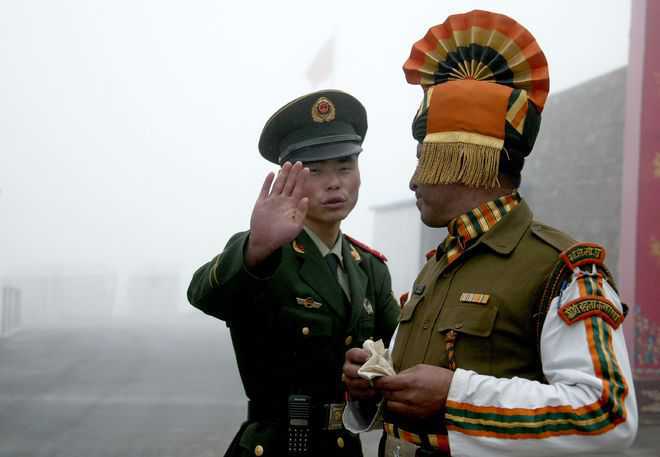
A Chinese soldier and an Indian soldier at the Nathu La border crossing. File photo

Beijing, December 28

Highlighting the Doklam standoff as its major achievement of international cooperation this year, the Chinese military on Thursday said India should “strictly control” its troops and implement border agreements to maintain peace and stability along the border.(Follow The Tribune on Facebook; and Twitter @thetribunechd)Chinese Defence Spokesman Col Ren Guoqiang said the highlights of his country’s international military cooperation in 2017 included handling ‘hotspot issues’ like Doklam.This year, under the unified deployment, the military has “resolutely” safeguarded China’s sovereignty and security interests, Col Ren told media here.The Chinese military has “played its due role in the handling of the hotspot issues such as the Sino-Indian confrontation in the Donglang (Doklam) area and safeguarded the China’s rights and interests in the South China Sea,” he said in response to a question.The Doklam standoff began on June 16 after the People’s Liberation Army (PLA) began building a road in area claimed by Bhutan. The Indian troops intervened to stop the road as it posed a security risk to Chicken Neck, the narrow corridor connecting India with its north-eastern states.The standoff ended on August 28 following a mutual agreement under which China stopped the construction of the road and India withdrew its troops.The 3,488-km-long Line of Actual Control between India and China covers from Jammu and Kashmir to Arunachal Pradesh.When asked how Chinese military view its relations with its Indian counterpart in 2018 in the backdrop of the Doklam standoff, Col Ren said India should implement the border agreements and control its troops.”We hope the Indian side can earnestly implement the relevant agreements reached between the two sides on the border issue and strictly control its border defence troops and do more for the positive development of China-India military-to-military relationship,” he said.During the border talks, the first since the 73-day-long military standoff in Doklam, in Delhi on December 22 between National Security Adviser Ajit Doval and Chinese State Councillor Yang Jiechi, both sides stressed the importance of maintaining peace and stability along the border, Ren said.”As far as we know both sides have agreed that it is important to maintain peace stability along India-China border and create favourable conditions for further development of bilateral relationship, which has provided a good environment and good momentum for the continued enhancement of China and India relationship,” he said.In terms of China and India military-to-military relationship, it is important to have strategic communication and push forward healthy development of ties between the two militaries, Col Ren said.”We hope Indian side walk towards the same direction as the Chinese side and both sides can push forward the development of the relationship and jointly maintain the peace and stability along the China-India border which is in the interest of both sides,” he said.About a recent incident in which an Indian drone crashed on the Chinese side in the Sikkim sector, Col Ren declined to reveal details and whether the parts of the drone recovered by Chinese troops have been handed back to India.”It is our position that India should have learnt lesson from the incident,” he said.On December 7, China had lodged a diplomatic protest with India claiming that an Indian drone has “intruded” into its airspace and crashed in the Sikkim section of the border which included Doklam.India has clarified that the Unmanned Aerial Vehicle had developed a technical snag and asked China to return it. — PTI 


Ruthless Strike Across LoC Signals India’s Eye-for-an-Eye Resolve by Lt Gen SYED ATA HASNAIN

Recent ceasefire violation in the Keri sector in Jammu seems to be a deliberate attempt to escalate tension at a time when the focus is on the meeting between alleged Indian ‘spy’ Kulbhushan Jadhav and his mother and wife.

There is a common saying in the Indian Army that the LoC is one place where a sub-tactical situation can become strategic in less than five minutes. That’s because alongside that state, a host of other situations interplay to give it hype. The context here is about the Pakistani trans-LoC strike, which killed an officer and three jawans of one of India’s finest Infantry units – the 2nd (Royal) Sikh in the Keri sector of Rajouri on 22 December 2017.

A response by the Indian Army on Christmas at Rakh Chikri area of Poonch sector laid low three Pakistan Army personnel, and critically injured some more. Ordinarily, this news would have disappeared from media tickers within hours. However, currently it’s a different situation. How different is it really?

LoC Emerges as the Ground for Messaging

First, 15 months ago, India’s surgical strikes within ten days of losing 20 soldiers in the Uri terror attack sent a clear message of intent that India would no longer accept such actions without an effective response.

Second, the LoC is no longer just a line on the ground separating the two Armies. It’s a place where Pakistan attempts to send a message to the world about the existence of the Jammu & Kashmir (J&K) issue, especially when the situation in the state comes under the total control of India. For many years it has sponsored a proxy war in the state, especially in the Kashmir Valley. It has failed in its attempts to turn the situation in its favour.

Third, currently after a year, and more so of attempting to create turbulence of an extreme kind in the Valley, Pakistan’s efforts have been largely neutralised. This has been done through effective professional military domination of the situation by Indian security forces (SF) led by the Indian Army.

Fourth, in Pakistan, the polity is in turbulence with radical elements attempting to rule the roost.

Deep State on the Lookout for Vulnerabilities

We recently witnessed the lockdown of Islamabad by the Tehreek Labaik Ya Rasool Allah (TLY), a new radical organisation. Jamat-ud-Dawa chief Hafiz Saeed has founded the Milli Muslim League (MML) to gain political clout. His pre-eminence and that of the JuD/LeT has been under threat by other organisations in the strategic space for political and terror-related power.

Peaceful conditions in J&K do not enhance his image and call for something spectacular. It is not an easy doing with the kind of domination the Indian SF have gained in the hinterland.

The LoC is a little different where troops are strung along its length in large and small deployments, necessitating patrolling and counter infiltration, thus enhancing vulnerabilities. It is these vulnerabilities which the JuD/ISI/Pakistan Army (also known as the deep state) can exploit.

Also Read: Pakistan Protests: Mix of Politics & Religion Adding Fuel to Fire

Having operated extensively on the LoC, I can vouch for the above vulnerabilities, and can confirm that it is near impossible to be secure everywhere because all deployments carry an element of risk.

The Indian Army’s vulnerability is higher because of deployment in smaller detachments and sub-units aimed at curbing infiltration. Patrolling is done to dominate gaps.

I can visualise Late Major Ambadas and his men of the 2 Sikh moving from one post to another to take stock, direct, brief, control and simultaneously dominate. That’s what tactical level commanders do all the time. His move was probably waylaid by a combined ambush of Pakistani regulars and a few terrorists, called Border Action Team (BAT).

Rakh Chikri: The Location for Trans-LoC Operation

Within three days, the Indian Army’s very famous 93 Infantry Brigade at Poonch has retaliated by killing three Pakistani soldiers.

This area of the LoC is approximately 120 km by road from Keri, where the Pakistani action was executed (much less as per crow flight), and falls within the responsibility of the Pakistan Army’s 2 POK Brigade located at Rawalakot. Apparently, it is the 59 Baluch deployed at Rakh Chikri where the Indian Army’s trans-LoC operation has been conducted.

This is a well-known landmark. In its vicinity, major operations were conducted both in 1965 and 1971.

It’s a forested feature (Rakh means forest), approximately a kilometre in depth, with many satellite posts in front. A trans-LoC operation need not be a surgical strike on a precise location such as a terror camp. It can simply be an entry across the LoC by a small body (10-15 soldiers) of well-trained sharp shooters from Special Forces, or the locally deployed Infantry unit, carrying prepared improvised explosive devices (IEDs) with pressure switches for initiation.

Routes of Pakistani patrols and logistics supply are well known to our forward troops as much as ours are known to Pakistan Army. Thus, it’s a question of selection of ground across the LoC where such a tactical level strike is conducted, essentially in the ambush mode followed by more casualties inflicted by concealed IEDs; a safe route for get away to own side is ensured.

Link Between Keri’s Ceasefire Violation and Jadhav

The Pakistan Army has admitted the casualties, but as per its policy, it remains in denial about the entry of Indian troops across the LoC. This has been a consistent policy for long, and was also followed during the September 2016 surgical strikes.

The very frequent transgression of foreign troops into its territory under Pakistan Army control (US Navy Seals strike at Abbotabad and Indian surgical strikes in PoK) has left it red-faced and hence this policy.

Lastly there is an apparent link of the Pakistani action at Keri with the permission for the family of Kulbhushan Jadhav to meet him. Pakistan possibly wished to deliver a message of psychological ascendancy; that it had an alleged Indian spy in custody and could conduct an operation to impose casualties on Indian troops, while having the ‘magnanimity’ to allow the alleged spy’s family to meet him. This despicable approach of the Pakistan establishment is unlikely to ever result in gestures for peace from India.

Also Read: Surgical Strikes Will Happen Again If Need Arises, Says Army Chief

(Lt Gen (Retd) Syed Ata Hasnain is a former GOC of the army’s 15 Corps and now associated with Vivekanand International Foundation and Institute of Peace & Conflict Studies. He can be reached at @atahasnain53. This is an opinion piece and the views expressed above are the author’s own. The Quint neither endorses nor is responsible for the same.)


From tea seller to army man

From tea seller to army man
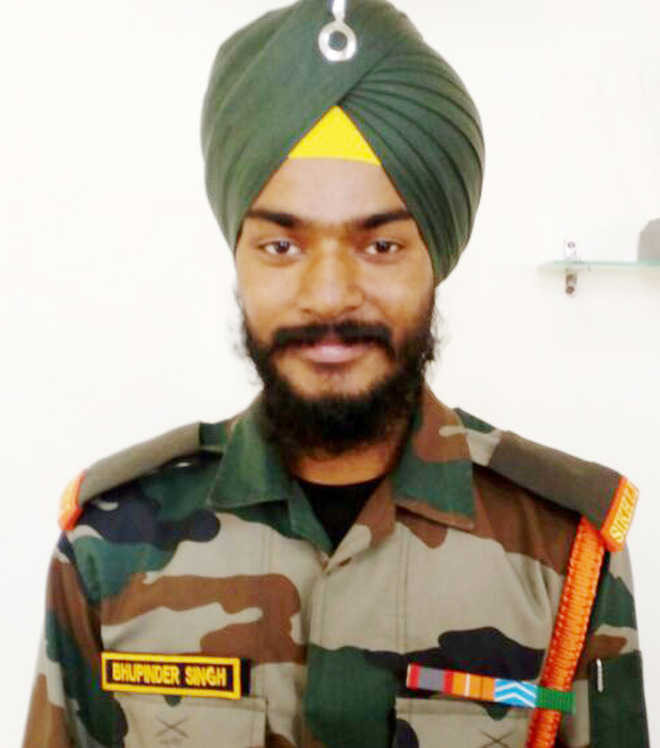
Bhupinder Singh

Tribune News Service

Amritsar, December 22

While selling tea near construction sites in and around his nondescript Fattu Bhila village, 30 km from the city, during his childhood, Bhupinder Singh had nothing to dream about in his life.Now, while receiving training as a general duty soldier in the Sikh Light Infantry unit of the Army, Bhupinder (20), son of a labourer, wonders how the destiny had something else in store for him.With the recently earned badge of honour and the olive green on his back, Bhupinder returned triumphant to his village, bringing pride and joy to his family and the villagers.He recalls how he dropped out of Class V from a government school to support his family. The life took a turn in 2011 for this hardworking lad when he was serving tea to labourers at the construction site of Satya Bharti Adarsh School’s expansion project. He caught the attention of schoolteachers, who got him enrolled where he used to serve tea in Class VI to continue his studies.Initially, Bhupinder’s father was worried over the financial burden of studies, but he was soon brought to ease when he learnt that his son would get free education, uniform, textbooks, stationery and mid-day meal.Displaying a keen interest in science, he brought home several accolades for his academic progress, projects and models. Before he could complete his higher secondary, he cleared the entrance test for the Army.“From pouring tea to figuring out hydraulics, Satya Bharti School has brought wonderful surprises and the happiest of memories for me,” he said.Ravinder Vohra, Principal, Satya Bharti Adarsh Senior Secondary School, said, “Bhupinder had developed good work ethics during his school and with sheer perseverance and grit he overcame all the hurdles to accomplish his goals.”