Sanjha Morcha

Saudi Arabia In Ferment: Complexities Of A Royal Coup by Lt Gen Syed Ata Husnain

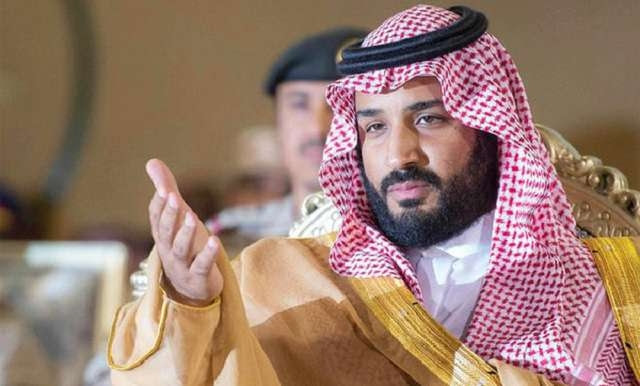
Mohammad bin Salman

SNAPSHOT

The attempted transition of Saudi Arabia is not going to be an easy affair. The strategic environment of the Middle East isn’t exactly conducive for that and the internal structure of the Saudi ruling family is a mixture of politics, deceit and subterfuge.

If you haven’t been following the events in Saudi Arabia you should start by knowing something about the ‘Sudairi Seven’. It is not a sports team or a fancy club but a lineage of royalty; to know more you need to go back to 1953. King Abdulaziz ibn Saud set up the current House of Saud in 1932 and named the desert territory he captured and consolidated, Kingdom of Saudi Arabia. He lived till 1953 and thereafter three successors followed, all his sons – kings Saud, Feisal and Khaled.

Thereafter, the throne has invariably been occupied by one of his seven other offspring from his favourite wife; Hassa bin Ahmad al Sudairi, thus called the Sudairi Seven. The current ruler King Salman is possibly the last of these sons although there was one more to follow, Prince Muqrin bin Abdulaziz, now disempowered. The next generation of the Sudairi Seven is currently hankering for power. It all started in 2015 when the current ruler King Salman ascended the throne. His nephew, Prince Mohammed bin Nayef was appointed the Crown Prince but that lasted till 2017 when King Salman’s young, dynamic and ambitious son Mohammad bin Salman (MBS), 32, usurped the appointment after labelling Prince Nayef a drug addict.

It is now MBS all the way; where he plans to take Saudi Arabia is where the nation could apparently go but there could be more palace coups waiting to take place. The attempted transition of Saudi Arabia is not going to be an easy affair. The strategic environment of the Middle East isn’t exactly conducive for that and the internal structure of the Saudi ruling family is a mixture of politics, deceit and subterfuge.

It just needs to be remembered that Saudi Arabia’s stability all these years has been based upon a ‘live and let live’ policy followed by various inter-related members of the royal family. Cocooned in comfortable high profile jobs they get paid obnoxiously high packages. Most have invested money obtained by selling royal largesse. Now the next generation of the Sudairi Seven is positioned to take power after King Salman and there is little time left for niceties.

On 5 November 2017, officials loyal to MBS moved rather quickly, to arrest 11 princes, along with dozens of other officials and businessmen, at his direction and that of his father, King Salman. Nominally, the arrests are part of an anti-corruption drive spearheaded by the prince but what’s really happening is that the Crown Prince and heir to the throne is consolidating power and eliminating potential rivals. The military and the National Guard, a 100,000-man praetorian guard that was the long-standing preserve of late King Abdullah, has remained silent in the wake of this weekend’s arrest of its commander, Prince Mutaib bin Abdullah, a son of Late King Abdullah, and the dismissal of the navy commander. The National Guard is a force that evolved from late King Abdulaziz ibn Saud’s (founder of the House of Saud) original tribal army and later functioned as a sort of loyal protection for the regime from possible coups. Which side its loyalties will tilt will be an important factor, but it is likely that MBS would have catered for that while attempting his turbulent actions.

What are the internal and external dynamics related to Saudi Arabia’s immediate future and how does the arrival of MBS impact these is the key question that analysts are examining.

Internally Saudi Arabia isn’t exactly in the state of pink. Decline in oil prices, dilution of US energy dependence and a shrinking economy have led to lowering of its prestige and a weak economic situation. MBS wants to overcome this by preparing the nation for the post energy era, 2030 and beyond; a noble and pragmatic thought indeed. The carefully emplaced balance of power between the powerful Wahabi clergy and the royal house is under strain. This is because, internationally, the Saudi ideological footprint is being blamed for the rising tide of radical extremism in Islam. Saudi Arabia has been funding the spread of Wahabi ideology across the world through construction of mosques and seminaries. In fact, the Saudi-funded seminaries established in vicinity of Pakistan’s western borders with Afghanistan, post the 1979 Soviet invasion of Afghanistan were responsible for the creation of Taliban and a host of others who spread the radical message across the world.

MBS is attempting to project a new Saudi Arabia, much more moderate towards different segments of society. Permitting women to drive and also attend sports events at stadia is a part of this move. The clergy who has been politically quiet because of the balanced equation thus far may not wish to remain so in the future; that could spell problems for MBS. The last time that the clergy really exercised its power was after the Ikhwan takeover of the Grand Mosque in Mecca in December 1979. Its insistence thereafter on greater ideological responsibility by the royal house led to the worldwide increase in Saudi funding and activity towards its brand of Islam.

Will MBS be able to pull off his mission of creating a more moderate society even if resisted by the clergy? In the light of the fact that the Shia revival is moving forward strongly with the defeat of the ISIS, the Russia-Syria-Iran combine’s domination in the Syrian civil war and the Levant emerging as a virtual Shia territory, will the Saudi clergy loosen its ideological strings to accommodate MBS’ aim and intent? Whether MBS is schooled well in history is not certain but consolidation of power without the clergy’s support may prove to be a handful for the young and ambitious Crown Prince.

MBS is obviously hugely encouraged by the apparent support he seems to be getting from US President Donald Trump. Bruce Reidel, the US expert on the Middle East, had this to say – “the Trump administration has tied the United States to the impetuous young Crown Prince of Saudi Arabia and seems to be quite oblivious to the dangers. But they are growing every day.” Trump visited Saudi Arabia early in the first year of his presidency but more for the purpose of consolidating a front against Iran. The finalisation of the Qatar standoff within the Gulf Cooperation Council can be traced to this visit although Trump remains uncertain on Qatar. It is Iran that he is after.

Iran as an entity in the Middle East politics plays a major role. Firstly, it provides the Shia pole in the Shia-Sunni sectarian divide. Ever since the 1979 Iranian Revolution, it is perceived to harbour ambitions of leading the Islamic world in which the Shias are as it is in minority. The ideological and sectarian divide manifests politically in a severe competition for domination. Currently, this is happening in two areas. First is in Yemen where Iran supports the Houthis by proxy. The Houthi movement champions Yemen’s Zaidi Shia Muslim minority.

In 2015, Saudi Arabia and eight other mostly Sunni Arab states began an air campaign aimed at restoring the Sunni majority government of Yemen. The war has continued inconclusively, in fact politically quite disastrously for Saudi Arabia. Just as the virtual palace coup was in progress a missile is reported to have been fired over Riyadh by the Houthi rebels and was shot down by the Saudis. The Saudi reluctance to enter into a ground campaign leaves them with no possibility of a victory. This is going to be a mill stone around the neck of the young Crown Prince. Prudence demands that he declares a victory and ceases further conduct of the campaign and politically manages the post seizure of operations scenario as best as he can. It will, however, further weaken him in his conflict of interest with the clergy and also consolidate Iran’s growing clout.

The less than comprehensive defeat of ISIS (it still remains in a networked state much as the Al Qaeda did) and the impending domination of the Levant by the Russia-Syria-Iran combine is having its impact already. Threatened by the Shia march, Lebanon’s Sunni Prime Minister Saad Hariri fled to Saudi Arabia and this week announced that he is stepping down. This creates another defeat for Saudi Arabia’s strategic hold over the Middle East and leaves one more precarious situation for MBS to handle. The Hezbollah’s hold now strengthened means Iran’s virtual control over Lebanon. Whether President Trump can even visualise the changing strategic balance of power in the Middle East is doubtful. A potentially rash action to disrupt the Iran nuclear deal could well follow leaving Iran even less responsible in its actions but fully backed by Russia.

To handle the complexities arising out of the fast changing strategic situation in the Middle East would require consensus within Saudi Arabia and not the divisiveness created by MBS’ actions. If Iran takes the battle inside Saudi Arabia by instigating the Shia minority which exists as majority in crucial locations such as the energy rich eastern segment of Dammam, it could well mean war. It is unlikely that Iran will be in a hurry so soon after scoring victories over ISIS and taking control of Syria and Lebanon.

MBS needs also to remain warned that the ISIS has only been defeated militarily in terms of territory. Where it has dissipated is not fully known. It thrives in a zone where turbulence exists and central authority is weak. Hypothetically the possibility of ISIS reaching out to a confused Saudi National Guard under instigation by the Saudi clergy, cannot be ruled out.

Thus Crown Prince Mohammad bin Salman for all his suaveness and youthful leadership is likely to remain embroiled in much more than he can chew. In such circumstances a counter revolution cannot be ruled out with disastrous consequences for the stability of the throne and Saudi Arabia’s very existence.

What is there for India in this emerging thriller? The greater the Saudi turbulence, higher is the likelihood of rise in oil prices. This is something that the Narendra Modi government can ill afford at a time when it is just emerging from the effects of goods and services tax (GST) and demonetisation. Secondly, a 2.3 million Indian diaspora in Saudi Arabia exists. In a state of internal turbulence its security will need to be safeguarded with a potential contingency of evacuation. Thirdly, India’s stakes in the stability of the Gulf region are extremely high. Saudi Arabia in turmoil is hardly likely to remain isolated as the same could spread to other kingdoms; a kind of late and perverse Arab Spring. The Indian diaspora all over the Gulf will remain in a state of flux. Fourthly, the Middle East in turmoil and state of potential conflict spells bad news for economics everywhere, especially for a nation like India, which is struggling to maintain an even keel in growth.

How much influence the US can exercise over this potentially negative situation to bring about any semblance of stability and freedom from conflict in the crucial region of the Middle East, is less sure than ever before. Russia’s cooperation will be sorely needed. Yet, for now all eyes should remain on how the internal affairs of Saudi Arabia pan out. The nation has suffered instability in the past too and emerged from it. This time too that may just be so.


War with India not an option: Pak PM

London, November 6

Pakistan Prime Minister Shahid Khaqan Abbasi has said war is not an option with India and that only talks can resolve all outstanding issues, including Kashmir.Addressing a conference on “Future of Pakistan 2017” at the London School of Economics’ South Asia Centre here on Saturday, Abbasi described Kashmir as a “core issue” and said relations with India will remain tense until that is resolved. “Kashmir is the core issue with India. Until that is resolved, Pakistan-India relations will remain tense. We are always open to talks at any level and talks are the way forward. War is not an option,” Abbasi said.Highlighting India’s Cold Start Doctrine among recent developments, Abbasi said Pakistan had a “deterrent” in place. “We have a deterrent to that (Cold Start Doctrine) but I don’t think deterrents where both sides are nuclear powers is a solution to any problem. The only solution is continued talks,” he noted. — PTI


Tell it to the marines

Internal politics in both India and Italy have led to questionable decisions that have vastly complicated an inherently difficult diplomatic case of the Italian marines accused of killing two Indian fishermen.

Tell it to the marines
In choppy waters: Italian marines Massimiliano Latorre (R) and Salvatore Girone in file photo. afp

Vivek Katju
Former Secretary, Ministry of External AffairsItalian Prime Minister Paolo Gentiloni’s trip to India on October 3, the first in a decade at that level, is a significant step of the process to put India-Italy bilateral ties on an even keel after the strain of the marines issue drove them to breaking point. The matter has not been resolved, though neither side publicly raised it nor was it mentioned in the media briefings of External Affairs Minister Sushma Swaraj’s meetings with Italian leaders in Rome last year. The Arbitral Council which has been constituted under the Laws of the Seas at Italy’s behest is expected to give its judgment next year on its plea that India does not have jurisdiction to try the case. It is unlikely that domestic politics of either country will not intrude to pressure the government concerned even if it would wish to take it in its stride. The Congress had charged the Modi government with putting up a weak case before the council when it ruled last year that the marine in India be allowed to go to Italy under conditions to be set by the Supreme Court. Allegations were also made that Italy’s cooperation needed in the Augusta Westland case also contributed to the so-called soft way India pleaded the case.Indeed, internal politics in both countries has led to questionable decisions that vastly complicated an inherently difficult diplomatic matter. In Kerala, it raised popular sentiment which fed into government decision-making.

Case timeline

To recall the facts: On February 15, 2012, two marines, Massimiliano Latorre and Salvatore Girone, on an Italian oil tanker, MV Enrica Lexie, shot at St Antony, an Indian fishing boat, 20.5 nautical miles off the Kerala coast, causing the death of two Indian fishermen, Ajeesh Pinku and Jeslestine. After the incident, Enrica Lexie filed an incident claiming a piracy attempt and carried to sail ahead. St Antony proceeded to the Kochi port. The Indian authorities being apprised of the incident caught up with Enrica Lexie and it came to the port. After investigations, the two marines were arrested and charged with murder.The Italians protested the arrests. They claimed that as the incident had occurred in the contiguous zone and not in Indian territorial waters, the Indian courts had no jurisdiction and the case should be tried in Italian courts. They further implied that St Antony’s sailing pattern just prior to the firing led to an apprehension of a pirate attack. The Italian contention was rejected by the Kerala High Court, which held that the Indian courts had jurisdiction under Indian laws. The high court also did not accept that as the marines were Italian defence personnel they enjoyed immunity. It, however, allowed bail to the marines and allowed special quarters. Such consideration was shown to them later by the Supreme Court, too.The Italians appealed against the Kerala High Court’s views to the Supreme Court. Notwithstanding the unacceptable action of Enrica Lexie in sailing away despite its captain knowing that it was innocent and the hollowness of the claim of immunity, the main issue on which the whole matter turned was: did the Indian courts have jurisdiction to try the marines for murder in the contiguous zone? That the firing was unjustified and Lattore and Girone should be tried for murder is beyond doubt; but where? The compensation given by Italy to the families of the fishermen does not reduce the guilt.It would have been appropriate for the government to urge the Supreme Court which became seized of the matter to give a final decision on this basic issue. While doing so, it would have naturally argued that India did have jurisdiction. However, the court was not pressed to definitively determine the jurisdiction issue. Even after a Supreme Court ruling, the Italians could have approached the Law of Seas dispute resolution mechanism, as they finally did in 2015, but this could have hardly opened the government to charges of going soft on Italy. Clearly, the UPA’s primary objective was to prevent any adverse reflection of the Congress first family and not let diplomacy have full play.

SC ruling

The Supreme Court decision ruled that while Kerala state did not have jurisdiction, the Union did, and the case should be tried by a special trial court set up for the specific purpose. Significantly, the court allowed Italy to agitate the jurisdiction question before the trial court. No action was taken to set up the court and the Italians also adopted delaying tactics.The Home Ministry decided to hand over the case to the NIA and invoke the Suppression of Unlawful Activities Act. This implied that the marines would be tried as terrorists. This was simply untenable and naturally led to great bitterness in Italy. Eventually, the Act was dropped, and the Indian Penal Code provisions were relied upon.If domestic Indian politics muddied diplomatic waters, so did the Italian politics. Having put the marines as guards on commercial Italian vessels without the protection of any international instrument governing the actions of such personnel, the Italian authorities could not be seen to be abandoning them. Indeed, the pressure to get them back soonest and maintain their dignity led Italy to decide that they would not return to India, although the Italian Ambassador had personally assured the Supreme Court that they would. The court had allowed them to go to Italy to cast their votes. The unacceptable Italian action precipitated an unprecedented diplomatic crisis in which the court became involved. Ultimately, the Italians backed down but after the incident, the UPA had to reinforce its rigid approach. Nevertheless, Modi criticised the NDA’s handling of the case during the 2014 election campaign.

Jurisdiction a stumbling block

With the Modi government coming to power, the two countries engaged on ‘private’ and ‘public’ tracks to resolve the issue. Nothing came of these attempts for jurisdiction obviously was a stumbling block. Italy approached the Laws of the Seas International Tribunal (ITLOS) in December 2015, seeking that it denies India jurisdiction. It also sought a provisional order that the marine in India be allowed to return to Italy. The Supreme Court had already allowed one to go back for medical reasons. Both countries are currently filing their submissions and that process will be completed in February 2018 after which a date will be set for the hearing.This case will confront the Arbitral Council with difficulties as it will go into new territory. Some Indian legal experts feel that India has a good case in view of recent evolutions of international law and prevailing circumstances. It is difficult to predict how the issue will go at The Hague next year. Thus India-Italy ties will have to navigate a stretch of choppy waters and politics will again, no doubt, compel diplomacy to take a back seat, which way the decision may go.


Lessons for life On Gurpurab Day :::GURRU NANAK DEV G BIRTHDAY::Sanjha morcha wishes all veteran Happy Gurparb

Guru Nanak Dev Ji::vedio

http://

http://

http://

Manpriya Singh

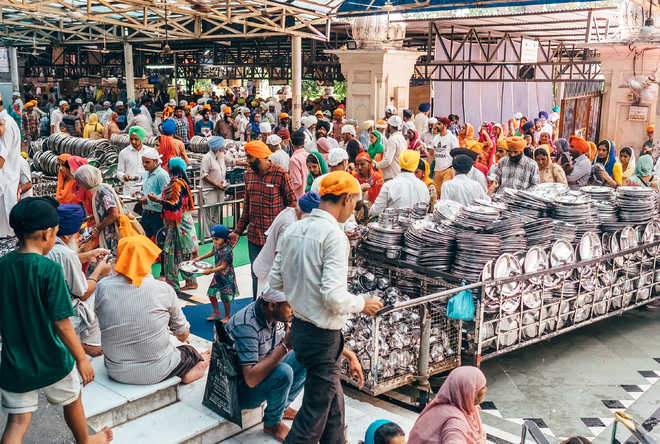
How difficult is righteous conduct, virtuous living and social responsibility? Unfortunately, very; especially in times of religious animosity, unbridled materialism and moral decline! However, improbable simple living and rightful conduct might sound, Guru Nanak’s teachings all the more become a practical compass for humanity today. A great prophet, a poet and a pious spirit; on Guru Nanak’s birth anniversary, we ask celebs how his teachings are relevant in today’s times and whether they have had any brush with community service.  Duty towards the needy Singer Jassi Gill makes it a point to go to the gurdwara, especially when he happens to be at home. Community service was inculcated at a very young age, courtesy a very religious upbringing. “Whenever we begin anything at home, akhand paath is a ritual and so is the langar. I have always tried to be as hands-on as possible especially with serving langar, if not making it,” shares the singer of Zimindar fame, who believes that Guru Nanak’s emphasis on social responsibility is something the world needs to embrace today. He adds, “I already sponsor a special child’s education till college and plan to increase that number soon.” He did that to a child from his native village; anyone following suit? The power of serviceThe earliest memory that Bollywood playback singer Sukhwinder Singh has of community service is when as a child they would splash water on hot marble floor. “In Golden Temple, especially during summer afternoons, the floor would be piping hot; we would as children love splashing water and cooling it down for the sangat,” he recalls. “Then of course we would move onto doing the dishes and serving langar, irrespective of who was coming to partake that food. It’s the similar devotion towards one’s society that we need to imbibe in today’s times,” he signs off. There’s a parting note. “Guru Nanak was the greatest poet of the universe and I remember Gulzaar sa’ab saying it to me once.” Make it holistic, not ritualistic From washing dishes to serving food to making it, you name it and actor Gugu Gill has done it all. “As children whatever opportunity we got for community service, we did,” he shares. “It wasn’t a ritual that we followed, rather it was a way of living,” adds the singer, who feels we need to imbibe Guru Nanak’s teachings in every day living rather than ritualistic practices. Good intentions, clean thoughts Almost every gurpurab, singer-actor Ammy Virk recalls having been in India. “Hardly during one or two gurpurabs I must have been abroad,” he recalls, while focusing on how important is the festival for him and his family. “As a child I was proactive about the concept of community kitchen started by Guru Nanak,” opines the singer, who feels we need to imbibe clean thoughts and good intentions in almost every breath we take. “I would like to tell all my readers and fans, stay true and right in everything you do; that is a major part of Guru Nanak’s teachings.” Rest, “A very Happy Gurpurab,” he signs off.  


KNOW MORE ABOUT THE MOHALI INSTITUTE

KARUN SHARMA/HT■ Besides 78 hostel rooms, the institute provides facilities such as a multi gym and sports fields, et al.2015: 25 students (1,500 had applied). The first batch is called Spearheads 2016: 25 students (1,200 had applied). This batch is called Smashing Seconds 2017: 25 students (1,800 had applied). This batch is called Tenacious Troikas

ROUTINE

5am: The day begins

5.40am: Morning muster begins with master parade followed by a pledge, prayer, debate on news, etc

5.50am: Physical training

8am: Girls leave for college and return by 2.30pm

3pm: Preparatory period, drill class and games followed by break

6pm: Evening classes on communication skills and personality development 8pm to 10.30pm: Dinner and self-study 11 pm: Lights off

MANAGEMENT

Maj Gen IP Singh, VSM (retd), an alumnus of Sainik School, Kapurthala and National Defence Academy, Khadakwasla, is the director of the institute. Maj Gen Singh, Col PS Gill (retd) and Sukhpreet Thind are the triad handling the institute’s functioning. Administration officer Col Gill, an alumnus of Punjab Public School Nabha, who joined the institute in June 2016, also prepares the girls for interviews. “I update the girls about current affairs, and provide them feedback on their presentations,” says Gill.

HIGHLIGHTS

Motto: Shubh karman tey kabhoon naa taroon

The girl cadets are trained in sports, personality development, communication skills, team building, and leadership, besides being prepped for the services selection board (SSB) interview. The girls are allowed to keep mobile phones as the teachers claim they trust them

Young joinees and veterans hold lectures to motivate the students. Cultural activities are organised from time to time.

Girls are also taken for trekking and other fitness exercises.


Sikh war heroes’ portraits at Golden Temple museum: ‘Wars different from Op Bluestar’

AMRITSAR: Portraits of late Lt Gen Harbaksh Singh, Lt Gen Jagjit Singh Arora and Marshal of Indian Air Force Arjan Singh were put up at the Central Sikh museum in the Golden Temple on Tuesday.

HT PHOTO■ SGPC chief Kirpal Singh Badungar (third from right) and others unveiling portraits of Lt Gen Harbaksh Singh (left) and Lt Gen Jagjit Singh Arora at a museum at Golden Temple, Amritsar, on Tuesday.

› Point is that the Sikhs have always fought against atrocities. During the 1965 and 1971 wars, the role of army was different from one it played during Operation Bluestar. KIRPAL SINGH BADUNGAR, SGPC president

Golden Temple head granthi Giani Jagtar Singh, along with Shiromani Gurdwara Parbandhak Committee (SGPC) president Kirpal Singh Badungar and general secretary Amarjit Singh Chawla unveiled the portraits.

Prior to this, a brief religious function was also organised in the museum.

Relatives and other accomplices of the Sikh war heroes, who were present on the occasion, were given ‘siropas’ (robes of honour).

The museum houses portraits of some radical leaders as well, including Jarnail Singh Bhindranwale who was killed by the army during Operation Bluestar.

Badungar said the SGPC has installed the portraits Sikh war heroes who fought wars against Pakistan.

“My point is that the Sikhs have always fought against the atrocities. During the 1965 and 1971 wars, the role of army was different from one it played during Operation Bluestar. All these three Sikh officers played a key role in defeating Pakistan,” he said, addressing the reported irony.

“The Sikhs are biggest patriots of this country, who sacrificed their lives for it,” he said, adding, “However, this is quite unfortunate that they have been denied the status to which they deserved for. They were suppressed time to time and deprived of Punjabi suba for long time.”


Will Narendra Modi Win 2019? by Vivek Kaul

ebook

I am writing this on Sunday, October 22, 2017. The prime minister Narendra Modi will visit Gujarat the third time this month. In the run-up to the state assembly elections, he will inaugurate and lay the foundation stones to a number of projects.

The prime minister’s multiple visits to Gujarat have led to the question-is the BJP on a weak wicket in Gujarat? A strong anti- Bhartiya Janata Party (BJP) front seems to be emerging in the state. The leader of the other backward classes (OBCs) Alpesh Thakor is expected to join the Congress on October 23, 2017.

Hardik Patel, the leader of the Patidar Patels, through his tweets seems to have indicated his preference for the Congress, though some of his aides have joined the BJP. Also, Patel currently is not old enough to fight elections.


On the flip side, Gujarat (unlike many other Indian states) has always been a two-horse race between the BJP and the Congress. And in this race, the Congress has gone nowhere in the recent decades. Its vote share has moved between 33-38 per cent of the votes polled and hence, India’s grand old party has not managed to displace the BJP. The extra 5 per cent votes that the Congress needs to give tough competition to the BJP, has never really come.

How will things turn out this time around? Honestly, I am not a political analyst and don’t know the answer to this. But what I do know is that the BJP has built a formidable election management system under its president, Amit Shah.

Prashant Jha in his new book How the BJP Wins-Inside India’s Greatest Election Machine describes this election management system in detail. And after reading this book I can say with reasonable confidence that displacing BJP at the state level (in the various assembly elections scheduled up to 2019) and in the Lok Sabha elections scheduled in 2019, will be no cakewalk.

This, despite the fact, that the Modi government has managed to screw up the economy big time through the disastrous decision to demonetise Rs 500 and Rs 1,000 notes, and a terrible implementation of the Goods and Services Tax.

I will not get into the details of the election management system of the BJP that Jha writes about in his book, given that a single Letter cannot do justice to it. Hence, dear reader, if you do have the time and the inclination, do check out the book.

Nevertheless, in this Letter I will talk about the factors that go in favour of the BJP and Modi, and the factors that go against them, when they fight an election in the days to come and this includes the Lok Sabha elections of 2019. Let’s look at these factors one by one.

Let’s start with the performance on the economic front. The promised acche din are nowhere in sight. In fact, the informal part of the economy which forms around 40 per cent of the GDP and employs more than three-fourths of the labour force, has collapsed. Economic growth has collapsed from more than 9 per cent to now less than six per cent. As far as the non-government part of the economy is concerned, which forms close to 90 per cent of the economy, it is now growing at just 4.3 per cent. So, there clearly are issues on the economic front. Having said that the government has time up until 2019 to set it right.

Also, more importantly does economic performance of the nation, really matter to the core supporters of Modi and the BJP. Or are they simply happy with the stand that the government is taking on the Ram temple in Ayodhya and all the rhetoric that surrounds the protection of the cow.

This will be a really important factor in any election. It remains difficult to figure out to what portion of the voters are these issues important. Not surprisingly, a narrative is already being built around these issues, for the core support base. And as May 2019 approaches, things could get murkier on this front.

As Evan Davis writes in Post Truth-Why We Have Reached Peak Bullshit and What We Can Do About It: “Like-minded groups of individuals share a narrative about many things… These narratives are sometimes true, sometimes not, but they are often like stereotypes… Once embedded in our minds though, they can easily gain excessive traction and trample over truth as willing believers put too much weight on propositions that conform to their narrative without looking for evidence in support of them.”

Further, it is worth asking whether voters vote based on the economic policy being practiced by the government. As Davis writes: [THE] argument that who you are matters more than the substantive point you are making is especially true about politicians. Voters focus on character rather than policy partly because they are better able to judge character and are relatively uninformed on policy… So, for a politician, having a good reputation is worth a hundred quick victories in specific arguments.

Modi’s personal brand still remains strong, though it may have been battered a bit. Over and above this, his brand will always be compared to those he is competing against and on that Modi wins hands down.

Expanding on the third point, the question is who will be the leader of the opposition parties. Will it be Rahul Gandhi? Or will it be a leader like Mamata Banerjee? As Jha writes in How the BJP Wins: “Will Rahul Gandhi accept a regional leader? Will a powerful regional leader like Mamata Banerjee accept a Rahul Gandhi?”

It will be imperative for the united opposition (if anything like that emerges) to have a consensus candidate and fight their elections under him, because a presidential style contest is likely to emerge, in the fight against Modi.

Other than choosing the right candidate, the opposition parties will have to build a credible narrative around him and what they have to offer. The narrative will be necessary to expand the core base. Just saying that we are there to displace Modi is unlikely to work. As Jha writes: “If ‘remove Modi’ is the only message, and the glue that binds them together, then they have a problem. Modi will project it, much like Indira Gandhi did, as a battle between him – a man committed to removing India’s poverty, man committed to India’s vikas – against a conglomeration of small, scattered, disparate units – united only by their hatred for him.”

Also, do these parties have the organisational muscle to take on the organisational muscle of the BJP and the Rashtriya Swayemsevak Sangh (RSS). The BJP always had access to the organisational muscle of the RSS, but the Sangh in the past, has not always deployed those resources totally, to help the BJP. That has changed now because of the personal relationship that Modi shares with the Sangh boss Mohan Bhagwat.

Narendra Modi was practically brought up in the RSS. And as Jha writes: “To top it all, Modi’s mentor in the Sangh happened to be Bhagwat’s father.” How do you tackle an equation like this?

In many states, like Gujarat, Rajasthan, Madhya Pradesh, Chhattisgarh and Karnataka, any election will be a direct contest between the Congress and the BJP. Does the Congress have the organisational strength to take on BJP and the RSS?

The bigger problem for the Congress is that it does not have full time politicians at the top. Narendra Modi and Amit Shah are full time politicians. They don’t have any other interests in life. The same cannot be said about the Congress leadership. Whatever people might say about the recent revival of Rahul Gandhi, he just doesn’t inspire enough confidence. I am just waiting for him to take his next holiday at a point of time, when he should be in the country.

The Congress Party for the last many years has always been led by a Gandhi. The Gandhis brought in the votes. But now that is no longer the case. So, the question that is being asked can a non-Gandhi lead the Congress. For a moment, let’s assume that the Gandhis take a backseat. Will the other leaders of the Congress be ready to work under the leadership of a non-Gandhi? I don’t think so. Without, the Gandhis at the top, the glue that holds the party together, the party is likely to break up and if not that the factionalism is bound to increase dramatically.

A big advantage that the Modi government has, and which the opposition doesn’t, is that it can use the official machinery in its favour. Recently, the Election Commission announced the election dates for the assembly elections in Himachal Pradesh, but did not do so for the assembly elections in Gujarat and offered a very flimsy reason for it. This gave Modi and the BJP more time to launch more new projects in the state and offer more sops to the voters, something they wouldn’t have been able to do, if the election dates would have been announced.

Over and above this, the government (like the previous governments) can continue using taxpayers’ money to keep building their brand. They can also announce waive offs closer to the election date. I have a feeling that sometime in late 2018, early 2019, a big Mudra loan waive off is on its way. More than 9 crore Mudra loans have been distributed till date. And any waive off of these loans, will give a huge push to the electoral chances of the BJP in 2010, given that it will impact 45 crore individuals in total (assuming a family of 5 per household).

Up until now, I have offered reasons which go for the BJP. Now that doesn’t mean that all is well with the BJP. The section of the population is clearly not happy with the economy not doing well. A million youth are entering the workforce every month and the job scene continues to remain bad. The trouble is that the government is simply unwilling to recognise this problem and keeps talking about self-employment opportunities that it has created. These claims are rarely based on any data. The problem with trying to be too clever all the time is that ultimately you get found out. This something that the BJP leaders need to seriously think about.

So, it remains to be seen whether this issue emerges as a strong political issue. It further remains to be seen whether the opposition parties are able to tap into the frustration of the youth who are entering the workforce and not been able to find decent jobs.

Many land owning communities like Marathas, Jats, Patidar Patels and Kapus, have launched protests in the recent past, demanding reservations in government jobs. This remains a tricky issue to handle.

In states like Uttar Pradesh, where the BJP has done well, it has built a broad coalition of castes. In Uttar Pradesh, along with the support of upper castes, the BJP was able to reach out to backwards particularly those who did not like the rise of the Yadavs under the previous regime, and the Dalits, particularly those who did not like the rise of the Jatavs under Mayawati. The trouble is that the any government has only so many resources to share and distribute.

As Jha writes: “Caste groups end up competing with each other for state patronage, resources, access to power. There are limited opportunities available and so certain caste groups and, within the caste groups, certain individuals end up cornering more than their share of positions… A road is constructed or schemes are more effectively implemented depending on whether the constituents of that village are supporters of the regime in power. Given weak institutions, access to political power often determines if a person of a specific caste has access to the local police station.”

If sabka saath sabka vikaas has to become a reality, then the current governance structures will have to be changed. Local police officials need to respond to various complaints, irrespective of the caste of the individual making the complaint. This remains very difficult to implement.

Already, in Uttar Pradesh there are accusations of Thakurs, the caste to which chief minister Yogi Adityanath belongs to, taking over the police administration.

For a very long time, the BJP was a party supported by the upper castes and the business castes. Under Modi and Shah, the support base of the party has expanded and includes a large section of the poor as well.

While, this has benefitted the party tremendously, the party organisation hasn’t changed to reflect this new reality. As a top BJP leader told Jha: “The party organisation has still not transformed itself. At the moment the party’s character and the PM’s support base may slowly diverge. You cannot have an SUV driving rich contractor as your district president if your target is the poor voter.”

This can lead to a situation where the party’s political messaging is neither here nor there.

To conclude, these are the factors which will matter in the runup to the 2019 elections. While, BJP is on weaker wicket in comparison to 2014, a small industry seems to have emerged in writing off the electoral chances of Modi and the BJP in 2019, on the basis of a few recent losses in assembly, Lok Sabha, and a few other smallish elections. But they are really jumping the gun, on the basis of very little evidence.

The BJP’s election machinery is very strong, and it can take on these defeats in its stride.

Comments on this edition of Vivek Kaul’s Diary: Post a comment | Read comments

Vivek Kaul is the Editor of the Diary and The Vivek Kaul’ Letter. He is the author of the Easy Money trilogy. The books were bestsellers on Amazon. His latest book is India’s Big Government – The Intrusive State and How It is Hurting Us.


Pakistan’s General Problem.

How Pakistan’s Generals turned the country into an international jihadi tourist resort BY Mohammad Hanif
(Mohammed Hanif is the author of A Case of Exploding Mangoes(2008), his first novel, a satire on the death of General Zia ul Haq)
What is the last thing you say to your best general when ordering him into a do-or-die mission? A prayer maybe, if you are religiously inclined. A short lecture, underlining the importance of the mission, if you want to keep it businesslike. Or maybe you’ll wish him good luck accompanied by a clicking of the heels and a final salute.
On the night of 5 July 1977 as Operation Fair Play, meant to topple Zulfiqar Ali Bhutto’s elected government, was about to commence, then Army Chief General Zia ul Haq took aside his right-hand man and Corps Commander of 10th Corps Lieutenant General Faiz Ali Chishti and whispered to him: “Murshid, marwa na daina.” (Guru, don’t get us killed.)
General Zia was indulging in two of his favourite pastimes: spreading his paranoia amongst those around him and sucking up to a junior officer he needed to do his dirty work. General Zia had a talent for that; he could make his juniors feel as if they were indispensable to the running of this world. And he could make his seniors feel like proper gods, as Bhutto found out to his cost.
General Faiz Ali Chishti’s troops didn’t face any resistance that night; not a single shot was fired, and like all military coups in Pakistan, this was also dubbed a ‘bloodless coup’. There was a lot of bloodshed, though, in the following years—in military-managed dungeons, as pro-democracy students were butchered at Thori gate in interior Sindh, hundreds of shoppers were blown up in Karachi’s Bohri Bazar, in Rawalpindi people didn’t even have to leave their houses to get killed as the Army’s ammunition depot blew up raining missiles on a whole city, and finally at Basti Laal Kamal near Bahawalpur, where a plane exploded killing General Zia and most of the Pakistan Army’s high command. General Faiz Ali Chishti had nothing to do with this, of course. General Zia had managed to force his murshid into retirement soon after coming to power. Chishti had started to take that term of endearment—murshid—a bit too seriously and dictators can’t stand anyone who thinks of himself as a kingmaker.
Thirty-four years on, Pakistan is a society divided at many levels. There are those who insist on tracing our history to a certain September day in 2001, and there are those who insist that this country came into being the day the first Muslim landed on the Subcontinent. There are laptop jihadis, liberal fascist and fair-weather revolutionaries. There are Balochi freedom fighters up in the mountains and bullet-riddled bodies of young political activists in obscure Baloch towns. And, of course, there are the members of civil society with a permanent glow around their faces from all the candle-light vigils. All these factions may not agree on anything but there is consensus on one point: General Zia’s coup was a bad idea. When was the last time anyone heard Nawaz Sharif or any of Zia’s numerous protégés thump their chest and say, yes, we need another Zia? When did you see a Pakistan military commander who stood on Zia’s grave and vowed to continue his mission?
It might have taken Pakistanis 34 years to reach this consensus but we finally agree that General Zia’s domestic and foreign policies didn’t do us any good. It brought us automatic weapons, heroin and sectarianism; it also made fortunes for those who dealt in these commodities. And it turned Pakistan into an international jihadi tourist resort.
And yet, somehow, without ever publicly owning up to it, the Army has continued Zia’s mission. Successive Army commanders, despite their access to vast libraries and regular strategic reviews, have never actually acknowledged that the multinational, multicultural jihadi project they started during the Zia era was a mistake. Late Dr Eqbal Ahmed, the Pakistani teacher and activist, once said that the Pakistan Army is brilliant at collecting information but its ability to analyse this information is non-existent.
Looking back at the Zia years, the Pakistan Army seems like one of those mythical monsters that chops off its own head but then grows an identical one and continues on the only course it knows.
In 1999, two days after the Pakistan Army embarked on its Kargil misadventure, Lieutenant General Mahmud Ahmed gave a ‘crisp and to the point’ briefing to a group of senior Army and Air Force officers. Air Commodore Kaiser Tufail, who attended the meeting, later wrote that they were told that it was nothing more than a defensive manoeuvre and the Indian Air Force will not get involved at any stage. “Come October, we shall walk into Siachen—to mop up the dead bodies of hundreds of Indians left hungry, out in the cold,” General Mahmud told the meeting. “Perhaps it was the incredulousness of the whole thing that led Air Commodore Abid Rao to famously quip, ‘After this operation, it’s going to be either a Court Martial or Martial Law!’ as we walked out of the briefing room,” Air Commodore Tufail recalled in an essay.
If Rao Abid even contemplated a court martial, he probably lacked leadership qualities because there was only one way out of this mess—a humiliating military defeat, a world-class diplomatic disaster, followed by yet another martial law. The man who should have faced court martial for Kargil appointed himself Pakistan’s President for the next decade.
General Mahmud went on to command ISI, Rao Abid retired as air vice marshal, both went on to find lucrative work in the Army’s vast welfare empire, and Kargil was forgotten as if it was a game of dare between two juveniles who were now beyond caring about who had actually started the game. Nobody remembers that a lot of blood was shed on this pointless Kargil mission. The battles were fierce and some of the men and officers fought so valiantly that two were awarded Pakistan’s highest military honour, Nishan-e-Haidar. There were hundreds of others whose names never made it to any awards list, whose families consoled themselves by saying that their loved ones had been martyred while defending our nation’s borders against our enemy. Nobody pointed out the basic fact that there was no enemy on those mountains before some delusional generals decided that they would like to mop up hundreds of Indian soldiers after starving them to death.
The architect of this mission, the daring General Pervez Musharraf, who didn’t bother to consult his colleagues before ordering his soldiers to their slaughter, doesn’t even have the wits to face a sessions court judge in Pakistan, let alone a court martial. The only people he feels comfortable with are his Facebook friends and that too from the safety of his London apartment. During the whole episode, the nation was told that it wasn’t the regular army that was fighting in Kargil; it was the mujahideen. But those who received their loved ones’ flag-draped coffins had sent their sons and brothers to serve in a professional army, not a freelance lashkar.
The Pakistan Army’s biggest folly has been that under Zia it started outsourcing its basic job—soldiering—to these freelance militants. By blurring the line between a professional soldier—who, at least in theory, is always required to obey his officer, who in turn is governed by a set of laws—and a mujahid, who can pick and choose his cause and his commander depending on his mood, the Pakistan Army has caused immense confusion in its own ranks. Our soldiers are taught to shout Allah-o-Akbar when mocking an attack. In real life, they are ambushed by enemies who shout Allah-o-Akbar even louder. Can we blame them if they dither in their response? When the Pakistan Navy’s main aviation base in Karachi, PNS Mehran, was attacked, Navy Chief Admiral Nauman Bashir told us that the attackers were ‘very well trained’. We weren’t sure if he was giving us a lazy excuse or admiring the creation of his institution. When naval officials told journalists that the attackers were ‘as good as our own commandoes’ were they giving themselves a backhanded compliment?
In the wake of the attacks on PNS Mehran in Karachi, some TV channels have pulled out an old war anthem sung by late Madam Noor Jehan and have started to play it in the backdrop of images of young, hopeful faces of slain officers and men. Written by the legendary teacher and poet Sufi Tabassum, the anthem carries a clear and stark warning: Aiay puttar hatantay nahin wickday, na labhdi phir bazaar kuray (You can’t buy these brave sons from shops, don’t go looking for them in bazaars).
While Sindhis and Balochis have mostly composed songs of rebellion, Punjabi popular culture has often lionised its karnails and jarnails and even an odd dholsipahi. The Pakistan Army, throughout its history, has refused to take advice from politicians as well as thinking professionals from its own ranks. It has never listened to historians and sometimes ignored even the esteemed religious scholars it frequently uses to whip up public sentiments for its dirty wars. But the biggest strategic mistake it has made is that it has not even taken advice from the late Madam Noor Jehan, one of the Army’s most ardent fans in Pakistan’s history. You can probably ignore Dr Eqbal Ahmed’s advice and survive in this country but you ignore Madam at your own peril.
Since the Pakistan Army’s high command is dominated by Punjabi-speaking generals, it’s difficult to fathom what it is about this advice that they didn’t understand. Any which way you translate it, the message is loud and clear. And lyrical: soldiers are not to be bought and sold like a commodity. “Na  awaian takran maar kuray” (That search is futile, like butting your head against a brick wall), Noor Jehan goes on to rhapsodise.
For decades, the Army has not only shopped for these private puttarsin the bazaars, it also set up factories to manufacture them. It raised whole armies of them. When you raise Lashkar-e-Taiba, Jaish Mohammed, Sipahe Sahaba, Sipahe Mohammed, Lashker Jhangvi, Al- Badar Mujahideen, others encouraged by the thriving market place will go ahead and start outfits like Anjuman Tahuffuze Khatame Nabuwat and Anjuman Tahuffuze Namoos-e-Aiyasha. It’s not just Kashmir and Afghanistan and Chechnya they will want to liberate, they will also go back in time and seek revenge for a perceived slur that may or may not have been cast by someone more than 1,300 years ago in a country far far away.
As if the Army’s sprawling shopping mall of private puttars in Pakistan wasn’t enough, it actively encouraged import and export of these commodities, even branched out into providing rest and recreation facilities for the ones who wanted a break. The outsourcing of Pakistan’s military strategy has reached a point where mujahids have their own mujahids to do their job, and inevitably at the end of the supply chain are those faceless and poor teenagers with explosives strapped to their torsos regularly marched out to blow up other poor kids.
Two days before the Americans killed Osama bin Laden and took away his bullet-riddled body, General Kiyani addressed Army cadets at Kakul. After declaring a victory of sorts over the militants, he gave our nation a stark choice. And before the nation could even begin to weigh its pros and cons, he went ahead and decided for them: we shall never bargain our honour for prosperity. As things stand, most people in Pakistan have neither honour nor prosperity and will easily settle for their little world not blowing up every day.
The question people really want to ask General Kiyani is that if he and his Army officer colleagues can have both honour and prosperity, why can’t we the people have a tiny bit of both?
The Army and its advocates in the media often worry about Pakistan’s image, as if we are not suffering from a long-term serious illness but a seasonal bout of acne that just needs better skin care. The Pakistan Army, over the years, has cultivated this image of 180 million people with nuclear devices strapped to their collective body threatening to take the world down with it. We may not be able to take the world down with us; the world might defang us or try to calm us down by appealing to our imagined Sufi side. But the fact remains that Pakistan as a nation is paying the price for our generals’ insistence on acting, in Asma Jahangir’s frank but accurate description, like duffers.
And demanding medals and golf resorts for being such duffers consistently for such a long time.
What people really want to do at this point is put an arm around our military commanders’ shoulders, take them aside and whisper in their ears: “Murshid, marwa na daina.”

भूतपूर्व सैनिक बनवायें अपना NEW ECHS CARD पुराना कार्ड होगा रद्द जानें क्यों 16 Nov,( 2017 Order)

http://


Tributes paid to first Param Vir Chakra awardee

Tributes paid to first Param Vir Chakra awardee
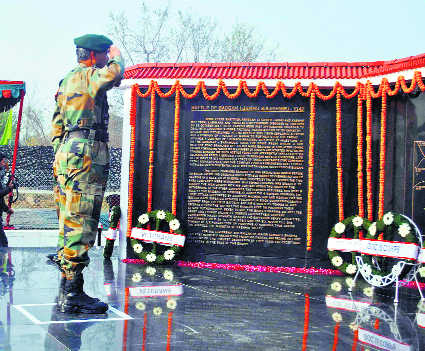
THE SALUTE: Victor Force GOC Major General BS Raju pays homage to Major Somnath Sharma at the Budgam War Memorial on Friday. Tribune photo

Tribune News Service

Srinagar, November 3

The Army on Friday paid tributes to Major Somnath Sharma, the recipient of the first and the highest war gallantry honour in India, Param Vir Chakra.Maj Gen BS Raju, Victor Force Commander, laid a wreath at the Budgam War Memorial and Brigadier Suresh Chavan, Commandant, JAK LI Regimental Centre, laid a wreath on behalf of the Chinar Corps at Major Somnath Sharma Memorial as a mark of respect for the martyr.Maj Gen Raju said the supreme sacrifice of Major Somnath had set an example of courage and leadership that would seldom be equalled in the history of the Indian Army.On October 22, 1947, when Pakistan launched the tribal invasion of Jammu & Kashmir with an intention to grab the Kashmir valley by force, the D Company of 4 Kumaon, led by Major Somnath Sharma, was airlifted to Srinagar on October 31 as part of the Army’s response after the Instrument of Accession was signed.“Major Somnath Sharma, with his arm in plaster, on November 3, 1947, established a base at Bugdam against raiders approaching Srinagar from the northern direction. In the contact that followed, despite facing a numerically superior enemy force of about 700 raiders supported with small arms, mortars and heavy automatics, Major Sharma and his troops held on to their positions and did not let the enemy succeed in their designs. This gallant effort stemmed the tide of the enemy advance on Srinagar and the airfield for some very crucial hours. In this battle, Major Somnath Sharma along with one JCO and 20 other personnel lost their lives.