



Sanjha Morcha

It’s Time to Openly Talk About the Problems Faced by the Indian Armed Forces

The army chief’s decision to deploy soldiers to build railway over-bridges and clean up garbage reflects a desire to please his political masters, even if at the cost of the men he commands.

The Indian armed forces have a rich history going back more than a century, at least in the case of army. They are also a very closed society. Within the organisation, there is little opportunity, incentive or encouragement to question or oppose things. From outside, the holy cow status of the armed forces makes it difficult to question what is happening inside. This situation is a ready recipe for disaster. Moreover, this institution is so critical to India that even a minor improvement in it will pay back manifold to the society and country. After 70 years of Indianisation, it is time to examine some aspects with candor.

Public image of senior officers of the armed forces

While the image of the armed forces remains high, that of its senior officers has hit rock bottom in the eyes of the public as well as its own veterans. Ironically, the veterans have turned out to be the biggest critics. This is most pronounced in the case of the army. Never before has a Chief of Army Staff (COAS) been a butt of so many jokes as now. For the previous chief, derogatory remarks were often passed on him being the only non-PSC (not Passed Staff College) in the line of chiefs. This was seen as a case of intellectual deficiency. If an officer repeatedly did not pass a professional examination on a level field with his contemporaries, he was surely not fit for holding the top job, the veterans claimed. For the present COAS, General Bipin Rawat, however, the comments are different. They are mostly about his unusual desire to please the political masters, even if at the cost of the men he commands. Several recent decisions by him have riled up veterans like never before. Some of them are the honouring of Major Leetul Gogoi, who tied a Kashmiri man to his jeep as a human shieldordering troops to clean up the garbage of othersordering the army engineers to make foot over-bridges (FOBs) for the railways in Mumbai and not objecting to the Delhi police manhandling elderly veterans and veer naris while evicting them from Jantar Mantar recently. WhatsApp groups of batchmates of veterans are using colourful adjectives for Gen Rawat that cannot be published. This castigation is not restricted to the COAS. Very strong comments have also been passed for the three chiefs collectively. Sample one here – ‘The Service Chiefs are dancing girls pirouetting to the tune of the babus’. This is not restricted only to the private WhatsApp groups of veterans but can also be seen in comments of veteran readers in the open media.

This is unprecedented. Never before in India and probably nowhere in the world have such comments been passed about the service chiefs. There is an unusual bitterness all over and veterans seem willing to air it rather openly. This does not augur well for the forces. Initially, the image of COAS just dipped a little. In the incident of Maj Gogoi using a human shield, only a handful of veterans wrote against it. When Gen Rawat ordered his army to clean up garbage, the level of criticism rose but still there were some who were ready to accept it for the larger good of cleanliness. However, ordering the army to construct FOBs for the railways has broken the dam.

The facts of the case are that several lives were lost due to a stampede on a narrow railways FOB due to heavy rains and mismanagement of traffic. There was no failure of the bridge or other infrastructure. All this happened in the megacity of Mumbai, not in some remote area. In response to this, the COAS has ordered three bridges to be made for the railways in Mumbai, not just one. This can not be explained except as an attempt to please the political masters. Even the railway unions and retired officers are against it. A.P. Mishra, former member of the Railway Board (Engineering) has said, ‘Railway workshops are much better equipped than army workshops. And, the railways engineering cadre is known to act fast in emergencies’. This observation is entirely true. The expertise of army combat engineers is to make a temporary bridge rapidly so that the advancing columns retain the required mobility even in enemy terrain, not to make permanent bridges for pedestrian traffic. Many in the railways have called it a ‘demoralising decision’ and a ‘knee-jerk reaction by the political leadership under popular pressure’, to which the army has unnecessarily become a part.

The veterans have trained their guns not only on the chief but on all generals and equivalent rank officers in the other two services. They are all portrayed and caricatured as working for their own career advancement at the expense of those they command. Just as IAS officers of state cadres are now known to be arrayed into sub cadres for different political groups for favours, general officers too are seen to be grouping themselves around politicians and IAS officers for improving their chances of becoming army commanders and/or COAS. The allegation of a Faustian bargain is also on the general officers of the army.

Veterans, particularly those of ranks lower than colonel, jeer at general officers fighting so hard for issues of ‘equivalence’, i.e., equivalence between army ranks and civilian posts. They claim that this is purely for benefit of the general officers who regularly rub shoulders with the IAS babus in South Block, Delhi. To an officer in the unit (colonel rank and below), how does it matter who is equivalent to whom? For the PBORs (persons below officer rank), it simply does not matter. For issues relating to pay grade fixation, it does matter. However, in those cases, the top brass muddles up things by repeatedly claiming that it is not about money, but izzat (honour). The One Rank One Pension (OROP) proposal is definitely about money, not izzat. There is nothing wrong in asking for more money. By always ending the discussion of OROP with ‘izzat of the soldier’ and such other terms, rather than money in the hand, they always weaken the case. In case of NFU (non functional upgradation), it is entirely about more money and nothing about izzat. Izzat is something to be looked into while ordering troops to clean up garbage thrown around by others, not in discussions of OROP and NFU.

On the importance of the relationship between the active army and the veterans, I quote George Washington: ‘The willingness with which our young people are likely to serve in any war, no matter how justified, shall be directly proportional to how they perceive the veterans of earlier wars were treated and appreciated by their nation’. India will disregard the opinion of its veterans at its grave peril.

Does it harm the armed forces to discuss these things in public? Is it even fair? Well, if we can openly discuss the prime minister of the country, why not the service chiefs? One has to see what does more good to the army – brushing all concerns and grievances under the carpet or airing them so as to limit the damage.

Privatisation of forces

The other big anomaly worthy of discussion is that, on the one hand, the Indian army is going in for privatisation of certain services, and at the same time is using its combatant troops for jobs that are best done by private companies. Services presently being provided by AEC (Army Education Corps), APS (Army postal services) and some of EME (Electrical Mechanical Engineers – some station workshops in country), some animal transport units, some units of Ordnance and Military Farms are sought to be shut down. This is seen as the ‘creeping in’ of private sector in purely military domains because obviously, the load will be taken up by private firms. Alongside, we see the strange phenomenon of using highly specialised combat troops to make bridges and clean up garbage.

While the present plans of correcting the teeth to tail ratio will not degrade the army’s capability noticeably, this trend must be challenged. This is particularly so in view of India’s growing proximity to the US. The US army relies heavily on military contractors. So much so that it is openly said that wars initiated by America are fought largely for the benefit of private companies in USA. In his book, The Lexus and the Olive Tree: Understanding Globalization, Thomas Friedman reminds us that “the hidden hand of the market will never work without a hidden fist – and the hidden fist that keeps the world safe for Silicon Valley’s technologies to flourish is called the US Army, Air force, Navy and the Marine corps.” Now that the hidden could also include Indian forces too, let us at least debate the trend. This becomes even more alarming in view of India signing the Logistics Exchange Memorandum of Agreement (LEMOA) with the US, which could bring US civilian contractors to the shores of India’s naval bases. No doubt they will be fully supported in this by Indian companies like the Adanis and Ambanis, who are widely rumored to be having the support of the government irrespective of which political party is in power.

Has the Indian public given its consent for such a change in the use of its armed forces? Will a combat army so remodeled and trained be able to take up the strain of a prolonged war on two and a half fronts? Will the civilian contractors that will so happily take up the work of the forces being downsized now, provide the same services in heavy combat conditions too?

It is true that many of these changes are as per recommendations of the Shekatkar Committee, but that is only half the truth. The committee made 188 recommendations, of which the Ministry of Defence (MoD) has sent only 99 to the armed forces for implementation. Are the others being shelved? It’ll be interesting to note what some of the others are – performance audit of non combat organisations directly under MoD viz defence estates, defence accounts, Directorate General of Quality Assurance (DGQA), Ordnance Factory Board and Defence Research and Development Organisation (DRDO)? The MoD will never touch the modernisation or even accountability of these. On hearing of the selective implementation, Lt Gen Shekatkar, retired, commented: ‘It is a welcome step but the government must implement all 188 recommendations, otherwise the purpose of this exercise will be lost’. Alas, it seems the good general did not understand the real purpose of the government in ordering this committee.

The promotion system of the armed forces

The third point for debate is the promotion system of the armed forces. Presently, all inputs for promotion are provided only by the superiors of the officer. This is indeed strange for a force that lays so much emphasis on leadership, i.e., the art of leading well. That being so, who knows the worth of the leader better than those led? They alone know the real leadership quotient of their officers. However, those who are led i.e. the troops under command, have absolutely no say in the promotion of their leaders. The senior officers know only that part of the officer what is shown to them. A correct understanding of leadership calls for taking a promotion input from subordinates, as well as peers and superiors. In the corporate world, this has long been the case under the name of 360 degree appraisals. Activate this in the armed forces and in one stroke you’ll wipe out the chances of apple polishers making it to the top. Let us not worry about how practical it will be to take inputs from so many soldiers. In today’s world of Iiformation technology, this is easily achievable.

In his book Bleeding Talent – How the US military mismanages great leaders and why it is time for a revolution, Tim Kane notes that ‘The more closely we scrutinise either the theory or practice, the more inadequate the exclusively top down assessment of performance and potential appear’. It seems that armies the world over mismanage their leaders. However, some armies have become wise to this while the Indian army has yet not.

This one change, if done, will solve all ills of the army in one stroke. Bad officers will never be able to rise to higher levels, much less the level of COAS. Those who reach higher ranks will genuinely care for the izzat of the men they command, as well as the size of their pay packet. They will not say yes to the unfair and sometimes illegal demands of the government. Troops will be employed only on tasks which is their mandate. When they are not actively engaged in combat or countering insurgency, they’ll actually train for war. If time is available even after that, they’ll rest and enjoy life with their families. Is there anything objectionable in that? This million-strong force, according to the analysts, is under tremendous stress. In fact, it is true that the army is losing more soldiers in suicides and fratricides than in action against the enemy. Most experts attribute the growing stress to deteriorating morale, poor service conditions, denial of leave at the required time, unattractive pay and promotions, early retirement ages, communication gap with superiors etc.

Different readers will have different viewpoints on these topics. However, what is unmistakable is that these issues must be discussed openly. For the holy cow to remain holy, an occasional scrubbing is necessary. The time is now.

Alok Asthana is a retired colonel of the Indian Army.

A failed experiment Anniversary of an unnecessary disaster

A failed experiment

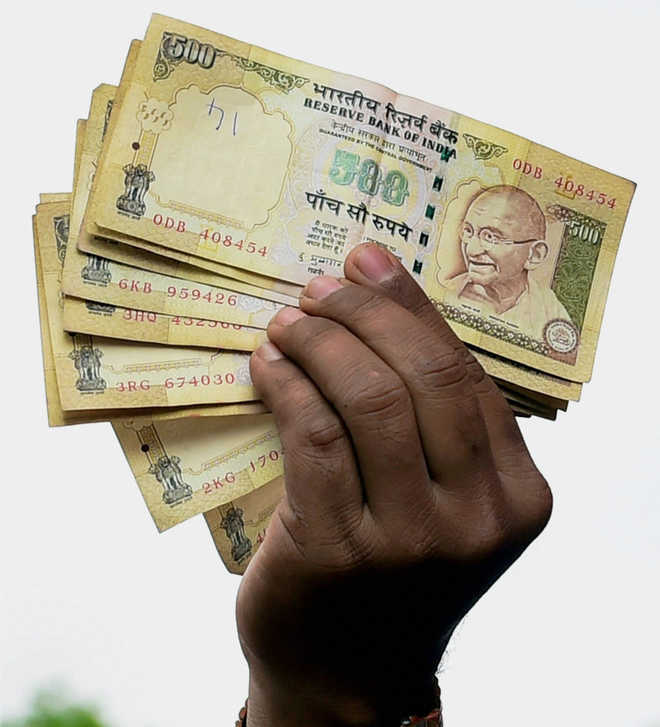
Even after a year of painful demonetisation, the government is struggling to smoke out black money. Contrary to its expectation, almost the entire black money stash found demonetisation an easy way to blend in the banking system and thereby earn interest. Even the attempt to curb counterfeit notes through the move failed. The other two principal promises — choking terror funding and ushering in the era of digital economy — did not exactly take-off. FM Jaitley’s assertion that demonetisation has reduced stone pelting in J&K is, at best, an oversimplification of a complex issue. Admittedly, the removal of old currencies from the system did accelerate digital payment transactions. The tempo, however, quickly went down soon after re-monetisation. Later, the GST encouraged small businessmen to dump digitation and resort to cash to escape the tax net.Demonetisation, however, did nudge people towards greater compliance. But, this would be more out of the coercive pressure of the tax inspector, which is not an easy sentiment. This fear has already robbed “household savings” of millions of families by forcing women to disclose their small reserves, and thereby, killed the Indian culture of micro-savings. Thus, demonetisation destroyed the informal financial cushion that often came in handy at times of a family crisis. Lifetime savings of Gurkha regiment retirees in Nepal became worthless. Similarly, Indian currencies kept as valued forex by millions of citizens in neighbouring Bhutan, Bangladesh, Sri Lanka and Myanmar became worthless paper, thereby eroding trust in the Indian rupee. Imagine, if the US were to do the same with the dollar.Undoubtedly, PM Modi’s stated intent behind demonetisation had initially been well-received by the people, who patiently endured it for more than 50 days. Its socio-economic costs, however, have been enormous. Most of those who lost jobs or shut their small business units due to the currency squeeze were from extremely vulnerable background. Many people also lost their lives due to this futile experiment. Whatever be the government’s self-congratulatory sales pitch, for many Indians it has been a jolt from which they will take a long time to recover.



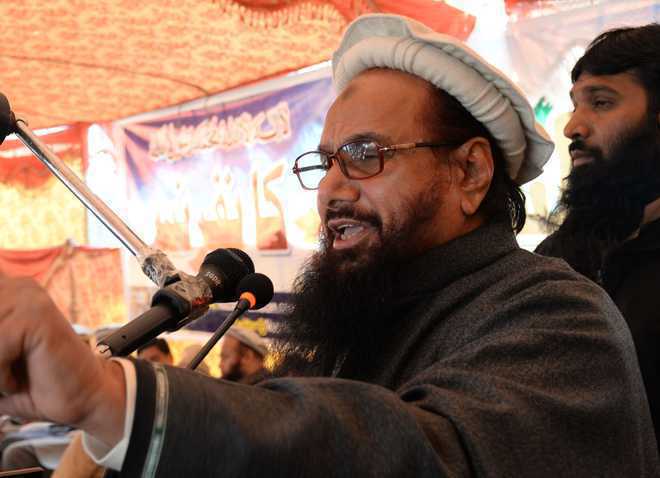
Re-arrest Hafiz or ties bound to suffer: US to Pak

Re-arrest Hafiz or ties bound to suffer: US to Pak
Hafiz Saeed

New Delhi, November 25

Stepping up the heat on Pakistan, the US today sought immediate re-arrest and prosecution of LeT founder Hafiz Saeed and threatened of an adverse impact on ties if Islamabad failed to act against the mastermind of the 26/11 Mumbai massacre.After Saeed’s release from house arrest yesterday, the US State Department had asked Pakistan to re-arrest and try him for heinous crimes. The White House, in its latest statement, said there was a “clear international consensus regarding Saeed’s culpability” in the 2008 Mumbai attacks that left 166 persons, including six American nationals, dead.(Follow The Tribune on Facebook; and Twitter @thetribunechd)“Saeed’s release sends a troubling message about Pakistan’s commitment to combating terrorism… If Pakistan does not detain Saeed and charge him, its inaction will have repercussions for bilateral ties and for Pakistan’s global reputation,” it said. Pakistan, meanwhile, has justified the release. — TNS


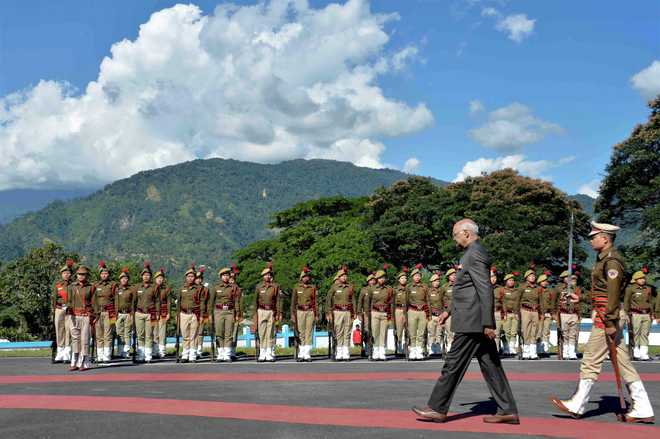
China objects to Kovind’s visit to Arunachal

China objects to Kovind’s visit to Arunachal
President Ram Nath Kovind inspecting the Guard of Honour on his arrival at Raj Bhavan helipad in Itanagar, Arunachal Pradesh on Sunday. PTI

Beijing, November 20

China on Monday strongly objected to President Ram Nath Kovind’s visit to Arunachal Pradesh, saying India should refrain from “complicating” the border dispute when bilateral relations are at a “crucial moment”.President Kovind visited Arunachal Pradesh yesterday.“The Chinese government never acknowledged the so-called Arunachal Pradesh and our position on the border issue is consistent and clear,” Chinese Foreign Ministry spokesman Lu Kang told the media when asked about Kovind’s visit to Arunachal Pradesh, which China claims as Southern Tibet.China routinely objects to any senior Indian officials’ visit to the area.India has dismissed Beijing’s objections, maintaining that Arunachal Pradesh is an integral part of the country and Indian leaders are as much free to visit the state as they are to any other part of the country.Both countries are “in the process of settling this issue through negotiation and consultation and seek to reach to a fair and reasonable solution acceptable to all”, Lu said.Pending final settlement all parties should work for peace and tranquillity, he said.“China firmly opposes the Indian leader’s relevant activities in the relevant region when China-India relations are at a crucial moment,” he said.“We hope India could work in the same direction and maintain general picture of bilateral ties and refrain from complicating border issue and work to create favourable conditions for border negotiations and for the sound and stable development of bilateral ties,” he said.The Line of Actual Control (LAC) between India and China stretches to 3,488 kms.On November 6, China had raised objection to Defence Minister Nirmala Sitharaman’s visit to the border areas of Arunachal Pradesh.Both sides held 19 rounds of talks by the special representatives to resolve the boundary dispute.The 20th round is expected to be held next month in New Delhi, though dates have not yet been announced.National Security Advisor Ajit Doval and his Chinese counterpart Yang Jiechi are the designated special representatives for the boundary talks. — PTI


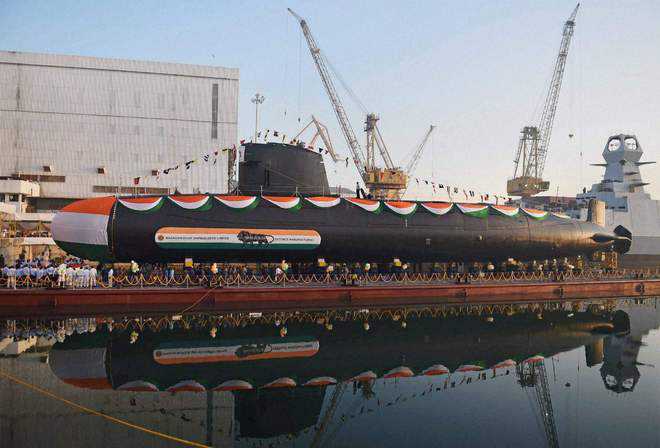
Indigenous sub set for mid-Dec sail First of six scorpene-class vessels planned in 1999 to be commissioned

Indigenous sub set for mid-Dec sail
Kalvari is being built by a Defence Ministry-owned firm in collaboration with France’s Naval Group. PTI file

Ajay Banerjee

Tribune News Service

New Delhi, November 20

Eighteen years after an action plan was announced for having 24 modern submarines by 2030, the first indigenous conventionally powered submarine is set to be commissioned in mid-December.The submarine, named ‘Kalvari’ (meaning deep sea tiger shark), will be the first diesel-electric version to be commissioned under the action plan announced in 1999 following a meeting of the Cabinet Committee on Security.India has since taken on lease a nuclear submarine from Russia and named it INS Chakra and commissioned one nuclear powered submarine of its own and named it INS Arihant.The Kalvari is the first of the six scorpene-class diesel-electric submarines being built by Mazagon Docks Limited, a Ministry of Defence-owned company, in collaboration with France’s Naval Group (earlier known as DCNS). In security circles, a diesel–electric sub is referred to as “conventionally powered”. The last time a diesel-electric submarine was commissioned into the Navy was in July 2000.The submarine would be equipped with anti-ship missiles and long-range guided torpedoes along with a modern sensor suite.For Naval planners, the worrisome part, however, is that China’s submarine fleet—nuclear and conventionally powered—is four times that of India’s.The Indian battle-ready under-sea fleet of diesel electric vessels is at present down to 14: nine Kilo-class (EKMs), four German-designed HDWs (SSKs) and one Akula class nuclear-powered submarine (SSN) on a 10-year lease from Russia (since 2012).The Navy plans to have 22 submarines by 2021-22 and is looking at building more of these under the newly announced strategic partnership, which allows foreign companies to partner with Indian firms under the “Make in India” initiative. Making submarines here is one of the four targeted sectors, the other three being fighter jets, helicopters and tanks.In comparison, China is rapidly expanding its submarine fleet. The US Department of Defence, in its annual report to the US Congress, has spelt out the rise of China’s submarine fleet.The report, “Military and security developments involving the People’s Republic of China 2017”, says: “The People’s Liberation Army Navy places a high priority on the modernisation of its submarine force and presently possesses 63 vessels. By 2020, this force will likely grow to between 69 and 78 submarines.”


LeT top leadership in Valley wiped out

General Officer Commanding (GOC) of 15 Corps Lt Gen JS Sandhu with DGP SP Vaid during a press conference in Srinagar on Sunday.

BANDIPORA GUNFIGHT Six Pak militants including Owaid,

nephew of 26/11 mastermind, were eliminated on Saturday

From page 01 SRINAGAR: The Army said on Sunday that the top leadership of the Pakistan-backed Lashkar-eTaiba (LeT) in the Kashmir valley has been wiped out with the killing of six militants in Jammu and Kashmir’s Bandipora district.
WASEEM ANDRABI / HT
General Officer Commanding (GOC) of 15 Corps Lt Gen JS Sandhu with DGP SP Vaid during a press conference in Srinagar on Sunday.
Lieutenant General JS Sandhu, who heads the Srinagar-headquartered 15 Corps, said, “With the elimination of six of its terrorist commanders on Saturday, the top leadership of LeT in the Valley has been wiped out.”
Giving details about Saturday’s operation, he said, “Hajin was an area of concern for us. Terrorists had killed some people in the area. We inducted Special Forces into the area and good intelligence inputs started pouring in. We were keeping Chandegeer village on our radar. These terrorists had been staying there in a house for two to three days.”
The Lt Gen identified one of the terrorists killed as Osama Jungvi or Owaid, a nephew of Zaki-urRehman Lakhvi and probably the son of Zakiur Rehman Makki.
Six Pakistani militants including Owaid and two other top commanders of LeT, Zargar and Mehmood, were killed on Saturday. An IAF commando was also killed in the gunfight.
“We look forward to continue the operations and restore peace in the Valley very soon,” the Lt Gen added.
‘TWO-PRONGED STRATEGY’
“We are working on two lines,” the Lt Gen added. “One is counter terrorism and the second is that we want the local terrorists to return.
“We pulled out and saved an injured militant in Kulgam and saved his life. The local terrorists must realise whether they are ‘Mujahids’ (Islamic fighters) or proxies of Pakistan.”
Jammu and Kashmir director general of police (DGP) SP Vaid
refuted the claims of the Islamic State that claimed that the Zakura attack on Friday in which a police officer and a militant were killed was the first IS attack in Kashmir.
Asked to comment, he said, “No, it is yet to be verified. I don’t think ISIS has any imprint here.” “Kashmir will be free of violence
very soon. Yesterday’s operation has cleaned up the area. I am sure people can now live their lives without any fear of terror,” he added.
Vaid complimented the Army, the Central Reserve Police Force (CRPF), Police and intelligence agencies for Saturday’s killings of militants.


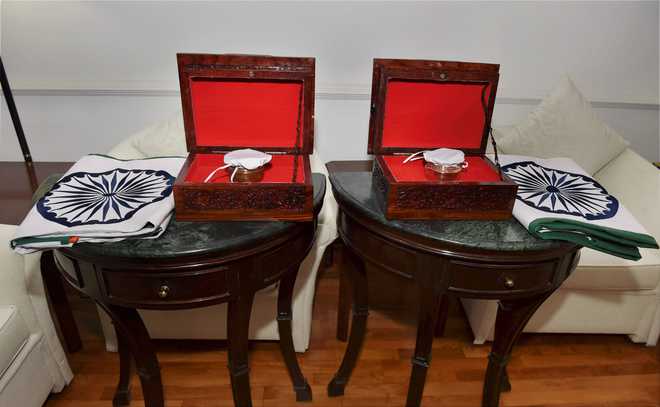
Soil from grave of Garhwal Rifles’ soldiers brought from France

Soil from grave of Garhwal Rifles' soldiers brought from France
Urns containing the soil of the grave of two Indian soldiers of 39 Garhwal Rifles who lost their lives during WWI in France, which were presented to Defence Minister Nirmala Sitharaman in New Delhi on Tuesday. PTI

New Delhi, November 14

A delegation of the Garhwal Rifles Regimental Centre on Tuesday returned with soil from France where two soldiers of the 39 Garhwal Rifles had laid down their lives fighting in World War I.Two urns containing the soil were handed over to Defence Minister Nirmala Sitharaman by the delegation comprising Commandant Brigadier Indrajit Chatterjee and Subedar Major Trilok Singh.The urns, brought from Laventie in France, would now be carried to the Garhwal Rifles Regimental Centre at Landsdowne.On September 20 last year, during an excavation on the southern side of Richebourg village near Laventie Military Cemetery, approximately 230 km from Paris, two human remains were found.They were identified to be of soldiers of the 39th Royal Garhwal Rifles.The office of Commonwealth War Graves Commission decided to hold a ceremony to rest them along with their comrades with full military honours during the annual memorial service that is held to commemorate the Indian soldiers who were martyred in action in France and Belgium.The decision was taken in consultation with the French government and Indian Embassy.On November 12, the remains of the two soldiers were sent on their final journey with full military honours at the military cemetery.During the First World War, the Garhwal Brigade comprising 1st/39th and 2nd/39th Royal Garhwal displayed unparalleled bravery in treacherous trenches of France and Flanders.Fighting shoulder to shoulder with British soldiers, the Garhwal Brigade earned six battle honours and was twice awarded Victoria Cross in France and Flanders Theatre. — PTI


Commandant-level talks to resume with Pakistan

Commandant-level talks to resume with Pakistan
Tribune file photo

New Delhi, November 10

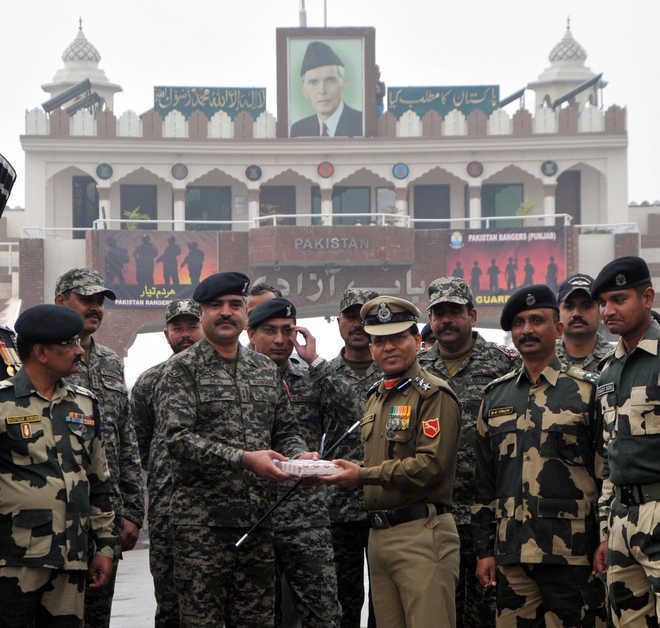
India and Pakistan today decided to resume Commandant-level talks along the International Border (IB) even as the BSF “strongly” raised the issues of unprovoked firing, killing of civilians and use of tunnels for cross-border crimes.The proposal for the Commandant-level meetings was discussed at a three-day meeting between the chiefs of the border guarding forces of the two nations, which concluded today. (Follow The Tribune on Facebook; and Twitter @thetribunechd)BSF Director General KK Sharma said both the sides agreed to holding border meeting at regular intervals.A 19-member delegation of Pakistan Rangers, led by Maj Gen Muhammad Saeed, Director General, Sindh Rangers, had arrived in New Delhi to attend the 44th biannual Director General-level talks. “The Indian side firmly and strongly took up specific issues of concern, including unprovoked cross- border firing, smuggling of narcotics, infiltration attempts, tunnelling and defence construction activities,” the BSF said.A senior officer privy to the talks said the BSF also asked the Rangers to ensure their land was not used by terrorists to infiltrate into India. It specifically underlined the discovery of a number of tunnels along the International Border (IB) in the Jammu region that are used by the other side to facilitate cross-border smuggling and infiltration, the officer added. — TNS


Cry, Punjab, cry 8 students run over in foggy Bathinda

Sukhmeet Bhasin

Tribune News Service

Bathinda, November 8

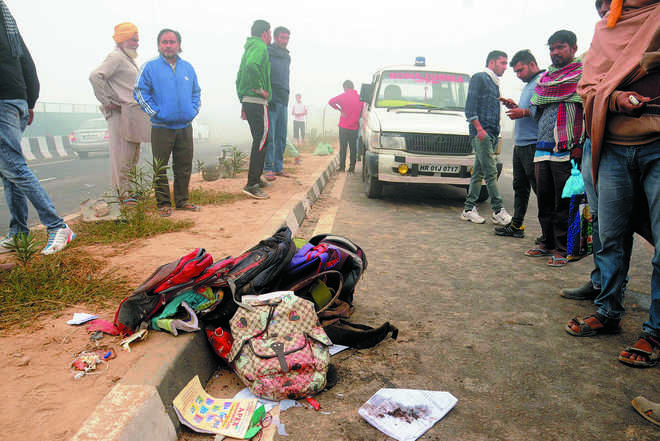
With fog enveloping the region, 10 persons were killed, eight of them students on their way to various colleges and coaching centres in Bathinda, in two accidents on a bridge over the Bathinda-Chandigarh highway this morning. Their bus having met with an accident, passengers were standing at the roadside when they were run over by a cement mixture truck, which first hit a Tata Sumo. The truck driver fled. (Follow The Tribune on Facebook; and Twitter @thetribunechd)The students who died on the spot were identified as Rafi Mohammad (23) of Dyalpura Mirza, Vinod Kumar (18), Shikha (17), Khushbir Kaur (20), Jaspreet Kaur (18) and Nancy (19) of Rampura Phul; Ishwar (19) of Bhucho Mandi and Manpreet Kaur (19) of Lehra Khana village. Lovepreet Kaur (25), who belonged to Rampur and worked with the Food and Supplies Department, was killed too. Four of the injured were admitted to the Civil Hospital and Adesh Medical College here. On the other side of the road on the bridge, a PRTC bus, that rammed into a Tata pick-up standing in the middle of the road after it broke down, was hit by a private bus from the rear, leading to a pile-up involving three or more cars. Mandeep Kaur, a teacher from Bathinda, was killed and 12 persons were injured.Survivor Prince of Rampura and a student of DAV College, Bathinda, said he saved himself by jumping to the other side of the road. He suffered minor injuries. Another eyewitness Kewal Singh said, “Just as we were asking commuters to slow down owing to the pile-up, a truck rammed into a Tata Sumo and then people standing along the road.”The bodies crushed, the victims’ kin could recognise them only from their clothes and belongings.Finance Minister Manpreet Singh Badal visited the injured and announced Rs 1 lakh each for the next of kin of those killed and Rs 50,000 for the injured. Rampura MLA Gurpreet Singh Kangar also announced an ex gratia of Rs 1 lakh and Rs 25,000 for the injured.Gurmeet Singh, SP-City, said a case under Section 304 of the IPC had been registered against the truck driver. The truck belonged to Patel Constructions.Schools shut for 3 daysThe Punjab Government has closed all schools — government and private— for three days till November 11. The order will be applicable to primary, middle, high and senior secondary schools. TNS


Loss pegged at over Rs 81 cr as cross-LoC trade remains suspended

Loss pegged at over Rs 81 cr as cross-LoC trade remains suspended
A soldier stands guard on the LoC. Tribune File Photo

Jammu, October 31

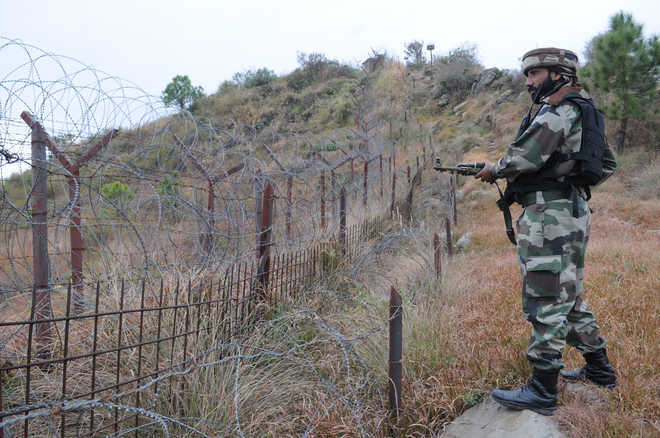
Suspension of cross-LoC trade between Jammu and Kashmir and Pakistan-occupied Kashmir (PoK) for the last 17 weeks has resulted in a loss of over Rs 81 crore, an official said on Tuesday.Authorities in Jammu and Kashmir have sought a meeting with officials of Pakistan-occupied Kashmir (PoK) on Thursday to discuss resumption of cross-LoC travel and trade via the Poonch-Rawalkote road.Trade across the Line of Control (LoC) was suspended on July 11 after heavy firing and shelling from the Pakistani side caused damage to trade facilitation centres and police barracks.”Due to suspension of trade along the LoC, there was a loss of over Rs 81 crore during the period,” custodian of LoC trade (Poonch), Mohammad Tanveer told PTI.”We have requested PoK officials — via the government — for a meeting on November 2 to decide on resumption of the cross-LoC travel and trade via the Poonch-Rawalkote road,” he said, adding a response from PoK authorities was awaited.Cross-LoC trade and transport facilities are considered major confidence building exercises between India and Pakistan. According to official figures, goods worth Rs 1,500 crore was traded since the start of the facility in 2008.The cross-LoC bus service via Poonch-Rawalakot road too remained suspended for the past 17 weeks.Jammu and Kashmir has witnessed the worst border skirmishes between India and Pakistan along the LoC this year.According to Indian Army figures, till August 1, there were 285 such violations by the Pakistan Army, while in 2016, the number was 228 for the entire year.Eleven people, including nine soldiers, were killed and 18 injured in ceasefire violations by the Pakistan Army in July, according to the Army data.There were as many as 83 ceasefire violations, one BAT (border action team) attack and two infiltration bids from the Pakistani side in June in which four people, including three jawans, were killed and 12 injured.The cross-LoC bus services on the Poonch-Rawalakot road between Jammu and Kashmir and Pakistan occupied Kashmir (PoK) also remained suspended for the fourth consecutive week. — PTI