



Sanjha Morcha

China’s New J-20 Fighter Jets Outclass Regional Rivals

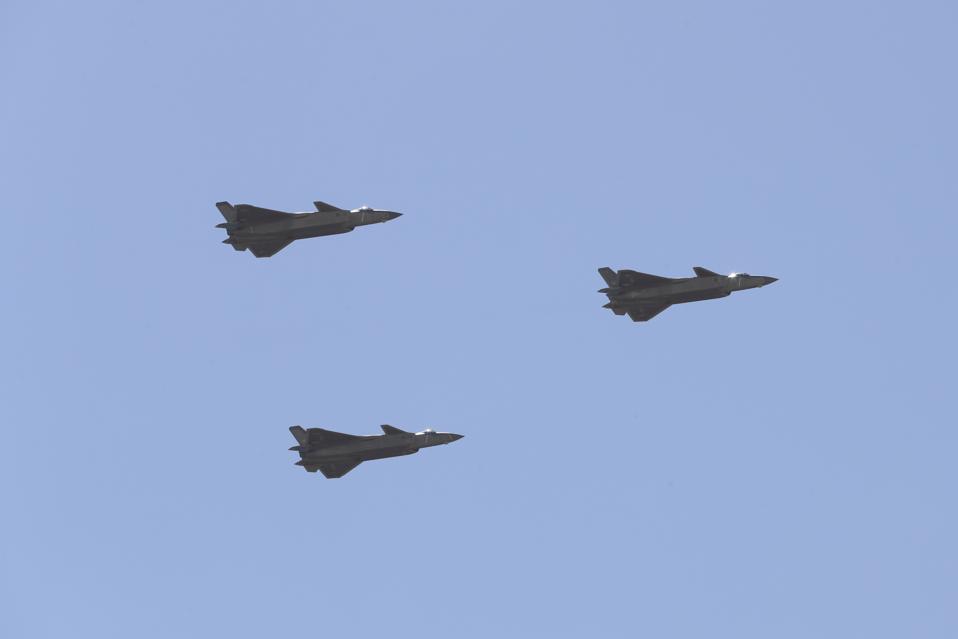
Chinese J-20 stealth fighter jets fly past during a military parade at the Zhurihe training base in China’s northern Inner Mongolia region on July 30, 2017. (STR/AFP/Getty Images)

China just started using its Chengdu J-20 fighter jets, a military official announced last week via state-run Xinhua News Agency. The long-range stealth fighters are evidently China’s best in their class. They should help the People’s Liberation Army air force with long-range interception or position it to strike first at infrastructure targets on the ground. China will probably focus on its coasts and land borders, the most likely sites of skirmishes given China’s turbid neighbor relations. “The PLA Air Force, like the PLA Navy, lagged behind for many years and is eager to acquire cutting-edge capabilities now that the Chinese industrial base has grown stronger and budgets are flush,” says Joshua Pollack, editor of The Nonproliferation Review in Washington.China’s latest can beat three other weighty countries that are developing similar aircraft, although this is largely because rival aircraft have yet to be released or proven yet in service. They are:

    1. India: Indian aerospace and defense firm Hindustan Aeronautics Ltd. is working with Russian aircraft maker JSC Sukhoi Co. to develop what this news report describes as a fighter aircraft with stealth capability. It would be in the same class as the J-20. But the project is “complicated,” and work will go slowly, the head of a Russian state-owned export promotion firm was quoted saying in the report. The two countries have worked together since 2007. Russia’s military is considered stronger than China’s, but India is a step behind and troops from the two countries faced off over a disputed border region for 70 days in mid-2017.
 Japan: An R&D institute under Japan’s Ministry of Defense has contracted Mitsubishi Heavy Industries to develop a stealth fighter called the X-2 Shinshin. After eight years of development, a test flight delayed due to parts failure went smoothly in April 2016, per this industry news report. The aircraft is built expressly to dodge radars. But the plane is still in development. On top of that, Japan is reportedly considering development of another fighter jet, dubbed the F-3. Why so many fighters? The rise of China’s military strength troubles Japan. The two face off regularly over a dispute tract of the East China Sea, and Tokyo is taking an ever stronger role in checking Beijing’s expansion in the South China Sea.
    1. Russia: In addition to the fighter being developed with India, Sukhoi will finish research and development on another J-20 peer, the PAK FA T-50, in 2019 with initial trials due next year, the country’s news service TASS reports. This aircraft, two of which got into a mock dogfight at an aviation show in July, was originally due for use this year. China got there first. The two countries have lived in peace for the past 25 years, following several border clashes. But China’s J-20 would also be a tough rival against the American-made, U.S. Air Force’s hundreds of
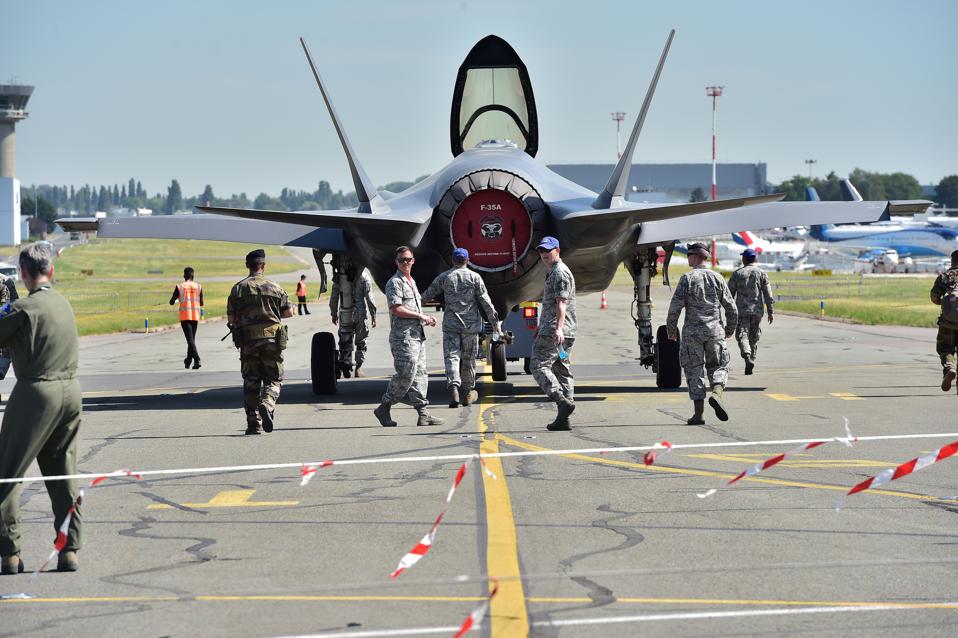
U.S. military personnel escort a Lockheed Martin F-35 fighter jet towards the runway at the International Paris Air Show in Le Bourget outside Paris on June 20, 2017.The United States is the “only country with a fully operational fifth-generation fighter,” think tank Center for Strategic & International Studies says in this analysis of the J-20. The F-35, first shipped in 2011, differs from the J-20 in its wing layout and the sources of key components such as engines, per this analysis. China and the United States, two old Cold War foes, regularly disagree now over geopolitical issues, though decades of dialogue have reduced the threat of war to near zero.

IAF raises concern over illegal mining around airport

Akash Ghai

Tribune News Service

Mohali, October 28

Illegal mining on land around the airport is posing a security threat to it. The Air Force authorities have raised their concern in this regard with the local administration. The issue will also be taken up in the upcoming Civil-Military Liaison Conference in the first week of December.A senior official of the Mohali administration said the threat to the airport area due to the presence of pits caused by illegal mining was one of the main points of the agenda in the upcoming meeting.“A number of pits, several of which are nearly 20-foot deep, are present around the airport area. These are the result of illegal mining, which had taken place five to six years ago. These pits are certainly a threat to the airport and the Air Force authorities are also concerned that these would cause problems during the expansion of the airport in the near future,” said the official on condition of anonymity.Mohali DC Gurpreet Kaur Sapra said the pits were the result of illegal mining. “The mining had taken place around six years ago. Currently, no mining is being done in the area,” said Sapra, adding that the issue was a cause of concern for defence personnel.“I have directed the local SDM to prepare a report in this regard after conducting a proper survey of the area. The issue is serious and steps for the redressal of the problem will be taken immediately,” said the DC.



United States wants to deepen defence, bilateral ties with India

United States wants to deepen defence, bilateral ties with India
File photo

Washington, October 28

The US wants to deepen military relationship and expand bilateral trade with New Delhi which will ease the sale of the F-16 and F-18 jets to India and will also help create a defence technology partnership, a top American diplomat has said.

“This is a dynamic relationship with really” hasn’t “begun to see the potential yet,” Acting Assistant Secretary for South and Central Asian Affairs and Acting Special Representative for Afghanistan and Pakistan Alice G Wells, told reporters here.

Wells accompanied Tillerson on his just concluded trip to Afghanistan, Pakistan and India.

“This was an extremely friendly, very wide-ranging dialogue on how we can partner together on the strategic relationship that we think is going to define the rest of the 21st century,” Wells said.

While there was a bilateral component to the visit, but they talked about how the two countries with shared values – a respect for democracy, transparency, freedom of navigation, for economic development – can inculcate these values in the broader Indo-Pacific region, working with important partners like Japan and Australia.

“Tillerson’s visit to Gandhi Smriti was very moving, and again, really was a touchstone for what unites – that this relationship is very much one built on values,” she said adding that the Secretary of State laid out a lot of ambitions for the relationship.

“We want to build on the June visit by Prime Minister Narendra Modi with the President, and just say, How do we take this relationship to the next level?,” she said.

“Obviously, we’d like to deepen the military-to-military cooperation that has moved very quickly; over the last decade we’ve gone from zero in defence sales to 15 billion in defence sales,” Wells said.

“There are important defence agreements that the two countries can move forward on that will make it easier for the US to share classified data and that will facilitate sales like the F-16 or the F-18 and will help create a defence technology partnership, which is what India is seeking, but which will also create jobs for Americans at home,” she said.

“We’d like to expand the bilateral trade and investment dimension of the relationship. We have about US$ 115 billion in trade, USD 40 billion in bilateral investment,” she said noting that this week they have two important meetings going on, the Trade Policy Forum and the Commercial Dialogue.

US sees this as a two-way street. In November Mahindra is opening an auto plant in Michigan.

“We’ve seen purchases of Boeing aircraft, all of which produce, again, thousands of jobs for American citizens,” Wells said.

Later in November the Global Entrepreneurship Summit to be attended by Ivanka Trump, which is going to bring together 1,300 entrepreneurs and investors, really demonstrate the entrepreneurial spirit of the relationship.

“During his India visit, Tillerson focused on how they can promote regional stability. In the South Asia strategy, we’ve given an important role to India on helping to stabilise Afghanistan economically and to build its human resource capacity,” Wells said.

“Since 2001, India has invested US$ 2 billion in Afghanistan. They’ve pledged another US$ 1 billion by 2020.

India has projects in 31 provinces and all of these projects have been very well received. They’re constructive, and I think it’s demonstrated that India is an important and valuable partner,” she said.

“At the same time, of course, we’ve made it clear to everyone that we would never tolerate anyone’s soil being used against the other,” she added.

Finally, on the fight against terrorism, building on the joint designation we did of Harakat ul-Mujahidin during Prime Minister Modi’s visit, we’re looking forward to working with the the Indians on identifying additional designations that we should pursue together,” Wells said. PTI


Donkey at the border! by GS Aujla

Donkey at the border!

GS Aujla

WHAT would appear to be the most objectionable provocation at the International Border today was known in the mid-seventies as an acceptable indulgence on the dhussi bundh separating India and Pakistan. The heavily vegetated area, with a kutcha road all along the border in Gurdaspur, was home to a teeming brood of black partridges and wild boar.A tacit courtesy that Pakistan Rangers extended to their Indian counterparts was to allow shooting partridge and wild boar. Since pork is forbidden in Islam, they did not mind us shooting the pigs. I found in the late PD Vashisht, the then Additional Deputy Commissioner of Gurdaspur, an avid hunter. Although a Brahmin by birth, his mouth would start watering the moment he saw a partridge in the bushes. In the hunting season, the two of us — after duty hours — would proceed to the dhussi for ‘patrol’, with our 12-bore shotguns jutting out of the windscreen. We would often leave the jeep and let a bird fly to take a shot. The chances of survival of our likely prey was 50-50 as neither of us was an expert at flying shots. I was an ace rifle shot in my younger days and made a lousy shot with the shotgun. I am told a good rifle shooter scarcely becomes a good shotgun firer. Vashisht was a cerebral hunting addict and was happy with a small bag of partridges — mostly ‘sitting ducks’, as the phrase goes.The BSF officer at the border outpost would facilitate the roasting of the partridges and had a cook who was an expert at barbeque that he made out of wild boar. We had the most enjoyable time at the International Border and there was no cross-border tension.One day, when we were driving on the dhussi bundh, we saw a donkey in our territory. It was so heavily loaded that it could hardly walk. We got off our jeep and with the help of our driver and retainers searched the animal. We found five cases of ‘Solan Number One’ (a popular brand of whisky made in India) in the bags. Handing over the donkey at the outpost, we were told that Indian smugglers used to load donkeys with their favourite brand of liquor for Pakistani counterparts. We were also told that a bottle of ‘Solan’, costing Rs 35 in India, was sold for Rs 350 in Lahore on the black market. The forbidden fruit is always dearer.The unfortunate donkey had strayed back into the Indian territory, apparently having lost its way and failing to deliver it to the assigned receiver across the border. Ironically, there was no punishment for it — it was mercifully spared a torturous interrogation. A triumph for animal rights!


Army Chief in Valley, briefed on security

Tribune News Service

Srinagar October 18

The Chief of Army Staff (COAS) General Bipin Rawat on Wednesday reviewed the security situation in the Kashmir valley.“The COAS was briefed by Chinar Corps commander Lt Gen JS Sandhu on the latest operations and updated on the overall security scenario along the Line of Control as well as in the hinterland,” a spokesperson of the Srinagar-based Chinar Corps said.General Rawat addressed all officers in the Badami Bagh Cantonment and complimented them on providing excellent military leadership in the most challenging circumstances.He also commended all ranks for their relentless pursuit towards achieving the objective of bringing in peace and normalcy to the Valley.The Army Chief was received by Northern Command chief Lt Gen Devraj Anbu and the Chinar Corps commander on his arrival in Srinagar today.


CM Amarinder hails Cong’s landslide win

CM Amarinder hails Cong’s landslide win
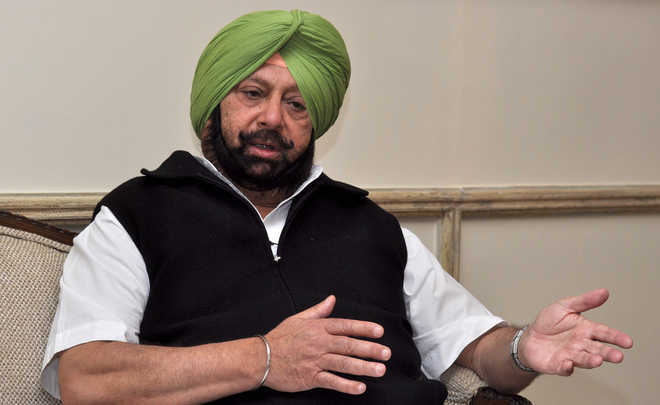
Punjab Chief Minister Amarinder Singh. Tribune file

Tribune News Service

Chandigarh, October 15

Punjab Chief Minister Amarinder Singh on Sunday hailed the Congress win in the Gurdaspur Lok Sabha byelection as a “total rejection of the anti-people policies” of the BJP and its ally SAD, and said it underlines the “political annihilation” of the AAP.

(Follow The Tribune on Facebook; and Twitter @thetribunechd)

The Gurdaspur result has once again shown that the Congress was on the path of revival across the country, he said.

“The massive win for Congress candidate Sunil Jakhar shows the people’s complete denunciation of the corrupt and immoral BJP and SAD,” the Chief Minister said, adding that it also underlines the “political annihilation” of the Aam Aadmi Party (AAP) in the state.

Read: Sunil Jakhar wins Gurdaspur Lok Sabha byelection with huge margin

BJP must read writing on wall after Gurdaspur defeat: Sunil JakharAhead of key state polls, Cong’s Gurdaspur win sends big message to BJP

He said that it’s a victory for the Congress and the party’s policies and development agenda.

The Chief Minister assured the people of Gurdaspur that every single promise made by the party will be fulfilled and development works will be fast-tracked.

Amarinder Singh said he was humbled by the faith reposed in the Congress candidate, who won by a margin of over 1.90 lakh votes over his nearest rival of BJP Swaran Salaria, and thanked the voters for their overwhelming love and support.

The over 1.93 lakh margin of victory has not only more than compensated for the 1.36 lakh vote defeat of Congress candidate Pratap Singh Bajwa against BJP’s Vinod Khanna in 2014 but has surpassed even the 1.51 lakh lead by which Sukhbans Kaur Bhinder (Congress) had won in 1980, he said.

“Jakhar’s victory comes as a strong rebuttal to the persistent Akali efforts and campaign of the past six months to undermine the work being done by his government in the state,” he added.

“For AAP, this election marks the end of its political ambitions in Punjab,” Amarinder Singh said, pointing out that the dissolution of the Pathankot and Gurdaspur units of AAP a day before the declaration of the results showed that the party had conceded defeat and accepted that it had completely failed to connect with the people of the state.

Dubbing the alleged moral bankruptcy of the BJP and the total failure of the party at the Centre as the key factors behind the crushing defeat of its candidate, Amarinder said the people wanted development, which only the Congress could give them.

“The people were completely aware of the welfare initiatives taken by the Congress government since taking over the state’s reins in March this year,” he said in a statement here, adding that they had full faith in the government’s commitment to their progress.

“Both the BJP-SAD and AAP had stooped to the lowest levels in their brazen attempts to mislead the people with their false propaganda against the Congress government,” Amarinder alleged.

“It was evident that these parties failed to learn their lessons despite the fact that such cheap tactics did not succeed in voting them to power in the Assembly polls earlier this year,” he added.

Amarinder Singh said, “While the SAD went all out to deceive the people with its false statements on various issues, especially farm loan waiver, the AAP once again resorted to street politics and theatrics in a desperate bid to grab the seat”.

The fact that both the parties suffered a crushing defeat “showed that the people of Gurdaspur had the maturity to distinguish the right from the wrong and trusted the Congress to lead them out of the depths of miseries into which they had been pushed by the erstwhile SAD-BJP government”.

The Chief Minister came down heavily on the BJP and the AAP for their personal attacks on Jakhar, who they tried to project as an ‘outsider’ all through the campaign, without, however, making any dent in his clean image and sincere commitment.

“Development was the only thing the people of Gurdaspur were concerned about,” he said, and added that for a region deprived of growth for so many years, the domicile of the candidate was completely irrelevant as they only wanted someone with sincerity and dedication.

Describing Jakhar as an ideal representative to raise the voice of the people of Gurdaspur in Parliament, Amarinder assured the people that all promises made to them by the Congress MP would be fulfilled.

“The development work initiated in the region in the past six-odd months would get a major boost with Jakhar taking on the mantle of representing the region in the Lok Sabha,” he asserted.

Amarinder said the Gurdaspur result once again showed that the Congress was on the path of revival across the country.

“The party’s recent victory in several university students’ union elections and its resounding win in the Maharashtra civic polls just two days ago were clear indicators that the party’s fortunes were on the upswing and the result of the Gurdaspur bypoll further strengthened its prospects for the 2019 Lok Sabha elections,” he added. With PTI


Pattern of first Anglo-Af war followed whenever Af invaded by Arwin Rahi

As we move from a unipolar world (with the US as the only global power) to either a bipolar (the US and China as world powers), or a multipolar world, the chances of restoring peace in Afghanistan through a regional consensus will increase.

Pattern of first Anglo-Af  war followed whenever Af invaded
A handover ceremony of Blackhawk copters from the US to Afghan forces in Kandahar on Oct 7. REUTERS

In 1838, the governor-general of India Lord Auckland declared war on Afghanistan, triggering the first Anglo-Afghan War. The East India Company, in tandem with the ruler of Punjab, Maharaja Ranjit Singh, launched a two-pronged invasion of Afghanistan-through the Khyber and Bolan Passes. The objective was to unseat the Afghan ruler, Amir Dost Mohammad Khan, whom the British accused of collusion with the Russians, and replace him with Shah Shuja ul-Mulk. The invasion was executed swiftly. Except Ghazni, no Afghan city put up much of a resistance.  In August of 1839, Shah Shuja ul-Mulk was installed on the throne of Kabul, with British bayonets. The following year, the dethroned Amir Dost Mohammad Khan surrendered to the British, and was sent to India as a hostage. Initially, everything seemed to have been under control. But it was only a matter of time before the whole country would rise in rebellion. To make matters worse, the British lacked the experience and knowhow to occupy a country with complex tribal rivalries and rough terrain that didn’t generate much revenue. Things came to a head in December 1841, when the British envoy William Macaghten (or the de facto ruler of Afghanistan) was assassinated by Wazir Mohammad Akbar Khan, who led the uprising in Kabul. In the following month, an entire British army numbering 16,500 (4,500 troops and 12,000 camp followers) was destroyed in the passes and gorges between Kabul and Jalalabad. In April 1842, General Pollock, leading the Army of Retribution, forced through the Khyber Pass to relieve the British garrison at Jalalabad and recapture Kabul. To avenge the massacre of British troops, General Pollock briefly occupied and burned down parts of Kabul and Istalif, a village to the north of Kabul. However, the new governor-general of India, Lord Ellenborough, ordered the British troops to evacuate Afghanistan before the cold weather set in. The following year, Wazir Mohammad Akbar Khan received his father Amir Dost Mohammad at Ali Masjid, and escorted him up the Khyber Pass to Kabul to assume his throne as the Afghan ruler. The First Anglo-Afghan War was therefore considered the single largest military catastrophe for the British Empire in the 19th century. 


FIRST ANGLO-AFGHAN WAR PATTERN

The First Anglo-Afghan War set up a pattern that would be followed in subsequent invasions of Afghanistan. The pattern has four phases: First, swift invasion and occupation of Afghanistan without much resistance; second, resistance to foreign forces increases with the passage of time; third, the war is condemned to a stalemate; fourth, withdrawal (or retreat) of foreign troops. The events of the Second Anglo-Afghan War 1879-1880, the Soviet war 1979-1989, and the US and NATO mission in Afghanistan corroborate the statement. It is interesting that each one of these three military adventures was headed by a superpower of its time, and each one of these military adventures followed the pattern of the First Anglo-Afghan War. 16 years ago in October, the US launched its invasion of Afghanistan. With America’s Afghan war entering into the 17th year, the First Anglo-Afghan War offers stark lessons. Although there are visible differences between the two wars, the four-phased pattern in both wars remains the same.  First, the US invasion of Afghanistan was swift. Second, resistance to US military presence grew over time. Third, American officials have publicly admitted that there is a stalemate on the battlefield. Fourth, the US has largely withdrawn its troops from Afghanistan, and the remaining troops no longer operate in a combative capacity. In a face-saving effort, the US has encouraged negotiations with the Taliban. Back in 2001, things were different. When in December that year, Hamid Karzai suggested to US Defense Secretary Donald Rumsfeld that Mullah Omar wanted to retire to a local village in Kandahar in exchange for a safe exit from Kandahar City, Donald Rumsfeld rejected Hamid Karzai’s suggestion. Now it’s proving challenging to bring the Taliban to the negotiating table. The US embarked on a costly war to topple the Taliban regime, but it is very likely that the same war will come to an end after the US-backed Afghan government reaches some sort of power-sharing agreement with the Taliban. Or even worse, if the US abandons Afghanistan once again (as it did after the end of the Cold War) and Afghanistan’s neighbours and major regional powers like China and Russia do not reach an agreement about the future of the country, it is very likely that the Taliban might overrun much of the country again. Then one could argue that the very war that was launched to topple the Taliban, has come to an end after power was restored to the Taliban. Everything will be back to square one. 


REGIONAL CONSENSUS ON AF FUTUREHistory suggests that Afghanistan enjoyed periods of stability when competing powers’ interests were not on a collision course in Afghanistan. The Tsarist Russia and British India agreed on a buffer state status for Afghanistan. As a result, even though Afghanistan’s foreign affairs were under British supervision, the country was generally peaceful and stable from 1880 to 1919. Later, during the two World Wars and first three decades of the Cold War, Afghanistan, unlike its immediate western and eastern neighbours, remained neutral. Afghanistan’s neutrality preserved a ‘Balance of Interest’ (BOI) between major powers. Forces of chaos and instability were unleashed when the BOI was upset as a result of a Communist coup in 1978. The Soviet Union not only did not help to restore the BOI, but totally destroyed it when it invaded Afghanistan in 1979. Peace and stability will return to Afghanistan when the BOI is restored again. However, the longer the Afghan war drags on, the more complicated will it get, and the more difficult will it be to restore that balance. Certainly the US presence will not help mitigate the crisis. The US has lost regional support for its presence in Afghanistan. It is fair to say that except India, no other country in the region wants to see US troops in Afghanistan anymore. When that’s the case, it is likely that the countries that remain opposed to US presence in Afghanistan will work (together if possible) to make life harder for the US. The total withdrawal of US troops will help tremendously with restoring the BOI in Afghanistan, providing regional players prevent a total collapse of state institutions. That being said, the good news is as we move from a unipolar world, (with the US as the only global power) to either a bipolar (the US and China as world powers), or a multipolar world, the chances of restoring the BOI through a regional consensus will increase. Peace and stability in Afghanistan will further facilitate regional connectivity, trade, and tourism between South and Central Asia, and the Middle East and East Asia. Pakistan, Iran, China, Russia, and to an extent India are in a better position than the US to work with Afghanistan to find a long-term, sustainable solution to the Afghan war. 


By arrangement with the Dawn 


Advancing national causes are fine but the armed forces’ primary mission is to safeguard the nation. By Lt Gen H S Panag |

The first-ever Param Vishisht Seva Medal of the Indian Army was awarded to Lt Gen B M Kaul in 1960, notably for the successful completion of Operation Amar – the construction of 1,450 barracks/family quarters for troops in Ambala – which was inaugurated by the Prime Minister on August 20, 1958. This project was the brainchild of the Defence Minister VK Krishna Menon. To save on cost, the project entailed using troops as labour for the construction. Gen Thimayya, the Chief of Army Staff, was opposed to the project, but during his absence for a visit to the USA, Maj Gen B M Kaul, then General Officer Commanding (GOC) of 4 Infantry Division at Ambala, directly approached the Defence Minister and got the necessary approvals. The famous Red Eagle division rose to the occasion under his dynamic command and successfully completed the projected in a record seven months.
During his command tenure, in 1956, he had also given a fire-power and manoeuvre demonstration by an infantry battalion to the visiting Chinese delegation led by Prime Minister Chou En Lai at the Naraingarh field firing ranges. All that our army and air force had was put on display. Troops had rehearsed the demonstration for months to achieve perfection. The Chinese were awestruck and a visiting General was compelled to ask, “General would such immense resources be available to a battalion in war?” Thus 1956-1959 was spent by 4 Infantry Division in organising great spectacles to showcase nationalistic spirit by constructing accommodation using troop labour and in impressing the Chinese by using disproportionate assets in support of a battalion attack.
In end 1959, 4 Infantry Division was despatched to NEFA. Lt Gen B M Kaul, having earned his PVSM, was now the Quarter Master General responsible for housing of the army. War clouds were looming, but the General was still obsessed with his pet projects. Rather than staying in tents and focusing on preparing defences, the ever-efficient 4 Infantry Division was tasked to construct bashas (temporary mud and tin-roofed accommodation) under Operation Amar 2. Representations were brushed aside and construction began on a war-footing. Operation Amar 2 was inaugurated by none other than the Prime Minister on April 14, 1960.
In the early 1960s, the unit lines, messes and bungalows were also used for ‘grow more food’ campaign to grow wheat and other crops. It was a common sight in Meerut Cantonment to see troops engaged in farming. Bullocks and ploughs had been bought from regimental funds and old Persian wells had been reactivated. A still older method of drawing water out of conventional wells using a buffalo hide as a water bag and pulled by bullocks or male buffaloes, was also put to use. Once during a locust attack, it was a comical sight to see troops in hundreds beating empty peepas (metal canisters) to frighten the locust away from the wheat being grown.
In 1961, it was clear to all that war with China was imminent. However, the government at this juncture decided to throw the Portuguese out of Goa. Operation Vijay to liberate Goa was a classic tri-service operation against a very weak enemy and was all over in two days. However, great publicity was given to this ‘feat of arms’ with high-pitch political rhetoric and public adulation. The only sour note was that some units indulged in looting and were forced to march on foot on the way back. The liberation of Goa was long overdue but in hindsight, the timing, by design or default led to public attention being diverted from what was happening on the northern borders. Also, it brought in a false sense of complacency about our military prowess.
Such was the prevailing environment, ethos and culture in the armed forces in the Fifties and early Sixties. Grassroots training, the primary preoccupation of an army in peace time, had been neglected, generals were bending backwards for political favours. The Army chief had resigned due to reckless political orders for taking over the northern borders to execute the forward policy without requisite infrastructure. He was cajoled into withdrawing his resignation but was later humiliated during discussions in the Parliament.
Note the irony, when war came in October-November 1962, it was 4 Infantry Division that faced the brunt in the Kameng Division. 4 Corps, responsible for the defence of NEFA, was commanded by none other than Lt Gen B M Kaul. During the final conference held by the Chinese Politburo on October 6, Marshal Ye Jianying informed all present that during his 1957 visit to India, he had met General Kaul, the Indian Commander in NEFA. He said that though Kaul had served in Burma during World War II, he had no actual combat experience. He added that Kaul seemed, “to be very rigid, even if an impressive looking soldier. Still, he was one of India’s most outstanding commanders”. Mao cut him short and sarcastically said, “Fine, he’ll have another opportunity to shine.”
Alas, the rest is history. The Indian Army with 200 hundred years of unblemished history was routed in just eight days of fighting, four days each in October and November 1962. Of course, we have come a long way. It took us three years of concerted training and ‘detoxification’ to keep our heads above water in 1965 and another six years of hard work to redeem our reputation in 1971.
With the above backdrop, I appeal to our political leaders and our generals, that while participation in non-military ‘national causes’ is a noble effort, do not forget that our primary mission is to safeguard the nation.
Gen HS Apnay

Retired Army man told to prove citizenship

Retired Army man told to prove citizenship

Guwahati, October 1

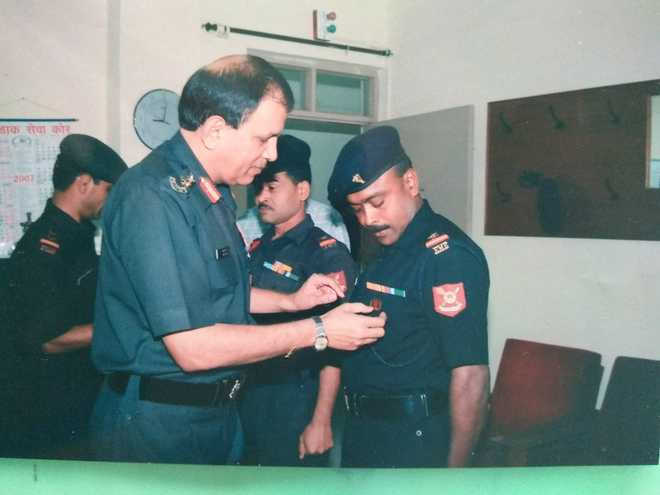
An Assam-based retired defence personnel has claimed that the Foreigners’ Tribunal has sent him a notice asking him to prove that he was not an illegal Bangladeshi migrant, but an Indian citizen.Mohd Azmal Hoque, Junior Commissioned Officer (JCO) who retired from the service on September 30, 2016, told the media yesterday that he had received a notice placing him in the doubtful-voter category.(Follow The Tribune on Facebook; and Twitter @thetribunechd)It also charged him with having entered India in 1971 without proper documents, he said. “I have served the Army for 30 years,” Hoque said adding that he had received the notice asking him to appear before a local tribunal on October 13 with relevant documents to prove his Indian citizenship.The retired JCO said he had missed the first date of appearing before the tribunal on September 11 as he received the notice after that date. He said he would appear before the tribunal on October 13.“In 2012 also, I had received a notice saying I was a doubtful voter, but I submitted all documents in the tribunal court and it declared me an Indian citizen,” he said.He said he was not the first member of his family to have been served with such a notice. In 2012, his wife was also summoned by the tribunal to prove her citizenship.The issue was brought to the attention of the Army by a twitter post of lawyer Aman Wadud. Replying to Wadud’s tweet, Major DP Singh notified the Eastern Command that said “necessary assistance will be provided to the veteran”. — PTI


Placed in doubtful-voter category

  • Mohd Azmal Hoque, Junior Commissioned Officer (JCO) who retired from the Army on September 30, 2016, has received a notice placing him in the doubtful-voter category
  • The notice also charges him with having entered India in 1971 without proper documents
  • In 2012 also, I had received a notice saying I was a doubtful voter, but I submitted all documents in the tribunal court and it declared me an Indian citizen, he claimed


Joshi at helm as Andaman transforms into major base

Joshi at helm as Andaman transforms into major base
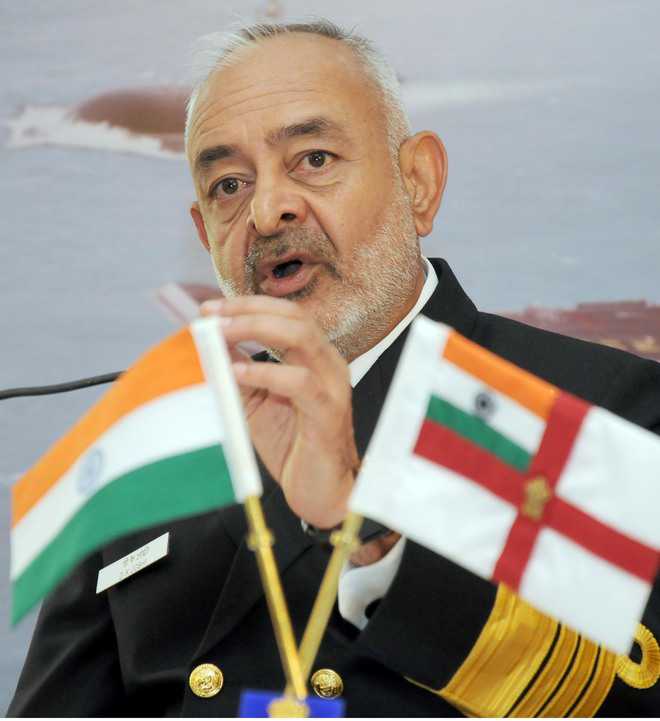
Admiral DK Joshi, Navy ex-Chief

Ajay Banerjee

Tribune News Service

New Delhi, September 30

Former Navy Chief Admiral DK Joshi (retd) takes over as the Lieutenant Governor of Andaman and Nicobar Islands at a time when India is planning to make the islands its foremost military strategic outreach towards the east.A major Indian Tri-services base exists at Port Blair but with the dynamics changing, India is upgrading its capacities — ramping up its airfields on the islands that will enable it to hold large surveillance planes, have greater number of warships and another floating repair dockyard that can repair ships at sea.All these are aimed at keeping an eye on Beijing’s growing economic and military reliance on the Strait of Malacca. Admiral Joshi will be administrative head of the islands that are some 1,230 km east of Visakhapatnam and lie in the Bay of Bengal.Admiral Joshi, who also headed the country’s only Tri-services Command at Andaman and Nicobar Islands, will help ease clearances. The Malacca Strait is located less than 100 km south of the southernmost part of the Indian islands.The ‘six degree’ channel — the main shipping channel between the Indian Ocean and the Pacific Ocean — passes through it. Nearly 70,000 vessels pass through the strait annually, making it about 25 per cent of all global trade. In June, India started a permanent naval patrol of sea-shipping routes to the Malacca Strait.Indian warships are now present 24×7 at the western edge of the strategically vital straits — ‘looking’ at ship movement. Singapore is at its eastern edge. In the first week of June, the US Department of Defence had — in its report — highlighted why the Malacca Strait was crucial for China. “Malacca Strait is critical to the transport of natural gas and oil… China is particularly reliant on unimpeded sea lanes of communication like the South China Sea and Malacca Strait,” said the annual report to the Congress. “In 2016, approximately 80 per cent of China’s oil imports and 11 per cent of natural gas imports transited the South China Sea and Strait of Malacca,” the report had noted.China continues to look primarily to the Persian Gulf and Africa to satisfy its growing oil and gas demands, making the Malacca Strait even more important. China fears that India can interdict supplies in case of a conflict.Top sources have confirmed that the Navy is planning to position a greater number of assets on the islands.The P-8I series of surveillance planes will soon be stationed at INZ Baaz which is being expanded and so is the Shibpur naval air station.