Sanjha Morcha

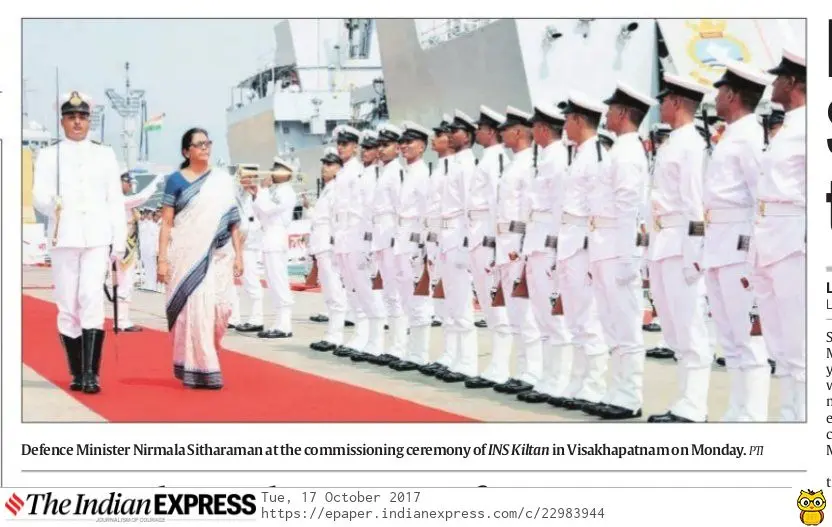
Navy gets INS Kiltan

clip

Defence Minister Nirmala Sitharaman with Chief of Naval Staff Admiral Sunil Lanba (2nd from L) in Visakhapatnam on Monday. PTI

The indigenously built anti-submarine warfare stealth corvette INS Kiltan, which was commissioned on Monday, is equipped with a plethora of weapons and sensors to provide a Common Operational PictureIt is India’s first major warship to have a superstructure of carbon fibre composite material resulting in improved stealth features, lower top weight and maintenance costs, the release said


Anatomy of the Doklam face-off MK Bhadrakumar No immediate threat from China

Anatomy of the Doklam face-off
PARANOIA: Reports of ‘Doklam.2’ are untrue. Our foreign policy is too ‘militarised’.

MK Bhadrakumar

THE Press Trust of India featured a stunning report on October 5, quoting sources, that China maintains a sizeable presence of its troops near the site of the Doklam standoff with India and has even started widening an existing road at a distance of around 12 km from the earlier face-off site. Sources confided that “China has been slowly increasing its troop level in the Doklam Plateau which could further escalate the current situation as India has reasons to be concerned over it.” Even as the nameless sources whispered softly, the Chief of Air Staff, Air Chief Marshal BS Dhanoa, also admitted publicly on the same day: “The two sides are not in a physical face-off as we speak. However, their forces in the Chumbi valley are still deployed and I expect them to withdraw as their exercise in the area gets over.”These reports meshed with what the Army Chief, Gen Bipin Rawat, insinuated exactly a month earlier on September 6: “As far as the northern adversary (read China) is concerned, the flexing of muscle has started. The salami slicing, taking over territory in a very gradual manner, testing our limits of threshold is something we have to be wary about and remain prepared (sic) for situations emerging which could gradually emerge into conflict.” It doesn’t need much ingenuity to figure out that there has been some orchestration behind these synchronistic statements. Interestingly, the official Russian news agency Sputnik, too, reported from Delhi on October 5 that a “Chinese troop buildup” in Doklam has “kept the Indian military on its toes, forcing it to stall the annual winter retreat from north Sikkim.”All in all, a strange thing is happening. The military, whom we expect as people who are precise and business-minded and from whom we get definite answers, is posing riddles. Fortunately, the Ministry of External Affairs promptly clarified on October 6: “We have seen recent press reports on Doklam. There are no new developments at the face-off site and its vicinity since the August 28 disengagement. The status quo prevails in this area. Any suggestion to the contrary is incorrect.” The General, the Air Chief, the “sources” — and Sputnik — were apparently put on the mat.The sensational reports regarding fresh Chinese deployment to Doklam were timed to coincide with Foreign Secretary S Jaishankar’s visit to Bhutan for consultations on October 5 and the scheduled visit by the new Defence Minister, Nirmala Sitharaman, to the Sikkim region the next day as part of her familiarisation tour of border areas. As Vladimir Lenin once asked: “Who stands to gain?” This is of a piece with General Rawat’s recent demand for an increase in the defence budget to enable the Army to fight two-and-a-half wars simultaneously.The Chinese reaction to the hullabaloo is insightful. Beijing took a detached view. Surveying the media frenzy about a Doklam.2 in the offing, Chinese commentators made three pointed observations. First, unsurprisingly, an assurance was held out that China does not plan to precipitate a conflict; it was clarified that, in fact, India is not a “major focus for China’s international strategy” currently. Nor is there any conceivable reason for China to regard India as its rival and, therefore, India has no need to work up such paranoia. Second, Beijing appreciated Sitharaman’s open display of goodwill toward the PLA soldiers on October 7 while visiting the Sikkim border and regarded her friendly gesture as an articulation of her hope for peace on the India-China border and her aversion toward a fresh standoff.     Third, and most important, in Beijing’s reading of the tea leaves, Sitharaman’s goodwill gesture faithfully reflects the “realistic and responsible attitude” of the Modi government. Beijing anticipates that a “new era of crisis management” is possible in India-China relations following the Doklam standoff. However, alas, while the two leaderships are exploring more cooperation and their focus and priority should be on avoiding friction and conflict, there is dissonance within India on this account. It is not only that the Army has corporate interests in bargaining for bigger budget allocation, the Indian public opinion too is distrustful of China’s intentions – although only a maverick section of extreme nationalists demands military confrontation with China. Therefore, the path ahead is challenging for the Indian leadership “to fix the stagnated ties” with China.It is difficult to quarrel with the above assessment of the Modi government’s policy predicament vis-à-vis China. The government is riding a tiger. It is not possible to disown the Himalayan blunder of mid-June to walk into the standoff at Doklam. But the saving grace is that the Indian public, willingly, suspends its disbelief and accepts the denouement of end-August as “victory”. However, instead of moving on, a contrived attempt is being made by interest groups to recreate time past. There is a big question involved in all this, which must be asked upfront: Can we really afford to fight “two-and-a-half wars”? The grim realities speak otherwise.In the 2017 Global Hunger Index released last week, the Washington-based International Food Policy Research Institute ranked India 100 among 119 countries, three places down from its last year’s position at 97. It means, shockingly enough, that more than a fifth (21%) of the children in our country are wasted, with stunted growth. India shares its 100th position with Djibouti and Rwanda. China is ranked at 29. Again, Shenzhen city in China’s Guangdong province used to be a market town to the north of Hong Kong 40 years ago and today its GDP alone equals three-fourths of India’s. And, in the Xiongan New Area to the south of Beijing, China is just launching another mammoth Shenzhen over an area that is a third bigger than Delhi state. By the way, China added new steel-making capacity in 2016 alone, which equals half of India’s entire production. TN Ninan wrote recently:“China expects to create 11 million urban jobs this year; for India, don’t ask.”Clearly, China has no reason to view India as “rival” and has nothing to gain out of another war. China belongs to a different league than India’s and is fixated on the obsessive thought that by the centenary year of the communist revolution in 2049, it should transform as a moderately prosperous country. Aren’t we missing the plot? Doklam is a wake-up call that our foreign policy is far too militarised and has jettisoned its core agenda of creating a peaceful external environment for India’s rapid development through the crucial make-or-break period of the coming 15-20 years.The writer is a former ambassado


India-China ties in the near term will remain uncertain

Beijing’s political and military leaders will evaluate the Doklam face­off and plan to salvage their damaged pride

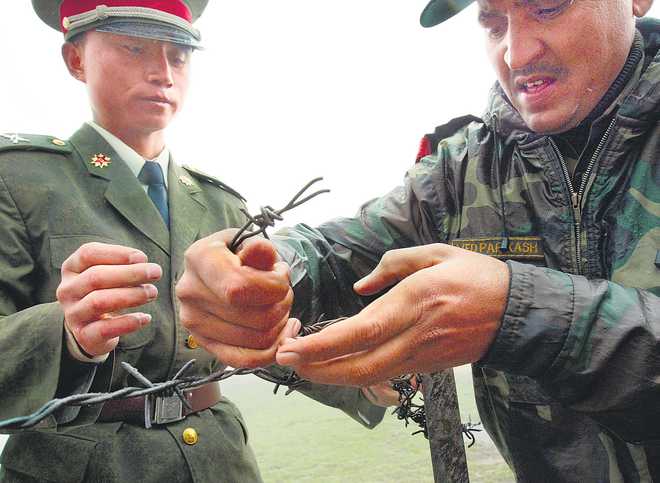
As Indian and Chinese diplomats begin repairing the bilateral relationship damaged by China’s threats and vitriolic propaganda during the over 70-day face-off at Doklam, Delhi-based Chinese diplomats led by Chinese Ambassador Luo Zhaohui are trying to portray that there is scope for “reconciliation” and “cooperation” and China and India “can dance together”.

A disconnect is apparent, however, with the People’s Liberation Army (PLA) and China’s powerful propaganda apparatus adopting a different stance than China’s diplomats. China’s official media continues to allege that India is wary of Pakistan’s ‘rise’ and that the US is manipulating India. Unlike prior to the face-off at Doklam, PLA border personnel exchanged no pleasantries with Indian counterparts on China’s National Day on October 1. Neither has China proposed dates for the annual ‘Handto-Hand’ exercises between the two armies, which are now unlikely to be held.

Stymied by the unanticipated action of Indian forces stopping the road construction, the PLA is smarting at the decision to withdraw. In all probability when India did not yield ground despite sustained Chinese propaganda using language and threats not seen in over 40 years, Chinese President Xi Jinping concluded the PLA would not achieve a decisive victory against India and agreed to the withdrawal of troops. Anything short of victory would have been a humiliation for China, the Chinese Communist Party (CCP) and Xi Jinping, especially before the 19th Party Congress scheduled to be held from October 18 to 28, 2017.

China’s actions were deliberate. Certainly approved by the CCP’s highest body, the Politburo Standing Committee, the propaganda offensive revealed their thinking about India. China’s authoritative news agency Xinhua additionally revealed that Xi Jinping had decided in May – long before the Doklam face-off began – to dismiss General Fang Fenghui, Head of the Joint Staff Department under the Central Military Commission (CMC), because of corruption. Reports that he was removed because he instigated, or opposed, the withdrawal of forces on August 28, are incorrect. Xi Jinping also publicly flourished his control over the PLA by last month appointing long time associates to head the PLA ground forces, Air Force and new Rocket Force and appointing another 20 General officers to new positions.

The withdrawal has had repercussions inside China with clear indications that people are upset. Soon after the withdrawal on August 28, Chinese Foreign Minister Wang Yi became the first senior Chinese leader to assert that Doklam is Chinese territory and that China will resume building the road. On August 30, Yue Gang, a retired Colonel of the PLA’s General Staff Department and frequent commentator on military matters, said while the events where Xi Jinping and Modi were to meet had offered a way out “there are different interpretations as to which side actually compromised more.” Quite significantly, he added, “Despite Beijing’s deliberate ambiguity, China has apparently made substantial concessions in order to end the dispute. India has got exactly what it has wanted. It was a humiliating defeat for China to cave in to pressure from India despite all the tough talk.”

There are numerous comments on China’s social media as well. Their not being deleted suggests some tacit official support. Netizens have asked why there has been no “apology” from India and whether China gave up “legitimate rights such as building the road?” Others expressed concern “whether India’s withdrawal is unconditional” and asked “for a clear explanation.” Meanwhile, a rumour spread in China claiming that China had purchased India’s acquiescence to the withdrawal by giving it a loan of US$20 billion! Highlighting the Chinese leadership’s concern, separate denials were issued by the spokesman of China’s Ministry of National Defence Colonel Ren Guoqiang, spokesperson of China’s Ministry of Foreign Affairs (MFA) and the CCP’s official mouthpiece, People’s Daily. In a widely circulated video clip the Editor-inChief of Global Times, He Jixin, declared the people are unhappy with the ‘withdrawal’.

India-China relations in the near term are likely to be uncertain. Till China sees it will benefit by working with India, it would be prudent to expect that China’s political and military leadership will evaluate the faceoff at Doklam and prepare plans to salvage damaged pride. China will naturally choose a time and place of its advantage.

Jayadeva Ranade is a former additional secretary in the Cabinet Secretariat and is president of the Centre

for China Analysis and Strategy. The views expressed are personal


HEADLINES::::09 OCT 2017

  • CAPT AMARINDER ALL OUT TO RESTORE RESPECT,DIGNITY,PRIDE OF EX-SERVICEMEN IN PUNJAB WRITE TO DC’S. JALLUNDER DC RESPONDED
  • IN PUNJAB, CONG HAS A STRONG, POPULAR LEADER IN CAPT: TULLY
  • MAHARANI SAHIBA PRANEET KAUR SHOWS CONCERN ABOUT WELFARE OF EX-SERVICEMEN AT :PATHANKOT RALLY
  • IN J&K, A BATTLE OF WITS WITH ‘FIDAYEEN’ BY LT GEN SYED ATA HASNAIN
  • IMAGES OF SOLDIERS’ BODIES IN PLASTIC SACKS TRIGGER ROW
  • WE’RE BATTLE-READY: IAF CHIEF
  • 92 BASE HOSPITAL: A LIFE SAVER TO THE INDIAN ARMY BRAVEHEARTS AND MANY MORE BY LT GEN SYED ATA HASNAIN
  • SECURING PERMANENT DEFENCES IN PUNJAB
  • SOLDIERS, SPIRITUAL LEADERS TWIN PILLARS OF NATION: PRESIDENT
  • NOTHING ‘SIMPLE’ ABOUT GST POLITICAL TEMPTATIONS COMPLICATE RESOLUTION
  • CIVILIAN OFFICERS DEMAND SEPARATE HEAD FOR MES
  • STRIKING A BALANCEBY VIVEK KATJU
  • ARMY TO CHANGE INTAKE NORMS FOR OFFICERS, BETTER DEAL FOR SSC AIM: TO RAISE SHORT SERVICE CADRE STRENGTH, YOUNGER COMBAT FORCES
  • NS MAKES AERIAL SURVEY OF DOKLAM-NATHULA AREA
  • PAKISTAN HAS GONE OUT OF KASHMIR EQUATION: EX-RAW CHIEF DULAT
  • HOT PURSUIT: WHAT INDIA COULD LEARN FROM RUSSIAN HISTORY

Manmohan worked hard for country: AAP

Tribune News Service

Anandpur Sahib, October 5

Aam Aadmi Party (AAP) spokesman Himmat Singh Shergill drew a comparison between former Prime Minister Manmohan Singh and incumbent PM Narendra Modi in the style of their working.“Manmohan Singh had worked hard for uplifting the economic condition of the country. It is another matter that he never bragged about his achievements,” said the AAP leader, who was here to convene a meeting of party workers.Shergill, who lost the 2014 Lok Sabha and 2017 Assembly elections, lashed out at Modi, saying he did not leave any stone unturned in claiming credit for even small developments.On the reasons behind AAP’s defeat in the Assembly elections, he said the SAD-BJP alliance and the RSS played a role in damaging the party’s prospects. He claimed the RSS had instructed its cadre to vote for the Congress.On Anandpur Sahib MP Prem Singh Chandumajra, the AAP leader said the MP had failed to bring any change to the constituency. “Chandumajra is known for making announcements which never take shape,” he alleged.


Srinagar Attack: Terrorist Disguised Himself in CRPF Uniform to Ambush Soldiers

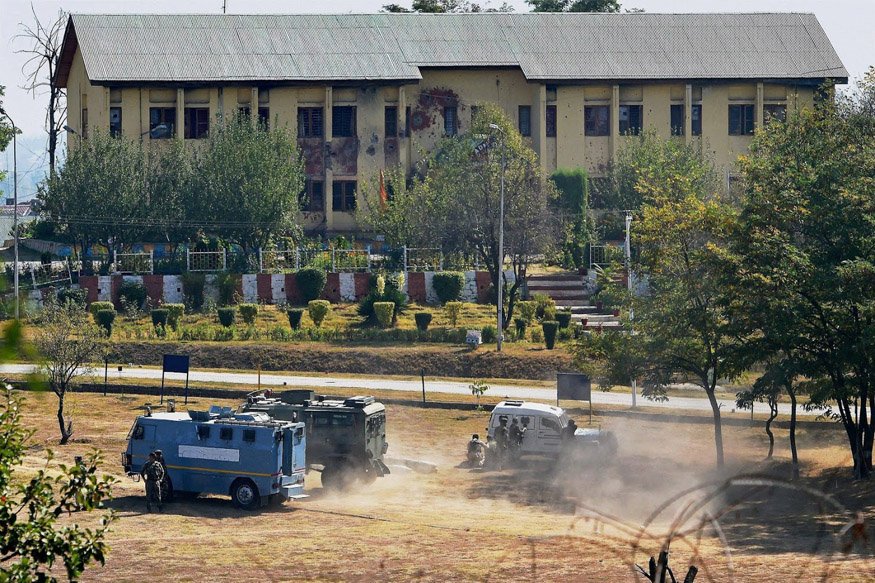
Srinagar: Security personnel during an operation at the  building were militants were believed to be hiding after they stormed a BSF camp early morning near Srinagar International Airport on Tuesday. PTI Photo by S Irfan (PTI10_3_2017_000050B)
Srinagar: Security personnel during an operation at the building were militants were believed to be hiding after they stormed a BSF camp early morning near Srinagar International Airport on Tuesday. PTI Photo by S Irfan (PTI10_3_2017_000050B)

An assistant sub-inspector of the BSF was killed and four security personnel were injured in the attack on the security camp, which is close to the Humhama airport

Srinagar: The last of the three terrorists to be killed in the attack on the BSF camp near Srinagar on Tuesday had disguised himself as a CRPF personnel before mounting a final assault on the soldiers stationed at the base.

An assistant sub-inspector of the BSF was killed and four security personnel were injured in the attack on the security camp, which is close to the Humhama airport. According to an official, after the first terrorist was killed, the two others ran into two buildings – the mess and the administrative block – and started firing from there.

While the terrorist who ran towards the mess was killed in retaliatory firing by the security personnel, the third one came out of the administrative block wearing CRPF-like camouflage and tried to slip into the defensive perimeter set up by the security forces.

He also positioned himself facing the administrative building and signalled a CRPF soldier to come closer. The soldier, assuming that it was a colleague who had run out of ammunition, moved towards him to supply more ammunition.

It was then that the terrorist turned around and tried to shoot down as many CRPF men as he could, but was neutralised in retaliatory fire, said the official.

The gun battle had lasted close to 10 hours. Pakistan-based terror outfit Jaish-e-Mohammad called a local news agency and claimed responsibility.

However, police sources said that the fidayeen squad has taken a lot of precautions to hide their Pakistani links. Police also believe that the attackers are from the same group that killed eight security personnel in Pulwama on August 26.

“This group infiltrated from the Sakhdar side in Jammu region. We suspect 6-7 more terrorists from the group could still be in the valley,” IG Muneer Khan said in a press conference at the BSF battalion headquarters.


30 yrs on, AFT finds Capt’s orders were vitiated

Vijay Mohan

Tribune News Service

Chandigarh, October 18

Thirty years after an Army Captain was convicted by a general court martial (GCM), the trial has been set aside after the Armed Forces Tribunal held that the GCM’s convening order was passed in violation of rules and regulations.In 1987, a GCM under the Western Command tried Capt CS Dhumi on three charges of intent to defraud and had awarded him three-year forfeiture of service for the purpose of promotion, three-year forfeiture of service for the purpose of increased pay, three-year forfeiture of service for the purpose of pension and a severe reprimand.The officer then challenged the GCM proceedings in the Punjab and Haryana High Court and the case was later transferred to the tribunal on its inception. Setting aside the convening order and all proceedings consequent thereto, including the court’s findings and sentence, the tribunal’s Chandigarh Bench comprising Justice MS Chauhan and Lt Gen Sanjiv Chachra directed the Centre to notionally fix the pension payable to the petitioner as on the day of his superannuation by taking into account three years of service that had been forfeited in the execution of the sentence.The Bench said the petitioner would be allowed subsequent raise in pension, if any, till the pension payable to him as on date is reached and release the revised benefits within four months. The petitioner, however, would not be entitled to restoration of his seniority, chances of being considered for promotion and revised gratuity etc.He had contended that the analysis of evidence available on the GCM’s record established that the charges against him remained unsubstantiated and the prescribed procedures and canons of natural justice were flagrantly breached.The Bench observed that the chargesheet and the convening order were signed by staff officers and not the formation commander and there was no evidence on record to show that the formation commander had recorded his satisfaction with the constitution of the GCM and other allied matters. Resultantly, the convening order had not been appropriately and duly passed, the Bench ruled.

3-year forfeiture of service set aside

  • In 1987, a general court martial (GCM) tried Capt CS Dhumi on three charges of intent to defraud and awarded him three-year forfeiture of service for the purpose of promotion, increased pay and pension, besides a severe reprimand
  • The officer challenged the GCM proceedings in the Punjab and Haryana High Court and the case was later transferred to the Armed Forces Tribunal on its inception

CMO push for retd Major as DSP hits roadblock

Rajmeet Singh

Tribune News Service

Chandigarh, October 12

Amid the controversy over the appointment of a grandson of former CM Beant Singh as DSP, the state Legal Department has raised an objection to an ex-serviceman’s case backed by the Chief Minister’s Office (CMO).Major Sumer Singh (retd) had applied for the DSP’s post in the ex-servicemen quota in 2015, but the matter didn’t make headway. With the change of guard in the state, his case has been fast-tracked, reportedly at the insistence of a senior political appointee in the CMO, with instructions to the Home and Personnel Departments to initiate the process for his appointment.After the CM’s approval, the Home Department relaxed the height criterion for this candidate. However, the Legal Department has stated that such a move is not in conformity with the provisions of Rule 14 of the Punjab Police Service Rules, 1959.As per the Legal Department, the minimum height stipulated for the DSP’s post is 5 ft 7 inches and the norm can’t be changed after the initiation of the selection process. Moreover, recruitment has already been completed and the posts filled. The post with relaxed norms can be filled through an advertisement against a new vacancy, the department has said.Relaxation in the criteria for age and educational qualification for Guriqbal Singh, the ex-CM’s grandson, had drawn flak from about 200 contractual employees, whose services were not regularised on the plea that they had got degrees from other states’ universities through distance education.


92 Base Hospital: A Life Saver To The Indian Army Bravehearts And Many More BY LT Gen Syed Ata Hasnain

92 Base Hospital: A Life Saver To The Indian Army Bravehearts And Many More

SNAPSHOT

This is a motivation and leadership-based essay with its backdrop being the iconic 92 Base Hospital located at the Badami Bagh Cantonment in Srinagar. It is a common belief among soldiers that if you are delivered to 92 Base Hospital with your life hanging even by a thread, it is guaranteed that you will live.

I attend various seminars on leadership and speak on it all over the country and abroad. It is fun and sometimes humorous to hear gurus of every hue hold forth on various scientific theories on leadership and how to make it more effective. I rarely speak with reference to such theories as I am unfamiliar with them, and pepper my talk with examples of a lifetime of challenging situations. The term challenge is comparative and perceptional; each to his own way of considering something as a challenge. From warriors stories of valour are expected as related to leadership. Yet, there are more stories not related to battle which make up the repertoire of military leadership case studies.

I recall that when I was appointed to head the Srinagar-based Chinar Corps in 2010, even as Kashmir burned, the challenges were many, each in competition with the other. I mulled over what my first gesture on assuming command should be because that is a symbolic message people you lead, always look to.

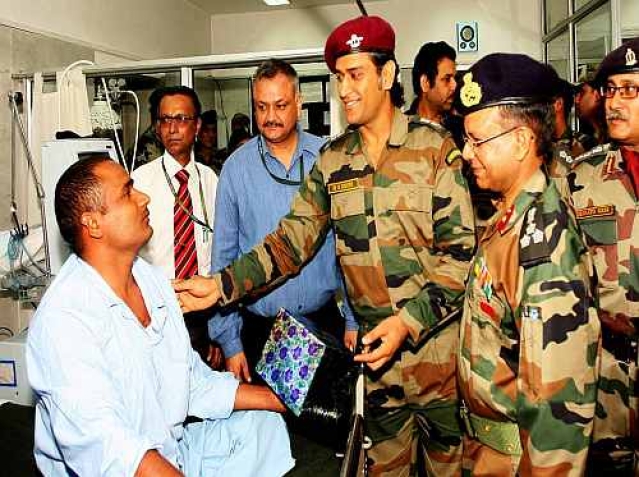
It wasn’t difficult to arrive at a decision because for most soldiers life of fellow soldiers is an abiding priority. It’s the Army’s 92 Base Hospital (BH) at Badami Bagh, where lifesaving is done if a casualty occurs in operations or even due to the plethora of life-threatening situations, which are ever present in the life of army personnel in Kashmir. It is the same hospital, which rose magnificently to the occasion, when casualties came streaming in during Kargil 1999. As the staff came to me to take directions on what would be my first activity I made it clear, much to their surprise, that it would be a visit to 92 BH. The idea was to meet not only convalescing patients suffering from gunshot wounds or other debilitating injuries but more importantly to motivate and encourage the medical staff. It is they who needed to maintain the institutional image that a soldier could consider 92 BH as a sure-shot life saver once he had taken the necessary risks in operations for his nation and his fellow soldiers.

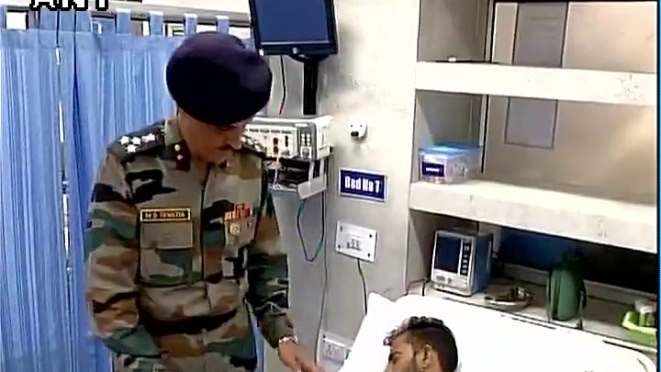
A doctor attends to an injured soldier.

Word of my visit spread like wildfire; first it took 92 BH by surprise because in the perception of the medical staff, medical assistance and lifesaving was hardly a priority for senior military officers, whose focus was on operational effectiveness and achieving the task. In that focus the medical field could hardly be the highest priority. That is exactly the perception I wished to change and convey to them; that they were my priority people, who would ensure the motivation of the troops by their energetic commitment to those who became casualty in the daily run of operations.

Where did this aspect of my psyche come from? Officer warriors are sensitive people; we do not forget experiences and especially bad ones. At the rank of a senior Major in Sri Lanka in 1989, my convoy was ambushed and there were casualties on my hands. The militants had quickly broken contact and vanished into the labyrinth of lanes and by-lanes of the built-up area leaving dying men in my arms. I did not consider it worth chasing from a position of disadvantage and would rather save lives. I ceased the operation in which the initiative was not with me and proceeded to evacuate the casualties on priority; they all lived.

However, I was taken to the cleaners for giving priority to the saving of lives rather than to the chasing of militants to gun down a few for brownie points of the formation (my unit never questioned my wisdom but the brigade commander did because the men were not his, although as the commander every life was actually as much his responsibility). The incident never left my memory.

Through my career I continued to preach to my subordinates that in conventional operations casualties would always be second priority, to be attended to as soon as there was a lull in battle. That was how we always looked at the issue of casualties in battle situations. However, I was also aware that in hybrid and irregular operational situations militants and terrorists had short life spans; if not killed in one encounter they would meet their fate at our or someone else’s hands in a matter of days. What mattered more were the lives of the soldiers. That is the priority I wished to convey to the excellent medical staff at 92 BH, give them a feeling of the significance of their responsibility which in turn would convey back to the soldiers that they could take risks in an environment where lifesaving would receive the highest priority as long as there was no loss of national territory.

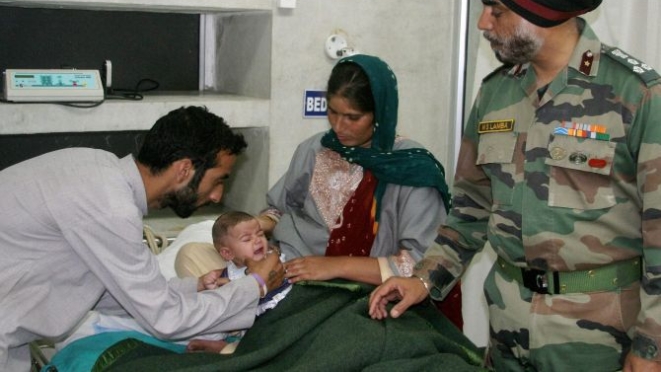
A soldier’s infant receives medical care.

The need to keep motivated those who perceive that their importance is lower in the scheme of things and many times those who suffer from low esteem due to the very nature of their duties, is an abiding belief in my style of leadership. In early 2012, Kashmir was having a bad winter and that means avalanches on vulnerable army posts or garrisons. One such avalanche hit the Gurez Garrison wiping out 18 good soldiers while another at Sonamarg on the same night took the lives of three more. With 21 fatalities, the priority became the rapid move of the mortal remains to the soldiers’ homes. For that they needed to be prepared for transportation.

92 BH was tasked, as always, to perform post mortem, stitch and prepare the 21 cadavers in 24 hours with all documentation in place. Everything was ready for the wreath-laying ceremony, where we paid our last respects to our fallen comrades, covered by national television. With the ceremony over, and the mortal remains on their way to soldiers’ homes, it was now up to me to show the right sensitivity. I chose to change my programme of the morning, from flying to the Line of Control, to a more somber visit to 92 BH. I asked someone to immediately organise samosasand tea for 20 people, who I wished to fete. That done I announced that I wished to meet every single man involved in the task of post-mortem and the preparation of the mortal remains; those who kept awake the entire night performing a job considered distasteful by many and below their dignity by some.

Little did I know that most of the working people at the morgue were housekeepers (safaiwalas – as per previous nomenclature). On learning this, each member of the morgue and pathology staff was addressed, hands pumped and backs thumped. It conveyed exactly what I needed to convey – that no job that was performed was too small for recognition; even the perceived lowly jobs made a difference to our effort.

A few days ago, I met a lady doctor, who arrived at 92 BH after I had left Srinagar. She excitedly came up to me in a large gathering and said she wanted to meet me because everyone in 92 BH remembered these moments with great nostalgia. The nursing staff remembered the facilities provided in their mess and the provision of heated vehicles to transport them for night and emergency duty. The time and energy invested in 92 BH was minimal, in fact miniscule but the dividend of that investment was huge. That is why leaders must always know where the priority lies. It does not lie in the most glamorous, romantic and media-hyped entities but in the unsung and practical ones, where ordinary human beings will deliver for everyone much greater output than the effort which will go in motivating them.

92 BH remains one of the best known landmarks of the Indian Army in the Valley. Not only the Army, all police forces and even many civilians will swear by its ability to keep people alive even though all hope may have been lost. To its tireless doctors, nurses and medical staff, I convey the nation’s gratitude.

Gen SA Hasnain 1

The writer is a former GOC of India’s Srinagar based 15 Corps, now associated with Vivekanand International Foundation and the Institute of Peace and Conflict Studies.