If the country has to be liberated from corruption and misgovernance, the political executive needs to accept its responsibility, assume leadership and play a visibly proactive role in promoting productive governance. It would no longer do to attribute all our failures, on various fronts, merely to the deficiencies of the bureaucracy
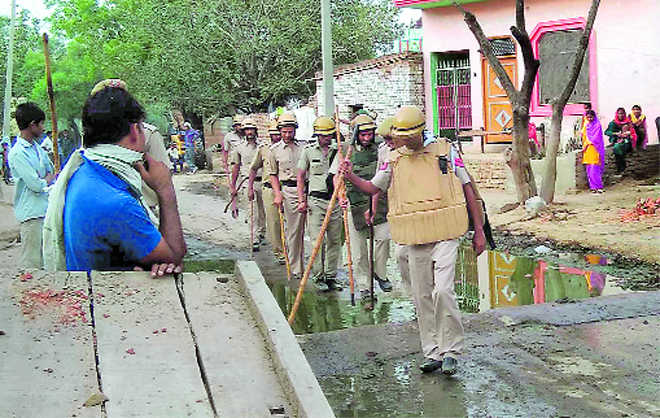
SOCIAL UNREST: Police officials staging a flag march after communal violence in Palwal. Our tolerance levels are witnessing erosion.
AMONG the factors which have contributed to the failures of governance in the past years: the foremost is corruption which has spread unchecked and presently permeates all levels of functioning. The continuation of corrupt and unlawful practices has resulted in seriously damaging the capability and credibility of the institutions of governance. It is a matter for grave concern that in many States it has virtually become a practice for pliant officers of doubtful integrity being handpicked on considerations of caste, community or political affiliations and assigned to lucrative posts for gathering funds for their political masters. Resultantly, the best available public servants are perhaps not even considered for manning important posts in the administrative system. This phenomenon has bred frustration and demotivation among the competent and upright elements in the various cadres, all over the country.Day-to-day political interference in the functioning of the governmental machinery has generated indiscipline and unaccountability. Resultantly, it has become growingly difficult for the common man to get any work done without paying bribes and this has led to the common man losing trust in the functioning of the administrative system. The incessant interference in the functioning of police organisations has led to serious damage being caused to the morale, discipline and professionalism of the constabularies. A grave consequence of this situation has been the progressive deterioration in the maintenance of public order, open defiance of the law, and increase in the incidence of varied serious crimes.
Criminal systems
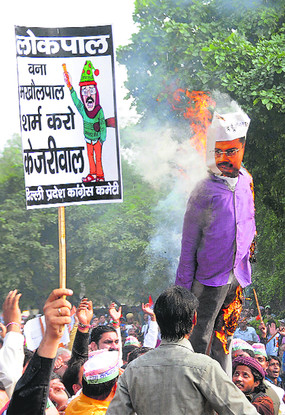
The past decades have witnessed the growing phenomenon of criminal elements enjoying the protection of politicians in power and a threatening nexus developing between unprincipled public servants, corrupt politicians and organised crime and mafia networks in the country. Side by side, while several major scams and scandals have continued to remain under investigation for decades none of the alleged offenders have so far been brought to book. This is perhaps because the CBI and CVC, the apex central agencies responsible for dealing with corruption among public servants, are no longer looked upon as professional agencies which are capable of resisting political pressures and extra-legal influences. This has rightly led to the general belief that the rich and those who hold high positions are not answerable to the laws of the land. It is indeed a sad failure that successive governments at the Centre have not as yet succeeded in establishing an effective law to curb corruption in the highest echelons, including at the level of the Prime Minister. After decades of discussion, the country is still awaiting the appointment of the first Lokpal.Time has come for leaders of all political parties, particularly those who wield power at the Centre and in the States, to recognise that the continuance of corruption shall damage and weaken the administrative and legal framework to the extent of threatening the very foundations of our polity and society and thus endangering the unity and integrity of the country.The rule of law cannot be enforced unless the criminal justice system functions with speed, efficiency and fairness. Unfortunately, we have failed on this front. It has been reported that well over 3 crore cases are pending trials, of which nearly 2 crore relate to criminal offences. Because of the virtual collapse of the justice system, the offenders get discharged for want of evidence, after awaiting trials for years and there has been a worrisome decline in the conviction rates of the criminal cases put to trial. It is a matter for even greater concern that, besides the failures arising from infrastructural deficiencies, the judicial apparatus has been also facing complaints which reflect on its competence and integrity and, in the past years, members of the superior judiciary, even up to the level of the Chief Justice of India, have been the subject of serious allegations. We also face serious challenges in regard to the management of national security. For the past several decades now, adversary external agencies and international terrorist groups have been continuing with their determined activities to subvert and destabilise India by spreading religious fundamentalism, inciting conflicts and perpetrating violence and killings. It is important that the highest attention is paid to ensure that there is no gap or deficiency whatsoever in the effective preservation of the country’s territorial integrity.
Safeguarding national security
Even after the terror attacks in Mumbai, on our Parliament and, more recently, on the Air Force Base in Pathankot, we are still in the process of establishing the required country wide apparatus which would have the capability of effectively safeguarding national security. Also, the required steps have still to be taken for securing firm and clear understandings between the Centre and the States for enacting a comprehensive federal law for establishing a fully empowered central agency which can take immediate cognisance and promptly investigate a terror attack which may take place at any time, anywhere in the country, without precious time having to be lost in securing multiple clearances. It is of crucial importance, particularly at the current juncture, for the Centre and the States to join hands for working most closely together and tackling all major pending tasks for building a strong and vibrant India. In working towards such a goal, the very first steps required would relate to speedily de-politicising the entire administrative apparatus, curbing corruption, fearlessly enforcing the rule of law, ensuring impregnable national security management and creating a country-wide environment for re-energising, enlarging and strengthening the vital institutions of governance.While the poverty ratios in our country have been progressively declining, about one-fifth of our population is still living below the international poverty line and, considering the large size of our population, the current level of unemployment is cause for serious concern. Even when the per capita incomes have marked a near ten-fold increase we have still not achieved the requisite headway in securing meaningful reduction in inequality. As reported, 1 per cent of the richest in our country are reported to own nearly 60 per cent of the total national wealth of which only 2 per cent is owned by the entire bottom half of the population. It is, however, a matter for great pride that today we are amongst the leading exporters of food commodities while, in the earlier years, we were almost entirely dependent on imported food grains. The corpus of our scientific and technical manpower is the second largest in the world and India is among the top in the arena of nuclear power and space technology. As an industrial power we do not stand very high, but India has the distinction of achieving the fastest growth among the major world economies. Another of our notable achievements is that in the past seven decades democracy has got deeply rooted in our country and despite adverse geo-political factors and influences in our neighbourhood and beyond, our democratic institutions are firmly established. At our last General Elections in 2014, no less than 66 per cent of the country’s 834 million voters turned out to participate in the polls.
Reducing inequality
In looking towards the future we need to recognise that among the most daunting challenges facing us is to reduce inequality without losing any more time. The continuance of social and economic inequalities could unleash confrontations and conflicts which could trigger chaos and disorder across the country. For this reason alone it is of vital importance to ensure that the administrative system, all over the country, functions in a manner which ensures against any injustice being done to our people, particularly to those who belong to the disadvantaged segments of our society and are already suffering. Another cause for concern relates to the wanton manner in which rights and liberties are sought to be exercised in our country. This trend must not continue. It is also essential that our citizenry remains duly conscious of its obligations and duties to the nation. Side by side, it would be beneficial for the Central and State governments to take sustained initiatives for promoting an environment which imbues our people with values founded in equality and secularism and respect for the diversity of our numerous and far spread communities. For this purpose we shall need to make conscious efforts to learn, understand and appreciate the diversities of our various communities in regard to their views, beliefs, cultural practices, customs and habits. Already, in several parts of the country, community relations are being disturbed and disrupted by growing caste and religious divisiveness. This is resulting in time-honoured socio-cultural traditions and practices being questioned with unjustifiable aggressivity, leading to inter-community clashes and violence. While we may be rightly proud of our civilisational past and repeatedly keep reminding the world that the people of India are multi-religious, multi-cultural and multi-lingual, it is cause for considerable anxiety that our tolerance levels and traditional sensitivity to differing views and beliefs are witnessing erosion. It is also necessary to devote due and timely attention to the upcoming generation. If we are to benefit from the youthful demographic profile of our large population it is essential that gainful opportunities are provided to our youth and all required steps are taken to ensure against their energies being exploited for generating disharmony or causing disruption. For this reason alone, it is essential to ensure against there being any failure in providing clean, prompt and efficient governance which is aimed at achieving inclusive and equitable human, social and economic development to rapidly promote the welfare of all our people, in every part of the country.
Efficient delivery of services
It would be useful to keep in mind that meaningful governance can be provided if all the public services cadres, across the entire country, ensure efficient delivery of services and secure timely implementation of the nation-wide schemes and programmes which are aimed at poverty alleviation and removal of illiteracy and provision of employment, safe water, food, shelter and health care to all our people. These crucial goals cannot be achieved unless the entire administrative machinery functions with total commitment, efficiency and visible accountability. If the country has to be liberated from corruption, maladministration and misgovernance, the political executive shall needs to accept its responsibility, assume leadership and play a visibly proactive role in promoting productive governance. It would no longer do to attribute all our failures, on various fronts, merely to the deficiencies of the bureaucracy. In conclusion, let it be said that we do not have the luxury of waiting endlessly for reforming the governance of the country. If we have to move forward and achieve the goal of eradicating inequality and discrimination and for all our people to become free from want and fear of any kind, then the entire administrative apparatus, effectively and honestly led by the political executive, shall need to perform with efficiency, speed and accountability, all over the country.Excerpted from the first B K Nehru Memorial Lecture delivered by NN Vohra, Governor of J&K, at CRRID, Chandigarh, on June 10.










 PTI
PTI