Sanjha Morcha

2 die in Darjeeling violence 35 security men injured, Rajnath reviews situation

2 die in Darjeeling violence
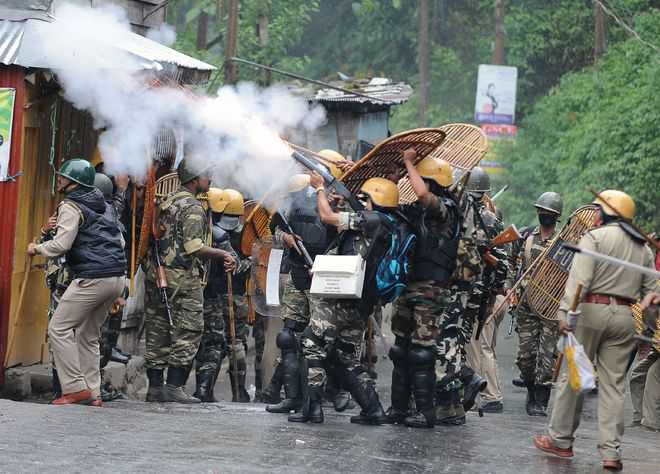
Security forces fire teargas shells to disperse Gorkha Janmukti Morcha supporters in Darjeeling on Saturday. AFP

Shubhadeep Choudhury

Tribune News Service

Kolkata, June 17

Darjeeling turned into a war zone for a couple of hours today—sixth day of the indefinite bandh called by the Gorkha Janmukti Morcha (GJM)—with violent clashes between security forces and GJM supporters claiming the lives of at least two agitators.Around 35 security personnel were injured, including an IRB officer seriously.(Follow The Tribune on Facebook; and Twitter @thetribunechd)Army contingents were deployed to control the situation and they staged flag marches in various areas.Home Minister Rajnath Singh telephoned the Chief Minister Mamata Banerjee and discussed the situation prevailing there.The CM briefed the Home Minister about the steps being taken by the state government to maintain law and order and restore normalcy in the hill district, official sources said.From an undisclosed location, GJM chief Bimal Gurung released a video footage passionately appealing to the people to come out of their homes to protest against police action.Kiran Tamang, India Reserve Battalion (IRB) assistant commandant, was critically injured after being stabbed by miscreants. The CM claimed the police did not fire at GJM supporters.

It’s a conspiracy, says Mamata

  • It is a deep-rooted conspiracy. So many bombs and arms cannot be gathered in a day… There is a terrorist brain behind this vandalism. — Mamata Banerjee, WB Chief Minister

Darjeeling turns battle zone as stir gets bloody

MAMATA FURIOUS Blames ‘terrorists’ as 4 protesters killed, policeman stabbed

Four people were allegedly killed in police firing and a security official was critically injured as a violent agitation for a separate Gorkha state turned the picturesque hill station of Darjeeling into a battle zone on Saturday.

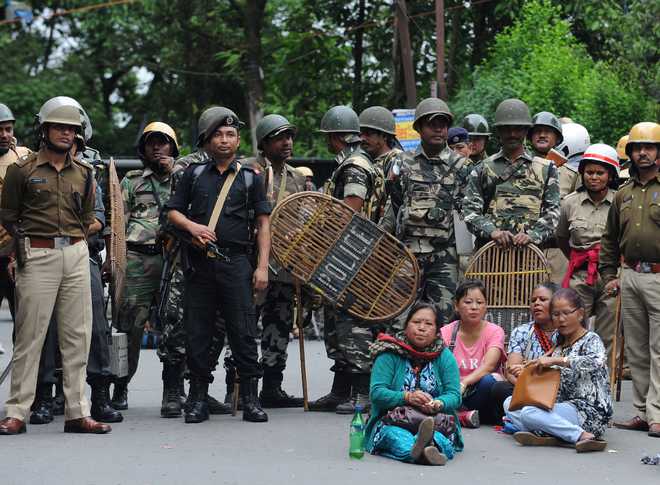
AFPSecurity personnel patrol a road following clashes with supporters of Gorkha Janmukti Morcha (GJM) in Darjeeling on Saturday.

Chief minister Mamata Banerjee denied that police fired on protesters.

The Gorkha Janmukti Morcha (GJM), which rules the semi-autonomous Gorkhaland Territorial Administration, said four of its supporters were killed in Darjeeling’s Singamari, where the party’s supporters attacked security forces with bricks and bottles, in one of the worst violence since the flare-up on June 8.

TV footage showed forces smoke billowing from tear gas shells and security forces firing from semi-automatic weapons.

“Police did not open fire. This is absolutely wrong,” Banerjee said in Kolkata even as she blamed the GJM of having links with militant outfits, based in the northeast, and foreign countries.

“There is a terrorist brain behind this hooliganism and vandalism. We have got clues that this has terrorist connections. They (GJM) have connections with underground insurgent groups of the northeast…,” she said. Kiran Tamang, an assistant commandant of the India Reserve Battalion was stabbed on the back with a traditional Gorkha knife known as ‘khukri’ as security forces struggled to contain thousands-strong mobs that torched police vehicles and ransacked government property, shouting anti-government slogans. His condition was said to be critical.

Scenes across Darjeeling and nearby Ghoom resembled a battlefield with charred buses, police vehicles and bricks strewn on the road. Officials said Tamang was among 35-odd security personnel injured in the violence, officials said, amid rising concerns that Darjeeling might lurch back to the unrest of the 80s, when hundreds died in a crackdown on the statehood movement.

The present crisis was sparked by fears of Bengali being imposed in schools in the GJM-administered areas where a majority of the people are Nepali-speaking Gorkhas. Though the government clarified that Bengali will be an optional subject, the GJM refused to back down and instead revived the almost 100-year-old demand for a separate Gorkhaland. A raid on the GJM’s office this week fanned anger.

Experts see the agitation as the GJM’s efforts to revive its political fortunes after the Trinamool made history by registering its first victory in a hill municipality in Mirik.


Centre rushes 600 paramilitary troops to Darjeeling, seeks report

Centre rushes 600 paramilitary troops to Darjeeling, seeks report
Security personnel stand guard during a protest by supporters of the GJM in Darjeeling on June 13. AFP

New Delhi/Darjeeling, June 13

The Centre on Tuesday despatched 600 paramilitary personnel to assist the West Bengal Government in restoring normalcy in violence-hit Darjeeling hills which witnessed incidents of stone pelting on the second day of GJM-sponsored indefinite bandh.The Centre also sought a detailed report on the prevailing situation in the hill district from the state government.A Union Home Ministry spokesperson said that as many as 600 paramilitary personnel, including 200 women, were sent to Darjeeling.Around 400 personnel, already stationed in West Bengal, have also been deployed in the hill areas along with additional forces.The Home Ministry said it was closely monitoring the situation in Darjeeling and was ready to offer all assistance to the state government to restore normalcy there.Chief Minister Mamata Banerjee told reporters at the state secretariat in Kolkata that the situation in the hill district was ‘peaceful’.She, however, said the Centre did not seek any report on the Darjeeling situation from the state government.As their indefinite shutdown entered its second day today, protesters demanding a separate state of Gorkhaland hurled stones at the police at Chowkbazar area in Darjeeling after they were stopped from enforcing their shutdown in many government offices.Senior police officers were seen leading large police contingents in various parts of the hills.Police pickets and barricades were put up in front of the government and the Gorkhaland Territorial Administration (GTA) offices and various entry and exit points of the hills, while Rapid Action Force (RAF) and a sizable number of women police personnel were also deployed.Shops downed shutters as the violence broke out.The Gorkha Janmukti Morcha (GJM) leadership, however, accused the police of unprovoked lathi-charge on its procession.“The police resorted to unprovoked lathi-charge on a peaceful rally. The more they use force against us, the more intense will be the struggle for a separate Gorkhaland state,” GJM general secretary Roshan Giri told PTI.Yesterday too, Gorkhaland supporters vandalised government offices as the GJM-sponsored indefinite shutdown forced tourists out of the picturesque hill station due to threat of violence.The GJM, which controls the GTA, has called a shutdown of all state and GTA offices to press its demand for creation of a separate state.Giri said that a meeting of six political parties, including GJM and Gorkha National Liberation Front during the day, decided to strengthen the movement for a seperate Gorkhaland.Their next meeting has been scheduled on June 20 to discuss the future course of action, he said.GJM chief Bimal Gurung said that he was in constant touch with the Centre and was hopeful that its ally the BJP would consider its demand for a separate state “compassionately”.“I am constantly in touch with the central government and various ministers. I am very hopeful that they will understand our pain and struggle and will consider our demand for a separate state of Gorkhaland.“The government at the Centre is our ally and they will surely consider our demand compassionately,” Gurung said.BJP, he said, has always been in favour of small states.The GJM chief slammed the West Bengal Chief Minister for calling out the Army to control the situation in the hills and advised her to stay away as “the people of Darjeeling are well equipped to take care of themselves”.“My advice to Mamata Banerjee is please stay away from the hills. We don’t need your charity. The people of the hills will not accept TMC’s hegemony,” he said.Gurung said, “Mamata Banerjee is just pursuing opportunist politics.“In December last year she had accused the Army of trying to attempt a military coup. She can do anything for the sake of cheap politics,” he alleged.“We are not like her. We respect the Indian Army. Every year hundreds of youth from the hills join the Indian Army,” he said. — PTI


The South Kashmir Rage: What Went Wrong? by Lt Gen Syed Ata Husnain (Retd)

8

The
South Kashmir Rage: What Went Wrong?

SNAPSHOT

South Kashmir with its real estate and people cannot be relegated in importance.

This game will eventually be won through the wisdom of experience which clearly says, you cannot ignore the people.

People reading, observing and commenting on the happenings in Kashmir rarely ever look at a map and understand the lay of the ground and the significance of geographic and demographic factors in the proxy conflict imposed on India. It was only after 8 July 2016 that South Kashmir became a landmark region in the minds of common Indians. That was the day Burhan Wani, the young Kashmiri terrorist leader, was killed in an encounter by 19 Rashtriya Rifles (RR) and other security forces (SFs), and Kashmir started burning.

Sensing opportunity, the sponsors and managers of proxy conflict exploited every negative moment to their advantage and helped create an environment of turbulence, which has not stabilised to this day. The focus of the turmoil is in South Kashmir, where the new militancy has raged for the last four years or so. Before that it was mostly the badlands of Handwara, Sopore, Lolab and Bandipura in North Kashmir. Yet, South Kashmir was always relevant; it is only that we have been mistakenly relegating its strategic importance in the proxy conflict.


Map represents South Kashmir with the Pulwama - Shupiyan - Kulgam - Bijbehara (PSKB) quadrangle. The arrows show the alignment where density of troops reduced over time and which today demands fresh deployment.

Why has South Kashmir become the new turbulent zone? What was it like at the commencement of the proxy conflict and near midway around the turn of the millennium? These are natural questions anyone should ask if he is interested in studying conflict and is not fully aware of the dynamics of South Kashmir.

There are various ways in which one can look at South Kashmir. The northern part hugs the Shamashabari Range and is prone to infiltration into the wetlands around the Wullar Lake and the forested belt of Rafiabad and Hafruda forests. In the eastern part of North Kashmir, the heights around Safapura leading up to Harmukh feature are suitable areas for terrorist hideouts and camps. However, the southern part hugs the vast Pir Panjal and Kishtwar ranges bordering Jammu region. Infiltrators enter the region from all directions; filtered from the north through the urban areas of Srinagar and Budgam, via the Mahadeo Ridge to Tral and the infamous Meadow in the Pahalgam heights, across Doda-Kishtwar into the Kapran valley, directly via the Pir Panjal axis from Rajouri and through the gullies such as Chinamarg and Chor Panjal to the karewas (broken plateaus) of the Beerwah belt.

In the heydays of splurging infiltration, South Kashmir was sandwiched from virtually every direction. The Wullar in the north severely restricts movement to areas around it, making it simpler for the security forces (SFs) to deploy and focus on intelligence efforts. The south is open country only restricted by the flow of the rivers from the Pir Panjal, Jhelum, Rembiara and Vaishav plus Lidder from Pahalgam. There are karewas, forests and densely packed villages, which dot the area. The line from Qazigund to Pir Panjal road, which hugs the Pir Panjal range is heavily populated. It is this area, which has been largely ignored by us in our deployment in recent years.

It was because the local hold of the Hizbul Mujahideen was far greater here that Pakistan perceived the movement slipping from its hands, as early as 1991. Without its direct control the direction it wished for the movement to take would have actually not materialised.That is why we found the Lashkar-e-Taiba (LeT) taking primacy after 1996 and announcing its arrival here with every major atrocity.

South Kashmir has traditionally been the breadbasket of Kashmir, the land of the white collared citizens from Anantnag and Pulwama. It is in Kulgam that the seat of the Jamat-e-Islami (JeI) Kashmir exists; the Amir-e-Jamat resides and functions from here. While the population all over Kashmir is restive, in South Kashmir, the awareness levels are much higher. Leadership among terror groups has usually rested in the hands of locals. There have been some very high profile and long lasting leaders such as Amir Khan, Engineer Zaman and the wily division commander Shabir Baduri. That a Burhan Wani arose here should never have surprised people.

The Ikhwans, as a counter group, were centred in both North and South Kashmir under their respective leaders; Mohammad Yusuf Parray (Kuka Parray) in Hajan and Liyaqat Ali in Anantnag. While Kuka Parray entered politics, Liyaqat Ali’s movement in the south proved extremely useful for the security forces to control the very turbulent Anantnag and Pulwama districts. Kuka Parrey was killed in Septemer 2003 but well before that the Ikhwan movement was the victim of the lack of understanding by both the Army and the political leaders. This usually happens with counter group movements. For the sake of political expediency of the time, the Ikhwan’s contribution was ignored and its future capacity to deliver was never developed. There is no doubt that South Kashmir’s Ikhwans contributed immensely towards establishment of control by the Army, but as in other aspects of the situation it was considered only a stepping stone towards normality as the political dividends of then emerging peace could not factor the Ikhwans into it.

So what was it like in South Kashmir when I took charge as the Colonel General Staff of Headquarters (HQ) Victor Force (planning and coordination of operations, intelligence and training are the responsibility of this appointment in a division headquarters). The HQ itself was an experiment, raised in 1994 to take control of the entire expanse of South Kashmir. It was and is still located at Avantipura just above the National Highway.

In 1999, when I reached to take over the appointment, the HQ was a sparse entity, in fact, almost Spartan in terms of comforts you usually associate with large HQ. What was on at the very moment I stepped in is history. The Kargil intrusion had just been discovered and 15 Corps was in flux. For us, on that day three operations were simultaneously on, two in 1 Sector’s Chhatergul and Aishmuqam areas and one in 2 Sector’s Kapran valley. Helicopters were whizzing across from Srinagar to pick up casualties in Chhatergul. Three terrorists had also been killed there while in Kapran a leading Afghan terrorist had been killed. This was to become a routine affair for the next two years, where at times, I was monitoring five major operations simultaneously.

There is much that characterised South Kashmir in 1999, but three issues demand mention. First, the area had an improvised explosive device (IED) threat even greater than what I faced in Sri Lanka. The route from Victor Force HQ to Avantipur airfield was itself so unsafe that moving in vehicles was fraught with risk. There were a number of IED doctors (fabricators) among the terrorist ranks; an IED was always referred to as roti or chapati in all radio communications which were intercepted by us. With trained monitoring, it was always possible to home onto a general area where an IED was being prepared to be laid; the exact point could not be ascertained. The National Highway was always vulnerable; on 28 May 1999, a sideways IED in the hillside targeted an officer bus of the Jammu convoy just across the tunnel towards Banihal. Families were the victims, something I cannot forget, although many human rights activists never ever mention such events in their commentaries.

The road from Kulgam to the National Highway near Khudwaini was even worse. Through June-August 1999, Victor Force was also responsible for the safe movement of ammunition convoys from Khundru where the large ammunition depot exists. The 18km route from Khundru to Khanabal at the National Highway had 110 Hume Pipe crossings; each such crossing was a potential IED site and one successful IED meant the loss of momentum of the ammunition movement for the Kargil operations. To top it the road did not even have tarmac, it was just macadamised. This was the area where Army dogs from our outstanding Dog Units along with their handlers carried out operations all the time. There is but one way to prevent the emplacement of an IED and that is day and night domination. It means identified segments of the roads or tracks have to be under constant surveillance of static and patrolling troops by day and night. It is a sapping operation, which requires dedication and stamina. Today, IEDs have completely dried up. The last one with any major effect was on 20 July 2008, at the crossing of the roads from Srinagar to Gulmarg and Baramula. Nine soldiers proceeding on leave lost their lives when their bus was targeted.

Yet, it needs to be mentioned that the then GOC Victor Force, Maj Gen Raj Kaushal moved more by road than by helicopter. I almost always accompanied him but no one ever had an inkling of where we would go on a given day. That is the best precaution against IEDs.

The second issue of concern in South Kashmir was the ever present threat against minorities – Kashmiri Pandits still resided and there were many Sikhs all living in clusters. Victor Force never seemed to have sufficient troops for us to be able to provide this security. In 1999, a place such as Tral did not have an RR unit; a Border Security Force (BSF) unit was responsible for its security. Today, everyone knows Tral as Burhan Wani’s town. A full RR unit was deployed only in 2002. Vulnerability of minorities still remains a challenge although a well-guarded camp of Kashmiri Pandits exists at Wisu near Qazigund, on the highway. There are Sikh settlements, which need dedicated protection, considering that local terrorists have shown no qualms about targeting Lt Umar Fayaz, who was unarmed and a Kashmiri.

The third observation; in 1999, our focus was once again on the Pulwama – Shupiyan – Kulgam – Bibehara (PSKB) quadrangle, where a mass of villages and orchards exist. Our deployment was right up to the Pir Panjal and in fact even beyond. Victor Force strongly believed that intelligence about possible infiltration from across the Pir Panjal would come from the Army bases at the foothills on the southern side towards Surankot, Rajouri and Thana Mandi. We thus had deployment at the meadows looking towards the gullies and intelligence detachments deployed with the troops in the south of the range.


Indian Navy looks to dominate Malacca Straits

Indian Navy looks to dominate Malacca Straits

Ajay Banerjee

Tribune News Service

New Delhi, June 11

Warships to monitor movement 24×7 at western edge of Indian Ocean’s main shipping channel

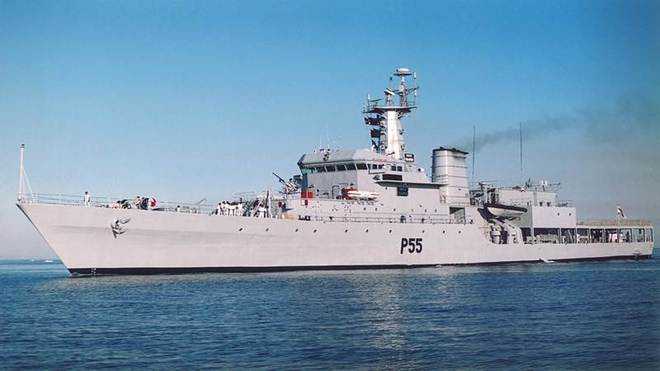
Aiming to dominate the Indian Ocean and have maritime domain awareness, the Navy was last week tasked to patrol sea-shipping routes to the Malacca Straits, an important ‘choke-point’ south-east of the Andaman  and Nicobar Islands in the Bay of Bengal.Indian warships will now be present 24×7 at the western edge of the strategically vital straits “looking” at ship movement. Singapore is at its eastern edge.Top sources have confirmed to The Tribune this is part of the target given to the Navy to ensure its dominance in the Indian Ocean by 2020. It’s not for patrol or deployment, but only for awareness of the busiest sea lane of communication that passes through these straits, sources confirmed. These are international waters and infringe upon no country’s rights.The target for dominating the Indian Ocean has been discussed and agreed upon in the top echelons of New Delhi’s security architecture. Sources said the ramping up of capabilities to secure the ocean includes buying newer warships, especially those capable of anti-submarine warfare, helicopters, string of additional radar, surveillance planes and drones, besides submarines.Last week, the US Department of Defence had, in its reports, highlighted why the Malacca Straits were crucial for China.“Malacca Straits are critical to the transport of natural gas and oil… China is particularly reliant on unimpeded sea lane of communications like the South China Sea and Malacca Straits,” said the annual report to the Congress, “Military and Security Developments Involving the People’s Republic of China 2017”.“In 2016, approximately 80 per cent of China’s oil imports and 11 per cent of natural gas imports transited the South China Sea and Strait of Malacca. Despite China’s efforts, the sheer volume of oil and liquefied natural gas that is imported to China from the Middle East and Africa will continue to make strategic sea lane of communications important to China,” the report noted.In 2016, China imported oil to meet approximately 64 per cent of its needs. This figure is projected to grow to approximately 80 per cent by 2035, according to the International Energy Agency. China continues to look primarily to the Persian Gulf, Africa to satisfy its growing oil and gas demands, making the Malacca Straits even more important.


13 armed intruders killed in 4 days along LoC, says army

SRINAGAR: One militant was killed as the Indian Army foiled an infiltration bid in Gurez sector in north Kashmir on Saturday, taking the number of deaths of infiltrators to 13 in the past four days.

While confirming Saturday’s development, an army spokesperson said one weapon was recovered from the militant. The operation is underway, the spokesperson added.

“The sinister designs of Pakistan army to push in multiple groups of armed intruders across the Line of Control (LoC) in Jammu and Kashmir continue to be defeated by proactive operations being carried out on the LoC. Relentless operations mounted by troops have successfully intercepted groups of armed intruders all along the LoC in Gurez, Machhil, Naugam and Uri Sectors, leading to the elimination of 13 armed intruders in the past 96 hours,” the army said in a statement.

Forty infiltration attempts were prevented along the Line of Control so far this year.

On Friday, the army gunned down five militants in north Kashmir’s Uri sector.

The army’s northern command said on Thursday it was tackling several infiltration bids along the LoC in north Kashmir. The army has been engaging with armed militants in four sectors — Machhil, Naugam, Gurez and Uri — in the three frontier districts of north Kashmir since Wednesday.

While three militants were killed on Thursday in Nowgam sector of Kupwara district, four more were killed in the district’s Machhil sector on Wednesday. A soldier was also killed in Nowgam.

Meanwhile, militants opened fire on two ITBP vehicles at Vessu on the Srinagar-Jammu highway on Saturday morning, missing their target and injuring a civilian in a car behind them.

The civilian, Arif of Anantnag, was on his way to work at a construction company at Banihal when the militants fired at the Indo-Tibetan Police Force (ITBP) vehicles in front of him. The fire missed the target and hit his car, injuring him in the back, police said.

Though he is stable, he was referred to the Shri Maharaja Hari Singh Hospital (SMHS) in Srinagar.

Residents said they heard gunshots soon after the morning prayers at 5am.

Twenty empty cases of AK ammunition were recovered from the spot.

It was the second militant attack on security forces in the Qazigund area of Anantnag district in a week. On June 3, two soldiers were killed and four injured in a militant ambush on an army convoy near a toll post at Qazigund on the highway.


Jawan, 3 militants killed as Army foils infiltration bid in Nowgam

Jawan, 3 militants killed as Army foils infiltration bid in Nowgam
The operation is still underway. —ANI

Majid Jahangir

Tribune News Service

Srinagar, June 8

An Army jawan and three militants were killed in a gunfight as the Army foiled an infiltration bid in North Kashmir’s frontier Kupwara district.The bid was foiled close to the Line on Control in Nowgam sector, 130 kms from here, when a group of militants was intercepted during the intervening night of Wednesday and Thursday by the Army.”As terrorists were challenged, they opened fire triggering a gunfight. In the gunfight, three terrorists were killed and one soldier was martyred,” an Army spokesman said.The operation in the dense forests is still underway. The identity of the slain soldier and militants could not be ascertained immediately.This is the second infiltration bid foiled since Wednesday in north Kashmir. Three unidentified militants were killed in Machil sector of Kupwara when they were trying to sneak into the Valley.


HEADLINES::—-04 JUN 2017

breakl line

DEF VETERANS HONOUR 1971 WAR MARTYR SEP DALIP SINGH OF 8 SIKHLI

HIKED PENSION FOR PRE-’96 RETIRED MAJORS

ARMY CHIEF VISITS LOC UNITS IN NORTH KASHMIR

CBI ARRESTS LT COL, MIDDLEMAN IN ARMY TRANSFER RACKET

2 ARMY JAWANS KILLED, 4 INJURED IN MILITANT ATTACK ON CONVOY IN J&K

THREE ASSAM RIFLES JAWANS INJURED IN BLAST IN MANIPUR

A SOLDIER KILLED IN ACTION ISN’T A MARTYR

हर कश्मीरी युवा नहीं चाहता पाकिस्तान, यह समझने की जरूरत

MAHARANA PRATAP CHAIR FOR PUNJABI VARSITY

GO ZOJILA AZHAR QADRI AT ZOJILA PASS (J&K)

EMULATE GILL, CAPT TELLS YOUNG OFFICERS

NIA CONDUCTS RAIDS IN KASHMIR, DELHI OVER TERROR FUNDING FINDS RS 1.5 CRORE CASH

HUMAN SHIELD INCIDENT SHOULD NOT BE REPEATED, SAYS GEN MALIK

‘HARYANA GOVT INSULTED FAMILY OF JAWAN KILLED IN MACCHIL’

MAJOR GOGOI’S INTENTIONS WERE RIGHT: GEN MALIK

RELIEF FOR DEFENCE FAMILY AS DETAILS OF ACQUIRED LAND SOUGHT FROM DMC

LT GEN JAGDEEP SHARMA ELEVATED TO THREE-STAR RANK

IAF PILOT MOVES SC AGAINST STAY ON RELIEF


FOR DETAILED NEWS CLICK

Moving-picture-down-arrow-on-spring-animated-gif  www.sanjhamorcha.com


breakl line


HEADLINES —–02 JUN 2017

BRIG JOGINDER SINGH JASWAL MESSAGE TO HIS WELL WISHERS FROM MH JALLANDER.ACTION TAKEN BY PUNJAB GOVT : PRAISEWORTHY

RAWAT MEETS HIS GENERALS IN SRINAGAR AS LOC BURNS

WESTERN DISTURBANCE JAITLEY SAYS INDIA DOMINATES LINE, PAK SUMMONS INDIAN ENVOY

2 Hizb ultras behind Sopore attack on cops killed

HOW THE ARMY SHOULD HANDLE PSYCHOLOGICAL PRESSURE OF LONG DRAWN HYBRID CONFLICT IN J&K BY LT GEN ATA HUSNAIN

MODI INKS RUSSIA N-PACT, TO MEET TRUMP ON JUN 26

STRATEGIC PARTNERSHIP TO HELP ATTRACT FDI IN DEFENCE: JAITLEY

NO ‘TIGHT’ MILITARY TIES WITH PAK, INDO-RUSSIA TIES CANNOT BE DILUTED: PUTIN

RAJNATH BREAKS PROTOCOL, HUGS BRAVE BSF JAWAN SUFFERING 85 PC DISABILITY

MAJOR GOGOI AND FAROOQ DAR – GREY IS THE COLOUR OF DECISION MAKING IN HYBRID CONFLICTS SUCH AS KASHMIR BY LT GEN ATA HUSNAIN

2 HYDROGRAPHIC SURVEY VESSELS UNVEILED

Navy sailor found dead aboard INS Rana in Vizag

2 PAK SOLDIERS KILLED IN ARMY LOC RETALIATION GREF LABOURER DIES IN POONCH SHELLING

PUNJAB NEWS ::02 JUN 2017

  • 400 govt primary schools set to go English medium
  • As Cong MLAs sulk, Capt asks officers to give them due respect
  • The story of cooks who cooked the goose
  • Roadways buses ply on BRTS lane
  • Wheat scam:14 food inspectors suspended
  • Ex-MLA’s brother gets Rs 40-cr land for just Rs 35,100
  • Ministers split on farm loan waiver
  • MLAs, officers told to work in tandem
  • Cook’s company gave loan of Rs 50 lakh to Rana Gurjit