Sanjha Morcha

Army Chief’s J&K remarks reflect govt’s view: CPM

New Delhi, June 6

The CPM has criticised Army Chief Bipin Rawat for defending the use of a “human shield” in Kashmir, saying his comments reflected the views of the Modi government, which seeks to “suppress” the people there.The Left party said the Army and Kashmiris would suffer “irreparable damage” because of the government’s “blind” adherence to the use of force against civilians in the Valley.“Unfortunately, the Army Chief is reflecting the views of the Modi government which seeks to suppress the people of Kashmir, who are voicing their political protest, through sole reliance on the use of force,” former CPM general secretary Prakash Karat said.Karat’s comments appeared in the editorial of the latest issue of the party mouthpiece “People’s Democracy”. Karat alleged Rawat made no distinction between young protesters throwing stones and armed militants.“To taunt protesters to take up arms, so that the Army could deal with them appropriately, is a needless provocation and displays an attitude which is unbecoming of a senior Army officer,” he added.Karat said the Army Chief’s remarks exemplified “all that is wrong” with the way the Modi government was dealing with the situation there. “The Army Chief of Staff, by commending this act, has let down the high professional standards of the Army,” the Marxist leader said.Karat was asked questions by reporters on the sidelines of a CPM politburo meeting here, but refused to speak more on the subject. “It was an editorial (which is) the party stand,” he said.Meanwhile, The CPM today defended its criticism of the Army for backing the use of a “human shield” against stone-throwers by an Army major in Jammu and Kashmir, saying it stood by “every word” it had said in this regard. — PTI

clip

clip

clip

clip


After decades of wait, Indian Army finally gets modern Bullet-Proof Ballistic Helmets

For a soldier today, a bullet-proof helmet is an essential part of his kit that can prove to be the difference between life and death during combat operations.

But Indian Army soldiers, who fight in adverse conditions to save lives of fellow countrymen, were deprived of even this basic need.

Indian armed forces have relied on patkas that are worn over outdated infantry helmets to save themselves from enemy fire. But they have severe limitations as they are bulky and heavy, weighing over 2.5 kgs, and can protect only the forehead and back of the head.

Now, there is a good news for our soldiers. After decades of life-threatening wait, Indian Army has finally received modern bullet-proof helmets this month which can bear the impact even from short range.

Earlier this year, a Kanpur-based company, MKU limited, which supplies military equipment to the UN and NATO, was awarded a contract worth Rs 180 crore to supply nearly 1.6 lakh helmets. The company has recently delivered the first tranche.

ET got an opportunity to visit the manufacturing facilities of MKU in Kanpur and Fatehpur districts of Uttar Pradesh to watch the production of helmets.

The bullet-proof helmet has the main protective layer of Kevlar, the material used by Batman for his Batsuit and cape. Although the helmet won’t let our army men do things batman does, it will surely save them by bearing the impact of an enemy bullet.

The helmets are designed to bear the impact of 9 mm ammunition fired from a short range. This meets the global standard for protection among leading armed forces. They are also designed to be comfortable and can be integrated with communication and night-vision devices.

Indian Army has ordered the bolted version of bolt-free ballistic helmets. Not currently on the Indian Army order list, bolt-free is a higher and expensive version of bullet-proof helmets, which gives all-round protection from head injuries as helmet bolts increase the risk of injuries due to vibrations produced by direct impact of bullet on helmet.

MKU claims that these helmets go through rigorous quality tests and ballistic lab test conducted in company’s testing facilities in India and Germany.

Although the ordered helmets don’t carry the communication device and other equipment such as night-vision device and camera, the company says the helmets could be improvised to include all these devices in future. MKU also manufactures integrated mounting system consisting communication and night-vision devices, camera and torch that make the helmet a unique protective-cum-communication machine.

Riding high on the success of its biggest helmet order of nearly Rs 180 crore from Indian Army, the Kanpur-based company is also hopeful of grabbing orders for currently under-process 44,000 night-vision devices and bullet-proof jackets.

Talking to ET, MKU Managing Director Neeraj Gupta said, “Head is the most venerable part of the body to get injured in a combat operation. According to studies, 26 per cent to 28 per cent of soldiers die because of head injuries.”

“In addition to the current 1.6 lakh order, we hope to deliver over 7 lakh helmets to Indian Army and overall one million helmets to different Indian armed forces,” Gupta said.

MKU manufactures a wide range of military products including bullet-proof helmets, body armours, bullet-proof jackets and night-vision devices. The 30-year old company calls itself one of the biggest arms exporters in India. It claims to supply military equipment to more than 100 countries. It has a manufacturing and testing facility in Germany, in addition to three units in Kanpur and Fatehpur districts of Uttar Pradesh.



Fighting a flawed Army promotion policy by Lt Gen OP Kaushik (retd)

The Ministry of Defence has refused to accept an amendment to the two-stream policy, divided along staff and command lines. The consequences of this policy are serious and will cause a negative impact on the Army’s functional efficiency.

Fighting a flawed Army promotion policy
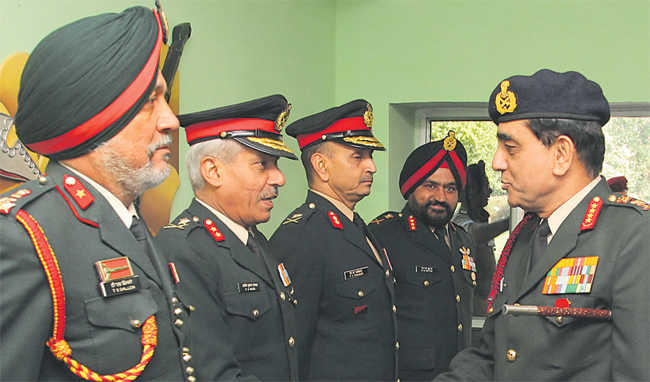
General Deepak Kapoor meeting senior Army officers at the Western Command headquarters.
The single-stream promotion policy was amended during his tenure as COAS. The bitterness caused by the two-stream model will negatively impact the Army.

RECENTLY, the Army has been in the news about the promotion policy drafted by the Army headquarters for promotion to the ranks of Major General and Lieutenant General. The Ministry of Defence (MoD) sat on the draft for over six months and then returned it unapproved. Due to this delay two Major Generals, who had been approved for promotion to the rank of Lieutenant General, retired without picking up the next rank and three others have lost an opportunity to command a corps resulting in frustration and discontentment among senior officers of the Army.Prior to General Deepak Kapoor taking over as the Chief of Army Staff (COAS), the promotion policy in vogue for promotion to the ranks of Brigadier to Major General and Major General to Lieutenant General was that the promotion board put all those approved for promotion in one common list and it was called a single-stream promotion policy. It implied that the approved officer was fit to hold an appointment involving command of troops as well as staff appointment, which is purely administrative in nature. General Kapoor amended this policy and all those who were approved for promotion were put in two different lists, that is those who will command troops (command stream) and those who will hold only administrative assignments (staff stream). This also implied that officers put in the staff stream were not to be considered for any further promotion and would be considered junior to those who were placed in the command stream. The above scheme, although approved by the MoD, caused discontentment in the Army and all the officers’ placed in the staff stream went on appeals to the Army headquarters, the government as well as to the courts to seek redressal. General VK Singh, who succeeded General Deepak Kapoor as the COAS, was constrained to have a relook on the issue. The matter was placed before the Army Commanders’ conference and all the Army Commanders unanimously decided that the organisation should switch back to the single- stream promotion system. Recommendations made by the Army Commanders (Army Board) were sent to the MoD. Arguments in support of the single stream were:  better promotion avenues for all, equality of opportunity, improve the stinging environment that the two-stream policy had generated as also to reduce appeals and challenges in the courts of law.The MoD sought the opinion of the Solicitor General on the amended policy. Interestingly, no such advice was demanded when Gen Kapoor amended the existing policy. The Solicitor General in his specific comments stated: “Till the time the Army frames a comprehensive fresh promotion policy, the current one should be adhered to since ad hoc measures will be counterproductive.” The MoD, based on the Solicitor General’s remarks, did not approve the draft promotion policy.  Army Commanders, who constitute the apex body of Army organisation, had made these recommendations after feeling the pulse of the entire Army. During the survey, not a single person had opined in favour of dividing promotions into two different streams. Since the policy, as amended, was universally favourable to one and all, there could be no legal implications. The unfounded fears of the Solicitor General that it could be challenged in the court of law had no basis. After all, on what account would anybody challenge it? It placed everybody in one stream, that is the command stream. It affected no one’s seniority and offered all a better career profile. More serious was the bitterness that had been caused by the two-stream policy. There is no specific criteria or qualifications to be considered for dividing the approved officers into command and staff streams. The promotion board prepares a list of officers approved for promotion. From that list, officers appearing lower in order of merit are placed in the staff streams. It is, therefore, a most ad hoc, arbitrary and flawed policy and denies equality of opportunity to all.The two-stream model was first conceived in 1986 by General K. Sundar ji, the then COAS, for promotion from Colonel to Brigadier. It could not be implemented for want of approval by the MoD. Efforts were made to revive the two-stream policy in 1992 for promotion from Major General to Lieutenant General on the basis of age in that  if an officer, on promotion to the rank of Lieutenant General, did not have more than four years residual service, he was denied command of a corps (involving command of troops) and was promoted only on a staff appointment. This period was subsequently reduced to three years. Furthermore, after having commanded a corps and having rendered distinguished performance, including earning highest decoration, if an officer did not have more than two years residual service, was not promoted as an Army Commander. It is amazing that suddenly a highly experienced and decorated officer gets bracketed as an inferior officer and a mediocre person is moved up just because he has few more years to serve. It is so surprising that the Army has allowed itself to languish in such a lackadaisical and destructive policy. It would have been better to promote the officer to the rank of an Army Commander and give them minimum two years in that appointment or the date of retirement, whichever is later. This provision has been made in some selected secretary-level promotion in civil services. Notwithstanding the MoD’s refusal to accept an amendment to the two-stream policy, its ramifications are dangerously serious and will  negatively impact the functional efficiency of the Army. Hence, soon it will have to be revised under the comprehensive promotion policy as suggested by the Solicitor General. This must be done at the earliest to save the Army from its negative influence.  The writer has been a General Officer Commanding in the Kashmir Valley & Chief of Staff  Eastern Army


Three militants killed, Army officer injured in Kashmir Youth killed in clashes in Pulwama

Three militants killed, Army officer injured in Kashmir
Villagers look at a damaged house where militants were hiding in the Kakpora area of Pulwama, south of Srinagar, on June 22, 2017. AFP

Majid Jahangir

Tribune News Service

Srinagar, June 22

Three local Lashker-e-Toiba militants were killed and an Army officer was injured in an overnight gunfight in south Kashmir’s Pulwama district.

(Follow The Tribune on Facebook; and Twitter @thetribunechd)

A protester was later killed and scores of others were injured in clashes that erupted in Pulwama following the killing of the militants.

The gunfight had erupted late Wednesday at Kakpora, nearly 30 km from Srinagar,   when joint teams of the police, Army and CRPF launched a cordon-and-search operation following input on militants’ presence.

“As the searches were launched in the area, militants opened fire, which was retaliated, triggering a gunfight. In the exchange that continued for many hours, three local Lashkar militants were killed and a Major was injured,” a police officer in south Kashmir said. Two Rifles and ammunition were also seized from the site.

Sources identified the three slain militants as Majid Mir, Shakir Ahmed and Irshad, all residents of Pulwama.

Clashes also broke during the operation and youth pelted stones at the forces to disrupt the operation. The police had to fire teargas shells to disperse the protesters.

After the encounter broke, the authorities suspended the Internet service in Pulwama district late last evening. The situation was tense in the district.

As the news about the killing of three militants spread, clashes and protest erupted in the area. In the ongoing clashes, 22-year-old Touseef Ahmed Wani, a resident of Tengpuna Pulwama, was killed and many other were injured.

At least five militants have been killed since Wednesday morning. Two Hizbul Mujahideen militants, including a district commander, were killed in an encounter with the police and security forces in Pazalpora area of north Kashmir’s Sopore sub-district.


Batchmates remember of IAF’s lone Param Vir Chakra awardee recall his valour

Special tributes will be paid to Flying Officer Nirmal Jit Singh Sekhon by his fellow coursemates who intend to reminisce about the time they spent together while under training.

Nirmal Jit Singh Sekhon, iaf officer Nirmal Jit Singh Sekhon, Param Vir Chakra awardee, flying officer


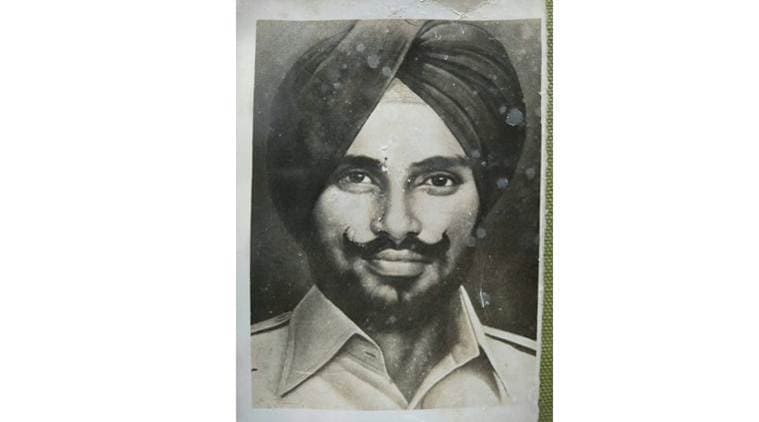
Had Flying Officer Nirmal Jit Singh Sekhon been alive today he would have been celebrating the 50th anniversary of the passing out of his course along with his fellow officers at Air Force Academy in Dundigul, near Hyderabad. However, the lone Param Vir Chakra awardee of the Indian Air Force will form part of the memories of the 97th General Duty Pilots course and 36th General Duty Navigators course when they meet on Sunday (June 4) at Hyderabad to mark the 50th anniversary of getting commissioned in the IAF.

The members of this course consider themselves special because of Sekhon and the fact that he was posthumously awarded the nation’s highest gallantry award while deployed at Srinagar airfield in the 1971 war. Special tributes will be paid to Flying Officer Nirmal Jit Singh Sekhon by his fellow coursemates who intend to reminisce about the time they spent together while under training.

As many as 168 pilots and 27 navigators had passed out on June 4, 1967 out of which 71 laid down their lives in combat operations and on active duty including flying accidents. Tributes will be paid at memorial at the Air Force Academy by the members ofe course in honour of those batchmates who lost their lives while answering the cal of duty.

Nirmal Jit Singh Sekhon, iaf officer Nirmal Jit Singh Sekhon, Param Vir Chakra awardeeThe members of this course consider themselves special because of Sekhon and the fact that he was posthumously awarded the nation’s highest gallantry award while deployed at Srinagar airfield in the 1971 war.

Out of all the fellow officers who served with Flying Officer Sekhon, Wing Commander GM David (retd) is the one who saw him off on his last sortie when he took on four attacking Pakistani F-86 Sabres on December 14, 1971 in his Gnat aircraft. It was in this action, while chasing off the Pakistani attackers singlehandedly, that Sekhon’s aircraft got damaged in enemy firing and he dies in the ensuing crash.

Recalling Sekhon, Wing Commander David told The Indian Express that both used to stay together in the same block. “He was an excellent human being, not given to boasting or false bravado. His only passion in life was to fly the G Bird (as the Gnat was known) to the best of his ability”. David added that Sekhon was so tall that he barely fitted into the Gnat cockpit even with the ejection seat in the fully down position. “We suspect he cheated on his height a bit so that he would be accepted on the Gnat,” he said jocularly.

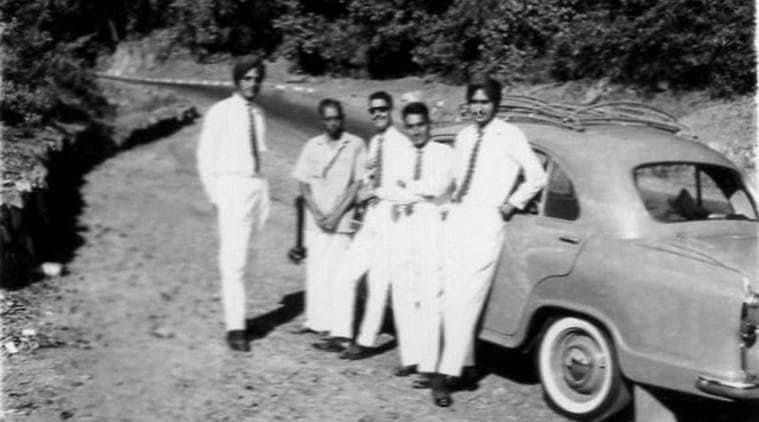
Nirmal Jit Singh Sekhon, iaf officer Nirmal Jit Singh Sekhon, Param Vir Chakra awardeeSekhon (right) during an excursion with a fellow cadet while undergoing training.

Narrating the sequence of events of the action in which Sekhon earned the Param Vir Chakra and he saw as an eyewitness, David said that the F-86 Sabre was known to turn better than the Gnat. “I think that during the battle, Sekhon may have proved everyone wrong because he held the turn with the Sabres even with his underwing external tanks laden with fuel. He shot the first Sabre with his wing tanks on. He jettisoned his external wing tanks, and using the superior power of the Gnat to close in to shoot at the second Sabre. He must have been overwhelmed by the closeness of the Sabre in front of him. All along he was aware of one of the escorting Sabres manouvering to shoot him. He thought that he would get F-86 in front before he got shot. That was the unflinching courage of the man and his supreme confidence in his machine,” he said.

Wg Cdr CS Grewal (retd), who was a room mate of Sekhon during the academy days, recalls him as a quite person who was always polite. “He would call every body ‘brother’ and was most affable. After our initial training we parted ways as he went for advanced training to Kanpur. We are proud that 50 years ago he passed out with us and today we remember his sacrifice for the country”.


16 Corps bids adieu to Naik Bakhtawar Singh

Jammu, June 17

The Army today paid tributes to Naik Bakhtawar Singh, who laid down his life while responding valiantly to unprovoked firing by Pakistan in the Nowshera sector on Friday.At a wreath-laying ceremony in Rajouri today, General Officer Commanding (GOC) of the Ace of Spades Division Maj Gen S Dayal laid a wreath on behalf of the GOC, White Knight Corps (16 Corps) Lt Gen AK Sharma and Northern Command chief Lt Gen D Anbu.The mortal remains of the soldier were airlifted to his native Hajipurin village in Hoshiarpur district of Punjab for last rites. Naik Bakhtawar Singh is survived by his wife Jasbir Kaur and three children. — TNS


Appointment of judicial members to AFT Bench sought

Tribune News Service

Chandigarh, June 14

Members of the Armed Forces Tribunal (AFT) Bar Association have written to the Chief Justice of India (CJI) saying that there are supposed to be three courts functional at the Chandigarh AFT Bench, but it is currently without even a single judicial member, due to which the entire work has come to a standstill, leading to serious problems in access to justice for defence personnel and their families.The letter states that the Chandigarh Bench currently functions only for a few days every month when an outstation judicial member on temporary duty from another bench holds court. “Even by this arrangement, fresh cases cannot be listed and fresh or urgent cases filed months ago are taken up for hearing by temporary outstation judicial members,” the letter adds.Bar members have said, “The non-appointment of any judicial member in the Chandigarh Bench is against the statement of the Union of India recorded in the orders of the SC on a similar letter petition filed by the AFT Bar Association’s Delhi chapter.” Seeking immediate appointment of judicial members so as to make the AFT Benches functional, the Bar members have also sought placement of the AFT under the Ministry of Law.


Badals’ ‘blue-eyed boy’ is worth ₹1,200 cr: VB probe :VB unearths Pehalwan’s 92 properties, Rs 57-cr deposits

Tribune News Service

Chandigarh, June 14

The Vigilance Bureau today claimed to have unearthed 92 properties worth crores purchased by five firms floated by former GMADA Chief Engineer Surinderpal Singh Pehalwan him in the name of his family members and associates.Additionally, Rs 57 crore was deposited in three companies owned by his family. An official spokesperson revealed that the accused had purchased these properties with ill-gotten money.Giving details, the properties had been purchased by Surinderpal between 2001 to 2016, out of which 42 properties were purchased in the name of Access Agro Seed Pvt. Ltd. Ludhiana, five properties by Award Agro Traders Pvt. Ltd., Ludhiana, 11 properties by Auster Agro Traders Pvt. Ltd, 20 properties of Akme Crushers and Builders Pvt. Ltd, Ludhiana; two properties of Ek Onkar Builders and Contractors Pvt. Ltd, Ludhiana; and 12 other properties in the name of his family members and relatives.He had also purchased a two- kanal kothi in Chandigarh in 2014 in the name of Award Agro Traders Pvt. Ltd. Access Agro Seeds Pvt. Ltd., Ludhiana, was incorporated in March 2005 and directors of the company were Surinderpal’s wife Mandeep Kaur and mother Swarnjit Kaur.The acused had deposited about Rs 20 crore in cash till March 31, 2016 in the company and further verifications were underway in the case.Award Agro Traders Pvt. Ltd. Ludhiana, was formed on February 9, 2009, in which the directors too were Mandeep Kaur and Swarnjit Kaur.The spokesperson added that about Rs 18 crore was deposited in cash in this firm till March 31, 2016.


ED seeks files from VBJalandhar: Already probing alleged money laundering by PCS officer Anand Sagar Sharma, the Enforcement Directorate now intends to investigate the case of former Chief Engineer, Greater Mohali Area Development Authority (GMADA), Surinderpal Singh Pehalwan (pic). The zonal office of the central investigative agency has written to DGP (VB) seeking a copy of the FIR and related documents. TNS

Badals’ ‘blue-eyed boy’ is worth ₹1,200 cr: VB probe

CHANDIGARH: The vigilance bureau has found that man di board superintending engineer( SE) Surinder Pal Singh ‘Pehalwan’, an alleged favourite of the Badals of the Shir omani Akali Dal( SAD ), has 92 properties worth more than ₹1,200 cr ore across the state in the names of his family and associates.

These include 30 commercial properties in SAS Nagar, Ludhiana, Moga, Sangrur, Muktsar, Malout and Rupnagar, among other places, and a 1,000-sq-yard house in Chandigarh bought in 2014. Three companies owned by his family also have deposits of ₹57 crore. The properties were allegedly amassed over 16 years — SAD-BJP ruled Punjab for 10 of those years — starting from when he was a junior engineer.

This is clearly disproportionate to his salary, which is now around ₹1 lakh a month, VB sleuths conducting the probe said. A detailed analysis of documents shows that there is “hardly any prime location left” in the state’s major cities where the SE — son-in-law of a cousin of former CM Parkash Singh Badal — does not own property, said VB officials on Wednesday.

“Estimation of present value of the properties is on,” said vigilance chief director BK Uppal, adding, “The possibility of his owning more properties is not ruled out.”

The Badal regime was so benevolent to the officer that, at one point in 2014, he held 22 official posts, including those of chief engineer of Mandi Board, of Greater Mohali Area Development Authority (GMADA), and of Greater Ludhiana Area Development Authority (GLADA).

IN WHOSE NAME?

Uppal said these properties were purchased by five firms floated by him in the name of his family and associates. Of the 92 properties, 42 were purchased in the name of Access Agro Seed Pvt Ltd and five in the name of Award Agro Traders Pvt Ltd, both firms registered in Ludhiana. Eleven properties were bought by Auster Agro Traders Pvt Ltd; 20 by Akme Crushers and Builders Pvt Ltd; two by Ek Onkar Builders and Contractors Pvt Ltd, Ludhiana; and 12 in the individual names of relatives. A two-kanal kothi in Chandigarh was bought in the name of Award Agro Traders.

Access Agro Seeds was incorporated in March 2005 and the directors of the company are Pehalwan’s wife Mandeep Kaur and mother Swarnjit Kaur. The same two women are directors in Award Agro Traders.

There is also a case of appropriating and routing government money. Ek Onkar Builders and Contractors was formed in December 2010; its directors and shareholders are a former mandi board JE, Gurmesh Gill, and Mohit Kumar, son of a retired employee of the board. It is alleged that Pehalwan allotted construction works to this firm during his stint in the GMADA.


Darjeeling tense after rally call, GJYM to defy Sec 144

Kolkata, June 14

Fear has gripped the Darjeeling Hills following an announcement by the Gorkha Janmukti Yuva Morcha (GJYM) of organising a rally in Darjeeling tomorrow defying Section 144. The GJYM has threatened that if the police try to stop them, they would give a call for an indefinite total bandh. GJYM adviser Jiten Rai has said the rally was to protest “police atrocities” and has demanded immediate release of those arrested since June 8 when Gorkha Janmukti Morcha (GJM) supporters clashed with the police in Darjeeling.GJM’s call for indefinite bandh in Gorkhaland Territorial Administration (GTA) and state and central government offices in Darjeeling Hills to press for the demand of a separate Gorkhaland entered its third day today.On Tuesday, GJM chief Bimal Gurung got a shot in the arm after five parties and an apolitical Gorkha outfit took part in the all-party meeting he called in Darjeeling and unanimously vowed to fight for a separate state of Gorkhaland. Even though a local leader of BJP was present at the all-party meeting held in Darjeeling yesterday, BJP state president Dilip Ghosh today denied that BJP was in favour of creation of a separate Gorkhaland state carved out of West Bengal. Talking to reporters at Tamluk, Ghosh alleged that the ruling Trinamool Congress and GJM headed by Gurung were fighting in Darjeeling to create division between Bengalis and Nepali-speaking people so that TMC and GJM both could derive political benefit from the polarisation.In a related development, West Bengal government appointed a new secretary of the GJM-run GTA. C Murugan, who was the managing director of Tourism Development Corporation, has replaced Donbosco Lepcha and will take over charge as GTA secretary immediately, a notification said. CM Mamata Banerjee, it may be noted, has ordered special audit of the GTA expenses suspecting financial bungling by the GJM-ruled autonomous body.  She today also met Governor Keshari Nath Tripathi in Raj Bhawan to brief him about the situation in the hills.

clip


Five infiltrators had planned fidayeen attack in Uri: Army

Five infiltrators had planned fidayeen attack in Uri: Army
Army men stand guard at Panzgam in Kupwara district. File photo

Majid Jahangir

Tribune News Service

Srinagar, June 11

The Army today said five infiltrators killed in Uri on June 9 were fidayeen who had planned to attack an Army installation in the border town of Uri.The five slain Lashkar-e-Toiba militants, the Army said, were armed with uniquely body-strapped improvised explosive devices (IEDs) with a timer mechanism.Brigadier YS Ahlawat, Commander of Army’s Uri brigade, said militants tried to infiltrate into the Uri sector by exploiting the thick jungles on the Line of Control (LoC) during night time.“The alert troops detected their movement and immediately engaged them in a fire-fight. After the initial fire-fight and a prolonged search operation, which lasted for over two days in thick jungles and difficult terrain under inclement weather conditions, the five terrorists have successfully been eliminated,” he said.The Army claimed to have recovered a huge quantity of arms and ammunitions during the search of the area. That includes five AK 47 rifles, two UBGL, large quantity of explosives, combat dresses, incendiary material, eatables with Pakistan markings and IEDs.“All this indicates that this was a fidayeen group which was infiltrating into the sector with a sinister plan to carry out an attack on an Army camp or a civil installation in and around Uri. There are large possibilities that with the kind of material they were carrying they could have carried out a fidayeen attack which was similar to the Uri incident,” Brigadier Ahlawat told reporters in Uri.On September 18 last year, an Army base in Uri responsible for guarding the LoC came under an attack, when a group of four fidayeen stormed it. At least 19 soldiers were killed in the attack. This was followed by the Army launching surgical strikes on militant launchpads in Pakistan-occupied Kashmir (PoK).Brigadier Ahlawat said the recovery of uniquely body-fitted IEDs with timer mechanism implies that they would have finally blown themselves up in the end.Brigadier Ahlawat said the alertness and resilience of the Army had not only resulted in elimination of the group but also ensured peace and tranquillity in the Valley which they tried to vitiate, especially during the holy month of Ramazan.“This is the fifth infiltration bid that has successfully been eliminated by the Army in the past three days. The Army continues with the resolve to keep a strict vigil along the LoC and foil all such nefarious designs of Pakistan abetted terrorists,” he said.Since Wednesday, the Army has killed at least 13 militants along the LoC who were trying to infiltrate through different sectors.