Sanjha Morcha

Another Fayaz…by Brig Gurinder Singh (Retd)

Another Fayaz...

JAMAAL has been working as a gardener with an Army camp since last 20 years in North Kashmir. He has seen violence, hartals, militants, security forces all through his adult life. While troops are busy on the LoC and fighting militancy, Jamaal is rather indifferent to what is happening around him. He appears to have limited his universe to plants, trees and his two daughters and son Tanvir. I was intrigued by his silent dedication to work and decided to decode his muteness. ‘Mere saath ke bahut se ladke zaaya ho gaye hain is militancy me’he said once, talking about militancy. Perhaps he knows the irrelevance of having an opinion and disagreement on the social and political discourse. He was concerned about the future of his three children. He wanted either peace should return to Kashmir or his children should move out of there. It has been seven years since I left Kashmir. We speak every few days. He always seems to downplay major incidents of violence. At the peak of the unrest, he would say ‘halat bahut ache nahin’ and would quickly change the topic to family, children, weather and other mundane issues.Two years back when peace seemed to be prevailing in Kashmir, his son had passed Class X with high grades, and he was very pleased. But all that changed in the last few months. Jamaal is fidgety and wants his son out of the Valley to join the National Defence Academy (NDA) and become an Army officer. I sent him books to prepare for the written test and have offered to arrange for his coaching and training for the exam this September.As I watched the news of the kidnapping and murder of a young Kashmiri Army officer, Lt Fayaz, I instinctively called Jamaal. As usual, he sidestepped the subject, talking only of good weather, paddy cultivation, apples and walnut trees and beginning of the holy month of Ramzan after two weeks. When I prodded about his son, Jamaal was buoyant, ‘Bahut mehnat kar raha hai aur NDA ki tayari bhi karta hai, aapki madad aur dua chahiye (He is working very hard and is also preparing for NDA, need your help and blessings).’The shrill debate on nationalism and Kashmiriyat on a television channel is getting acrimonious; a ‘proud Indian’ friend has given a clarion call on Whatsapp and Facebook to come to India Gate to light candles and sing the National Anthem in the memory of young Lt Fayaz. I switch off the television and my mind wanders to 17-year-old Tanvir and I see a thousand splendid lights in the beautiful misty Valley.


Martyr’s kin get Rs 1 lakh from NGO

Martyr’s kin get Rs 1 lakh from NGO
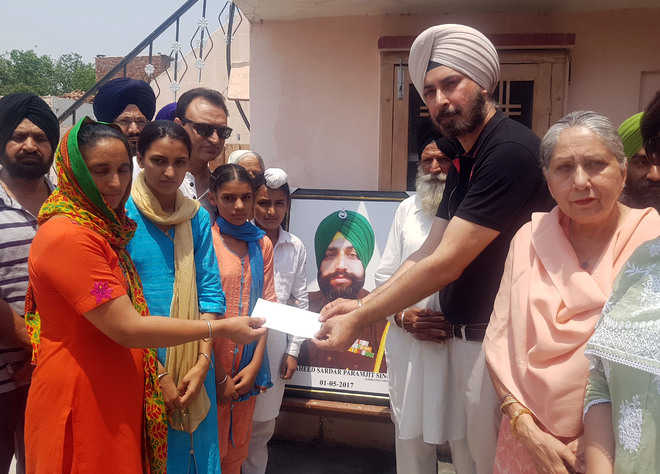
Members of VOA, an NGO, hand over a cheque to a martyr’s family on Sunday. Tribune photo

Tribune News Service

Amritsar, May 14

Voice Of Amritsar (VOA), an NGO, today honoured its commitment to help the family of slain martyr Subedar Paramjit Singh at Vein Pein village near Taran Tarn. A cheque of Rs 1 lakh was given to his wife Paramjit Kaur. She has two daughters — Simrandeep Kaur and Khushpreet Kaur — and a son, Sahildeep Singh.Subedar Paramjit Singh displayed exemplary courage taking on the enemy and laid down his life defending the motherland. His mutilated body was later recovered from the Line of Control (LoC) in J&K. VOA, in its tribute to the soldier, initiated this help to ease out the financial burden of the family, said Dr Rakesh Sharma, founder president of the VOA.While handing over the cheque to the wife of the martyr, VOA president Seenu Arora urged the government to support his family, especially the children for their education and ensure all possible help in this hour of need. “It’s our duty to look after the family of the martyr till it achieves self-sufficiency,” said Indu Arora , a VOA executive, who accompanied the delegation of members of the NGO.“We promise to offer their family all medical support at Guru Nanak Dev Hospital, Amritsar, whenever they need,” added Dr Rakesh Sharma. “We will never let the morale of our soldiers die and will always keep them in high spirits ensuring a full support to their families,” said Neeta Mehra, a VOA executive. Their family is our responsibility, she added.


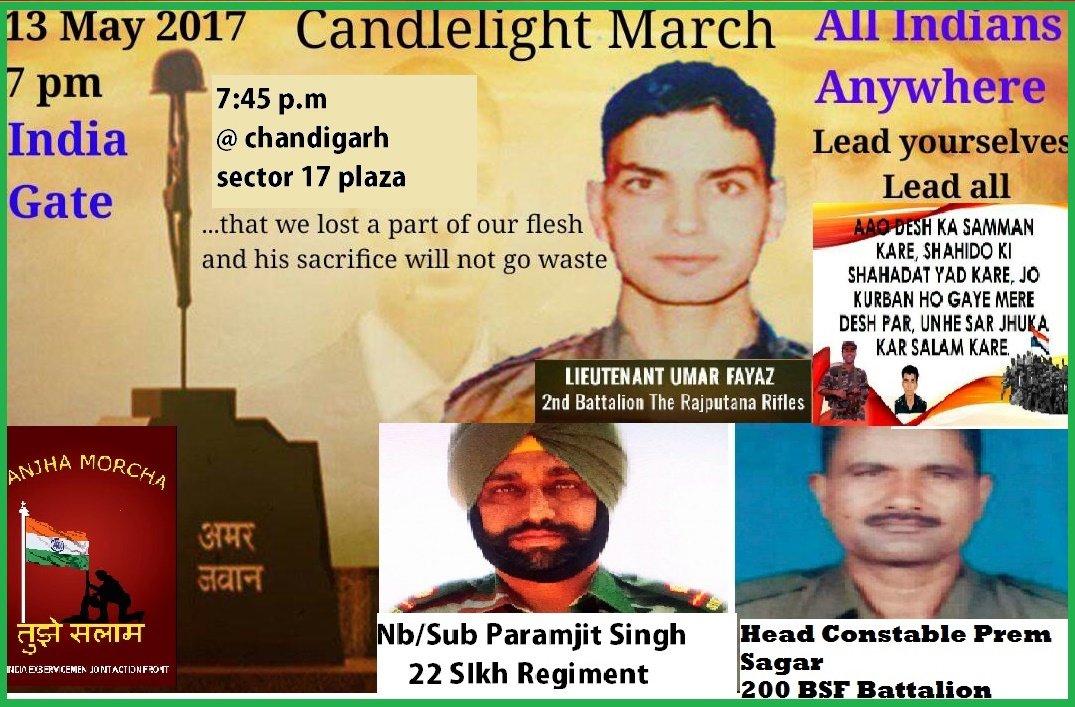
CANDLE LIGHT VIGIL FOR MARTYRS ON 13 MAY 2017 THROUGH OUT INDIA::at the Palaza Sector 17 , Chandigarh*.

 Untitled
      As WE ALL  know  *Lieutenant Umar Fayaz was murdered while on leave by the terrorists* a few days ago AND Nb Sub Paramjit Singh of 22 sikh Regt and and Head Constable Prem Sagar od 200 BSF battalion in .  Poonch district of Jammu and Kashmir
ALL are requested to take part in the vigil to pay homage to these Martyrs  by joining the said *candle light vigil*  in overwhelming numbers. on *13 May 7.45 PM at the palaza Sector 17 , Chandigarh*. Do bring Candles alongwith and banners if any
Col Charanjit Singh Khera(Retd)
Gen Secy
Sanjha Morcha
9988266450

Woman killed in Pakistan shelling in J&K’s Rajouri district

Schools to remain closed along LoC in Nowshera today

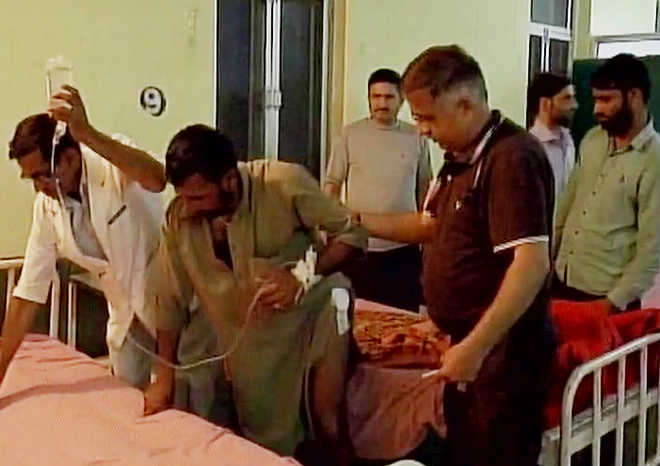
An injured being treated at a hospital in Nowshera. ANI

Tribune News Service

Jammu, May 11

A 35-year-old woman was on Thursday killed and her husband injured in mortar shelling by Pakistani troops in Nowshera sector of Jammu and Kashmir’s Rajouri district.

The shelling hit a village in Laam belt of Nowshera sector, killing Akhtar Bi and injuring her husband Mohmmad Hanief (40).

“The Pakistani Army fired from small arms and automatic weapons from 10.40 last night on Indian Army posts along the LoC in Nowshera belt of Rajouri district,” a defence spokesman said.

(Follow The Tribune on Facebook; and Twitter @thetribunechd)

They also shelled forward posts and civilian areas using 82 mm and 120 mm  mortars, he said.

“The Indian Army posts are retaliating strongly and effectively. The firing is presently on,” he said.

There have been six ceasefire violations in April Month.

The latest incident of ceasefire violation comes after the beheading of two Indian soldiers by Pakistan’s Border Action Team on May 1.

Under the cover of heavy mortar fire, the Pakistani special forces team sneaked 250 metres across the Line of Control (LoC) into the KG sector of Poonch and beheaded the soldiers.

The Home Ministry has said that at least one incident of ceasefire violation by Pakistan took place daily along the LoC in Jammu and Kashmir in 2015 and 2016 in which 23 security personnel lost their lives.

As many as 1,142 terror incidents were reported in the state between 2012 and 2016 in which 236 security personnel and 90 civilians were killed, it said.

According to the reply, Pakistan breached the truce along the Line of Control 449 times in 2016 as compared to 405 violations in 2015. 23 security personnel were killed in the two-year period.

Meanwhile, the administration has directed closure of schools in villages adjoining Line of Control in Nowshera today.

—With Agencies


HEADLINES :::09 MAY 2017

breakl line

VISIT TO MARTYR SUB PARAMJIT SINGH RESIDENCE AND HONORED WITH RS ONE LAKH:::: VIRAL VEDIOS AND REACTIONS

EXCLUSIVE: HOW 4,000 ARMY PERSONNEL THWARTED AN ATTEMPT TO DECLARE SHOPIAN AS ‘AZAAD KASHMIR’

FINALLY, A RETURN TO OLD TACTICS BY LT GEN SYED ATA HASNAIN (RETD)

TIME TO TAKE A BREAK, ARMCHAIR WARRIORS BY LT GEN K.J. SINGH (RETD)

MAOISTS FORGE ‘ROCKET­POWERED’ RESURGENCE TO TAKE ON FORCES

ONE STEP AHEAD THE MORE WE LEARN THEIR TACTICS, THE MORE THEY LEARN OURS, SAYS CRPF

INDIA ‘OVERLY INTERPRETING’ BEIJING’S MILITARY BUILD UP: DAILY

MOD RAPS MILITARY ENGG WING OFFICERS FOR COMPLAINING DIRECTLY

84-year-old donates savings to armed forces

PAKISTAN AGAIN VIOLATES TRUCE IN NOWSHERA SECTOR

NOTHING TO DO WITH IS, OTHER JIHADI GROUPS: SEPARATISTS ‘STRUGGLE FOR FREEDOM A LOCAL MOVEMENT… NO LINK WITH GLOBAL MOVEMENTS’

PUNJAB NEWS :::09 MAY 2017

2 pvt producers got Rs 900 cr for no generation of power
No jeans, tops for women teachers in Punjab
SGPC honours Capt at Golden Temple
IT WAS CAPT’S FIRST VISIT TO THE SHRINE AFTER BECOMING PUNJAB CM
INAUGURATES TRACTOR PRODUCTION FACILITY
Ensure security of Sikhs in US, CM tells Centre
Need-based changes in Cong unit on cards
70 yrs on, holy city holds on to its British legacy

breakl line


China-Nepal joint exercises: Whispers of a larger game Bhartendu Kumar Singh

The joint military exercises between China and Nepal reaffirm doubts about China’s larger strategic intentions. The constitutional stalemate in Nepal, the domination of pro-China elements in internal politics and the off and on bitterness with India strengthen Chinese grip over the landlocked country.

China-Nepal joint exercises: Whispers of a larger game
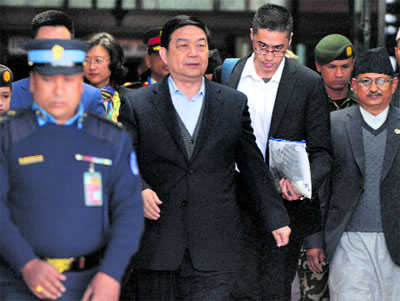
diplomatic power: Chinese Defence Minister Chang Wanquan (C) arrives at Tribhuwan International Airport in Kathmandu, to discuss joint military exercises. AFP

China has been conducting joint military exercises with many countries of the world. Yet, many of those have not generated as much heat as the recent Sagarmatha exercise with Nepal did. True, the scale of exercise was brought down due to internal apprehensions and external doubts and limited to generic issues of counter-terrorism and disaster response but it has reaffirmed doubts about China’s larger strategic intentions towards India and South Asia. The strategic intentions become clear if contexualised within the contours of emerging strategic realities related to China. First, China is going through another phase of military reforms. There is a single theatre command against India and other South-Asian countries, including Nepal. In earlier stages of military modernisation, China undertook massive development of logistics in Tibet, including roads, railways and other communication network to facilitate movement of troops. Though the approximate numbers are not known but China has positioned huge number of missiles of different ranges, tanks and armoured brigades enhancing its strategic advantage near the Line of Actual Control (LAC) with India. Second, while China has not named India as adversary in its February white paper on defence focussing, instead, on Asia Pacific neighbours. Its treatment of neighbours is increasingly becoming more assertive and, often, quite offensive. It has been pricking India through recurring intrusions across the LAC and has hardened its position in border negotiations through new demands on Tawang. Third, Nepal is fast metamorphosing into China’s grand strategy of soft-boxing India. China is extending road and rail networks from Tibet to the Nepal border and inside. It would prefer reaching upto Nepal’s southern peripheries. China is also developing some airports and power projects that could become an alibi for testing infrastructural support and terrain for futuristic requisition. China has also been pampering Nepal with soft tools of military diplomacy like friendly treatment akin to an ally, training of Nepal troops and supplying them with light weapons. In the bargain, the goal could be terrain familiarisation and route mapping of Nepal. The joint exercise reflects the complex contest for supremacy in Nepal where India has been doling out Rs 2,000 crore every year in defence pensions only to Gurkhas, apart from other elements of a benevolent neighbourly policy. China is building up and consolidating geographic and strategic advantage in its favour. There are various hypothetical scenarios of increasing Sino-Nepal military cooperation becoming permissive cause of rift and even war between China and India. At its minimum, the Chinese could use Tibetans, Nepalese or even themselves to spy on India by sitting in the Terai tract of Nepal. Since the India-Nepal border is open and not well-guarded, Chinese could play hide and seek in border areas. China could also be planning out a long-term strategy to reduce Nepal’s dependence on India and make it look northwards through the Tibet gateway. Nepal’s willingness for inclusion in China’s One Belt, One Road (OBOR) is a step towards economic and strategic dependence of Nepal towards its northern neighbour. Even if it happens partially, Nepal becomes part of Sino-centric regional order threatening pax-Sinica (peace at Chinese terms) to India. At its worst, China could use the Nepalese corridors to push through an attack on Northern UP and Bihar in no time. Humphrey Hawksley in his fiction Dragon Fire (2000) had partially alluded to such a futuristic scenario. India does not have any defensive corps presence or any major military formation north of Ganga to hold on to the Chinese till reinforcements arrive from Bengal or UP. Some border roads in Bihar that were constructed in the wake of the 1962 War are yet to be developed as strategic roads. The Border Roads Organisation (BRO) is yet to take up any road development project in North Bihar or UP. It is debatable if such a hypothetical Chinese attack using Nepal is imagined in India’s threat perceptions since no research institutes have come out with any publication alluding to such hypothesis. This despite the fact that the Sino-Nepal axis could be equally damaging to India like the Sino-Pakistan axis since China is exploiting Nepal’s military diplomatic requirements into an opportunity for itself. India, therefore, needs to initiate several policy steps. First, India’s think tanks need to develop and proliferate a complete database about the military formations, logistics development and stockpiles of arsenals in Tibet. Second, steps are needed for hyphenating Nepal with China. Should India have a forward defence along the Sino-Nepal border akin to the spirits of 1950 treaty? Does India need to play a more proactive role in the military modernisation of Nepal? Should India compete with China and help the development of roads and rails in southern Nepal? These are issues that need consideration. Third, India needs to develop military logistics and infrastructure along with reasonable military deployment in northern Bihar and UP for better deterrence. Probably, that can help India manage Chinese overtures towards Nepal without affecting its own national security. The writer is in the Indian Defence Accounts Service. The views expressed are strictly personal. 


Troops on alert as tension simmers at Indo-Pak border

AMRITSAR: With tensions simmering along the Indo-Pak borders after bodies of two soldiers were mutilated by Paksitani forces in the Poonch sector, the Border Security Force (BSF) is maintaining a high vigil along the Punjab border.

HT FILEBSF is maintaining tight vigil in the Bamiyal sector in Pathankot.

SURVEILLANCE HIGH AT THE ATTARI­WAGAH JOINT CHECK POST

Surveillance is high at the Attari-Wagah joint check post where thousands of visitors gather every evening for the retreat ceremony. The security inside and around the integrated check post (ICP), where trade takes place between the two nations, has also been heightened. BSF sources have claimed that extra caution is maintained in the Bamiyal sector along Pathankot.

“Top vigil is being maintained to ensure that no attempt of infiltration or smuggling is made. After the Poonch incident, fresh guidelines have been issued to the troops,” said a BSF official.

Infamous for smuggling of drugs, things have changed after 60 Pakistani nationals were killed in a blast on the Pakistan side of the visitors’ gallery. After the incident, a few tourists are allowed near the zero point and CCTV cameras have been installed to keep a check on the movement.

There is multi-tier checking of vehicles by the BSF soldiers that reach the border every evening for the ceremony. Meanwhile, tension along the Jammu & Kashmir border has not impacted trade between the two countries in Punjab.

Speaking to HT, an ICP official said, “Security is high but the trade between two countries is normal. Trucks are coming from Pakistan, carrying mainly gypsum, cement and few other products while India is exporting cotton to Pakistan.”


Kashmir Valley On the Boil: Talks Necessary for Peace by LT GENERAL HARWANT SINGH

Kashmir valley is once again on the boil, though with greater intensity. School and college girls too, joining the ranks of stone pelters is a new and worrying development. What should be of concern is the radicalization of the youth through indoctrination and call for creating an Islamic state and not so much for mere ‘azadi.’ Stone pelters no more need monetary incentive for targeting security forces. In this new development separatists have been rendered some what irrelevant while gun, totting terrorists roam the lane of remote villages and elsewhere threatened people, calling upon them to keep away from pooling booths.

It was the killing of a known terrorist, Burhan Wani, that started the agitations and the stone pelting. Since Then social media and cell phone have become the new weapons in the hands of the separatist and ISI of Pakistan, to radicalize the youth, as also through this medium marshal crowds who indulge in stone pelting to interfere with the anti-terrorist operations by the security forces and this often helps terrorists to escape. It is something, which the state government and the Centre, has failed to counter and let the situation slip out of hand. Blocking social media sites and clamping on inter-net by itself is not adequate.

Use of pellet guns by the Central police blinded large number of young boys and that gave greater impetus to protests. It was a wrong weapon for crowd control, equally police used its gun to kill rather than incapacitate the miscreant.

Pakistan was expected to not only exploit the situation but, give further impetus to the disturbances by staging cross border raids in continuation of its policy of ‘thousand cuts.’ Pakistan enjoys China’s backing and together they are putting pressure on India: one by raking up the issue of Dalai Lama’s visit to Arunachal Pradesh and the other by giving death sentence to Kulbushan Yadhev. At our end, cow vigilantism and Hindutva brigade, has created new fears in the minds of people of the Valley.

Surgical strikes have had no discernible outcome, except some political gain. Much of the discontent in the Valley has been hyped up. There is no abject poverty there, as it is in other areas of J and k and parts of India. Billions of rupees that Indian government has been doling out to J and K, since independence, have mostly been deployed in the valley, where majority community has been getting the benefits of ‘Minority Community.’ Where subsidized rations has been the norm for a very long time. Ofcourse good portion of funds have been ending up in political and bureaucratic pockets and together they have tried to maintain this state of uncertainty and ambiguity.

Job of security forces in handling bloodthirsty mobs, especially when there is so much restrain on their reactions, is both difficult and stressful. Carrying a stone pelter on the bumper of a jeep was perhaps the best option to rescue those nine odd security personnel, surrounded as they were, by a few hundred strong murderous mob.

Those who criticise this action by the officer have little alternative to offer. What were the possible options for the officer on whom the call for help was made! He could have used force to disperse the mob and rescue those nine odd security personnel. In any case those surrounded by the mob had weapons and could use these and come out of that cordon. However the officer decided to adopt a novel idea of carrying a stone pelter on the bumper of his jeep, which left the mob amused if not confused and he rescued those nine odd security personnel without having to resort to use of force etc. The stone pelter was not put there as a shield because, he shielded nothing. Those living in secure environments and operating from air condition offices cannot get a feel of the stress, heat and pressure on those facing violent mobs and called upon to take instant decisions.

There has been some degree of uneasiness in the present collation government in the state and demand are being made to dismiss it and bring in Presidents rule with a suitable governor. On the issue of starting a dialogue with the ‘stake holders,’ the central government is less enthusiastic and wants normalcy to be restored first. It has become the question of egg or chicken first! The central government does not appear to want to include separatist leaders.

There is much talk of a political solution and yet no one seems to spell out as to what that solution is! It cannot be Azadi. Nor can India accept reverting back to the status the state enjoyed prior to 1953. On the other hand Pandits were driven out of the valley while the Indian state, (during President’s rule ) remained in a state of paralysis and helplessly watched this national disgrace and ignominy. Now their resettlement in the valley is nowhere on the scene. Those who came from PoK and settled South of Pirpanjal Range have yet to get their citizenship and voting rights. Their number is 7.5 lakhs. Even request for land on lease at Baltal, to built temporary shelter for pilgrim on Amarnath yatra resulted in large scale protests by the locals. A defence colony at Srinagar , for ex-servicemen from J and K too has been vehemently opposed by the separatists. Yet government spends around Rs 100 crores for the security and comfort of separatist leaders.

The state has its own constitution and almost independent High Court. Elections are regularly held and political party with majority forms the government as per the democratic norms. It get more money from the central government than its due share.

The immediate solution lies in starting a dialogue with all the stake holders and bring peace to the Valley. It is perhaps wrong to exclude separatists leaders from this proposed dialogue, though they do not contest elections, but do call the shots in the valley. The long term solution lies in bringing prosperity to the state through large scale investment in tourism, industry, education and healthcare, thus creating lakhs of jobs for the youth. Large scale investments can only come about where there is peace and the existing state laws are suitably amended.


With lal-batti, has the Bandobust gone too?

With lal-batti, has the Bandobust gone too?

With lal-batti, has the Bandobust gone too?
Sandeep Sinha
There was a popular ad by a luggage manufacturing company that said, “VIPs are made and unmade, but aristocrats are born.”
In one stroke, Prime Minister Narendra Modi has lived up to this adage, with his government deciding to do away with the lal-batti culture and defining the pecking order by listing only those who are entitled to this symbol of power and authority.
The Prime Minister was not far from truth when he said the lal-batti had become a part of a person’s psyche in the country. In fact, it had not only become a part of psyche, but also a status symbol, signifying the ultimate aspirations of a wannabe.
And therein lied the problem. Other than the officials and constitutional authorities who could use it, the beacon caught the fancy of even the lower-rung politicians and the proliferation of bureaucracy, which would have delighted a Sir Humphrey Appleby, only compounded the problem with the number of vehicles fitted with beacon atop, increasing in number.
It is a good start. But to be fair, there is no dearth of officials who do not misuse it. There are many men of integrity who do not allow even their spouses to use their official car and the beacon flashes only when the officer himself is aboard.
But in a country where the feudal mindset still prevails, the lal-batti came to denote privileges and facilities as a symbol of power and the clamour for its use increased. Why only this? In mufassil towns, one can find vehicles with “Sarpanch” or “Chairman, Zila Parishad” written on them. It is a manifestation of that mindset.
But the lal-batti is only a part of the VIP culture Mr Modi talked about. The VIP culture also includes putting people to inconvenience. When PM Modi visited Chandigarh in 2015, the city witnessed a complete shutdown putting the citizens to great hardship. All 187 public and private schools were declared shut.
It made Modi tweet: “The inconvenience caused to citizens of Chandigarh, especially shutting of schools due to my visit, is regretted. It was totally avoidable.” An inquiry was ordered.
During the tenure of Manmohan Singh as Prime Minister, in 2009, Sunit Verma of Ambala, who was critically ill, died as his ambulance got stuck in barricades around the PGI. Again in 2011, Surjit Kaur of Mohali died as her ambulance was stopped for the security rehearsal of Nepal President Ram Baran Yadav’s visit.
And these are only the cases which got reported. There must have been many more who must have suffered.
In Delhi, when Inder Kumar Gujral was the Prime Minister, I alighted from a bus at the ITO only to find policemen wildly swinging their lathis and chasing people into the alleys as the PM’s cavalcade was to pass that way.
And recently, there was the instance of a former Union minister, Hukum Deo Narayan, who refused to travel along with the other passengers in the coach to board the aircraft. He wanted the whole bus to himself, a privilege granted to him by the airline.
It is not just those in power who enjoy VIP status in our country. VIPs in our country enjoy disproportionate privileges even when out of power. I was watching TV when David Cameron resigned as Britain’s PM. He left in a different car after meeting the Queen and it was heart-warming to see his car stop at the traffic lights. That’s some lesson for the netas of a country that has modelled its democracy on the Westminster model.
We are a country where people are deprived of even the most basic of facilities. Positions of power appear to be a way out. The lal-batti acts as a social leveller, investing power and authority, which in turn begets perks and privileges. By doing away with it, the government has taken a good initiative.
But the beacon is only a part of the malaise. The cavalcades that keep getting longer and the elaborate security arrangements too are part of the VIP syndrome. That too will call for efforts to rid the representative form of government in this country of VIP culture.


An uncomfortable corner Vivek Katju

An uncomfortable corner
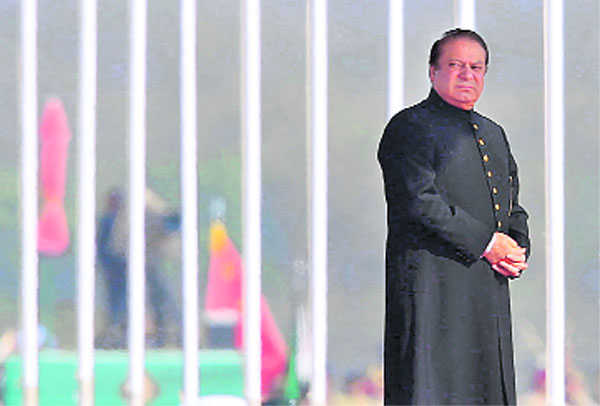
In spot: Sharif’s political future and the fate of his family is in the army’s hands.

WITHIN a few months of taking over, Pakistani army chiefs feel the need to send sharp messages to their country’s political leadership that they will not allow the dignity of the institution they lead to be trifled with. They also send signals both to their own elected government as well as to Delhi that the buck stops with them in the making of Pakistan’s India policy. Gen Qamar Bajwa who took over as the army chief five months ago has not been an exception. He has delivered messages on both fronts. Last October, the Dawn newspaper reported that at a top level meeting where PM Nawaz Sharif was present his brother, the powerful chief minister of Punjab, Shahbaz Sharif, rebuked the then DG ISI for putting pressure for the release of terrorists arrested by the law enforcement agencies. At the same meeting, the then Pakistan foreign secretary said inaction against terrorist groups such as the Lashkar-e-Toiba, the Haqqani Network and the Jaish-e-Mohammad was leading to the country’s isolation. The report was denied but the army was furious at the leak of even an ‘inaccurate’ account of a sensitive meeting. Its real anger was, of course, at it being projected at the receiving end of a civilian tirade. It compelled Nawaz Sharif to appoint a committee chaired by retired judge Aamar Raza Khan with intelligence agencies representatives, including the ISI’s, along with others as members. The committee submitted its report to the interior ministry on April 25. A day later, it reached Nawaz Sharif’s office. On April 29, Sharif’s office conveyed to the ministry that the PM had inter alia approved that the foreign policy charge of his influential special assistant Tariq Fatemi be withdrawn and that appropriate action be taken against the government’s principal information officer (PIO). In the wake of the Dawn report, the information minister had resigned in October itself. Obviously, the report, which has not been released, had passed strictures of some kind against Fatemi and the PIO.No sooner was Sharif’s decision made public, the DG ISPR, Maj-Gen Asif Ghafoor tweeted, ‘Notification on Dawn leak is incomplete and not in line with the recommendations. Notification is rejected.’ Clearly, the army’s swift and brutal response was to put the Sharifs, already weakened by the Panama leaks case, on the mat. It was also to show that the army’s honour would be satisfied only if the PM was to sacrifice someone close to him; it is widely believed that Nawaz Sharif’s daughter Maryam, who is being groomed by him in politics, had a hand in the Dawn leak. Sharif is in a quandary and is holding meetings with his top aides to find a way out. It is unlikely though that General Bajwa will allow him to escape without extracting a higher price. The Pakistan army’s corps commanders and principal staff officers meet regularly under the army chief’s chairmanship not only to discuss military matters, but also important issues before the country. No doubt, they do so as the army is the self-appointed guardian of the ideology of Pakistan. However, even by its own standards, the commanders’ decision to discuss the Supreme Court decision in the Panama leaks case against the Sharifs was simply extraordinary. More so was what the ISPR conveyed after the meeting. On April 24, Maj-Gen Ghafoor tweeted, ‘Forum also discussed the Panama case decision of the Supreme Court with special reference to the joint investigation team (JIT). The forum pledged that the institution through its members in JIT shall play its due role in a legal and transparent manner fulfilling the confidence reposed by the apex court of Pakistan.”This stretches the court’s decision to include the ISI and MI representatives in the JIT to an unwarranted extent. It also signals to Sharif that not only his political future, but virtually the fate of his family is now in the army’s hands. Clearly, the ISI and MI representatives will be guided by the army leadership on the stand to be taken in the JIT.These two cases are within the ambit of Pakistan’s domestic politics. However, Bajwa’s decision of April 11 to confirm the death sentence against Kulbhushan Jadhav, and the mutilation of the bodies of Naib Subedar Paramjeet Singh of the Indian Army and the BSF’s Head Constable Prem Sagar on May 1 relate to Indian-Pakistan relations. They were killed inside Indian territory by a Border Action Team of the Pakistan army. Significantly, Bajwa had visited the LoC a day before, from where he accused India of state terrorism in Kashmir. Through these actions, he was seeking to ensure that Sharif and PM Narendra Modi give up any thought to untangle bilateral ties. There was intense speculation in the media about a meeting of the two Prime Ministers on the margins of the Shanghai Cooperation Organisation summit next month in Kazakhstan following the flying visit on April 27 of Indian industrialist Sajjan Jindal of the JSW group to Pakistan to meet his ‘friend’ Nawaz Sharif. The media pointed out that Jindal had played a crucial role behind Sharif’s visit to India for Modi’s inauguration in May 2014 and also Modi’s visit to Lahore on Christmas in 2015. Pakistani politicians and the media also speculated that Jindal’s meeting with Sharif was to pass a message on the Kulbhushan Jadhav matter. Maryam Sharif clarified that Sajjan Jindal visit was of a private nature, but hardly anyone in Pakistan believes that. The army has not said a word. However, it may be recalled that it was very unhappy with Sharif’s Delhi visit as also Modi’s Lahore trip. It simply does not like back-channel arrangements in which it has no direct role. It also has bad memories of the Modi-Sharif’s 2015 Ufa decisions. The mutilation would make a productive Modi-Sharif meeting in Kazakhstan unlikely, if not sabotage it altogether.All these developments point to the fragility of Pakistan’s current politics and Sharif’s vulnerabilities. The army may not work to show him the door, but it has put him on notice to refrain from going beyond the red lines on ties with India. There is little doubt that it feels that India is on the defensive in J&K and it does not wish to release pressure.  The writer is a former Secretary, Ministry of External Affairs