Sanjha Morcha

Situation untenable: Basit Pak envoy says from J&K to terrorism, Islamabad ready to discuss all

Situation untenable: Basit

Simran Sodhi

tribune news service

New Delhi, May 19

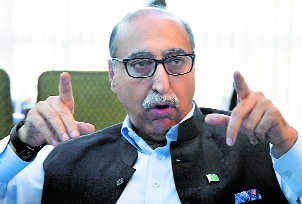
The present India-Pakistan situation is “untenable”’ and “pre-conditions” to talks don’t work, Abdul Basit, Pakistan’s High Commissioner to India, told The Tribune today.Pointing to the Kulbhushan Jadhav case, he said: “Pakistan as a responsible country, never flip flops on principles to cater for temporary benefits. And like all other states, we do not compromise on issues related to national security.”(Follow The Tribune on Facebook; and Twitter @thetribunechd)Reiterating Pakistan was willing for a “meaningful engagement with India,” he emphasised the only way forward was dialogue. On India’s contention that “talks and terror can’t go together”, Basit said sooner or later, Pakistan and India would have to come to the negotiating table, “either now or five years down the lane.The envoy urged India to return to the 2009 Sharam al Sheikh Statement wherein the two countries had decided to keep the issues of terrorism and talks apart. “We need to revert to that statement,” he said, stressing Pakistan was willing to discuss all issues, from Jammu and Kashmir to terrorism.Consistently referring to Jadhav as “Commander Jadhav,” he spoke of the “limited reprieve given to India”  by the  International Court of Justice (ICJ) while giving a stay on Jadhav’s execution, which the envoy pointed out was of no consequence as “he (Jadhav) was not being executed yesterday.” He was non-committal on whether the ICJ verdict was legally binding on Pakistan “I don’t see how Commander Jadhav can be executed over the next month. There is a process which will take its course.”On consular access/ visas to Jadhav’s family, the envoy said these would have to be decided on merit. “Pakistan is not really worried; we believe that as far as Commander Jadhav is concerned, Pakistan is on terra firma (solid ground). The case is also a testimony to the fact that terrorism in Pakistan is not without external dimensions.”Referring to the lack of progress in the Mumbai and Pathankot trials, Basit stuck to his earlier argument that progress could not be achieved till the two countries talked to each other.   “On Pathankot, how can you achieve results without cooperation? We agreed to send our investigators, we extended full cooperation. It is important to retain the spirit of cooperation.”On the speculation that Narendra Modi and Nawaz Sharif might meet on the sidelines of the Shanghai meeting in June, Basit said there was no such proposal yet from either the Indian or the Pakistani side.“Pakistan’s stand has always been that back-channel diplomacy without front-channel diplomacy is irrelevant,” he added. 

clip

clip

clip

clip


Jaitley reviews J&K security

Jaitley reviews J&K security
A girl carries stones during a clash with police outside a college in Srinagar. PTI

Srinagar, May 17

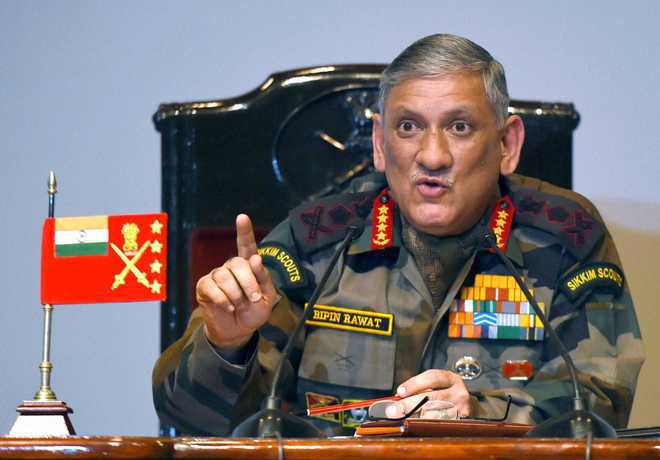
Amid a spurt in ceasefire violations along the Line of Control, Defence Minister Arun Jaitley and Army Chief Gen Bipin Rawat held a security review here today and discussed measures for countering the street violence in the Valley as well as militancy.Jaitley, who also holds Finance portfolio, is on his first visit to Kashmir after taking over the additional charge from Manohar Parrikar. “The Defence Minister was apprised of measures to strengthen the robust counter-infiltration grid along the LoC. He was briefed on the close coordination among all agencies towards bringing back normalcy in the region,” defence spokesperson Col Rajesh Kalia said. (Follow The Tribune on Facebook; and Twitter @thetribunechd)Also at the security review meeting were Sanjay Mitra, Defence Secretary-designate,  and top Army officers. Lauding the valour, sacrifice and patriotic fervour of soldiers, Jaitley urged them to ensure safety of the innocent. — TNS


Militant leader quits Hizb after war of words

SRINAGAR: Radical militant leader Zakir Musa on Saturday severed ties with the Hizbul Mujahideen, hours after the outfit trashed his threat to behead separatist Hurriyat leaders, a development which could potentially impact militancy in Kashmir.

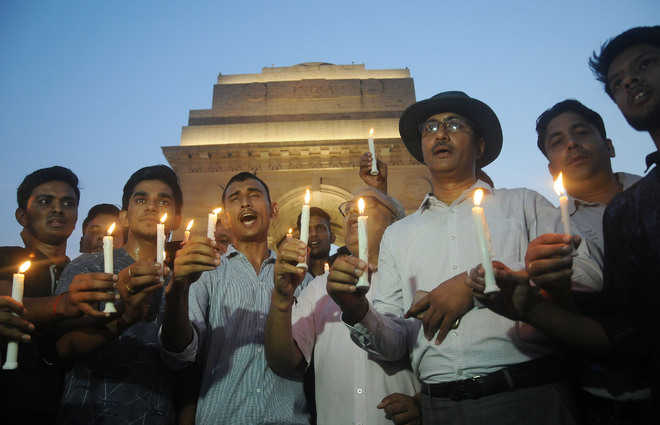
BURHAAN KINU / HTPeople hold a candlelight vigil for slain army officer Lt Ummer Fayaz at India Gate in New Delhi on Saturday. >>P8

In a separate incident, at least two civilians including a minor girl were killed when Pakistani troops rained mortars on 35 villages and Indian posts along the Line of Control (LoC) in Jammu and Kashmir’s Rajouri district on Saturday. Nine other people, including four Indian Army personnel, were injured.

India’s blames Pakistan of stoking militancy in Kashmir but Musa’s decision signalled serious differences among homegrown militants in the valley and the outfit’s leadership, based in Pakistan-occupied Kashmir.

Musa said the armed insurgency was aimed at creation of an “Islamic Kashmir”. “…If Hizbul Mujahideen doesn’t represent me, then I also don’t represent them. From today onwards, I have no association with Hizbul Mujahideen,” Musa said in an statement on Saturday.

IG GILANI SHUNTED OUT

Kashmir range insepctor general SJM Gilani was shunted out on Saturday amidst ongoing incidents of violence in parts of the Valley. He has been replaced by Muneer Khan.


Lt Fayaz’s killing will be avenged: Army

Lt Fayaz’s killing will be avenged: Army
People take part in a candlelight procession in memory of Lt Ummer Fayaz at the India Gate in New Delhi on Saturday. Tribune Photo: Mukesh Aggarwal

Suhail A Shah

Kulgam, May 13

General Officer Commanding (GOC), Victor Force, Major Gen BS Raju, said today that the life of Lt Ummer Fayaz, killed by militants while on holiday, would not go waste and the militants involved in the cowardly act would be brought to justice.General Raju today visited the slain Army officer’s family at Sursuna village in Kulgam district.Lt Fayaz was abducted by militants from Batpora village of Shopian district on the evening of May 9, where he was attending the marriage ceremony of a cousin.Lt Fayaz was found dead the next morning in an orchard, his body riddled by multiple bullets. The killing was widely condemned.General Raju assured the mourning parents of Lt Fayaz (and later while talking to mediapersons) that his killing would be avenged soon.“Action will be taken against militants involved in this cowardly act. The action will be taken in our way and very soon,” General Raju assured.He said the Army would take utmost care that no civilians were hurt or put to inconvenience during Army operations, targeting these militants.General Raju praised Lt Fayaz’s parents for deciding to send him to the National Defence Academy (NDA).“His fight began five years back when he decided to join the NDA and serve in the Army. He chose the unconventional and I must say he has been successful in his battle,” General Raju said.He added that despite serving the Army for only four months Lt Fayaz was already a hero to him.“He is already a hero and he has won his battle,” the GOC told the reporters.The GOC presented a cheque for Rs 75 lakh from the Army Group Insurance Fund to the bereaved family and another for Rs 1 lakh from the martyr’s regiment Rajputana Rifles.The GOC said the situation in south Kashmir was calm in general, but there was little bit of agitation in a few educational institutes.“The life is going on normally. 95 per cent of the schools are functioning normally… There are 40-50 students in four to five colleges who create ruckus. Some virus has entered them which we have to remove. I am sure that the summer will be peaceful,” General Raju said.


Army school to be renamed after martyrThe Army has decided to name one of its “Goodwill” schools after Lt Ummer Fayaz. General Officer Commanding (GOC) the Victor Force, Major Gen BS Raju on Saturday announced the decision at Lt Fayaz’s home at Sursuna village of Kulgam district. “The Army-run Goodwill School in the Behibagh area of Kulgam district will be renamed after our martyred officer,” the GOC told the family. The school will be called “Shaheed Lt Ummer Fayaz Goodwill School” from now on. oc


Punjab seeks Centre’s help to check cross-border drug

Punjab Chief Minister Amarinder Singh today sought help and cooperation from the Centre and neighbouring states in putting an end to smuggling of drugs into the state from across the border.

Addressing the 28th meeting of the Northern Zonal Council (NZC) here, presided over by Home Minister Rajnath Singh, Amarinder referred to the rampant drug menace in Punjab and said the problem needs to be combated in a systematic and organised manner

The chief minister said the Centre should order security forces to maintain strict vigil on the border to check cross- border smuggling of drugs.

He stressed on the importance of inter-state coordination and urged the neighbouring states of Rajasthan, Haryana, Himachal Pradesh and Jammu and Kashmir to make focused efforts for the destruction of illegal poppy and cannabis cultivations.

Amarinder, according to a state government release here, also called for effective plugging of pilferage of narcotic substances from areas where they are being cultivated legally for pharmaceutical and related purposes.

Sharing of information and initiating criminal action against the smugglers involved in the trade should be encouraged, he said.

He also called for shifting of poppy husk vends located in Rajasthan along the border villages of Punjab.

Saying that Punjab was a border state, Amarinder demanded central government concessions as compensations for the financial and economic loss already suffered by it.

He also called for greater operational freedom to states in choosing and financing their developmental properties, since state governments “are in a much better position to understand, address and solve the problems of their people, at the cutting edge.


China asked to take note of India growth

BEIJING: India has the potential for “explosive economic growth” and could develop into a “China 2.0” with its big market, low labour costs and large population, a Chinese think tank has said, cautioning Beijing to ignore competition from the neighbouring country at its own economic peril.

AFPBig market and low labour costs are among India’s advantages.

India’s GDP might be much lower at present but it is at an economic stage that China was a few years ago, Anbound Consultancy, a Beijing-based think tank on Chinese public policy, said.

“Just as what happened with China in the past, the changes that are taking place in India may also point to great potential for development. With a large population of young people, which is not only the labour force but also a potential consumer group, India has the possibility of seeing explosive economic growth in the future,” it said in an article published in the nationalist tabloid Global Times.

The think tank said that China hasn’t closely studied its “unfamiliar neighbour” and needs to track its economic development.

“It should be pointed out that China has not conducted enough studies on India. From the perspective of think tanks, China cannot wait until India grows into an apparently promising competitor before discussing how to deal with the situation,” it said.

“China should develop a more effective growth strategy for the new era or it may become an unfortunate bystander watching India’s success. Therefore, we must pay close attention to the development of this unfamiliar neighbour,” scholars said in the article. It added that some Chinese companies are doing well by investing in India.

“An increasing number of Chinese companies have invested in India in recent years, covering such sectors as hardware, software and marketing. Smartphone manufacturers like Vivo, OPPO and Lenovo have already entered the Indian market,” the think tank


Upholding majesty of international law

India’s moving the International Court of Justice to seek justice for Kulbhushan Jadhav, a former naval officer who was sentenced to death by a Pakistani military court vindicates the majesty of international law. It also vindicates the need for India to take international law more seriously across the board as an instrument of state policy.

Upholding majesty of international law
Long arm of law: Hopefully, the ICJ action in the Jadhav case will bring about sobriety in Pakistan”s behaviour and it will back off from the brink.

India has made a deft move to the International Court of Justice (ICJ) seeking justice for its national, Kulbhushan Jadhav, a former naval officer, who was sentenced to death by a Pakistani military court. This is the first such action by India as it had hitherto refrained from taking any bilateral issue to international forums or judicial bodies (courts and tribunals). This action has been triggered by the consistent denial by Pakistan of “consular access”, a minimal courtesy exercised by all civilised states, to Jadhav as a national of India. India expressed determination to rescue Jadhav from the Pakistani custody as it viewed the case as stage-managed abduction, slapping of false espionage charges and secretive military trial leading to imposition of death penalty. Notwithstanding lack of “compulsory” jurisdiction of ICJ, India sought to tap the legal remedy available under Article 36 (1) of the ICJ Statute (all matters provided for in treaties and conventions in force) and Article 1 of the Optional Protocol Concerning the Compulsory Settlement of Disputes (1963) to the Vienna Convention on Consular Relations (1963). The Optional Protocol provides that “unless some other form of settlement has been agreed upon by the parties…Disputes arising out of the interpretation or application of the Convention shall lie within the compulsory jurisdiction of the International Court of Justice and may accordingly be brought before the Court by an application made by any party to the dispute being a Party to the present Protocol”.  As of May 2016, the Protocol was ratified by 51 states and, amazingly, included both India and Pakistan! This represents a growing trend, wherein a state party seeks to raise issue of breach of specific treaty obligation by another state. For instance, Ukraine has taken the Russian Federation to ICJ for breach of Convention for the Suppression of the Financing of Terrorism and the Convention on Elimination of all Forms of Racial Discrimination.It is the first such resolute support provided by India to rescue a national, accused of violations of local law in another country. Due to the unusual situation prevailing in Pakistan as well as regular incidents of aiding and abetement of cross-border terror chain of pin-pricks, India has been forced to bypass time-tested rule of “exhaustion of local remedies” as they are in any case not available due to the current impasse. The Indian action has been buttressed by turning down of more than 15 requests for consular action by the Pakistani authorities. In a petition filed in the registry of the ICJ in the Hague, India underscored the urgency of this situation. It referred to the provisions of Article 75 of the Rules of Court, asked the Court to indicate forthwith, and without holding any hearing, provisional measures proprio motu. As laid down by the ICJ in Vienna Convention on Consular Relations case (Paraguay v. USA case;  April 9, 1998), the Court could order interim measures if there is possibility of “irreparable prejudice…to rights which are the subject of dispute…”. As a corollary, in a swift move, the President Rony Abraham issued an order to Pakistan to “act in such a way so as to enable the court to enforce any decision it takes on the Indian plea.”  As a founding member of the United Nations, India has been forced to move to ICJ not for violations of sovereignty per se but breach of an international treaty obligation — the Vienna Convention on Consular Relations, 1963. India has otherwise consistently denied efforts of countries like Pakistan to drag her to ICJ on the basis of the “Commonwealth Clause” in  declaration under Article 36 (2) of the Statute of ICJ.  Pakistan’s steadfast refusal to allow consular access to Jadhav has lent credence to Indian claim about “fixing” of Jadhav, circumstances of his alleged abduction and “sale” in early 2016 to elements in Pakistan and slapping of “espionage” case even though it was proved he was carrying an Indian passport. This, as India argued, “has prevented India from exercising its rights under the Convention and has deprived the Indian national from the protection accorded under the Convention”. The issue at stake has been the nationality of Jadhav and the prevalent right of India to provide diplomatic/consular protection to Jadhav. The case has assumed grim proportions since efforts were stonewalled by Pakistan to allow consular access to him. Demarche issued to the Pakistan High Commissioner were ignored and all pleas at the highest level fell on deaf ears. It has placed bilateral relations in serious jeopardy. The Indian contention in the Jadhav case is rooted in Article 36 (1) of the Vienna Convention that guarantees unimpeded consular communication, access and providing of legal representation by a ‘sending state’ to its nationals who are arrested or committed to prison pending trial or detained in any other manner. Pakistan’s consistent and wilful denial of India’s right to provide consular protection to Jadhav has led to the ICJ to underline sanctity of the Convention as well as efficacy of the remedy available under the Optional Protocol. Indian legal recourse is a cogent step to obtain judicial restraint of Pakistan’s aberrant conduct resulting in not only gross violation of India’s consular right but also basic human right of Jadhav under Article 6 of the International Covenant on Civil and Political Rights. This provides every human being the inherent right to life.    Generally, the UN member states take matters to ICJ on issues concerning territorial integrity and sovereignty like delimitation of land and maritime borders or other violations. It is rare that states contend before ICJ issues concerning rights of a corporate entity (Interhandle case by Switzerland against USA) or individuals (Asylum case by Columbia against Peru). In 1980, the USA also had to ICJ against Iranian revolutionary guards’ seizure of the US Embassy in Tehran. In the famous LaGrand case (1999), the ICJ upheld German contention that the USA violated the Vienna Convention on Consular Relations by not advising its national Karl and Walter LaGrand on their right to consular access that prevented Germany from obtaining effective trial counsel for them. In spite of repeated German assertions Karl La Grand was executed in the state of Arizona on February 24, 1999. The ICJ did grant urgent provisional measures and stayed the execution of Walter LaGrand that was slated for  March 3, 1999.  India had no choice amidst the groundswell of domestic public opinion as well as to counter Pakistan’s compulsive “irritation” campaign to ward off international isolation. The decisions given by the ICJ are binding on the parties to the dispute. There are glaring cases of defiance in the past by countries such as USA (Nicaragua case) and Iran (Hostages case). Still Pakistan can defy ICJ only at its own peril and at the cost of irreversibly damaging India-Pakistan relations. In this grim scenario, Indian recourse to this international law remedy has brought about a glimmer of hope. It provides a robust message that it will work wonders if India takes this vital instrument more seriously in internal governance structure as well as in the conduct of external affairs and, in turn, for maintenance of international peace and security.     Bharat H Desai is Chairman of Centre for International Legal Studies, JNU. Balraj K Sidhu is faculty member of RGSOIPL, Indian Institute of Technology-Kharagpur


Army chief hints at retaliation for soldiers’ beheading by Pak

Army chief hints at retaliation for soldiers’ beheading by Pak
Gen Bipin Rawat. File photo

New Delhi, May 4The Indian Army does not reveal plans before executing them, Army Chief General Bipin Rawat said on Thursday, indicating possible retaliation to the Pakistan military beheading two Indian soldiers in Jammu and Kashmir.Replying to a volley of questions on whether the army would respond to the barbaric act, Rawat, without giving a direct reply, said the armed forces would effectively respond to such actions by the neighbouring country.“We do not talk about future plans beforehand. We share details after execution of the plan,” Gen Rawat said, refusing to elaborate further.

(Follow The Tribune on Facebook; and Twitter @thetribunechd)

He said, “When this kind of action takes place, we also carry out retaliatory action.” He was speaking to reporters on the sidelines of an event.Vice Chief of Army Staff Sarath Chand on Tuesday had said that the army would respond to the dastardly act at “a time and place of its choosing”.Defence Minister Arun Jaitley had said that the “sacrifice (of the two soldiers) will not go in vain” and the Indian armed forces would react “appropriately” to the “inhuman act”.Sources said the army is weighing various options to respond to the beheading of a naib subedar and a BSF head constable by a Pakistani Border Action Team on the Line of Control on May 1.Asked about the reactivation of terror launchpads across the LoC which were destroyed by India during the surgical strike last year, Rawat said the “counter-infiltration postures” had been beefed up.“Terrorists are trying to infiltrate. Snows are melting, summer months have started. Like each year, infiltration will commence. We are taking measures. We have beefed up our counter-infiltration postures,” said Gen Rawat.On security forces launching a massive anti-militancy operation at multiple places in south Kashmir’s Shopian district on Thursday, the army chief said it is being carried out to bring the situation under control.“The combing operation is going on as some banks were looted and some policemen have been killed. It has been launched to ensure that the situation is brought under control. These operations are carried out regularly,” he said. PTI

23-year-old IAF man shoots himself to death in Chennai

Chennai, May 4

A 23-year-old Indian Air Force Airman allegedly shot himself to death at the Air Force station in Tambaram on the city outskirts, Defence and Police officials said on Thursday.

The airman committed suicide last night by using a firearm, they said.

“It is a case of suicide. An inquiry is on,” a Defence official said but declined to divulge any further information.

The police said body of the airman had been shifted to government hospital.

Airmen are deployed on ground-based jobs in the IAF. PTI


How nations defied them by Lt Gen Bhopinder Singh

The onus of ‘responsible’ international behaviour is realistically self-mandated on nations as the mechanisms for enforcement are weak.

Nations have unique foundational narratives, governing instincts and moral scruples that drive them to respond varyingly to internatio­nal verdicts and advisories. The verdicts, advisories or opinions of the International Court of Justice at Hague, which adjudicates over international legal disputes are a test of the intrinsic morality of the sovereign, as the same gets tested by the way the affected nations internalises, rationalises and honours the same.

As the judicial branch of the United Nations, all 193 UN-member nations automatically become party to the court’s statutes – though, the element of mutual consent to resolve disputes through the ICJ intervention, affords moral implications on complying with the ultimate verdict, irrespective of favourability.

The complexities, intrigues and unsettled positions of the Indo-Pakistan saga have ensured that the ICJ has been invoked four times (including, the recent Kulbhushan Jadhav case where India obtained a stay against the execution orders, by the questionable Military Martial Court in Pakistan). Interestingly, while India initiated the recent proceeding by invoking the Vienna Conventions of 1961, the previous three cases before the ICJ were initiated by Pakistan.

The first was in 1971 when Pakistan alleged that India had violated the International Civil Aviation Convention and the International Air Services Transit Agreement (India’s initial appeal that Organisation’s Council had no jurisdiction to decide was dismissed in Pakistan’s favour — though, the matter was mutually dropped in 1976 after the creation of Bangladesh, as the issue of overflight became irrelevant).

Similarly, the second case involving the fate of 195 Pakistani Prisoners-of-War was again mutually withdrawn with the signing of the bilateral New Delhi Agreement in 1973 that encompassed the issue. However, it was the 1999 shooting down of the Pakistani Navy patrol and reconnaissance Atlantique plane over the Indian airspace, with 16 people on board, that made Pakistan seek reparations of $60 million in the ICJ for compensation to the victims’ families.

Soli Sorabjee, India’s then attorney general, won the day with the essential plea that the International Court had no jurisdiction on disputes covered by multilateral treaties or by disputes between India and the Commonwealth countries, besides the fact that Pakistan had violated a 1991 bilateral treaty prohibiting the flying combat planes within 10 km of each other’s airspace, including Air Defence Identification Zone.

The thumping endorsement of the bench decision, with a score of 14-2, was in favour of India — the two dissenting jud­ges were Awn Shawkat Al-Khasaw­neh from Jordan and Justice Syed Sharifuddin Pirzada (who along with India’s former SC judge B P Jeevan Reddy, co-opted into the bench as ad-hoc judges).
Pakistan’s frustrations in its first three failed attempts at the ICJ were accentuated by the fourth debacle in the Kulbhushan Jadhav case. Unsurprisingly, a jarring note of disrespect emanated from the official spokesperson of Pakistani Foreign Office Nafees Zakaria, who unequivocally stated, “Pakistan doesn’t accept ICJ’s jurisdiction in Jadhav’s case”, after the negative verdict.

Now, a glaring contrast to the Pakistani response to the recent ICJ judgement is the India-Bangladesh dispute regarding the delimitation of the maritime boundary. This five- year-long arbitration case under the UN Convention on Law of Sea (UNCLOS) resulted in the tribunal awarding Bangladesh 19,467 sq km of 25,602 sq km sea area of Bay of Bengal.

However, the unambiguously negative verdict against India did not manifest in any nationalistic bravado or refusal, ins­tead the Indian external affairs ministry spokesperson stated, “We are committed to abiding by the outcome of that pro­cess.” Adhering and respecting the binding nature of the ICJ orders, given the voluntary acceptance of allowing the case to be tried in the ICJ, is a logical expression and expectation of any ‘moral state.’

Like Pakistan, its ‘all-weather-friend’ China exhibited a similar instinct to that of Pakistan’s, when it lost an arbitration case against Philippines in 2016, where the Permanent Court of Arbitration rejected China’s claim to historic rights on the region and its creative interpretation of territorial limits via the ‘nine-dash-line’ approach.

Chinese President Xi Jinping then stated, “China will never accept any claim or action based on those awards”, eerily reminiscent of the recent Pakistani intransigence. The question of a ‘moral state’ were poked by the US State Department spokesman John Kirby who said, “The world is watching to see if China is really the global power it professes itself to be, and the responsible power that it professes itself to be.”

Legislative escape-vents
The onus of ‘responsible’ international behaviour is realistically self-mandated on nations as the mechanism for enforcement are essentially weak and susceptible to the subsequent angularities of the five UN Permanent Security Council members, who can veto any proposal. However, even countries like the US are often guilty of dishonouring ICJ verdicts owing to technicalities and legislative escape-vents that belie the spirit of legality and morality.

The restive perceptions between the US and some Latin American co­untries can be explained by the US’ frequent unwillingness to submit to the plenary authority of the ICJ, especially when the verdict in a dispute is adverse to US positions. The US brazenly refused to participate in the proceedings in the merits of the case initiated by Nicaragua in 1984 and later withdrew from compulsory jurisdiction — the optics of such irresponsible sovereign behaviour militate against efforts towards international justice.

Islamabad has its own political compulsions and existential intrigues that routinely vitiate against the expected standards of a ‘moral state’. The often interchangeable terms like ‘rogue nations’ (currently the US considers North Korea, Iran, Sudan and Syria), ‘pariah states’, ‘states of concern’ or ‘state sponsor of terrorism’ are typified by a certain irresponsible sovereign behaviour towards international law, undemocratic internal frameworks and dubious intents towards other nations. Herein, disrespecting an international verdict of an independent court of law is a sure-sign of a ‘non-moral’ state.

Pakistan has an increasingly inglorious reputation of harbouring the ‘terror nurseries’ of the world, and the emerging optics of defiance to the ICJ verdict are worrisome pointers of a flawed national nar-
rative, aspiration and ultimately destiny.

(The writer is former Lt Governor of Anda­man & Nicobar Islands, and Puducherry)


’65 war hero remembered

’65 war hero remembered

’65 war hero remembered
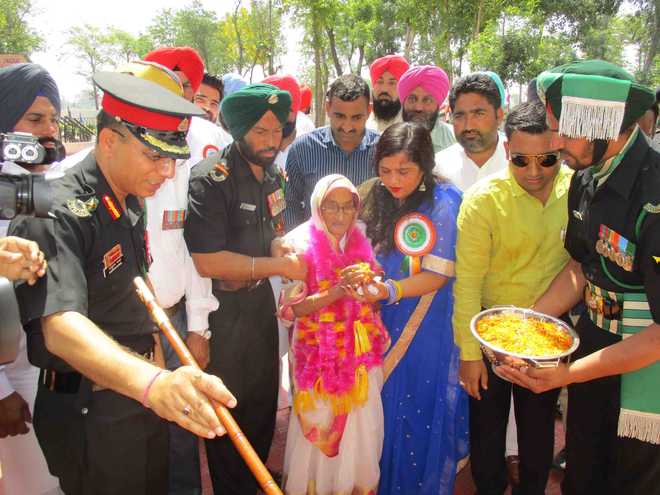
Rasoolan Bibi, wife of Param Vir Chakra awardee Abdul Hamid, pays homage at his samadhi at Asal Uttar on Monday. Tribune photo
Gurbaxpuri
Tarn Taran, May 22
Rasoolan Bibi (80), wife of Param Vir Chakra (posthumous) awardee Abdul Hamid, the hero of 1965 Indo–Pakistan war, paid homage at his samadhi at Asal Uttar today.
She was accompanied by her sons and grandchildren. Many veterans as well as civil and military dignitaries also graced the occasion and laid wreaths at the Shaheedi Smarak. Immaculately dressed troops of Gurki Brigade presented a Guard of Honour to the martyrs.
Later, Bibi also inaugurated a medical camp on naturopathy and Yoga wherein specialist doctors from Delhi rendered valuable advice and treatment to locals and veterans. She also motivated school children to join the forces and serve the nation.
She said she was proud of her husband’s sacrifice for the nation.
Company Quartermaster Havildar Abdul Hamid of 4 Grenadiers was mortally wounded in the Battle for Asal Uttar in the Khem Karan sector in 1965.
Amid artillery shelling by enemy, he turned himself into a tank-destruction element. With a 106 mm recoilless rifle (RCLR) mounted on his jeep, he camouflaged himself in the field of cotton and sugarcane. Ditching the armoured formation of the enemy, he shot down three M48 Patton tanks but was blown to bits while targeting the fourth one.