Sanjha Morcha

Modi’s hawai baatein Dreams for the privileged sold to the masses

Narendra Modi has said it is his dream to see a person wearing hawai chappals travel in a hawai jahaz. The PM is entitled to his dreams. But he should be a little more open and upfront about his priorities. Fast growth in recent years has raised middle class incomes, yet these are not sufficient to make airports and flights sustainable. If people can’t afford anything better than rubber slippers, they may find it difficult to reach an airport, let alone buy an air ticket. Such is, however, Modi’s sway over the faithful that he can easily convince them that a Rs 2,500-an-hour Shimla-Delhi flight is affordable for the poor. Modi’s, and the BJP’s, politics is marketed as “pro-poor” but his government’s priorities are pro-elite. Scarce resources are diverted to benefit the privileged few.  Airports and bullet trains cater to the needs of a small but influential minority. Common sense says that demand should dictate where, and whether, an airport is to be located. Investments made in regional airports, including the one in Shimla and another in Bathinda, are lying idle as business has not picked up and there are not enough air travellers. Now smaller planes and subsidized rates, introduced under “UDAN” (Ude Desh ka Aam Nagrik), are expected to make passengers fly places.  The vast majority of Indians travels by trains, which are not only inadequate to handle the rush but are also unsafe and unclean. Modi’s interest is in bullet trains meant for the same class that can afford air travel. But the cost to the nation will be huge. In November last year Modi finalised a deal with Japan to start an Ahmedabad-Mumbai bullet train at a cost which an expert has calculated will be three times India’s health budget. Modi’s”New India” seems to be about airports and not railway stations, bullet trains and not passenger or goods trains. NITI Aayog recently outlined its development vision which envisages, among other things, cars, air-conditioners and digital connectivity for all citizens by 2032. In good old days they used to plan for education, health, environment and sustainable development. Some parivartan!

http://www.tribuneindia.com/news/editorials/modi-s-hawai-baatein/399085.html


India wants Pak to give certificate on Jadhav’s health

Tribune News Service

New Delhi, April 27

India today asked Pakistan for a certificate on the health condition of Kulbhushan Jadhav, who has been awarded death sentence by a military court in Islamabad after it found him guilty of espionage.Expressing concern over the wellbeing of Jadhav, the Ministry of External Affairs said since Jadhav had been in Pakistan’s custody for over a year now, India was anxious to know his wellbeing.Only yesterday, India’s High Commissioner to Pakistan Gautam Bambawale met the Pakistan foreign secretary for the 16th time and sought consular access to Jadhav. “We have asked Pakistani government earlier also, and yesterday our High Commissioner (to Pakistan Gautam Bambawale) made a request on providing a report on his medical condition. So we await Pakistan’s response,” MEA spokesperson Gopal Baglay said today.Baglay also said the government was yet to receive a copy of the charge sheet against Jadhav, and did not even know who had defended him in the military court that sentenced him the death sentence.Denying consular access to Jadhav, Pakistan has consistently stuck to the line that the Indian national is a spy arrested by the Pakistan military from the restive Baluchistan area. India, while accepting the fact that Jadhav is indeed a former Indian Naval officer, has denied the charges of him being a spy.Islamabad says no to 26/11 reinvestigationPakistan has told India that a reinvestigation of the Mumbai attack case was “not possible” as the trial was at an advanced stage and demanded “concrete” evidence against Hafiz Saeed, the mastermind of 26/11 assault, for putting him on trial “All proceedings (in the case) have been finalised except recording of 24 Indian witnesses’ statements… if India wants conclusion of the case, it should send witnesses to Pakistan to record their statements, a senior official of the Pakistan interior ministry said

3 Naga officials in NIA net for funding terror

Bijay Sankar Bora

Tribune News Service

Guwahati, April 27

The National Investigation Agency (NIA) has arrested three Nagaland Government officials for alleged involvement in large-scale extortion and illegal tax collection on behalf of the banned National Socialist Council of Nagaland (Khaplang) from various government agencies in the state.The funds were being siphoned off to armed militant groups in connivance with a section of government officials in the hill state.The NIA today said the three government officials were Tulula Pongen, joint director, Nagaland’s Social Welfare Department; Alienba Pangjung Jamir, joint director, Nagaland’s Land Resources Department; and K Lashito Sheqi, cashier, Department of Land Resources.They money was being extorted on behalf of NSCN (K) from various government organisations and others by NSCN (K) cadres in Dimapur and Kohima areas under direction of self-styled brigadier Isac Sumi (A-3) of NSCN (K) and other senior leaders.The accused allegedly provided substantial amount to the NSCN (K) by way of contributing government funds to the banned outfit by misusing their official capacity and position, thereby supporting the NSCN (K) in furtherance of its unlawful activities, the NIA said.They were also allegedly involved in paying huge sums of money to various other underground rebel groups of Nagaland factions such as NSCN (Reconciliation), Federal Government of Nagaland (FGN), Naga National Council (NNC) and others.This was revealed during the scrutiny of the documents, including demand letters and payment receipts, seized during the search operation carried out by the NIA in 13 government offices on January 18.


IAF enhances capabilities of Halwara base near Indo-Pak border

IAF enhances capabilities of Halwara base near Indo-Pak border
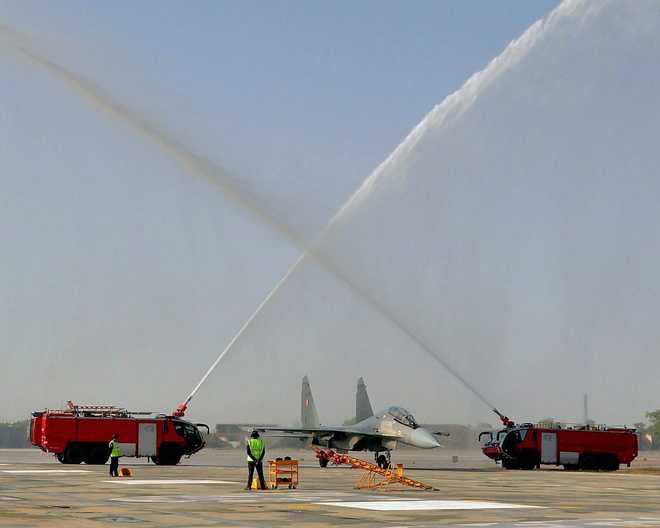
Water cannon salute being accorded to a SU-30 MKI aircraft to mark its induction into the recently resurrected 221 Squadron of the IAF, in New Delhi on Monday. PTI

New Delhi, April 24The IAF has enhanced capability of its frontline base in Punjab’s Halwara, which is close to the Indo-Pak border, by deploying additional Sukhoi fighter jets.The Su-30 MKI jets were today inducted into the IAF’s ‘Valiant’ squadron.The deployment of additional Su-30 MKI jets at the airbase comes amid heightened tensions between India and Pakistan.It will boost the offensive capabilities of the IAF in this sector, the force said about the induction of the jets into the Valiant squadron.The ‘Valiant’ was formed as an offensive fighter squadron in 1963 at Barrackpore in West Bengal.The squadron was then equipped with three types of aircraft — the Vampires, Spitfire, Hurricane and Su-7.The squadron has changed many bases during its 54 years long journey and has taken part in the 1971 war as well as in Kargil operations.”The ‘Valiants’, operating MiG-23s, were the first ones to fire weapons on the enemy during the Kargil war,” the IAF said in a release.Air Marshal C Hari Kumar, Air Officer Commanding-in- Chief, Western Air Command IAF was the chief guest for the induction ceremony. — PTI 


HEADLINES —–22 APR 2017

KAPURTHALA SAINIK SCHOOL TO GET FACELIFT TEAM FROM CMO ASSESSES CONDITION OF BUILDING, ASSURES REPAIRS IN PHASED MANNER

EX-SERVICEMEN CELL IN CM’S OFFICE GETS GOING

ON THE DIGITAL FRONT WRITTEN BY LT GEN SYED ATA HASNAIN 

NOW, FLY SHIMLA TO DELHI IN RS 1,920 AIR LINK AFTER FOUR-AND-A-HALF YEARS; PM TO FLAG OFF FLIGHT FROM JUBBARHATTI AIRPORT

POLLS IN CONFLICT ZONES: A KASHMIRI LESSON SYED ATA HASNAIN

PAKISTAN INTENSIFIES CYBER WARFARE OVER KASHMIR MHA AUTHORITIES FINDING WAYS TO CURB PROPAGANDA MACHINERY

Clashes in Valley, youths protest use of force against students

DEATH TOLL IN AFGHAN MILITARY BASE ATTACK RISES TO 140

US SEEKS HELP FOR DISMANTLING FINANCIAL NETWORKS OF TERROR GROUPS’

IME TO DISMANTLE TERROR SAFE HAVENS: INDIA ON AFGHAN ATTACK

PUNJAB NEWS :::22 APR 2017

  • Sushma: Blacklist pruning on; passport office for SBS Nagar

  • Sidhu finds anomalies, suspends SDO

  • Ready for conversation with Capt on investment: Sajjan

  • Tie-up with Israel for police training

  • CM prunes own security cover

  • Police to review arms licences

  • Engg colleges to conduct third-party audit of works

  • Minister faces students’ ire

  • Capt’s power @₹5/unit promise to give ₹3,200-cr shocker to exchequer

  • Punjab authorities forget Chappar Chiri memorial

  • Punjab government to review policy regulating marriage palaces: Secy

  • PRTC tightens noose around bus timetable inspectors


Military college triumphs in inter-state quiz contest

Tribune News Service

Dehradun, April 18

Rashtriya Indian Military College (RIMC) won the 17th All India Inter-School Challenge Quiz 2017 held on the college premises here yesterday.However, in a rare show of generosity, the RIMC team, which was playing host, handed over the winning trophy to Pinegrove School, Solan, which came second after breaking the tie with Summer Valley which stood third. Thirty teams from various parts of the country participated in the quiz.RIMC has been conducting quiz programmes for the last 16 years in a row and has become one of the best quizzing platforms in the Doon Valley. The quiz was conducted in two rounds. A preliminary round was held to shortlist candidates for the final. Six teams, which entered the finals, were Summer Valley, Pinegrove School, Solan, YPS, Patiala, Scholars’ Home, St Thomas College and the host RIMC.On this occasion, Karamveer Lifetime Achievement Puraskaar awardee Gopal Krishnan Swamy, a retired economist, social activist, educationist, and founder and secretary of Purkal Youth Development Society, Dehradun, was the chief guest. He interacted with children who had come from all over India and advised them to imbibe good habits in life.The quiz masters for the event were Taiyabba Khatoon and Thamil Selven while Karthik Chadala provided the technical assistance. Closing the programme, head of the institution Col Vivek Sharma, Commandant, RIMC, extended his heartfelt gratitude to all and sundry who contributed directly or indirectly for the success of the programme.


India says will ‘go to any lengths’ to get Jadhav justice

NEW DELHI/ISLAMABAD: India on Thursday said it had no knowledge of the location or health condition of Kulbhushan Jadhav but vowed to “go to any extent” to ensure justice for the former navy officer sentenced to death by a Pakistani military court.

The assertion by home minister Rajnath Singh also coincided with the Pakistani army saying it will not compromise on the death sentence awarded to 46-year-old Jadhav, accused of spying and fuelling sectarian unrest in Balochistan.

“We will go to any extent to ensure justice to Kulbhushan Jadhav,” Singh said on the sidelines of a CISF event in Delhi.

He said external affairs minister Sushma Swaraj had already made the country’s stand clear in this regard and that whatever he had said in Parliament a few days back remains unchanged.

In forceful speeches in both houses of Parliament, Swaraj had said that if the sentence is carried out, India will consider it “an act of premeditated murder” and also warned Pakistan of consequences “for our bilateral relationship”.

However, India has admitted that its efforts to help Jadhav has been stymied due to Pakistan’s refusal to access to him.

Pakistan has not shared with us till now any details of Kulbhushan Jadhav’s location or how he is,” external affairs ministry spokesperson Gopal Baglay said. “All our requests for consular access have been denied. The so-called legal process done by Pakistan was opaque,” he said.

The MEA spokesperson said the neighbouring country had once said it would give consular access provided India investigate the charges against him.

Pakistan has turned down 13 requests for consular access to Jadhav, who India maintains is an “innocent Indian, kidnapped by Pakistan: “That itself (the precondition) is a proof that they didn’t have enough evidence.”

Baglay said India was engaged in efforts to bring back Jadhav, adding he would not like to speculate on the steps being taken.


At the crossroads KC Singh China, US, Pakistan — India has its hands full

At the crossroads
As it stands: India must let diplomacy take precedence.

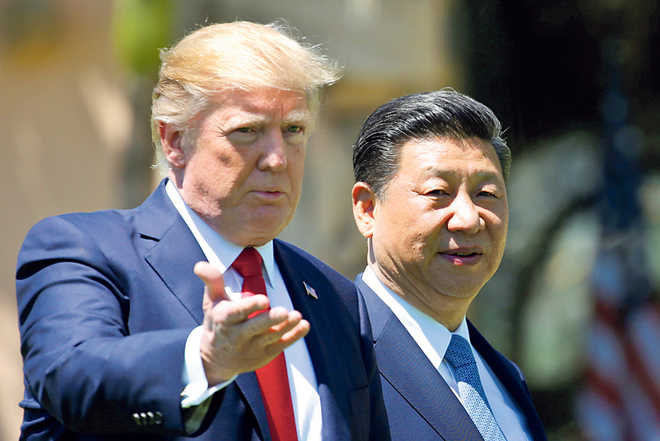
HAROLD Wilson’s quip that a week is a long time in politics comes to mind reviewing last fortnight’s developments. The US rained missiles on Syrian air base at Shayrat, near Qoms, in retaliation for the alleged Syrian use of sarin gas, notified as a chemical weapon, against civilians in Khan Sheikhoun. Pakistan upped the ante sentencing to death, for espionage and terrorism, Kulbhushan Jadhav,  a former Indian Naval officer, allegedly apprehended in Balochistan. India ignored Chinese threats over the Dalai Lama visiting Tawang, which has the second holiest Buddhist monastery after Lhasa, and the birthplace of the sixth Dalai Lama. Taking them serially, Trump’s decision to punish Syria’s Assad regime surprised both his “Alt-right” allies, who felt betrayed by his neo-interventionism, as too his critics in own party and among Democrats, who were elated. Trump was recanting from his election rhetoric of distancing the US from geopolitical cesspools. He perhaps had multiple motives. He was able to jettison charges of cosiness, if not actual complicity, between the Russian government and his election campaign. It is speculated that the US gave Russians a heads-up to avoid direct conflict by ensuring no Russian lives were lost. Careful target selection by avoiding living quarters and attacking in the dead of night, when plane hangars were unmanned, also had the same objective. Chinese President Xi Jinping did not get the same courtesy as Trump, having ordered the Tomahawks fired, sat down for dinner with him at his Mar-a-Lago resort in Florida, informing him of the decision only post meal. Trump thus altered the dynamics between Xi and himself, demonstrating the resolve to defend the global order, which his withdrawal from  the Trans-Pacific Partnership (TPP), flip-flop on ‘one-China’ policy and election rhetoric, urging isolationism, seemed to question. Xi swallowed the embarrassment but the Chinese media — after he left the US — lambasted the breach of Syrian sovereignty. Analysts are wondering if this was a mere knee-jerk reaction, or the first move towards replacing the Assad regime. If the latter is true, there is yet no evidence that Russia is ready to abandon the Iran-Assad-Hezbollah alliance sine qua non to re-balance the Shia alliance. In any case, to force a ceasefire and realign half-a-dozen Sunni groups which oppose the Assad regime and hold parts of Syrian territory, ranging from effective Kurds — whose success Turkey resists — to Al Qaida associates and the IS, would be impossible without an international force, ideally with the UN Security Council imprimatur and the US and NATO participation. But such a force would be an anathema to Russia and China. Clearly, the generals manning critical positions in the Trump administration are finally getting to influence policy choices. This may not augur well for India-Pakistan relations as Pakistan gets emboldened the minute it gets access to influential US presidential aides. Trump’s revision of the Obama doctrine to use the Shias, led by Iran, to counter the IS by attempting to separate Russia from the Shia alliance has resurrected the demoralised Sunni brigade, led by Saudi Arabia. Pakistan allowing its former army chief Gen Raheel Sharif to head the Sunni alliance forces conducting operations in Oman indicates re-convergence of Pakistani, GCC and US interests. That leads to the next issue of Pakistan suddenly pronouncing the death sentence on Kulbhushan Jadhav. The Indian public reaction and uproar in Parliament is perfect reading by Pakistan to get Indian attention. The exact motive is difficult to decipher at present, but may be multi-fold. It could have been triggered by a former Pakistan ISI officer going missing in Nepal, allegedly abducted by India. The desire to exploit the spring offensive by protesters in the Kashmir valley, whose protests have seen unprecedented success by forcing the negation of the electoral process, is a perennial factor. The Central government’s inability to understand this dynamic is inexplicable, particularly that the rise of Yogis as commissars will feed the paranoia of the Muslim majority in a sensitive state and that an alliance with the BJP has rendered the PDP politically irrelevant in the Valley. The Pakistan army may also have concluded that PM Nawaz Sharif is vulnerable to indictment in the Panama Papers case and political instability seems real. Finally, after the initial trepidation about how Trump led to the detention of Hafiz Saeed in a fit of delayed contrition, Pakistan now has a measure of Trump the interventionist, at whose court Pakistan will present itself as the nuclear weapon-wielding mercenary. Finally, the Indian decision to test China by a more forward policy is laudable, but the timing may be inappropriate if it is based on the assumption of continued US assessment that a stronger India was in US interests to balance a rising China. This has been the US assumption since after the initial brouhaha over Indian nuclear tests of 1998. Although the Trump-Xi summit in Florida was overshadowed by the Syrian imbroglio, the two leaders seem to have bought time to negotiate differences over imbalanced trade, North Korea and South China Sea, etc. The statement by US ambassador to UN Nikki Haley about US mediation in India-Pakistan dispute raises questions whether Pakistan is really as isolated as the BJP claims.Finally, the Indian reaction to the Kulbhushan episode, with External Affairs Minister Sushma Swaraj promising all in India’s power, is hyperbolic. Hostage takers are best dealt with by quiet threats, which should be credible, and carrots that are tangible. By minimising Indo-Pak contact there are few carrots that India holds. The only credible threat, short of a war, can be that abducting each other’s citizens and conducting mock trials is letting security agencies override diplomacy. Former foreign secretary MK Rasgotra recalls calling on President Zia-ul-Haq to convey Indira Gandhi’s message that if Pakistan did not stop abetting the hijacking of planes — which was assuming epidemic proportions in the early 1980s — India would do likewise. The gambit worked as differential of power between the two states had not yet been levelled by Pakistan possessing nuclear weapons. Jingoism may work for domestic electoral cycles, but can be dangerous internationally. Confronting the Sino-Pak combine, assuming Trump as a credible pro-India counterweight, is risky at best. Pliny the Elder’s advice to avoid ‘brutum fulmen’ or ‘senseless thunderbolt’ is perennially sound. PM Modi needs to send his ‘Rasgotra’ to Pakistan and avoid public fist-clenching. The writer is a former Secretary, Ministry of External Affairs


India snubs US on J-K mediation offer

Simran Sodhi

Tribune News Service

New Delhi, April 4

India has politely turned down the US offer to mediate with Pakistan and emphasised the “bilateral” aspect of  India-Pakistan ties,  US Ambassador to the United Nations Nikki Haley said today, indicating a serious shift in the US policy. Previous US Administrations have stayed away from getting caught up in the India-Pakistan narrative, maintaining that its a matter between the two nations.Speaking at a press conference in New York, when asked if the US would want to play a role in defusing tensions between India and Pakistan, Haley expressed the hope that US President Donald Trump could also play a role in mediating between the two countries.(Follow The Tribune on Facebook; and Twitter @thetribunechd)“We very much think that we should be proactive in the way that we are seeing tensions rise and conflicts start to bubble up and so we want to see if we can be a part of that,” Haley said. She said that she “wouldn’t be surprised if the President participates in that as well”. India, however, was quick and blunt in its response to the gesture.  “Our position for bilateral redress of all India-Pakistan issues in an environment free of terror and violence hasn’t changed,” said the Ministry of External Affairs.To another question, a veiled reference to China using its veto in the UN to block the designation of Masood Azhar as an international terrorist, Haley said: “Are we going to have people that veto certain issues? Yes. But that doesn’t preclude the US from acting and it certainly does not preclude us from trying to see if we can change that as well.”


Something to unlearn from China

Ira Pande
Let us pause before we rush to ape the China success story. What will we lose if we follow their script? The argumentative Indian will become a fossil for sure

WE returned from our China trip just a few days ago and I am still trying to process all the sights and experiences that are stuffed in my head. However, I can offer a few quick observations about the country and its people. Virtually the first problem one encounters is language: apart from a couple of words of greeting and gratitude, my knowledge of Chinese is non-existent. Accustomed as we are to English as the lingua franca of the international world, imagine a tourist’s frustration at not being able to read the menu or haggle (Chinese goods must be bargained for). In the more popular tourist spots (The Great Wall, for instance) there is a smattering of English signs but, by and large, the waiters and shop-keepers are as ignorant of English as we are of Chinese.Yet even more frustrating is the absence of Google and Gmail. Wired as most of us are to Bhagwan Google’s internet world, this absence hits one hard. Without the familiar crutches of readily available information (where to go, what to see and buy), we were at the mercy of our English-speaking tourist guide. A word here about intonations and accents must be added as a caution if you ever plan to hire one: ours were University post-graduates in English but their degrees were about as worthless as any of our own mofussil university degrees. However, they made up for their inability to pronounce ‘r’ and ‘l’ in the correct place by being most polite and helpful. Sadly, somewhere along the route to present times, their sense of humour seems to have vanished. I rarely saw a laughing face (except on the delightful Laughing Buddha) in my travels. Everywhere you go there are earnest, dedicated and hard-working people going about their business with the determined look of an army of ants. What must be acknowledged China’s singular achievement is the massive shift from a peasant and rural economy to a modern one. The cleanliness that one encounters takes one’s breath away: there is not even a matchstick to be seen as litter. An army of safai karmcharis, armed with brooms and dustpans, sweep even the leaves as soon as they fall on the pavement. Swachch Bharat could learn some important lessons from what they have done to clean their cities. The infrastructure (roads, railways, water and sanitation) is breath-taking with its beautifully landscaped roads and expressways, public gardens and parks. We were there through the famed Spring and I swear I have not seen such blossoms and flowers in my life. I had never seen hydrangeas grow on a small tree and yet, there they were! Huge bunches of them so large and healthy that I thought they were plastic or silk flowers that had been attached to branches. Despite these admirable achievements, what I missed most is a sense of the ‘real’ China, one that had been portrayed by writers like Pearl Buck. The old villages have been flattened to make space for the townships that dot the landscape of modern China. Block upon block of cement towers now accommodate all those who once lived in rural communities. And with the loss of that life is also a family that was reduced to one child by a state decree. Religious practice of any kind is discouraged (we could learn from that) but with that went the sense of cultural and civilizational memory. As in Pakistan, history is a distorted state-sponsored subject. It is almost as if in this new China, the world began in 1921.Let us then pause before we rush to ape the China success story. What will we lose if we follow their script? The argumentative Indian will become a fossil for sure and so will all the quirks and eccentricities of our land that give a personality to our cities and a lilt to our language. We may also forget to laugh (to not offend national pride) and sing and dance. Our cities may become free of the homeless and destitute but the richness of diversity will surely be affected. So my advice to our urban planners and those who recently razed the Hall of Nations in Pragati Maidan to make way for a new expressway (or something) is pause before you call in the bulldozers.Finally, a heartfelt homage to Mrs BK Nehru who passed away recently in Kasauli. She was a national treasure not just because she was the repository of a gracious and beautiful age but because she joyfully adopted every change and gave it her special touch of grace. Born a Hungarian, she became an Indian after she married the Nehru family and I know of few women who could carry a sari with the elegance that she did. She could speak fluently in Hindustani and worked alongside her husband after Partition to bring help and succour to families torn apart in Punjab. She was at home in the grand diplomatic receptions she hosted as the wife of the Ambassador in Washington. As the wife of the Governor in J&K, Assam and in Gujarat, her interest and promotion of crafts and textiles will long be remembered. She was among the band of pioneering women who set up the Central Cottage Industries Emporium. A rare woman by any standards, her warmth and interest in people is a fragrance that will never fade away. RIP, Aunty Fori.