Sanjha Morcha

Chadoora, a new Kashmir tack Lt Gen (retd) Syed Ata Hasnain

The combined experience of the Army, police and paramilitary forces in handling volatile situations is effective in J&K.. However, political authority and a connect with people will also have to be a part of security strategy to counter separatists. The Chadoora encounter proves how the separatists have changed tack.

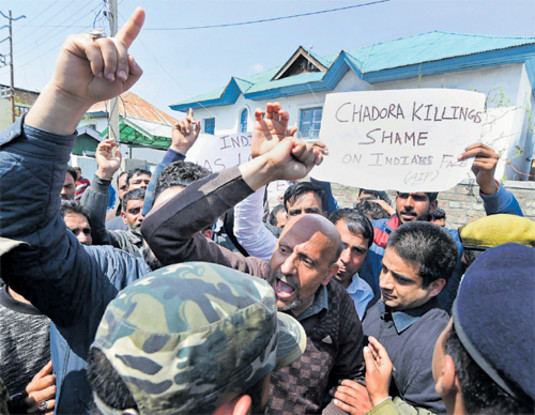
The police stop the Awami Itihaad Party (AIP) president and Independent MLA, Abdul Rashid Sheikh, and his supporters as they hold a protest in Srinagar against the killing of three civilians in the Chadoora-Budgam encounter.  PTI

IN the history of Jammu and Kashmir’s innumerable encounters, the one at Chadoora on March 28 will probably be just another among the statistics. It may also acquire the notoriety of being the trigger for the summer of 2017.  To save one or two terrorists, a mob of locals built up to disrupt the joint operations of the Army, CRPF and the J&K Police. Three civilians were killed in the crossfire, while almost 63 policemen were injured. The separatists immediately called for a lockdown. Attempts to break the curfew, if imposed, will lead to a couple of injuries to stone throwers and you have the return of the entire spectre of 2016 on the streets of the Valley. And this time even without the Darbar having yet returned to Srinagar. Is this cocking a snook at the Army Chief’s warning? Amateur minds will read it exactly as this, decry the Army’s inability to find a solution and urge that all involved in breaking the law should be systematically eliminated at the point of many guns. That is boorish, immature and irresponsible. The state still has a duty to control the law and order and calibrate its response. It is not so feeble. For those of us who have seen turbulence in our lifetimes and situations completely out of hand have lived to tell the tale of a few good men who took the challenge and resolved the problem but not without trials. Enough people have seen this happen repeatedly in Jammu and Kashmir itself;  perhaps, in not the exact circumstances, yet many akin to these.Intense emotions in the environment pander to extreme positions. Social media shows people on one side wishing the worst for the other — an unhappy commentary when maturity demands that middle ground be sought. To understand the nuances of how this form of confrontation has emerged, there is a need to look at both the professional and tactical demand of a hybrid conflict situation and the emotive desire of subnationalism. Any insurgent group will seek to progressively acquire the means to put the security forces on the defensive, cause casualties and endeavour to place them at a psychological disadvantage. The unthinking terrorist mind only contends the use of naked violence; bombs, rifles, rockets and IEDs. That does not get to the psyche of the people; it does not involve them to take ownership of their struggle.  Not many are aware of the degree of thinking which goes on within separatist ranks and we have students of conflict sitting across the LoC who are reading, analysing and scheming, providing the intellectual guidance so to say. Sponsored proxy wars are not about guns and explosives alone, they are as much about ideas, innovations and the involvement of people. The aspiration of those who are the guides and the ideologues is to force an out-of-proportion response from security forces so that the “martyr effect” is brought into play repeatedly, alienation spirals out of control and the movement receives impetus. For the first few years of the proxy war, it was more about the Army against the terrorist. The Army progressively improved its concept and strategy, neutralising terrorist strength. Then in 1997, the humanisation effect came into being with Sadbhavana. It remained a question of which side could garner the support of the people, large majority of whom sit on the fence for fear of the final outcome of conflict. The years 2007-8 were crucial. The effects of Mufti Sayeed’s “healing touch” (commenced in 2002) faded and Atal Bihari Vajpayee’s philosophical approach of Insaniyat, Jambooriyat and Kashmiriyat could not be taken to the next level through outreach and engagement, which were the pre-requisites. That is when the separatists changed tack. Seizing initiative, they brought the proxy war to the streets. Thereafter, it has been a combination of terrorist activities, street protests and psychological blending of the minds of the populace towards the movement. The gen next emerged in the forefront by an evolutionary process and not so much by design. In fact, the older generation was wary about allowing the youth to take the leadership; yet it happened. The security forces did well as far as their military-oriented operations were concerned. They limited infiltration and maximised the neutralisation of terrorists but the psychological element eluded them for the sheer want of continuity and inability to doctrinally conceptualise. The Army was brilliant at altering its tactics; intelligence improved exponentially, cooperation was of a higher order, flexibility in size of operations was exercised and counter-infiltration received a great fillip. However, the human aspect remained elusive not for any other reason than for a lack of understanding of the cultural terrain. That is where the separatists stole a march — bringing the emotional connect to the street. The years 2008-15 witnessed an ardent effort on the part of the separatists to intensify the street. In 2015, with south Kashmir in the throes of Burhan Wani’s locally dominated movement it tested the waters with greater turnout of mobs at the funerals of slain terrorists; surprisingly even Pakistani terrorists for whom the emotional surge was limited. It was experimentation with flash mobs more than emotions. Soon, the first flash mobs appeared at encounter sites. The security forces quickened the pace of response to counter the phenomenon but the mobs became emboldened, resulting in the recent encounter at Hajan leading to the Army Chief’s statement. It is now a phenomenon which I would classify as the culmination of an evolutionary process of refinement of methods to disrupt operations of the security forces. The combined experience of the Army, Jammu and Kashmir Police and CRPF in handling multifarious threats over a period of time holds them in good stead to find the counter to such disruptive tactics. In 2010, an attempt was made by the separatists with threats of marching to surround the Army camps. The situation was subtly handled with coordinated efforts. We have seen intense challenges in the Valley. Undeniably, alienation is extremely high but all is not lost. The nation must repose more trust in those who are in charge. Detractors against separatists are insufficiently courageous to raise their voice. What we need to appreciate is that the security forces by themselves cannot take on the separatists’ outreach. That is many years old and based on a time-tested structure. Without a joint strategy forged by the political authority and the security forces, the people’s dimension — which the separatists have stolen from the establishment — cannot be restored to the  state establishment. After all, the theme political-military integration in hybrid conflict is not for nothing.The writer, a former GOC of the Srinagar-based 15 Corps, is now associated with the Vivekanand International Foundation.

‘Ex-servicemen will require Aadhaar to avail pension benefits’

‘Ex-servicemen will require Aadhaar to avail pension benefits’
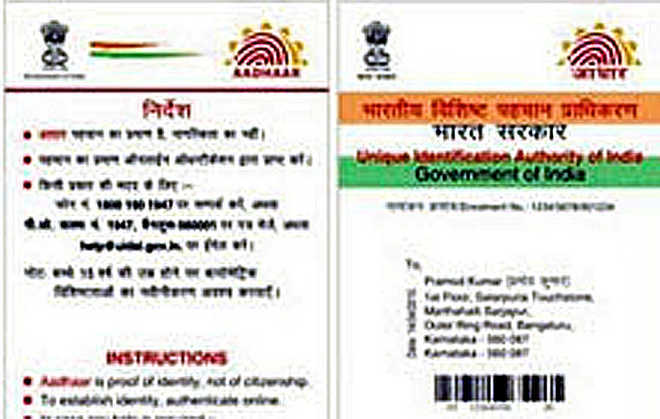
File photo for representation only.

New Delhi, March 31

Ex-servicemen will require Aadhaar number to avail pension benefits the government informed the Lok Sabha on Friday.In written response to a question in the Lok Sabha, Minister of State for Defence Subhash Bhamre said the Department of Ex-Servicemen Welfare, through a notification on March 3, has said that defence forces are required to furnish proof of possession of Aadhaar number or undergo Aadhaar authentication.“However, if an eligible individual entitled to receive pension benefits does not possess the Aadhaar number or is not yet enrolled for Aadhaar, but desirous to avail pension benefits is required to make Aadhaar enrolment by June 30, 2017.“The pension benefit shall be given to such individuals till Aadhaar is assigned to the beneficiaries, subject to the production of identification documents,” Bhamre said.In response to another question, Bhamre said the delay in construction of the six submarines under Project-75 at Mazgaon Dock Shipbuilders Ltd, Mumbai are due to infrastructure augmentation requirements and procurement of material from foreign vendors.Bhamre said the Indian Navy has hosted a global Request for Information (RFI) for Multi-Role Carrier Borne Fighter (MRCBF) Aircraft in January 2017.Responding to another question, Bhamre said India and Vietnam have agreed to take forward a proposal for training Vietnam Air Force personnel on Su-30 aircraft.The minister, in his response to another question, said the government has prepared a long-term roll on works plan for construction of 519 roads by the BRO in the border regions. — PTI


North Korea says ready to strike US aircraft carrier Two Japanese ships join US group for exercises; S Korea on heightened alert

North Korea says ready to strike US aircraft carrier
US President Donald Trump ordered the USS Carl Vinson carrier strike group to sail to waters off the Korean peninsula. Reuters file photo

Seoul, April 23

North Korea said on Sunday it was ready to sink a US aircraft carrier to demonstrate its military might, as two Japanese navy ships joined a US carrier group for exercises in the western Pacific.

(Follow The Tribune on Facebook; and Twitter @thetribunechd)

US President Donald Trump ordered the USS Carl Vinson carrier strike group to sail to waters off the Korean peninsula in response to rising tension over the North’s nuclear and missile tests, and its threats to attack the United States and its Asian allies.

The United States has not specified where the carrier strike group is as it approaches the area. U.S. Vice President Mike Pence said on Saturday it would arrive “within days” but gave no other details.

North Korea remained defiant.

“Our revolutionary forces are combat-ready to sink a US nuclear powered aircraft carrier with a single strike,” the Rodong Sinmun, the newspaper of the North’s ruling Workers’ Party, said in a commentary.

The paper likened the aircraft carrier to a “gross animal” and said a strike on it would be “an actual example to show our military’s force”.

The commentary was carried on page three of the newspaper, after a two-page feature about leader Kim Jong Un inspecting a pig farm.

North Korea will mark the 85th anniversary of the foundation of its Korean People’s Army on Tuesday.

It has in the past marked important anniversaries with tests of its weapons.

North Korea has conducted five nuclear tests, two of them last year, and is working to develop nuclear-tipped missiles that can reach the United States.

It has also carried out a series of ballistic missile tests in defiance of United Nations sanctions.

North Korea’s growing nuclear and missile threat is perhaps the most serious security challenge confronting Trump.

He has vowed to prevent the North from being able to hit the United States with a nuclear missile and has said all options are on the table, including a military strike.

Worry in japan

North Korea says its nuclear programme is for self-defence and has warned the United States of a nuclear attack in response to any aggression. It has also threatened to lay waste to South Korea and Japan.

U.S. Defense Secretary Jim Mattis said on Friday North Korea’s recent statements were provocative but had proven to be hollow in the past and should not be trusted.

“We’ve all come to hear their words repeatedly, their word has not proven honest,” Mattis told a news conference in Tel Aviv, before the latest threat to the aircraft carrier.

Japan’s show of naval force reflects growing concern that North Korea could strike it with nuclear or chemical warheads.

Some Japanese ruling party lawmakers are urging Prime Minister Shinzo Abe to acquire strike weapons that could hit North Korean missile forces before any imminent attack.

Japan’s navy, which is mostly a destroyer fleet, is the second largest in Asia after China’s.

The two Japanese warships, the Samidare and Ashigara, left western Japan on Friday to join the Carl Vinson and will “practice a variety of tactics” with the U.S. strike group, the Japan Maritime Self Defence Force said in a statement.

The Japanese force did not specify where the exercises were taking place but by Sunday the destroyers could have reached an area 2,500 km (1,500 miles) south of Japan, which would be waters east of the Philippines.

From there, it could take three days to reach waters off the Korean peninsula. Japan’s ships would accompany the Carl Vinson north at least into the East China Sea, a source with knowledge of the plan said.

U.S. and South Korean officials have been saying for weeks that the North could soon stage another nuclear test, something the United States, China and others have warned against.

South Korea has put is forces on heightened alert.

China, North Korea’s sole major ally which nevertheless opposes Pyongyang’s weapons programmes and belligerence, has appealed for calm. The United States has called on China to do more to help defuse the tension.

Last Thursday, Trump praised Chinese efforts to rein in “the menace of North Korea”, after North Korean state media warned the United States of a “super-mighty preemptive strike”. — Reuters


From String Of Pearls To Head Vice: Is China Squeezing A Strategic Advantage Over India? Syed Ata Hasnain

From String Of Pearls To Head Vice: Is China Squeezing A Strategic Advantage Over India?
SNAPSHOT

The Chinese Defence Minsiter General Chang Wanquan recently visited Sri Lanka and Nepal even as the state-owned media in China issued veiled warnings to India.

Is China’s wariness of India’s relationship with the US forcing it to move beyond the ‘String of Pearls’ strategy.

Asia Pacific is quiet at present awaiting President Donald Trump’s true strategic emergence; uncertainty about rebalancing and pivot reinforce the belief that the US is yet unprepared to seriously address the issues concerning China. West Asia still steals the march in terms of glamour news such as the ongoing battle for Mosul and discussions on the future strategy of Islamic State (IS or Daesh).

However, a reading of 2017 thus far gives indicators of a bolder China, preparing itself for all options that the US strategy may adopt to address the future needs of its interests in the Asia Pacific. Although South Asia classically remains a peripheral zone for the Asia Pacific it is an important area of the Indo-Pacific region. For China, the Pacific Rim and waters are within reach with potential for greater control due to direct accessibility from the mainland. It is the Indian Ocean Rim (IOR) of South Asia where China’s access is not from the mainland but through belts and corridors. That zone is crucial because through it are aligned the sea lines of communication (SLsOC), China’s commercial and economic lifeline.

It is not usual to commence analyses with deductions but here it may be necessary. A flurry of reportage and commentary in Chinese media, especially the print, considered virtual official mouthpieces, appears to indicate that Beijing perceives an emboldened New Delhi due to the emerging US-India strategic partnership. The coming of Trump doesn’t appear to have diluted that even as details are being resolved. China’s original strategy the ‘String of Pearls’, hotly denied by it, was obviously a form of psychological encirclement of India through more active diplomatic outreach to the smaller states of South Asia. That, in the new dispensation, is being progressed to the next level which is obviously less benign and taking the shape of a ‘Head Vice’. Here is why such a deduction seems more plausible; with activities from Myanmar to Gwadar under the scanner.

Fourteenth November 2016 is an important date; on that day the operationalisation of the China Pakistan Economic Corridor (CPEC) appears to have commenced with movement of ships from Gwadar to other ports. The deepening of Pakistan’s strategic relationship with China goes up several notches and as the $50 billion project progresses the notches will convert to rungs. This will be notwithstanding the supposedly blood sucking 11 per cent interest on Chinese loans amounting to $35 billion. It may see transfer of land and assets of choice from Pakistan to China in a later timeframe. Gwadar also allows China to monitor US and Indian naval activity in the Persian Gulf and Arabian Sea, and Pakistan to dominate the energy routes to which it is a gateway. CPEC has done more for Pakistan’s strategic confidence than any other arrangement in 50 years. The same if not already evident in Pakistan’s diplomatic and military stance will manifest very noticeably as we proceed to the future.

Even more than the Sino-Pakistani strategic relationship it is China’s surge towards Sri Lanka that should draw attention. It had already established a hold during the later stages of the Eelam wars through supply of weapons worth almost $1 billion to the Sri Lankan armed forces. China had also won favour by securing the project for construction of a modern port at Hambantota and an ultra-modern international airport at Mattala in 2006. It was a project initially offered to India but not taken up by us due to questionable commercial viability. China grabbed it and after completion realises its commercial non-viability but immense strategic value for its own maritime presence in the Indian Ocean to oversee the security of its SLsOC.

Sri Lanka, beholden to Chinese support during the final stages of the war against the Liberation Tigers of Tamil Eelam (LTTE) and financially in no position to pay for the project has apparently bartered 80 per cent holding in the project and the nearby modern airport at Mattala. Till the time Mahinda Rajapaksa was in power the Chinese confidence was evident but with the arrival of President Maithripala Srisena the urgency that Sri Lanka felt towards making up with the West increased; this was primarily due to the human rights investigations that were being sought in relation to the final stages of the war against the LTTE. To regain some strategic space China has sent its defence minister on a recent visit with offers on renegotiating Hambantota, supply of military hardware to give Sri Lanka a more proactive role in patrolling the oceans and self-confidence to preserve its integrity. Details of the visit are yet emerging.

Switch to Bangladesh and we have the Chevron gas fields under sale with China’s Zhenhua Oil bidding for these. Zhenhua raises no eyebrows until it is revealed that it is a subsidiary of Norinco, the Chinese defence manufacturing company. The brow would raise even more once it was known that the gas fields in question are not in Southern Bangladesh but in the North Eastern part bordering Meghalaya, lower Assam and Tripura. India is not paranoid but surely land based presence of an adversary’s assets bordering your rear areas is not a position of comfort. Strategic literature emanating from Dhaka expresses deep interest in the Bangladesh-China-India-Myanmar (BCIM) corridor which has not received a very enthusiastic response from India. China’s involvement in development of port infrastructure in Bangladesh is but a matter of time as the latter cannot afford to drag its feet on this due to its own economic compulsions.

Maldives is more complex in complete contrast to the size of its geography. A Chinese firm has acquired “Feydhoo Finolhu” island on a 50 year lease for $4 million for developing a resort near capital city Male. This has now been supplemented by a Saudi Arabian initiative of investing $10 billion for wholesale acquisition of Faafu, 19 low-lying islands 120km south of Male. It would involve building seaports, airports, high-end housing and resorts and the creation of special economic zones. No doubt Chinese-Saudi Arabian cooperation is not something which has been contemplated as a security threat.

Yet, when viewed in the context of the increasing footprint of radical Islam in the islands, increasing visibility of Chinese Saudi defence cooperation becomes worrying for India’s strategic watchers. As per an interesting paper written by James Dorsey of the RSIS – “Riyadh sees its soft power in the Maldives as a way of convincing China it is Saudi Arabia – and not its regional rival, Iran – that is the key link in Beijing’s “One Belt, One Road” initiative to link Eurasia to the Middle East kingdom through Chinese-funded infrastructure”. That explains the concern for India.

Nepal’s relationship with India has been tentative for some time and even the goodwill re-established by the relief work after the disastrous earthquake of 2015 has not translated into any major strategic advantage. At the same time the deterioration of Indo-Nepalese relations over the new constitution and the rights of people of Indian origin has also not been fully exploited by China. There are pin-prick events such as a low-level military training exercise and continuing negotiations on project feasibility of a trans-national (Tibet to Nepal) railway project and power lines. The Belt-Road concept of President Xi Jing Ping has yet to emerge here but interest in the same has been expressed by Nepal; its future inclusion is a given.

Prime Minister Prachanda is likely to visit Beijing in the near future but China’s Defence Minister Chang Wanquan is already visiting Kathmandu after his visit to Sri Lanka. Prachanda’s visit may set the stage for the Chinese President’s visit to Kathmandu which was postponed last year following some unconfirmed reports of Beijing’s unhappiness over a lack of seriousness to push bilateral projects. That moment seems to have passed. China has recently pledged $8.3 billion in investment to Nepal – equivalent to nearly 40 per cent of its entire GDP. That staggering commitment dwarfed India’s offer of $317 million.

China’s Global Times wrote on 26 December 2016 – “It is neither realistic nor possible for India to always regard Nepal as its backyard and put pressure on Sino-Nepalese cooperation.” The deepening of Sino-Nepalese ties can therefore be taken for granted although the speed of the same may be a little slower.

On Bhutan the Global Times recently stated – “New Delhi is one of the crucial reasons why China and Bhutan, which is controlled by India economically and diplomatically, have not yet established diplomatic relations”. Summing up the discomfort of India it said – “If such tendencies in India continue, China will have to fight back, because its core interests will have been violated. This is not what we hope for, but the ball is in India’s court”.

It is obvious that China is concerned about India’s efforts to secure its neighbourhood and keep it within its realm of influence. There is an element of realpolitik in this. Its ambitious designs to achieve its interests mainly extend to securing SLsOC and the Belt and Road linkages and facilities. It has invested just too much time, energy and money into this and its sensitivity to all this will increase progressively. That is the reason why it is trying to send aggressive messages and enhancing the psychological squeeze on India. India’s stance has been correct and balanced. It has objected to issues such as the construction of the CPEC through the territory of Gilgit-Baltistan over which India lays claim. Norms of international conduct do not permit this but just as in the case of the South China Sea dispute China is beyond adherence to legal procedures.

The cold war between India and China with respect to influence in the South Asian region is already taking the shape of a New Great Game. This is likely to intensify. Maturity demands that rhetoric be reduced and engagement increased so that economic and diplomatic activities continue which perhaps will bring some compulsion to view each other’s interests with sensitivity. India cannot be pressurised regarding its partnerships with other countries which are based upon mutual and shared strategic interests. The New Great Game in the IOR of South Asia is likely to continue with increasing attempts at securing spheres of influence. There is a set of old military tactics which states that when surrounded hit at the enemy from outside the area of encirclement.

India must develop Chahbahar at the earliest and convince the US to support the India-Afghanistan-Iran initiative as it makes ample sense. In Sri Lanka, it must seek ways of enhancing its presence and supporting the Sri Lankan government with more economic initiatives. Handling Maldives has been a challenge but control over its strategic decisions must be exercised with consultation. Our relationship with Bangladesh is strong and progressing; Prime Minister Sheikh Hasina is visiting India in April 2017. Her visit is one of the most strategically important visits in recent months and must help in developing long-term trust and faith between countries which are considered natural partners. With Nepal an exercise of a degree of strategic independence by it is inevitable. The question is how that can be managed to advantage. Lastly, the BCIM Economic Corridor needs to be analysed more deeply for hidden agenda. The overall benefit to the North East may assist in stabilising the region through the economics route.

What India has to fully ensure is that the String of Pearls do not convert to a Head Vice which will squeeze it out of options.


New ITR forms, cap on cash deals Can’t receive over Rs 2L in cash; return on small savings cut by .1%; Aadhaar must for tax returns

New ITR forms, cap on cash deals
Photo source: iStock

Tribune News Service

New Delhi, March 31

With the passage of Finance Bill, a host of tax measures and changes will kick in from April 1, including a new Income Tax Return (ITR) form, lower returns from small savings schemes and a cap on cash transactions exceeding Rs 2 lakh.The Central Board of Direct Taxes has notified new Income Tax Returns (ITRs) forms for assessment year 2017-18. A key change in the notified forms is the one-page simplified ITR Form-1 (Sahaj). It can be filed by an individual having income up to Rs 50 lakh from salary, one-house property or income from interest or other sources. This initiative will benefit over two crore taxpayers.(Follow The Tribune on Facebook; and Twitter @thetribunechd)Parts relating to tax computation and deductions have been rationalised and simplified, reducing the compliance burden to a significant extent on the individual taxpayer.Sahaj makes quoting of the 12-digit biometric Aadhaar number mandatory along with Permanent Account Number (PAN). It also seeks details of cash in excess of Rs 2 lakh deposited in bank accounts during the post-demonetisation window — between November 9 and December 30, 2016. The last date for filing of ITRs for 2017-18 is July 31.From April 1, small savings will fetch lower returns as the government has lowered interest rates on small savings schemes such as Public Provident Fund, Kisan Vikas Patra and Sukanya Samriddhi scheme by 0.1 per cent for the April-June quarter. However, interest on savings deposits has been retained at 4 per cent annually. A Finance Ministry notification said investments in the PPF scheme will fetch a lower annual rate of 7.9 per cent, the same as five-year National Savings Certificate. The existing rate for these two schemes is 8 per cent.Among the tax changes, Aadhaar number has to be quoted from July 1, 2017, in the return of income. Anyone allotted PAN as on July 1 must list the Aadhaar number to the tax authority, failing which, PAN allotted to such person shall be deemed to be invalid. As per the Finance Bill changes, no one can receive more than Rs 2 lakh in cash.

Disclose deposits over Rs 2L post-note ban

  • Taxpayers who deposited Rs 2 lakh or more in banks post-demonetisation will have to make the disclosure in the new ITR form. Column Part-E of ITR Form-1 (Sahaj) seeks information on cash deposits made by the assessee between November 9 and December 30, 2016 for “aggregate cash deposits” of Rs 2 lakh or more.

Returns simplified for 20 m taxpayers

CURBING EVASION Individuals need to make more disclosures in the one­page form, including linking of tax returns with Aadhaar

THE DEPARTMENT HAS MANDATED THAT TAXPAYERS WILL HAVE TO DISCLOSE ANY CASH DEPOSIT ABOVE ₹2 LAKH MADE DURING NOV 9 AND DEC 30

From page 01 NEW DELHI: The income-tax department has notified a simplified one-page tax-return form aimed at making it easier for taxpayers to file their annual returns.

HT/FILEPeople queue up to file their returns. There are around 40 million taxpayers in India

At the same time, the new form also requires taxpayers to make additional disclosures —including mandatory linking of tax returns with an individual’s Aadhaar number — which will help curb tax evasion.

Not only will this make it easier for 50% of the country’s 40 million taxpayers and encourage more people to file their tax returns, the new disclosures will also encourage better compliance.

A press release issued by the tax department says individuals earning up to ₹50 lakh and possessing one house will need to file only a single-page tax return form called ITR-1 (Sahaj) for financial year 2016-17.

However, the department has mandated that the taxpayer will have to disclose any cash deposit above ₹2 lakh made during November 9 and December 30 as it moves to track instances where high-value cash deposits post-demonetisation do not match with the income profile of the taxpayer.

Further, in line with the changes proposed to the incometax Act, providing the Aadhaar number or the Aadhaar enrolment number in the I-T return form has been made mandatory.

The tax department has also rationalised various columns relating to tax computation and deductions for easy compliance.

“This will reduce the compliance burden to a significant extent on the individual taxpayer. This initiative will benefit more than two crore taxpayers who will be eligible to file their return of income in this simplified form,” said the income-tax department in a statement.

However, taxpayers who have more than one house will have to file a much more detailed ITR-2.

The number of income-tax return forms have also been reduced from the existing nine to seven. Further, only those individuals above the age of 80 years or whose income does not exceed ₹5 lakh and have not claimed any refund of income tax will be able to file paper returns.

Earlier, taxpayers filing ITR-1 and ITR-2 could file paper returns and claim a refund.

Also, the tax department has now made it mandatory to report exempted long-term capital gains in the tax return form; dividend income also has to be disclosed. “The government has shifted focus to those earning upwards of ₹50 lakh and having income from sources other than salary with multiple home ownership. Income-tax return filing will be detailed for them. Besides, the government has kept up the momentum on efforts of demonetisation,” said Archit Gupta, founder and CEO of ClearTax, a website which helps people file tax returns.

Around 37 million people filed their income-tax returns in 2015-16, of which 9.9 million reported annual income below the exemption limit of ₹2.5 lakh, 19.5 million reported an annual income between ₹2.5 lakh and ₹5 lakh, 5.2 million showed income between ₹5 lakh and ₹10 lakh and only 2.4 million people showed income above ₹10 lakh, according to the tax department.

Further, only 172,000 people reported income above ₹50 lakh in the entire country. A majority of the individual assessees reporting income above ₹5 lakh were from the salaried class.

Small savings schemes to fetch less interest now; what it means for you

NEW DELHI: The government on Friday slashed interest rates on small savings schemes, including Public provident Fund (PPF) and Kisan Vikas Patra (KVP), by 10 basis points to align them with market rates, a move that may facilitate further rate cuts by commercial banks in the absence of policy rate cuts by the Reserve Bank of India (RBI).

A basis point is one-hundredth of a percentage point.

RBI is expected to hold rates in its quarterly monetary policy review on April 6. The central bank in its last policy review in February changed its stance to neutral from accommodative, citing inflationary pressure. However, the linking of interest rates of small savings schemes to the yields of government bonds is expected to allow banks to pass on policy rate cuts by the central bank through lower lending rates.

“We are doing it keeping in mind the interests of small investors,” economic affairs secretary Shaktikanta Das said.

So, should you rethink your investments in these schemes?

RATE CUTS

According to the finance ministry notification, the interest rate on a savings accounts with post offices will stay at 4% annually, whereas all other schemes will fetch 0.10% less starting next quarter. Investments in PPF will fetch an annual interest rate of 7.9%, compared to 8% in the quarter ending March 2017; similarly five-year National Savings Certificate will give interest of 7.9% instead of 8%. KVP investments will now provide 7.6% return and mature in 113 months.

The scheme for the girl child, Sukanya Samriddhi Account Scheme, and five-year Senior Citizens Savings Scheme will provide 8.4% return. The five-year monthly income scheme will offer 7.6% returns. Term deposits of 1-5 years will offer 6.9-7.7%. The five-year recurring deposit will earn 7.2% interest.

SHOULD YOU KEEP INVESTING?

“0.10% decrease in the interest rate of PPF is not huge in the current falling interest rate scenario. Given that PPF still offer a return of 7.9%, that too tax free, which no other instrument provide, one can continue investing in it,” said Suresh Sadagopan, founder, Ladder7 Financial Advisories, a Mumbai-based financial planner.

However, when it comes to other small savings schemes such as time deposits, where returns are not only low but are taxable too, “one should look for alternatives,” Sadagopan suggested.

“An investor can consider investing in a debt mutual fund instead, if the time horizon for investment is more than three years. Though debt mutual funds will also provide similar returns, but available indexation benefit while calculating tax on return will increase the investor’s overall profit.”


Air Chief Marshal visits Agra IAF station

Air Chief Marshal visits Agra IAF station
Air Chief Marshal BS Dhanoa at the Air Force Station in Agra. PTI

Tribune News Service

New Delhi, April 29

Air Chief Marshal BS Dhanoa visited the Air Force station in Agra where he flew onboard an Airborne Warning and Control System (AWACS) aircraft. He viewed the Air Force exercise conducted over the north-western part of the country.The Indian Air Force Chief flew from Agra yesterday to check the forces participating in the ongoing war gaming exercise of the Western Air Command “Exercise Trishul”. The AWACS provides a live picture of 800-km radius when airborne.Under the exercise, all assets of the Western Air Command were mobilised to demonstrate the potency of the Indian Air Force in a real-time war-like scenario.This included engaging with a large of number of fighter jets in electronic warfare environment, an Indian Air Force spokesperson said today. 


Tata Safari to replace Army Gypsy

Tata Safari to replace Army Gypsy

Tata Safari to replace Army Gypsy
Tribune News Service
New Delhi, April 27
The Army will now start using an upgraded Tata Safari vehicle to replace the three-decade-old Maruti Gypsy for movement.
The Army has ordered 3,192 units of the Tata Safari Storme 4×4 drive.
The Ministry of Defence (MoD) wanted the replacement vehicle to fulfil three basic criteria — minimum payload capacity of 800 kg; hard roof and air-conditioning. Safari Storme was tested across various terrains across the country.
A company statement said Safari Storme was conceived and designed keeping in mind the need for a rugged, comfortable and reliable vehicle, making it popular with law enforcement agencies.


Hold ‘Defence melas’ to raise funds for ex-servicemen, kin: Governor

Tribune News Service

Jammu, April 24

The 79th annual meeting of the J&K Rajya Sainik Board, followed by 64th meeting of the State Managing Committee, for the Flag Day Fund was held at Raj Bhawan here under the chairmanship of Governor NN Vohra.The Governor appreciated the efforts put in by the Sainik Welfare Department to further enhance interaction between the ex-servicemen/serving soldiers and the civil population, including programmes organised during the Flag Day celebrations.The Governor mentioned that due to their presence in far-flung areas, the Army should be able to complement efforts of the Sainik Welfare Department in maintaining effective liaison with ex-servicemen/widows. He expressed his deep concern about the status of non-pensioner ex-servicemen/widows and observed that he had recently written to the Defence Minister to consider significantly enhancing the quantum of relief to non-pensioner widows below and above 65 years of age, which is presently too meagre to meet the cost of living.He suggested that the Sainik Welfare Department should consider organising “Defence melas” to raise funds for the welfare of ex-servicemen and their families.He called upon the citizens and civil society organisations to donate liberally for the J&K Flag Day Fund, which is used for promoting the welfare of ex-servicemen and families of martyrs.The Governor complimented the Northern Army Command Headquarters for developing software for the Sainik Welfare Department to computerise the database of ex-servicemen.He emphasised that an institutional framework should be put in place in facilitate re-employment of eligible and qualified ex-servicemen for the jobs available in the Central and state governments and impressed the importance of increasing awareness about the horizontal reservation of 6 per cent for ex-servicemen in jobs under the state government.The Governor observed that all welfare schemes for ex-servicemen and their wards should be regularly revised and updated to address their problems and stressed the need for an effective grievance monitoring system to be put in place at the district and state levels to ensure that their problems are solved expeditiously.The Rajya Sainik Board approved grants to the non-pensioner ex-servicemen and widows from the state Flag Day Funds being doubled to Rs 12,000 pm to help them financially. It increased the grant for decent last rites to Rs 5,000. For wards of ex-servicemen and widows figuring in merit list of Class XII, an incentive of Rs 5,000 has been approved and dependent children clearing the Civil Services Exams will get an award of Rs 10,000. Education grants to children of martyrs have been enhanced from Rs 1,200 to Rs 3,000 per annum.Earlier, there was no provision for widows to buy four-wheelers from the CSD, which has now been approved. The status of a number of other welfare schemes of the Centre and state governments for helping out ex-servicemen and their families in various fields, including daughter marriage, education, house repair and penury grants, was discussed and decisions taken.Brig Harcharan Singh (retd), secretary, Rajya Sainik Board, made a detailed presentation and provided details of the various measures taken for the welfare of the ex-servicemen and financial status of the board.Prominent among those present in the J&K Rajya Sainik Board meeting were BR Sharma, Chief Secretary; Lt Gen Devraj Anbu, GOC-in-C, Headquarters, Northern Command; Prabhu Dayal Meena, Union Secretary, Department of ESM Welfare, New Delhi; Umang Narula, Principal Secretary to the Governor; RK Goyal, Principal Secretary (Home) and Navin K Choudhary, Secretary, Finance.


MANN KI BAAT’ PM: ‘Every Person is Important’ should be priority rather than ‘VIP’

PM: ‘Every Person is Important’ should be priority rather than 'VIP'
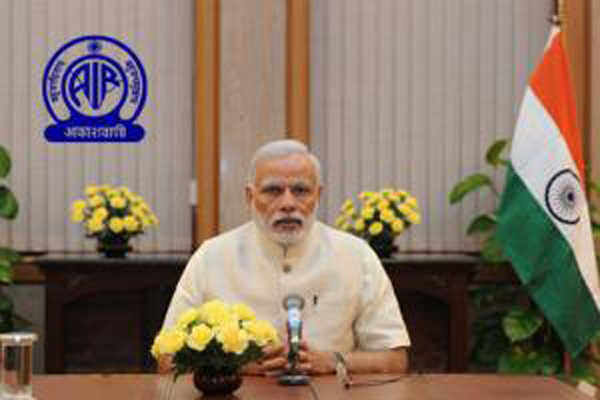
PM Narendra Modi addressing the nation during the ‘Mann ki Baat’ radio programme. Reuters file photo

Ajay Banerjee

Tribune News Service

New Delhi, April 30Prime Minister Narendra   Modi on Sunday yet again hit-out at the ‘VIP-culture’ saying removal of red beacons atop government vehicles was a symbolic step and the time is now to remove the ‘VIP-culture’ from the minds.Addressing the nation through radio talk programme ‘Mann ki Baat’ broadcast by the All India Radio, Modi said the average citizen hates the VIP-culture.  “Removal of red beacons was just a symbol. We have to remove this VIP culture from the minds,” he said adding that under the ‘New India’ concept the acronym ‘EPI’ (Every person is important) is more suited rather than the ‘VIP’.

(Follow The Tribune on Facebook; and Twitter @thetribunechd)

On red beacons from atop vehicles — the government had last week ordered the removal of these beacons last week — Modi said: “The red beacon was just on vehicle and this slowly was entered the mind-space and behavior”.Modi asked young people who have just finished examination and are now planning for vacations in the summers to come out of their ‘comfort zone’.

He said he feared that children, while struggling to have best marks, have become like robots and are going about with life as a machine. “It’s good to have aspirations but make sure the human element is not being lost,” he said.He asked the youth to learn singing, learn swimming, or learn drawing to ease out their minds from studies.New things will make you think out of the box. “Do something out of box now, when you are at the stage of career then you will not have time,” Modi suggested.For the vacations he suggested three things — Go to a new place; try out new schemes and have new experiences. Do things during vacations that you have not done before. He said the youth could learn more by seeing more places, new villages or towns.The Prime Minister asked vacationers to share their pictures on with #incredibleIndiaAddressing the middle class and ‘well off’ youth he asked: “ Have you tried to travel in an unreserved train compartment?  Try it for 24 hours.  What do those passengers talk about? You will possibly learn more things in 48 hours than you would in one year”.He suggested, go try and play football or volleyball with poor children in slums, learn from them. When these children play with you (middle class) they will also learn.He asked the youth from educated families teach poor children various skills.The Prime Minister also addressed the issue of climate change saying the heat wave being experienced in the country during March-April was akin to the summer normally in May–June.He said the country would observe the 1000th birth anniversary the Sant Ramanujacharya, who had fought against caste system and launched a movement to allow lower castes to enter temples, on Monday.The country will launch the South Asia satellite on May 5, which will be used for mapping of natural resources, education, IT connectivity and more.


Ex-soldiers as guardians of Punjab welfare schemes: Know details, and meet the General who will lead

Former chairman of the Punjab Public Service Commission (PPSC), a much-feted commandant of the Indian Military Academy, a decorated armoured corps officer, and a military historian, Lt Gen TS Shergill (retd) has worn a variety of hats.

Lt Gen TS Shergill (retd)

Former soldiers will guard against leaks in social welfare schemes in Punjab by keeping a close vigil at the village level, in a first-of-its-kind scheme by any state government in India. Here’s who’s heading it. Former chairman of the Punjab Public Service Commission (PPSC), a much-feted commandant of the Indian Military Academy, a decorated armoured corps officer, and a military historian, Lt Gen TS Shergill (retd) has worn a variety of hats. Now he’s donned a new one, that of heading the ‘guardians of Punjab’. Read on for details of the scheme and excerpts from a conversation with Lt Gen Shergill.

Seed of the idea: “We thought it would be a great way to productively use ex-servicemen, many of whom retire after 15 years of service, when they are only 35. Alexander had said a soldier was at his best at this age.”

The purpose: The General says a study found that of every rupee earmarked for social welfare, only 15 paise reached the target group. “We will plug this leak.” Former soldiers will be appointed guardians in all the 12,710 villages of Punjab. They will educate the villagers about the various schemes, find out if they are reaching them, and then report their findings to a central control room. “It’s an information system to help the administration. It won’t replace, replicate or become a shadow of the administration,” says Shergill.

Appointing guardians: Every village will have one guardian. “He will have to volunteer for the job. The chief selection criterion will be the respect he commands in the village regardless of his rank,” says Shergill, pointing out that “respect” holds the key. He also underlines that it’s an apolitical scheme.

The structure: The CM will be the chairman of the scheme. The guardians will have four layers: one at the village level; second at the tehsil level with a three-member team comprising an officer, junior commissioned officer (JCO) and other rank (OR), headed by an SDM; and third at the district level with a team of two officers, JCOs, and ORs each headed by the deputy commissioner. The 24-hour control room will be set up at the CM’s office.


E-governance: Every guardian will be armed with a check list of schemes and a cellphone. He will file a fortnightly report, and will be free to red-flag any lapse in the interregnum. “The information received by the control room will flow to the administration. The objective is to ensure that rectification or assistance is carried out at the village level.”

Training: Maharaja Ranjit Singh Institute of Public Administration is producing a manual for the guardians who will be trained before they take charge.

Honorarium: A sum of Rs 11,000 is being proposed for the village guardians to cover their daily expenses. They will initially be given tenure of two years.

Job scheme: The government is also tying up the guardians with its scheme of Ghar Ghar Naukri (job for each household) under which unemployed educated youths in the age group of 18 to 35 will be given a stipend of Rs 2,500 a month. “The guardians will approach these youth to serve as their eyes and ears,” says Shergill, adding that over time they will also channel them into sports and skill development.

Rollout: The district-level launch will take place in July.

GoG to supervise execution of government schemes

Amarinder Singh Final

April 1, 2017

Chandigarh: Punjab Chief Minister Capt. Amarinder Singh has begun to set up a place a mechanism which has to be christened Guardians of Governance (GoG), to manage the implementation of government schemes and to collect feedback on the working of officials to ensure not to indulge in corrupt practices. The Congress had promised to fight against corruption as stated in the manifesto.

The Amarinder Singh government’s aim is to recruit and train ex-servicemen at the village and block level. Advisor CM, Lt. Gen TS Shergill (retd.), held a meeting to prepare a blueprint for GoG appointments. It is not clear whether any honorarium or a fixed salary will be given to ex-servicemen who will be recruited for the purpose. Punjab has around 12,000 villages and the number of ex-servicemen are approx. two lakh.

Sources said that ex-servicemen would be trained in information technology and special portal will be created to upload the information. Action would be taken based on the report filed by the ex-servicemen with in a stipulated period.

The ex-servicemen would report on delivery of services such as healthcare, drinking water, power and education.

Former servicemen, unemployed to ‘guard’ governance in Punjab

A brainchild of chief minister Captain Amarinder Singh, the process to recruit the ex-servicemen is expected to start by July.

Punjab Chief Minister Captain Amarinder Singh (Photo: PTI)

 Punjab Chief Minister Captain Amarinder Singh (Photo: PTI)

Chandigarh: The Punjab government will soon begin the process of recruiting ex-servicemen and unemployed youths for its ambitious ‘Guardians of the Governance’ scheme wherein the members will act as the “eyes and ears’ of the administration at the grassroots level.

For the scheme, which is being conceived to oversee the implementation of programmes and policies at the grassroots level, the state government will enroll around 13,000 ex-serviceman, one from each village across the state.

A brainchild of chief minister Captain Amarinder Singh, the process to recruit the ex-servicemen is expected to start by July.  The state government has a budget of about Rs 170 crore for the scheme. The willing ex-servicemen will be roped in for the programme irrespective of their ranks.

According to Lt Gen T.S. Shergill (retd) senior advisor to the Punjab CM, “GOG scheme is not going to replace, hinder or replicate the administrative arrangement or the grievance redressal system, but assist the administration in providing the information at all levels of  governance village panchayat upwards.”

clip

clip

clip