Sanjha Morcha

Polls in conflict zones: A Kashmiri lesson Syed Ata Hasnain

CRPF personnel standing guard at a polling station during repoll in Srinagar Lok Sabha constituency in Budgam district of Kashmir. (Photo: PTI/File)

CRPF personnel standing guard at a polling station during repoll in Srinagar Lok Sabha constituency in Budgam district of Kashmir. (Photo: PTI/File)

Jammu and Kashmir is in election mode, and two important

Lok Sabha byelections are in process. The turnout in Srinagar

was abysmal, and the same would have happened in Anantnag

too if it hadn’t been postponed for six weeks. Of course, there

is no guarantee of normal polling on May 25, when the bypoll

is now scheduled. In Srinagar, the violence made more news

than the turnout, with eight lives lost.

Having been associated with most elections in J&K since 1989,

I can recall heated discussions whenever they took place. But

none revolved around the real issue – conduct of democratic

processes of any significance in an internal security scenario

that has proxy war at the core. The United Nations, for

instance, invariably seeks to hold elections as the grand finale

of any peace process in a conflict zone in which peacekeeping

operations have been in place. The finest examples are

Cambodia and Mozambique, both of which had proxy internal

conflicts of Cold War vintage, and ended in situations of

stability with elected governments; both have their run with

problems, but none of the magnitude of pre-election periods.

Democracy is presumed to be a great leveler and empowers the

very people who fight each other or the state; and gives them a

chance to enter an era of stability and aspire to improve their

lives. It is supposed to make the voice of the silent majority

relevant, and a chance for their children to lead better lives. It

is also meant to iron out differences and let the majority view

prevail. However, a million-dollar question always remains: is

democracy necessarily the end process of seeking peace in a

conflict zone, or is it a facilitator that enables the advent of

peace? There’s no better place to examine this than Kashmir,

which has seen turbulence and conflict for the past 28 years –

conflict driven by the proxy support of an adversary, a mix of

ideology and politics and confused aspirations. It’s a classic

case where the democratic process has been in place alongside

conflict for almost 21 years (since 1996).

The current context of the conflict goes back to 1989, but the

background is too well known. Let it suffice that the trigger

was an allegedly rigged election (1987) but it was just a trigger.

The actual conflict emerged for historical reasons, more so due

to external support for secession and internal mismanagement.

A couple of points from 1989 to 1996 are relevant. During this

time the sentiment for separatism was strong in Kashmir and

some other Muslim areas south of the Pir Panjal. Why was it

considered necessary that Assembly elections be held in 1996

without awaiting full stabilisation? Obviously polls were seen

as a stability facilitator. India was under intense pressure

internationally amid the Pakistani campaign to paint it

black. New Delhi had, however, weathered a serious onslaught

by US assistant secretary of state Robin Raphel, an ardent

Pakistan backer. The foreign element of the militancy – the

pipeline of the non-Pakistani Mujahideen – had dried up. The

Ikhwanul Muslimeen, the counter group set up by India, was

reasonably effective at that time. The decision to hold

Assembly elections at that juncture was extremely bold, and

well thought out. The turnout percentage was not the essence;

the event itself was, including the installation of an elected

government. Its strategic messaging was massive. The turnout

didn’t prove too bad either. The years 1996-97 were crucial for

India. Pakistan had successfully installed a Taliban-led

government in Kabul, and could focus its attention much more

on J&K. The decision to risk elections was also aimed at

countering the Pakistani propaganda that J&K was in chaos. It

also firmly communicated India’s resolve after another

landmark event was used for strategic messaging; this was the

joint resolution of the two Houses of India’s Parliament on

February 22, 1994 that the entire kingdom of the erstwhile

Maharaja of Kashmir belonged to India.

The 1996 elections brought a legitimately-elected government

to power. It gave an impetus to political activity, but given the

security situation it was risky for legislators to venture into

their constituencies. In areas close to the Line of Control it was

easier, and that’s where political activity flourished. This led to

the creation of the PDP at the instance of Mufti Muhammad

Sayeed, adding more variety to Kashmiri politics. Where

politics and elections failed the people of Kashmir in particular,

and not J&K, was the inability of the political class to involve

the people in more governance-based issues at the ground

level. There were few legislators willing to undertake personal

risk to enable active engagement with people. The stream of

elections since 1996 did create awkward moments, and some

sense of confusion in the minds of mainland India.

Among the reasons for confusion was, first, the improving

voting turnout percentage. Yet after government formation,

support to anti-national activity continued by some who had

taken part in the elections. Most of this was in the form of

over ground support. The Indian public largely assumes that

voting in elections affirms faith in the Indian Constitution.

Some Kashmiris aligned against India, however, say they vote

only for the purpose of their administrative needs, but don’t

have faith in the Constitution or accession to India. Second, on

a similar note, many young boys turn out for recruitment to the

Army or paramilitary forces every time a drive is held. It is

claimed many are stone-throwers. My experience shows this is

not true. There are many young people who may not have any

love for India, but they don’t necessarily indulge in any form of violence.

They carry deep-rooted alienation, and at the first instance of a

chance of employment they shed their inhibitions; quite apart from the stone thrower variety.  Classically,

this is a case for psychologists and sociologists to study in more detail.

Alienation and dislike amounting to hatred are very powerful

emotions that can’t be glossed over. Psychologists should

suggest methods of communication to deal with this alienation.

A lot of people believe that applying principles of rationality

may fetch dividends. This means people should use elections to

convey their true feelings. They shouldn’t use violence but

voice democratic dissent against issues they strongly feel

about. This advice is, however, fine for straightforward security

situations, but not where vicious proxy wars are under way.

The separatists invariably oppose elections, but with varying

degrees of seriousness. When they sense there is a public desire

for betterment through “roti, kapda aur makan”, the objections

are low-key, but at politically sensitive moments the level of

discouragement is again very high.

The current impasse is the most challenging in the short history

of J&K’s electoral processes since 1989. The separatists will be

elated by the government’s failure to control violence as well

as the low turnout. The Opposition parties don’t seem to

mind this either as it gives them a chance to browbeat the

government.

Elections may perhaps not be the best way to counter violence.

They may actually provide circumstances for more violence.

But elections can’t be wished away either in a democratic

nation – and that is where the dichotomy lies.


Evolving External Influence in Jammu and Kashmir (Part II)

Lt Gen (Retd) Syed Ata Hasnain
Member, Governing Council, IPCS, & former GOC, 15 Corps, Srinagar
Pakistan’s propensity to calibrate its role in J&K is usually contingent upon its strategic confidence at a given time and the situation present in the state. It appears in the midst of a new found confidence quite evident from social media and the statements by its leaders and mainstream media. Notwithstanding Operation Radd-ul-Fasaad launched by the Pakistan Army after the recent surge of terror activity, the common internal belief is that the worst is over. The Pakistan Army has sold the idea that it has been successful in clearing out the terrorist strongholds on the western front and that it has forcibly sent back a section of refugees from Afghanistan. Fencing is being carried out along the Pakistan-Afghanistan border despite Afghan objection. However, no one tells the public that military operations can reduce terrorist strength but without a resolution to the Afghan issue, Pakistan will remain in the vortex, and in the eye of the storm.
Pakistan will continue to pursue its interests there by supporting the Haqqani Network and garnering influence. With prevailing chaos along its western border and across in Afghanistan, the Tehreek-e-Taliban Pakistan (TTP) and other anti-government elements will take full advantage to keep the internal violence going. As long as Pakistan’s internal security machinery is targeting the anti-government groups, chances that it will seriously go after the Punjab-based and J&K focused terror groups that are friendly towards the Pakistan government remains a vain hope. So much for the interest generated in India on the Pakistan announced detention of Hafiz Saeed, the oldest ploy employed to keep the foreign powers convinced that Pakistan is serious about weeding out terror and does not endorse the principle of good and bad terrorists.
US-Pakistan
Has any difference been seen in Pakistan after the US President Donald Trump’s administration took over in Washington? Not really. If there is one thing the US foreign policy has never wavered from, it is the pursuit of its interests through Pakistan. Nowhere in the new administration’s scheme of things is there any evidence of a reduced level of support for Pakistan. The US Ambassador to the UN, Nikki Haley’s, surprise offer of mediation between India and Pakistan appears once again to miss the core issue. It was again hyphenating the India-Pakistan narrative in order to serve US interests. Therefore, nothing much has changed and in fact the understanding within the US administration about Pakistan’s role in the promotion of global terror, appears the least, ever.
The US is concerned about the quantum of strategic space in the South Asian and extended region being garnered by the China-Russia combine; and Washington’s attitude towards Islamabad will be dictated by this phenomenon.
China-Pakistan
China’s active investment in the China Pakistan Economic Corridor (CPEC) has given Pakistan a strategic boost. Analysts differ on the financial benefits of the CPEC that will eventually reach Pakistan. However, the Pakistani perception is that the current 5 per cent growth rate will move upwards to 7 per cent over the next three years.
It is not the reality but a perception that makes a difference in the context of India-Pakistan relations. China’s diplomatic support to Pakistan is almost guaranteed and after the recent spat with India over the Dalai Lama’s visit to Arunachal Pradesh, China is unlikely to change its stand on Masood Azhar; it withheld support to a move in the UN Security Council to declare him a terrorist and although a year has elapsed, nothing has changed. China complicity with Pakistan’s entire approach on J&K will probably receive a boost. Russian proclivity to approach South Asia via the Afghanistan prism and alter its traditional diplomatic support to India is another factor that will strengthen Pakistan’s resolve to change nothing. The Russians are concerned about the possible entry of the Islamic State (IS/Daesh) being squeezed into Afghanistan and from there to Central Asia. It perceives the need for Pakistan’s support to prevent this happening.
Saudi Arabia-Pakistan
The other major player who makes a difference to Pakistan’s strategic thinking is Saudi Arabia; Pakistan is back at scoring brownie points with that country. The unhappy episode involving Islamabad refusing to provide troops for Riyadh’s war in Yemen is now history. An infantry brigade worth of troops may soon be on their way to Saudi Arabia; and Pakistan’s former Army Chief Gen Raheel Sharif rules the roost with his appointment as the head of the 39-nation Islamic Alliance against Terrorism.
Thus with emerging stronger relationships with China, Russia and Saudi Arabia Pakistan perceives itself in a much stronger position with ability to counter India’s diplomatic strength. In the past, such a situation has always led to Pakistan lifting restraint on its security agencies and the deep state in general. This is what India has to guard against. Our diplomacy and strategic communication must convey that we are prepared to handle anything Pakistan attempts to do to put India on the back foot in J&K.
This commentary is the second of the two-part series on the evolving nature of external influence impacting security and stability in Jammu and Kashmir, India.

This is how India treats Pak spy by sheltering

This is how India treats Pak spy by sheltering
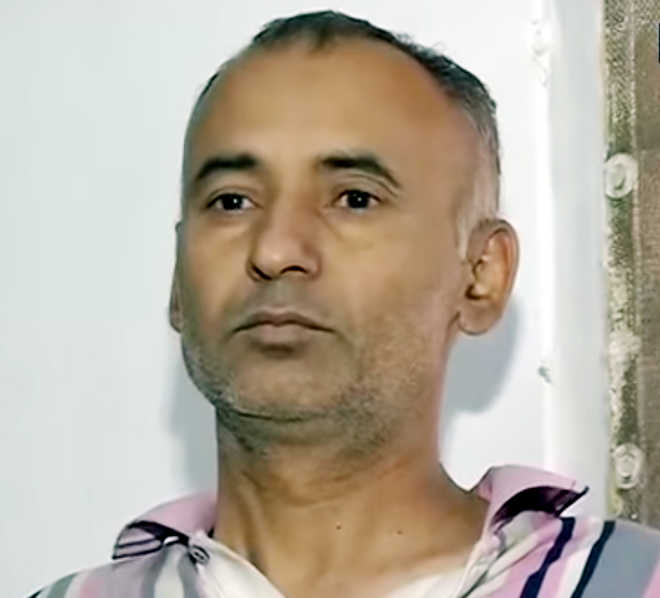
Sajeed Muneer has completed 12-year sentence. — ANI photo

Bhopal (Madhya Pradesh), April 12On one hand Kulbhushan Jadhav and Sarabjit Singh were tormented by Pakistan on a flimsy grounds that they were Indian spies, here the Bhopal Police have been feeding and sheltering a Pakistani spy for almost a year after his release from jail.Sajeed Muneer was jailed for 12 years for espionage, but after his release Pakistan did not respond to extradition requests by the Indian government.

(Follow The Tribune on Facebook; and Twitter @thetribunechd)

By default, he became the Bhopal Police’s responsibility and the District Special Branch (DSB) has been taking care of him for 10 months now.The DSB pays for his food and other necessities.Speaking to ANI, Superintendent of Police Rajesh Bhadoria said since the time of end of his conviction every angle related to the issue is being discussed but Pakistan is delaying the process of deportation.”On June 4 last year his sentence ended. In between the deportation process, he was kept in the detention centre, as those who are not from India they are kept in that centre,” he said.The SP added that police officials are in constant contact with the Pakistan High Commission and the process of consular access, where High Commissions of both the countries did the verification of Sajeed Muneer, has been done.“The Bhopal Police arrested him in May 2004 when he was collecting some official secret material from the army regiment. That time he was impersonating himself as an Indian national. He has been current put in Shahjahanabad police station’s detention centre,” Bhadoria said.Investigations revealed that Muneer was lured by the ISI while he had gone into hiding after a murder case.He had murdered a Karachi youth to avenge his brother’s killing. — ANI


In death, ex-IAF man gives new lease of life to two Corneas to help another two in getting eyesight

Tribune News Service

Chandigarh, April 8

The family of an ex-serviceman of the Indian Air Force, who was declared brain dead at the PGIMER here yesterday, today gave the consent to donate his organs, which saved the lives of two critical patients and will give vision to another two.Nirmaljit Kaur, wife of Manjit Singh (64), said, “My husband was a brave soldier. He lived saving others and even in his death, he has turned a saviour for four others.”The Kharar resident was admitted to a local hospital on March 26 following a brain stroke and remained in an extremely critical condition for almost 12 days. He was shifted to the PGIMER on April 6 where he was declared brain dead the next day.After his family’s consent, his kidneys and corneas have been harvested for transplantation.


HARYANA BRACKETS PARAMILITARY WITH ARMY

Arecent move by the Haryana Government to bracket paramilitary forces personnel with soldiers has gone virtually unnoticed. Apparently the charter of the state’s Sainik Welfare Department has been expanded to include the well being of central armed police forces like the BSF, CRPF and ITBP. Now, the reasoning for ex-servicemen’s welfare departments in states is because soldiers have abbreviated service tenures with vast majority, typically retiring between 35 and 40 years of age. Retiring at this young age with their children still studying, they need help in resettlement and getting access to the schemes put into motion for their welfare, necessitating extra efforts by the government.

HT PHOTOUT administrator VP Singh Badnore (left) with Punjab chief minister Captain Amarinder Singh (right) during the book launch.Personnel of paramilitary forces on the other hand serve until the age of 55 to 60, though they do lead tough service lives with frequent moves, operational deployments and postings on the border. Minimum work is required to be done by government agencies to resettle them. So why have they been clubbed with soldiers who spend the better part of their youth on extremely hard assignments? I wouldn’t exactly call this a sinister move but definitely the armed forces need to protest to the Haryana government.


AMARINDER SINGH’S NEW BOOK RELEASED

Captain Amarinder Singh’s latest book ‘The Samana Forts: The 36th Sikhs in the Tirah Campaign 1897-98’ was released at a glittering function last evening, attended by hundreds of veterans, serving soldiers and the region’s elite. The book is an account of the service of the battalion we now know as 4 Sikh in the Tirah Campaign on the North-West Frontier of India. It particularly focuses on one of the greatest last stands in military history, that of 22 men of the battalion at the signal link post of Saragarhi on 12th September 1897. With his usual meticulous research, Captain has demolished some of the myths that have grown up over the years about the battle, particularly the number of enemy combatants and the casualties.

COURT MARTIAL ON AT N AREA

A summary general court-martial is on at N Area, near the Chandigarh airbase, to try an officer and eight Other Ranks (ORs) of 168 Field Regiment on charges stemming from the alleged murder of a jawan in Ladakh in 2010. A member of a patrolling party died under mysterious circumstances with three bullet wounds on his body. A medical examination ruled out suicide.

While summary in nature, this court martial has a complete jury. All prosecution witnesses have deposed in the trial. The defence having entered a plea of ‘No Case’ the GCM has now adjourned. Evidence in the case is reported to be circumstantial in nature. A botched investigation has ensured that the all-important forensic evidence is missing. 168 Field Regiment distinguished itself at the Battle of Longewala in 1971. A sad affair.

NO DEFENCE MINISTER AGAIN!

For the second time in three years, we have no full-time defence minister. Speaks volumes for the lack of expertise on national security issues among our political class. This seems to cut across all parties with even the Opposition not cornering the ruling party on this vital issue. May God save this country! It’s politicians certainly won’t.


Avalanche kills 3 jawans, Valley reels under rain, snow

FLOODS IN SRINAGAR Education institutes closed for 3 days as Jhelum’s water level rises

J&K CM MEHBOOBA MUFTI, WHO HELD A REVIEW MEETING, ASKED OFFICIALS TO SET UP A UNIFIED CONTROL ROOM TO MONITOR THE SITUATION

From page 1 SRINAGAR: Three soldiers were missing after multiple avalanches tore through Kashmir’s Batalik sector on Thursday as the valley reeled under unprecedented rain and snow that swelled rivers and inundated vast areas over the past three days.

WASEEM ANDRABI/HTVehicles and commuters wade through a waterlogged street in Srinagar on Thursday after fresh snowfall. Snowfall and rain have forced the authorities to close schools and colleges even as the only all­weather road link connecting the Valley with the rest of India has been cut off.

Two civilians are also missing after a vehicle they were travelling in skidded of the road and fell into a stream in Anantnag district. Five other passengers were rescued.

The administration declared floods in Kashmir’s summer capital Srinagar where the Jhelum’s water level rose alarmingly and shut education institutions for three days, officials said.

The met office said the weather was likely to improve from Thursday as panic set in the valley which had seen death and devastation after torrential rain had triggered a deluge in 2014, the worst in many decades.

Kashmir experienced rare snowfall in April with vast areas blanketed in white due to the freak weather phenomemon.

An army spokesperson said the heavy snowfall triggered multiple avalanches, burying one post in the Batalik sector.

While two out of five trapped soldiers rescued were rescue, operations were on to trace the three others.

Specially trained and equipped avalanche rescue teams have been deployed for the operations in the area.

The administration also issued an avalanche warning for next the 24 hours in Kashmir valley and Kargil district.

In Srinagar, officials declared flood after the Jhelum’s water level crossed 18 feet in Ram Munshibagh area in the evening.

Chief minister Mehbooba Mufti, who held a review meeting, asked officials to set up a unified control room to monitor the situation. She also directed chalking out contingency plans for flood-prone areas and make available nearby buildings in case of emergency evacuations.

Kashmir divisional commissioner Baseer Ahmad Khan asked deputy commissioners to arrange buses and boats for evacuation of people


Shaurya Chakra awarded to heroes of surgical strike

Shaurya Chakra awarded to heroes of surgical strike
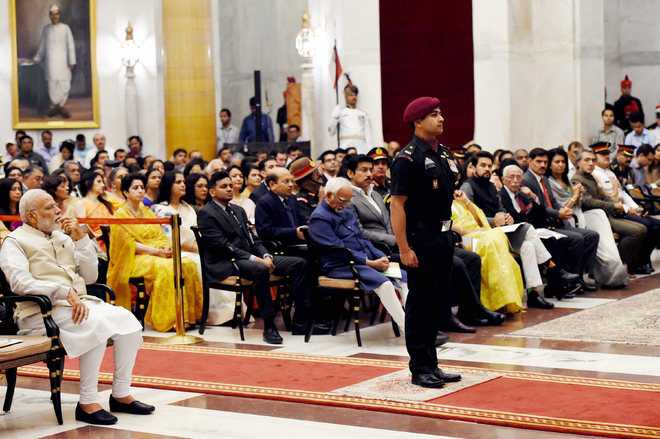
Major Rajat Chandra at the Defence Investiture Ceremony at Rashtrapati Bhawan in New Delhi on Thursday. PTI

New Delhi, April 6

President Pranab Mukherjee today awarded Shaurya Chakra to the officers who took part in the surgical strike across the Line of Control (LoC) last year.He also awarded the Shaurya Chakra posthumously to Lt Col Niranjan Ek, who died while recovering IED from the bodies of Pathankot terrorists in January 2016.As per the citation against Shaurya Chakra awardees, Major Rajat Chandra killed two terrorists during the surgical strike, while Captain Ashutosh Kumar eliminated four terrorists. Both belong to 4 Para Special Forces, which took part in the surgical strike in September last year.(Follow The Tribune on Facebook; and Twitter @thetribunechd)Major Deepak Upadhyay and Paratrooper Abdul Qayum, both of 9 Para Special Forces, were also awarded with Shaurya Chakra for their role in the surgical strike.Nineteen soldiers of the 4 and 9 Para — units of the special forces —,who undertook the cross-border surgical strike across the LoC, were awarded with gallantry medals, including a Kirti Chakra, on January 25, while their commanding officers have been given Yudh Sewa Medal.Shaurya Chakra was also posthumously awarded to Sanjewan Singh, head constable with the J&K Police, Naib Subedhar Kankara V Subba Reddy, Naik Pandurang Gawande, and Kirti Chakra to Lance Havildar Prem Bahadur Resmi Magar of the Gorkha Rifles. All laid their lives fighting terrorists. Family members of Singh, Reddy, Gawande and Magar received the honour by the President.Lt Gen PM Hariz, one of the two senior most officers superseded by Chief of Army Staff Gen Bin Rawat, was awarded Param Vishisht Seva Medal. Hariz is the Commander-in-Chief of the Southern Command.Shaurya Chakra was also awarded to Atu Zumvu, Sub-Divisional Police Officer with the Nagaland Police, who shot down three National Democratic Front of Bodoland (NDFB) outfit members, responsible for killing 81 people.Captain Elisen Y Jami of the 12th Batallion Parachute Regiment; Kukudapu Srinivasulu, police constable with the Telangana Police; Lt Col D Vinay Reddy of the Madras Regiment and Havildar Hanuman Ram Saran of the Rajputana Rifles were also awarded with Shaurya Chakra. — PTI


HEADLINES —04 APR 2017

breakl line

INDIA ARMY KIDS ::VEDIO

WESTERN COMMAND CHIEF CALLS ON CAPT AMARINDER

FROM STRING OF PEARLS TO HEAD VICE: IS CHINA SQUEEZING A STRATEGIC ADVANTAGE OVER INDIA? SYED ATA HASNAIN

LIGHT AT END OF J&K TUNNEL PM’S CATCHY SLOGANS INADEQUATE

ARMY JAWANS LEARN PARAGLIDING

J&K: TENSE ENCOUNTERS OF THE UNWANTED KIND BY LT GEN SYED ATA HASNAIN

PAKISTAN TARGETS INDIAN POSITIONS ON LOC IN RAJOURI DISTRICT

Court grants bail to jawan held with grenades at airport, hands him to army

KASHMIR ATTACK: MARTYR CREMATED

CHADOORA, A NEW KASHMIR TACK LT GEN (RETD) SYED ATA HASNAIN

NOD TO BARAK MISSILE FOR NAVY

ARMY LISTS RULES OF SOCIAL MEDIA ENGAGEMENT FOR JAWANS

NOW, LIVE BULLET FOUND IN SOLDIER’S BAG AT SRINAGAR AIRPORT

DALAI IN TAWANG: TEST OF INDIA’S WILL SYED ATA HASNAIN

PUNJAB HEADLINES 04 APR 2017

:::SEE WHAT’S NEW AT SCROLLING NEWS .CLICK SCROLLING HEADING FOR DETAILED NEWS 

breakl line


Now, live bullet found in soldier’s bag at Srinagar airport

Now, live bullet found in soldier’s bag at Srinagar airport
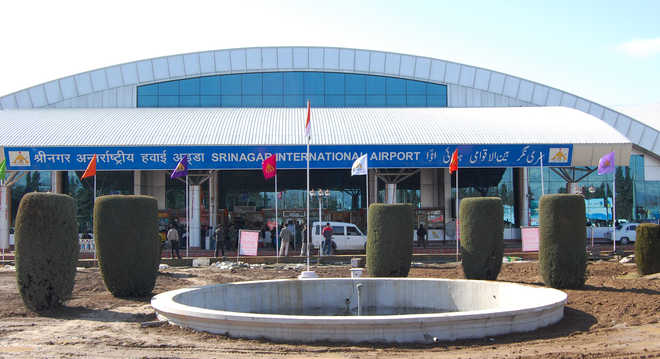
This is the second incident of an Army soldier caught at the airport with live ammunition. Tribune file photo

Srinagar, April 4

A live bullet was on Tuesday found in the baggage of an Army jawan at the Srinagar International Airport, after which he was detained, a security official said.The soldier, Pandia Raj, who was proceeding to Delhi on leave, was handed over to the Army for further investigation, the official said.(Follow The Tribune on Facebook; and Twitter @thetribunechd)Prima facie, it seems that the bullet was left behind in the bag “by mistake”, the official added.This is the second incident of an Army soldier caught at the airport with live ammunition.Yesterday a jawan was arrested after two hand grenades and other ammunition were found in his baggage during the security screening.He had claimed that the grenades had been given to him by a “superior official” for transporting these to Delhi.  — PTI


HEADLINES 01 APR 2017

breakl line

WHY THIS TUNNEL WILL BECOME JAMMU AND KASHMIR’S LIFELINE

REDUCING OBESITY IN THE INDIAN ARMY ::ORDERS

HOW ‘BROWN BAG LUNCHES’ WHET APPETITE FOR LEADERSHIP IDEAS BY LT GEN SYED ATA HASNAIN

THIS IS HOW WE CAN DEFEAT IS

WATER WASTAGE TO COST YOU DEAR FROM TODAY

BHAKRA WATER LEVEL PLUMMETS GOOD SNOWFALL OVER HIMALAYAS EXPECTED TO OFFSET WATER DEFICIENCY

FAZILKA JAWAN FOUND DEAD IN KASHMIR

‘EX-SERVICEMEN WILL REQUIRE AADHAAR TO AVAIL PENSION BENEFITS’

NEW ITR FORMS, CAP ON CASH DEALS CAN’T RECEIVE OVER RS 2L IN CASH; RETURN ON SMALL SAVINGS CUT BY .1%; AADHAAR MUST FOR TAX RETURNS

Returns simplified for 20 m taxpayers

breakl line

PUNJAB HEADLINES 01 APR 2017

:::SEE WHAT’S NEW AT SCROLLING NEWS .CLICK SCROLLING HEADING FOR DETAILED NEWS