Sanjha Morcha

‘I sound strong because that’s how my Sikh parents raised me’

I am the daughter of Indian parents who said to me whatever you do be great at it and make sure people remember you for it. That’s all I have ever shown, try to be. NIKKI HALEY, US ambassador to the UN

UNITED NATIONS: : A Punjabi may be out of Punjab, but Punjab is never out of her.

Nikki Haley, the outspoken US ambassador to the UN, says if she comes out sounding strong, it’s because that’s how she was raised by her parents, who are Sikhs from Punjab.

“I do my job to the best of my abilities and if that comes out blunt, comes out strong, I am one of two brothers and a sister and my parents raised us all to be strong,” she said at a news conference on Monday.

Her father, Ajit Singh Randhwa, who is from Amritsar district, had been a professor at the Punjab Agricultural University, Ludhiana, and her mother, Raj Kaur Randhwa, had completed her law degree from the University of Delhi.

One of her brothers, Mitti Randhwa, was an army officer who saw action in Operation Desert Storm (1990-91) leading a company tasked with finding chemical weapons.

Just over two months into her office as the first IndianAmerican to be appointed to a cabinet-level position, she has made waves by calling a spade a spade, if not a shovel, in an arena where a diplomat may delicately call it a spoon.

She has called the UN Human Rights Council “corrupt”, the UN of being a partner of a “corrupt” government, and Syrian President Bashar al-Assad a “war criminal”, and declared she was free to “beat up on Russia”.

And she perceives her job as shaking up the UN and pulling it by its purse strings, kicking and screaming, to carry out reforms.

A TV reporter addressed her as “Madam President” because she presides over the Security Council this month, and quipped that’s what she may be called in eight years — a hint that she may become the nation’s President.

Haley said that in every job she has held “people assumed I was looking for something bigger”.

But, she said, “In reality, I am the daughter of Indian parents who said to me whatever you do be great at it and make sure people remember you for it. That’s all I have ever shown, try to be.”

Haley has emerged as the face of American diplomacy with her outspokenness and availability to the public and the media — she was on three Sunday morning TV talk shows speaking out on US foreign policy, in addition to a speech at the Council on Foreign relations.

Unlike most of President Donald Trump’s cabinet and top officials, she has a warm relationship with the otherwise belligerent media.

In contrast, secretary of state Rex Tillerson has kept away from the media and minimised public appearances. Even his spokesperson, Mark Toner, is a holdover from President Barack Obama’s administration.

This makes Haley the only accessible authentic voice of Trump foreign policy, raising her public profile.

That in turn has led to media speculation in recent days that she is likely to succeed Tillerson.

Answering a question if she was offered the job of secretary of state, Haley said that Trump did not make the offer when she met him at the Trump Tower barely two weeks after the election in November. But she said: “The original call that I got to go to Trump Tower was to discuss Secretary of State.”

She added: “When we went in that was the position we were discussing.”


Light at end of J&K tunnel PM’s catchy slogans inadequate

Prime Minister Narendra Modi is an acknowledged nonpareil in focusing attention solely on his message. His effective use of inventive acronyms and choreographed gestures ensure that each of his public appearances makes it to the front pages of newspapers and prime time TV. In Udhampur on Sunday, he continued with his use of homophones by asking the Valley’s youth to choose between two Ts: terrorism and tourism. No one can have a gripe with a universal statement like that — or the ones that followed such as “this game of blood has failed to benefit anyone in 40 years.” Narendra Modi was at his persuasive and conciliatory best — offering funds, projects, business and employment to tamp down the unending cycle of violent conflict in Kashmir.As history has shown, the Prime Minister may be on the right path. An infusion of massive funds accompanied by the heavy hand of the military has helped end chronic insurgency in many parts of the world. But such recipes presuppose that Kashmir is not a political problem but a terrorist one that has to be solved militarily. This approach may be in sync with muscular nationalism on show in mainland India. But it doesn’t account for the various narratives of identity politics that have led to hardly a day passing in the last 28 years when some part of Kashmir was not up in flames.After spending the Diwali night in Srinagar in 2014, Modi would know that this route is unworkable. It is not only because Islamabad-backed minders are inimically influencing Kashmiri youth with visions of independence or merger with Pakistan. The BJP’s consolidation of the Hindu vote and its conscious “othering” of Muslims in mainland India have reduced the credibility of the PM’s exhortation of forgetting the past and making a new beginning. Chief Minister Mehbooba Mufti may have sensed the absence of political content in the PM’s peace offering when she requested him to visit the Valley. This was a clear hint to New Delhi to address the deeper reasons for the disquiet.


J&K: Tense Encounters Of The Unwanted Kind by Lt Gen syed Ata Hasnain

J&K: Tense Encounters Of The Unwanted Kind

SNAPSHOT

Lt Gen (Retd) Syed Ata Hasnain breaks down the nature of the beast confronting India in the state of Jammu and Kashmir.

Director General of Police of Jammu and Kashmir Shesh Paul Vaid is absolutely correct. The trend of flash mobs being concentrated at encounter sites in the valley is now witnessing a virtual suicidal tendency on the part of many local Kashmiri youths. Suicide terror has never been associated with local terrorists. Actions of the so-called fidayeen have seen the involvement of local terrorists, but these are essentially ‘resist unto death’ type of actions, not the classic suicide-bombing activities seen in sub-conventional conflicts in parts of the Islamic world.

Chest-baring young men are now daring the security forces to fire at them. The dilemma for the state and its institutions is usually intense whenever such violence has to be dealt with. Punitive actions by the security forces in typical law-and-order situations are calibrated to detract people from taking the law into their hands; these situations are temporary and overcome by turning the screw just a bit. However, what is being witnessed in Jammu and Kashmir is not a law-and-order problem but one involving serious public disorder with threats to national integrity. In the rest of India, there are negative passions galore, recommending extreme steps by law enforcement authorities with advisories not to soft-pedal such brazen anti-national acts. This is not the first time that we see serious challenges to state authority in Jammu and Kashmir. Anger seen outside the state is legitimate, as brazen resistance against law enforcement cannot go on with impunity. Yet, enforcement authorities are also not expected to abide by public advisories, which may be ridden with passion and irrationality. What is definitely expected is that these situations are to be seriously war-gamed and solutions found. The problem is not local but national. It, therefore, cannot be left to the state authorities alone. The stamp of application of experience needs to be nationwide. Personally, I am confronted by ordinary people almost every day who ask why the situation is not being handled more professionally.

We need to be clear about what exactly is happening in Jammu and Kashmir and how things pan out in the events being witnessed. Let me explain from experience and observation. For many years, one has been aware of just how well the separatists have been structured. District, Tehsil and block-wise hierarchy exist with ‘specialists’ assigned responsibilities. Their virtual intelligence arm is well-embedded. There are rabble-rousers ready to respond in quick time. Outreach to media is instantaneous to get their point of view home. Care is taken to ensure that there is no over-exposure of this level of leadership. One of the known ways of preventing intelligence from being effective is to bring stone-pelters and flash mobs from neighbouring towns and villages so that they are not easily identifiable to the local troops and police. Leadership at the local level is faceless and diffused with power concentrated in the hands of many rather than a few. This prevents compromise and identification. The faces in front are projected to be that of juveniles so that there is reluctance on the part of security forces to arrest and prosecute.

Social media groups employing mobile technology are very active. Many of them are controlled from across the Line of Control with a constant flow of instructions from handlers who have the benefit of analysis of data being fed to them on a daily basis. The entire mechanism is professional and designed to irritate and instigate the Indian public, government officials and security forces personnel. Passionate responses from the rest of India such as “exterminate them all” are exactly what the separatists and their handlers wish to see. These angry responses are exploited on social media to spread greater anti-India sentiment. More the outpouring of negative emotion, more successful are those instigating this response from people.

In the face of this situation, how does one define national interest? Is it the appeasement of public or the attainment of a professional aim arrived at through gaming, ideation and discussion to overcome a situation in favour of the state’s interest? I can recall a few examples of responses to such threats in the past. In 2003, the then chief secretary of Jammu and Kashmir, the general officer commanding, 15 Corps, and the director general of Jammu and Kashmir Police undertook a mission of regularly speaking together at different places, taking questions and offering explanations. It was perhaps the high mark of cooperation and coordination with a civil-military interface. It was also the best use of the Unified Command concept. The challenges then were different, but effectiveness was high considering the threats of that time. It was regular meetings between the core group and Unified Command in 2010 which delineated responsibilities and identified the vulnerabilities of the security forces to eventually overcome the challenge that year.

The situation today is admittedly far worse, necessitating a more comprehensive response which must first rest on defining the meaning of ‘engagement and outreach’. These are terms being loosely used in the media. It is unfair to expect from the political leadership bold and meaningful initiatives in the midst of serious, violent situations, notwithstanding the fact that initiatives should have come long ago. If anything, the initiative has to happen quietly and behind the scenes, and the outreach has to be directed to the right quarters. While it may be partially right to assume that mainstream separatist leaders have lost their significance, the inability to identify the new executive leadership is putting the authorities in a quandary. This leadership is diffused and has remained under wraps, probably under the guidance of men from across the Line of Control. Interrogation reports of detained rabble-rousers have not been made public, but from these, the intelligence authorities would probably have a fair idea of where the brain trust lies. This is the intelligence problem which needs immediate action.

The issue of ‘outreach’, which is always recommended to the political leadership by the intelligentsia and the lack of which is inevitably rued by intellectuals, needs a measure of explanation. Even in times of stability, outreach has not been easy. In these challenging times, it may be even more difficult. With vigilantism of the young, less-educated and reasonably mindless, it is difficult to organise public meetings without expecting trouble. No one wishes to create negative situations. So outreach has got to be first to personalities – and these can be from all walks of life and different towns and villages. The clergy has an important role to play and must be taken on board.

Outreach is primarily an exercise in listening, something most important people are not comfortable doing. It is about confidence-building all over again, with the ability to listen and withstand venom spewed against the state, against the leaders and against institutions. Small gestures and concessions which can make a difference to the public can be made in such meetings. This spirals higher as confidence enhances along with public curiosity. This is not the blueprint for a solution to the intense problem which has gripped the valley. It is only suggestive of ways and means by which better understanding can prevail. Regarding harsher measures, if the situation deteriorates, the authorities will probably consider a full blanket ban on internet and mobile services, like in 2016. It is to India’s credit that the media remains free even in as challenging a situation as was witnessed in 2016 or could potentially come to the fore in 2017. This is our national strength, and that is how it must remain.

In dealing with separatist machinery, while principally we have been acting against the visible faces of Hurriyat leaders – detaining them and placing them under house arrest, the seriousness of tackling the infrastructure at their command appears limited. That seems to be mostly intact, considering the ease with which public ire is aroused. Perhaps the focus needs to shift even as the eyes remain on the visible face of leadership. The police and intelligence set-up are competent to do this when it decides to act. There have been preventive detentions and arrests made in the past. The police know how to take this a step further; it would, however, need full political backing.

The vulnerability of the local police personnel has also come into question. In 2016, the targeting of police families demoralised the personnel. The situation was overcome fairly early, but it appears that the adversaries continue to identify this as a major vulnerability. There is a need for astute leadership to overcome the problem. It cannot be left to the police hierarchy alone and would need political cooperation between all parties. Police stations are the core institutions whose sanctity cannot be compromised. They must remain strengthened with Central Reserve Police Force reinforcement and stand-by arrangements for army’s response. Local police personnel need recognition and empathy, which must come in droves.

Lastly, the one thing that such situations do not need is unprofessional advice and instigation of security forces against the public. The situation is admittedly bad, but India, its security forces, intelligentsia and political leadership have faced worse times before. The nation will not bend despite malicious attempts to pressurise it, even as it responds with the right blend of head and heart. A country of India’s reputation will always do that.


HEADLINES— 02 APR 2017

breakl line

INDIAN ARMY’S NEIGHBOURHOOD DIPLOMACY IS IN GOOD STEED

INVESTITURE CEREMONY AT IMA

PALAMPUR GIRL JOINS ARMY AS DOCTOR

MILITANTS AMBUSH ARMY CONVOY; 3 JAWANS INJURED

FOUR SENIOR POSTS IN ARMY FALL VACANT

OF 800 APPEALS AGAINST SOLDIERS WITH DISABILITY IN SC, JUST 1 WIN FOR CENTRE


PUNJAB HEADLINES 01 APR 2017

:::SEE WHAT’S NEW AT SCROLLING NEWS .CLICK SCROLLING HEADING FOR DETAILED NEWS 

breakl line


Militants ambush Army convoy; 3 jawans injured

Militants ambush Army convoy; 3 jawans injured
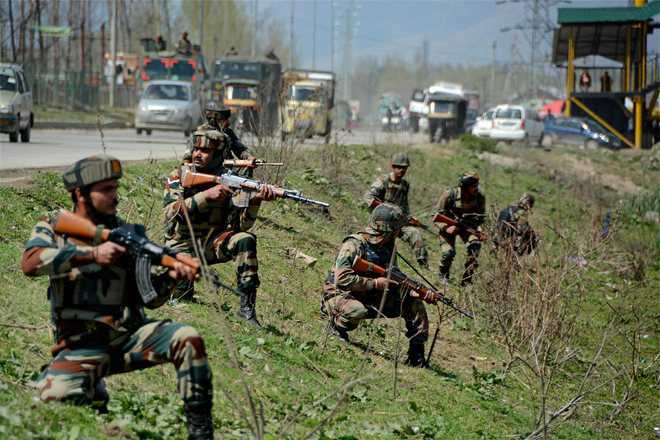
Security personnel take position during a search operation after militants ambushed an Army convoy in Srinagar on Saturday. PTI

Majid Jahangir

Tribune News Service

Srinagar, April 1

Just a day ahead of Prime Minister Narendra Modi’s visit to J&K, militants today surfaced in Srinagar and ambushed an Army convoy on the outskirts of Srinagar city, injuring at least three jawans.The ambush by militants, believed to be two to three in number, at the Bemina bypass along the Srinagar-Jammu national highway, took place in the afternoon when an Army convoy was on its way from border town of Uri in Baramulla to Srinagar.“Militants armed with assault rifles fired at the Army vehicles near a hospital on the Parimpora-Panthachowk bypass road which was retaliated. Three soldiers were injured in the ambush. The attackers managed to escape,” sources said, adding that the shootout created panic in the area.The attack took place despite the highway being secured by the Army and CRPF under the Road Opening Procedure (ROP), a daily drill to protect security vehicles that ply on the road.Soon after the attack, the police and CRPF cordoned off the locality and carried out searches to trace the militants involved in the attack.Defence spokesman Col Rajesh Kalia said three injured soldiers were evacuated to the Army’s 92 Base Hospital.“The firing took place in the overcrowded area and the Army showed maximum restraint,” Col Kalia said.Militant group Hizbul Mujahideen in a statement to a Srinagar-based news agency claimed responsibility for the attack.The attack took place amid heightened security in the wake of PM Narendra Modi’s visit to the state. Modi will inaugurate the Chenani-Nashri tunnel, India’s longest highway tunnel, on the Jammu-Srinagar national highway on Sunday.Even as many ambushes on forces on the national highway in south Kashmir took place last year, today’s ambush was the first attack on the Army on the 14-km Parimpora-Panthachowk bypass in the past nearly four years. In 2013, Lashkar-e-Toiba militants had ambushed an Army convoy at Hyderpora, Srinagar, in which eight jawans were killed and over a dozen injured.Minutes before the ambush on the Army convoy at Bemina, panic spread in the city centre of Lal Chowk after gunshots were heard in the locality. Sources said a mentally challenged man entered a hotel in the Lal Chowk and the security men took him as a militant. However, the person was detained from the hotel by the police. As he was being taken away, locals feared that a militant had been arrested by the police and they threw stones on forces. The forces fired a few gunshots.SP (East) Sheikh Faisal said a boy tried to enter the hotel. “I think he is mentally deranged. He is with us and we are ascertaining his identity,” Faisal said.Following the incident, there were massive clashes in the city centre for at least an hour. The police also fired teargas shells to disperse the mob.Soldier killed in explosion on LoCJammu: A junior commissioned officer of the Army was killed on Saturday in an explosion near LoC in Poonch district, the police said. Police sources said the incident occurred in the Degwar sector in Poonch. “The exact cause of the explosion is being ascertained,” the sources said. —IANSMajor attacks since 2016February 20-22, 2016: Three elite para commandoes, including two Captains, two CRPF men, three militants and a civilian were killed in a gunfight in Sempora, Pampore, on the Srinagar Jammu highway. The militants took shelter in the EDI building after carrying out an attack on a CRPF convoy on the Srinagar-Jammu national highwayJune 3: Three BSF jawans were killed and seven others were injured after militants ambush their convoy on the busy Srinagar-Jammu highway at Bijbehara in south KashmirJune 25: Militants intercepted a convoy of the CRPF and killed eight security personnel and injured 22 personnelAugust 17: Two Army jawans and a policeman were killed as militants ambushed a convoy of the Army in Baramulla districtDecember 17: Three soldiers were killed and two others injured in a militant attack on an Army convoy on the Srinagar-Jammu highway at Pampore in Pulwama districtFebruary 23, 2017: Three Army jawans were killed and five others, including two officers, were injured in a militant attack in south Kashmir’s Shopian district. A woman was also killed in the firing 
clip


Jadhav’s trial conducted in a ‘transparent’ manner: Pak

Jadhav’s trial conducted in a ‘transparent’ manner: Pak
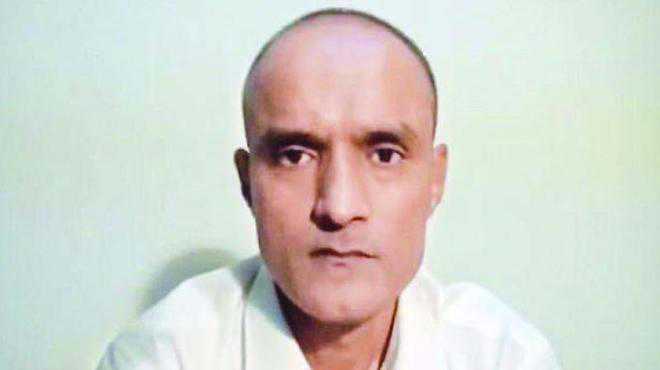
Kulbhushan Jadhav. File photo

Islamabad, April 27

Pakistan on Thursday stuck to its stand on Kulbhushan Jadhav’s sentencing, saying the military court’s ruling was based on specific evidence and the trial was conducted in a “transparent” manner.Pakistan’s assertion came a day after India handed over an appeal by the mother of retired Indian Navy officer Jadhav, sentenced to death by the Field General Court Martial, to the appellate court, initiating a process to get his conviction overturned.Pakistan Foreign Office spokesperson Nafees Zakaria claimed that Jadhav has been tried for espionage according to the law of the land in a “transparent manner”.Jadhav’s sentencing was based on specific evidence as well as his “confessional statement” that also led to the dismantling of the terror network in the country, Zakaria was quoted as saying by Radio Pakistan.Zakaria’s remarks at a briefing came a day after the appeal on behalf of Jadhav was given to Pakistan’s Foreign Secretary Tehmina Janjua by Indian High Commissioner Gautam Bambawale, who also handed over a petition by Jadhav’s mother seeking the Pakistan government’s intervention for his release and expressing the desire to meet him.Jadhav was given death sentence earlier this month, evoking a sharp reaction in India which warned Pakistan of consequences and damage to bilateral ties if the “pre- meditated murder” was carried out. — PTI


Captain’s knock awaited Punjab needs major shake-up to restore law and order

HERE are reports of gangster shootouts every other week in Punjab. It has been a baptism by fire for the Congress government on the law and order front, and it cannot be said that it has met the challenge with the gumption required. Putting a stop to drugs within a month was another promise to which the government is being held by the Opposition. To be fair, the Punjab Police have had some successes with the arrest of a few notorious gangsters and jail escapees. But when the crooks brazenly carry out executions, it does no good to public confidence. The arrests in the drug trade have been unimpressive. It defies reason that only petty street peddlers and some of the constabulary were involved, but they are the only ones the police seem to be going after.Another, and perhaps even more worrisome, aspect is the spectre of Congress workers or known supporters being involved in attacks on SAD and BJP leaders and associates. A few have been murdered too. Most of the violence has been in attempts to take over control of truck unions or of village-level politics from the ousted ruling alliance. But it is indicative of the confidence Congress leaders have felt in taking the law in their hands. Some MLAs have even gone to the extent of directly threatening the police against harming their interests. It may well be said the present state of law and order is a legacy the government has received from the SAD-BJP dispensation. But it must ponder what calculations and interests produced that situation. The Congress in its euphoria over a sweeping majority runs a serious risk of going down the same path.Capt Amarinder Singh has made much of his ability to take bold decisions in the interest of the state. He would establish his credentials if he could ensure the police are able to reach the root of every tentacle of lawlessness. If that means making an example of certain fat but bad apples in his own party, the police or the bureaucracy, so be it.

Dialogue of the deaf

NITI Aayog crowd lacked focus

Sunday’s meeting of chief ministers arranged by NITI Aayog saw diverse ideas thrown around with an option to pick and choose. The BJP chief ministers read out their report cards expecting a pat or a word of approval from the Prime Minister. Their mind, however, was elsewhere. Most of them tweeted about “Antyodaya”, meaning “the rise of the last person”, because of its association with Deendayal Upadhyay, who was the subject of a four-day ongoing RSS seminar in the national capital. Prime Minister Modi was on a different planet where having simultaneous assembly and Lok Sabha elections and a shift to a new January-December fiscal year occupied his attention. In-between he praised states for sinking their differences over GST without listening, or responding, to the CMs beseeching him to make good in time their revenue losses on account of the GST rollout. Apparently on being prodded by the Jammu and Kashmir Chief Minister, Narendra Modi also remembered to make an appeal to the CMs to protect Kashmiris living in their states. The BJP-PDP coalition has been going through a rough patch of late and Mehbooba Mufti had to be pacified even if the platform was a little inappropriate. The PM also asked states to spend more on infrastructure. He spoke about hiking fund allocations to states, whereas CMs kept asking for more. The opposition CMs, notably the ones from Bihar and Tamil Nadu, complained of bias in fund allocations. The Himachal CM gave instances of fund squeeze under Central schemes. The Punjab CM kept up the pressure on a farm debt waiver, while seeking funds for border area development. It was left to Kerala CM Pinarayi Vijayan to question the replacement of the Planning Commission by the NITI Aayog and point out that the “space for constructive debate is shrinking” with forums such as the National Development Council and the Inter-State Council becoming almost defunct. Two years down the line the NITI Aayog’s role remains hazy and undefined. At the end of the day, it remains far from clear what we mean by “New India”.


Training course for NDA/CDS from June 1

Col Sarabjit Singh Sangha (retd), District Sainik Welfare Officer (DSWO), today said a six-week training programme from June 1 onwards wherein the students would be trained to get admission in National Defence Academy and and the Combined Defence Services. The registration for the course will begin from May 20.He said that during the course, students would be imparted training in mathematics, sciences, English and general knowledge and would also be imparted training in personality development. An entrance test would be held on May 25. He added that there were limited seats for the course and those interested should contact the office of the DSWO. — TNS


India is now world’s fifth largest defence spender

India is now world’s fifth largest defence spender
India moved from 7th to 5th place. PTI file photo

Ajay Banerjee

Tribune News Service

New Delhi, April 24 

India, after having made a push in its spending, is now the world’s fifth largest defence spender for the year 2016.

India moved from 7th to 5th place after its largest annual military spending increase since 2009. China is second on the list, while Pakistan does not figure in the top 15 spenders.

(Follow The Tribune on Facebook; and Twitter @thetribunechd)

The rankings were released on Monday morning (IST) by Swedish think-tank Stockholm International Peace Research Institute (SIPRI). Titled ‘Trends in world Military Expenditure, 2016’, the report said India spent $55.9 billion on defence in 2016, which was 2.5 per cent of its gross domestic product (GDP). India also spent 3.3 per cent of global spending, which stood at $1,686 billion in 2016 or is estimated at $227 per person globally.

“After 13 consecutive years of increases (from 1998 to 2011), world military spending has continued to plateau—with only minor decreases between 2011 and 2014”, the SIPRI report said.

The US is the top most spender at $611 billion, followed by China at  $215 billion, Russia at $69.2 billion and Saudi Arabia $63.7 billion

Notably, five of the top fifteen global spenders in 2016 are in Asia and Oceania: China, India, Japan, South Korea and Australia. “China had by far the highest military spending in the region: an estimated $215 billion, or 48 per cent of regional spending. This amount is almost four times that of India’s total, which is the second largest in the region at $55.9 billion,” the report said.

Between the 2007 and 2016, China has seen the biggest growth in military spending, with an increase of 118 per cent, followed by Russia (87 per cent) and India (54 per cent).

Conversely, in the same period, Italy (–16 per cent), the UK (–12 per cent) and the United States (–4.8 per cent) were the only countries in the top 15 to see their military expenditure fall.

In 2016, total US military expenditure of $611 billion is over one-third (36 per cent) of world military expenditure. This is nearly three times the level of China’s spending.

US military grew by 1.7 per cent between 2015 and 2016, the first increase after five consecutive years of decline. Despite this slight growth, US military spending remains 20 per cent lower than its peak in 2010.


Action, not advisory Revival of attacks on Kashmiris

The thrashing of Kashmiri students in Chittorgarh’s Mewar University and hoardings in Meerut asking Kashmiris to leave Uttar Pradesh can only worsen the situation in the Valley. The Kashmiri sense of alienation, reflected in the recent bypolls, may aggravate. Whatever little that was sought to be achieved with a delayed, half-hearted realisation that the Army men were wrong in tying a Kashmiri youth to a jeep bonnet and the initiation of an inquiry has been undone by the latest incidents in Rajasthan and Uttar Pradesh. Already the video of youths heckling a CRPF jawan had generated a widely shared sense of anger against them.  Apart from those like Sonu Nigam seeking relevance by stoking communal tension, low-level and some not-so-low-level trouble-mongers are allowed to get away with mischief. They contribute to a nationwide buildup of anti-Muslim sentiment, which at places erupts in violence. Dubbing the Pehlu Khan killers “today’s Bhagat Singhs and Azads” by a saffron-clad president of the Rasthriya Mahila Gau Rakshak Dal is insulting to the national icons. More serious was a tweet calling for the killing of “100 Kashmiri stone-pelters” by no less than a serving member of the Lucknow bench of the Armed Forces Tribunal, Air Marshal Anil Chopra (retd). What impartiality or justice can be expected from such a member who hears appeals against a court martial? What is more worrying is the Centre’s resort to selective action. A BSF jawan has been sacked for a bad food video but the Air Marshal has not been touched. The Modi regime’s strong-arm response to the Kashmir stone-throwers contrasts with its soft approach towards those doing Muslim-bashing — physical or ideological — on behalf of the cow, the CRPF and the Army. Although the latest targeting of Kashmiris has evoked an appeal for their protection from the Home Minister, such gestures do not work in a charged environment. Instead of asking the BJP Chief Ministers in Rajasthan and Uttar Pradesh to deal sternly with the culprits, the Home Minister has issued a general advisory to all states. Social polarisation brings out the worst in some of us — but this may be as per political calculations.