Sanjha Morcha

HEADLINES ::08 APR 2017

EX-FAUJIS TO ACT AS EYES, EARS OF CAPT GOVT IN VILLAGES


SARAGARHI AND DEFENCE OF SAMANA FORT  BOOK BEING RELEASED TODAY :08 APR 2017

BATTLE OF SARAGARHI OF SIKH REGT:VEDIO

MAJ GEN (RETD) ON PAN-INDIA BICYCLE TOUR

NAVAL OFFICER’S PARENTS ELATED VICE ADMIRAL RAVNEET SINGH AWARDED ATI VISHISHT SEWA MEDAL BY PREZ

STUCK IN SNOW, SOLDIERS’ BOOTS TO SEND DISTRESS SIGNAL

BODIES OF 3 SOLDIERS RECOVERED FROM AVALANCHE SITE; JHELUM WATERS RECEDE

SAJJAN ON INDIA VISIT THIS MONTH

CHINAR CORPS JOINS SOCIAL MEDIA PLATFORM

NO ONE WILL QUESTION BSF’S DECISION TO INDUCT WOMEN’

3 HELD FOR SELLING CSD PRODUCTS

IAF RESCUES 17 FROM FLOODWATERS

BRAHMOS MISSILE PROJECT A ‘BIG SUCCESS’, SAYS BHAMRE

PUNJAB  NEWS HEADLINES -08 APR 2017–CLICK HEADINGS TO OPEN DETAILED NEWS

Sidhu’s TV show: Court questions state on propriety

BJP leader’s son arrested for ‘running’ drug racket

Former Akali MLA’s nephew held for illegal sale of liquor

Welfare payments in 10 yrs under scanner: Dharamsot

Secys’ performance under CMO lens

Manpreet Badal visits MC office, officials unaware

Capt’s decisions hailed

DRIVE AGAINST ILLEGAL SAND MINING 10 trucks, six tractor-trailers seized; four arrested

breakl line


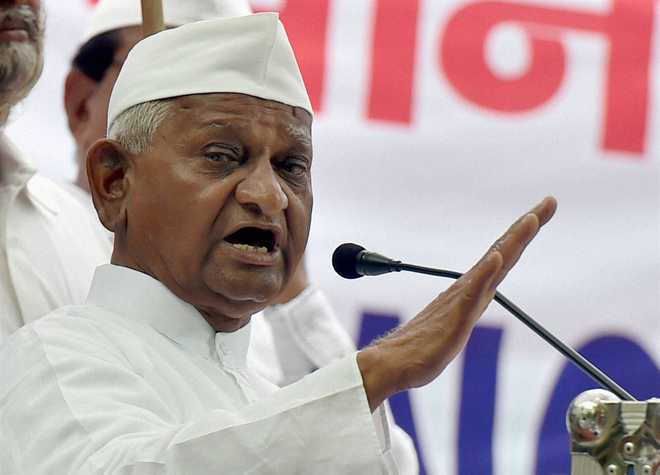
‘Kejriwal shattered my dream’: Anna Hazare’s cry of anguish

‘Kejriwal shattered my dream’: Anna Hazare’s cry of anguish
Anna Hazare. PTI file

Ralegan-Siddhi (Maharashtra), April 7

Veteran anti-corruption crusader Kisan Baburao alias Anna Hazare said on Friday that he was pained to read about the allegations against Delhi Chief Minister Arvind Kejriwal in the Shunglu Committee Report.“He was my colleague in the fight against corruption…At that time, I felt the educated new generation could help rid the country of graft. But it was a big dream–and my dream lies shattered,” Hazare said in an anguished note.Hazare said when Kejriwal launched the (Aam Aadmi Party) political outfit, it was the Lord who gave him wisdom to keep away (from Kejriwal) or even “my reputation would be ruined”.

(Follow The Tribune on Facebook; and Twitter @thetribunechd)

“Since then, and even after he became the Chief Minister, I never felt a desire to meet him. Now, I understand why he always used to address me as his ‘guru’. The Lord has saved me,” the 79-year-old said in a statement from his village Ralegan-Siddhi in Ahmednagar district of Maharashtra. IANS


Kashmir’s travails: Tourism vs terrorism by Hugh & Colleen Gantzer

The impact of terrorism on tourist footfalls has impacted the economy of Jammu and Kashmir. The more isolated the state remains, the greater is the danger of it turning into a fertile ground for sowing seeds of separatism.

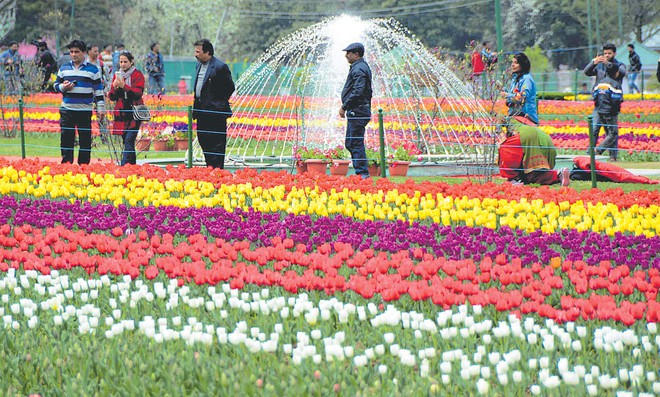
Asia’s largest tulip garden in Srinagar was thrown open for the public. PTI

WE have been travel writers for more than 40 years. During the first 13 years, we visited Kashmir a number of times, criss-crossing the state, writing about our encounters. Once, we even took along our TV team, driving “from Kashmir’s beautiful Srinagar, 85 kilometres to the frontier town of Sonamarg. This is the start of an exciting one-and-a half day road journey covering the 350 rugged kilometres over the Great Himalayas and the Trans-Himalayan Zanskar, stopping at the 3,450 m high Zoji-La, before descending into the starkly beautiful hills of Ladakh.” We have adapted this from the commentary of our television series, “Looking Beyond”. Not once, on that long road journey did we encounter any unrest. Unrest in Kashmir did not begin in 1977. We don’t need to conjure up our, possibly, fallible memories to relive a travel experience. They have been written about, passed the eagle-eyed test of editors, published, and then archived by us. In the Indian Express on March 31, 1979, we wrote: “There is no doubt that Jammu and Kashmir is the one state where the government and people alike are conscious of tourism as the world’s greatest industry and the only one that, by its very nature,  preserves a heritage.”  Clearly, there was no civic unrest in Jammu and Kashmir then though there seems to have been another outbreak of the jingoism that sweeps over some political parties in  Maharashtra periodically. A journalist acquaintance from Mumbai said that the Free Press Journal (FPJ) had found our piece in the Indian Express interesting and would welcome something similar. On July 14, 1979, the FPJ carried our, presumably soothing, words on prickly-heated Mumbaikars when we said: “But if anyone wants to assess the impact of tourism they should look at Kashmir. Here is a ruggedly individualistic people, rich in traditions, culture and handicrafts, determined to retain the qualities that make them what they are. … And yet tourism is not only Kashmir’s major industry but it is also under the direct control of Sheikh Mohmmed Abdullah: the Chief Minister of Kashmir as also the Tourism Minister.”Obviously, even in July 1979, there was no unrest in Jammu and Kashmir.In fact, Kashmir’s tourism kept pace with the diverse needs of its visitors. We had begun to contribute to a magazine once edited by Khushwant Singh: New Delhi. In its issue of April 21-June 10, 1981, we wrote: “After years of tourism development, the resorts of Kashmir have begun to specialise in various types of travellers. Gulmarg is still, largely, the scotch, skiing and golf resort. Sonamarg is ponies, plaits and plimsolls. Pahalgam is for the family.”  Resorts do not specialise unless they are assured of repeat clients, and repeat clients demand security, shun unrest. Kashmir was a safe destination in 1981.When we fast-forward to May 20, 1984, however, we get a hint of looming problems for Jammu and Kashmir Tourism. We had been invited to Srinagar for the annual conference of the Travel Agents Association of India.  In our Op-ed Indian Express column, we wrote: “Dr Farooq Abdullah asked for more Indian Airlines support to bring  tourists to Kashmir as long as disturbed conditions prevailed along the land route to the state.  To the best of our knowledge no delegate encountered any of the widely reported civil strife problems allegedly affecting the state.”These widely reported civil strife problems seemed to be nothing more than biased, and possibly motivated, reports. After the conference, we drove from Srinagar to Yusmarg. There we interviewed a family of Gujjar shepherds. They did not speak of terrorists or civil strife but of another bogey. As we wrote on September 6 in The Hindu, “The people here call them Rantas and they say they come out when the wind blows chill and the snow begins to fall on the high mountains.” Yetis or Abominable  Snowmen might be the stuff of nightmares but they are still unreal, not motivated and paid, AK- 47-toting, terrorists.We did, however, sense that events in the world beyond the mountains had begun to have an impact on this idyllic Valley. We began to probe, ask questions, seek statistics. Tourist inflows had declined. The sustained unrest in Punjab had had a sapping effect on tourism. And since tourism had assumed prime importance, its decline had resulted in a shrinking of glamorous jobs for its ambitious youth. As Abraham Maslow, the behavioural scientist, had predicted in his model of “hierarchy of needs”, once your lesser needs have been fulfilled the higher needs become your obsession.Consider the child of a shepherd, farmer, muleteer, porter or craftsman. He has seen the backbreaking toil his parents and grandparents had had to endure; he has tasted the good life, the glamour and fairly easy money of tourism. That is the development he craves. But the people of the plains have allegedly stopped tourists from coming to Kashmir. In the eternal highland-lowland dichotomy, he begins to resent those uncouth lowlanders and all that they stand for. It is easy for us, as a couple whose home is now in the highlands of the Himalayas but who were born in the plains of Bihar and Gujarat, to relate to their anguish. By snuffing out tourism in the Valley, and blaming “outsiders” for allegedly imposing their alien culture on Kashmiris, separatists and their handlers create disaffected youth: fertile ground for sowing the delusionary heroic glamour of the sponsored stone and the gifted gun. The Gantzers are Musoorie-based travel writers.


Won’t talk to separatists: Govt to SC

J&K HC Bar body had asked Centre to hold dialogue with Hurriyat leaders

NEW DELHI: The Supreme Court asked the Union government on Friday to facilitate talks between separatists and Kashmiri lawyers, paving the way for the first attempts to defuse tension in a region where nearly 100 people have been killed in waves of violence since last year.

PTIKupwara attack martyr Capt Ayush Yadav’s mortal remains arrive in Kanpur on Friday. The army paid floral tributes to three of its personnel who were killed in the Thursday attack.

The bench, headed by chief justice JS Khehar, told the representatives of the J&K High Court Bar association to use their influence in the region to open a dialogue with separatist Hurriyat leaders, the “first step to bring normalcy” to the Kashmir valley. During the hearing, the government ruled out engaging with the Hurriyat leaders, the political face of the anti-India movement in the region claimed by Pakistan as its territory.

The meeting, the bench told attorney general Mukul Rohatgi, should be facilitated only if the rules allowed it.

“The Centre is aware of the situation there and is taking all the measures,” Rohatgi told the court, objecting strongly to the HC bar association’s arguments that NDA government should hold “unconditional talks with the jailed Hurriyat leaders.”

The AG also said it was not for the court to commence a dialogue, but for the political parties.

The SC did not “appreciate” AG’s aggressive stand, saying, “what they say is that we are the bar association and we should be allowed to talk to them (separatists). Let them meet and talk. Court can always be a facilitator, though the solutions are somewhere else”.

The court said if Rohatgi felt the court had no jurisdiction then it would not hear the petition by lawyers’ body seeking a direction to stop the use of pellet guns by security forces in Kashmir. “The leaders are under house arrest by the state government who would be told what the SC has asked for. If a request is made, then the state shall take a decision as per the rules”, Rohatgi told HT, when asked about the next step.

Allegations of human rights violations – including a video of a man tied to an army jeep – have soured relations between locals and security forces in the Valley amid increasing incidents of stone pelting and civilian deaths.

The apex court said it was disturbed to see photographs presented by the petitioners of people injured by pellet guns. But it told the Kashmiri lawyers that no progress was possible unless the protests abated.

“We can put it (pellet firing) off provided there is some reasonableness on both sides. You tell us what you would do if we direct the government not to use pellets for two weeks.”

Senior lawyers from the association demanded the government hold a dialogue, which the court ruled out for the time being, and also declined their plea to remove the army from the Valley. “If we do that everything will finish.” “Most worrisome aspect is that children are getting involved. Girls are coming on the streets,” the bench told the advocates

DARBAR MOVE Vyas had been serving as principal secretary to chief minister for the past one year; replaces Braj Raj Sharma

JAMMU : On the last day of the Darbar Move office in Jammu, chief minister Mehbooba Mufti during a cabinet meeting on Friday appointed Bharat Bhushan Vyas, a 1986-batch IAS officer, as the new chief secretary of Jammu and Kashmir.

He replaced Braj Raj Sharma, who will now serve as an advisor to the chief minister.

Vyas had been serving as principal secretary to the chief minister for the past one year. He has also served as principal secretary to J&K governor and former chief minister Omar Abdullah, besides holding other positions, including principal secretary (finance).

Darbar Move offices closed here on Friday and shall reopen on May 8 in Srinagar.

OTHER CHANGES

Apart from this, the government also made some other major reshuffling in the administrative set up.

Krishan Ballabh Agarwal is posted as principal secretary (coordination) in the Resident Commission, J&K government at New Delhi.

Shaleen Kabra, principal secretary school education, is now the chairperson of J&K special tribunal.

Farooq Ahmad Shah, secretary tourism, floriculture, parks and gardens department, will hold additional charge of administrative secretary school education.

Navin Kumar Choudhary, commissioner secretary finance, will hold additional charge of administrative secretary, labour and employment.

Pawan Kotwal, divisional commissioner Jammu, is posted as commissioner secretary health and medical education. Mandeep Kumar Bhandari, commissioner health and medical education, is posted as divisional commissioner, Jammu.


Rohtang opened, Leh road’s turn now

Rohtang opened, Leh road’s turn now
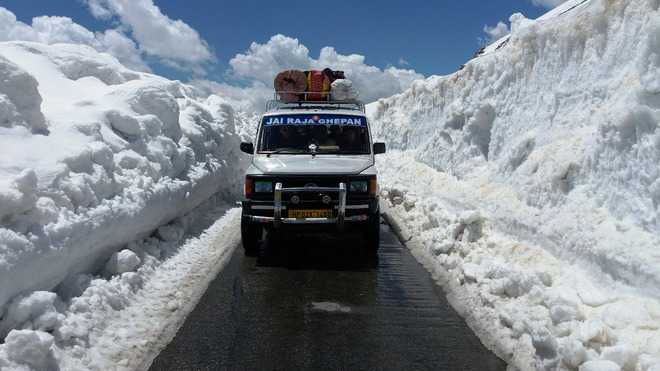
The Rohtang Pass was opened to all vehicles by the BRO on Friday. Photo by writer

MC Thakur

Rohtang Pass (Manali), April 28After the opening of the 13,050-ft-high Rohtang Pass for all vehicles today, the 474 km-long Manali-Leh highway will open to traffic by May 25 as the Border Roads Organisation (BRO) is now putting all efforts to clear snow from the Keylong-Sarchu highway.Mohan Lal, Chief Engineer, Project Deepak of BRO, today visited the Rohtang Pass and took stock of the progress of snow-clearance on the Manali-Sarchu highway. He applauded the officers and jawans engaged in the snow clearance, who opened the Manali-Keylong highway before the target.The Chief Engineer discussed strategy to clear snow from the Keylong-Sarchu and Gramphu-Kaza (Spiti) road with the 38 Border Road Task Force. He said BRO jawans were moving towards the Baralacha Pass with a rapid speed and had cleared the road till 162-km beyond Patseo. The Tandi- Sansari road has already opened to vehicles.He said the BRO would continue to maintain the road to the Rohtang Pass even after the completion of the Rohtang tunnel. “The Kunzum Pass area has thick layers of snow. The Gramphu-Kaza road over the Kunzum Pass is expected to open by June end,” he said.After snow clearance, the BRO will widen the roads and carry out maintenance works. The road is sinking at many places.The Chief Engineer said soon the entire 222-km-long Manali-Sarchu highway would be converted into double-lane road. The opening of the Rohtang Pass was not easy this year due to thick snow accumulation and inclement weather conditions. He said the region had experienced many avalanches and landslides recently posing a challenge to the jawans.He said the road till the Rohtang Pass had been opened by the BRO. “Now it will be decided by the administration that whether tourists should be allowed to the area or not. There is still risk of avalanches and landslides and proper monitoring is essential to avoid any untoward incident,” he added. Meanwhile, goods carriers from Kullu have started ferrying fresh vegetables and other goods to the Lahaul valley which got road connectivity after a gap of four months.BRO official reviews progress 

  • The 474 km-long Manali-Leh highway will open to the traffic by May 25 as the Border Roads Organisation (BRO) is now putting all efforts to clear snow from the Keylong-Sarchu highway.
  • Mohan Lal, Chief Engineer, Project Deepak of BRO, on Friday visited the Rohtang Pass and took stock of the progress of snow-clearance on the Manali-Sarchu highway.
  • He said the BRO would continue to maintain the road to the Rohtang Pass even after the completion of the Rohtang tunnel.
  • “The Kunzum Pass area has thick layers of snow. The Gramphu-Kaza road over the Kunzum Pass is expected to open by June end,” he said.


Kupwara attack: Escaped death twice, braveheart solider guns down 2 militants

Kupwara attack: Escaped death twice, braveheart solider guns down 2 militants
Blood-stained spots encircled with white powder where army killed two militants after they attacked their Panzgam camp in Kupwara on Thursday morning. PTI

Srinagar, April 27

When his camp came under fire from militants in Jammu and Kashmir’s Kupwara on Thursday, gunner Rishi Kumar, who was on a sentry duty, single-handedly killed two assassins and injured the third as he gave death the slip twice.Three militants stormed the army camp in Kupwara at around 4 am killing three personnel, including an officer, and injuring seven.As the militants fired indiscriminately and started advancing in the camp, Kumar, of Field Artillery Regiment, observed them approach and waited for them to come within close range.”He then engaged them and was hit on the head but was saved by a bullet-proof patka. However, the impact caused him to fall down. He immediately recovered and fired back to kill the two terrorists,” an army official said.Running out of ammunition, he moved out of his bunker and tried to pick the weapons of the slain terrorists to engage the third.The third terrorist, however, fired and injured him and managed to escape.Kumar has suffered injuries from splinter and is admitted to 92 Base Hospital in Srinagar. He is from Ara in Bihar and has eight years of service.”Rishi has shown the indomitable spirit of Indian soldier,” the official said. — PTI


4 ways to deal with the Kashmir crisis by Lt Gen Syed Ata Husnain

‘The strategy has to be restoring order in one part and countering the very effective propaganda through a very nimble monitoring and response system,’ says Lieutenant General Syed Ata Hasnain, who retired as the General Officer Commanding of the Srinagar-based 15 Corps.
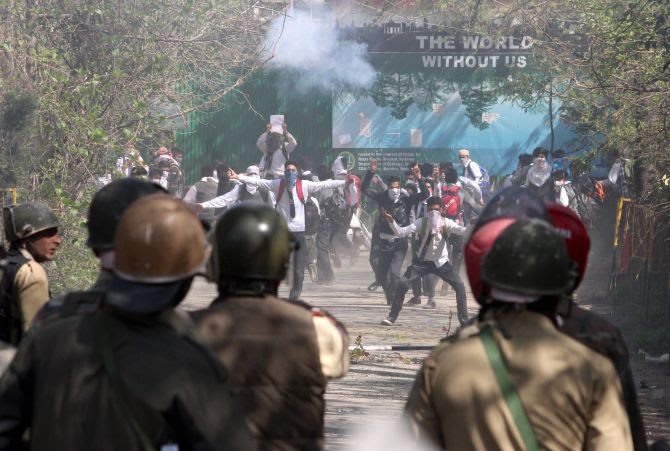
Students clashed with security forces in several places in the Kashmir valley April 17, 2017 during protests against the alleged 'highhandedness' of security forces at a college in Pulwama in south Kashmir. Photograph: Umar Ganie

When national crises occur, those which can spell existential problems, only national consensus can overcome them.

The more divisive the nation remains, more the adversaries exploit.

In modern irregular conflicts which involve people as the virtual centre of gravity an adversary will always attempt to keep the nation divided.

Slickly put together propaganda with no iota of truth is far more effective than a couple of hundred AK-47s; such is the power of information.

However, information used loosely, without coordination and no plan, is doomed to destroy the initiator, not the target.

These are just a few well known facts about Information Warfare which any good professional warrior will tell you.

The recent controversy over amateur and other videos in Jammu and Kashmir is a fine example to initiate an analysis on strategic communication.

The setting must be well understood. Here is a situation in which a 27-year- old proxy sponsored and supported internal conflict has come to a head after many dynamic curves on the graph.

These have many times indicated potential resolution and potential ‘tipping point’ for disaster.

Today, Pakistan with its strategic confidence on a new high is sensing that ever since July 8, 2016, when Burhan Wani was killed, it finally has India by the throat.

It is only coincidental that the regional and international strategic environment also appears to have shifted in Pakistan’s favor through this period. That notion is part reality and part perceptional.

Yet, it can hardly be denied that Pakistan’s propaganda machinery has worked overtime to paint India black and garner for itself a more positive image.

Achieving this at a time when the image of Islamic countries within the international community is highly besmirched has been no mean feat.

However, even more effective has been its strategic communication in relation to its intent in J&K. Here the aim is to generate ideas in the Kashmiri populace relating to a couple of fields.

The first is that India and its security forces are occupiers and that the power of the people always overcomes oppressors and occupiers.

Second is the idea that Muslim Kashmiris have little to do with India and much to do with the larger Islamic Ummah and brotherhood.

Third is the notion that they have suffered for 27 years and now the goal of azaadi is very near; the same was effectively used in 1990 too with the slogan ‘Kashmir banega Pakistan.’

To keep these and a plethora more of such crafted themes well embedded it is important for Pakistan to also ensure that the militancy remains alive with acts against the security forces, public servants and political leaders including paralysis of governance.

But the core strategy which is supported by all this is to involve the public in visible resistance to the presence of Indian xsecurity forces.

It is being done through clandestine networks by a diffused leadership with the front face of the comparatively discredited Hurriyat considered as incapable of delivering.

Financial support for this appears to be strong and there has been a bounce back after the setback suffered during the demonetisation.

In this situation attempting to instigate the security forces is a ploy so that they respond.

Each such response can be manipulated through videos without narratives and made to appear as human rights violations which can then be further exploited through media and other means to give a multiplication effect to the movement.

The army employed hard power through the early nineties when hordes of foreign terrorists roamed the countryside. It was necessary then, but conflict is dynamic and as the strength of the terrorists reduced over time so did the army adopt a softer approach.

The elections of 1996 were a landmark which brought change in a more marked way. It is not as if the coming of Sadbhavana in 1997 first saw the introduction of soft power.

The army’s basic doctrine of counter insurgency always spelled the need for winning hearts and minds, even from the Nagaland and Mizoram days.

What riles the Pakistan establishment is when the army displays successful adoption of soft power which aims at taking on board the public of Kashmir.

Pakistan’s ISPR (the Pakistan military’s Inter-Services Public Relations) then follows any method to target the bond between the public and Indian security forces and other institutions such as social organisations and individuals who mean well for the public and for India.

Many people are drawing a parallel between the situation in Kashmir today and that which existed in 1990. There are others who like to believe that India has lost Kashmir.

Let me say clearly to the nay sayers that none of this is true.

In 1990 an active insurgency with a couple of thousand militants under arms existed and more were coming and going through the virtually open LoC as the army’s presence was need based for peaceful times.

Armed police units were being rushed in response. They had little idea about dealing with street violence and even less about counter insurgency operations.

However, some ground facts are necessary for the public at large to know for reassurance and so as not to be misled or fall for the manipulation being done by Pakistan.

We then had a division size force with some independent formations performing dual tasks on the LoC and the nascent counter insurgency grid.

Today we have the Rashtriya Rifles (India’s finest military experiment) in good strength in the rural expanse of the Kashmir valley.

Reinforcing this is the strong presence of the CRPF in urban areas. The JK police was then just a social police force; today it has an anti-terror force and intelligence arm as good as any.

The border or LoC is secure with a counter infiltration grid deployed in depth although admittedly zero infiltration is not a reality and will never be.

There is 27 years of institutional experience of dealing with diverse threats in the given situation.

Yet, for all the evident strengths the major weakness which persists is the inability to deny Pakistan the non-military aspects of the conflict in its favour. This involves propaganda and manipulation of information and events so as to keep the public of Kashmir alienated.

The running of financial conduits through different clandestine means despite the Indian dragnet keeps the movement fuelled.

What is really different today from 1990 is the persistent presence of 24×7 television and the ever empowering social media.

No piece of information can be away from the eyes of some form of the media or the other.

The availability of the mobile with 3G and 4G makes communication possible across the LoC and sensitise opinion around the world and nationally at the touch of a button.

Thus, the militancy is no longer about physical threats alone, but much more about the mind.

The entire Arab Spring saw the employment of social media most effectively when Whatsapp was not even a reality.

Today it is well known that the flash mobs at encounter sites are generated through messaging on Whatsapp; much of the directions come from across the LoC. The guidance in the conduct of events is provided through this medium.

Those involved in separatist activities fully realise that to convert antipathy to hatred there has to be a stream of messages and videos showing the Indian institutions, political leadership and military in negative light.

Thus no opportunity is ever lost. Latest news reports do indicate that Pakistan has hired cyber warriors on the lines of the US army; videos are shot by networked individuals in the valley which are forwarded to Pakistani masters and their value for exploitation is then judged.

Specific themes are outlined and the separatist network which exists down to the block level remains active forever seeking opportunities.

Till now no one knows who shot the video of the so-called ‘human shield’ atop the army vehicle and who uploaded it. A short clip with no narrative had an electrifying effect.

What is the answer to all the problems that one is stating; can’t have an analysis sans answers? When you have just 200 to 250 terrorists the physical part of the counter insuirgency campaign has lesser significance.

The strategy has to be restoring order in one part and countering the very effective propaganda through a very nimble monitoring and response system.

Intelligence agencies, the army and police organisations just have to merge resources, jointly strategise and execute.

For this the institution of the Unified Command is the best provided it has adequate staffing and a joint think-tank which must be in existence every day.

The joint strategy in 2010 was evolved here. There are enough experienced people to understand its value and set all this in motion, possibly even through gaming models.

In addition, just four other short recommendations.

First, get completely serious on social media. None of the agencies in the valley have expertise on its use or counter.

A couple of high quality Indian academic institutions should be tasked to study this in the Kashmir context.

There are professional communication experts of great standing in India who along with psychologists and social scientists could relish the challenge of studying and testing.

Let it be fast tracked with both defensive and offensive concepts of social media in focus. The organisation to be created should not await the full study report.

It should commence being put into place with a pragmatic mix of civilians and uniformed services both in Delhi and in J&K; it can be refined once the recommendations are received and approved.

Don’t look for perfect models since we have time against us and there is scope to learn and improve.

Second, our tremendous experiment with demonetisation would have thrown up enough lessons which can be selectively applied to a conflict zone where finances and their conduits play a major role in fuelling unrest.

Convert this into ‘do-ables’ to dry out funding.

Third, engagement and outreach is part of the strategic communication effort.

However, it is a nuts and bolts exercise to be undertaken on ground. It cannot be a one off activity on basis of personal capability or restricted to one service or agency.

It has to be a strategy and under the political authority who must have suitable advice.

Before anything else the two terms need a common definition; that is not being attempted here but without commonality of perception this is bound to fail.

Fourth and last, when a crisis situation involving conflict and sponsored activity by an adversary hits us it must be as the navy calls it, ‘all hands on deck.’

All involved in the restoration of the situation need a common orientation; it is not the uniformed and security related services alone.

The role of the J&K bureaucracy, the jail service, the district authorities, and many more needs a focus.

Leadership is one facet which can provide this, but more importantly it is training and orientation which is the need.

This is another job for the Unified Command to undertake and conceptualise.

India is too big, too important and too resilient to allow its public to be emotionally distraught.

We have seen crisis before and this is not the last that we will see.

Ideas will make the difference provided political consensus exists and polarisation is curtailed.




Sacrifices of martyrs will not go in vain, says PM Modi

Sacrifices of martyrs will not go in vain, says PM Modi
Prim Minister Narendra Modi.

New Delhi, April 24Prime Minister Narendra Modi on Monday described the killing of CRPF personnel in Chhattisgarh by Maoists as “cowardly and deplorable”.”We are proud of the valour of our CRPF personnel. The sacrifice of the martyrs will not go in vain,” Modi tweeted.”Condolences to their families. May those injured in (the) attack recover at the earliest.” The Prime Minister said the government was monitoring the situation in Chhattisgarh closely.

(Follow The Tribune on Facebook; and Twitter @thetribunechd)

Home Minister Rajnath Singh said he was “extremely pained” over the Chhattisgarh killings.”Extremely pained to know about the killings of CRPF personnel in Sukma (district). My tributes to the martyrs and condolences to their families,” Rajnath Singh tweeted.He said he had spoken to Chhattisgarh Home Minister Hansraj Ahir, who “will take stock of the situation”.Chhattisgarh Chief Minister Raman Singh said he was “extremely distressed” over the Naxal attack in his state.”I am extremely distressed to know about the Naxal attack in Sukma. I am cancelling my Delhi tour and returning to Chhattisgarh to attend a meeting,” he wrote on Twitter.Congress vice-president Rahul Gandhi said, “Sincere condolences to families of CRPF personnel martyred in the attack in Sukma. We salute sacrifice and courage of our bravehearts.”The Congress described the killing of CRPF personnel as extremely unfortunate and called on the Narendra Modi-led NDA government to initiate appropriate counter action.Addressing the media, party spokesman Manish Tiwari said, “Extremely unfortunate. Hope government will act with alacrity. Hope government initiates appropriate action against people responsible for attack.”  — Agencies


Kapurthala Sainik School to get facelift Team from CMO assesses condition of building, assures repairs in phased manner

Kapurthala Sainik School to get facelift
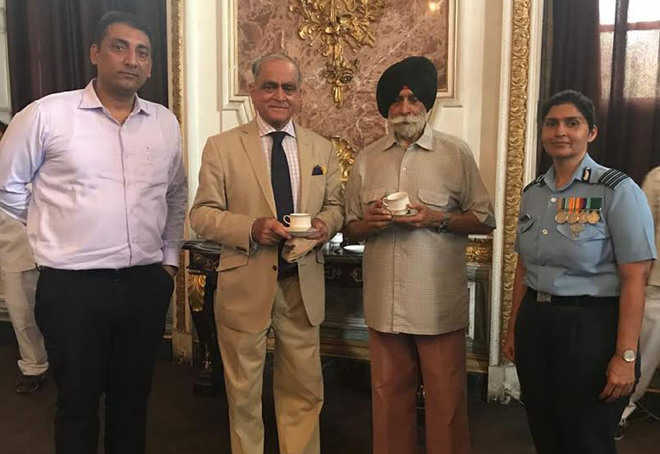
Senior Advisor to CM Lt Gen TS Shergill (left), Brig Sukhjit Singh and Principal Cmdr Shakti Sharma at the Sainik School in Kapurthala on Friday. A Tribune Photograph

Rachna Khaira

Tribune news Service

Jalandhar, April 21

Taking cognisance of a news report published in the Tribune on March 29 pertaining to the dilapidated condition of Maharaja Jagatjit Palace housing Kapurthala Sainik School, a team from the Chief Minister’s Office (CMO) today visited the school to assess its condition.Principal Cmdr Shakti Sharma said senior advisor to the CM Lt Gen TS Shergill (retd), Maharaja Kapurthala Brig Sukhjit Singh and Karan Veer Singh, political secretary to Lieutenant General Shergill, checked the school building, most of whose rooms were declared unsafe.“After a report was published in The Tribune, I met the Finance Secretary on April 19 and was assured of complete support by the present regime. The team today had a look at the 108-year-old school building and assured that experts will be hired to maintain the glory of the historic palace,” said Cmdr Sharma.The team also assured the school authorities that since the building requires a complete makeover, the repair works will be carried out in a phased manner. Also, the government will revise the scholarship slab for poor students, which is currently Rs 1.80 lakh per annum. The state government is also contemplating to grant diet money to the students on the lines of the Haryana Sainik School, whose students are getting Rs 75 a day.“The only task given to school authorities is to get maximum entries to the National Defence Academy in Pune. We accepted it,” said the Principal.Cmdr Sharma said the team also assured that the long-pending memorandum of agreement (MoA) between the state and the Centre would be signed soon to obtain financial aid from the MoD.About the school

  • The Maharaja Jagatjit Palace was bought by the Punjab Government for Rs 16 lakh in 1961 to open a Sainik School.
  • The school was the third in the line of five Sainik Schools established in 1961 across the country.
  • The only library established in the Durbar Hall of the school was closed on August 13 last year after its ceiling started giving in
  • At present, around 618 students study in the school
  • The 12 hostels commissioned in 1963 are also on the brink of collapse and a majority of them have been declared unsafe


Amid confusion, Sajjan finally given guard of honour No Punjab minister to accompany Sajjan

Amid confusion, Sajjan finally given guard of honour
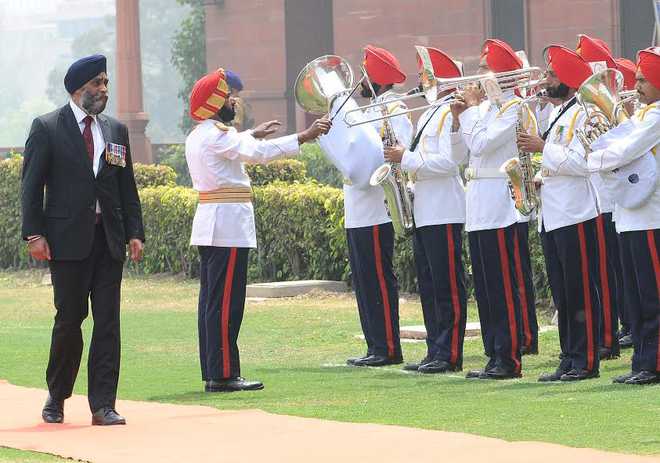
Candian Defence Minister Harjit Singh Sajjan greeted by a guard of honour at south Block in New Delhi on Tuesday. Tribune photo: Mukesh Aggarwal

New Delhi, April 18

Canadian Defence Minister Harjit Singh Sajjan was on Tuesday accorded a tri-service guard of honour outside South Block lawns in Raisina Hills.

There was confusion yesterday over whether a guard of honour will be given to the Canadian Defence Minister today.

(Follow The Tribune on Facebook; and Twitter @thetribunechd)Late in the night, MoD spokesperson Nitin Wakankar clarified that the advisory on cancellation of the guard of honour was issued erroneously.Sajjan arrived in New Delhi today and shall be going to India Gate tomorrow.When contacted, the Canadian High Commission refused to comment.Earlier in the day, an official invitation was sent to the electronic media for coverage of the event.Sajjan also held wide-ranging talks with Defence Minister Arun Jaitley on a host of bilateral issues, particularly on ramping up defence and security ties.A guard of honour is a ceremonial welcome for dignitaries when troops in full uniform and regalia lower their weapons and the visiting dignitary ‘inspects’ the guard. It ends in a salute.In Chandigarh, meanwhile, carrying forward the tough stance against Sajjan, the Capt Amarinder Singh government has decided that no minister would accompany the dignitary during his visit to various places in the state.Sources said only the DC and SSP concerned of the district would facilitate Sajjan’s visits.  The Canadian Defence Minister is scheduled to pay obeisance at the Golden Temple on April 20. He is also expected to visit his native village near Hoshiarpur. — TNSOn Agenda

  • During his trip, Harjit Singh Sajjan will travel to New Delhi, Amritsar, Chandigarh and Mumbai
  • In Punjab, Minister Sajjan will visit the Golden Temple and civil society organisations, and in Chandigarh, he will inaugurate the new office of the Consulate-General of Canada
  • In Mumbai, Sajjan will visit the Mumbai Port and meet several business and industry leaders.

Jaitley, Canada Def Min Sajjan hold talks

Jaitley, Canada Def Min Sajjan hold talks
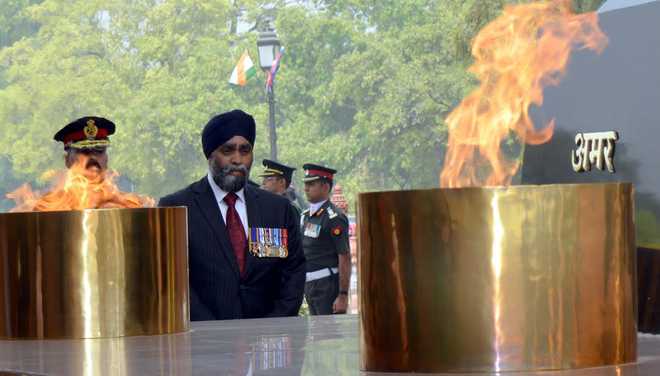
Canadian Defence Minister Harjit Singh Sajjan pays tribute at Amar Jawan Jyoti in New Delhi on Tuesday. Tribune photo: Manas Ranjan

New Delhi, April 18

India and Canada on Tuesday held extensive talks on enhancing defence and security cooperation between the two countries.

(Follow The Tribune on Facebook; and Twitter @thetribunechd)

Defence Minister Arun Jaitley and his Canadian counterpart Harjit Singh Sajjan explored ways to deepen the security ties.

Sajjan arrived here yesterday on a seven-day India visit, his first after assuming charge as Canada’s Minister of National Defence.

Sajjan, a Sikh, will also travel to Amritsar, Chandigarh and Mumbai. —PTI