Sanjha Morcha

Strike it out:—Gen Ashok K Mehta (retd)

Strike it out
No Win-Win: Neither side is gaining, only casualties are rising.

IN India, the term ‘surgical strike’ has become a metaphor for bold, unexpected and punitive  action. It is being liberally employed by paanwallahs, chaiwallahs and white-collar boardwallahs. For a country historically known for its strategic restraint and patience induced partly by being trapped between four cartographic  lines — LoC, LAC, Durand and McMahon — but mainly due to a passive and reactive temperament and philosophy, the strikes across the LoC on September 29 when internalised were pathbreaking. In Pakistan it was called  a storm in a tea cup. A month later, PM Narendra Modi’s second  surgical strike against corruption and terrorism was against  high value currency. Neither strike was thought  through. To start with, the military terminology used was imprecise. Surgical strikes are predominantly in the domain of the air forces and missile and nuclear warfare. Initially, the operation was described by the military as surgical strikes along the LoC against multiple terrorist launch pads causing significant casualties. Later, the Foreign Office refined it to ‘cross-LoC, target-specific, limited calibre counter-terrorist operations’. If the political objective for crossing the LoC and claiming ownership was to lift the immunity enjoyed by Pakistan for stoking militancy and unrest in J&K by employing non-state actors through infiltration and ending cross-border terrorism (CBT), the aim has not and will not be achieved. Pakistan’s low-cost high- yield CBT strategy cannot be deterred without further escalation and risk of war, given the finite capacities of the military and special forces in covert and overt cross-border operations. The political and military leadership is aware of this strategic deficiency.Let us examine the content of the surgical strikes. These were carried out by Army commandos 2 to 5 km across the LoC. The operation was circumscribed by two riders: no escalation; and no own casualties. This limited the option to one above the lowest rung of response — fire assaults to shallow cross-LoC multiple raids. The Pakistan army denied any cross-LoC operation had taken place though BBC’s Ilyas Khan has verified that attacks took place at five different targets north and south of the Pir Panjal. While such strikes have been executed earlier, though not on the same scale and clandestinely, for the first time they were accompanied with a declaration.Doing the rounds are a few questions. Is 19 soldiers killed at Uri the new normal for an Indian response? Has strategic restraint been abandoned? Has Pakistan’s nuclear bluff been called? Has Pakistan’s CBT been deterred? The answer to these queries is ‘no’. On the other hand, Pakistan has spiked the heat and tension on the LoC and IB as an initial reprisal to the strikes by conducting fidayeen attacks, including the beheading of a soldier and intense fire assaults. In these cross-LoC games, Pakistan enjoys the asymmetric advantage of having nearly 300 ready-to-die terrorists on the Indian side of the LoC.  As India does not want to be provoked  into  a war with  Pakistan, control over escalation is vital. It is instructive to rewind to 1965 to recall the spiral of escalation. Pakistan’s trial-balloon  in the Rann of Kutch was ended quickly by British intervention after neither side used its Air Force. Later, Pakistan launched insurgency  through Operation Gibraltar in J&K. India  retaliated with Operations Bakshi and Faulad in Haji Pir and Kishenganga whereupon Pakistan’s   Operation Grand Slam was unleashed in Chhamb-Jaurian forcing India to call in the Air Force and cross IB in Lahore and Sialkot sectors. The operations escalated from insurgency in J&K to war across the Punjab plains as both countries then were non-nuclear.The post-Uri escalation story so far in two months is that the surgical strikes were followed by fidayeen attack and beheading of an Indian soldier. In retaliation, four Pakistan posts were destroyed eliciting Pakistani response of widespread shelling and firing on the LoC. Since September 29, over 200 ceasefire violations have resulted in 11 Indian soldiers and 16 civilians being killed with considerable displacement of civilians to rear areas. Pakistani casualties are much higher, including seven soldiers killed on November 14  and at least 26 civilians having died earlier. Artillery has rarely been used to avoid escalation. Following 10 months of fire assaults and cross-LoC raids after the attack on Parliament in 2001, Pakistan sought a ceasefire on November 26, 2003, which held till around 2008. In J&K, due to CBT, nearly 6,245 security force personnel have been killed between 1972 and 2016, of which 4,675 were accounted between  2001 and 2015. Include figures pre-1972, more combatants were killed through CBT than in all wars  between India and Pakistan.India’s maiden declared surgical strikes since 1971, however grandly  eulogised, have not raised costs for Pakistan nor strengthened deterrence to disincentivise Pakistan’s CBT. Recently, at Mirpur in the PoK,  LeT chief Hafiz Saeed warned India that mujahideen will teach India how to launch a proper strike. Given the Panama dynamics and tenuous civil-military ties in Pakistan his threat has to be taken seriously till the appointment of Gen Raheel Sharif’s successor by November 29. India’s options for a meaningful retribution are conspicuously limited — repeat of September 29; or do nothing. In his book Choices: Inside the Making of India’s Foreign Policy, former NSA Shiv Shankar Menon has said after 26/11 Mumbai, he pressed for immediate military retaliation either against the LeT Muridke in Punjab or against their camps in the PoK or against the ISI because it would have been ‘emotionally satisfying’. It would also have erased the shame of the incompetence of the security agencies displayed in the full glare of TV lights in dealing with it, he added. His predecessor, MK Narayanan, recently wrote that the options being bandied about after Uri of striking terrorist camps in the PoK were considered unviable in 2008 after a cost-benefit analysis. He elaborated: ‘The reality is that the armed forces still do not have adequate capabilities for surgical operations despite claims to the contrary’. In their speeches, NSA Ajit Doval and Defence Minister Manohar Parrikar have espoused unconventional strategies to counter Pakistan’s CBT but done little to create capabilities to do so.Against this background, it is clear that Mr Modi ordered the surgical strike for political and emotional satisfaction and to justify his pre-poll promise of dealing with Pakistan with greater manliness. He has raised expectations for a more robust response to the next Pakistani cross-border strike. But one swallow does not a summer make. Nor does the September 29 riposte constitute a befitting reply. If India is to stop being bled by a thousand cuts, it must create assets and capacities to pay back Pakistan in the same coin as Messers Parrikar and Doval have suggested. In the interim, the tragic trail of martyrs coffins will continue to be flashed on TV screens as the strikes were too little too late.

18 troopers lost since Sept 29, Pak toll more

400 ceasefire violations since surgical strike

Ajay Banerjee

Tribune News Service

New Delhi, november 22

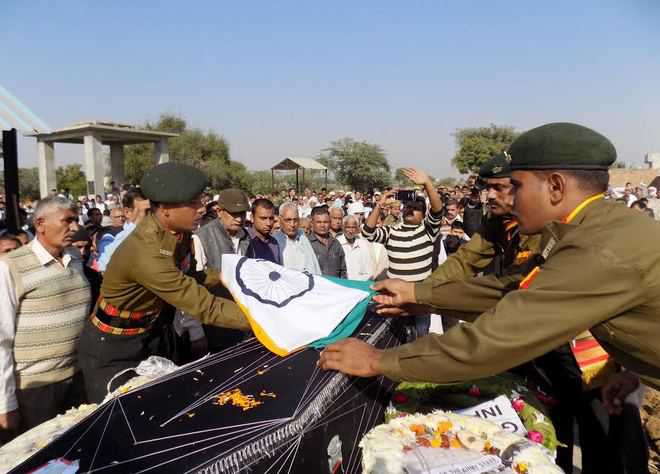
In the past fifty-three days after the September 29 ‘surgical strike’, India and Pakistan have been locked in a tit-for-tat firing along the Line of Control (LoC).    India has lost 18 of its troops — that includes the Army and the Border Security Force (BSF), while Pakistan is estimated to have lost more men even as it downplays its own casualties.(Follow The Tribune on Facebook; and Twitter @thetribunechd)Today, when reports filtered in that three Army men have lost their lives at Machil close to the Line of Control in the Kashmir valley, the death toll for the Army reached 13 martyrs, either killed by firing from across the LoC by Pakistan army or by militants aided by the Pakistan army.Pakistan has publically admitted to 13-14 deaths of its own, though the Indian assessment based on ground reports from local informers and radio intercepts is that Pakistan has lost 24 soldiers.Even this morning when the encounter with militants was on in Machil, Pakistan army was giving cover fire, sources said, adding that the LoC has been ‘very active’ as the snow will soon close down the high passes in the Himalayas. “Be aggressive” is the message to formation commanders on ground, who have been told to respond to all ceasefire violations. The decision of time of strike is left to the local units while the nature of weapons has been small arms and mortars. There have been some 400 violations of the November 2003 ceasefire.  Not only have the number of violations gone up,  the intensity and periodicity is up several notches across the LoC and the 198-km international boundary.


SWACHH ABILITY RUN TO START FROM CHANDIGARH

PANCHKULA: Every year, December 3 is celebrated as International Day of Persons with Disabilities (PwD) across the world. To commemorate the occasion, a Swachh Ability Run 2016, conceived by Major DP Singh (retd), the famous Indian blade marathon runner, is being organised in cities of Chandigarh, Ambala, Kurukshetra, Karnal, Panipat, Sonipat, and NCR along the historic Grand Trunk Road.

This year PwD day will be celebrated with the theme ‘A Run for All and Cleanliness by All’. This cause will be undertaken over a period of 7 days, starting on November 27 at Chandigarh and culminating at New Delhi on December 4 covering 7 cities, spreading the message of ‘Inclusion and Swachh Bharat’.

Major DP Singh, a veteran of the Kargil war, is an amputee himself and runs an organisation of amputees, called ‘The Challenging Ones’, in which he has already transformed lives of many amputees through sports.

Image result for major dp singh blade runner


Major D. P. Singh; India's first blade runner; Jazbaa ngo;


Image result for major dp singh blade runner

‘Swachh Ability Run’ to cover eight cities

‘Swachh Ability Run’ to cover eight cities
Major DP Singh

Chandigarh, November 21

To commemorate the International Day of Persons with Disabilities, a war-disabled marathon blade runner, Maj DP Singh, is organising “Swachh Ability Run – 2016” across eight cities. The programme will enable people with disabilities to challenge their physical capacities through a run and participate in a cleanliness drive thereafter.The event will start from Chandigarh on November 27 and will be held on subsequent days at Ambala, Kurukshetra, Karnal, Panipat, Sonepat and Noida before culminating in Delhi on December 3, the International Day of Persons with Disabilities. The run is open to all people for participation. — TNS


Demonetisation exercise is unsatisfactory and the Centre is framing rules as it goes along

he implementation of the demonetisation exercise is unsatisfactory and the Centre is framing rules as it goes along

SOMETIMES A SHOCK TO THE SYSTEM EFFECTS BEHAVIOUR CHANGE FAR BETTER THAN ANY OTHER MEANS. THIS MAY NOT WORK EVERY TIME AND NOT EVERYONE CAN PULL IT OFF

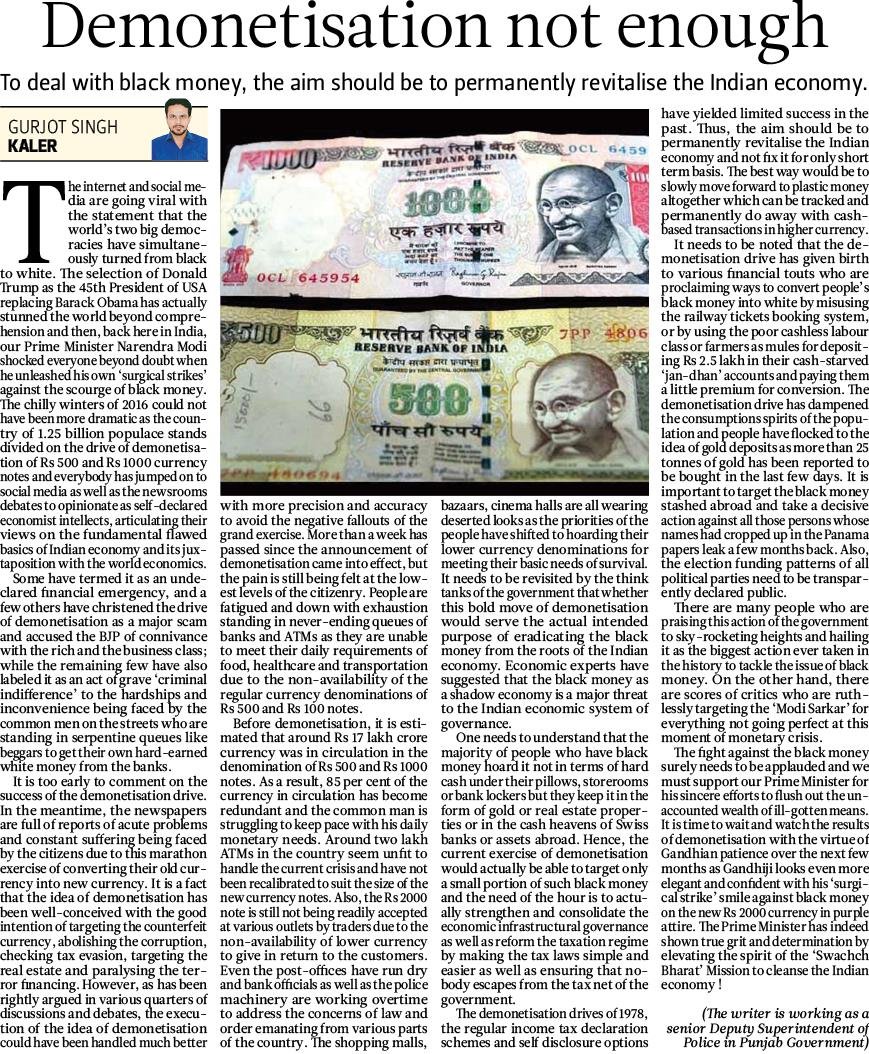
On November 8, Prime Minister Narendra Modi made an unscheduled televised address to the nation at 8 pm. No one had any idea what he was going to talk about. Sure, there had been rumours of a new ₹2,000 denomination banknote in the works — many of the rumours gave this new currency note near mythical properties — but no one expected Modi to speak about that.

RAVI CHOUDHARY/HTThere has been inadequate supply of cash at banks, not enough of the new notes are being printed, there’s some amount of panic, and agricultural markets and packaged goods distribution chains have been hit

As it turned out, the ₹2,000 denomination note did feature in the prime minister’s speech during which he announced what was effectively a demonetisation exercise by rendering existing ₹500 and ₹1,000 denomination notes invalid.

It has for long (and frequently) been argued that scrapping high-value notes will hamper, if not altogether stop (even if only temporarily), transactions in the parallel economy.

“The $100 bill accounts for almost 80% of the US’ stunning $4,200 per capita cash supply. The ¥10,000 note (about $100) accounts for roughly 90% of Japan’s per capita cash holdings at almost $7,000. And, as I have been arguing for two decades, all this cash is facilitating growth mainly in the underground economy,” Kenneth Rogoff, professor of economics and public policy at Harvard, wrote in September.

In India, high-value currency (₹500 and ₹1,000 notes) accounted for 86% of cash supply.

“Higher denomination notes are particularly useful to criminals and tax evaders. What if we demonetised the high value notes?,” economist Ajit Ranade asked in a March column in Mint.

The man widely credited as having influenced Modi to do this, social activist Anil Bokil of Arthakranti (it means economic revolution, which should leave no one in any doubt about his motives), has for long campaigned for such demonetisation.

Enough has been written about the fallout of Modi’s announcement. There has been inadequate supply of cash at banks, not enough of the new notes are being printed, there’s some amount of panic, and agricultural markets and packaged goods distribution chains have been hit.

It is clear that the implementation of the demonetisation exercise has left a lot to be desired. The government seems to be framing rules as it goes along and that is never a good thing. A government official told me that the announcement had been rushed because buzz about a new currency was gaining momentum, especially in social media, and the government was worried that news of the demonetisation would soon be out. Indeed, some conspiracy theories allege that several people knew about the demonetisation and benefited from this knowledge.

There has also been analysis of how the exercise could result in windfall gains for the government (not true, as Ranade wrote in Mint recently), a contraction in the economy (too early to say), or lower interest rates (perhaps; banks are now flush with funds and may well be able to better transmit the central bank’s interest rate cuts). It is also, despite arguments to the contrary, what analysts would call a “net negative” for anyone with unaccounted-for cash.

To me, it is clear that Modi has banked on his personal equity to effect a behaviour change. Indians, even those with credit cards and payment apps, use a lot of cash. Demonetisation has forced them to resort to plastic and apps. It is likely that at least some of them will continue to do so even after the current cash crisis ends. It is also clear that the demonetisation exercise will increase usage of formal banking channels by many people who currently do not have bank accounts or do not use the ones they have.

Sometimes a shock to the system effects behaviour change far better than any other means. Sure, this may not work every time and not everyone may be able to pull it off but Modi is evidently gambling that he can. What now? The government will have to follow up and put in place measures to curb the creation of black money. Solving the election-funding puzzle is part of that and Modi did air his thoughts on the State funding of elections last week.

There have also been rumours about a possible rationalisation of income tax rates and a banking transaction tax to replace income tax.

The first is a good idea. The second, again suggested by Bokil, is not such a good one as Mint pointed out in an editorial in early 2014 when the idea seemed to be gaining support in BJP and RSS circles.

Still, with Modi in charge, anything is possible.

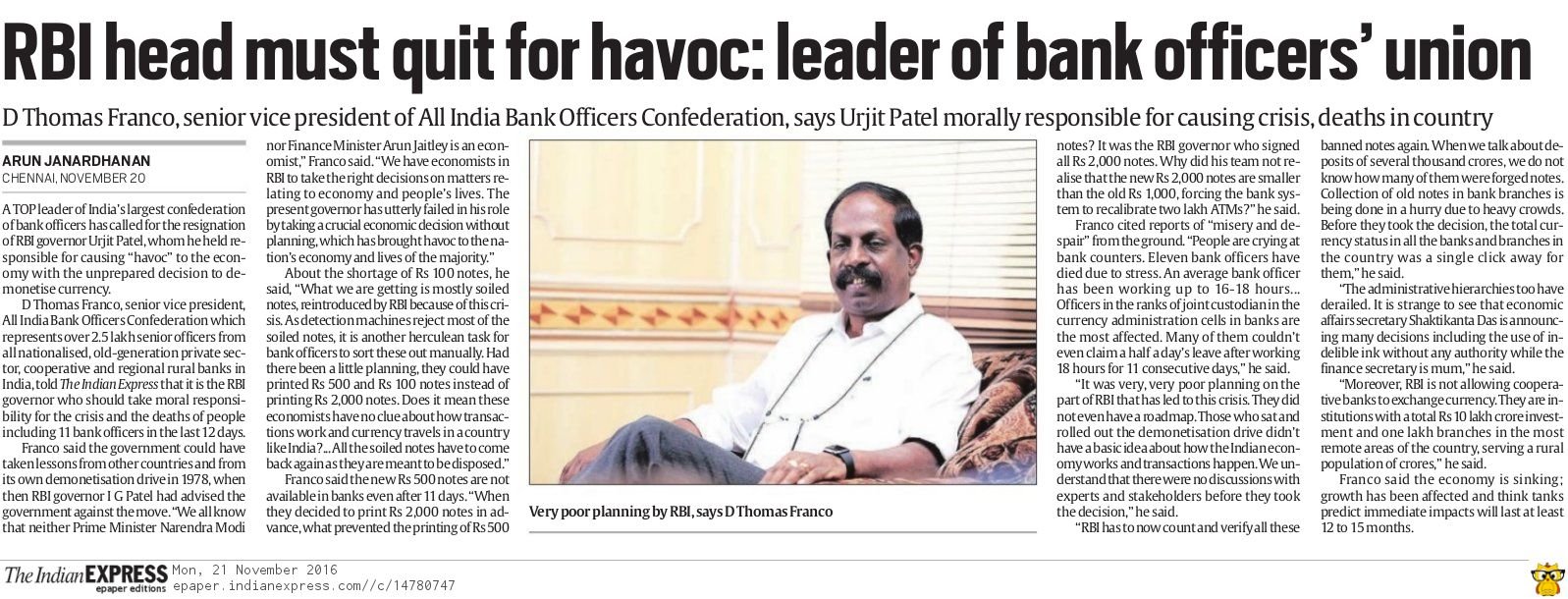
‘Note ban will lead to six months of chaos’

Former RBI deputy governor KC Chakraborty has come down heavily on the demonetisation exercise, adding it will lead to chaos in the next six months unless there is efficient replacement of currency notes. The outspoken former banker recently spoke to HT on the issue. Excerpts.

Can demonetisation curb black money?

Currency to the tune of ₹17 lakh crore is not black. If it goes into the hands of people who don’t pay taxes, it becomes black. If a taxpayer gets the money, it turns white. What we are killing is the note. We are not catching people who have not paid taxes. For that you have the I-T department, but they are not doing their duty. The poor hoard cash. The rich, who don’t pay taxes, don’t keep the black money under their pillows.

How much black money do you think is in cash?

Suppose there is 20% black money in the economy and of the total money supply, currency is only 10%, this means that 10% is black money. I feel that the rich move black money very fast as there are leakages. By banning notes, you are only increasing costs and taking away the right of the common man.

How can this be managed?

If your enforcement department, I-T , is weak, it cannot be managed. It is an administrative issue. You think income tax officials don’t know who hold black money? Next six months will be chaotic. It depends on how efficiently you bring back currency. If there is enough cash, why the restriction on withdrawals?

The UPA also planned to demonetise currency notes, but the RBI rejected the proposal. Why?

Yes. We thought it should not be done. That’s it.

How much black money is there in real estate?

People say that 20% of the economy is black money. In that case, black money constitutes 20% of all sectors. Its share is even higher in gold (40%) and real estate. But even the poor purchase gold.

What can be the negative impact?

The economy will suffer because liquidity has been sucked out. You have stopped market transactions for 70% of the economy. Even black money holders will not spend. The poor will suffer more. Already we can see farmers and small businesses are hit.

But banks are now flush with cash …

That (₹500 and ₹1,000 notes) is ultimately scrap paper now. The RBI will take six months to replace these and banks will have to pay 4% interest on those deposits. Only some time later, banks will be able to lend. There is no credit demand from the rich.

What about NPAs?

The NPA situation is very bad. All efforts should be made to identify the NPAs. If a person is sick, the person is not the problem. The problem with the NPA is the equity. Here no industrialist is doing business with his own money. It requires a surgical operation and we are administering small doses of tonic.

Will S4A (Scheme for Sustainable Structuring of

Stressed Assets) help?

It is bogus. The medicine is being given so that the person is not declared sick. The fellow who is sick needs more medicines. I (as a bank) am constantly trying to avoid the classification of NPAs. There is nothing sustainable and unsustainable. A person cannot be half sick. This is manipulation.

All NPAs should be identified. They are still hiding it. The RBI has said restructured debt will be NPA. When unsustainable debt gets converted into equity, it is the restructuring of an asset, which means it’s an NPA. If a bank thinks it can recover the money, why write it off. These write-offs are the biggest scandal of the century (and) must be stopped immediately.

But banks say entire provisions have been made and loans are being removed for accounting

You are an NPA, you are not ashamed of that, but showing it to other people is bad? If the economy improves, we will be better off, but banks need to perform.

201c15b7-676f-43c4-b90f-7a38313ac7b6 a1309ee6-abf7-4b4f-8151-164e9dbcc139 61619


Triple threat for border villages: Shelling, thefts & demonetisation

JAMMU: With no let up in Pakistani shelling on Indian villages and posts since India’s surgical strikes on terror launch pads on September 29, life of the villagers continues to be miserable.

NITIN KANOTRA/HTA resident shows mortar shells fired by the Pakistani army in Gigriyal village near Jammu on Friday.

With the shelling continuing for more than 45 days now, demonetization of ` 500 and ` 1,000 notes and continuing thefts have only added to their miseries.

“Today, when she went to her house she found that all her gold ornaments and money had been stolen,” 56-year old Mohan Lal said about a woman weeping inconsolably in the village. “She has lost all her savings.” Not so far away, Veena Devi cursed demonetization of `500 and `1000 notes by the NDA government. Both these women hail from Gigriyal — the last village on the Line of Control (LoC) in Pallanwala sector where Pakistan rained mortars on the intervening night of Thursday and Friday.

“We have had to flee our homes due to Pakistani shelling,” Lal further said, as most villagers looked at media persons furiously.

He said that nearly 1,500 villagers had taken refuge in Radha Swami ashram in Khour,

Veena Devi, like many others from the village, fell that they have been reduced to refugees in their own country.

“Pakistan is raining mortars on us, Modi government has demonitised notes and thieves are stealing gold and cash from our homes. We fled our fields at around 2.45 pm on Thursday when Pakistan started firing. Eventually, we left our homes and sought refuge in the ashram,” she said.

“It has been more than two months now. We have no place to live peacefully, have no money and now thefts are taking place,” she added.

Devi said that the government had done nothing on the ground.

“Please give us tents and food! For how long we will suffer?” she asked. “Schools are closed. Where should we go?” one of the children at the ashram asked.

Raj Kumar, another villager, said that the border population was facing immense hardships because of regular shelling by Pakistan.

“We have no clothes, no food and no money. Our standing paddy crop is getting ruined in Pakistani firing. We are facing starvation. Do we even have a government?” he asked.


SYL ::NEWS

Battle over riverwaters drains state coffers

Sarbjit Dhaliwal

Tribune News Service

Chandigarh, November 13

The inter-state dispute over the riverwaters has not only been exhausting the state emotionally but also financially. Since the state is fighting numerous legal battles on the issue, it has to spend a lot of money to pursue cases in various courts.Official sources said the state government paid about Rs 7 crore as fee to advocates engaged in fighting its legal battle in the Supreme Court and a high court in the current fiscal so far.For fighting such high-profile cases, the state has to engage constitutional experts who charge money in lakhs. Sources said an advocate, who earlier used to charge Rs 15 lakh per appearance, recently raised his fee to Rs 25 lakh. Another advocate is charging Rs 5 lakh per appearance, it learnt.There is a team of at least eight advocates to fight cases pertaining to the riverwaters. As of now, there are six important cases pending for adjudication in the Supreme Court and two high courts, it is learnt. Punjab is not only engaged in a legal battle against Haryana. Rajasthan is also fighting certain cases against it on the issue.Though the Supreme Court has announced its verdict on the Presidential Reference, litigation related to the issue is far from over. The Punjab Government can file a review petition in this case, appealing to the SC to re-examine the issue. As the SC verdict is said to be an advisory opinion under Article 143 of the Constitution for the President, for getting this opinion legally executed, the Haryana Government may have to re-approach the Supreme Court and also the Union Government. Certainly, there will be another bout of litigation on this issue.Among the pending cases include a prayer for directions to the Centre to constitute an appropriate tribunal under Section 4 (1) of the Inter-State Water Disputes Act, 1956; a petition in the Delhi High Court for setting aside the constitution of the Eradi Tribunal; a special leave petition against the Rajasthan High Court’s decision to hand over the control of head works of Harike, Ropar and Ferozepur to the BBMB.There is also a case about the Hansi-Butana canal pending in the Supreme Court. Punjab has sought dismantling of this canal arguing that it blocks the natural flow of rainwater. Another case is in the Supreme Court filed by the state challenging the Sections 78 and 79 of the Punjab Reorganisation Act. Then there are cases about Shahpur Kandi project and certain other issues related to riverwaters.

Costly affair

  • The state is fighting several legal battles over riverwaters
  • For fighting such high-profile cases, the state has to engage constitutional experts who charge hefty fee
  • Sources say an advocate, who earlier used to charge Rs 15 lakh per appearance, recently raised his fee to Rs 25 lakh

Experts divided over execution of SC verdict

New Delhi, November 13It took around 12 years for the Presidential reference on the SYL canal case to be decided by the Supreme Court, but uncertainty over implementation of the verdict continues, as experts are divided over the feasibility of its execution.Those supporting the verdict are of the opinion that there is no other option but to construct the remaining part of the canal on the Punjab side, while others say that change in circumstances in the past five to six decades have posed hurdles in the enforcement of the verdict.“The Supreme Court verdict is the opinion on question of law. The advisory opinion is also a declaration of law. In the SYL case, the declaration of the law is that the Punjab Termination of Agreement Act, 2004, is not valid. There is no option for the President to accept or not to accept. His job is over,” senior advocate Govind Goel said.Holding a contrary view, senior advocate RS Suri, who represented Punjab, said the state could not be left “remedy-less” in the water pact, as there was a deficiency in quantity which used to be there when the SYL canal pact was signed.Senior advocate and Rajya Sabha member KTS Tulsi said, “The problem is that if you force the agreement, the entire Punjab will turn into a desert. Almost 113 out of 140 tehsils are water-stressed. Most of them are dependent on groundwater.”He added the verdict of the five-judge bench was not binding on the Centre, as it was delivered under advisory jurisdiction.Another lawyer, who appeared for one of the states and did not wish to be named, endorsed Goel’s view and said, “The Centre, which has the executive power, can intervene and complete pending works.”Goel termed as “political” the stand of the Badal government that the SC verdict was merely an opinion. If Punjab did not act as per the judgment, the Centre had the option to impose Article 356, Goel said. Suri, however, alleged there was no “proper adjudication” in the matter and suggested a water tribunal could be the only solution to the dispute. — PTI

Capt: Will urge President to ignore SC ‘opinion’

Congress delegation to meet Pranab on Nov 17

Capt: Will urge President to ignore SC ‘opinion’
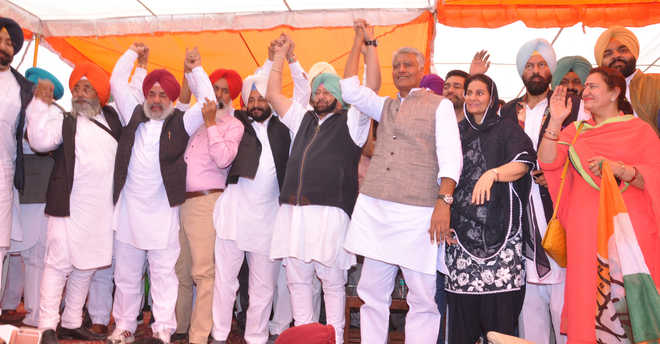
PPCC chief Capt Amarinder Singh with party leaders at a rally near Abohar on Sunday. Tribune Photo

Raj Sadosh

Abohar, November 13

State Congress president Capt Amarinder Singh today said he would lead a deputation of party MPs and MLAs to Rashtrapati Bhawan on November 17.Speaking to the media after addressing a rally at Khuyiansarwer village this afternoon, Amarinder said President Pranab Mukherjee would be requested to ignore the “opinion” of the Supreme Court on the SYL dispute.During the rally, Amarinder dared the Akalis to quit the Assembly and face the Congress in the coming elections, which he said should be held next month to prevent Chief Minister Parkash Singh Badal from further “vitiating” the state’s atmosphere.Thanking the people of Abohar and surrounding areas, which will be hit the most if the SYL judgment is implemented, for “turning up in large numbers”, he said the gathering at the rally showed the resentment of the people against the Badal government’s “failure” to protect their interests.Reacting to the CM’s assertion that he was ready to face the bullet to protect the state’s riverwaters, the PPCC chief said Badal had made such claims even in 1984, but when the time came to fight for Punjab he went into hiding in Uttar Pradesh, leaving the people of Punjab to fend for themselves. At least 35,000 innocent Punjabis had lost their lives in the turmoil, he added.The Akalis had 10 years to resolve the issue and battle the case in court effectively but they failed to do anything, he alleged, adding that they were only interested in the creation of Punjabi Suba to rule a Sikh-dominated region for their vested interests.Senior party leader Sunil Jakhar, who organised the rally, accused the CM of allowing the SYL issue to hang fire till the time of the elections to divert public attention. He accused the Akalis of selling off the state’s waters to the BJP in exchange for the passage of the Sahejdhari Bill so that they could retain hold on gurdwaras and the huge cash flows estimated at Rs 550 crore coming from there. The CM should be booked for trying to instigate people to face bullets to protect the riverwaters, he demanded.Indian Youth Congress president Amrinder Singh Raja Warring warned the Chief Minister that the “winds of destruction have already started blowing against him”.

State BJP to take up matter with Centre

Tribune News Service

Patiala, November 13

Rajya Sabha member Shwet Malik said today the Punjab BJP is “with the state” when it comes to the sharing of riverwaters with any other state. “The party’s stand is clear. Punjab does not have water to spare for anyone,” the MP said here.The state BJP could take up the matter with the Centre and Haryana to find a solution following the Supreme Court verdict which was “legally binding”, he said.Malik said the SYL issue concerned all Punjabis. “Farmers will have no water to irrigate their fields if the decision is implemented.”On demonetisation, the MP said only those with black money were opposing it. “The PMhas taken the initiative to weed out black money. In days to come, the decision will prove correct,” he added.

Kejriwal’s silence says it all: Capt

Tribune News Service

Chandigarh, November 13

Punjab Congress president Capt Amarinder Singh said today that AAP convener Arvind Kejriwal’s decision to put off his proposed Punjab visit had sent out a clear message that he was not supporting the state on the SYL issue.In a statement issued here, Amarinder said Kejriwal continued to remain “strangely silent” on the Supreme Court verdict.“This has unmasked his double standards on the vital issue, on which he has been doing a flip-flop for the past several weeks in a desperate bid to save his government in Delhi and keep the people of his birthplace in Haryana happy,” the PPCC chief said.

SYLissue: Five Congress councillors resign; effigies of Badal, Modi burnt

Rachna Khaira

Tribune News Service

Jalandhar, November 12

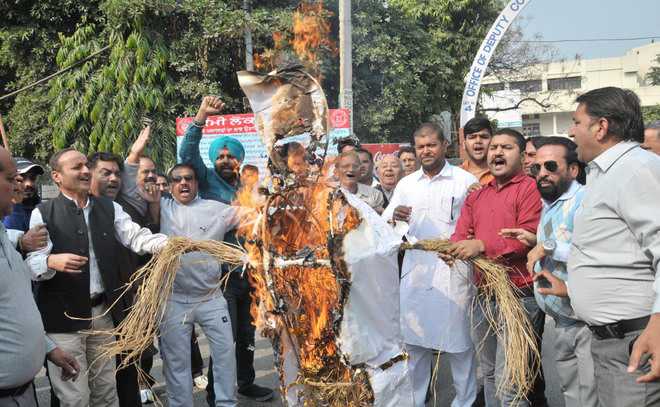
Five Congress councillors of the Municipal Corporation of Jalandhar (MCJ) today offered their resignation to Punjab Pradesh Congress Committee president Captain Amarinder Singh in protest against the Supreme Court’s verdict on Sutlej-Yamuna Link (SYL) canal issue.Councillor Sushil Rinku from ward number 46, Harsimran Bunty from ward number 47, Amanjit Kaur ‘Major’ from ward number 48, Kamlesh Grover from ward number 49 and Balkishen Bali from ward number 7 submitted their resignations. Out of these five, Rinku and Bali are also vying assembly tickets to contest the forthcoming elections in the state.Rinku said the sharing of water with Haryana would not only put a affect on farmers in rural areas, but would also adversely affect the economy in urban areas. “The economy of Punjab, being a major agrarian state, depends much on rural areas. The SYL decision will affect the crop yield and disrupt the economy cycle in urban areas as well,” said Rinku.While calling it a political gimmick, leader of opposition in the corporation Jagdish Raja said the councillors had offered resignation on their personal level. “So far, no directions have come from the party high command in this regard. If we get such directions in future, appropiate action will be taken in time.”Meanwhile, Jalandhar District Congress Committee (urban) today burnt the effigies of Punjab Chief Minister Parkash Singh Badal and Prime Minister Narendra Modi. The protest was organised to condemn the state government and the Centre over their “unfavourable” role in the SYL issue.District Congress Committee president Rajinder Berri alleged that Badal and Modi were directly responsible for the Supreme Court verdict on the SYL issue. He claimed that they had cheated the interests of the state and that the Chief Minister and Sukhbir Badal had been shedding crocodile tears on the verdict.Berri said the resignation of PPCC president Capt Amrinder Singh and other Congress MLAs showed who were the real well wishers of Punjab. He said Akalis and BJP MLAs should have resigned to show their solidarity to Punjab. He called upon Punjab BJP president Vijay Sampla to clear the stand of his party on the issue.Phagwara : In Phagwara too, the Congress held demonstrations against the SAD-BJP government for their “unclear stand on the SYL issue”. Activists led by former minister Joginder Singh Maan and ticket seeker Balbir Sodhi burnt effigies of Chief Minister Badal and Prime Minister Modi at Rest House Chowk and near Bus Stand, respectively during separate programmes in Phagwara.The BJP came out defensive. Party national secretary Chugh said it was height of betrayal that Capt Amarinder Singh who was witness to the exploitation of Punjab farmers at the hands of Indira Gandhi was now claiming to be their sympathiser by resigning from a post which he was otherwise likely to quit as he was all set to contest state assembly election from Patiala.Chugh said it was unfortunate and ridiculous that small-time leaders of the Congress from the state burnt effigies of Prime Minister Narendra Modi. Slamming the Congress leaders for their shameful act, Chugh said rather they should had burnt the effigies of their leader Indira Gandhi.The BJP leader said that the SAD-BJP government won’t allow even a single drop of water to flow out of Punjab and were all set to explore all legal possibilities in this regard. He said that the alliance partners with the help of people of Punjab would fight this battle in a peaceful manner.Cong enacting resignation drama: BJP Phagwara:The BJP on Saturday ridiculed the resignation of Congress MLAs as a “drama”. Party national secretary Tarun Chugh said that Capt Amarinder Singh and Punjab Congress MLAs were pretending to be martyrs without sacrificing anything. He said it was surprising that the Congress has decided to indulge in theatrics by resigning when the term of the present Vidhan Sabha was scheduled to end in a matter of just two months. Chugh said that it was public knowledge that the then Prime Minister and Congress president Indira Gandhi was the ‘architect and creator’ of SYL and Capt Amarinder Singh had not only given his consent to the move but also welcomed Mrs Gandhi when she came to lay the foundation stone of SYL canal. —OC

SAD in the dock for using school buses to ferry supporters

Mohit Khanna

Tribune News Service

Ludhiana, November 13

While the Transport Department claims to be taking action against the use of school buses for commercial purposes, officials shut their eyes to school buses ferrying supporters of Deputy Chief Minister Sukhbir Singh Badal.The matter has snowballed into a political issue as politicians are asking questions how the SAD was allowed to use school buses for a public function.“It is no hidden secret now that the SAD feels threatened from the Aam Aadmi Party. During our rally in Moga recently, the government stalled all bus services and told us through the babus that school buses couldn’t be used for political rallies. The AAP supporters were pulled out of their cars and asked to return. Now under which law they have been allowed to use school buses. Sadly, hundreds of students could not make it to their schools as their buses were used for a political purpose,” said Darshan Singh Shanker, general secretary of the state administration and grievance cell of the AAP.The Congress also took a potshot at the SAD. “Badal’s buses are minting money at the cost of schoolchildren’s studies,” said Congress leader Ishwarjot Singh Cheema.Despite repeated attempts, the District Transport Department officials were not available for comments.A government teacher said: “Since it is election time, studies of schoolchildren is bound to suffer. Either the teachers will be deployed on election duty or the school buses will be used to ferry staff on election duty.”


Politicians throng dead soldier’s village

NEW DELHI/BHIWANI: Police detained Congress vice-president Rahul Gandhi on Thursday — the third time in two days — as a political storm intensified over retired soldier Ram Kishan Grewal who killed himself in protest against an unequal pension policy for military veterans.

HT/PTICongress leader Rahul Gandhi at the cremation of ex-serviceman Ram Kishan Grewal in Bhiwani on Thursday; and (below) Delhi CM Arvind Kejriwal with the family members of the soldier.

The detention drama follows a VVIP parade to a Haryana village earlier in the day for the funeral of the 70-year-old Grewal. Gandhi and Delhi chief minister Arvind Kejriwal met his relatives at Bamla village in Bhiwani district and attended the last rites.

Kejriwal promised a `1-crore compensation to the family and a job for a relative of the deceased ex-serviceman. Also, he announced that his government would grant martyr status to the retired subedar, who served the army for 28 years till 2004.

Haryana CM Manohar Lal Khattar said Grewal cannot be called a martyr because brave soldiers do not take their own lives, while Union minister Gen VK Singh called the dead man a Congress worker after doubting his mental stability. Gandhi and party colleague Jyotiraditya Scindia were made to sit in a police van, after they walked a little distance during a Congressorganised candle-lit vigil from Jantar Mantar to India Gate on Thursday evening. They were detained near Janpath Metro station

“The way his family members were dragged and abused in the police station was incorrect. This affects the morale of our soldiers. The government must apologise,” Gandhi said as Congress protesters shouted slogans against the Centre.

“He committed suicide for personal reasons. Our Prime Minister implemented OROP unlike the Congress who failed to do so,” the Haryana chief minister said.

For his part, Union minister Singh remarked: “He fought sarpanch elections on a Congress ticket. His suicide is unfortunate.”

Defence minister Manohar Parikkar took a reconciliatory stand, announcing that the government will soon sort out “some technical issue” to ensure all soldiers get OROP, the “one rank one pension” programme the government approved last year.

Grewal was actively involved in the veterans’ longstanding demand for OROP, which promises to equalise pension payments for retired military personnel who served at the same rank and for the same amount of time, regardless of the year they retired.

Congress national spokesperson Randeep Surjewala called the government’s response insensible, saying defence minister Manohar Parrikar should have come to Bhiwani to offer condolences to the bereaved family.

“When it comes to demand of justice for soldiers, 125 crore people are united. But this government is not able to see the tears of the soldiers,” he said.

Gandhi and Scindia, Delhi chief minister Arvind Kejriwal and his deputy Manish Sisodia were detained on Wednesday too when they tried to meet relatives of the retired soldier at a central Delhi hospital where the body was kept. Grewal’s family members were detained too.

The Congress leader found support on this count from an unusual quarter — BJP ally Shiv Sena, which has been criticizing the government on various issues of late. “What kind of an attitude is this? The action of Delhi police was condemnable and shameful,” Sena leader Arvind Sawant said.

Political theatrics overshadowed Grewal’s death after he took Sulphas tablets at a park in New Delhi on Tuesday evening, allegedly for being denied an audience with defence minister Manohar Parrikar, and died the next day.

“Won’t let his death go in vain. Will snatch OROP from the central government,” Kejriwal said in Bhiwani.

BJP leaders lashed out at the Congress and Kejriwal’s Aam Aadmi Party for “politicizing” the death. But comments from Khattar and Singh, a retired army chief, were viewed as insensitive and faced criticism.


Fulfill my husband’s demand: OROP protester’s wife to Centre

Fulfill my husband’s demand: OROP protester’s wife to Centre
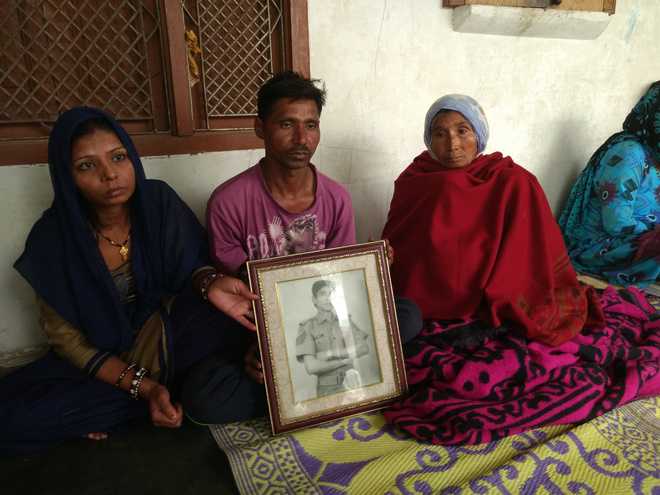
Kitabo Kaur (right), widow of Subedar Ram Kishan Grewal who committed suicide in New Delhi over One Rank-One Pension scheme, with her son Kulwant Grewal and daughter Sunita at their house in Bhiwani’s Bamla village on Wednesday. Photo: Indervesh Duhan

Sat Singh

Tribune News Service

Bamla (Bhiwani), November 2

Away from political buzz in New Delhi, Kitabo Kaur in the district’s Bamla village waits for the body of her husband Subedar Ram Kishan Grewal, who consumed poison at Jantar Mantar on Tuesday over One Rank-One Pension (OROP) scheme.“My husband was a brave man. I cannot believe that he committed suicide. He left the village on October 31 to participate in the One Rank-One Pension (OROP) protest in Delhi. He seemed to be in a good mood,” Kitabo Kaur (60) said. “He sacrificed his life for OROP. The Centre should fulfill his demand,” she said.The deceased’s son Kulwant Grewal said that on Tuesday, he got a call from his elder sister Poonam, who is married in Delhi, about the failing health of their father.“Four of my brothers left after receiving the call, without knowing what had happened,” he said. Kitabo Kaur and Ram Kishan have five sons and two daughters; the eldest of them, Dilwar Singh, works as a head constable in the Haryana Police.Kulwant said that after his father retired in 2004, he was elected sarpanch of the village. “His initiatives as sarpanch got him Nirmal Gram Puruskar from then President Pratibha Patil in 2008 at a function in Hisar. Because of his friendly and social nature, people used to call him pardhanji.”The family said Ram Kishan was engaged in OROP protest for one-and-a-half years.The family demanded a martyr status for Ram Kishan and cremation with full state honours. The family said it was unaware when the body would arrive from Delhi, as it failed to establish contact with other members of the family in Delhi.Keep OROP away from politics, tweets Vij Ambala: Health and Sports Minister Anil Vij on Wednesday advised the political parties to keep ‘One Rank, One Pension’ issue away from politics. He questioned the Congress leaders about not implementing it during their regime. He tweeted…“It would be better if OROP is kept away from politics. The Congress leaders shedding tears of a crocodile must explain why it was not done during their regime.” Vij’s tweet came after the Congress and AAP targeted the Modi government over suicide by an ex-serviceman from Haryana. 


Voters have right to know candidates’ edu status: SC

New Delhi, November 1

Voters have a fundamental right to know the academic qualification of a candidate and any false declaration on this count can warrant rejection of nomination papers, the Supreme Court has held.The Bench also ruled that if there are only two candidates in the fray and it is proved that the returned candidate’s nomination papers have been “improperly accepted”, then the one who lost the poll does not need to produce proof that the election has been materially affected.The verdict came on two cross appeals filed by Mairembam Prithviraj alias Prithviraj Singh and Pukhrem Sharatchandra Singh against each other challenging the judgment of the High Court of Manipur.The High Court had declared as “void” the election of Prithviraj, who had contested the 2012 polls on a Nationalist Congress Party ticket against Congress nominee Sharatchandra from Moirang Assembly seat in Manipur.It was alleged that Prithviraj, in his nomination papers, had said he was an MBA, which was found to be incorrect. Upholding the High Court verdict, the Bench said it was not “in dispute that the appellant did not study MBA in Mysore University” and the plea that it was a “clerical error” cannot be accepted.“Since 2008, the appellant was making the statement that he has an MBA degree. The information provided by him in the affidavit filed in Form 26 would amount to a false declaration. The said false declaration cannot be said to be a defect which is not substantial…,” the Bench said.The Bench also dealt in detail the legal question whether it was necessary to “plead and prove that the result was materially affected when the nomination of the returned candidate was found to have been improperly accepted, more so, when there are only two candidates contesting the election.” “There is no dispute that an election cannot be set aside on the ground of improper acceptance of any nomination without a pleading and proof that the result of the returned candidate was materially affected.The Bench did not allow the plea of the losing candidate that he be declared winner as the election of the returned candidate has been declared void. — PTI


Kanpur train mishap: Kin seek martyr’s status for lieutenant

Ravinder Saini

Tribune News Service

Jhajjar, November 22

Mortal remains of Lieutenant Sandeep Chahar (24), who died in the Kanpur train mishap, were consigned to flames at his native Silani village today with full military and police honour.Jhajjar SDM Pradeep Kaushik and DSP Rajiv Kumar attended the last rites to pay tributes to the martyr.Pradeep Chahar, Sandeep’s younger brother, lit the pyre in presence of a significant number of people from surrounding villages.Earlier, Sandeep’s body was brought to Silani village by Army personnel in an ambulance from Delhi.Talking to mediapersons, Honorary Captain (Retd) Jagdish Chahar, Sandeep’s grandfather, demanded the state government to accord a status of martyr to his grandson, stating he was on duty when the mishap took place.Dharampal Chahar, Sandeep’s father, said, “We want nothing but respect for our son which is given to a martyr.”


Northern Command bids farewell to Gen Hooda

Northern Command bids farewell to Gen Hooda
General Officer Commanding-in-Chief (GOC-in-C), Lt Gen DS Hooda

Tribune News Service

Jammu, November 29

The Northern Command today bid adieu to its General Officer Commanding-in-Chief (GOC-in-C), Lt Gen DS Hooda, who retiring after an illustrious career of 40 years. The General had taken over the command of the prestigious Northern Command on July 1, 2014.In his farewell address, the General paid rich tributes to the martyrs who have laid down their lives in the service of the nation and exhorted all ranks to continue to work with the same zeal and motivation to overcome the numerous challenges of combating terrorism, proxy war and external threats.General Hooda stressed upon the concept of “unlimited liability” associated with the profession of arms and the subtle difference of military profession from others. He emphasised the need to strengthen military ethos and stressed upon the increased responsibility that officers have towards the men they command.He appreciated efforts of all ranks for their immense professionalism and dedication in carrying out their tasks in trying conditions at the LoC/LAC and in counter-terrorists operations. He highlighted the immense contribution and cooperation of the IAF while carrying out various operations in the command theatre. He also complimented and thanked the civil administration and CAPF for the excellent synergy with the Army in pursuit of common goal of establishing “peace and tranquillity” in J&K.The General laid a wreath at Dhruva War Memorial to pay his tributes to the brave martyrs of the Northern Command.The Northern Command PRO said all officers, JCOs and men in Northern Command and the entire Indian Army would remember him fondly as an illustrious intellectual General.