Sanjha Morcha

Parrikar should weigh his words

The defence minister has reopened the debate on India’s nuclear doctrine

As a Goa chief minister Manohar Parrikar can say almost anything he wants in public. There is minimal collateral damage for the rest of the nation if everyone in Panaji takes leave of their senses. Unfortunately, this is not the case with a defence minister Manohar Parrikar. In this position he is one of the four senior-most Cabinet members and the one charged with the external security and defence of India. His words are carefully listened to and strongly influence the actions of a swathe of players, including the armed services, foreign governments and terrorist groups. Unfortunately, the person who seems to understand this the least is Mr Parrikar. His questioning of India’s long-standing nuclear doctrine on a public platform was avoidable. He effectively put a question mark over India’s nuclear deterrent, the sanctum sanctorum of the country’s national security posture. More worryingly, his “personal” comments seem to stem from an inadequate understanding of the strategic logic underpinning nuclear deterrence and a no-first-use policy.

In the dawn of the nuclear age, military strategists recognised that nuclear weapons changed the purpose of an army. A conventional arsenal is designed to defeat an enemy. A nuclear war would inflict such enormous damage on both sides that no one could win such a conflict. Therefore, the purpose of a nuclear arsenal was to prevent war. Thus was borne the concept of nuclear deterrent. To put it another way, one wins a nuclear conflict by never having it in the first place. Once this logic was understood, the next logical step was to signal this in a number of ways including no-first-use, developing the ability to carry out nuclear retaliation even after being attacked and, most important, maintaining the credibility of national intent through testing, technology and a iron-cast doctrine. A country can build all the warheads and delivery mechanisms it wants. But if there is evidence that it lacks the political will to actually use them, it encourages an enemy to carry out a first strike. The messaging of the political determination to retaliate, irrespective of the damage done in the first strike, is absolutely essential in ensuring the enemy attack never takes place at all.Whether in a personal or official capacity, for a defence minister to question India’s nuclear doctrine undermines the credibility of the country’s deterrent. Mr Parrikar, in other words, is inviting other countries to presume India is not certain how to use its final line of defence.
Rs 5-lakh ex gratia, govt job for family of martyr Gursewak

Rs 5-lakh ex gratia, govt job for family of martyr Gursewak
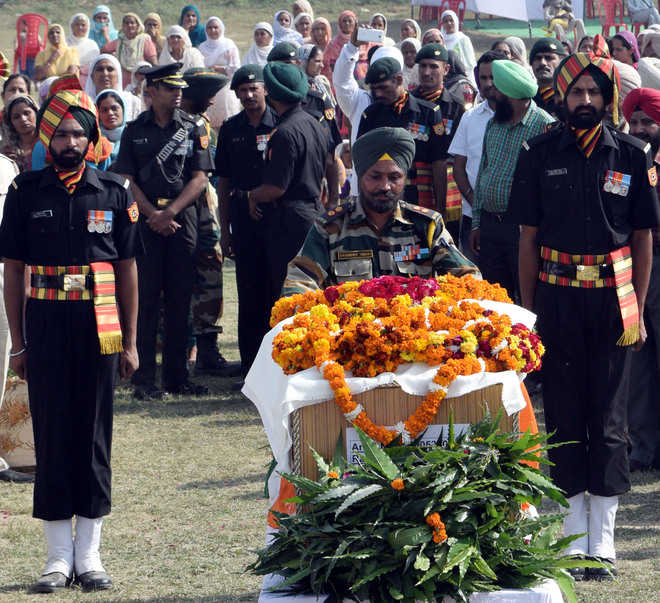
An Army officer pays tributes to martyr Gursewak Singh before his cremation in Tarn Taran’s Warana village on Monday. Tribune photo

Our Correspondent

Tarn Taran, November 7 Sepoy Gursewak Singh (24) of 22 Sikh, who was killed in Pakistani shelling in Jammu and Kashmir yesterday, was cremated today with state and military honours at his native village, Warana, in the district.Food and Civil Supply Minister Adaish Partap Singh Kairon, along with Army officers and officials of the district administration, was present. The Punjab Government announced ex gratia relief of Rs5 lakh for the family and a government job for Gursewak’s brother.He was to get married in February next year.The martyr’s body was brought to the village in an Army van. The pyre was lit by his father, Balwinder Singh. Nagoke village resident Gurmeet Kaur, who was engaged to Gursewak, attended the cremation.Col Subodh Gurung of the Mechanised Infantry, Deputy Commissioner BS Dhaliwal and SSP Manmohan Kumar Sharma were among those who laid wreaths on the body.Leaders of various political parties, including the SAD, the Congress, AAP and Aapna Punjab Party, also paid tributes to the martyr.


Army finishes pipeline work in Ladakh despite Chinese opposition

Army finishes pipeline work in Ladakh despite Chinese opposition
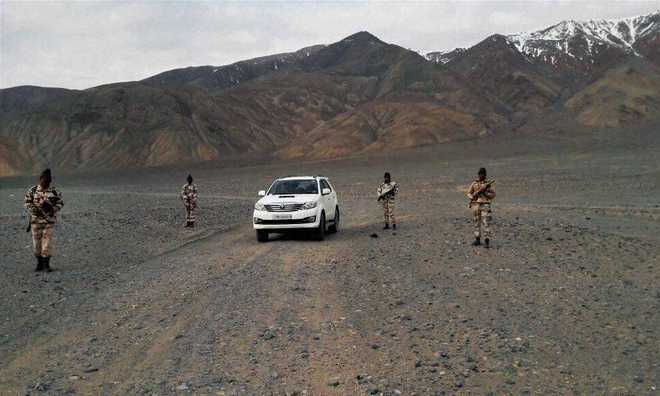
The face-off between the two sides continued for three days ending on Sunday evening. — Photo for representation only) Chinese and Indian troops were reported to have been locked in a stand off at the icy heights of Ladakh division. PTI file photo

Leh/New Delhi, November 6 Unfazed by the ‘sit-in’ by the Chinese border guards at Demchok in Ladakh that led to a face-off with Indian troops earlier this week, Army engineers have finished the work for laying a water pipeline for local villagers in Ladakh division.Chinese had pressed its People’s Armed Police Force (PAPF) personnel at the Line of Actual Control (LAC) in Demchok this time instead of usual PLA who came to erect a Fibre-Reinforced plastic (FRP) hut on Friday at the border but was not allowed by Army and Indo-Tibetan Border Police (ITBP) troops, official sources said.The sources said while the face-off between the two sides continued for three days ending yesterday evening, the Army engineers, ignored the warnings by PAPF personnel and continued laying pipeline for nearly a kilometre for irrigation purpose of the villagers in Demchok, located 250 km east of Leh.(Follow The Tribune on Facebook; and Twitter @thetribunechd)According to the sources, the formula of ‘active patrolling’ adopted by the ITBP and army ever since 2013 fortnight long stand-off near Daulat Beig Oldie has been reaping rich dividends and Chinese have been cautious in carrying out incursion especially in Ladakh sector.This time also, the sources said, army and ITBP personnel did not allow the PAPF guards to erect the hut and they were forced to take the material back to their base camp located a kilometre away at Demqog from the place of face-off.The fresh incident had erupted on November 2 when Chinese troops took positions on the LAC and demanded that work be stopped as either side needs to take permission from each other before undertaking any construction work, a claim disputed by India which says that as per the agreement between the two countries, information about construction needed to be shared only if it was meant for defence purposes.Both sides pulled out banners and have been stationed on the ground, the sources said, adding the Army and ITBP troopers were not allowing the Chinese “to move an inch” ahead despite the PLA claiming that the area belonged to China.The area had witnessed a similar incident in 2014 after it was decided to construct a small irrigation canal at Nilung Nalla under the MNREGA scheme which had been a sore point with the Chinese.The PLA had mobilised villagers from Tashigong to pitch Rebos (tents) at Charding-Ninglung Nallah (CNN) Track Junction to protest Indian action. — PTI


Capt seeks justice for soldier’s kin

CHANDIGARH: Punjab Congress chief Capt Amarinder Singh on Friday submitted a memorandum to governor VP Singh Badnore, seeking the Centre’s intervention for providing justice to the family of retired soldier Ram Kishan Grewal who killed himself in protest against an unequal pension policy for military veterans.

Alleging total breakdown of democratic system in the country, Amarinder urged Badnore to convey to the central government his party’s concern over the brutal handling of the situation in the wake of 70-year-old’s suicide and demanded exemplary action against those guilty of harassing, detaining and beating up his family members.He was leading a 20-member delegation of Punjab Congress leaders and ex-servicemen.


Worried India set to call back 8 officials from Pak

PAKISTANI MEDIA SHOWS PHOTOS OF THE INDIAN DIPLOMATS, DESCRIBES TWO AS SPIES; IDENTITY LEAKED AFTER MEHMOOD AKHTAR SPYING EPISODE

NEW DELHI/ISLAMABAD: Safety concerns could prompt India to bring back eight officials from its high commission in Islamabad after six members of the Pakistani mission in New Delhi left for home on Wednesday, taking ties to a fresh low amid heightened tensions.

The safety of the Indian diplomats was compromised as their identities were posted online and their photos flashed by Pakistani news channels. The Pakistani media described two of the officials as spies and quoted sources as saying that they were involved in espionage and “subversive activities”.

The standoff follows unrelenting Pakistani shelling in the border areas of Jammu and Kashmir over the past fortnight, resulting in heavy civilian fatalities. At least 20 people, including children, were killed as Pakistani troops pounded border areas with mortar shells.

Official sources in New Delhi said the identities of the Indian officials were leaked to Pakistani media shortly after a video emerged of the interrogation by Delhi Police of Mehmood Akhtar, a Pakistan high commission official arrested and expelled last week on charges of spying.

In the video, Akhtar is seen naming six more Pakistani officials as members of the spying ring. These six officials, including four of the rank of first secretary, were the ones who left India with their families on Wednesday.

The sources also questioned Delhi Police’s decision to release the video to the media. It is believed that this had resulted in tit-for-tat leaks to the Pakistani media.

Pakistani TV channels and news websites initially ran stories that described Indian commercial counselor Rajesh Agnihotri and press secretary Balbir Singh as intelligence agents. Later, names of six more Indian officials were made public.

Sources said the news reports had raised serious concerns about the safety of the eight Indian officials, especially as their photos were flashed on TV at a time of heightened tensions. This would make it easy for forces inimical to India to identify them in public, the sources added.

Though there was no official word, the sources said the officials would have to be called back as “there is a clear danger to their lives”

The Indian officials include a counselor, three first secretaries and four assistants. The external affairs ministry also summoned Pakistan’s deputy high commissioner Syed Haider Shah and protested against ceasefire violations on the frontiers in Kashmir. It also protested against the mutilation of the body of an Indian solider by a “terrorist” who crossed the Line of Control. Pakistani forces have targeted border villages and army posts since India’s elite forces conducted surgical strikes on militant hideouts in Pakistan-occupied Kashmir in September.No deaths were reported on Wednesday but many villagers living near the frontline have been evacuated to safe places.


Civil-military meet: Security of airfields, ammo depots taken up

Vijay Mohan

Tribune News Service

Chandigarh, November 2

In the backdrop of heightened tension between India and Pakistan and recent terror attacks in the region, the topic of security of airfields and ammunition depots in the state featured prominently in the annual civil-military liaison conference (CMLC) of the state government and the Western Command here today.Sources said the prime concern was large-scale unauthorised constructions adjoining the perimeter of sensitive installations, which not only posed a security threat for these but also raised the issue of the safety of the civilian population residing in the vicinity.“Some specific observations in this regard concerning ammunition depots near Bathinda, Ludhiana, Dappar and Pathankot were made and these will be pursued at appropriate levels further. Safety and security issues pertaining to airfields as well as some civilian airports, including those at Amritsar and Chandigarh, were also discussed,” an official said.Illegal constructions and encroachment around military installations has been a long-standing issue and the issue has also been dragged into courts, where some cases are pending. The issue has cropped up repeatedly during CMLCs. The meet today was conducted by Additional Chief Secretary, Home, Jagpal Singh Sandhu and Chief of Staff, Western Command, Lt Gen IS Ghuman. The Chief Minister, who traditionally presides over the CMLC, was not present as his helicopter could not take off from Amritsar due to bad weather.Sources said the Army had also raised the issue of damage being caused to the ditch-cum-bunds (DCBs) along the Indo-Pakistan border due to agricultural activities and sand mining. The state government was asked to undertake repairs of the DCBs that stretch over several kilometers and are designed to check enemy advances by flooding the ditches.The Army has sought allocation of about 23 acres of land in Nangal from the state government to meet its administrative requirements. It also pointed out that it is unable to carry out construction for the Services Selection Board at Rupnagar, which at present is running from an interim location at Kapurthala, due to recurring flooding of the site.In addition, the Army also wants to set up Ex-Servicemen Contributory Health Scheme polyclinics in four non-military stations in Punjab. While the state government has agreed to provide government land, where available, for the polyclinics, it will facilitate the Army in procuring land at other places.Filling up vacancies in the state government earmarked for ex-servicemen, welfare schemes and financial assistance to veterans and widows were among the other items of the 18-point agenda.

Other issues

  • Illegal constructions and encroachment around military installations
  • Damage being caused to the ditch-cum-bunds along the Indo-Pakistan border
  • Land sought by the Army in Nangal
  • Setting up of Ex-Servicemen Contributory Health Scheme polyclinics
  • Filling up of vacancies in the state government earmarked for ex-servicemen

2 militants killed in encounter

2 militants killed in encounter
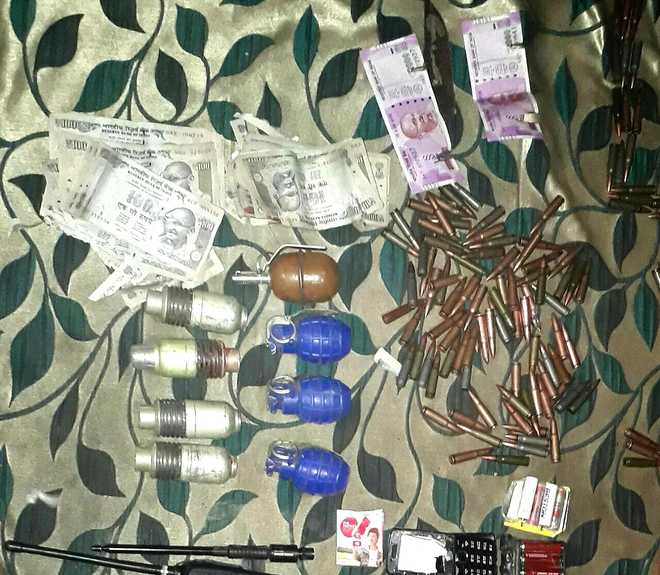
The new currency and arms recovered from the two militants who were shot dead in Bandipora on Tuesday. Tribune photo

Majid Jahangir

Tribune News Service

Srinagar, November 22

Two militants were killed in an encounter with security forces in north Kashmir’s Bandipora district today.The brief gunfight erupted early this morning when the police, CRPF and the Army cordoned off Bonikhan Mohalla in Hajin, around 30 km from Srinagar, following an input about militant presence in the area.“Two heavily armed terrorists were neutralised during the operation. We have recovered two AK rifles, one Under Barrel Grenade Launcher (UBGL) and a large quantity of war-likes stores,” Commanding Officer, 13 Rashtriya Rifles, Col Vikramjeet Singh told mediapersons after the operation.“The operation was conducted in a built-up area and we ensured that there was no collateral damage to the houses and civilians population in the area,” he added.A police officer said both slain militants were residents of Pakistan and associated with the Lashkar-e-Toiba.The militants were killed a day after suspected militants fled with nearly Rs 13 lakh, including Rs 11 lakh old currency, from a bank in central Kashmir’s Budgam district.Rs 2,000 notes recovered from slain ultras At a time when people are struggling to get new currency, fresh notes of Rs 2,000 were recovered from the two militants killed in the encounter. “We have begun investigations as to how the militants got the new currency,” said Senior Superintendent of Police, Bandipora, Zulfikar Azad. The police also recovered Rs 11,600 in Rs 100 denomination from the two slain militants. Earlier this month, Prime Minister Narendra Modi demonetised Rs 500 and Rs 1,000 currency notes and the move was mainly intended to curb the flow of funds to militant organisations and counterfeit money. However, the recovery of new currency notes from the possession of slain Pakistani militants indicates that the insurgents transact mostly in genuine currency. Several J&K police officers opine that the demonetisation is not going to have “much impact” on militancy in Kashmir.


‘ISI helped ULFA travel to Pakistan for training’

NEW DELHI: Several groups of United Liberation Front of Asom (ULFA) cadres travelled to Pakistan during the 1990s to receive training with the help of the Inter-Services Intelligence (ISI), according to a new book about the spy agency.

HT FILEAuthor Hein G Kiessling writes that Pakistan’s ISI began supplying weapons to Naga militant groups back in the 1960s.

Links between Pakistan and militant groups in India’s northeastern states date back to the 1960s, when the neighbouring country supplied weapons to Naga militants, author Hein G Kiessling writes in his book Faith, Unity, Discipline: The ISI Of Pakistan.

Kiessling, a historian who forged contacts with Pakistani military and intelligence officials while living in the country between 1989 and 2002, writes there was a temporary halt to weapons supplies after the 1971 war that led to the birth of Bangladesh.

“In 1990, via the Pakistan embassy in Dhaka, the NSCN (National Socialist Council of Nagaland) and ULFA developed contacts with the ISI…In January 1991, with the help of the ISI, several high-ranking ULFA leaders travelled to Pakistan to sign a training agreement for ULFA cadres,” he writes.

In 1991, two six-member ULFA groups arrived in Islamabad for training and a third 10-member group followed in 1993. The ISI procured weapons for the northeastern militant groups from countries such as Thailand and Cambodia, from where they were shipped to Bangladesh before being smuggled into India.

Kiessling writes there are indications that the “ISI is still present and active in northeast India”. In August 1999, Assam Police announced the arrest of two ISI officers and two local agents


SAD’s ex-servicemen wing seeks two tickets

Our Correspondent

Sangrur, November 19

The ex-servicemen wing of the Shiromani Akali Dal (SAD) yesterday demanded two tickets for the ex-servicemen from SAD president Sukhbir Singh Badal for the current Assembly elections.State president of the wing Gurjinder Singh Sidhu said the ex-servicemen and serving Army personnel were in great strength in the state and they had about 25 lakh votes. Besides, there were also 55,000 widows of ex-servicemen in the state. Therefore, the party president should give them representation in the Assembly elections by allotting the party ticket, he added.Sidhu regretted that during the previous Assembly elections not even a single ticket was allotted to the ex-servicemen by the party due to which they had been feeling ignored.



IAF plans to map performance data on first three female fighter pilots

NEW DELHI: The Indian Air Force is examining a proposal to gather data on the performance of its first female fighter pilots, potential difficulties due to physiological attributes and cultural issues in the male-dominated military, HT has learnt.

IAF(L-R) Mohana, Bhawana and Avani are in line to be the country’s first woman combat pilots.

The proposal, made by a leading woman aviation psychologist and accident investigator in the IAF, is under consideration of the force’s crucial inspection and safety wing, sources said.

Three women are currently taking a shot at becoming fighter pilots after the government approved a plan in October last year. “We propose to carry out a longitudinal study capturing every aspect of fighter flying,” said Kuhu Ganguly, a senior scientist in the inspection and safety directorate.

“The idea is to track how well they are progressing as they break into a male bastion,” she said. Such studies can stretch for years as subjects are repeatedly observed on specific parameters.

The three women are in the final stage of their training on British Hawk advanced jet trainers at an IAF facility in Bidar, Karnataka. The trailblazers — Bhawana Kanth, Mohana Singh and Avani Chaturvedi — will begin flying supersonic fighter planes from June 2017, considered a watershed in the IAF’s 84-year history.

Several IAF officers said the performance of the women during their training was on a par with their male colleagues.

Such gender-specific studies are not uncommon. Aviation medicine wings of international air forces, including the US and Australia, have researched women pilot programmes. Research has been done in areas such tolerance to gravitational forces, disorientation and motion sickness, pregnancy, use of “piddle packs” and ejection safety. Ganguly, whose rank is equivalent to an air commodore’s, said, “The fighter jet doesn’t know gender and it will behave as it will. The study could also help the IAF resolve problems, if any, for future women fighter pilots.” The IAF has advised the women trainees to put off motherhood for at least four years after they are commissioned as fighter pilots so that their flying schedule is not disrupted. No woman trainee from the next batch has opted for the fighter stream.

“Fitness norms for flying duties are clearly laid down and both men and women will have to maintain those standards,” said Air Marshal Pawan Kapoor, who heads the IAF’s medical wing.