Sanjha Morcha

India successfully conducts twin trial of Prithvi-II missile

India successfully conducts twin trial of Prithvi-II missile
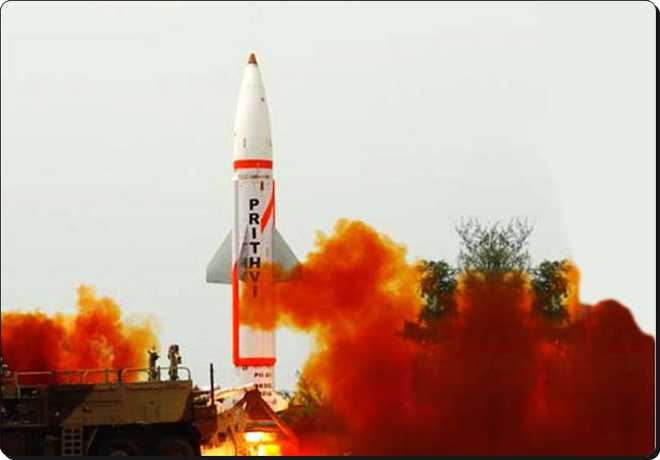
Photo from the twitter account of @airnewsalerts

Balasore, November 21

India on Monday successfully test-fired its indigenously developed nuclear capable Prithvi-II missile twice in quick succession as part of a user trial by the army from a test range at Chandipur in Odisha.

In salvo mode, the two surface-to-surface missiles which have a strike range of 350 km and are capable of carrying 500 kg to 1,000 kg of warheads were successfully test-fired in quick succession from mobile launcher from launch complex-3 of the Integrated Test Range (ITR) at around 9.35 am, defence sources said.

(Follow The Tribune on Facebook; and Twitter @thetribunechd)

A similar twin trial had been conducted on October 12, 2009 from the same base where both tests were successful.

The missile is thrusted by liquid propulsion twin engines. It uses advanced inertial guidance system with manoeuvring trajectory to hit its target, they said.

The missiles were randomly chosen from the production stock and the entire launch activities were carried out by the specially formed strategic force command (SFC) and monitored by the scientists of Defence Research and Development Organisation (DRDO) as part of training exercise, a defence scientist said.

The missile trajectory was tracked by the DRDO radars, electro-optical tracking systems and telemetry stations located along the coast of Odisha, sources said. The downrange teams on board the ship deployed near the designated impact point in the Bay of Bengal monitored the terminal events and splashdown.

Inducted into Indian armed forces in 2003, the nine-metre-tall, single-stage liquid-fuelled Prithvi-II is the first missile to be developed by the DRDO under the Integrated Guided Missile Development Programme, defence sources said.


Pakistan bans 2 groups with al-Qaeda, IS links

ISLAMABAD: Pakistan has banned two militant groups with links to the Islamic State and al-Qaeda for their involvement in several terror attacks, according to the National Counter-Terrorism Authority (NACTA).

AFP FILEOfficials said the groups were banned after recent deadly attacks in Balochistan and Sindh provinces.

The website of NACTA showed the ban on Jamaat-ul-Ahrar and Lashkar-e-Jhangvi al-Alami was imposed on November 11, taking the total number of proscribed groups to 63.

The Jamaat-ud-Dawah (JuD), blamed for the 2008 Mumbai attacks, is not among the banned organisations and is only “under observation”.

Lashkar-e-Jhangvi al-Alami has been linked to the Islamic State while Jamaat-ul-Ahrar is linked to al-Qaeda.

Jamaat-ul-Ahrar is a breakaway faction of the Tehrik-e-Taliban Pakistan and Lashkar-iJhangvi Al-Alami is also affiliated with sectarian organisations that have targeted the Shia minority.

Officials said both groups were banned after deadly attacks in Balochistan and Sindh provinces, including an assault at the Sufi Shah Noorani shrine in Balochistan that killed 52 people.

The IS claimed the attack on the shrine and Lashkar-e-Jhangvi al-Alami spokesman Ali bin Sufyan said his group was cooperating with the IS “directly or indirectly”.

The IS and Lashkar-e-Jhangvi al-Alami also claimed an attack on a police academy in Balochistan that killed more than 60 people.

The Lashkar-e-Jhangvi (LeJ), a Sunni group, has its roots in Punjab province and has usually targeted the Shia minority.

Jamaat-ul-Ahrar had claimed responsibility for a suicide attack on the Civil Hospital in Quetta in August that had killed at least 75 people.

Two LeJ militants were recently arrested for killing qawwal Amjad Sabri in Karachi but this was later denied by police.

The list of banned groups on the NACTA website showed that the JuD has been “under observation” since January 17, 2007.

The Lashkar-e-Taiba and Jaish-e-Mohammed have been listed as banned groups since January 14, 2002.


Ex gratia up for kin of military personnel

New Delhi, November 18The government today said it has enhanced the lump sum ex gratia being paid to families of military personnel.With effect from January 1 this year, next of kin in case of death in the course of duties attributable to actions of violence by terrorists etc has been increased to Rs 25 lakh in place of Rs 10 lakh earlier, Minister of State for Defence Subhash Bhamre said in a written reply to the Lok Sabha.In cases of death occurring during enemy action in war or border skirmishes or in action against militants, terrorists, the amount has been increased to Rs 35 lakh from the Rs 15 lakh at present.The Army Group Insurance Fund for Officers has been raised to Rs 75 lakh for officers with effect from October 1, 2016, from Rs 60 lakh while for JCOs/other ranks, the amount has been increased to Rs 37.5 lakh from Rs 30 lakh. — PTI


A corridor of concern by Vivek Katju

A corridor of concern
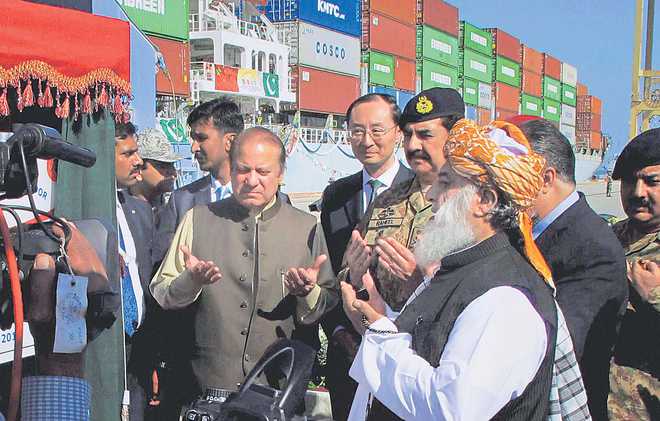
Game changer? Pak army has hailed CPEC as the “fruit” of Gen Sharif’s vision.

IN October 1994, Gen Naseerullah Babar, Pakistan’s influential interior minister in the Benazir Bhutto government, sought to open trade and transit routes to Central Asia by sending a convoy of the Pakistan army-owned national logistics cell trucks across chaotic Afghanistan into Turkmenistan. The convoy led by the ISI’s leading Afghanistan operative, Colonel ‘Imam’, was stopped by Mujahideen commanders before Kandahar but the fledgling Pakistan-promoted Taliban chased the commanders away and captured Kandahar. The Taliban, as Pakistan’s instrument, was on its way to control Afghanistan in the next few years but Pakistan’s historic aim of using its location to become a trade and transit route for Central Asia continues to remain a distant dream. Will the same fate befall the China-Pakistan Economic Corridor (CPEC) which Pakistan is touting as a “game changer” for the country? Or will it evolve into an effective trade route via the Gwadar Port, on Pakistan’s Makran coast, to Xinjiang and northwest China? These questions are now pointedly relevant, for, on November 13, Gwadar was opened up, albeit for the present largely symbolically, for trade activities under the CPEC. PM Nawaz Sharif and army chief Raheel Sharif werepresent on the occasion; this, at a time, when tension between Nawaz and the army is running high. Significantly, the Pakistan army’s information wing hailed the CPEC as the “fruit” of General Sharif’s vision.The absence of the Chinese leadership at Gwadar though indicates that the occasion was designed to quell growing scepticism about the CPEC in sections of Pakistani opinion. This is also borne out by what Maj-Gen Muhammad Afzal, director-general of the Frontier Works Organisation (FWO) of the Pakistan army — responsible for the construction of a large part of the CPEC’s road network  — told Pakistan’s leading newspaper, Dawn: “We pushed it to counter the despondency that was coming to surround the project. Too many people were airing views that this project is not viable or not going to materialise”.In typical army fashion, reminiscent of the Babar convoy, the FWO decided to organise one Chinese convoy and two from Pakistan to reach Gwadar to load cargo on two ships berthed there. The cargo largely from China was destined to the EU, the UAE, Sri Lanka and Bangladesh. The Chinese convoy crossed into Pakistan via the Khunjerab Pass and travelled on the Karakoram highway and reached Gwadar, as did the Pakistan convoys originating in Lahore and Sialkot through Balochistan. Instead of the Punjab-Sindh alignment of the CPEC the route through Balochistan to Gwadar was deliberately chosen. This was to signal to the Baloch that their interests would not be neglected. It is also to indicate to China and other countries that the Pakistan army which has raised a special force for the CPEC and its projects was competent to ensure its security.Chinese President Xi Jinping formally announced the CPEC during his visit to Pakistan in April 2015. It will involve an investment of around $50 billion to develop the port, vastly upgrade a large part of the road system of Pakistan that would link the port to the Chinese border and add around 11,500 MW of power at a cost of $33 billion. The latter will be undertaken by private Chinese entities on a commercial basis. The CPEC also envisages upgradation of Pakistani railways with the ambitious aim of joining it with Chinese railways in Xinjiang. Gas pipelines are also contemplated along the Karakoram Highway into Xinjiang. There is little doubt that the Chinese and the Pakistani leaderships are committed to quickly pursue the different energy generation as well as the road linkage projects. Work has begun on many of them but political questions as well economic are being raised about the CPEC. The Baloch are particularly concerned that the CPEC will be one more instrument to exploit their resources and further change the province’s demographics to their disadvantage. Some voices are being raised about if the CPEC will ever develop the volume of traffic to become commercially viable. Cost projections of freight overland on the CPEC and from Gwadar are not as yet known. The terrain too in Gilgit-Baltistan is very difficult. Despite the scepticism the Chinese consider the CPEC  as of strategic value and will seriously develop its connectivity component, especially the Gwadar Port. They will take a long term view and not look for short or medium term commercial viability. It will thus transform the foundation of Sino-Pak ties which was hitherto based on shared hostility towards India. Now a positive element, independent of India, is being added to this relationship. This has major strategic consequences for India. Some tensions have grown in US-Pakistan ties as the latter has continued to refuse to rein in the Afghan Taliban. Consequently, Pakistan has leaned even closer to China. On its part China is deeply concerned at growing India-US ties across all sectors and is worried about the Indian role in the latter’s approach to “contain” it. This has pushed China to draw Pakistan still closer and to clearly signal its stakes in Pakistan’s stability and well being through the CPEC. China has also obliquely cautioned India against seeking to disrupt the CPEC. India has objected to it as it will go through Pakistan-occupied areas of J&K.How far will this forward approach infuse Chinese actions on developing Gwadar as a naval staging post? Certainly, Pakistan, which has never hesitated in offering its facilities to the US, will not be reluctant to allow China to use Gwadar in this manner. It will be prudent for Indian strategic planners to take this aspect in their calculations as they look to India’s role in the Arabian Sea and the Indian Ocean. A signal to China and Pakistan that respect for security of important interests is a two-way street will not be out of place. In the connectivity game the CPEC is an undoubted boost for Pakistan. However, it does not help in furthering its objective in gaining connectivity to Central Asia via Afghanistan. This is notwithstanding plans for Afghanistan getting connected to the CPEC in the future. President Ashraf Ghani has said as long as Pakistan continues to deny India and Afghanistan full mutual access he will not agree to Pakistan using Afghanistan to freely transit to Central Asia.Meanwhile, India needs to energetically work on the Chabahar Port for assured access to Afghanistan. There seems to be little progress in the past six months since Prime Minister Narendra Modi joined the Iranian and the Afghan Presidents to witness the India-Iran agreement to develop Chabahar. India can only be tardy in implementing the deal at the cost of its national interest.The writer is a former Secretary, Ministry of External Affairs


Air Force officer conducts talk on disaster control for students

Air Force officer conducts talk on disaster control for students
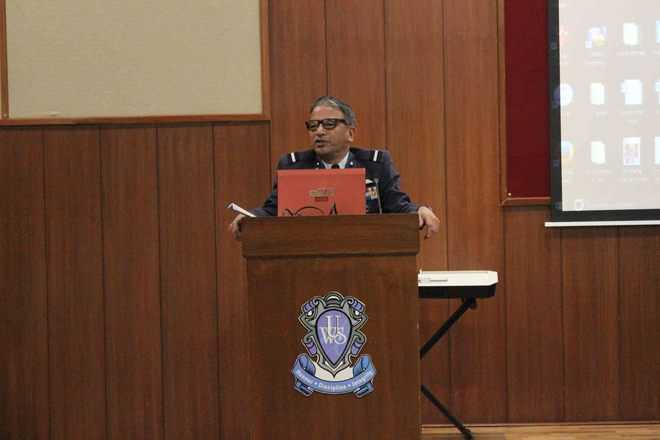
Air Commodore Nitin Sathe, Chairman of Air Force Selection Board, Dehradun, delivers a lecture on disaster mangement at Uniosn World School in Dehradun on Tuesday.

Tribune News service

Dehradun, November 16

Air Commodore Nitin Sathe conducted a session on disaster management for students of class X to XII of Unison World School on Tuesday evening.His session revolved around one of his two published books and an enthralling incident of his life— disaster management after Tsunami 2004— that he experienced at Bande Aceh, near Andaman and Nicobar Islands.Sathe described the initial signs, destruction and aftermath of the Tsunami that struck the coasts of Indonesia on December 24, 2004. Apart from this, he informed the students about the actions that were taken to revive life on the island and the resurrections over two years. Small and impressive lessons were propagated all throughout his speech, leaving a few eyes welled up with tears and a few minds thoughtful about the unfortunates in life. Towards the end of his lecture, Sathe spoke about ‘Predict, Prevent and Prepare-the three Ps of Disaster management’.Air Commodore Sathe is an alumnus of the National Defense Academy, Khadakwasla, and is at present the president of the Air Force Selection Board, Dehradun.


IWT: Another Indo-Pak showdown in the offing?

NEW DELHI: India and Pakistan are possibly headed for another showdown on water after New Delhi said on Thursday it wouldn’t be party to a court of arbitration process on Kishenganga and Ratle hydroelectric projects, a demand by Islamabad that has been accepted by the World Bank.

The World Bank had brokered the Indus Waters Treaty (IWT) in 1960 and has a specific role in the resolution of differences. Kishanganga is a tributary of river Jhelum and the 330 MW project is coming up in Bandipora in J&K. The 850 MW Ratle project is on the Chenab in Doda district.

In a communication to the World Bank on Thursday, India said the stand taken by it to start two parallel process simultaneously—initiating the court of arbitration (COA) process as demanded by Pakistan and setting up neutral expert as demanded by India—was not “legally tenable” under IWT. “Our stand is very clear. We have asked World Bank to stop the process. What happens if the COA and neutral expert give contradictory judgment? Under the IWT, the judgment of the neutral expert can’t be revoked by the COA,” said a senior government official.

However, not heeding to India’s request, World Bank on Friday held a draw of lots in its headquarters in Washington to determine who will appoint three umpires to sit on the COA. The COA has seven members, two arbitrators each to be appointed by India and Pakistan, and three ‘umpires’ nominated by certain global dignitaries. If parties can’t agree on who will nominate the ‘umpires’, a draw of lots decides which three of the global dignitaries will nominate one ‘umpire’ each.

But the World Bank asked both countries to “agree to mediation” to resolve issues regarding the two projects. “What is clear, though, is that pursuing two concurrent processes under the treaty could make it unworkable over time and we therefore urge both parties to agree to mediation that the World Bank Group can help arrange. The two countries can also agree to suspend the two processes during the mediation process or at any time until the processes are concluded,” senior vice-president and World Bank group general counsel, Anne-Marie Leroy, told PTI.

On Thursday, external affairs ministry spokesperson Vikas Swarup said the government will examine options. India’s grouse is that the World Bank hasn’t followed the procedures in the treaty. India says Pakistan’s objections are technical and the bilateral Permanent Indus Commission (PIC) can address them. If PIC can’t resolve the matter, it is termed ‘difference’ and is addressed by neutral experts appointed on request by either party to World Bank.


Listen to voiceless by ……..Lt Gen (retd) Baljit Singh

Listen to voiceless
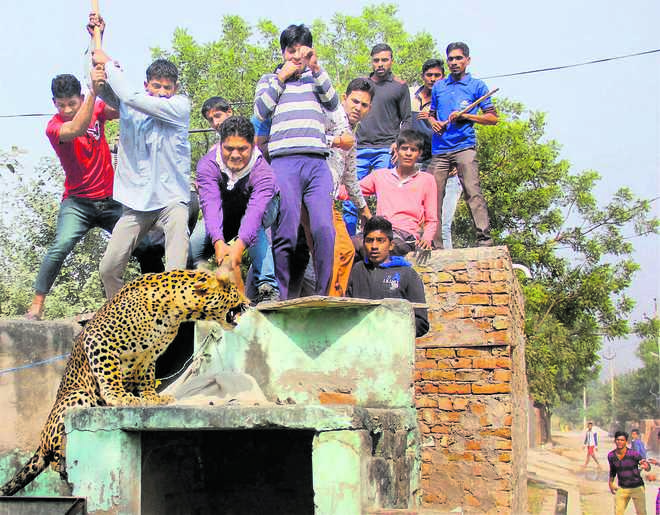
Villagers beat to death a leopard that ran amok in Mandawar village, near Gurgaon.

THE image of a leopard beleaguered by lathi-wielding assailants in Gurgaon district published in newspapers captured my attention instantly. I wondered whether the idea was (a) to bring to the fore the consequences of the ongoing, flawed strategies for “development,” which have expanded the human footprint all around and even through the heartland of animal habitats, (b) that wildlife refuges have in the process been fragmented into disjointed, meagre patches which hold inadequate prey-populations, in the instant case for the leopards’ survival, and (c) the inevitable transgression of predators into human habitation in search of food and resultant horrors of the avoidable man-animal, tragic conflict situations. Sadly, the inadequate related reportage is more likely to have demonised the leopard as a wanton killer because nine persons were injured. It unwittingly drummed up fear psychosis, furthering the prevalent antipathy towards our wildlife in general, beleaguered as it is. In almost all such conflict situations, my  mind always reaches out to wise but unheeded utterance of Mahatma Gandhi: “The worth of a civilisation is judged by the manner it treats its animals.” Even some 80 years later today, there is little evidence to suggest that we Indians have developed more empathy with the animal world.  The misconceived notion of a leopard surfeit in India and therefore frequent encounters in rural habitations and occasionally in urban India is patently borne out of ignorance.  Of the three larger surviving cats — namely the lion, the tiger and the leopard, the former two, fortunately, have reasonable habitat to support their current, diminished numbers. However, the leopard being reclusive had created niches for itself throughout the country in landscapes similar to the Aravalli range as in the instant case. The leopard alone is able to live and thrive almost anywhere except for the Thar Desert and beyond the tree-line in the Himalayas which is the exclusive domain of its more elusive sibling, the snow leopard.The leopard, as indeed the lion and the tiger, all had immigrated from the North, entering India from the two flanks of the Himalayas, ages ago.  And the leopard is believed to have preceded the other two cats, a theory supported by the fact that leopards had colonised up to the southern-most tip of our land, which ultimately got detached and became the island state of Sri Lanka, complete with leopards! The lion and the tiger evidently arrived in India after that geological event, which also explains their absence from that island nation.  Over time, while the lion got almost wiped out and the tiger too came under severe hunting pressures, the cunning leopard managed to fare better.   In the light of this historical backdrop it becomes easier to understand why today the leopard exceeds the lion population manifold and that of the tiger by a factor of perhaps 10. No matter how numerous the leopard may be but man has little to fear from them. Lieut Col AHE Mosse (1864-1929, the Indian Army), considered an authority on the leopard in India, had summed up his lifetime’s experience thus: “Generally speaking it may be laid down as an axiom that neither tiger nor panther will ever, unprovoked, attack mankind.  It is the Jungle Law, by virtue of the respect for and dread of man in which all the jungle creatures are brought up.”Lieut Col R G Burton (1868-1963), also of the Indian Army, who was a dedicated wildlife conservationist and is credited with the movement which resulted in the creation of the Indian Board for Wildlife in 1954, had opined that: “Leopard are timid and retiring, and no doubt conceal themselves on the approach of a human being…….I have known of a man who was lying asleep in the open in daylight, wrapped up in a black blanket.  It (Leopard) perhaps mistook him for a goat but dropped him as soon as he (man) cried out…I have myself nearly trodden on a panther.  I was going down a hill covered with sparse jungle when I smelt the animal and looking down, saw it lying under a bush at my feet.  It rose and walked over the slope into denser thicket…” Nevertheless, just as today it would be suicidal for a man to walk across a six-lane express-way so it would be unwise to invite a leopard’s wrath either through wanton provocation or by interfering when he is closing upon his prey.  Now why did that leopard stray into rural habitation in Gurgaon district? Well, just as a North Indian is drawn hopelessly to the aroma of saag garnished with a dollop of fresh butter and topped with a makki roti or a South Indian by the idli and rasam, similarly a leopard cannot resist the dog (domesticated or stray, one among its gourmet delights), goats or bovines. As the feline preys mostly nocturnally and on occasional misty winter’s nights when the scent of prey does not arise above the ground surface, the predator keeps his nose to the ground in search of prey and in the process tends to lose direction and discretion. Once inside any human habitation, the combination of high-voltage light beams with the constant thrumming of  vehicular traffic noise, engulfs the strayed leopard in a sense of panic and he seeks out a secluded, dark spot to take shelter.In the instant case, the leopard had been prowling in the area of encounter for about two weeks and the State Forest Department was in the process of trapping or perhaps tranquilising it to prevent any fatalities. But then who can prevail when an irate, hysteria-seized crowd of some1500 decides to pulverise one hapless and voiceless creature, unmindful that extinction of a species is irreversible?  It is ironic that four days prior to the above incident we had another gut-churning image of a cow elephant who was on a pathway genetically imprinted in her system since eons and so fell into a newly dug pit. She fractured a rear leg and her infant calf snuggled by her trunk, putting his head consolingly, on her  inert body. But to no avail as she died and the calf may or may not survive the shock. It is time that we learn to live and let live in the true symbiotic spirit.  And never forget the sage advice offered by the Red Indian Chief Seattle, to President Franklin Pearse of the USA in the 1850s: “What is man without the beasts? Once the beasts are gone, man will surely die from a great loneliness of the spirit.”


Not the friends one should have

The rise of white nationalists is a boon for Islamic extremists. Both sides believe Muslims and non­Muslims cannot coexist

TRUMP BLAMES MEXICO AND CHINA FOR LOSS OF JOBS, BUT TOMORROW IT COULD BE INDIA. AND IF AMERICA PULLS BACK FROM GLOBAL TRADE AS TRUMP HAS PROMISED, INDIA WOULD ALSO SUFFER FROM THE SUBSEQUENT GLOBAL RECESSION

In a desire to embrace the enemy of their enemy, some Hindus have been making some very foolish alliances. Earlier this year, one of the biggest Hindu groups in Britain invited one of the most prominent white racists to speak at their annual conference. Obviously, I made a big stink about it. Why legitimise someone like that in the eyes of the community? Some British Hindus also started asking similar questions. The organisers eventually cancelled the event after the uproar. They weren’t happy with me.

reUTersAs neo­Nazi nationalist groups have grown in popularity across Europe and the US, some Hindu groups have started to see them as allies against Muslims

The invited speaker went by the alias of “Tommy Robinson” — founder of the English Defence League (EDL). The EDL wasn’t a debating society. They organised violent rallies, harassed non-white people and got drunk. Supporters made neo-Nazi signs, posted racist messages online and didn’t hide their hatred.

The National Council of Hindu Temples UK said they invited the EDL’s founder merely for a “respectful dialogue” with him but many, including me, suspected a different motive: They wanted him to talk about why UK Hindus should be afraid of Muslims.

In politics, people have always made odd alliances on the basis of mutual interest. But even by those standards something weird is happening. As neo-Nazi nationalist groups have grown in popularity across Europe and the United States, some Hindu groups have started to see them as allies against a common enemy: Muslims. Others think the election of nationalist leaders in the West, such as Donald Trump in the US, would be good for India.

Recently, Union home minister Rajnath Singh said Indians “should feel proud” of Trump because his victory mirrored that of Modi. The Hindu Sena, an extremist group from New Delhi, celebrated when he won, saying: “India will now have the support of the US in our efforts against terrorists.”

One was Trump’s biggest backers, donating tens of lakhs of dollars. On Twitter and Facebook there have been hundreds of jubilant Indians welcoming Trump for similar reasons.

In Britain, the EDL courted Hindus and Sikhs so its leader could pretend they weren’t racist. Though they largely failed, some were willing to ignore the EDL’s racism against a common enemy.

But allow me to be a bit blunt here: These people are out of their bloody minds.

Hindus and Sikhs who think an alliance with western white-nationalist groups will help us in any way are being delusional. It isn’t just wishful thinking, it is self-sabotage.

At a glance, the white neo-Nazi groups look like nationalists who take a strong stance against Islamic terrorists and too much immigration. I can see why some Indians would regard them as harmless.

But appearances can be deceptive. Over the last decade these neo-Nazis have worked hard to look more respectable, ditching the Hitler-salutes, shaved heads, pro-Nazi chants and violent marches. Now they wear sharp suits and choose their language very carefully. They’ve realised that nationalism sounds a lot more attractive than traditional neo-Nazism.

This “cleaning-up” act coincided with a western backlash against globalisation, immigration and liberal values after the financial crash of 2008. Most of their supporters are poorly educated, poorly paid and older voters who feel their country is changing too fast and they are losing out.

So here are three big reasons why any alliance with them will hurt Indians.

First, these nationalist groups are riding a wave of populist anger not just against Muslims but against all nonwhites in the West. Scratch the surface and you can see the evidence. Last week Trump supporters at a conference in Washington DC were caught on video doing Hitler-salutes, saying he would make whites powerful again. There have been similar incidents in Germany, France, the Netherlands, Italy, Switzerland, Hungary and Romania too.

With every victory, from Brexit to Trump’s election, there have been big jumps in the number of racist attacks. If they become more powerful, Indians in the West will be among the first to suffer.

Second, most of these movements are against globalisation, immigration and trade. Trump blames Mexico and China for loss of jobs, but tomorrow it could be India. And if America pulls back from global trade as Trump has promised, India would also suffer from the subsequent global recession. If Britain becomes poorer after Brexit, as is predicted, Indian jobs will also be lost.

Third, the rise of white nationalist groups is a boon for extremist Muslims, not a threat. The extremists on both sides believe Muslims and non-Muslims cannot coexist , so any conflict will just reinforce their point. Trump is the best thing that happened to Islamic State and al-Qaeda recruiters in years. They too are celebrating his election.

Let me put it simply. White nationalists only care about white power. They hate what the modern world has become, and Indians are a big part of how the world has been shaped. We are their natural enemies, not their potential friends. Sunny Hundal is a writer and lecturer on digital journalism based in London The views expressed are personal


Civil military liaison meet on veteran welfare held

PANCHKULA: The civil military liaison conference on welfare of veterans was held between Western Command headquarters and Himachal Pradesh government, on Wednesday.

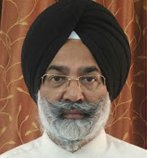
HT PHOTOHimachal Pradesh CM Virbhadra Singh and Lt Gen Surinder Singh during the civil military liasion conference at Chandimandir on Wednesday.

The meeting was co-chaired by Himachal Pradesh chief minister Virbhadra Singh and general officer commandingin-chief, Western Command, Lieutenant General Surinder Singh.

Sainik welfare minister, Colonel Dhani Ram Shandil, along with civilian officers of the state government and senior military officers from Western Command graced the conference.

The army commander in his opening remarks highlighted the initiatives taken by the armed forces towards the welfare of veterans and towards civil military joint functioning in the field of security and disaster relief.

The CM addressed the gathering and assured support for welfare of ex-servicemen and serving personnel.

CENTRAL ARMY COMMANDER VISIT ENDS General officer commandingin-chief, Central Command, Lt Gen Balwant Singh Negi, was on a three-day visit to Chandimandir military station.

He interacted with his counterpart from Western Command, and discussed strategic cooperation, effective utilisation of strategic forces and higher military planning.

Lt Gen Negi also visited the specialist engineer bridge regiment of the Surya Sappers and witnessed operational training to include specialist bridging and rafting operations for rapid induction of mechanised formations. He also stressed on maintaining the highest levels of operational readiness and commended the Sappers for their specialist skills and high levels of training.