Sanjha Morcha

Parrikar sends disability pension issue to anomalies committee

Parrikar sends disability pension issue to anomalies committee

Ajay Banerjee

Tribune News Sevice

New Delhi, October 13

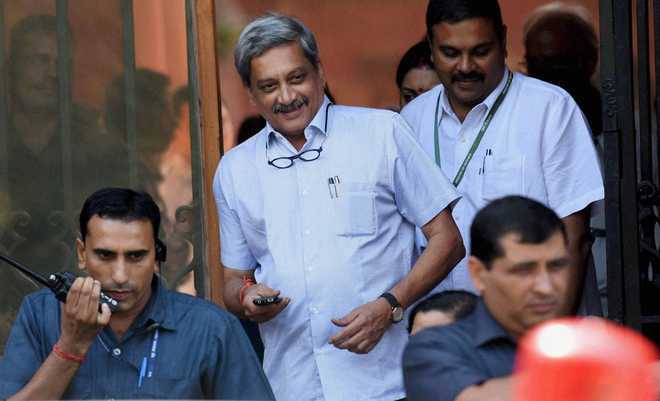
Defence Minister Manohar Parrikar on Thursday put a lid on the raging controversy of military personnel getting lower disability pensions than civilians by referring the matter to an ‘anomaly committee’ of the 7th Central Pay Commission (CPC).Parrikar’s move means the controversial notification issued by the Ministry of Defence on September 30 — that resulted in lower disability pensions for non-battle injuries, has been kept in abeyance.A statement of the MoD said, “The representation of the Service Headquarters (official lingo for three armed forces) has been referred to the Anomaly Committee of 7th CPC for consideration.”The 7th CPC recommended a fixed slab-based system for determining the disability pension for Defence Forces, which was accepted by the government. A system that allowed a percentage of basic pay be paid for non-battle disabilities was followed in the 6th CPC. This was the case for Defence Forces as well as civilians.The armed forces have represented that the percentage based system should be continued for calculating disability pension for Defence Services as their civilian counterparts are getting the same benefit as was available under the 6th CPC.
Read more at http://www.tribuneindia.com/news/nation/parrikar-sends-disability-pension-issue-to-anomalies-committee/309013.html#Y7qKsJGiIsl4HzCJ.99


No power can stop Pak from supporting Kashmiris: Sharif

No power can stop Pak from supporting Kashmiris: Sharif

Islamabad, October 10

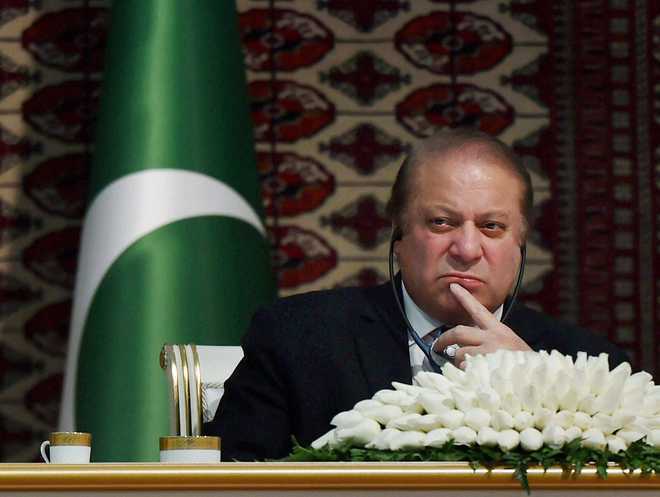
Pakistan Prime Minister Nawaz Sharif on Monday said no power in the world could stop Islamabad from supporting the struggle of Kashmiris.“India is mistaken if it considers that the freedom fight could be equated with terrorism,” Radio Pakistan quoted him as saying while chairing a central working committee meeting of the Pakistan Muslim League (N).He once again hailed slain terrorist Burhan Wani, who was the commander of Hizbul-Mujahideen terror group, as a freedom fighter and pride of Kashmiri people.

(Follow The Tribune on Facebook; and Twitter @thetribunechd)

Addressing the meeting, Sharif said those trying to paralyse the country through their negative politics would miserably fail in their designs.He said the government is striving hard to overcome all challenges, including terrorism and energy shortages, adding that the economy of the country had been strengthened as a result of effective policies. ANI


J&K Situation Dynamics: It’s Advantage India For Now

J&K Situation Dynamics: It’s Advantage
India For Now

Syed Ata Hasnain 
SNAPSHOT

Advantage India in the diplomatic domain, defeat of the deep state’s intent at the LoC and stabilisation of Kashmir’s streets will remain only a temporary achievement.

That advantage needs to be converted to victory in the domain which matters most, governance.

When events move fast in a hybrid conflict scenario, it is always good to do stock taking from time to time, especially after perceived situational success. The more important reason to do so is that we may delude ourselves in a celebratory environment and lose focus from the main task ahead. Before anything else it is important to remind everyone that the situation in Jammu and Kashmir (J&K) can never be viewed in a single dimension. It is always a sum of trends in diverse fields; military, political, human, social and economic; one could add a few more as peripherals.

Stating the bare bone truth, with regard to the strategic aims of India and Pakistan may be helpful in making a case for a change of focus by India in the current situation, if required. Pakistan’s aim is to bleed India through a series of actions with different levels of violence; create alienation in the state of J&K, particularly the Valley, and force the secession of the state through a combination of political, military and diplomatic measures. An essential element of the strategy is the control over escalation by keeping its multiple actions in diverse domains within a threshold of India’s ‘grudging tolerance’. India’s aim is to defeat the proxy war launched by Pakistan, overcome the alienation of the Kashmiri people and integrate or mainstream them with rest of India to deny Pakistan’s secessionist intent. India too is mindful of escalation and its own intent of pursuing high economic growth and betterment of its people in spite of provocations.

The centre of gravity revolves around the alienation of the people which is a common factor in both strategies. Pakistan wishes to promote alienation while India desires dilution of alienation and promotion of integration. Thus, the centre of gravity continues to be the Kashmiri people, in both cases.

India’s efforts at achieving integration are beset by some basic disadvantages. First is the fact that a new generation in Kashmir is yearning to take charge. It’s not a generation which has seen peace and tranquility in Kashmir. It has grown up used to the presence of the uniform and weapons; cases of parents perhaps humiliated, suffering the indignities of cordon and search operations and the rampant check point culture any one is subjected to in a conflict environment. Second, the compulsions of democratic politics, which strengthen the fabric of the rest of India have a near opposite effect on the population of a conflict zone. The real challenge of delivering the final blow to Pakistan’s aspirations by taking the next steps after conflict stabilisation in the military domain, through the socio-political route, has remained elusive. That is because of a lack of clarity. Whether it be the soft power route (including military soft power, which has a history of acceptance and credibility) or a flexible policy of weeding out anti-national elements and winning over the populace or even a more coercive route (for whatever it’s worth), the sheer lack of a strategy has disadvantaged India at different junctures. That has allowed Pakistan and its deep state to regain the initiative.

Pakistan seized the initiative once again in July 2016, in the wake of the killing of Burhan Wani, forcing serious turbulence in the streets for almost two and a half months. Fearing the flagging of the energy in the streets due to Indian peace efforts, a diluting stamina and economic problems of the people due to extended curfew, Pakistan chose to execute terror strikes against establishments of the India Army and police forces to convey messages of its full backing to the separatist elements. The Uri incident achieved for Pakistan success beyond expectations and gave it the opportunity to seek advantage in the diplomatic domain in the initial days after the incident.

However, India’s very focused military and diplomatic campaign surpassed the Pakistani campaign. While the campaign in the external dimension helped isolate Pakistan internationally and regionally, the trans-Line of Control (LoC) surgical strikes met the emotive needs of India’s domestic environment and after very long the projection of intent to execute retribution if pushed to the wall, now and hereafter. The combined effect of the surgical strikes, the countering of the terrorist action at Baramula and the elimination of seven terrorists in similar other operations have all contributed towards the Army regaining a temporarily lost self-esteem.

Clearly, it is advantage India at this moment. We have created apparent schisms within the Pakistan establishment, if current reports are true about the advisory given by the civilian government to the Pakistan Army. Pakistan stands deeply isolated. Even its staunchest friend China is having reported reservations of supporting Pakistan’s approach to terror; particularly the distinction between friendly and unfriendly terrorists, the support for Masood Azhar in the UN notwithstanding. However, hybrid conflict situations have a nasty way of springing surprises from domains from which focus has shifted. By continuing to focus on the LoC and directing its terror groups to launch sneak attempts more often Pakistan is clearly attempting to give the separatists the will and energy to continue the movement in the streets.

The Indian Army is now as robustly involved at the LoC, in the hinterland operations and in calming the streets in South Kashmir, as it ever was in the last 27 years. This is a negative for us and a positive for Pakistan. The Army’s move of two brigades into South Kashmir, the emerging return of confidence in the J&K Police, the arrest of some agitation leaders, opening of commercial establishments and the lifting of the apple crop from orchards and markets are a combination of trends which augur well for us.

The state government should also be finding itself far more confident after a very challenging period. It should look upon the situation as an opportunity to change the political and development narrative. That cannot happen if its attention remains rooted to the events at the LoC, other borders and in securing its institutions against renewed attempts at ‘fedayeen’ as was witnessed in 1999-2005. As soon as the situation permits the political community of Kashmir must endeavour to return to the people. The Army and the Police forces can enable this by creating locally secure conditions as and where required.

Perhaps since long the need for complete synergy between the state government and the Army has never been felt more than now. The chief minister’s confidence in the Unified Command will need to be progressively enhanced. She has hardly had the opportunity to discuss with the Unified Command issues other than those which plagued the immediate. Her father had achieved this to a great extent in 2002-05. There will be political compulsions, which are fully understandable, but through more interaction with the Army’s top officers there will be better understanding of the nature of conflict and a chance to debate the long-term strategy. The days of discussing winter and summer strategies are passé; long-term strategy should be the replacement.

The durbar will move in another three weeks, hopefully bringing a tumultuous period in Kashmir’s history to a close. The six-month hiatus when the seat of government will be at Jammu must be spent doing some important things. First, ensuring that Jammu receives its due attention. The Jammu populace and the BJP’s street have been remarkably quiet; that should never be taken for granted, and it must be compensated by paying due attention to the needs of the region. Two, winter offers an opportunity to bring comfort to the people if resources are planned and deployed in time. The Jammu-Srinagar road will close for two or three weeks bringing the annual misery in Kashmir in terms of shortages of everything. Let this be a year with a difference with special officers from concerned ministries of the state governments deputed and made accountable.

Advantage India in the diplomatic domain, defeat of the deep state’s intent at the LoC and stabilisation of Kashmir’s streets will remain only a temporary achievement. That advantage needs to be converted to victory in the domain which matters most, governance. Pakistan’s strategy of targeting peripherals to cause greater alienation and more enthusiasm in separatist ranks needs to be countered finally in the domain of governance and political outreach, both of which should be the joint effort of the central and state governments. Portends of that seem to be appearing; fingers remain crossed.

Uri,was designed by Pak to take the security focus away from the streets of Kashmir and motivate the youth to continue their agitation. India’s surgical strikes conveyed an adequate message of the will to respond in kind hereafter. However, none of this should take away our focus from the main task of ensuring Kashmir remains stable and on the path to normalcy. My analysis regarding this is in the latest piece in Swarajya.


 

Lt Gen Sharma takes command of 16 Corps

Lt Gen Sharma takes command of 16 Corps
Lt Gen AK Sharma

Jammu, October 9

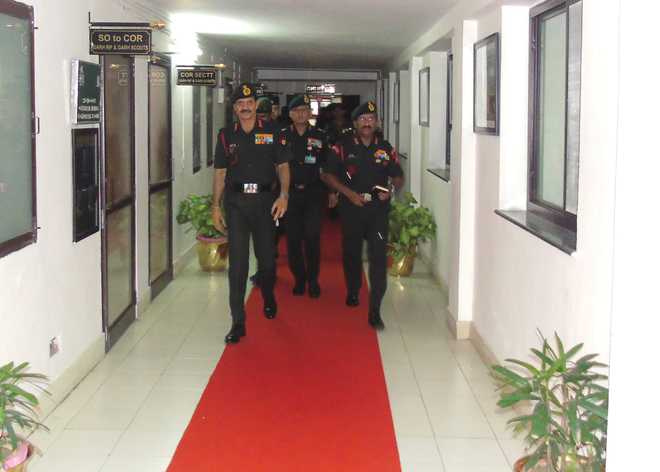
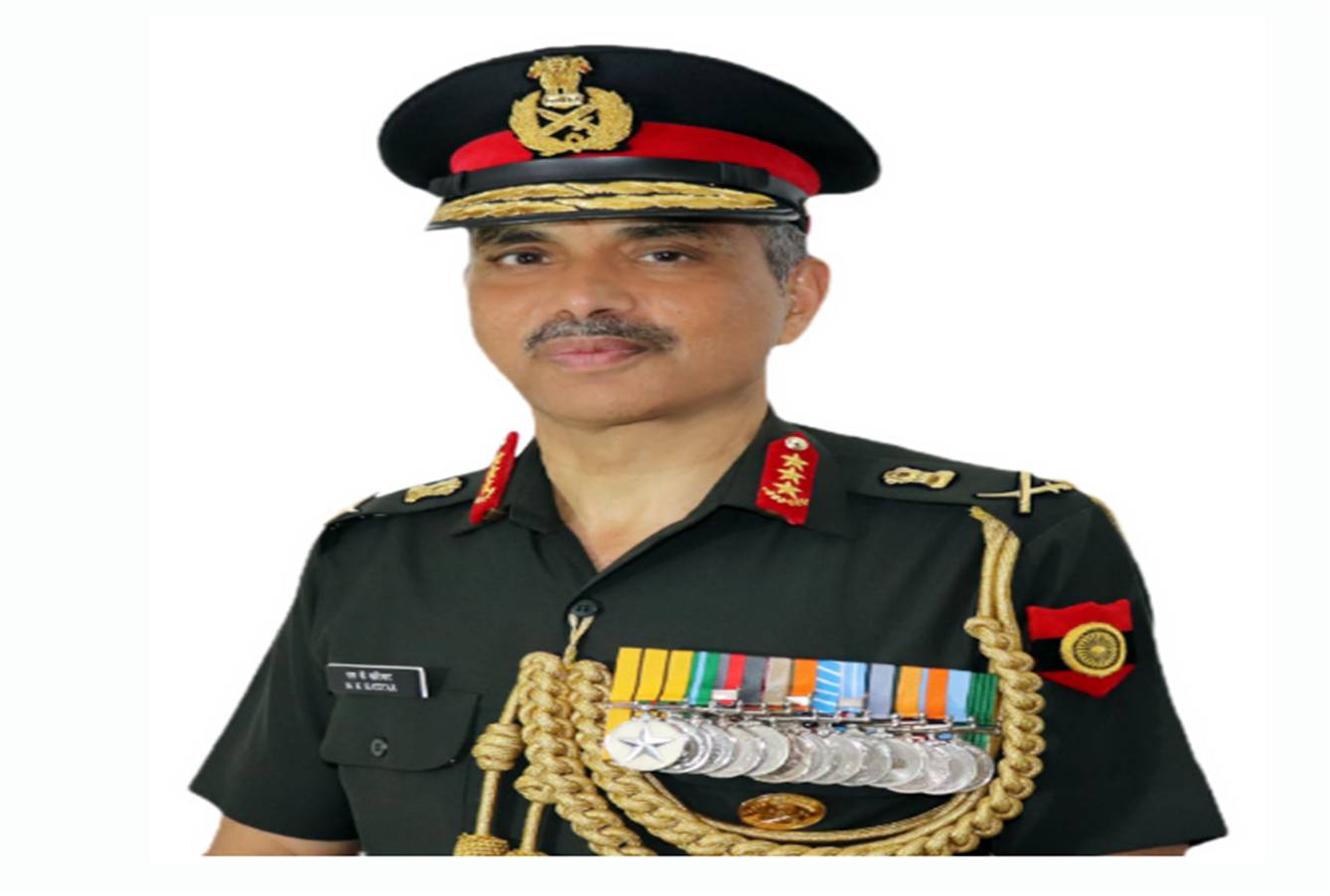
Lt Gen AK Sharma assumed command of the elite White Knight Corps (16 Corps) from Lt Gen RR Nimbhorkar, who is proceeding on posting after being in command for 14 months.In his farewell message, Lt General Nimbhorkar complimented all ranks of 16 Corps for their professionalism and dedication and thanked the civil administration for the excellent synergy with the armed forces.Lt General Sharma, was commissioned in 1980 into 2 Sikh Regiment, a unit which he later commanded on the Line of Control and during Operation Parakram. An alumnus of Defence Services Staff College, Wellington, Army War College and National Defence College, he has also attended Terrorism and Security Studies Course in Germany. He commanded the Mountain Brigade in the North-East, an Infantry Brigade Group in UN Mission in Congo and the Counter Insurgency Force in J&K.Lt General Sharma has been decorated with Yudh Seva Medal, Sena Medal and Chief of Army Staff (COAS) Commendation Card. On taking over, he exhorted all ranks of the 16 Corps to continue with the same zeal and enthusiasm and always be combat-ready. — TNS


Tributes paid to 1965 martyr in Rajouri

Tributes paid to 1965 martyr in Rajouri
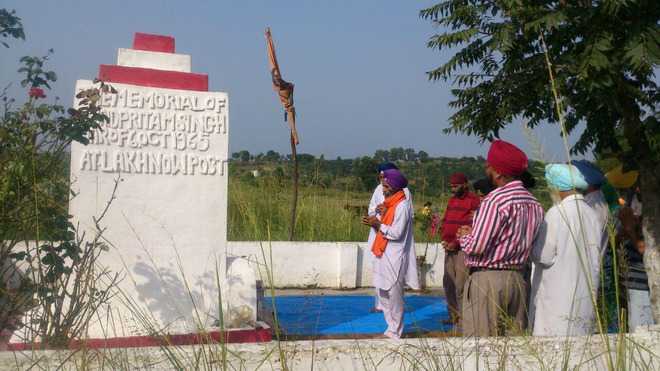
Family members and villagers hold prayers at a memorial to Pritam Singh at Rajowa in Nowshera. Tribune Photo

Shyam Sood

Rajouri, October 7

In 1964, Pritam Singh, a resident of Rajowa in Nowshera tehsil of Rajouri district, had got premature retirement from the Army.When the war with Pakistan broke out in 1965, Pritam and other ex-servicemen of the area were summoned by the Commandant of the local unit of the Army to cooperate with the unit and help it fight the intruders and Pakistani soldiers.Pritam Singh joined the B-company (as a volunteer) of the Kumaon Regiment which proceeded towards OP Top Hill on the night of October 5, 1965, which was captured by intruders led by the Pakistani army. On the morning of October 6, the final assault with artillery fire was launched on OP Top Hill and it was recaptured along with the Lukhnow post.“The Pakistan army had also resorted to artillery fire. Pritam Singh was hit by splinters and sacrificed his life for the integrity of the country,” said Isher Singh, Pritam’s younger brother.The task to recapture OP Top Hill and the Lukhnow post was given to the Commandant of the 14 Kumaon Regiment manning the area in 1965.Pritam Singh was martyred on October 6, 1965. A memorial was constructed later at Rajowa, where family members, Army and civil administration officials pay tributes to the martyr every year, said Pritam Singh’s family.On Thursday, family members with the help of Army and civil officers paid tribute to Pritam Singh at the memorial at Bajowa and remembered his services and sacrifice for the nation.“The then Commander of the Nowshera-based 80 Brigade, Brigadier UBS Verma, had issued a bravery certificate in favour of Pritam Singh and had also given Rs 1,000 to the family as financial help,” said Isher Singh.He said that on the golden jubilee celebrations of recapturing of OP Top Hill and the Lukhnow post, at Patials on October 6, 2015, the Kumaon Regiment had invited the family members of Pritam Singh.“During the golden jubilee celebrations, Maj Gen V Pandey had promised us to write to the Union Government either for a petrol station or an LPG gas agency in favour of family members. But nothing has been done in the matter so far,” said Isher Singh.Major Harvir Singh (retd), Sukhdev Singh, Dara Singh, Bhagwan Singh, Kamaljeet Singh, Zorawar Singh, social activists, were among the prominent people of the area who paid tributes to martyr Pritam Singh today.

Family awaits fulfilment of promise

  • In the 1965 war, Pritam Singh and other ex-servicemen of Rajowa were summoned by the Commandant of the local unit of the Army to help fight intruders and Pakistani soldiers. Pritam Singh was killed on October 6, 1965, after OP Top Hill and the Lukhnow post were recaptured
  • His brother Isher Singh said during the golden jubilee celebrations of post recapturing, the Army had promised them to write to the Union Government either for a petrol station or an LPG gas agency in favour of family members, but nothing had been done in the matter so far

One-armed wrestling F.S. Aijazuddin

Had the UNMOGIP been a human, it would have qualified for pension. The recent exchange of fire across the Line of Control roused this group from hibernation.

SURELY India does not need the blood of Pakistanis to cement its own unity? Yet it would appear that it still does.There could be no greater nor more tragic an indictment of India’s foreign policy than that even 69 years after Independence India’s 14th prime minister, Narendra Modi, should succumb to the temptation of whipping up anti-Pakistan hysteria to coagulate domestic support. The latest spat between these two one-armed wrestlers (their other hands are on the nuclear button) is another round in a tournament that — if common sense had prevailed — should have ended decades ago. One can think of no two countries since the end of World War II in 1945 that have maintained such a state of contest, such a war of words spewing from “the brazen throats of war”. Two generations on either side of the fractious border have seen 14 Indian Prime Ministers and 17 elected ones in Pakistan (not counting the interregnums of military opportunists). And yet, both neighbours today stand as far apart as they were on August 1947, when history created what geography deplored. During all this time, the only link between them that has endured has not been the Indus Waters Treaty of 1960, nor the Vajpayee peace initiatives following his bus yatra in 1999, nor the furtive back channels, but UNMOGIP, a cumbersome acronym for the United Nations Military Observer Group in India and Pakistan. Had that body, established in January 1949, been a human, it would have qualified for old-age pension. Instead, it sees itself as a benign, avuncular presence with (like some Pahari raja) a summer home in Srinagar and a winter one in the plains of Islamabad. Secondment to UNMOGIP must rank as one of the most comfortable sinecures in the UN. It is certainly the safest. Since its creation, UNMOGIP has suffered only 11 casualties — nine through accidents, two from illness. Its mandate is “to observe and report, investigate complaints of ceasefire violations and submit its finding to each party and to the secretary general”. Such oversight is not cheap. UNMOGIP’s budget for 2016-17 is $21 million. The recent exchange of fire across the Line of Control roused UNMOGIP from its hibernation. A spokesperson for UN Secretary General Ban Ki-moon disclosed that UNMOGIP, despite the Indian government’s claims of surgical strikes in Pakistan, “has not directly observed any firing across the LoC related to the latest incident”. That is intriguing. If surgical strikes did take place, then why could UNMOGIP find no trace of them? Or was it relying, like the Ruet-i-Hilal Committee searching the skies for the Eid moon, for “directly observed” evidence? A week ago, war seemed inevitable; today, it is receding into improbability. War, of course, can never be ruled out as an option, for as Georges Clemenceau observed and A.B. Vajpayee demonstrated, “it is easier to make war than peace.” Perhaps it is not accidental that the Prime Minister who received Vajpayee in 1999 was the man who is the current Prime Minister of Pakistan, Mian Nawaz Sharif. Even his detractors will concede that he has reacted to Modi’s provocations with mature restraint. He could have retaliated with equally bombastic rhetoric, but he chose not to. He has been Prime Minister thrice already. Unlike  Modi, he does not need to court re-election. He knows Pakistan’s nuclear capability. He was the man who authorised the first test at Chagai. Even naïve political pundits must have recognised the palpable difference between political attitudes in India and in Pakistan. In India, all the parties (particularly the Congress) sank their differences and pledged their support to the BJP government. In Pakistan, Imran Khan again reiterated his determination to sink Nawaz Sharif. Even at the multiparty meeting convened on October 3 by the Prime Minister in a call for national unity, Imran Khan sent Shah Mehmood Qureshi to field for the PTI. Qureshi’s declaration would have been more convincing had Khan not himself decamped for a quick holiday to Nathiagali, and certainly more plausible had Shireen Mazari (the PTI’s feisty spokesperson) not diluted Qureshi’s “faint praise” for Sharif with a damning modification. What does the future hold for India and Pakistan? One cannot speak for the Indians. It is clear they regard their Prime Minister as a Pandava — not Arjuna (who avoided unjust acts), or his elder brother Yudhishthira (steadfast even in war), but Bhima, the most aggressive of the five. One can, however, speak for Pakistan. The Indians must realise that we are not overripe for decimation. Balochistan is not East Pakistan. We are not a troupe of musicians and artistes who can be expelled on a whim. We are a sovereign nation of 200 million, capable of more than simple arm-wrestling.By arrangement with the Dawn.


Army Chief reviews operational readiness of South Western Command

Army Chief reviews operational readiness of South Western Command
Army Chief Dalbir Singh Suhag at South Western Command headquarters in Jaipur. ANI photo

Our Correspondent

Jaipur, October 5

Army Chief Gen Dalbir Singh Suhag on Wednesday visited Jaipur-based South Western Command headquarters to review its operational preparedness.Upon his arrival, the Army Chief was briefed in detail on the operational state of the Sapta Shakti Command (official name) by Lt Gen Sarath Chand, GOC-in-C, South Western Command.  General Suhag expressed his satisfaction at the state of operational readiness as well as measures undertaken by the Command to face evolving security challenges, especially along the western borders, a defense spokesman said.


Tension escalates, heavy LoC shelling, firing all day

Tension escalates, heavy LoC shelling, firing all day
A resident assesses the damage in Saujiyan sector of Poonch district on Tuesday. A car, 31 shops, two bikes and some houses were damaged after they caught fire due to shelling on Monday. Tribune Photo

Amir Karim Tantray

Tribune News Service

Jammu, October 4

The Line of Control (LoC) witnessed escalation in tension on Tuesday with the Pakistan army resorting to ceasefire violations in Pallanwala and Nowshera sectors of Jammu and Rajouri districts, respectively.Pakistan used 120 mm and 82 mm mortars and small arms at both places.Local sources said three persons were injured in the firing, but the district administration didn’t confirm it. “According to reports of the Chief Medical Officer, Jammu, and the police, no civilian has been injured,” Jammu Deputy Commissioner Simrandeep Singh said. At Pallanwala, the firing started around 2 pm and was continuing till the last report came in. Platan, Channi, Gigdyal, Damanu and Chapeyal villages were affected in the area. In Nowshera sector, firing started around 12.30 am and continued till 11 am. Villages between Kalsian and Makri were affected in this sector.PRO (Defence) Lt Col Manish Mehta said firing and shelling was continuing in Pallanwala sector and the Army was giving a befitting reply.Locals in Pallanwala sector said 200 to 300 mortars were fired from across the LoC, creating panic. “I am at the zero line and shelling is intensifying with every passing minute,” said Satish Sharma, son of former MP Madan Lal Sharma.Around 5 pm, Pakistan resorted to ceasefire violations in Nowshera and KG sectors using small arms and mortars. The firing stopped in KG sector at 8 pm, but it was intermittently on in Nowshera. 


1,500 turn up for Army recruitment rally

1,500 turn up for Army recruitment rally
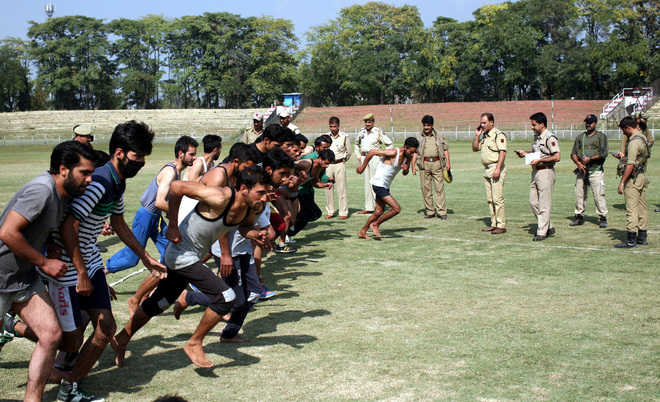
Kashmiri youths run during a police recruitment rally in Srinagar. tribune file Photo

Tribune News Service

Srinagar, October 3

At least 1,500 youths turned up for yet another recruitment drive in the Jammu and Kashmir Light Infantry Regimental Centre at Rangreth.A defence spokesman said the drive was held on October 1 and 2 at Rangreth for enrolment as soldier general duty, tradesmen, clerk and youths participated with full enthusiasm.“Individuals, who have cleared the physical screening, will now be put through a detailed medical examination and a Common Entrance Examination following which a merit will be drawn as per vacancies to shortlist the candidates who will join the centre for training,” he said.Another Army recruitment drive is also underway in Bandipora in north Kashmir since September 29. Earlier, a similar rally was held in Anantnag.

Army launches go-green campaign

Tribune News Service

Jammu, October 3

With a message to save the environment, the Army has initiated an afforestation drive with the theme of “Green India – Clean India”.The week-long event is being conducted by the Rashtriya Rifles Battalion at Kalal in coordination with the Department of Environment and Forests, local administration and local village committees at government schools in Mangiote, Seri and Deeing areas of Rajouri district.More than 600 students from schools and adjoining areas took a pledge to preserve the environment and maintain the flora and fauna in the region. The participants planted more than 1,600 ornamental and fruit bearing saplings to mark the event on the inaugural day. The concept of ownership of each sapling is being imbibed among students to ensure survivability of the saplings.Lectures on “Prevention of deforestation” and “Harmful effects of global warming and geological change in the sub-continent” were delivered by officials of the Forest Department on the occasion.

Militants had planned fidayeen attack

Attempt to sneak into Baramulla Army base camp foiled by alert BSF sentries

Militants had planned fidayeen attack
Army personnel during an encounter with militants in Baramulla on Sunday night. PTI

Majid Jahangir/

Ishfaq Tantry

Tribune News Service

Baramulla, October 3

Even as the combing operation was called off today in Baramulla, where two to four militants had attacked the battalion headquarters of the 46 Rashtriya Rifles late Sunday night, the recovery of a GPS (global positioning system) set and wire cutter at the site of the attack indicate the militants had come prepared for a fidayeen (suicide) attack. BSF constable Nitin, who was guarding the outer post, was killed while another border guard was critically wounded by the attackers before they fled from the spot. The slain constable belonged to Etawah in UP and had joined the BSF in October 2012.“It was a civilian area and the Army couldn’t retaliate effectively, apprehending civilian casualties in the dark. This resulted in the escape of the militants,” said Senior Superintendent of Police, Baramulla, Imtiyaz Hussain. “The militants were beaten back and they were not able to breach the perimeter of the camp.”After the firing stopped, the security forces recovered a GPS set, compass and AK magazines from the spot where attackers had attempted to sneak in. “These recoveries indicate that the militants were foreigners and had planned to sneak into the camp,” Hussain said.Vikash Chandra, IG, BSF, Kashmir, said the timely detection of the militants by the BSF guards thwarted their entry into the base. “If the militants had managed to cut the razor wire and sneaked inside the camp, there would have been heavy casualties,” Chandra said.On September 18, a group of four fidayeen had stormed an Army base in Uri close to the LoC which left 19 soldiers dead. This was the heaviest blow to the Army in a single militant attack since the insurgency erupted in the Valley.Initial investigations in the Baramulla attack suggest that the militants were not fresh infiltrators, but had been active in the area for some time. The attack on the Army base in Baramulla was the first terror attack after the Army conducted surgical strikes on militant launching pads in Pakistan-occupied Kashmir last week.The 46 RR Battalion is responsible for counter-insurgency operations in the garrison town of Baramulla and its headquarters are located on the banks of the Jhelum. The town surrounded by mountains on three sides reverberated with gunshots and huge blasts around 10.23 pm on Sunday evening as most of the residents were preparing to go to bed. On Monday morning, when the Baramulla town woke up there was panic due to the nearly two-hour firing in the dead of night. Shops were shut due to the unrest and few people were seen moving in the town.The Sunday attack was the second militant attack in the town during the current unrest.  On August 17, militants ambushed an Army convoy on the Baramulla-Srinagar highway, killing two Army men and a J&K policeman. In this attack too, the attackers managed to flee. GPS set, fence cutter recovered  A GPS set, wire cutter, and AK magazines were recovered from the spot where militants had attempted to sneak in the Baramulla Army camp. Militants snatch weapons in Kulgam Militants decamped with five weapons from a security picket after taking “hostage” two minority community members in Kulgam on Monday. They let off the two hostages only after the cops handed over their guns. P4 


PoK residents take to streets against atrocities by ISI, Pak Army

PoK residents take to streets against atrocities by ISI, Pak Army
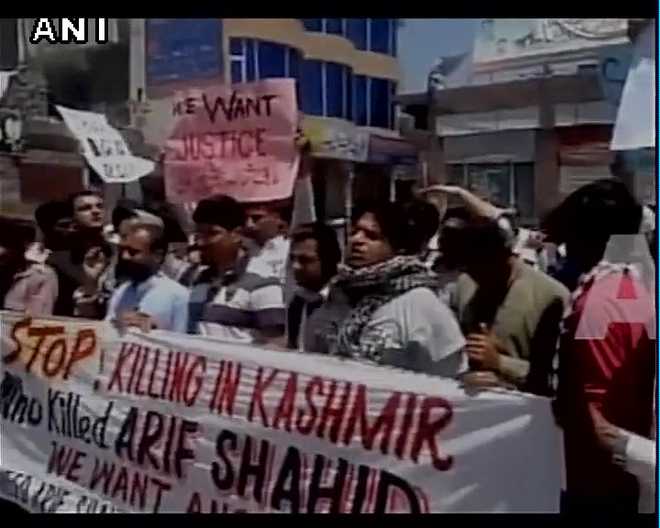
Protesters from PoK’s Kotli residents hold demonstrations against rights abuses by Pakistan’s ISI and Army. ANI photo

Muzaffarabad (PoK), October 2

Kotli residents in Pakistan-occupied Kashmir (PoK) recently took to the streets to protest against the atrocities committed by the Inter-Services Intelligence (ISI) and Pakistani Army.

The agitation was launched against extra-judicial killings, fake encounters and brutalities committed on pro-Azadi leaders, who disagree with the Pakistan State.

The angry mob raised slogans such as “Butcher of Kashmiris, Pakistan Army”, “Dogs are more loyal than ISI”.

(Follow The Tribune on Facebook; and Twitter @thetribunechd)

The protesters demand an independent investigation into the murder of Arif Shahid, a major Kashmiri nationalist leader, chairman of the All-Party National Alliance (APNA), and president of the Jammu Kashmir National Liberation Conference (JKNLC).

Shahid fought tooth and nail against Pakistan’s oppression in PoK before he was shot outside his residence in Rawalpindi on May 14, 2013. He was 62.

Investigation into Shahid’s murder is still inconclusive, and there is no closure in the cold-blooded murder, so far. The ISI is blamed for conspiring and executing Shahid’s murder.

According to an estimate by the Muzaffarabad-based All-Party National Alliance, more than 100 pro-freedom political activists have been killed by the ISI over the past two years.

There is growing resentment among PoK residents over the killings as well as the continued Army clampdown.

Earlier, PoK witnessed a series of protests by residents against rigged polls that saw Prime Minister Nawaz Sharif’s party, the Pakistan Muslim League (Nawaz), coming to power.

The United States’ State Department has recently also expressed concern over human rights violation in PoK, maintaining that it has always been urging parties in Pakistan to settle their differences “peaceably and through a valid political process”.

US States Department spokesperson Mark Toner said he could not agree with the view that nobody knew about human rights violations in PoK before Indian Prime Minister Narendra Modi highlighted that in recent times.

“Sure, Well, I would respectfully beg to differ. We do have concerns about the human rights situation there, have reported it for several years in our Human Rights Report, and we’ve obviously – are always urging all parties in Pakistan to work out their differences peaceably and through a valid political process. And with respect to Kashmir, our policy there is well known,” he said. — ANI