Sanjha Morcha

Pakistan wants de-escalation of tensions: Sartaj Aziz

Islamabad, October 10

Prime Minister Nawaz Sharif’s Adviser on Foreign Affairs, Sartaj Aziz, has said that Pakistan wants de-escalation of tensions with India for the collective good of the entire region.Radio Pakistan quoted Aziz as saying in an interview that no progress was visible in the Pakistan-Indian relations until Narendra Modi was in power in New Delhi. However, Pakistan did not desire escalation of the situation, he added.

(Follow The Tribune on Facebook; and Twitter @thetribunechd)

Pakistan would continue diplomatic efforts for improvement of ties with India, Aziz said.Asserting that Pakistan would never compromise on its principled stand on Kashmir, he said they would continue to extend political, moral and diplomatic support to the Kashmiris struggling to get their absolute right to self-determination.Speaking on Afghanistan, Aziz said Pakistan would continue its reconciliatory role for bringing peace in the neighboring country. ANI


Mend, not build, fences

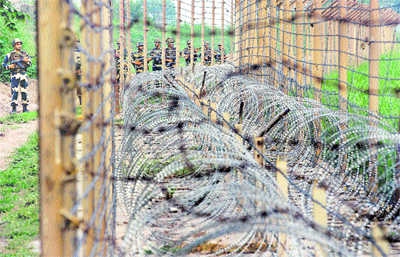
Sealing the entire 3,323-km border will be anything but easy

Mend, not build, fences
Walled in: Politically, this could be interpreted as an admission of defeat.

A NEW strategy toward Pakistan, it was supposed to be auguring — our strikes on the LoC 10 days ago. The doctrine of ‘jaw for tooth’ by a ‘New India’ was supposed to compel Pakistan to realise India has a ‘different leader’. But fundamental questions remain unasked.Is such a strategy viable against a nuclear country? So far, the only doctrine of military strategy and national security policy that has been taken seriously is based on the theory of deterrence, which Pakistan has embraced, which presumes that the use of nuclear weapons would cause the complete annihilation of both the attacker and the defender.The doctrine is based on a kind of ‘Nash equilibrium’ — India and Pakistan are both assumed to know the equilibrium strategies of each other, and neither has anything to gain by changing one’s strategy unilaterally. The Indian policy makers are acutely conscious of this stunning reality. Ten days after the surgical strikes — military analysts increasingly feel comfortable calling it ‘surgical raids’ — it is clear that the government does not have any new strategy toward Pakistan. Home Minister Rajnath Singh announced on Friday that the new strategy means fencing the entire India-Pakistan border. The fellow travellers of the establishment in our strategic community can stand down.Rajnath Singh was very clear-headed. He even christened the strategy as the Border Security Grid. The entire 3,323-km border will be ‘completely sealed’ by December 2018 — six months ahead of the next parliamentary poll due in 2019. A time-bound action plan will be prepared. The progress of the work will be properly monitored on a monthly basis to avoid shoddy performance.Of course, some confusion still remains, which is understandable, given the mammoth challenge of implementation. For example, what about the stretches of riverine or low-lying marshy areas in Gujarat where erection of physical barriers is not feasible? Digital India could, perhaps, deploy ‘technology solutions’ such as cameras, sensors, radars, lasers, etc. Conceivably, Israel could be sub-contracted so that there won’t be any breakdown in technology.Even at the peak of insurgency in the 1990s, we never thought of such an impractical idea. Politically, this is an admission of total defeat. The government obviously seems to resign itself to the conclusion that Pakistan will continue to wage the asymmetric war, and doesn’t care two hoots as to who is at the helm of affairs in India and no matter India’s formidable national security czarism. Not only that, we seem to apprehend that Pakistan will now expand the asymmetric war from the Kashmir theatre and wage it in the marshes of Gujarat and the deserts of Rajasthan as well, in a deliberate thrust at the heartland of the BJP. The International Border (IB) has been traditionally peaceful, except in times of war.However, Rajnath Singh did not seem to be aware that India and Pakistan’s conduct on the IB is guided by the mutually agreed Border Ground Rules (1960-1961), which, although not signed, has been largely observed. This is a matrix of the code of conduct, which specifies the kind of structures that can be built along the IB — how tall the watchtowers could be, how deep inside they should be from the border, and so on. Evidently, the government is either ignorant of the Border Ground Rules or abandoning the framework altogether. There will be consequences. The point is, in the downstream of the Border Ground Rules a welter of confidence-building measures also was created, which has its practical uses.What is possible is that the government can fill in the gaps in the IB fence that runs through the states. In Rajasthan, the fence in Thar Desert gets impaired by shifting sand dunes. Chief Minister Vasundhara Raje’s idea of erecting a spiritual line of defence, Rashtra raksha yagna —employing 21 ‘patriotic Brahmins’ to chant mantras ‘to protect troops from the enemy’ — will not work. Giving such religious symbolism to utterly worldly things can only confuse people that the government is utterly helpless and has no alternative but to seek divine blessings to ward off the evil that is Pakistan. (It is appropriate that Rajnath Singh failed to show up at the ceremony at Shri Mateshwari Tanot Rai temple in Jaisalmer.)The big question remains: Can Pakistan be reduced to a law and order problem? There is an international dimension to India-Pakistan relations. And that dimension causes serious worry. Despite the brouhaha over cancellation of the SAARC summit in Islamabad following the PM’s decision to boycott it, Pakistan is far from “isolated”. The period since Uri attack testifies to the reality that none of the big powers — the US, China, Russia or the EU — will pay heed to the Indian demarche to ‘isolate’ Pakistan or impose sanctions on it as a state sponsoring terrorism.It will be a reality check to acquaint ourselves with the ‘strategic dialogue’ that Pakistan last week held with the EU. The joint statement issued after the meet in Brussels on October 4 agreed to develop a medium-term Strategic Engagement Plan between the sides. The Joint Communique stated: ‘The EU acknowledged the significant efforts by the government of Pakistan and the sacrifices made in the fight against terrorism and reaffirmed EU’s continued support… They also agreed to strengthen dialogue on defence matters… The Pakistan side apprised the EU about recent developments in the region, including the current situation in Kashmir. Noting with concern the recent developments, the EU side underlined the need for resolving disputes through dialogue and constructive engagement.’The birds are coming to roost. The government’s self-centred attempts to turn the country’s foreign policies into an exercise of self-glorification for the Prime Minister are back-firing. We stare at a two-year chronicle of wasted time in Indian diplomacy. On Thursday, the US state department spokesman John Kirby added to the usual mantra about the crucial importance of India-Pakistan engagement a pointed reminder that terrorism is ‘a common threat, a common challenge in the region’ and a cooperative approach is needed in tackling it effectively.Referring to the Kashmir issue, Kirby underscored the importance of ‘meaningful dialogue’. The writing on the wall is unambiguous. The international community is getting restive as regards our strikes and it intends to have a say on how two nuclear powers should sort out their problems, because they also happen to be vitiating international security as a whole.Fencing is not the solution. It may supplement the ‘muscular’ grandstanding by the Modi government. But it is about time the country gets real. Life is real.The writer is a former ambassador


India can’t unilaterally revoke Indus Treaty: Pak

Simran Sodhi

Tribune News Service

New Delhi, October 7

Pakistan today hit back at India saying it cannot unilaterally revoke the Indus Waters Treaty (IWT). The reaction follows India’s recent change of stand with regards to the historic water-sharing treaty between the two nations. After a meeting chaired by Prime Minister Narendra Modi reviewed the treaty and took the decision that India, while staying within the legal limits of the treaty, would squeeze Pakistan more, the tensions over a growing “water war” have grown.In Islamabad, Pakistan foreign office spokesperson Nafees Zakaria said, “The IWT is not time-barred and was never intended to be time or event-specific. It is binding on both India and Pakistan and has no exit provision.”He went on to add that according the sub-provisions (3) and (4) of the Article XII of the IWT, it cannot be altered or revoked unilaterally. “The international community should take notice of Indian claims that are indeed a violation of India’s obligations and commitments under the treaty,” he said.Since the Uri attack of September 18, the India-Pakistan tensions have only increased with the passage of time. This is the first time that India is using the threat of tweaking the IWT to bring pressure on Pakistan to act against terrorism that targets India time and again. The treaty was signed in 1960 and has stood the test of time, so far.At the review meeting, Modi reportedly said “blood and water can’t flow together”. In another significant development, Pakistan told the US that the “road to peace” in Kabul ran through Kashmir. This is the first time Pakistan has clubbed Afghanistan and Kashmir together.

Indus Waters Treaty: Nehru’s Original Himalayan Blunder

Indus Waters Treaty: Nehru’s Original Himalayan Blunder

SNAPSHOT

How did India come to sign the Indus Waters Treaty when it was disproportionately in favour of Pakistan? Read here:

“No armies with bombs and shellfire could devastate a land so thoroughly as Pakistan could be devastated by the simple expedient of India’s permanently shutting off the source of waters that keep the fields and people of Pakistan green.” – David Lilienthal, former chief of the Tennessee Valley Authority, US

The ‘Aqua Bomb’ is truly India’s most powerful weapon against Pakistan. As the upper riparian state, India can control the flow of the seven rivers that flow into the Indus Basin. And yet, in the last 69 years, only once has it exercised this great power – and not very well.

On 1 April, 1948, with India and Pakistan battling for control of Jammu & Kashmir, engineers in Indian Punjab shut off water supplies from the Ferozepur headworks to the Depalpur Canal and Lahore. Around 8 per cent of the cultivable command area in Pakistan was impacted during the critical kharif sowing season. The city of Lahore was deprived of the main sources of municipal water, and the supply of electricity from the Mandi hydroelectric scheme was also cut off. Water rationing was introduced in Pakistan’s second largest city.

When India had its foot on Pakistan’s parched throat, when a little more pressure would have forced Islamabad to behave, and when Indian soldiers were fighting – and dying – to liberate Indian territory, Prime Minister Jawaharlal Nehru committed his first Himalayan blunder by relaxing India’s chokehold on Pakistan.

Later, it was to be under his leadership that India inked the Indus Water Treaty (IWT), giving away 82 per cent of the total water to Pakistan. Niranjan D. Gulhati, India’s chief negotiator, exemplified India’s muddled thinking: “We had to keep in view the interests of the other side: they must live; we must live. They must have water; we must have water.”

In his book Indus Waters Treaty: An Exercise in International Media, Gulhati narrates Nehru’s reaction to the stoppage of the waters: “Officially, the provincial government had acted without the federal government’s prior approval, and were to elicit little sympathy from some sections of the Indian central government. In fact, Nehru is thought to have castigated the East Punjab government and their engineers, in September 1949, for having taken matters into their own hands.”

Engineers in Indian Punjab had a valid reason for stopping the water to Pakistani Punjab. While the borders of India and Pakistan were demarcated haphazardly by British officials panicking in the backdrop of mutinies by India’s defence forces, the distribution of water resources was not discussed at all. Therefore, as a stopgap measure, India and Pakistan signed the Standstill Agreement on December 20, 1947, which maintained the status quo till March 31, 1948.

In the absence of any formal agreement, according to the engineers, had East Punjab had not closed the water temporarily, it might have led to West Punjab acquiring legal rights to the canal waters in that area. In effect, East Punjab was concerned about allowing a precedent to arise that would prove detrimental to it at a later stage.

On 24 April, 1948 Pakistani Prime Minister Liaquat Ali Khan asked for the “immediate restoration of the water supply”. Nehru replied on 30 April that he had instructed East Punjab to restore supplies to Lahore and Dipalpur. He also agreed to the Pakistani proposal for a conference to settle the dispute.

Delhi Agreement: Pakistan wriggles out

With Lahore screaming for water, Pakistan signed the May 1948 Delhi Agreement, which restored the water supply – but at a cost. Firstly, Pakistan was to pay for the transport of water through India. Secondly, India was to be allowed gradually to diminish this supply to Pakistan. India’s contention was that colonial rulers had built the irrigation system in West Punjab but neglected East Punjab completely. Such a state of neglect could not continue after independence, and therefore it would need to draw some water that flowed into West Punjab.

The ink had barely dried on the Delhi Agreement when Pakistan started to dig a channel from the River Sutlej in order to circumvent the Ferozepur headworks. It justified its decision to dig as a precautionary measure against India closing down the water supply in the future. India warned that it would take retaliatory action, and dig a channel further upstream of Pakistan’s channel.

Pakistan said the Delhi Agreement had been signed under duress, and gave notice of its expiry, in a note to the Indian government on 23 August, 1950. With both countries embarking upon competing – and conflicting – river diversion projects, Nehru wrote to Liaquat Ali Khan, proposing a joint declaration that their countries would not go to war over any dispute between them.

And typical of how Nehru had always acted – and would do so over and over again to the detriment of India’s interests – he proposed that both countries would seek peaceful means to resolve their differences, including third party intervention in the form of mediation, agencies especially set up to resolve the matter, or an international body recognised by both countries. This was like free money for Pakistan – Liaquat Ali Khan agreed.

Enter the World Bank

While India favoured a water sharing tribunal with an equal number of experts from each side, Pakistan kept demanding foreign mediation, preferably the International Court of Justice. It was even prepared to take the dispute before the UN Security Council. However, it was the World Bank – in reality an American bank – that waded into the dispute.

While Pakistan was happy with the outcome, there were many in India who doubted the World Bank’s intentions. One of these sceptics was President Rajendra Prasad. However, Prasad was softened up by Nehru’s nephew B.K. Nehru who was the Indian Executive Director of the World Bank. In early 1952, he allayed the President’s fears of falling into a debt trap by telling him that “international debts were never meant to be repaid”.

The World Bank also hinted that funding for the Bhakra-Nangal project, which was to usher in India’s Green Revolution, depended on the successful settlement of river disputes. A country on the brink of war would hardly be regarded by the World Bank’s bond investors to be a good investment opportunity, the bank’s representative pointed out.

The pressure worked. India agreed to World Bank mediation, surrendering all its advantages as the upper riparian state. Incredibly, Nehru refused to link the Indus river dispute to the settlement of the Kashmir issue. In a letter to the World Bank, the Prime Minister made it clear: “The canal waters dispute between India and Pakistan has nothing to do with the Kashmir issue; it started with and has been confined to the irrigation systems of East and West Punjab.”

The Pakistanis couldn’t believe their luck. Liaquat Ali concurred with this opinion, stating that the parties should “refrain from using the negotiations in one dispute to delay progress in solving any other”. How convenient.

Generous to a fault

After nearly three years of negotiations, in 1953 India and Pakistan presented their respective proposals. Again, typical of Nehru’s misplaced magnanimity, India was more generous than Pakistan was towards India. India was willing to give Pakistan 76 per cent of all the waters of the three eastern rivers, whereas Pakistan was allocating a meagre 13 per cent to India. Even the Indian claim to 7 per cent of the western rivers was drawn from the River Chenab flowing through Indian controlled Jammu and Kashmir.

Keeping in view how much each side was willing to yield, and sensing Nehru’s soft side, the World Bank Plan allocated 82 per cent to Pakistan and a mere 18 per cent to India. Nehru gave the thumbs up to the plan.

The Indian negotiators believed there was enough water within the entire Indus Basin to meet India’s requirements. Nehru stated: “We are convinced that there is more than enough water in the Indus Basin to satisfy the needs of both India and Pakistan, provided it is properly exploited.”

China on his mind

There was another critical factor that contributed to the undue haste with which Nehru gifted the Indus Basin to Pakistan. In the early 1950s, China had began its incursions, first into Tibet, and then into the Indian border regions themselves. For years, Nehru had dismissed the Chinese threat, sidelining and even rebuking loyal army officers who pointed out the fallacy of his China policy. He had even declined a permanent seat in the Security Council, saying that it belonged to Beijing. With Chinese troops making provocative incursions across the McMahon Line, Nehru realised he now had more than the Pakistani boundary to defend. He believed he could buy peace with water.

Pakistan’s mindset

The treaty provides a peek into the Pakistani way of thinking. For Pakistan, anything that involves India is the unfinished business of Partition, which was essentially the Islamist vision to establish a beachhead from where it could launch jihad or “holy war” on India. Islamabad’s constant cribbing is in keeping with that mindset. From Pakistan’s perspective allocation of “only” 82 per cent of water as against 90 per cent of irrigated land violated the principle of “appreciable harm”, writes Moin Ansari in the book India’s Aqua Bomb.

Western involvement

For many Indians it’s a mystery why the West rushes to Pakistan’s defence every time it gets into trouble. Well, it’s not such a mystery. Pakistan was midwifed by Britain and the United States as a bulwark against Russia. There was no way they would have allowed it to fail.

In all its wars against India, Pakistan was rescued by its patrons in the West before it was destroyed as an entity by India. The IWT was backed by the governments of Australia, Canada, New Zealand, the UK, the US, West Germany and the World Bank itself. It is clear the Anglo nations did not want their future satellite to fail or be absorbed by India.

Pakistan is today the Ivy League of terror but the West isn’t ditching its baby yet. The Anglo countries continue to describe the IWT as the “treaty that has survived four wars”. These are the same words the leftist media and Lutyens crowd use, urging India not to abrogate the treaty.

The IWT should have been abrogated in 1965 when Pakistan launched a war in Kashmir. But many liberal Indians continue to believe India is Pakistan’s older brother and reckon that being generous towards Pakistan will buy peace. Well, that theory has been proved wrong hundreds of times – most lately in Uri – by Pakistan. At any rate, after Uri, the treaty is past its use by date.

If India walks out of the treaty, Pakistan is in big trouble. Even with the plentiful waters of the Indus Basin, it remains a semi-arid country where drought has parched many parts. Its water table is falling rapidly. Pakistani Punjab, which has the largest canal density in the world, is getting waterlogged. Its vast reservoirs – that were built to offset the loss of the three eastern rivers to India – are silting up. India, which never quite stopped building dams and hydro-power projects in Kashmir in keeping with the spirit and letter of the IWT, is ideally placed to divert water to its own parched cities.

The impact of the Aqua Bomb will indeed be greater than being imagined now. India should use it wisely to make Pakistan wind up its terror industry and give up its anti-India policy.


ASEAN should cooperate to destroy terror networks: Parrikar

ASEAN should cooperate to destroy terror networks: Parrikar
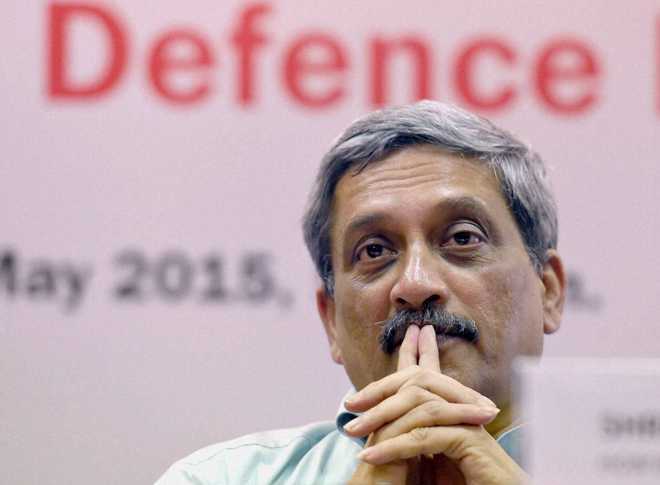
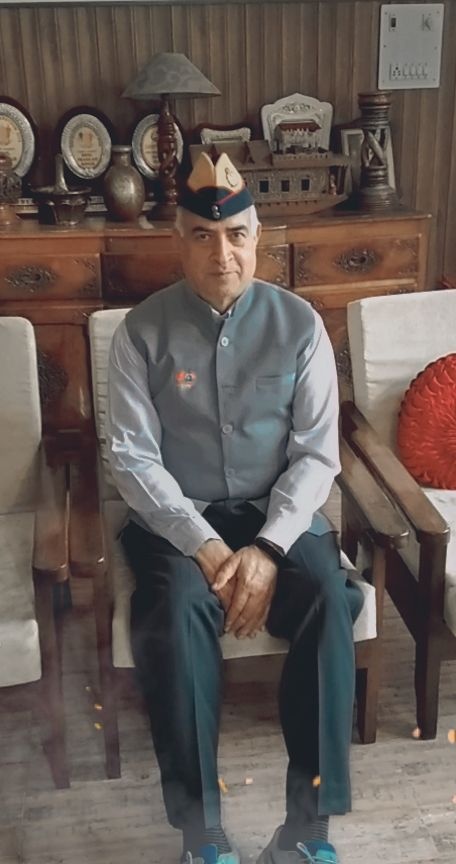
Defence Minister Manohar Parrikar.

New Delhi, October 6

Terming terrorism as the foremost challenge in the region, Defence Minister Manohar Parrikar on Thursday said it should be delegitimised as a state policy and urged ASEAN countries to “cooperate unreservedly” to locate and destroy terror networks.

Security frameworks in ASEAN region still do not give enough attention to terrorism. This must change, he said at 20th ASEAN Regional Forum Heads of Defence Universities Meet here.

(Follow The Tribune on Facebook; and Twitter @thetribunechd)

“Terrorism remains the foremost challenge to our region.

“We need to oppose terrorism resolutely everywhere, delegitimise it as an instrument of State policy and cooperate unreservedly to locate and destroy terrorist networks,” he said

The Association of Southeast Asian Nations (ASEAN) has the Philippines, Singapore, Thailand, Brunei, Cambodia, Indonesia, Laos, Malaysia, Myanmar and Vietnam as members.

Parrikar’s remarks came on a day when terrorists launched another attack on an army camp in Jammu and Kashmir. Three terrorists, believed to be Pakistan backed, were killed in the attack on the army camp north Kashmir’s Kupwara district.

19 soliders were killed in a militant attack on an army camp in Uri on September 18. The Army had launched surgical strikes targeting terror camps located across the LoC on September 28 night. —PTI


Discussions on surgical strikes will be insult to Army, says Naidu

Discussions on surgical strikes will be insult to Army, says Naidu
Says no need to respond to irresponsible comments

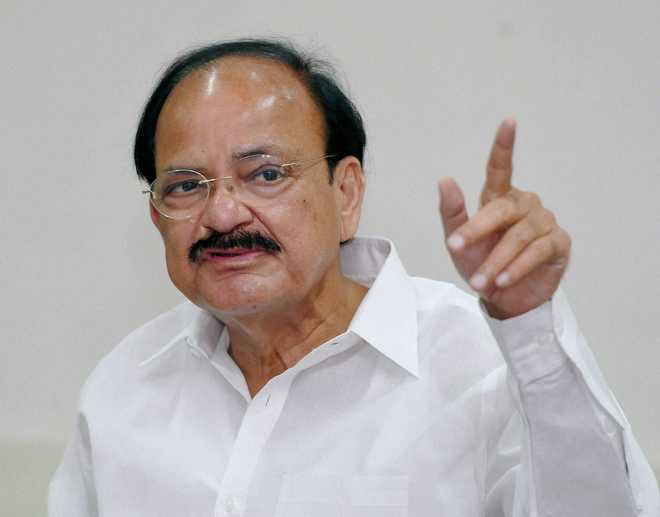
New Delhi, October 5Hitting out at those “seeking proof” of the surgical strikes in PoK, Union Minister M Venkaiah Naidu on Wednesday said further discussions on the operations would be an “insult” to the “commendable” task carried out by the Army.“There is no need to respond to such irresponsible comments and demands. Fortunately, the Congress has also realised its mistake and distanced itself from the comments of its leaders. The AAP has also made it very clear,” he told reporters on the sidelines of an event here.He said nobody had any doubt about the “credentials and commitment” of the Army which had done a “commendable” job and further discussions on the operations would be an “insult” to the force.

(Follow The Tribune on Facebook; and Twitter @thetribunechd)

“I don’t think any Indian citizen has got any doubt. Nobody doubts the credentials and commitment of the Army. It did a commendable job. It would be an insult to the Army if we further discuss it,” he said.Naidu said the Director General Military Operations himself had given the statement about the operations in full details and also shared the information at an all-party meeting.He wondered if giving further details would be in the interest of the nation.Observing that the entire country is happy about the surgical strikes, he said the world had also acknowledged the step. “Only Pakistan is saying something because they have to say something. They are not in a position to conduct funeral or last rites of their own citizens,” he said.Earlier, addressing the event, the minister said India did not want war with anybody, but would give a befitting reply if continuously provoked.“We never want a war with anybody. If somebody continuously provokes us, we will give them a befitting reply like our jawans gave the reply recently,” he said.Congress leader Sanjay Nirupam had accused the BJP of indulging in politics over national interest and called the surgical strikes on terror camps as fake, the comments which were slammed by his own party. PTI


White House shuts petition to declare Pak terror state

WASHINGTON: The White House has abruptly shut down on suspicion of fraud an ongoing online petition that asked it to designate Pakistan a state sponsor of terrorism, citing a law introduced in the House of Representatives last week.

In a blurb headlined Closed Petition, the White House’s We the People web page, which hosts the initiative inviting petitions to the administration, said on Monday, “This petition has been archived because it did not meet the signature requirements. It can no longer be signed.”

The petition had, until October 21, to gather 100,000 signatures to merit a response from the White House under the rules of the programme, which it had already collected, and several times more. At closure, the petition had 625,723 signatures.

The website said no more, but a White House official told HT on condition of anonymity that there were “some technical issues with some of the signatures” that needed to be looked into. Some of the signatures “could potentially be removed if there is evidence of fraud” consistent with the terms of participation, the official added.

Supporters of the petition, which had generated considerable excitement among Indian Americans and in India, will be disappointed, especially as a counterpetition demanding a similar designation for India — as a “terrorist state” — was still up on the We the People page; although way behind, with nearly 66,000 signatures.

The first petition seeking the Pakistan designation was started by an individual known by initials ‘RG’ on September 21, the day after Republican congressmen Ted Poe and Dana Rohrabacher introduced a legislation in the House of Representatives demanding Pakistan be designated a state sponsor of terrorism.

Citing the legislation in the petition, the sponsor wrote it (designating Pakistan a state sponsor of terrorism) was “important to the people of United State of America, India and many other countries which are continuously affected by Pakistan sponsored terrorism”.

The White House official did not explain the kind of suspected “fraud” that shut down the petition. It was also not clear if it had been suspended and will return after the bad signatures were weeded out or whether the process will have to start afresh.

Anyone can start a petition after opening an account — just a name and email would do. (This reporter opened an account on Monday, and it took barely a few minutes.) But you don’t need one to merely sign an ongoing petition.

Under the terms of participation, every individual is allowed only one email account, whether the intention is merely to sign or start a petition.

The individual must be over 13 and cannot sign the same petition more than once.


Indian Army, PLA discuss border on Chinese National Day

A cultural bonanza, showcasing the vibrant Chinese culture and traditional grandeur, was the highlight of the BPM. | EPS

GUWAHATI: Against the backdrop of purported incursions by the People’s Liberation Army (PLA) of China in Arunachal’s Anjaw district last month, a ceremonial border personnel meeting (BPM) was held on the occasion of 67th Chinese National Day at Bumla near the India-China border town of Tawang on Saturday.

According to defence sources, the Indian delegation was led by Brigadier MP Singh, Commander of Tawang Brigade, while Colonel Yao Shi Chen represented the Chinese side. The meeting was hosted by the PLA.

he sources said the BPM was inaugurated by unfurling the national flags of India and China and with the playing of the national anthem of both countries. It was followed by the formal address by the leaders of both sides.

“The proceedings reflected a mutual desire of maintaining and improving relations on the border. Both delegations interacted with each other in a congenial and cordial environment and expressed a commitment towards continued friendship, enhancing the existing cordial relations and maintaining peace along the Line of Actual Control,” defence spokesman Lt Col Sombit Ghosh told Express.


NUCLEAR THREAT Act responsibly: US to Pak

Washington, October 1

The United States has strongly objected to threats of nuclear warfare made by Pakistan against India and has conveyed its displeasure to that country in this regard. “We made that (American objection on nuclear threat) clear to them (Pakistan). Repeatedly,” a senior State Department official said.(Follow The Tribune on Facebook; and Twitter @thetribunechd)The official who spoke on condition of anonymity, however, would not reveal the level at which the message was conveyed to Pakistan.“It is very concerning. It is a serious thing,” the official said when asked about Pakistan Defence Minister Khawaja Asif’s assertions, twice in the last 15 days, that his country could use nuclear weapons against India “We will destroy India if it dares to impose war on us,” Asif had told a Pakistani news channel in his latest interview. “Pakistan army is fully prepared to answer any misadventure of India.” “We have not made atomic device to display in a showcase. If such a situation arises we will use it (nuclear weapons) and eliminate India,” Asif had said. — PTI


Govt no help, villagers fend for themselves

People in vulnerable areas forced to lug around luggage, call up kin for asylum as promise of tents, shelter, transport hasn’t come through

MODE/DAOKE/RORANWALA (ON PAKISTAN BORDER NEAR AMRITSAR): Thousands across India may be celebrating the army’s surgical strikes but villagers near the International Border (IB) are upset with the lack of government support in evacuation and say they fear for the safety of their houses and property.

GURPREET SINGH/HTSatnam Singh (in blue turban) packing up to leave Mullakot, a village 20 metres from the Pakistan border in Amritsar sector, and (below) a migrant labourer left behind spraying pesticide over a field near the zero line on Thursday.

Residents in Punjab’s Attari sector say they feel abandoned by the local administration with little support in getting transportation or choosing possible destination, more than 24 hours after the government announced evacuation of villages in border areas. “No government official has reached the village. Just an announcement was made. I sent my children and wife away and stayed back to keep my house safe,” said Angrej Singh of Daoke, which is metres from the fence. Two-third of the village’s 3,000 people have left.

The evacuation was ordered as relations between New Delhi and Islamabad nosedived following the Indian Army’s announcement of surgical strikes against “terror launchpads” in Pakistanoccupied Kashmir, amid fears of retaliation by the neighbouring country. But people in the most vulnerable regions say they are forced to lug around their luggage and call up relatives for asylum as the local administration’s promises of tents, shelters and transport hasn’t come through.

Many families have sent the women and children away but the men are staying back to ward off thieves, often standing in fields with swords to guard their property. “Anyone can take advantage of the situation. People in border villages are worried about their houses, cattle and crop,” said Saab Singh of Daoke.

“We did not sleep. We stood guard all night with swords in hand,” said Kashmir Kaur of Daoke. Many fear widespread looting if police and officials don’t arrive to direct the evacuation efforts.

“The government says leave but what about our belongings? How much can we carry? Anyone can break into our home and loot,” said Sukhdev Singh of Mode village.

But the administration has rebuffed the allegations, saying they needed some time before informing villagers about the location of shelters and arranging transport. “We are on the job and already places for shelters have been identified and will be operational by Friday evening,” said deputy commissioner Varun Roojam.

“We have hired 20 buses to move villages to safer places. The Shiromani Akali Dal will arrange for langar (community kitchen) to provide food to the evacuees,” he said. Transport has emerged as a major problem and many say people with no relatives in faraway places have nowhere to go.

“People are making their own arrangements to leave. What about those with no relatives in cities? How do they go if they don’t have own transport? Public transport does not reach here,” said Surjit Singh of Mullakot village, which was captured by Pakistan in the 1971 war.

Dyal Singh, who had gone to evacuate his daughter Baljit Kaur from Daoke, said he had arranged everything by himself. The Border Security Force said it was on high alert and didn’t let farmers go near the fence. “We do not know till when this order stays. But till that time, we are asked to stay away from the fence,” said Harjap Singh of Daoke.

1,750 REPORT AT CAMPS IN FEROZEPUR, FAZILKA FEROZEPUR: Mass evacuation of women, children, and the elderly is being reported from border villages in Ferozepur and Fazilka districts.

Nearly 15,000 people of 365 villages along the 85-km border with Pakistan in Ferozepur and 10,000 from 125 border villages in Fazilka district have moved to safer places. The administration has set up 40 rehabilitation camps at Ferozepur and 30 at Fazilka. Nearly 250 people have reported at camps in Ferozepur and 1,500 in Fazilka.


Border residents back armed forces

Border residents back armed forces
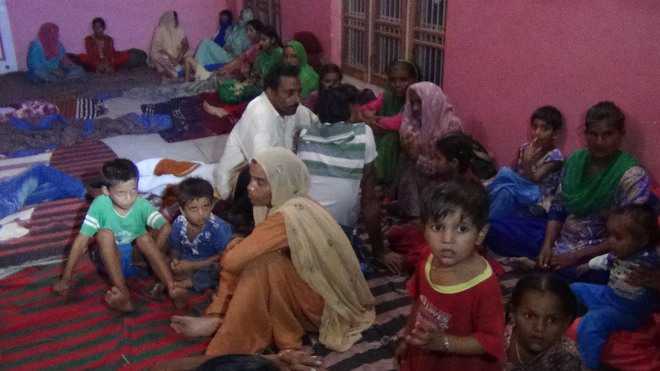
Border residents take shelter at a government school in Samba district. A Tribune Photo

Amit Khajuria

Tribune News Service

Jammu, September 30

Extending full support to the armed forces, people residing in border villages have urged the Central government to go for what they termed a one-time and final settlement with Pakistan.After tension gripped the areas near the international border and the Line of Control (LoC), following the Army’s surgical strikes on terror launch pads on Wednesday, authorities have instructed residents of 45 villages in Samba district to shift to safer places near the Jammu-Pathankot national highway.An alert has been sounded in Sadwal, Sujana, Chachwal, Chalatriyan, Mangu Chak, Ragal, Mawa, Bain-Glad, Manga, SM Pura villages and many others. Many families have shifted their elders and children to safer places, but some of the family members are staying in villages during daytime to take care of their crops.Though these villagers are the first victims of the war or cross-firing, they are standing by the forces and urging Narendra Modi-led Central government to settle issues with Pakistan once for all.“We are now fed up with cross-firing and rumours of war, now the forces should be given a free hand by the government to go ahead and finish the things once for all,” said Updesh Kumar, a resident of SM Pura village.“How many times we will move everything to temples, banquet halls and schools located at safer places? After every six-seven months, Pakistan starts shelling and we have to face huge loss of lives and property,” he added.“We are with the Army and will extend full support to our forces. Though we have to evacuate our villages, the forces should be given free hand this time,” said Moti Lal of Glad village.