Sanjha Morcha

Technical hold on Azhar’s UN terror listing already extended: China

Technical hold on Azhar's UN terror listing already extended: China
The Chinese technical hold was set to lapse on Monday, and had China not raised further objection, the resolution designating Azhar as a terrorist could stand passed automatically. Reuters file photo

Beijing, October 1

China said on Saturday that its technical hold on India’s move to get Pakistan-based Jaish-e-Mohammed chief Masood Azhar designated a terrorist by the United Nations had been extended by six months, days before its expiry.

The Chinese technical hold was set to lapse on Monday, and had China not raised further objection, the resolution designating Azhar as a terrorist could stand passed automatically.

“The technical hold on India’s listing application submitted to the 1267 committee in March, 2016 has already been extended,” Foreign Ministry spokesman Geng Shuang said.

“There are still different views on India’s listing application. The extended technical hold on it will allow more time for the Committee to deliberate on the matter and for relevant parties to have further consultations,” Geng said.

On March 31 this year, China, a veto-wielding permanent member of the UN Security Council, had blocked India’s move to put a ban on the JeM leader, the person who is suspected to have plotted the attack on a military installation in Pathankot in January, under the Sanctions Committee of the Council.

China was the only member in the 15-nation UN organ to put on hold India’s application while 14 members other members of the Council supported it. India wants Azhar on the 1267 sanctions list, which would mean assets’ freeze and travel ban on the militant.

Geng said the 1267 Committee of the UNSC “organises its work as mandated by relevant resolutions of the Security Council.”

“China always maintains that on the listing matter, the 1267 Committee should stick to the main principles of objectivity, impartiality and professionalism, base its judgments on solid evidence and decide upon consensus among the members of the Security Council,” he said in a written reply to a question.

After the decision, the hold now has been extended in the midst of India-Pakistan tension over the Uri terrorist attack, which was blamed on the JeM group.

China’s technical hold coupled with its move to block India’s membership of the Nuclear Suppliers Group (NSG) cast a shadow on the Sino-India ties. Both the countries have held several rounds of talks on the issues in recent months.

China’s move to extend the technical hold comes ahead of the expected meeting between Prime Minister Narendra Modi and Chinese President Xi Jinping in Goa during the BRICS Summit on October 15-16.

In June last year, China had blocked India’s demand for taking action under the Council’s anti-terrorism resolutions against Pakistan for releasing Lashkar-e-Taiba commander Zaki-ur-Lakhvi – the mastermind of the 2008 Mumbai attacks.

Sources have previously said India is not alone in its bid to get Azhar listed as terrorist as the US, the UK and France had “co-sponsored” the resolution seeking Azhar’s listing.

India has repeatedly criticised the UN Sanctions Committee for its failure to designate terrorists for proscribing terrorist groups but not those heading them.

India accused UN sanctions committee for taking a “selective approach” in tackling terrorism when its application was put on hold. — PTI


Brigade Commander shifted in Uri attack aftermath

Brigade Commander shifted in Uri attack aftermath
The attack had led to a public outrage. PTI

Srinagar, October 1

The Army has removed the commander of Uri Brigade, which was the target of the deadly terror attack on September 18 that claimed the lives of 19 soldiers and left several others injured, defence sources said.Brigadier K Somashanker has been shifted out of the sensitive brigade, sources said.

(Follow The Tribune on Facebook; and Twitter @thetribunechd)

They said an officer from the 28 Mountain Division of the Army is scheduled to take over as the Uri Brigade commander.Army officials did not respond to calls seeking comment on the development. PTI


Rally Schedule for Junior Commissioned Officers/ Other Ranks.

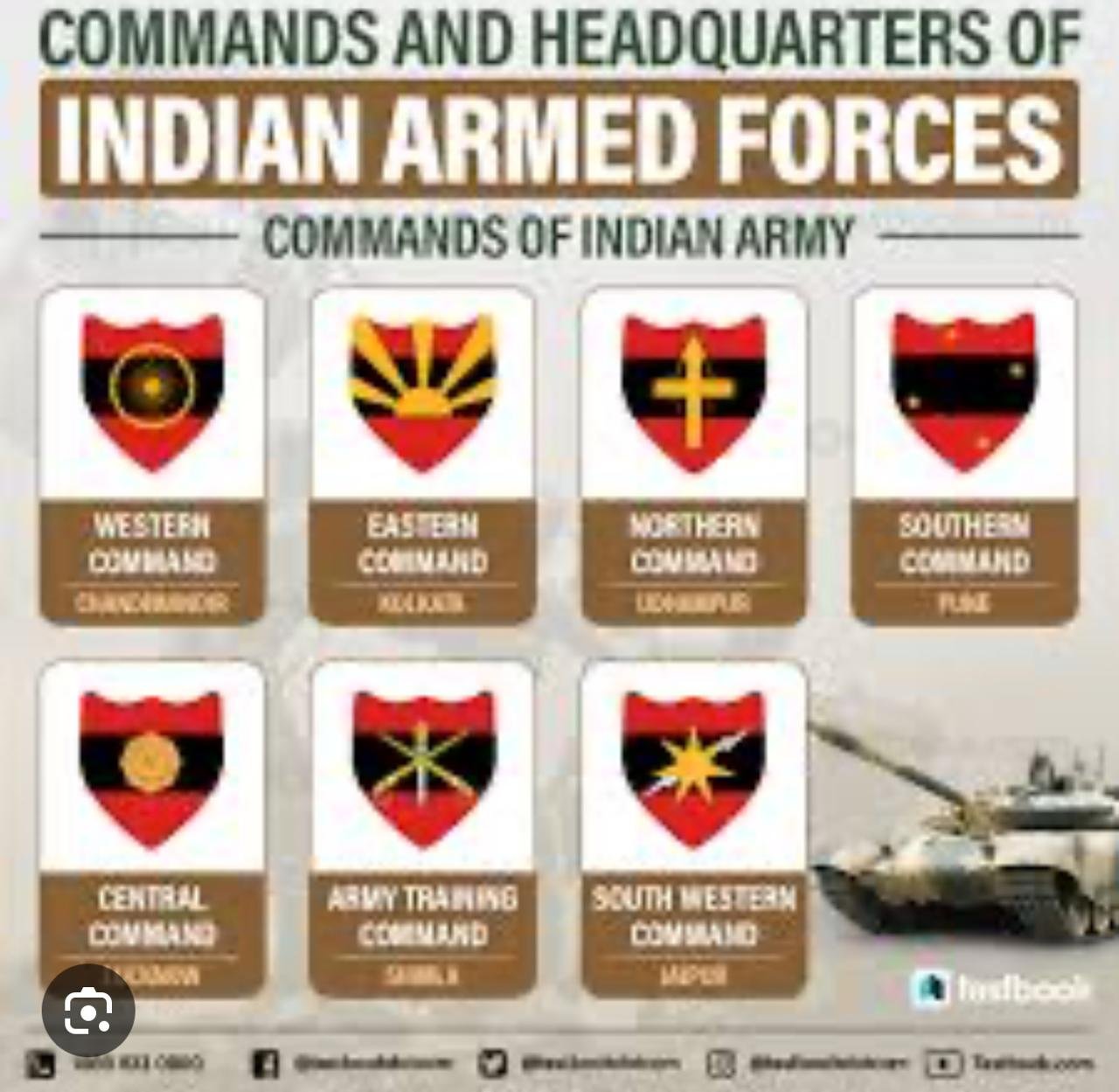
Lieutenant General Surinder Singh, Army Commander #Westerncomd flagged in the #IndianArmy (TRIPEAK Brigade) Mountaineering Team, which summited Mount Trishul,(7120 mtr) at Pooh.The Army Commander congratulated the mountaineers on their remarkable feat.


Homage paid to martyr Mandeep Singh

Homage paid to martyr Mandeep Singh
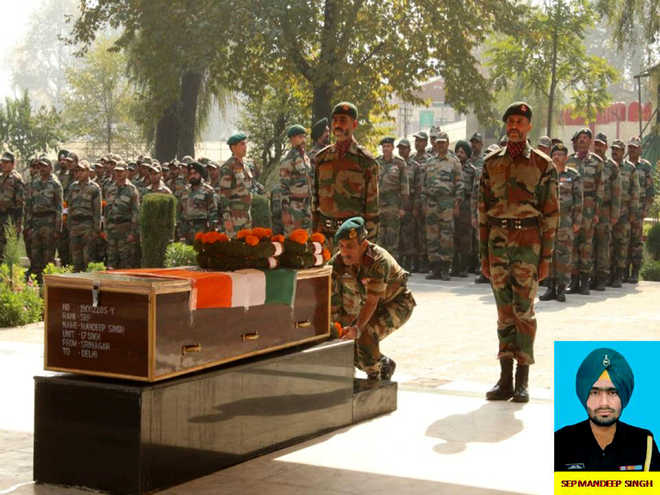
The GOC, Chinar Corps, Lt Gen Satish Dua, lays a wreath on the coffin of Sepoy Mandeep Singh (inset) at Badami Bagh Cantonment in Srinagar. A Tribune photo

Tribune News Service

Srinagar, October 29

The Army paid rich tributes to Sepoy Mandeep Singh who was killed along the Line of Control in the Machil sector of Kupwara district on late Friday evening.An Army spokesman said a solemn wreath-laying ceremony was held at Badami Bagh Cantonment inSrinagar onSaturday to pay homage to the slain soldier who was killed in an operation in which one militant was also killed while a group was attempting to infiltrate under cover of fire from Pakistan army posts.“The General Officer Commanding of the Chinar Corps Lt Gen Satish Dua, and all ranks paid tributes to the national hero on behalf of a proud nation,” he said.Son of a truck driver, this 26-year-old soldier from Kurukshetra, who had joined the Army in 2009, is proudly remembered by his comrades in the unit that also includes his own maternal brother, as a highly professional soldier and a true patriot.He is survived by his young wife, serving in the Haryana Police, who he had married only a couple of years back in 2014. The slain soldier belonged to 17 Sikh Light Infantry.

Had joined the Army in 2009

  • Sepoy Mandeep Singh had joined the Army in 2009. He was killed along the Line of Control in the Machil sector of Kupwara district on Friday evening
  • An Army spokesman said a solemn wreath-laying ceremony was held at Badami Bagh Cantonment in Srinagar on Saturday to pay homage to the slain soldier


Parrikar for ‘holistic’ look into rank parity

Tribune News Service

New Delhi, October 28

Aiming to put a lid on the raging controversy over parity of ranks in forces vis-a-vis civilian officers, Defence Minister Manohar Parrikar has decided to set up a three-member committee that will “holistically” study the matter to resolve it.Even though the Ministry of Defence yesterday issued a clarification saying no rank parity had been disturbed and it was simply reiterating earlier orders issued between 1991 and 2005, the forces did not accept the argument. Media reports pointed to a decision of the Group of Ministers in 2009 which was ratified by the Union Cabinet. This decision fixed a different rank parity than the one mentioned in the MoD letter dated October 18 from where the controversy erupted.(Follow The Tribune on Facebook; and Twitter @thetribunechd)Parrikar was informed by an aide yesterday that the rank-parity issue had not been addressed totally as some facts needed to be studied further. Parrikar, not completely satisfied with the turn of events in the past week, decided to set up a committee that would take 10 days to study all documents, sources said.The MoD would study the matter ‘holistically’ and arrive at the final decision to end this long-festering issue, sources added.  Parrikar is learnt to have been unhappy at how the seemingly bureaucratic matter had festered at a time when the Army was being lauded for the surgical strikes and readying itself for a militarily-tough winter along the Line of Control.As per an MoD letter issued on October 18, a Major General was equated to a principal director; a Brigadier with a director and a Colonel with a joint director. In 2009, the Cabinet had okayed that a Lt Col (lower in rank than Colonel) would be equal to joint director.

clip


Rafale deal will strengthen France-India technological & industrial cooperation: Sirugue

As part of efforts to boost India-France trade & investment ties, French Minister of State for Industry Christophe Sirugue is on a three day tour to India beginning October 25. The focus of his trip is on developing bilateral industrial partnership under the “Make in India” initiative as well as on innovation & new technology.

In an interview to The Hindu, Sirugue termed the €7.87 billion deal for purchase of 36 Rafale fighter aircraft by India as a major strategic success, and said it will pave the way for an unprecedented strengthening of France-India technological & industrial cooperation. Besides, he said Alstom’s troubles in France owing to poor demand will not impact its India operations — including implementation of the over €3 billion contract it bagged in November 2015 to supply Indian Railways 800 freight electric locomotives and carry out the related long-term maintenance. The minister also said in addition to defence, aerospace and nuclear energy, he sees strong potential in three rapidly growing sectors in India: urban development (including urban transport, renewable energy, water & waste treatment), food processing and healthcare. (Edited excerpts)

Q: An India-France joint statement in January had referred to the attractiveness of France for Indian investors, especially for leveraging French technological expertise & competencies. Which are the sectors in India where there is a demand for French technologies; and what are the problems being faced by French firms regarding transferring technology to Indian firms?

A: There are many solid reasons behind France’s attractiveness for Indian investors. France is the fifth largest economy in the world, and the second largest market in Europe. Around 25,000 foreign companies present in France employ more than 1.7 million people, and, every week, 19 foreign firms choose France for new investments, considering its skilled workforce, its excellent infrastructure and its central location in Europe.

French technology and know-how are renowned worldwide in numerous sectors. There is longstanding cooperation between our countries and our companies in sectors such as defence, aerospace and nuclear energy. Both sides have developed long-term partnerships. I also see strong potential in three rapidly growing sectors in India: (i) urban development – an area in which many French companies are already present and can offer innovative technologies in urban transport, renewable energy, water and waste treatment; (ii) the food processing sector, in which many of our specialized SMEs wish to establish themselves; and, (iii) healthcare, a competitive and technologically advanced sector in which France has much to offer.

Q: Can you share some details on cooperation between states / provinces of India and France?

A: Indo-French economic relations are ever-intensifying, at all levels, be they at the central, state or local ones. The union territories, states and local bodies are obviously key players with whom French companies are increasingly working. French companies are spreading their presence throughout India, especially in large metropolitan cities like Chennai, Bengaluru, Mumbai, Delhi, Hyderabad and Ahmedabad. During my India visit, I made it a point to schedule a trip to Chennai, where I will be meeting companies that have been successfully established there: so, that includes Renault’s Kwid assembly plant and the Saint-Gobain research and development centre.

Urban development, smart cities and renewable energy are particularly promising sectors. More than 60 French companies with recognized expertise are now operating in India. French authorities have organised more than twenty French companies’ delegations / roadshows in various Indian states and cities. During the State Visit of President François Hollande in January 2016, France entered into a preferred partnership with the cities of Chandigarh, Nagpur and Pondicherry with the view to offering them assistance and expertise on their participation to the Smart City mission.

Some French regions and cities have also entered into direct cooperation with Indian authorities, like the one between Bordeaux Metropole and the State of Telangana for Hyderabad city on various matters, such as aerospace, urban transportation, water and heritage management. Centre Val de Loire has cooperation with Tamil Nadu since 2008. Similarly there is ongoing cooperation since 2011 with Region des Pays de la Loire, which has opened a permanent representative office in Chennai.

Q: Regarding the €7.87 billion deal for purchase of 36 Rafale fighter aircraft by India, what kind of technologies will the French industry transfer and develop with Indian defence labs? How will France / French firms help build capacity in India to make them part of the French global defence supply chain to execute the offset requirements?

A: The Rafale deal is a major strategic success that forms part of a longstanding and close defence relationship between our two countries, and paves the way for unprecedented strengthening of our technological and industrial cooperation. The offsets contract was concluded between French companies and Indian authorities, so I’m not in a position to provide you its details. They will define, together with Indian companies, how the required transfers of technology will be implemented. I believe they have already made good progress on this.

What I can tell you, though, is that the offsets will contribute to a soaring, solid and autonomous defence industry in India. France perfectly understands this quest for strategic autonomy, which is a goal that we ourselves have been pursuing since decades. We welcome our cooperation with India in implementing this.

Q: (French rail transport major) Alstom had bagged an over €3 billion contract to supply Indian Railways with 800 freight electric locomotives and carry out the related long-term maintenance. However, Alstom was in trouble recently as it had announced plans to halt production in Belfort (France), and the French state (which holds a 20% stake in the company) had to face criticism regarding a rescue package aimed at saving around 400 jobs. Will the multinational company’s troubles have any impact on its Indian operations and the $3 billion contract with Indian Railways?

A: Alstom and the French government recently held talks on the future of Belfort site, and more generally on the situation of Alstom’s different sites in France. The government, Alstom and stakeholders elaborated a joint plan which will preserve Alstom’s strong technological expertise on several segments of the railway market, in particular locomotives. Therefore, those talks will have no impact on Alstom’s operations in India, including the contract you mention.

Q: It was reported that France is aiming to be a major protein supplier by 2030 with plans to hike investments into ‘intelligent food’ from vegetable & animal sources. India had recently allowed 100 per cent foreign direct investment in marketing of food products produced & manufactured in India. Can you share some details on the proposed collaboration between India and France in food processing, food technology and retail industries?

A: French companies are also involved in Make in India in the food processing industry. Axereal, Bongrain, Danone, Lactalis, Limagrain, Pernod-Ricard, Roquette and Soufflet – to mention but a few – are all European or world leaders successfully established in India. These food companies are well aware of the advantages of investing in India: abundant agricultural supply at a low price, diversification of agricultural production which can be transformed, and the possibility of selling not only in the Indian market but also exporting to the Middle-East or Southeast Asia.

It is also well known that the French agricultural and food processing industries innovate constantly, be it in packaging, preservation methods, or nutritional aspects, what you called ‘intelligent food’. And this is done with the constant aim of adapting to consumer needs.

Regarding innovation and technologies, France is a leader in building world class equipment for food processing companies. In this domain, we have companies specializing in cold chain, packaging solutions and every food processing sector: dairy, bakery, meat, grains processing, fruit and vegetable processing. France is already involved in training Indian experts in the cold chain field. This is a partnership based on knowledge sharing and awareness of better technologies.

In a nutshell, the potential is indeed immense not only for the food processing groups, but also for equipment manufacturers for this industry. The Goods and Services Tax reform as well as the new FDI policy in this sector are certainly strong positive signals. It will definitely help attract more investments in India, and more innovations from French companies.

Q: France had welcomed India’s recent ratification of the Paris climate change pact. Will this lead to higher French investments in India’s renewable energy sector?

A: Our authorities have stated on many occasions how India played a driving role in the adoption of the Paris Agreement in December 2015. Prime Minister Narendra Modi’s decision to ratify the Agreement also helped accelerate its entry into force, which will take place on 4th November. Also, France supported India’s initiative on the International Solar Alliance, which will help attain the goals of the Paris Agreement by facilitating access to solar energy.

India has fixed the target of producing 40 per cent of its electricity from non-fossil fuels by 2030, while meeting its vast energy needs that are necessary for nurturing its economic growth. Prime Minister Modi’s impetus has already resulted in a remarkable development of Indian capacities in renewable, which today has attained 44 GW. France is, of course, ready to extend all assistance – and has already done so. Did you know that 10 per cent of India’s installed solar capacity is provided by French companies? The French Development Agency (AFD) was among the first to back this emerging sector via two credit lines extended to the Indian renewable energy development agency (IREDA).

French companies, which have recognised expertise and know-how in the renewable energy sector, are already present in the market and participate in tenders floated in this sector. Thus, we can anticipate a major increase in French investments in this area.


Uri terror attack martyrs remembered

Uri terror attack martyrs remembered
Activists of the Anubhuti Women and Child Welfare Committee pay tributes to martyred Indian soldiers in Haridwar on Saturday. Tribune photo: RAMESHWAR GAUR

Haridwar, October 23

The Anubhuti Women and Child Welfare Committee paid tributes to Army soldiers, who lost their lives in the recent Uri and Poonch terrorist attacks, at its office at Arya Nagar here yesterday.Candles were lit and women activists spoke of the contributions of Army personnel in saving the country and its people from cross-border terrorism.President of the committee Kusum Gandhi urged people to light candles as a tribute to the valiant soldiers guarding the country.Social activist Kamla Joshi said every citizen should remembered our soldiers by lighting a candle for them during Divali celebrations. This would boost the morale of the soldiers.BJP district women president Rita Chamoli and senior leader Kamani Sadana lauded the key role played by National Security Adviser Ajit Dobhal and Vice-Chief of the Army Lt General Vipin Rawat, both of Uttarakhand origin, in the current scenario. They said people of the state had always been ahead in serving the country through armed forces, with hundreds of soldiers getting martyred in 1961, ’65 and ’71 wars against China and Pakistan and the Kargil war in 1999.Manju Manu Rawat, Rashmi Chauhan, Renu Sharma, Anita Dayal, Sunita Joshi and Annapura paid tributes’.—TNS


Bicycle expedition spreading national unity returns to city

Bicycle expedition spreading national unity returns to city
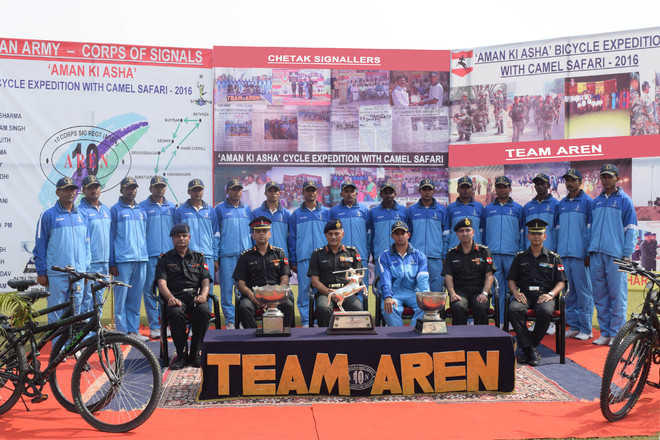
Members of the bicycle expedition pose for a photograph in Bathinda on Saturday. A Tribune photograph

Tribune News Service

Bathinda, October 22

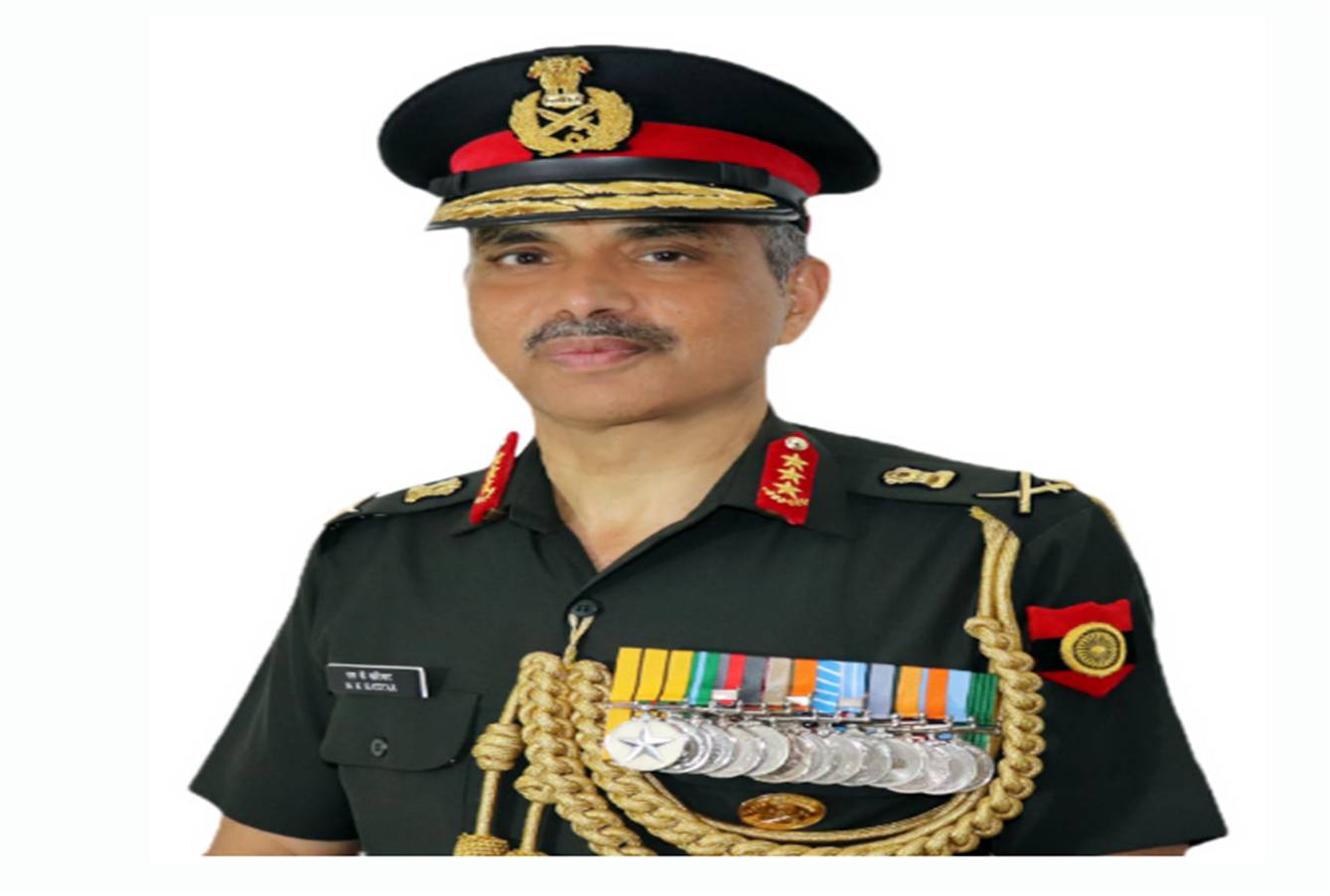
The 15-day bicycle expedition with camel safari, led by the ‘Team AREN’, Chetak Signallers, culminated here today. The expedition was flagged in by Lieutenant General Ashwani Kumar, VSM, General Officer Commanding, Chetak Corps, yesterday.It covered a distance of 712 km starting from Bathinda and explored the important towns and cities of Muktsar, Abohar, Sri Ganganagar, Suratgarh, Mahajan, Lunkaransar, Bikaner, Surnana, Birdhwal, Hanumangarh and Mandi Dabwali.The team had a refreshing and challenging exposure of the rugged terrain of Punjab, Haryana and Rajasthan during the course of the expedition.The aim of the expedition was to reach out to veterans, foster a spirit of adventure and camaraderie among the members of the expedition team and spread awareness about the Indian Army among the youth and motivate them to join the army.The team interacted with veterans along the way and also interacted with schoolchildren and youth, spreading the message of national integrity and educating the youth about various opportunities available for joining the Indian Army.The expedition team also highlighted schemes of the Central Government initiated towards the development of society and the nation.


Western Command chief visits Indo-China border

Chandigarh: Lt Gen Surinder Singh, General Officer Commanding-in-Chief, Western Command, visited field formations deployed along the International Border with China in Himachal Pradesh during a two-day visit to the sector. While reviewing operational readiness of the formations in the forward areas, he held detailed deliberations with field commanders and also interacted with the troops. TN

clip


Enemy our prey, mantra for snipers on Line of Control

Enemy our prey, mantra for snipers on Line of Control
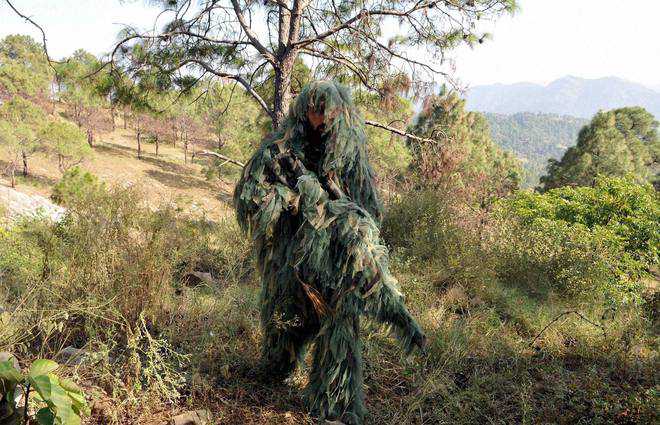
An Army jawan in camouflaged battle gear takes position near the Line of Control in Nowshera sector. PTI

Nowshera, October 11

For Army snipers donning camouflaged battle gear, “Dushman Shikaar, Hum Shikaari” is the duty mantra as they guard the highly sensitive Line of Control (LoC).Ply boards with “Dushman Shikaar, Hum Shikaari” written on them dot pine tree tops on the foot tracks of patrolling parties and border woods along the LoC.LoC snipers and soldiers, whose morale has gone up further post the surgical strikes on terrorist launch pads in Pakistan-occupied Kashmir (PoK), are out to give a befitting reply to any ceasefire violation by Pakistan and foil terrorist infiltration and border action team (BAT) attack.Pointing to a ply card motto nailed to a pine tree on a foot patrolling track along the three-tier fence, Sniper Ram Singh (name changed) said, “The enemy sitting across the Lakshman Rekha (LoC) is my prey and I am his hunter. We work as per this motto for those daring to cross this Lakshman Rekha.”He and other snipers are highly trained and target-hitting soldiers meant to hit specific enemies daring to breach the LoC.Like snipers, the motto is no different for jawans and officers monitoring the forward post. They undertake foot patrolling along the LoC amid electronic surveillance put to guard the Indo-Pak border in the Nowshera sector of Rajouri district.The sector falls opposite the Bhimbher district of PoK, where heavily armed special forces hit terror launch pads in pre-dawn surgical strikes last month.The Nowshera sector with thick coniferous woods, deep valleys and rock-cut mountains is now a target of Pakistani soldiers post surgical strikes. It was once the biggest infiltration area as there were huge launch pads and terrorist training camps in the Bhimbher-Samahni-Nikyal belt across the LoC.“We are most vigilant along the LoC. We cannot keep the LoC out of manual and electronic sight even for a moment. We cannot trust Pakistani soldiers. They feel insulted following the surgical strikes,” said another soldier at the forward post.Showcasing electronic surveillance of the LoC, the company commander said, “We are keep a hawk eye on the LoC and forward posts and sensitive gaps on the border.”“Even the movement of a cat is watched now through electronic gadgets. We cannot afford to give a chance to them,” the officer said.Rocky mountain clips, dense forest lines and deep rock-cut valleys along the border are manned round-the-clock manually and electronically.“Apart from continuous observation from forward posts and electronic observation rooms, there is manual patrolling and three-tier lit-up fencing to guard against infiltration and cross LoC raids,” he said.Amid hostile weather conditions, the soldiers guard border posts and vow to safeguard the territorial boundaries at the cost of their lives.Undeterred by continuous mortar shell blasts and rattle of heavy machine guns at their posts last week, jawans brave bad weather and inhospitable terrain to keep a strict vigil on the LoC in Poonch.“Even during the recent heavily shelling and firing, we kept hawk eye vigilance on the LoC to foil any design of infiltration or any attack,” the officer said. The situation in the Poonch-Rajouri sector had deteriorated in the past week following the surgical strikes. — PTI