Sanjha Morcha

China stands up for Pak again, calls border closure ‘irrational

Simran Sodhi

Tribune News Service

New Delhi, October 11

China today again lived up to its reputation of being Pakistan’s strong ally and friend when it questioned India’s claims of Pakistan being behind the Uri terror attack and further labelled India’s decision to fence the India-Pak border as ‘irrational’.The comments were made by some leading Chinese experts and carried in Global Times, a newspaper which is known to be close to the Chinese Government and is viewed primarily as a channel to promote and reflect the perspective of the Chinese Government.Post the Uri attack, India has tried to show to the world Pakistan’s complicity in the attacks and the Chinese statement today is a setback.“India is making a very irrational decision, since no exhaustive investigation has been conducted after the Uri incident, and no evidence proves Pakistan is behind the attack,” Hu Zhiyong, a research fellow from the Institute of International Relations of the Shanghai Academy of Social Sciences, is quoted by the Global Times on Monday.China’s reaction to India’s decision to seal the 3,323-km border with Pakistan by December 2018 is also a bit of a shocker. Hu is quoted as saying that this action was reflective of the “Cold War mentality” and that this “would only cause deeper hatred among residents living in India and Pakistan-controlled Kashmir”.On Monday, China had accused India of trying to make political gains by insisting on the United Nations ban on Jaish Chief Masood Azar as an international terrorist. Even on the entry into the Nuclear Suppliers Group (NSG), while China seems open to talks, it is quite clear that it would never let India into the club without dragging the case of Pakistan’s membership alongside.On Saturday, PM Narendra Modi is scheduled to meet Chinese President Xi Jinping on the sidelines of the BRICS Summit in Goa. Sources have indicated that Modi will again raise the issue of India’s entry into the NSG with Xi. However, in light of the series of comments coming out of China in the past two days, the meeting between the two leaders is likely to yield no results

HM to brief regional media on Oct 17

  • Home Minister Rajnath Singh would address nearly 150 editors of the regional media in Chandigarh on October 17 to explain them the state of the country’s internal security scenario and also the prevailing situation along the India-Pakistan border
  • The two-day event would see participants from Haryana, Punjab, Himachal, J&K, Chandigarh, Uttarakhand, Uttar Pradesh, Assam and other Northeastern states

China loves Pakistan? Secret Behind

China and Pakistan relations are the best example of how greed for money, power and supremacy can bring even opposite ideologies together. Pakistan is an Islamic republic and China has no love lost for Islam. Burkhas are banned in China, people with long beard can’t ride public transport, Muslim shopkeepers are forced to sell liquor and government employees and their kids can’t go to mosques or observe fast during the month of Ramdan. Still China and Pakistan are closest of allies.

On Saturday 1st Oct 2016 China extended its technical hold on India’s move to get Pakistan based JeM chief Maulana Masood Azhar listed as a terrorist by the UN, just two days before the expiry of the hold. An extremely calculative move by China as Massod Azhar is an important part of Pakistan’s terror assets and China will not do anything to disturb the trust that both countries have built based on mutual gains. So what if the whole world is facing the menace of terrorism. So what if the terrorists like Masood Azhar is a threat to the whole humanity.

Pakistan’s foreign policy revolves around China and for China, Pakistan is pivotal for establishing economic and military supremacy in Central Asia, Middle East,Afghanistan and eventually Europe. Mutual benefit involves pure economics.Firstly China is earning loads of money by exporting arms to Pakistan. Only a few years back the US and China shared an equal portion of Pakistan’s arm imports, 39% and 38% respectively. Today China has 63% share and the US has only 19% share. China is world’s third largest arm exporter and as China’s biggest buyer of arms credit goes to Pakistan. Secondly CPEC is a very ambitious dream project of China and role of China in the future of central Asia, Middle East and Europe would depend on it. CPEC will hugely impact China’s industry and economy.


Govt unwilling to air cross-LoC raid proof

Army gives footage; ministers ‘not to speak out of turn’

Govt unwilling to air cross-LoC raid proof
Armymen patrol near LoC in Pallanwala sector, 70 km from Jammu. PTI

K V Prasad

Tribune News Service

NEW DELHI, OCTOBER 5

Amid the political clamour for authenticating the surgical strikes by the Indian Army on terror launch pads across the Line of Control in Jammu and Kashmir, the emphatic view among those tasked with security is that there is little room for such a concession.Doubting Thomases can continue to raise questions, but sources privy to the thinking in the higher echelons of the security establishment on the South Block told The Tribune that notwithstanding the vociferous demands, the government is unwilling to succumb to it.Across the border, Pakistan Prime Minister Nawaz Sharif continued to raise the temperature on developments in Jammu and Kashmir and maintained that without any investigation into the Uri incident, within a few hours, India blamed Pakistan for the attack.On his part, Prime Minister Narendra Modi is understood to have cautioned his Cabinet colleagues not to speak out of turn on the surgical strikes and leave the job to those entrusted to comment. The sources said the view is that succumbing to the demand of providing evidence would be a cowardly response. This categorical assertion came even as the Army handed over footage of the strikes recorded by the assault teams.(Follow The Tribune on Facebook; and Twitter @thetribunechd)“The laid-down procedure has been followed. The DGMO [Director General of Military Operations] briefed [about the surgical strikes]. It was not the Defence Minister, nor the PM and not the Home Minister. That was the right thing to do and they [Army] did it. There was a time when documents were submitted. Now clips are given and the clips have been given,” Minister of State for Home Hansraj Ahir told reporters here.As the debate intensified, the Congress sought to couch the demand for making the evidence public as it will help to call Pakistan’s bluff. “Time was ripe to expose the malicious lies,” it said.


Pak ramps up cross-border violations: Shelling in Rajouri, recce in Gurdaspur

Pak ramps up cross-border violations: Shelling in Rajouri, recce in Gurdaspur
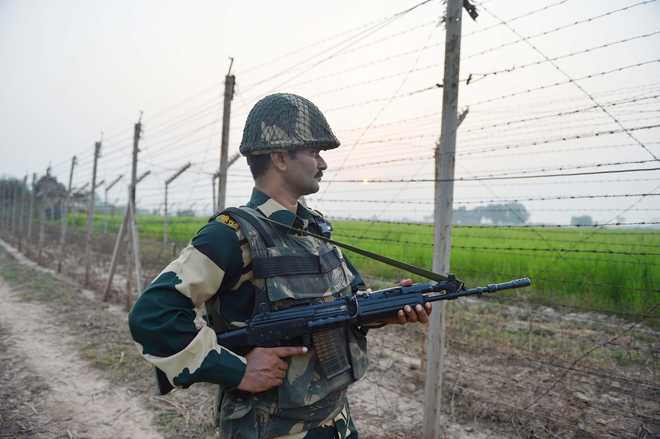
A BSF soldier patrols along a fence at the India-Pakistan border in RS Pura south-west of Jammu. — AFP

Ravi Dhaliwal & Amir Karim Tantray

Tribune News Service

Gurdaspur/Jammu, October 4

Pakistani troops on Tuesday again resorted to mortar shelling and firing on Army posts and civilian areas along the LoC in Jammu and Rajouri districts, even as BSF sources said eight men spotted near the India-Pak border in Punjab’s Gurdaspur recently might have come scouting the area for a possible militant strike.Meanwhile, amid heightened vigil, BSF troops seized an empty Pakistani boat on the Ravi in the Pathankot sector on Tuesday.

(Follow The Tribune on Facebook; and Twitter @thetribunechd)

Defence Spokesman Col Manish Mehta said, “Pakistan troops resorted to unprovoked firing in three areas of Noushera in Rajouri district from 0515 hours today.”They fired mortar bombs, automatic weapons and small arms, he said, adding that Indian troops gave a befitting reply.This was the sixth ceasefire violation in the past 36 hours when Pakistan troops have resorted to shelling and firing on Indian posts and civilian areas along the LoC.No casualties were reported in firing that began at Pallanwala at 1.35 pm on Tuesday. Mortars were being used by the Pakistan side and appropriate response was being given by the Indian Army.Yesterday, the Pakistani troops violated ceasefire four times and restored to heavy firing and mortar shelling in Saujian, Shahpur-Kerni, Mandi and KG sectors in Poonch district, injuring five civilians.UAVs seen close to border, says BSF The BSF said it has witnessed movement of UAVs very close to the Indo-Pak border in the recent past.”No doubt, the overall vigil has been increased (along western borders). All the defence and security forces establishments are on their highest alert. There is tension on the western border…we are having active engagement (with Pakistan) at the Line of Control and we are receiving shelling from the other side. However, we are in supportive role at the LoC (to army),” BSF Director General K K Sharma told reporters in Delhi.”We have noticed UAV (Unmanned Aerial Vehicles) coming 100 metre up to the border…maybe they (Pakistani forces) want to check our preparedness but I can assure you that we are fully capable of giving a befitting reply and we will not allow any nefarious design of terrorists to succeed,” he said.‘CCTV footage showed unarmed men close to fence’Meanwhile, two days after the border guards saw “suspicious movement” near the India-Pakistan border in Gurdaspur, BSF sources said eight unknown men spotted near the border may have been scouting for a possible militant strike.Senior BSF officers who were at Chakri on Tuesday claimed that images captured by CCTVs showed what clearly looked like people near the border, after the force reportedly cast doubts over what they had seen. A video showed the men, all unarmed, scattering when the guards began firing at them, sources said.  “Our Jalandhar-based analysts who checked the contents of the DVR have found some useful information. A group of unarmed men were loitering at a distance of 800 metre to 1 km from the barbed wire fencing… We can say with conviction that they were not smugglers. They had come to carry out a recce. An infiltration bid at a later date cannot be ruled out. We have tightened security near the border while the police have been asked to act as the second line of defence,” a BSF officer said, not wanting to be named because he was not authorised to speak to the press.Until Monday night, the force was unsure if they had seen humans or a herd of cattle, sources said.However, coming as it did within hours of a militant strike at an Army camp in Baramulla, the development led to increased security in Punjab’s borders, particularly since the state has seen two terrorist strikes within six months of each other in the past year-and-a-half. Seventy personnel from the Punjab Armed Police have been deployed in area on the Punjab Police’s insistence.Although the BSF have not commented, police appeared to confirm that some people had been spotted near the area.“Now that we have concrete evidence that a group of men were sighted on the Pakistani side of the border we have increased surveillance in the area. All neighbouring villages are being searched. The operation will continue till tomorrow, when we will review it in the presence of senior officers. There are chances that the group may have acted as a camouflage to enable some men sneak in. We are ruling out nothing… we are leaving nothing to chance,” said Superintendent of Police Jasdeep Singh, who oversaw the deployment and remained at Dorangla for a large part of Tuesday.After an empty Pakistani boat was seized on the Ravi, a BSF officer said, “We have captured a Pakistani boat which had washed away to this side in the Ravi along the International Border (IB) in Pathankot sector.” a senior BSF officer said.The boat was probably washed away due to the rising water level in the Ravi in Pathankot sector, he said.The seizure comes two days after a Pakistani boat with nine crew members was apprehended off the Gujarat coast by the Indian Coast Guard on October 2. — With agencies


How India punished Pak

Sharif’s UN speech raising Kashmir was inflection point

From page 1 NEW DELHI: India will neither forgive nor forget, Prime Minister Narendra Modi declared less than a week after the Uri outrage. It wasn’t just rhetoric: Modi had already okayed a strike against Pakistani terrorist launchpads across the Line of Control (LoC).

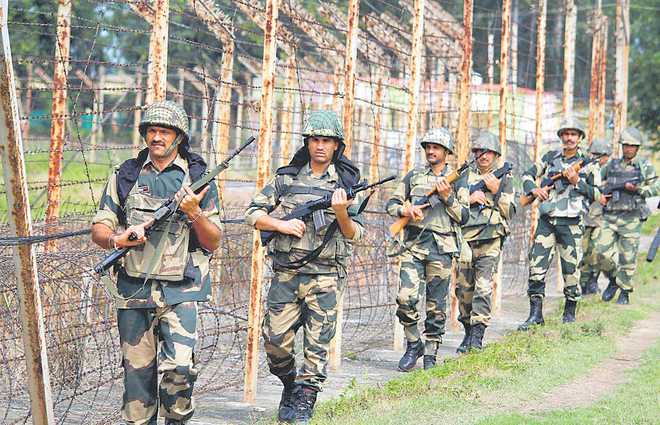
AP FILEBorder Security Force soldiers patrol the India-Pakistan international border in Akhnoor sector.

The decision to punish Pakistan was conveyed to defence minister Manohar Parrikar and National Security Adviser Ajit Doval on September 23, and the build-up to D-day began the next day.

It was no rash decision. The diplomatic route was chosen before unsheathing the iron fist. Immediately after the September 18 attack on the Indian Army at Uri, Modi called Doval for information on the perpetrators and how they managed to get inside the brigade headquarters.

The Pakistan connection became evident from the GPS sets found on the four dead terrorists as well as from the interrogation of their two guides caught by Uri villagers.

Pakistan’s High Commissioner to India Abdul Basit was summoned on September 21 and given a protest letter detailing the involvement of a terror group based in his country. Pakistan chose denial as its response, with Prime Minister Nawaz Sharif raising Kashmir in his speech at the United Nations.

That was the inflection point, when the idea of a military response began to crystallise.

Late on September 22, Modi, Parrikar and Doval were briefed by Director General of Military Operations Lt General Ranbir Singh on LoC strike options as well as the posture of the Pakistan army. Army chief General Dalbir Singh was present at this briefing in the War Room of the ministry of defence. By this time, Pakistan had activated all its radars along the LoC and its forces were on high alert.

After examining the options put up by Doval in consultation with the three service chiefs, the surgical strike option was chosen by September 23.

Once the decision had been taken, Doval, Army chief Gen. Dalbir Singh and other operational planners discarded their mobile phones. All communications were direct or through highly secured lines only. Constant monitoring of the Pakistani political leadership and army brass, including the Rawalpindi-based X Corps in charge of PoK as well as the Gilgit-based commander of the Northern Areas, was carried out. As the strike plan was hammered out, Modi chaired some of the meetings.

The Army chief tasked his Northern Army Commander Lt Gen DS Hooda to segregate special forces troops from the 1, 4 and 9 parachute at his disposal, and prepare for action. The army build-up began on September 24. Meanwhile, the National Technical Research Organisation (NTRO) programmed Indian satellites to monitor the target area using GPS coordinates and linkups as a result of which Delhi had real-time imagery of the strike through helmet-mounted cameras of Indian soldiers on D-day. Video footage of the entire action exists but has not been released to the public. Given that Pakistan had activated its radars across the LoC, insertion of special forces through helicopters was ruled out. Special forces squads with night-vision devices, Tavor 21 and AK-47 assault rifles, rocketpropelled grenades, shoulderfired missiles, Heckler and Koch pistols, high explosive grenades and plastic explosives crossed the LoC on foot. The teams were 30-strong each and had specific targets. While the corps commanders were getting their men ready, the planners in Delhi went below the radar. Starting September 26, Doval held three meetings with the three military chiefs, foreign secretary, two intelligence chiefs, NTRO chief and the DGMO. No uniforms were allowed at these meetings; unmarked cars were used to meet at discreet locations around Delhi to discuss the plan as well as possible Pakistani retaliation.

Operational planners had narrowed things down to eight contingencies. It comes as no surprise that evacuation of civilians living close to border in Jammu and Kashmir and Punjab started at 10 pm on September 27, an hour before Indian soldiers went across.

D-day began with Special Forces squads slipping across the LoC towards designated targets. The plan was such that teams with distant targets left early on September 27 evening so that all strikes would be coordinated. The instructions were that all teams would engage the terrorists simultaneously so that none could rescue another. Using mortar and machine-gun fire from the Indian side to pin Pakistani troops down, the soldiers of the special forces crawled to their targets without meeting any resistance. Sentries at the launchpads were neutralised by snipers before the troops went in and finished the job. Barring one soldier who stepped on a landmine, all teams returned to their bases by 9am on September 28. The surprise had been complete and there had hardly been any retaliatory fire. Even as the operation was on, Doval received a call from his US counterpart Susan Rice. Although the US later said that Rice had offered India help against terrorism, the Modi government has kept this conversation top secret.

Throughout the operation, Modi, Parrikar, Doval, the service chiefs, DGMO, intelligence chiefs, NTRO chief, Northern Army Commander and his two corps commanders were awake and in touch. After the troopers returned, the operational planners, led by Doval, met Modi and briefed him.

Six launchpads had been razed to the ground with Indian troopers gunning down 45 terrorists at various locations. Uri had been avenged.

After the operation, Modi called a meet of the Cabinet Committee on security, and DGMO Ranbir Singh called his Pakistani counterpart to inform him about the strike. Former prime minister Manmohan Singh was briefed by Modi after the CCS meet. Starting with Congress president Sonia Gandhi, Opposition leaders were briefed directly or at the all-party meeting held later the same day.



Now, over to diplomacy ————-Gen Ashok Kumar Mehta (retd)

Now, over to diplomacy
Mean business: The strikes have signalled our readiness to violate the sanctity of LoC.

IT is quite bizarre. Pakistan’s brazen denial of India’s smart and sharp punitive raid by both the military and civilian leadership has put New Delhi in a quandary about any military riposte. The situation is confusing. GHQ Rawalpindi was extremely surprised by India’s punitive retaliation. While Pakistan’s Inter Services Public Relations maintains that the LoC has not been crossed and army chief Gen Raheel Sharif has called it malicious propaganda. Pakistan TV channels have added to the opacity by showing doctored footage of captured Indian soldiers. Some media reports say the attack was a ground trespass in which eight Indian and two Pakistani soldiers  were killed. Hafiz Saeed has said: “Let us teach Indians surgical strikes.” He wants the Pakistan army to liberate Kashmir. By denying that the LoC had been crossed, a response might be averted.On the face of it, the strategic message is that no escalation is being contemplated and it is business as usual. Domestically and internationally, Pakistan is in one big mess. While General Sharif’s popularity is soaring and his term is coming to an end in weeks, the battle for succession is waging in the minds of the army, the public and PM Nawaz Sharif. Despite the army clarifying that the General will retire by November-end, nobody is sure the transition will be bloodless. The economy is in bad shape, the campaign against terrorism is not going well and Mr Sharif’s standing is slumped. Pakistan has never been so isolated regionally and internationally as it is today. Presidential favourite Hillary Clinton’s latest pronouncement that she fears a jehadi coup in Pakistan and suicide nuclear bombers roaming the streets paints a scary nuclear scenario. Given these conditions, a Pakistan army adventure should not be surprising ‘at a time and place of its choosing’, though without significant escalation. Overt or covert tit-for-tat strikes should be expected in the form of spectacular fidayeen attacks on military camps or more measured strikes inside J&K.World attention was grabbed by India’s retributive, preemptive raid described as a calibrated counter terrorism operation. It was not condemned by even some of Pakistan’s best friends like China, Saudi Arabia, Qatar and Bahrain. Cleverly choreographed and kept below the escalatory threshold, it sent the right message to Pakistan that henceforth its cross-border terrorism (CBT) will not go un-responded. It is the domestic audience which has been overwhelmed by the punitive retaliation. Dileep Chand, the taxi driver who brought me back after one of the many angry and emotional TV studio indictments of Uri, asked me whether India would retaliate. Before I could answer, he shot back: “Our leaders indulge in empty threats.” He was old enough to have lived through the cyclic ignominy of the attacks on Parliament and Mumbai and the numerous Pathankots and Uris over the last three decades. Dileep Chand is a happy man now.The cross-border operation was symbolic to signal our readiness to violate the sanctity of LoC, something we didn’t do even during Kargil — to make the Deep State rethink its strategy of employing non-state actors as instruments of coercion. As more Uris will happen, our capacity to deal with them has to expand. Former NSA MK Narayanan has revealed that our retributive capabilities are inadequate and that the options of striking terrorist training camps in the PoK were considered unviable after Mumbai in 2008 following a cost-benefit analysis. He said at that time India lacked the capability of conducting spectacular raids, rescue missions and extractions like Entebbe, Mogadishu and Abbottabad, adding that “the reality is that India’s security agencies and the armed forces still do not have adequate capabilities of this kind notwithstanding claims to the contrary”.Defence Minister Manohar Parrikar has admitted that mistakes have been made in Pathankot and Uri. He has also talked about using a terrorist to fight a terrorist and putting back in place the dismantled deep assets in Pakistan. Similarly, NSA Ajit Doval has warned Pakistan “if there is another Mumbai there will be no Balochistan”. These capabilities should be constructed.India has not invested in transparent and clandestine punitive capabilities despite it being bled for the last 30 years, if not 70, by Pakistan’s CBT. According to the latest Pew Research Centre poll,  62 per cent of Indians want military force to be used to defeat terrorism; 63 per cent want India to spend more on defence. An online poll post-Uri suggests that 67 per cent Indians want the application of kinetic force. According to Credit Suisse, India has the fourth-largest militaries in the world and unarguably one of the most competent and yet it has not been employed effectively. That said, it is clear that certain necessary and urgently needed capabilities have not been developed. Who is to blame? The military, of course, but even more, successive governments that have starved it of funds and requisite political direction. The announcement last week by Finance Minister Arun Jaitley that the defence budget will be increased has not come a day too soon.PM Modi should devote more time and resources on the defence of the realm. Without sanitising the periphery and the homeland, his goal of building a prosperous and secure India cannot be realised. There was no reason for him to meet his Service Chiefs individually and collectively four times before going to Kozhikode, had he visited the War Room ab initio more frequently. In fact, on assuming office, he should have asked the military chiefs, two questions: readiness to respond to the next Mumbai type attack; and dealing with CBT. He should also have attended a war game or two to imbibe the nuances of a nuclear overhang. Had he done all this, contingency plans and rehearsals of a fitting reply commensurate with existing capabilities would have been ready for immediate use and not 10 days later.The retributive strike is not going to end CBT. The battle to alter the behaviour of the Deep State has been joined. For now, the Pakistan media is toeing its army’s line that the Indian Army did not cross the LoC. This make-believe allows Pakistan to not respond and escalate the situation. We should not try to rub GHQ Rawalpindi’s nose to the ground but leave it with the face-saving exit option. At the same time, we should be prepared for  retaliation, mainly in J&K. The military should keep its powder dry and let active diplomacy take the front seat, though India’s dilemma will remain crafting retribution over the next Uri.The writer is a founder member of the erstwhile Defence Planning Staff



Ranbir is my legally adopted son, says a proud retired Col

Deepkamal Kaur

Tribune News Service

Jalandhar, October 1

A young Lt-Gen Ranbir Singh, DGMO, Indian Army, along with his wife and son.

Former Deputy Director, Sainik Welfare, Lieut-Col Manmohan Singh (retd) is a busy man these days as several people from across the region have been calling on him to congratulate him on the feat of his adopted son Lieut-Gen Ranbir Singh, DGMO, Indian Army, who strategised the surgical strikes across the LOC two days ago.At his residence in Urban Estate here, the Lieut-Col said, “Since we did not have any child, I legally adopted my brother’s son Ranbir, whom we fondly call Babbu, at the age of three and a half years. My brother, who retired as a JCO, was residing at Ambala Jattan village near Garhdiwal in Hoshiarpur. Since there was no good education facility there, we brought him here and sent him to St Joseph’s Convent School, Lajpat Nagar, right from LKG.”Taking out old pictures, he recalls, “Ranbir was very intelligent but a bit lazy. I had to push him out of the bed early and he maintains the habit. At the Class V level, I made him study rigorously and prepare for admission to Sainik School Kapurthala. There he worked hard and got through in the National Defence Academy (NDA). He went to Khadakwasla, then the IMA in Dehradun and got commissioned in the Army in December 1980. He has been the only infantry general to have commanded an armoured division after Gen Sundarji.”He proudly tells, “Till date, he maintains all habits that I passed onto him. He is regular with early morning walks. I am a teetotaller and he too is. He is an avid book reader till date.”Says Lieut-Col Manmohan Singh, “He got married to a Marathi girl. They have a son, who is studying in the Delhi College of Engineering. My brother (Lieut-Gen Ranbir’s biological father) passed away at 50, while his wife and two daughters are in Vancouver for the past 20-25 years.”He further said, “Ranbir keeps coming here every four months or so. But this time, he won’t come till the tension defuses. Having been promoted as Lieut-Gen six-seven months ago, he was tipped to be the Corps Commander and get posted here. The incumbent here Lieut-Gen BS Sehrawat and Ranbir have been batchmates. In any case, he will have to serve as a Corps Commander for a year to be eligible as the Chief of Army. He has been accompanying Defence Minister Manohar Parrikar on his foreign tours. He has shown his capabilities and is among the front-runners now.”Lieut-Col Manmohan, who has been training youth for entry to Defence, paramilitary forces and police for the past over two decades, said he had been in Delhi with Lieut-Gen Ranbir a week ago and he remained very busy. “He comes home late even now. He calls me up daily after returning from work. He called me even on the day when they conducted the strike.”


Pak Army chief warns of ‘befitting response’ to any misadventure

Pak Army chief warns of ‘befitting response’ to any misadventure
The General flexes his muscle. Reuters

Lahore, October 1

Asserting that the highest state of vigil is being maintained along the Line of Control (LoC), Working Boundary and the international border, Pakistan’s Army Chief General Raheel Sharif has warned that any misadventure by Islamabad’s adversary will meet the most befitting response from the country.Sharif made the remarks during a visit to the Combat Reaction Training facility on Friday, established in the vicinity of Lahore Garrison.“Any misadventure by our adversary will meet the most befitting response from Pakistan. Pakistan can’t be coerced through any amount of malicious propaganda,” Dawn quoted Sharif as saying.His statement came amid heightening tensions between Islamabad and New Delhi in wake of terror attack in Uri sector in Jammu and Kashmir in which 19 Indian soldiers were killed.Indian Army conducted surgical strikes on terror launch pads across the Line of Control (LoC) in response to the terrorist attack at Uri sector.Two Pakistani soldiers and over 30 terrorists were reportedly killed in the attack.In a statement released by Inter-Services Public Relations (ISPR), the army chief exhorted all formation commanders to lay more emphasis on combat readiness, adding that training in peacetime is the only guarantor of winning a war, if imposed. ANI


SANJHA MORCHA WISHES ALL ITS READERS A VERY HAPPY DEWALI

logo


SANJHA MORCHA WISHES ALL ITS READERS A VERY HAPPY DEWALI

Diwali is certainly one of the biggest, brightest and most important festivals of India. While Diwali is popularly known as the “festival of lights”. The celebration of Diwali as the “victory of good over evil” refers to the light of higher knowledge dispelling all ignorance. While the story behind Diwali and the manner of celebration of the festival differ greatly depending on the region, the essence of the festival remains the same – the

http://

http://

http://

http://

SANJHA MORCHA

ALSO APPEALS TO ALL VETERANS TO LIGHT CANDLES IN THE MEMORY OF THE MARTYR’S SOLDIERS WHO HAVE LAID DOWN AND SACRIFICED THEIR LIVES FOR THE NATION. A SUPREME SACRIFICE.

WITHOUT A THOUGHT

BUT THE DEAF  AND BLIND GOVT CANNOT SEE ALL THIS EXCEPT THE  WHAT IS SHOWN TO THEM BY THE BABUS. THEY CAN ONLY SEND SANDESH TO SOLDIERS GUARDING THE BORDERS .

REMEMBER WHAT LATA SUNG YEARS AGO LISTEN BELOW

http://

http://


Sweet gesture by martyr CO’s friends

Sainik School buddies of Col Mahadik send 400 packets to unit jawans in Valley

Sweet gesture by martyr CO’s friends
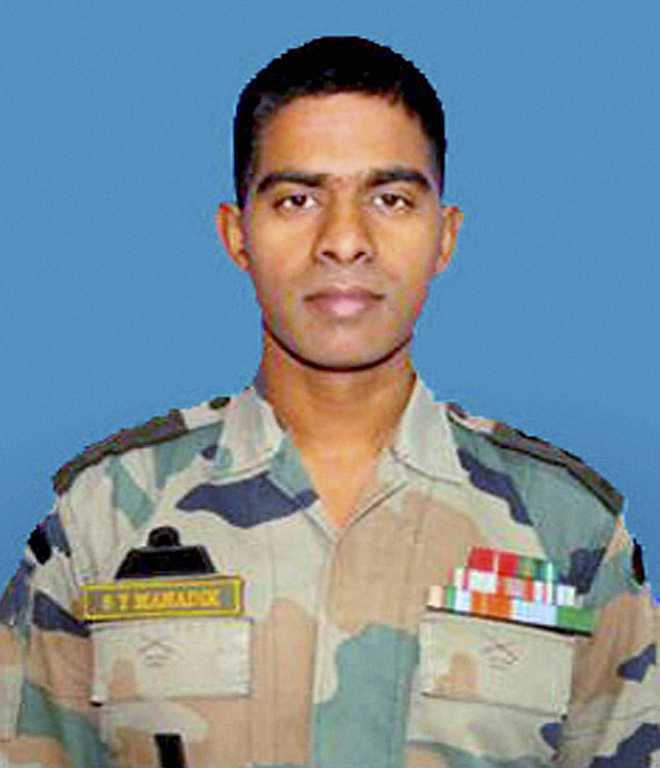
Col Santosh Mahadik

Mumbai, October 29

Classmates of an Army officer from Maharashtra, who laid down his life battling militants near the Line of Control (LoC) in north Kashmir’s Kupwara district last year, have sent 400 packets of sweets to soldiers in his unit.Col Santosh Mahadik, the Commanding Officer of 41 Rashtriya Rifles, was critically injured during the operation in the Haji Naka forest area of Kupwara near the LoC in November and succumbed to his injuries at a hospital later.“The boxes, weighing just over 300 kg, landed at Srinagar airport and are being sent to 41 Rashtriya Rifles for distribution among the soldiers the martyr once commanded,” a classmate of Mahadik, involved in this initiative, said.Col Mahadik was a student of Sainik School, Satara.“This Diwali, we thought of his comrades-in-arms, who suffer harsh climes and the enemy from across the border, as well as some within. We thought this would be a nice gesture for soldiers, who spend Diwali away from their families,” he said.An officer from the elite 21 Para-Special Forces unit, Col Mahadik was awarded a Sena Medal for gallantry during Operation Rhino in the North-East in 2003.Mahadik’s wife Swati last month joined the Officers Training Academy (OTA) in Chennai as part of the SSCW (non-technical) course for 11 months’ training before she joins the Army as a Lieutenant. An ace football goalkeeper, a skilled horse-rider and a passionate boxer, Mahadik was an all-rounder, his friends recall.Despite the inhospitable terrain that made the Kupwara operation immensely challenging, the Colonel particularly chose to lead his battalion.Mahadik’s classmates, including Manish Manidergi, Giridhar Kole, Deepak Patil and Shashikant Waghmode, have launched the initiative which they are calling ‘Operation Diwali’.Waghmode said, “I, along with my wife, was in his Regiment just before Diwali last year and she carried Diwali sweets for him. We miss him this Diwali.” — PTI