






Sanjha Morcha

Is there a Plan B? Now a brawl over surgical strike tapes

The temporary coagulation of political unity soon after the Indian army conducted surgical strikes in Pakistan has fractured. The two sides of the political coin are now locked in a sterile debate over the existence of the videos of the army’s strikes. This is symptomatic of the political leadership mixing up the means with the ends. The continuing slugfest over releasing the tapes hardly promises what the social media and ruling party politicians have primed the citizenry to expect — a teeth-grinding fight to the finish with Pakistan over terrorism. An alternative narrative suggests that the four-hour operation has chastened Pakistan into dumping terrorism as a geopolitical tool.Pakistan withstood 15 years of American diplomatic pressure and drone killings of top Taliban leaders. And now Kabul has been forced to accommodate the “butcher of Kabul” and ISI asset Gulbuddin Hekmatyar. Mercifully, the attack on the army camp in Baramula was unsuccessful. What if militants strike again with a large body count as in Uri? A repeat of the cross-border raid is ruled out. The only option for the government to hang on to its aura of machismo and sustain public expectations may be a full-blown war. Are we ready to pay the ensuing consequences of domestic economic distress and international isolation?  Talking of war, there are lakhs of inconvenienced civilians on Pakistan’s border with Punjab and J&K. The political accord between the Akali Dal, the Congress and AAP has dissipated amidst questioning about the purpose of their dislocation. Having taken a leap in the unknown, the onus is on the Modi Government to land on its feet. For this, the government needs an alternative plan to retain public support. If the Modi government opts for talks, it would begin to look like a soaped-up version of the Manmohan Singh government. The only difference was the UPA undertook covert cross-border forays that set the stage for dialogue while this government banks on over-the-top media exposure. Meanwhile, the nation stands diverted while both sides succumb to the lure of extracting political mileage.


Pak PM Sharif pins blame on India, says ‘we are against war

Pak PM Sharif pins blame on India, says ‘we are against war'
Nawaz Sharif. — AFP file

Islamabad, October 5

Asserting that his country wants peace and not war, Prime Minister Nawaz Sharif on Wednesday said Pakistan has done everything to bring India to the dialogue table but New Delhi did not let that happen.Addressing a joint session of Parliament, he also spoke about the ‘surgical strikes’ carried out by the Indian Army across the Line of Control (LoC).(Follow The Tribune on Facebook; and Twitter @thetribunechd)


“On September 28, India’s ceasefire violation resulted in the death of our two soldiers. It was befittingly responded and was conveyed that Pakistan Army is fully capable to respond to any aggression.”Apparently responding to Indian Prime Minister Narendra Modi’s statement that both nations should battle to eradicate poverty, Sharif said if New Delhi wants Islamabad to fight them to end poverty then the Asian neighbour should realise that “poverty cannot be ended by driving tanks on farmlands”.Sharif said within hours of the terrorist attack on the Indian Army camp in Uri, India started blaming Pakistan for it without carrying out any investigation.Sharif said Pakistan has a firm commitment to continue its support to “Kashmiris for their legitimate” struggle.The UN resolutions on Kashmir are still on the agenda of the UN Security Council and the international community should take immediate steps for implementation on these resolutions, Radio Pakistan reported Sharif as saying.Kashmir is “burning continuously like a volcano and a convoy of Hurriyat is on its way to achieve the objectives”, Sharif said.”Indian forces cannot suppress the struggle of Kashmiris for right to self-determination.”Meanwhile, the Pakistan Tehreek-e-Insaf (PTI) announced that it would boycott Wednesday’s joint parliamentary session on the Kashmir issue, with party chairman Imran Khan saying his party would no longer endorse this Parliament.”We fully back Kashmiris’ right to self-determination,” said Imran, adding there wasn’t much left for discussion in the joint session of Parliament.He said that Nawaz Sharif had lost the moral authority to stay as the Prime Minister and that Tehreek-i-Insaf would no longer endorse this parliament. — Agencies


NO 36-MONTH WAIT? INDIA MAY GET RAFALE JETS SOONER

PUNE: Defence minister Manohar Parrikar said on Sunday India might start getting Rafale fighter aircraft from France earlier than the agreed upon 36-month period.

“As per terms of the deal it is 36 months (during which the delivery has to start), but it may come slightly earlier. We have requested them to (deliver it) as fast as possible,” he said.

On September 23, India and France signed the much-delayed 7.87-billion euro (`59,000 crore approximately) deal for 36 Rafale fighter jets that will come equipped with latest missiles and weapon systems besides multiple India-specific modifications that will give the IAF greater “potency” over arch rival Pakistan.

The “vanilla price”, or the price of the aircraft lone, will be about 91 million euros for a single-seater and about 94 million euros for a two-seater.

Parrikar also said a 12-member committee to suggest structural changes in the military on cutting down flab and reducing revenue (maintenance) expenditure would soon submit its report.

The deal is crucial for the IAF that is grappling with a drawdown of its fighter fleet. The IAF has 33 fighter squadrons, each consisting of 18 fighter planes. It requires 45 combat units to counter a combined threat from China and Pakistan.

The delivery of the jets will begin in 36 months and will be completed in 66 months from the date the contract is inked.

The Centre had initially planned to purchase 126 fighter planes but later opted for just 36 jets in fly-away condition with PM Narendra Modi announcing the revised deal in Paris last year.


Army Chief reviews ‘operational preparedness’ along LoC

Army Chief reviews ‘operational preparedness’ along LoC
The General arrives in Udhampur

Udhampur/Chandigarh, October 1

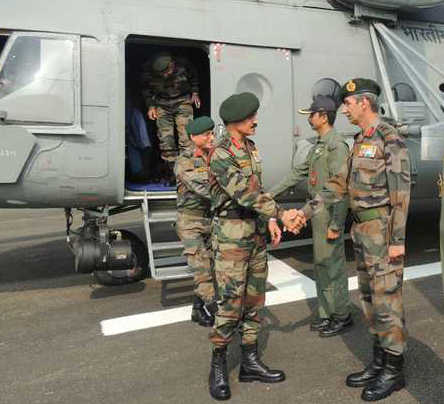
Army Chief General Dalbir Singh Suhag on Saturday visited the Northern and Western Commands to review India’s “operational preparedness” along the border with Pakistan in the wake of heightened tension between the two countries following the surgical strike at terror camps across the LoC.

The Army Chief was briefed by top commanders in both the crucial commands about the prevailing situation and their overall preparedness and contingency plans.

At the Udhampur headquarters of the Northern Command, which planned and executed the surgical strike, General Singh interacted with special forces personnel who successfully carried out the operation.

(Follow The Tribune on Facebook; and Twitter @thetribunechd)

He was briefed by Lt Gen DS Hooda, GOC-in-C Northern Command on the overall security situation in the Command theatre.

“The Army Chief interacted with the Corps Commanders and took a first-hand assessment of the prevailing security situation and operational preparedness,” a top Army official in the Northern Command said.

He said General Singh also interacted with the troops who participated in the surgical strike operation and conveyed his appreciation for the successful operation.

Singh personally complimented officers and men who “successfully” targeted seven terror launch pads located in Leepa, Tattapani, Kel and Bhimbar.

“The Army Chief was briefed on the operational matters by GOC-in-C, Western Command, Lt Gen Surinder Singh,” a defence spokesman said in Chandigarh.

“The Army Chief interacted with senior formation commanders and exhorted them to continue to maintain the highest vigil and alertness on the western borders,” he said.

Sources had said the decision on the surgical strike was taken soon after the attack on the Uri Army base on September 18. They said India was ready with contingency plans considering the possibilities that Pakistan may retaliate in the wake of the surgical strike.

It has been estimated that the number of casualties was at least 40 on Pakistani side but there was no official confirmation.

The Army has also trashed reports in Pakistan about Indian casualties during the operation, saying one member of the special forces received minor injury while returning but it was not due to any enemy or terrorist action. — PTI


As Always :: PM Modi celebrates Diwali with Indian Army in Himachal Pradesh

Prime Minister Narendra Modi on the auspicious occasion of Diwali on Sunday met jawans of the Indo Tibetan Border Police (ITBP), Indian Army and Dogra Scouts in Kinnaur district of Himachal Pradesh. Showering his praise on the armed forces guarding the nation, PM Modi dedicated this year’s Diwali to the jawans. PM Modi had earlier spent Diwali with soldiers of the Indian Army posted at the world’s highest battlefield of Siachen as well as the Dogra war memorial at Amritsar. He also made it a point to be in Srinagar before his visit to Siachen in 2014, in solidarity with the flood victims in Jammu and Kashmir.

PM Modi had launched a campaign named “Sandesh for Soldiers” to send Diwali greetings to those serving on India’s borders.

PM Modi took to Twitter to dedicate this year’s Diwali to the Indian army. He asked the nation to use #Sandesh2Soldier hastag and send Diwali greetings to the jawans.

Prominent celebrities like film actors Aamir Khan and Akshay Kumar as well as several Union Ministers have sent messages tagging PM Modi during the course of this campaign.

Addressing the nation in the 25th edition of his ‘Mann Ki Baat’ radio programme, the Prime Minister said that he was flooded with messages full of wishes and love for the jawans.

In a veiled reference to the unrest in Kashmir Valley, PM Modi also called for forces of unity to be strengthened and those of separatism to be defeated.

PM Modi credited the soldiers for maintenance of peace and security in the country and called upon everyone to remember their gallantry while celebrating Diwali.

PM Modi also made an unscheduled stop at Chango village, close to Somdu, to wish the local villagers on Diwali. PM Modi said that he was deeply touched by the impromptu reception from the people of Chango village.

PM Modi also posted a separate picture with a “young friend” in Chango village.


Government, Army reach consensus on the next COAS: Sources

pak-army

LAHORE (Saeed Chaudhry) – Lieutenant General Qamar Javed Bajwa is very likely to be appointed as the new Chief of army staff while Lieutenant General Zubair Mahmood Hayat as the new Chairman of Joint Chief of Staff Committee (CJCSC), sources told Daily Pakistan.

Sources confirmed that the decision was made after a consensus was reached between Government and military leadership.

The ongoing battle against the menace of terrorism across the country was the main ground on which the important decision was made, sources told Daily Pakistan adding that the recommended officials were the adequate persons for the task.

Lt. Gen. Qamar Javed Bajwa was previously Commander of important Rawalpindi Corps and was presently employed as Inspector General Training and Evaluation, at GHQ, a position General Raheel Sharif held before becoming the army chief.

Lt Gen Zubair Mahmood Hayat is the second in the seniority list of lieutenant generals. He was currently serving as Chief of General Staff (CGS) in GHQ.

Lt Gen Zubair served as Bahawalpur Corps Commander and Director-General of the Strategic Plans Division. He also served as General Officer Commanding, Sialkot. Lt Gen Zubair was due to retire on January 13, 2017.

The present Army Chief Gen. Raheel Sharif will retire on Nov 28 this year and Gen. Rashad Mahmood, who is the existing Chairman Joint Chief of Staff Committee, will be retiring a day prior to the Army Chief, on Nov 27.

https://en.dailypakistan.com.pk/pakistan/government-army-reach-consensus-on-the-next-coas-sources/


Defence personnel to get disability pension under old formula for now

Ajay Banerjee

Tribune News Service

New Delhi, October 29

The Ministry of Defence (MoD) on Saturday issued instructions to keep the disability pension of armed forces at previously allowed rates and there would be no reduction in the same.On September 30, the MoD had issued instructions, which had introduced a slab-based system for calculating pensions for disability. The MoD had cited the 7th pay commission for determining the disability pension for Defence Forces. Before September 30, disabled soldiers were getting pensions based on percentage of disability. The new ruling meant pensions were reduced and this had led to protests from the retired soldiers and there was widespread criticism from opposition parties and the military establishment.Defence Minister Manohar Parrikar had referred to the matter to the anomalies committee. Instructions issued on Saturday say that disability pensions will continue to be calculated at old rates that are percentage based. The system will continue until the committee submits a report, defence sources said.The Defence Ministry had previously said the 7th pay commission had recommended a slab-based system for determining disability pension, which was accepted by the government.A percentage-based system was followed under the 6th pay commission for calculating disability pension for armed forces as well as civilians. What the military personnel are upset about is that civilians will continue to be paid pension according to the earlier “percentage system”, which means that a civilian employee will get higher disability pension than his military counterpart.


Disability pension for forces under old formula, for now

New Delhi, October 29

The Defence Ministry on Saturday ordered implementation of the 7th Pay Commission’s recommendations on pensions but added the disability pension component will be paid as per the old system until the pay panel’s Anomaly Committee comes out with a solution.A ministry order, issued on the eve of Diwali, announced implementation of revised pension under 7th Pay Commission for pre-2016 defence force pensioners, said an official statement. It also said the issue of disability pensions — which is presently on percentage basis but the panel has recommended making it slab based — has been submitted to the Anomaly Committee, and, for now, the old system will continue.(Follow The Tribune on Facebook; and Twitter @thetribunechd)“The implementation of 7th CPC recommendation relating to methodology for calculation of disability element has been referred to the Anomaly Committee,” the statement said. “The disability element which was being paid to pre-2016 Defence Forces Pensioners as on December 31, 2015 will continue to be paid pending decision on the recommendations of the Anomaly Committee,” it said.As per the order, for those who started getting pensions before January 1, 2016, revised pension will be calculated by multiplying by 2.57 the old pension drawn in December 2015. A soldier getting disability pension as a percentage of his salary will get a fixed slab-based amount if the pay panel’s recommendation implemented. — IANS

Panel report awaited

  • The 7th pay panel favoured a slab-based system for determining disability pension, which was accepted by the government
  • But the matter was sent to the Anomaly Committee after pensioners demanded 6th pay panel’s percentage system to stay

MoD says rank-parity of forces to stay

MoD says rank-parity of forces to stay
Defence Minister Manohar Parrikar. File photo

Ajay Banerjee

Tribune News Service

New Delhi, Oct 27Two days after Defence Minister Manohar Parrikar ordered a cross-checking of facts on rank parity between officers of the three forces and civilians, the Ministry of Defence (MoD) on Thursday issued a clarification saying there has been no “downgrading” of service officers.The MoD said media reports had “erroneously” stated that the equivalence has been disturbed and status of service officers has been downgraded.“It is clarified that there has been no down-gradation or any change in the existing equivalence of the service ranks whatsoever”, spokesperson for the MoD said. The existing functional equivalence as clarified in 1991 and further reiterated in 1992, 2000, 2004 and 2005 has only been re-affirmed, the MoD said.There have been reports in the media that the central government has issued a new order lowering the status of military officers with respect to their civilian counterparts in the Armed Forces Headquarters.

(Follow The Tribune on Facebook; and Twitter @thetribunechd)

The MoD said: “The present reiteration of rank equivalence, is only for matters of assigning duties and functional responsibilities as is already existing in different offices of the respective service headquarters of the Army, Navy and Indian Air Force having component of service personnel as well as Civilian officers”.This has no bearing on civilian employees outside these offices of the service headquarters.A circular issued on October 18 and reported in media said a Major General (Rear Admiral in the Navy and Vice-Marshal in the Air Force) was at the same level as principal director at the Armed Force Headquarters (AFHQ) Civil Service. Similarly, Colonel had been placed on the same level as joint director on a civil post.
















































