Introduction
Xi Jinping the current Commander-In-Chief of Chinese Armed Forces has the Peoples Liberation Army (PLA) under his full control and is leaving no stone unturned to fulfil his Chinese Dream. Simplistically the Chinese Dream is based on two characteristics, “Strength and Wealth”. The PLA is the Hard Power of the People’s Republic of China and also has helped the Chinese economy to reach its current state. The Chinese Armed Forces are currently modernising exponentially. They are upgrading their systems and recently introduced reforms for their Armed Forces.
Reforms
Broadly the reforms are to improve theoretical and technological innovation, restructuring of the organisation to fight in an age of information. They are based on the White Paper published in 2015.
The first aspect is to clarify is that the three new services are the PLA Land Army (PLAA), the PLA Rocket Forces (PLARF) and the PLA Strategic Support Forces (PLASSF). The Land Forces would be the Army Component of the PLA, the PLARF would be the erstwhile Second Artillery of China and the PLASSF would be undertaking aspects pertaining to Cyber Warfare and Outer Space. The PLA Land Army would have a separate Headquarters like the Navy and the Air Force. The PLARF is rechristening of the erstwhile Second Artillery of the PLA. The force is upgraded to the same status as the Navy and Air Force. The overall structure remains the same .The PLASSF is a High Technology force with its focus on Information Warfare. This organisation would focus on Space Operations to include Reconnaissance and Navigational Satellites. Further it would combat Electronic Warfare and Cyber Warfare. The PLASSF puts the PLA in the era of Hi Tech combat forces.
Closely following the formation of the three new services was the restructuring of the Central Military Commission (CMC) in mid January 2016. The erstwhile four departments of the CMC have been reconfigured into six functional departments, three commissions and six offices. The six departments are Joint Staff, Political Work, Logistical Support, Equipment Development, Training & Administration Department and National Defence Mobilisation Department. The three Commissions are Discipline Inspection, Politics& Law and Science and Technology Commission. The six offices are the General Office, Administration, Auditing, International Cooperation, Reform & Organisation Structure and Strategic Planning Offices. The orders were given on 10 January 2016. These departments replace the General Staff, General Political, General Logistics and General Armament Departments.
The CMC would be would provide the leadership and command over the entire PLA. The entire control of all elements would come under the Chairman of the CMC. In the CMC, the Joint Staff Department would be tasked to carry out operational planning, operational logistics and formulate strategy for undertaking military operations. The Political Work Department would be responsible for the political orientation of the entire Armed Forces. It is pertinent to note that the PLA belongs and comes under the Communist Party Of China and there is a political commissar in each formation, unit, war ship, air base, missile base and training establishments. The Logistics Support Department would be responsible for the overall logistics of the PLA and the Equipment Development Department would deal with Research & Development as also acquisition and maintenance of military equipment. The Training and Administration Department would look after the leadership training of the PLA and the training establishments. The National Defence
Mobilisation Department would boost the quality of the reserve system to enable speedy mobilisation of reserves.
The three Commissions in the CMC have a significant role to play in the governance of the PLA. First of all the Discipline and inspection Commission will send inspection teams to various Theatre Commands of the PLA to keep a check on the organisational cohesiveness. The Politics & Law Commission would work towards enhancement of military governance and military law. Both these aspects are extremely important in a military set up. The Science and Technology Commission would be applying itself in the fields of Defence Technology. This Commission would integrate developments in the civilian sector and have its accent on self reliance and innovation.
The affiliated offices are to undertake the office aspects pertaining to the functions of the CMC. The Strategic Planning Office is to improve the Strategic Planning system. The Reform and Organisational structure office would be tasked to undertake military reforms. Military engagement and coordination would be undertaken by the International Military cooperation office. The other offices comprising Audit and Administration would undertake military audit and administration of the organisation of the CMC.
Theatre Commands
Further China has for a long time been practising War Zone style of undertaking operations since 2008. This primarily means optimising forces available to effect operations in a coherent manner. Often it meant troops of more than one military region undertaking operations together. Keeping this in mind China decided to transform the Seven Military Regions and form five theatre Commands. On 01 February 2016, President Xi Jinping officially inaugurated five theatre Commands representing geographic directions. North, South, East. West and Central. The Northern Command Headquarters is located at Shenyang, the Eastern Command at Nanjing, the Southern Command at Guangzhou, the Western Command at Chengdu and the Central Command at Beijing. The Theatre Commands are ready for Active Defence in comparison to the Military Regions being ready for multi layered defence. The exact boundaries are yet to be promulgated and the assets regarding the PLAN and PLAAF are being decided. All Commanders of the Theatre Commands belong to the Army. As per the Hongkong Press, the North Sea Fleet is to be given to Central Theatre Command, the East Sea Fleet is likely to be allotted to Eastern Theatre Command and the South Sea Fleet is likely to be allotted to Southern Theatre Command. Though the exact boundaries are under consideration a map showing the Theatre Commands is given below.
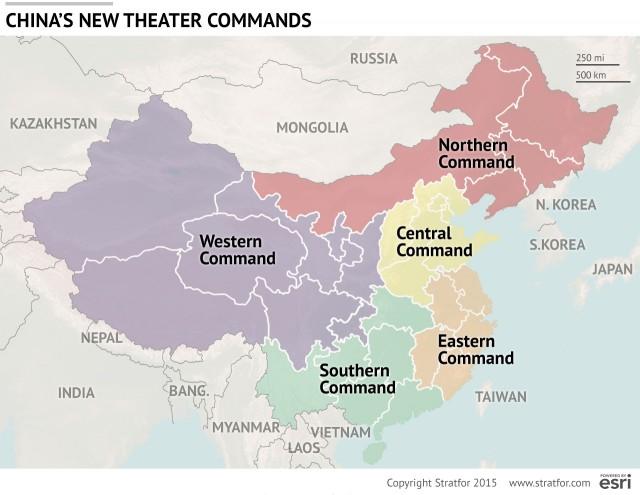
As shown in the map shows that the Northern Command would be dealing with Mongolia, Russia and North Korea. The Central Command would be interested in both the Koreas. Japan and possibly be a reserve for operations being conducted in other regions. The Eastern Command would be focussed on Taiwan. The Southern Command on Vietnam, Laos and Myanmar. The western Command has a large continental border and would deal with India, Bhutan, Nepal, Pakistan, Afghanistan, Kazakhstan, Kyrgyzstan, Tajikistan and Southern Mongolia. If the maritime threat to India is concerned it would be with the South Sea Fleet likely to be placed under Southern Command which would pose a threat to the Indian Ocean with further modernisation of the Chinese Navy.
Issues which Merit Importance
On 03 September 2015 Chinese President Xi Jinping announced that the PLA will reduce 300,000 troops. Xi made the announcement during a speech just before a massive military parade in Beijing held to commemorate the 70th anniversary of the end of World War II. This forms a part of the modernisation process where modern organisations call for an optimised rank and file. It is pertinent to note that even after cutting of troops China remains the largest Armed Forces in the World. The cut will be made in a manner so as to cause minimum turbulence. The recruitment process would enlist lesser personnel and those compelled to leave would undergo skill development training to be absorbed in State Owned Enterprises. Further the PLA continues to run a few business organisations despite Zhang Jemin’s directions of 1998. Overall the reforms are a continuation of the Revolution in Military Affairs set up by the PLA after the First Gulf War.
Need For Indian Armed Forces to Note the changes
. China’s official media continues to publicise articles intended to caution India that China retains the option of initiating military hostilities. Wen Wei Po a Hong Kong based daily owned by the People’s Republic of China with editorial staff from the CCP and controlled by the ruling Politburo Standing Committee, published an article in June 2013, captioned Six Wars to be fought by China in the next 50 years. It was reposted on a Hong Kong web site around middle of September 2013. The details of the authors background is yet to be ascertained the details have been possibly obtained from Chinese defence analysts. The article asserts that China can wipe out past humiliations and regain dignity only after it attains national reunification. The article visualises Six Wars would have to be fought by China in the next 50 years to achieve their goal. The Wars which are visualised are as under:–
-
Unification of Taiwan which is expected to be fought between 2020 to 2025.
-
Capture of Spratly islands in the South China Sea possibly in the timeline 2025 to 2030.
-
Re conquest of Southern Tibet (Arunachal) would possibly be undertaken in the years 2035 to 2040.
-
Capture of Diaoyu Island and Ryukyu island between 2040 and 2045.
-
Unification of Outer Mongolia between 2045 to 2050.
-
Militarily recapture territory lost to Russia between 2055 and 2060.
The anticipated six wars deal with reclaiming of the Chinese national territories lost since Imperial China was defeated by the British in the Opium
War of 1840-42. The first option that deals with Taiwan states that Taiwan must peacefully unite by 2020 failing which the country should be unified by War which should take place by 2025. This would be a test for the modernised PLA. The war would be difficult in case there is an intervention by USA and Japan. The author feels in such a case the War would last for six months otherwise for three months.
There would be a pause for two years after reunification of Taiwan. During this period China will send an ultimatum to the countries patrolling the islands in the South China Sea to withdraw with a deadline of 2028. The countries can preserve their investments followed by withdrawal. China anticipates Vietnam and Philippines to oppose the move and both of them will fight with possible assistance from the US. As per the author if concrete results are not attained by negotiations then the best option is for China to attack Vietnam. The reason is obvious as Vietnam is the most powerful country in the region. Victory over Vietnam will scare the rest. While the war with Vietnam goes on the other claimants would adopt a wait and watch policy. China is expected to beat Vietnam as per the author and thus China would establish its suzerainty over the entire Spratly group of islands.
The third War would be the reconquest of Southern Tibet (Arunachal) in the years 2035 to 2040. The article emphatically states that Arunachal as the only point of conflict between the two countries. It further notes the close relations between India, US, Europe and Russia. It assumes that during this period India would militarily lag behind China. However, war with India would result in victory after sustaining losses.
Accordingly the best strategy would be to initiate disintegration of the region. China should leave no stone unturned to instigate Assam and Sikkim to fight for independence. The other option is to provide state of the art weaponry to Pakistan which would enable the country to capture Indian part of Kashmir
by 2035 and thereby enable Pakistani control of the entire region. While the fight is on for Kashmir, China should launch a blitz attack to conquer Arunachal. As per the author, India lacks the capability to successfully fight a two front war. However, if this plan cannot be adopted, the other option is to launch a ground offensive to capture Arunachal (Southern Tibet).
It is pertinent to note that this article may not have emanated from high levels in China’s military establishment, but it iterates an issue often emphasised by the Chinese media that the country will have to ultimately resort to the use of the PLA to settle border issues. Articles of similar nature have been appearing in the Chinese press ever since Review of Asia policy was undertaken in 2011. China currently has clearly stated that its territorial claims are not negotiable and viewing this the Indian Armed Forces have to be prepared for the worst scenario which is a two front war.
The current Chinese reforms have led to jointness and enabled it to undertake future operations in Cyber Warfare and Outer Space. There is a dire need for the Indian Armed Forces to integrate to stand up to the new reforms undertaken by the PLA. As per these reforms the Western Command of China would face the Indian Army on its Northern and North Eastern borders. Threats from China have to be viewed also from the Maritime angle and in this case the Chinese Southern Command with the South Sea Fleet would be of importance to our country. From our side we have to see a new Force Structure within a decade to match Chinese continental and maritime capabilities. We must understand in the CMC there is a Chief of General Staff to coordinate all operations.
Currently, we dont have a joint structure to fight a two front war. After the Kargil War a committee under K Subramanian was set up to resolve this issue which submitted its report and the same was reviewed by a Group of Ministers in 2000. To improve jointness, there was need for a Chief of Defence Staff (CDS) and integration of the three services. In the 17 years that have elapsed we have established a tri service Headquarters of Integrated Defence Staff (IDS), a tri service command Andaman and Nicobar theatre command and a Strategic Forces Command. There is no jointness of command and control and the three services are operationally independent with limited coordination being undertaken by the Ministry of Defence. To find an answer to the current impasse, the Government had appointed a 14 member task force headed by Shri Naresh Chandra a former bureaucrat on 14 July 2011 to review the unfinished tasks of the Kargil Review Committee and suggest a plan of implementation. The panel completed the task and submitted the report. It is learnt that the Committee has recommended for a Permanent Chairman Chiefs of Staff Committee (PCOSC) and joint theatre Commands. There are reports in the print media which state that the Government is possibly going ahead with the proposal of a PCCOSC who would be a four star General. This would be the first step and is likely to take place.
While this is being processed, being a democratic country, it may be pertinent to note that we must look at the American and the UK experience of integrating their armed forces. The first step is the issue of Defence Policy Guideline. The US Secretary of Defence issues a Defence Policy Guideline which includes national security objectives and policies, the priorities of military missions and the availability of resources. This document is prepared with the advice from the Chairman Joint Chief of Staff. In our case the National Strategic Policy is not issued. At best a generic chapter on National Security Environment is included. Today there is no single point military guidance on strategic matters to the Defence Minister and Prime Minister. On most of the occasions it is the Defence Secretary who is coordinating military issues. This is certainly incorrect for a country fighting insurgency and dealing with sensitive borders. Presently there is no unified action and a lot depends on individual perception of a situation which often leads to lack of optimisation of resources in dealing with critical situations.
Need for a joint structure
The present organisational structure is not suitable from the security point of view. Our nation is fighting insurgents and in a worst case scenario should be prepared for a conflict on two fronts. With each service viewing from its own perspective, the nation will not be able to take a unified pro active stand with panache and precision. We have currently 18 Service Commands. To respond effectively to any situation there is a need for a unified Theatre Command Headquarters under a Chief of Defence Staff (CDS). All of us should look at national objectives, rather than guard our turf and procrastinate on this critical subject. The organisational structure should have the Chief of Defence Staff (CDS) with the joint commands responsible for the operations and the Service Headquarters would be responsible for acquisition of equipment and training.
The role and mission of the CDS would be the principal military adviser to the Government of India. He would have direct access to the Raksha Mantri and the Prime Minister. The three Service Chiefs would function under him. There would be broadly two types of theatre commands. Northern, Western and South Western Commands would comprise of Army and Air Force units where as Eastern, Southern, Andaman& Nicobar, Strategic Forces and Training Commands would be tri service in composition. This will enable us to undertake network centric warfare with speed and precision. The inter service structure would improve our logistics and improve our acquisition of equipment which would enable us to modernise and thereby enhance our capability development. This process has to be undertaken by Parliament as the services would try and guard their turf. In the current situation if we accept the post of PCCOSC, he would be able to currently look after the following:-
-
Andaman and Nicobar Command.
-
Strategic Forces Command.
-
Acquisition of all equipment of the three Services
-
Possibly handle the three new Commands which would be Cyber, Special Forces and Outer Space.
Overall this organisation would be too little to make a substantial difference. In our present context a War against China which involves the Eastern portion of the country, we have the Eastern Command of the Army located at Kolkata, the Eastern Command of the Navy located at Vishakapatnam and the Eastern Command of the Air Force located at Shillong. In the current environment despite a PCCOSC each Service would be fighting its own War. This is inappropriate and there is a need for joint theatre Commands. Without jointness it is not possible to even handle internal situations.
Way Ahead
The Armed Forces need a joint structure and this has to be a political decision. The United States is now planning to proceed to Goldwater-Nichols Act 2.0. Senator John McCain the Chairman of the Senate Armed Services Committee has started the process of transforming the Jointness which is in vogue since 1986. We also need to visualise our requirement and undertake jointness at the earliest to ensure operational effectiveness.
India would have to be prepared for a two front war and internal problems. The Government would need a Chief of Defence Staff who would have the following Joint Theatre Commands:-
-
Northern Command, Western Command and South Western Command comprising of Army and Air Force.
-
Eastern Command, Southern Command and Andaman& Nicobar Command comprising all the services.
Apart from these there would be the Strategic Forces Command, Cyber Warfare Command, Special Forces Command and Outer Space Command. These organisations must look at our operational challenges and should not be based on current requirements of the Services. The Raksha Mantri who has signed the LEMOA with the US and back from a visit to China must study their organisations and appoint a Committee to look into all papers on the subject and make a realistic assessment. This should be submitted in a year to the Government and should have no extraneous consideration.
By 2030 the Indian Armed Forces with their Joint Theatre Commands should be able to be a vibrant force capable of fighting a two front war and dominate our Area of responsibility from the Persian Gulf to the straits of Malacca.nclusion
There is a need to seriously look at the reforms undertaken by the PLA. The newly formed Joint Theatre Commands would be in place by 2020. Viewing China’s timelines it is essential that we wake up and improve our Force Structure to meet the Chinese continental and maritime challenge.
READERS COMMENTS
Dear Sirs,
NEED FOR INDIAN ARMED FORCES TO RESPOND TO PLA REFORMS By Major General P K Chakravorty
1. It indeed is a seminal work of a very high order. Normally, I do not read such lengthy Dissertations but it is due my personal respect for the love you have for the country.
2. India’s biggest strength is Democracy and its biggest enemy is Democracy itself. India’s Political Leadership publically fears so much over Military take over but its real time is spent on SAUDAGRS/Comrades– continuous sniping that no Military is required for Regime Change.
3. The Chinese have found a simple solution for it. In a Democracy there is a separation of Power between Executive, Legislature and Judiciary with nominal titular Head, the President.
Chinese have separated the Military and combined the Executive, the Legislative and Judiciary, both come under the Communist Party with Common Executive President for both and the same person is the boss of the Communist Party. Thus Xi is the Supreme Leader of China in all its facets.
Tragically, the Indian TRISHUL is busy destroying each other. India has the option of revisiting its Constitution now or after it is BALKANISED.
4. General Sahib talks of 6 Wars the Chinese are preparing to win by 2050. He has missed one critical point. In Chinese vocabulary, Peace and War are a continuum. Already by 2016, most of their Wars have been won by Economic Interdependence and by strife within & their 6th Columnist Constituencies. Indian Areas of Arunachal Pradesh, Sikkim, Bhutan are already de-facto their vassal constituencies. One Road and One Belt and CPEC would give them Indian Kashmir. Assam and NE are already destabilized via Bangladesh and Myanmar. Nepal is neutralized. They are supplied with Chinese Arms and funding by the West.
5. Russia has already given their Far East to 2 Million Chinese working there. Along with that goes Outer Mongolia to Chinese Inner Mongolia. New Taiwanese President is making a bee line to China for talks and prosperity. With US not willing to put its boots down in and around South China Sea, Central China Sea and Sea of Japan, the numerical strength of Chinese HUNS is very large every where. Who is going to get the Chinese to vacate them.
6. General Sahib suggestions are similar to the beaten trail of late K Subramanium. Jointness is asked for but the suggestions have no flavour of Jointness, as the 3 Armed Forces mutually distrust among themselves and are putting road blocks for each other to the glee of HUKMARAN. All playing into the Chinese Time Frames of their 2050 World Order.
7. Goa would have shown the limits of Indian Diplomacy which does not want to walk the Talks with Military. And China and Russia have thwarted all Indian Diplomatic initiatives and which have been unfruitful on Terrorism . The History shows that Gains are achieved only on the Ground by Military, and then must be held by wise Leadership. World does not give anything to a Democracy Weakling.
With best regards,
Commander Prem P Batra Retiredgen









 People from border villages at a relief camp in Chabhal, Punjab, Friday. (Source: Express photo by Rana Simranjit Singh)