Sanjha Morcha

Family prays for soldier’s safe return from Pak

PUNE/NEW DELHI: The fate of an Indian soldier who inadvertently crossed the Line of Control on the day of the surgical strikes remains uncertain, with efforts to bring him back proving fruitless so far. Chandu Chavan, who was serving with 37 Rashtriya Rifles, has been in the custody of the Pakistani army for more than three weeks.

AP FILEChandu Chavan, who was serving with the 37 Rashtriya Rifles, inadvertently crossed the LoC on the day of the surgical strikes.

Army sources said the directorate general of military operations had taken up the issue twice with the Pakistani army but had made no headway in securing Chavan’s release.

“We will continue to make efforts to get him back. It’s not uncommon for soldiers from either side to stray across the LoC and there’s a mechanism to send them back,” said a senior officer.

The 22-year-old soldier’s family has been under tremendous stress since the news broke on September 29 — his grandmother died of a heart attack two days later. His brother Bhushan, who is also in the army and posted in Jamnagar, has taken leave to be with the family that lives in a village near Dhule.

Chavan’s sister-in-law Sheetal said that the government had informed the family that it was making all-out efforts for the soldier’s return. “We have been told that process was going on, which takes minimum 20 days,” she told HT. However, that time has already passed.

“We received two shocks: the incident involving Chandu and then the death of grandmother. Lot of people visited us to express their sympathies but our lives have not been normal,” she said.

Chavan’s parents died when he was two years old and grandmother Lilabai took care of her two grandsons.

“My husband is disturbed. He is not even taking his meals,” Sheetal said.

Top ministers have been in touch with the family and assured that the government was trying its best to bring him back. However, with every passing day, anxiety levels are only increasing.

Chavan had plans to visit his village, Borivihir, around Diwali. Sheetal said, “We had big plans for him and would have finalised his marriage during Diwali.”

Several of Chavan’s relatives are serving the army and the family is proud of its military tradition.

Family members described him as a soft spoken and wellmannered person. “He is a family person. Both brothers are attached to each other as they lost their parents during childhood,” said a family member.


Air Force board celebrates IAF’s 84th anniversary

Tribune News Service

Dehradun, October 15

The 1 Air Force Selection Board (AFSB) conducted week-long activities from October 3 to 8 to commemorate the 84th anniversary of the Indian Air Force.Various events were conducted which included Bara Khana for all personnel and a volleyball match.An oath was administered to all personnel of the Board by Air Commodore Nitin Sathe, Air Officer Commanding. On this occasion, the AOC presented the CAS commendation to Wing Commander BM Lathika for her meritorious service and also appreciated 16 air warriors and civilians for their hard work and contribution towards the board.Air Commodore Nitin Sathe, Air Officer Commanding, felicitated all air warriors, civilians and their families and complimented them for their efforts. He urged all personnel to continue to work hard with the same zeal and devotion and bring laurels to the country. He exhorted all personnel to be prepared for all contingencies.


Delegitimise all terror groups, go after terrorists: US to Pak

Washington, October 15

Delegitimise all terror groups, go after terrorists: US to Pak

The US has told Pakistan to go after those terrorists who seek and “sometimes find safe haven” in the country and delegitimise all terror groups operating on its soil.

“We continue to urge Pakistan to take action to combat and delegitimise all terrorist groups operating on its soil,” State Department Deputy Spokesman Mark Toner told reporters at his daily news conference.

“Obviously Pakistan has suffered greatly at the hands of terrorists and violent extremists. We want to help Pakistan confront this terrorist threat, but we also want Pakistan also to go after those terrorists who seek and sometimes find safe haven on Pakistan territory,” he said in response to a question on Friday.

(Follow The Tribune on Facebook; and Twitter @thetribunechd)

His remarks come amid heightened tensions between India and Pakistan following the Uri terror attack in which 19 Indian soldiers were killed and India’s surgical strikes on seven terror launch pads across the LoC on the intervening night of September 28 and 29.

Earlier this week, in a clear indication of its support to India’s surgical strikes in PoK, the US said it empathises with the Indian position that it needs to respond militarily to terror threats and dubbed the Uri attack as a “clear case of cross-border terrorism”.

The US had also called for greater cooperation and dialogue between India and Pakistan to bring down the recent tensions and said that they should adopt a “conciliatory approach” to resolve their “contentious issues”. — PTI


US rules out treaty alliance with India, says that era is over

US rules out treaty alliance with India, says that era is over

Washington, October 13

The US has ruled out any kind of treaty alliance with India, saying the 21st century is not an era of alliances and a mutual agreeable concept of major defence partner is a very apt description for India.

“The 21st century is not an era of alliances. It is an era of identifying interest, common values and working together in solving all those problems. I do not think that anyone in the United States Government or the Indian Government has any compulsion at all to form a treaty alliance,” said Peter Lavoy, Senior Director for South Asia at the National Security Council (NSC), White House.

He was responding to a question at the Center for Strategic and International Studies (CSIS), a top American think-tank.

“Why have that shackle (of being a treaty alliance). I think, the friends that benefit from that are probably satisfactory. I would highlight a phrase that should not be underestimates – Major Defence Partner (with India),” he said.

“There was an understanding, growing perception that we have been doing so much together that we have expanded, deepened the boundaries of co-operation. But there was no brand or phrase or some term that qualified what this relationship is about. I think, the mutual agreeable concept of major defence partner is a very apt description,” he said.

“It was largely driven by the extent of deepening co-operation. India achieves success rate of 99 per cent in licenses applied for. That is really astounding. Other kinds of technology is being transferred much more easily and readily than ever before. So there are very significant changes to our own policies and rules and procedures that enabled this defence partnership,” Lavoy said.

Lavoy said even before India places a request for something, the United States is ready and prepared.

“Well before a challenge arises, we are already working with India to try to prevent the things from occurring,” he said.

“Each of the (US) departments has installed in them the critical importance of this partnership and have internalised thinking about India’s interest, thinking about our joint interest as a driving force and how we do business.

That is completely transformational. That was not the case even in the beginning of the Obama Administration,” he said. — PTI

Read more at http://www.tribuneindia.com/news/nation/us-rules-out-treaty-alliance-with-india-says-that-era-is-over/308995.html#Y4gXHjmoVVzKLUmC.99


Indian Army was set to cross LoC in 1999, Vajpayee stopped us: General V P Malik

Malik said he was “very unhappy” when Vajpayee asked to “let go of Pakistan”.

Express News Service | Ahmedabad | Updated: October 11, 2016 3:51 am

surgical strikes, indian army, army strikes, india pakistan, india strikes, LOC, border strikes, atal bihari vajpayee, general malik, terror activities, pakistan terrorism, indian express news, switch global expo, india newsGen V P Malik in Vadodara on Monday. Source: Bhupendra Rana

Extending “full support” to Indian Army’s surgical strikes along the LoC, General (retd.) V P Malik, who was the Army chief during the Kargil episode, on Monday said the Indian forces were all set to enter the Pakistan-occupied territory in 1999, but they were stopped by the then PM Atal Bihari Vajpayee following international pressure.

“After the surgical strikes, we don’t have to beg to the international community (to build pressure on Pakistan to stop supporting terror activities against India). We have to tell them that if they (Pakistan) continue to do this, we will have to go to war,” he told the audience while delivering a speech on leadership and motivation during the ongoing Switch Global Expo here.

Later, taking a question from the audience during an interactive session — most questions pertaining to the heightened tension between India and Pakistan — Malik said, “I am not optimistic that Pakistan will change after one surgical strike. We must be prepared for more action from them and more reaction from us.

Taking an exception to the war of words between the ruling BJP and opposition parties Congress and AAP over the surgical strikes, he said, “We have to tell them that when it comes to national security, we must work together. Also, politicians who do not have the knowledge about national security should not speak (on the matter).”

Drawing references to the 1999 Kargil conflict, Malik said the Army was ready to cross the LoC to retaliate the Pakistani incursion, but it was stopped by Vajpayee. Malik said, “On June 2, PM Vajpayee told the Army not to cross the border. The then national security adviser Brajesh Mishra had said in an interview that the Army was told ‘not to cross the border today, but we don’t know about tomorrow’.”

Malik said he was “very unhappy” when Vajpayee asked to “let go of Pakistan”. He said, “It required three long meetings in a single day and a lot of convincing from the then prime minister to make me let them (Pakistan) go. I was unhappy and so were the soldiers. Among the many reasons, one was that the international community pressuring India… another was the general elections (held later that year). In the hindsight, it was a right decision.”


Help destroy terror pads: Parrikar Asks ASEAN to ‘cooperate unreservedly’ to end menace

Help destroy terror pads: Parrikar
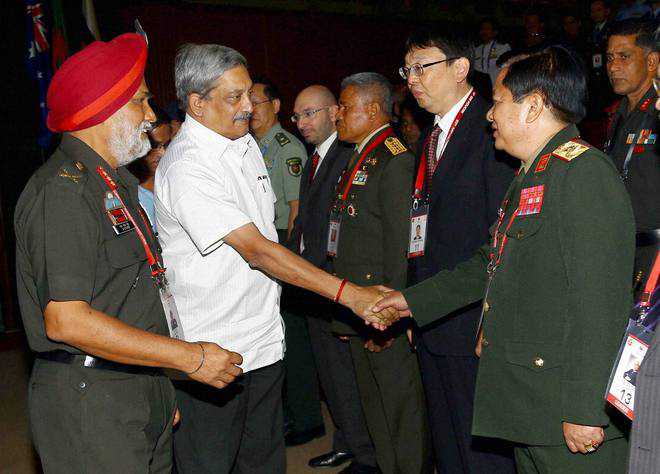
Defence Minister Manohar Parrikar meets heads of the delegations of 20th ASEAN Regional Forum in New Delhi on Thursday. PTI

New Delhi, October 6

Terming terrorism as the foremost challenge in the region, Defence Minister Manohar Parrikar today said it should be delegitimised as a state policy and urged ASEAN countries to “cooperate unreservedly” to locate and destroy terror networks.Security frameworks in ASEAN region still do not give enough attention to terrorism. This must change, he said at 20th ASEAN Regional Forum Heads of Defence Universities Meet here. “Terrorism remains the foremost challenge to our region. “We need to oppose terrorism resolutely everywhere, delegitimise it as an instrument of State policy and cooperate unreservedly to locate and destroy terrorist networks,” he said.The Association of Southeast Asian Nations (ASEAN) has the Philippines, Singapore, Thailand, Brunei, Cambodia, Indonesia, Laos, Malaysia, Myanmar and Vietnam as members.Parrikar’s remarks came on a day when terrorists launched another attack on an army camp in Jammu and Kashmir. Three terrorists, believed to be Pakistan backed, were killed in the attack on the army camp Kashmir’s Kupwara district.Nineteen soliders were killed in a militant attack on an army camp in Uri on September 18. The Army had launched surgical strikes targeting terror camps located across the LoC on September 28 night. — PTI


Refugees again

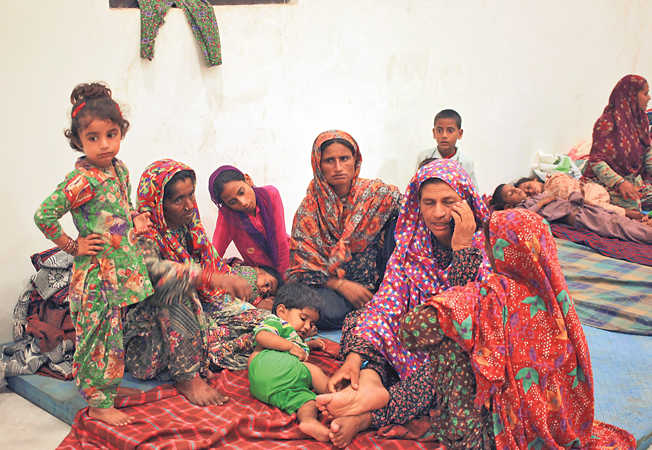
People have spent days bearing hunger, thirst and discomfort in hastily set up makeshift camps. It looks like evacuation was a just a bit of choreography to fluff out the “surgical strike” drama.

Refugees again
At the receiving end: Villagers in a relief camp after being evacuated from their village near the border with Pakistan in Ranbir Singh Pora, southwest of Jammu. Reuters.

ALTHOUGH newspapers and news channels have thumped the “surgical strikes” story non-stop ever since September 29, precise information on this strike has yet to emerge. Initially, an Army general was shown on television saying that soldiers crossed the LoC and inflicted “heavy casualties” on terrorist camps. Clumsy visuals showed soldiers sliding down from helicopters. The next day,  junior Information Minister Rajyavardhan Singh Rathore denied that there were aerial strike and said helicopters were not used. Pakistan  denied that there were any strikes at all. Supposedly, Indian soldiers struck seven camps but where exactly were these camps and what were the casualties inflicted?Why isn’t full, exact information being released? One possible explanation is that the government (and ruling party) want to give the impression that the operation was much more heroic that it actually was. If it turned out that the targets were easy “small potatoes” of little military value, then coming out with the specifics would invite ridicule — and this can’t be good with four states gearing up for the Assembly polls within the next few months.As a consequence of the “surgical strikes,” people living in villages along the international border in Punjab were ordered to leave. The implementation of this order has been haphazard. Some left, some did not.Reporters who have visited the border have found that the Indian Army is conspicuous by its absence — here and there BSF jawans stand guard at bridges. That is about the extent of heightened military readiness to meet a Pakistani attack. If the threat of attack is not to be taken too seriously, then why were villagers ordered to be evacuated from their homes? Lack of securityA reporter for The Wire noted: “In over two hours spent travelling through the villages in the border district, no military personnel inquired about who they were, checked their papers, or even examined the contents of their car — most hotels in New Delhi appear to have higher security.”From the farmers’ point of view, this “surgical strike” couldn’t have come at a worse time. The rice crop is ready for harvesting. The Government of India says nothing about compensating the villagers for loss of crop or livelihood on account of this untimely hiatus. People have spent days bearing hunger, thirst and discomfort in hastily set up makeshift camps and increasingly, it looks like the evacuation was just another bit of choreography to fluff out the “surgical strike” drama.As it is, a farmer whose land is next to the border fence gets the short end of the stick. He is restricted to just a few hours each day in which to cultivate his crop. If he can manage to sell out, then he can buy land somewhere else — but since nobody can effectively cultivate this land, who will buy it? When land is acquired for constructing national highways, land-owners are compensated. The farmers whose land lies in the 1.5-km wide strip next to the border fence should be paid for their land so that they too can relocate. It is only fair to cover their loss.Years ago, the Government of India proposed to evacuate a five-km wide strip of land within the actual border of India and turn it into a no-man’s land. This plan was reversed only after a prolonged effort by Punjab human rights’ groups. However, the government still insisted on keeping a 1.5 km strip cleared on the Indian side of the border. How does the government then maintain that every inch of land in India is equally sacred?

Immune to war hype

People have grown immune to the hype over the years. When there is a lot of it, people automatically look around to figure out what it is that the hype-mongers want to distract them from. Things are not looking too good for the BJP in Gujarat and Uttar Pradesh. Voters in Punjab are fed up with the ruling SAD-BJP alliance. The party is facing the anger of Dalits all across India. In the South, even erstwhile supporters are deserting the party over the Cauvery issue. Were the “surgical strikes” supposed to make us forget about all these things?When things are not going well domestically, the time-honoured response is to whip up turmoil on the international front. Indira Gandhi invariably trotted out the “foreign hand” to maintain her grip at home. It’s nothing new: way back in 1597, Shakespeare was writing the scene in Henry IV in which the dying king advises his son: “Be it thy course to busy giddy minds with foreign quarrels; that action, hence borne out, may waste the memory of the former days.” One is reminded of a limerick: I like to see the rooster crow He’s like so many men I know Who brag and bluster, rant and shout And beat their manly breasts without The first damn thing to crow about.The writer, a human rights’ activist, is the Chairperson, Movement Against State Repression.


Will war rhetoric defeat development agenda?

MG Devasahayam
There is the same disturbing pattern that continues —confusion in command and control, abysmal physical security measures, leadership without responsibility, and political one-upmanship. Add to this, the media nautanki and Paki-bashing. The game of warmongering continues. However, we do need to ask a few tough questions.
Will war rhetoric defeat development agenda?
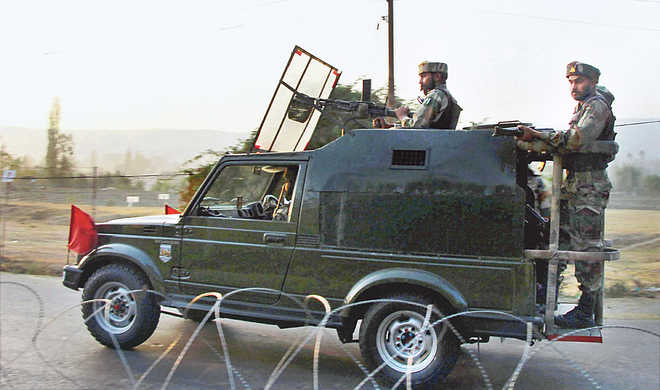
Cost of subconventional war: Soldiers move around during an encounter with the militants after the recent attack on an Army base camp in Baramulla district of north Kashmir. PTI

ALL that Lt Gen Ranbir Singh, Director General Military Operations said in the afternoon of September 29 is that there were limited “surgical strikes” across the border to foil the attempts of terrorist teams planning to carry out infiltration and terrorist attacks in India resulting in “significant casualties” on them. He was emphatic when he said: “the operations aimed at neutralising the terrorists have since ceased. We do not have any plans for continuation of further operations.” But media pounced on it and along with assorted columnists/journalists, ex-diplomats, ex-Generals and party hawks went for the kill with unabashed hatred-peddling. As if eye-witnesses, they rattled out the number of launch pads  attacked, Army units that conducted the strike, number of soldiers in the strike force, distance the soldiers walked, weapons used, ammunition fired and precise number of terrorists killed. They also talked of intense diplomatic engagement by National Security Advisor (NSA) and Foreign Secretary and the critical conversation between the former and his US counterpart. Nothing was left to the imagination. Electronic media went ballistic and encouraged use of expletives and jingoist language. Anchors and panellists did not separate fact from fiction. They just chose to be cheerleaders of the government and its spin-doctors. Saner voices were shut down as heretic. Debates were so scary that there was panic all over as if war was imminent. People living in the border areas of Punjab evacuated their abodes, abandoning crops ready for harvesting. Soon enough the cat was out of the bag. Mukesh Aghi, president of  the US-India Business Council, a business advocacy organisation working to boost India-US trade, made a brazen statement that the expected increase in India’s defence spending due to the current stand-off with Pakistan has presented a “tremendous opportunity” to major US companies including Boeing, Lockheed Martin and Raytheon to expand their Indian operations. He went on to say that the technology on big- ticket items will definitely come from the US, either from the aircraft carriers or secured communications or from the missile side! The military view, echoed by some former Generals, is that the successful “surgical strikes” could kick-start a new phase of confrontation between India and Pakistan, possibly characterised by wholly new strategies which will be tested over time and refined.  The big question is: confrontation for what purpose — to wage another full-fledged war after 45 long years? Unfortunately, an analysis of various reports shows that it is highly unlikely that India has the artillery and ammunition resources even to fight a limited war like Kargil. On war India has three options-conventional, sub-conventional and nuclear. An all-out nuclear war is out of question. Sub-conventional warfare involves stealth attacks and guerrilla tactics, similar to the Army’s surgical strikes. The third option is conventional warfare. Notwithstanding the importance of regional, strategic and political considerations and all that is lost in the rhetoric, the truth is India is not economically prepared to wage war in this manner. In any conventional warfare with Pakistan, it is the Indian Army that will be at the forefront. As of now, the revenue to capital ratio of Army spending is highly skewed in favour of the former as much as 85:15. This indicates that a large amount of budget spend for the Army is towards pay and allowances rather than for capital expenditure. Further examination of data suggests that ratio of indigenous acquisition to foreign sources for the Army is approximately 70:30. Since the Army’s artillery and ammunition needs are exclusively met by ordinance factories (OFs) it is over-dependent on domestic acquisition. This has made army very vulnerable in terms of its war wastage reserves (WWR). As per the Army’s operational doctrine, India is required to maintain a WWR of 40 “days of intense war” (war (I)). After the Kargil war of 1999, the Army headquarters introduced a new target of Minimum Accepted Risk Level (MARL), which was set at 20 war (I). The findings of a CAG report show that the Army’s current WWR stands at a critical low of 10 war (I) or even less as of March 2013. As per data in the report, of the 48 ammunition categories audited by CAG, it was found that OFs were unable to meet their production targets across 52 per cent of the product categories. Of this 52 per cent, in 23 per cent of the product categories, the shortfall was well over 50 per cent. The Army top-brass has been continuously pointing out this severe flaw to the government, but to no avail. Realising these constraints and shortfalls, they have been reticent and restrained. Coming to brass-tacks, the surgical strikes are the fallout of the failure of the Uri Brigade commander to secure his base, which led to his removal from that position. But retired Army brass insists it was an institutional weakness and not command failure. They want citizens and even uniformed personnel to be better sensitised about national expectations versus national willingness to part with more resources for defence and security. One of them has gone to the extent of asking the Army to unequivocally state that the nation will get the security it pays for and no more. One wonders whether mercenary language is creeping in! These worthies should realise that Uri closely followed the Pathankot air base mess-up by the Indian Air Force, National Security Guards, Indian Army and Defence Security Corps all put together. A disturbing pattern continues —–confusion in command and control, indifference to warning of a terrorist attack, abysmal physical security measures, leadership without responsibility, incoherent public communication and political one-upmanship. Added to this is the same old media nautanki and Paki-bashing. The regime change in 2014 has not made any difference. Why this? The answer is not far to seek. Despite the cacophony of reforms, ‘Make-in-India’, FDI, and what not, India’s basic governance and administration is at its nadir and national security forms part of this basic. In the event, India does not even have a national security architecture. We have Ministries of Home and External Affairs responsible for internal security and foreign affairs respectively. But we have no geopolitical-based foreign policy or national security system. Instead we have the NSA, an office that has neither institutional sanction nor parliamentary accountability. It is this entity which is in command of all affairs concerning external and internal security. We saw this happening in Pathankot and now in Uri, wherein the Army Chief was playing second fiddle. Unless this severe malady is addressed with urgency and remedied any amount of warmongering will be of no avail and India will continue to remain a nation sans security. There is a famous saying: “Freedom is the outcome of the tranquility of peace.” Without these two attributes in a nation there cannot be any “development.” War is the enemy of freedom and peace and, therefore, that of “development”. The question in everyone’s mind is whether Prime Minister Narendra Modi is abandoning the “development” agenda by drumming up the war cry. Or is it to cover-up the failure of this agenda in the first half of the Modi government? Will not warmongering, using soldiers as cannon-fodder, divert scarce resources towards massive arms purchase? Will this cost India security and development? These questions need to be asked and answers found. The sooner, the better. The writer is a former IAS officer .


5 injured in Pak shelling in Poonch

5 injured in Pak shelling in Poonch
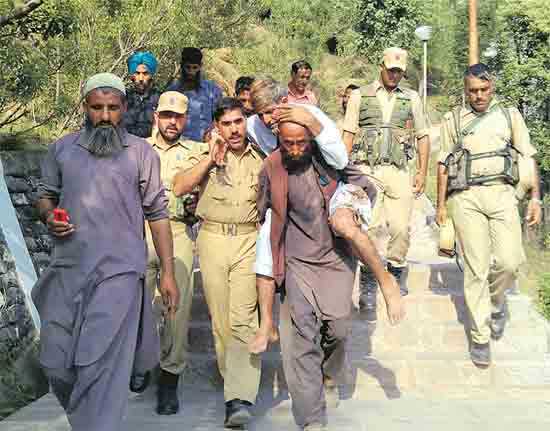
Civilians being evacuated in Guntrian sector. Tribune photo

Arteev Sharma & DK Sudan

Tribune News Service

Jammu/Poonch, October 3

The Pakistan army today again violated the ceasefire at three places along the Line of Control (LoC) by resorting to unprovoked heavy shelling and firing on forward villages in Poonch district, resulting in injuries to five persons, including four women.Pakistani troops targeted seven-eight forward villages along the LoC, with 82 mm and 120 mm mortars, and heavy machine guns, forcing villagers to run for shelter.The intense shelling and firing comes against the backdrop of an unsuccessful “fidayeen” attack in Baramulla last night and the two-day visit of Union Home Minister Rajnath Singh to Ladakh beginning today.Sources said the Pakistani troops violated the truce between the two countries in Shahpur and Saujian sectors along the LoC in Poonch.“The Pakistan army targeted Kranti post in Krishna Ghati sector at 1 am and firing continued till 1.45 am. Our troops gave a calibrated response,” sources said. Pakistan troops again violated ceasefire at Shahpur and Saujian sectors along the LoC in Poonch in which three civilians, including two women, were injured.In the Shahpur sector, Pakistan troops resorted to heavy shelling and machine gun fire at 10.45 am. The firing continued till late this evening. Another ceasefire violation was reported at the Saujian sector. The firing started at 11.20 am. Heavy loss to civilian property has been reported in the shelling. However, there was no report of casualties on either side.“Five persons received splinter injuries after a shell from across the LoC exploded in Qasba and Gagrian villages of Shahpur sector. A woman Special Police Officer was also among the injured. She had gone to meet her relatives in Qasba,” sources said.The injured were identified as Ghulam Hussain and Raseela Bi, both residents of Qasba village, Uzma Bi (18) and Haneefa Akhtar (17), both residents of Gagrian village, and woman SPO Shah Begum. The injured were shifted to Poonch district hospital.The shelling from Pakistan side also created among the people in Gali Maidan area of Saujian sector after some containers filled with kerosene caught fire at a joint base camp of the BSF and the Army. “Some civilians were injured in the firing along the LoC as Pakistani troops targeted forward villages in Saujian and Shahpur sectors,” Mohammad Harun Malik, Deputy Commissioner, Poonch, said. The administration had asked civilians to move to safer places, he added.In the Gali Maidan area of Saujian sector, some kerosene containers caught fire after a shell exploded near the joint Army-BSF camp there. The Deputy Commissioner said some shops, mainly kiosks, outside the joint Army-BSF camp were gutted after the kerosene containers caught fire. While sources put the number of damaged shops at 11, the DC said the exact number was yet to be ascertained. “We have sent a naib tehsildar and the SHO concerned for assessment of loss to the shops,” he said.


BSF fires in Gurdaspur

BSF fires in Gurdaspur
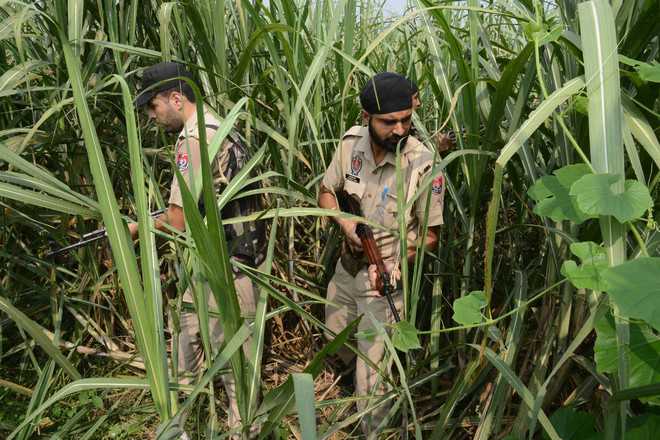
Punjab cops conduct a search in a cane field near Chakri post. afp

Ravi Dhaliwal

Tribune News Service

Dorangla (Gurdaspur), Oct 3

Border Security Force jawans fired in the air after noticing some suspicious movement across the barbed wire fencing near the BSF Chakri post late last night, igniting rumours that an “intrusion bid” had been foiled.Sources said the firing, which went on for a couple of minutes, started around 10.45 pm after the troopers, using handheld thermal imagers (HHTI), noticed “some suspicious movement” near the international border. “It could be related to some animals grazing across the border or a group of people,” said a Punjab Police officer. Senior BSF officers remained tightlipped and steadfastly refused to comment on the incident.There was no cross-border firing and whatever shot were fired were from the BSF side. An officer, who was engaged in the firing,said: “All I can say is that our jawans fired after we suspected some movement.” Hours later, Gurdaspur DC Pardeep Sabharwal convened a meeting of BSF and police officers to take stock of the situation. Later, a high-level meeting of officials of the Army, RAW, IB and the police was held. The Punjab Police launched a search operation in the morning near the Chakri picket.