



Sanjha Morcha

Why India Must Get The Better Of Hybrid Warfare:—–Lt Gen Syed Ata Hasnain(Retd)

Why India Must Get The Better Of Hybrid Warfare

SNAPSHOT

The military aspect of a hybrid conflict is just a small subset, and India must adopt proactive ways of bringing information operations to the fore to deal with this pervasive threat.

Hybrid conflict is a combination of conventional, irregular, and asymmetric means – and is nothing new.

Non-military threats are not stand-alone ones and require a rapid intermingling and overlapping of domains that everybody needs to know something of everything.

This piece is a spin off from the happenings in Jammu and Kashmir in the last three months. It is increasingly clear that what we have faced all these years and will continue to do so is hybrid conflict. Hardly anyone is fighting conventionally any more. That’s for training yourself and for readiness as part of deterrence forces.

Why do I perceive the need for all national leaders and intellectuals to be fully conversant with the hybrid variety of conflict? Simply because the military part of this warfare is just a small subset. It is more about the nonmilitary aspects but the label ‘conflict’ throws it squarely back at the military without a second thought. Preconceived are the thoughts that these terms belong to the Armed Forces, not even the police or the intelligence community. This is the reason why in India in particular we are unable to cope with hybrid threats. The non-military threats are all perceived as stand-alone ones. Few in the domain of academia realise their crucial role, and the business community’s interest in such issues is abysmal.

So what’s this sudden brainwave all about? Here is one nice and complex definition which you would do well to read once and then look at the different domains it covers, once again. “Hybrid conflict has been defined as a combination of conventional, irregular, and asymmetric means, including the persistent manipulation of political and ideological conflict, and can include the combination of special operations and conventional military forces, intelligence agents, political provocateurs, media representatives, economic intimidation, cyber-attacks, and proxies and surrogates, terrorist, and criminal elements.”

Let us be clear hybrid conflict is nothing new; it is just that the various segments of the conflict spectrum are getting more complex with introduction of new technology and also with regressive actions such as stone throwing. The use of narcotics to paralyse a society is another novel way of non-violent conflict.

A mix and match of the various domains of the conflict spectrum is the concept in hybrid conflict; in doses as perceived to be effective for a situation. In other words, you can closely examine the spectrum and identify the range of conflict activities that you can indulge in and exploit with your experience, imagination and resources. You can add a few innovative ones too. For example, cyber warfare is probably the most crucial new entrant into the spectrum after the introduction of the World Wide Web and modern networks. Cyber warfare and stone throwing are two poles within the spectrum and quite dramatically different in scope, content, resources and effect. Networks have enabled social media, and social media is the new weapon too, as a part of information warfare. It can get an entire community to rise in arms or simply resort to as archaic and as banal an activity as stone throwing. It can generate flash mobs at encounter sites in counterinsurgency situations or whip up passions for separatism by spread of hate speeches or disinformation.

Through the first Kashmir uprising led by the Hurriyat in 2008-2010 few were aware that Syed Ali Shah Geelani’s chief guide was a book by Gene Sharp calledFrom Dictatorship to Democracy – more specifically the write-up by Sharp – ‘198 Methods of Nonviolent Action’. That, nonviolent action used in a novel way could become such an important subset of hybrid conflict few could appreciate. Geelani’s ‘chalo programmes’ took a leaf from Sharp’s book, and the protest calendar too was an idea taken from there.

Hybrid warfare is ensuring that security agencies cannot look at just their narrow domains because there is such rapid intermingling and overlap of domains here that everybody needs to know something of everything. This is one of the reasons why there is such paralysis in the Indian security community on information warfare or adopting proactive ways of bringing information operations to the fore while dealing with hybrid conflict. No one knows whose domain it is, certainly not the Information Ministry. Since we do not know, it remains unexploited while the adversaries merrily use it against us.

From across the Line of Control (LoC) a sharp and well informed leadership of the Inter-Services Intelligence (ISI), which has understood and experienced the hybrid domain in Afghanistan, is now applying it against us progressively with greater understanding than ever before. It has selected various domains for its ‘mix and match’ strategy. It also emphasises on a combination of these in a given duration. From the activities of the Border Action Team and infringements of ceasefire, to terrorist actions in hinterland, financial conduits including fake currency, to attempts at civil disobedience and stone throwing, use of mosques for ideological warfare and targeting of political functionaries and police officials, there is no limit to the range that it has chosen to adopt. Most of our nonmilitary leadership is unaware of the nuances of this type of conflict. Without the basic knowledge it is unnerving to be hit by a situation which is typically hybrid in every way. The political community and the bureaucracy need to be briefed and orientated to this.

It is now the Army which has been tasked to establish order. If the higher leadership of the Army has not done its job of sensitising and actually teaching the commanders and staff about hybrid conflict it will be found wanting. I am aware that a modicum of understanding exists within the Army officer cadre but yet insufficient. The task at hand of re-establishing state control is a challenging one and has not been attempted before. In 1990 a similar situation arose. However, then the presence of the Rashtriya Rifles was not there and much more kinetic was our approach. No one is advising the Army to follow a benign or soft approach; let it be completely situational. What the Army has to remember is the basic principle of countering hybrid conflict – ‘whole of government approach’. It should not attempt to do it by itself but by empowering the police, the administration and the political community. It acts as the enabler and the stand by element to respond. The Army is there for everyone to rely upon and it must make itself omnipresent without becoming the overarching authority.

Hybrid conflict is more akin to manoeuvre philosophy – it opposes attrition and linear approach. It’s a question of how good a conjurer one can be to mix the right domains at the right time. One of the most difficult things in this situation is the measuring of success. Victory must not be a notion at all since there is nothing black and white here. This is one of the reasons why we failed to appreciate that pulling out the Army was always fraught with danger and that Armed Forces (Special Powers) Acts is really not such a bad law if you correctly play the information game related to it.

The fact that the Army’s Center for Land warfare Studies (CLAWS) is conducting a full day seminar on hybrid conflict in the very near future should be an indicator for all that there is a need for a clearer understanding of this all-pervasive threat.

How The Waving Of Chinese, Pakistani Flags On Indian Soil Reflects The New Kashmiri Narrative

How The Waving Of Chinese, Pakistani Flags On Indian Soil Reflects The New Kashmiri Narrative

SNAPSHOT

J&K has become an area of strategic competition between three countries.

Some of the Kashmiris in the Valley have taken it upon themselves to further China’s strategic interests vis-à-vis India.

In the absence of a cogent nationalist ideology, the psychological and physical unity of the country will continue to suffer.

The eighth BRICS summit in Goa had its anti-India reverberations in the Kashmir Valley. Anti-national elements in Baramulla hoisted Pakistani and Chinese flags after Friday prayers. This coincided with the arrival of Xi Jinping on the Indian soil. The coincidence was lost out on none. The messaging for China’s help by the separatists and the militants in Baramulla injects a new dimension to militancy and jihad in Kashmir.

Invariably, all anti-national demonstrations in the Valley are staged after Friday prayers. Prayers have become a passport or vehicle to violence. When prayers are abused for anti-national activities, it is indicative of the abysmal level that a society has sunk to. It is the level of self-destruction. A society that compromises with the sanctity of religious arena and its ancestors will never have love for the land. On this very land, how many kinds of flags have been waved or hoisted – flag of Islamic State, of Lashkar-e-Taiba, of Pakistan and now of China? What kind of Kashmiriyat is this and what kind of Islam?

The youth of the Valley could be least concerned or aware about an international meet on the Indian soil in Goa. The flag hoisting, it is well understood, has been orchestrated by Pakistan and with the backing of China. Jihadis in Kashmir are now trying to intimidate India by flexing the China card. It is an attempt to sell out Kashmiri land to a new buyer. China is desperate to see the China-Pakistan Economic Corridor (CPEC) through. It is desperate for the corridor to make strategic thrust into the Persian Gulf by way of Gwadar. It therefore needs the land of Pakistan, as well as of Jammu and Kashmir (J&K).

In J&K, to be more specific, China needs the land of Gilgit-Baltistan. This is the land of India inhabited by the Shia majority, who has fought alone the depredations of Islamabad since 1947. Majority in that land love India. In the year 1980, an erudite gentleman from Kargil, now a pilot, went to Gilgit-Baltistan to meet his relatives, separated after the 1947-48 war in J&K. He found that every signboard carrying the name of a place were in Devanagari script (Hindi), apart from the Arabic script and English. The Devanagari feature was added by the locals in the fond and certain hope that it would assist the Indian Army once it came to their rescue from the clutches of Pakistan. There was a practice in every home of Gilgit-Baltistan to make 10 additional roti (bread) in anticipation of the Indian Army.

It is to assist the Chinese in the CPEC that Chinese flags have been hoisted in the Valley. It is indeed true that the Kashmir Valley never had any soulful linkage with the other parts of J&K, like Jammu, Kargil, Leh-Ladakh and Gilgit-Baltistan. All Chief Ministers of J&K have been Valley-centric. All of them have also been Pakistan-centric, as if there were no borders with China. The China facet of J&K was left entirely to New Delhi. This has been a strategic ploy to ingratiate Pakistan.

Partly, this attitude of the Valley-oriented administration and leaders could be attributed to the geographical isolation and harsh terrain of the high-altitude regions. New Delhi too is guilty of having being seduced by the pro-Pakistan Chief Ministers in this regard. Army formation commanders posted in the state confined themselves to their respective areas of operational responsibility, and never treated the State as one integral geographical entity.

The same narrative impacted people outside J&K, who thought that the Valley – constituting only 7 per cent of the area – was the entire State. The cumulative consequence of these narratives was that the country’s leadership and instruments of governance had come to treat the present territorial arrangement of J&K between India and Pakistan as fate-accompli. Gilgit-Baltistan, without which the CPEC is not possible, occupied an increasingly blurred space in their mental and strategic horizon. The result was Kargil.

The surgical strike on Pakistan-occupied Kashmir (PoK) terror camps may have disabused this mindset. The nearly 800km Line of Control, when treated with a holistic and offensive perspective, has reincarnated itself as a strategic bonanza, because of the magnitude of cross LoC options it generates and the infinite deception methods it offers.

LoC is no longer a burdensome defensive proposition.

We now need to accept the reality that a new poison has been injected in the J&K discourse, i.e., China and CPEC. Now, not formally, but in reality and effect, J&K has become an area of strategic competition between three countries. It is also a foregone consequence that such a strategic competition arising out of China’s thrust to Persian Gulf, running parallel and close to the Indian frontier, will be contested not only by India but other powers as well. This may be the new geopolitical reality bearing on J&K.

If the CPEC becomes a reality, it would become a critical lifeline for Western China. As a matter of fact, entire Pakistan would have become a lifeline for Western China. It needs to be underscored that the CPEC, which is essentially a strategic linkage between Pakistan and China, is predicated on PoK. Being an Indian territory, PoK has collaterals with J&K as a whole, thus causing grave anxiety in China and Pakistan.

What is reprehensible and unpardonable is that some of the Kashmiris in the Valley, on behalf of whole of J&K, have taken it upon themselves to further China’s strategic interests vis-à-vis India.

The CPEC is not only a territorial embrace between Pakistan and China, but it has also engendered a strategic partnership between Islamists and communists. This strategic partnership manifested in the hoisting of the Chinese flag in Baramulla and earlier in the form of anti-India slogans in the Jawaharlal Nehru University (JNU).

Why would, then, China want Masood Azhar and his Jaish-e-Mohammed to come in the harm’s way internationally? Similarly, why would the separatists in Kashmir and the communists in India want Masood Azhar to suffer? Among the people, most rattled by India’s surgical strike in PoK have been the communists, who are now on an overdrive to push India into ‘talks’ with Pakistan.

Only recently have the intelligence agencies in India warned that the jihadis controlled by Pakistan and the Maoists have planned to coordinate their activities and operations in India’s hinterland. This has been vindicated a week later by the arrest of six Maoists in Noida, in the National Capital Region. These Maoists belong to different states and are adept at assembling bombs. Reportedly, they were planning some major attacks in and around the national capital. Possibly, one of their targets was Hindon Airbase.

Both China and Pakistan are ideological states. Both are leveraging on their ideological constituents within India. These constituents also comprise Maoists and the jihadis respectively. Their convergence has dangerous consequences. India’s undoing has been that we did not crush these foreign ideologies. We did not develop any counter ideology.

For some reason, could be due to reasons of suffering slave status for years, we have always been shy or apprehensive about evolving an uncompromising nationalist ideology. Indeed, if we had, China’s and Pakistan’s proxies would not have made the daring tryst in JNU, and nobody would have dared to hoist China’s and Pakistan’s flags in Baramulla.

In the absence of a cogent nationalist ideology, the psychological and physical unity of the country will continue to suffer.

This piece was first published on Indian Defence Review and has been republished here with permission.


Army jawan’s widow returns Sena Medal

Says government has failed to provide facilities promised to kin of martyrs

Army jawan’s widow returns Sena Medal
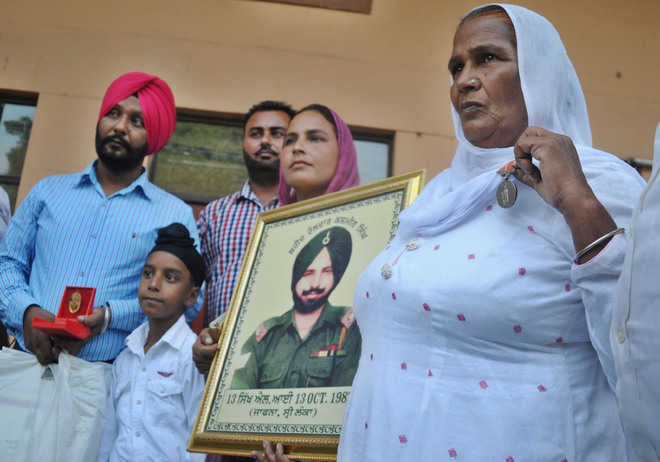
Surinder Kaur holds the Sena Medal awarded to her husband Havildar Kashmir Singh while her daughter carries his picture at the DC office in Ludhiana on Monday. Tribune Photo: Himanshu Mahajan

Gurvinder Singh

Tribune News Service

Ludhiana, October 17

A war widow returned her husband’s medal in protest against the government’s failure to provide facilities promised to the kin of jawans who laid down their lives in Sri Lanka in 1987. Surinder Kaur, wife of Army Havildar Kashmir Singh of Gurdaspur, who attained martyrdom as part of the Indian Peace Keeping Force during Operation Pawan in Sri Lanka, submitted her husband’s Sena Medal and a letter addressed to Prime Minister Narendra Modi to an official to be handed over to Modi during his visit to the city tomorrow.She said her son was only eight years old and her daughter six years old when her husband attained martyrdom. She couldn’t see the body of her husband as it never reached India, she lamented.Twenty jawans of 13 Sikh Light Regiment, in addition to commandos, were killed when they were para-dropped at Jaffna University in an attempt to take control of Jaffna from the LTTE.She said her husband was conferred Sena Medal posthumously in 1991. It was announced by the government that kin of the Indian Army jawans, who were gunned down in Sri Lanka, would be given 10 acres of land, a petrol station or an agency apart from a government job to one member of the each family, she claimed. “I received official letters and made to do the rounds of offices in Gurdaspur and Amritsar. The officials concerned said the matter concerned the other district,” she said, with tears rolling down her eyes. She said if the government couldn’t look after the family of the martyr who laid down his life for the country, there was no point keeping the medal.Satnam Singh Dhaliwal, president of the Universal Human Rights Organisation, said the government had given facilities to the family of Indian spy Sarabjeet, who died in Pakistan jail, but had been indifferent to the brave soldiers who laid down their lives during the Army operation in Sri Lanka.  Meanwhile, Swati Tiwana, Assistant Commissioner, said she asked the family to reconsider the decision to return the medal. She said they would check out with the Gurdaspur administration and look into the matter.


Arms deal with Moscow fits into India’s defence needs

Ajay Banerjee

Tribune News Service

New Delhi, October 15

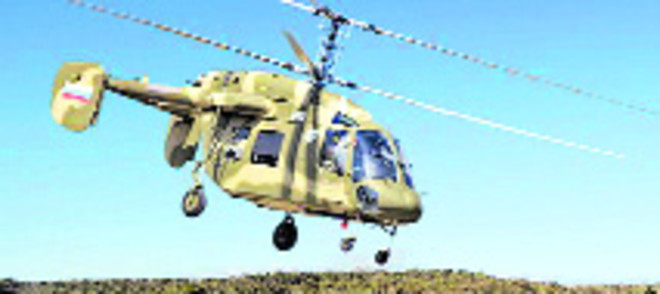
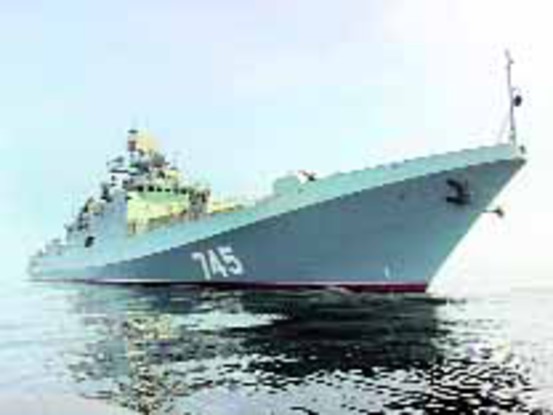
The agreement between India and Russia on military equipment purchase is being tipped as a “game-changer” as it further cements the five-decade-old ties between the two nations.The outcome of the Narendra Modi-Vladimir Putin bilateral meeting in Goa this afternoon will be read with keen interest among military observers in China, Pakistan, the US, Japan and Europe.Set to cost $5 billion (Rs 39,000 crore), “S-400 Triumf” air defence missiles are mounted on road mobile launchers and carried by specialised trucks. The missile system includes multi-layered radars capable of tracking 300 targets such as missiles, planes, drones, helicopters and shoot down around three dozen simultaneously. It can hit incoming airborne targets between 20 km and 400 km — a rarity to have such vast range mated in a single missile system. It can also hit target at an altitude of 55 km. With inter-continental missiles (having more than 5,500 km range) travelling at 70-80 km altitude, this can come in handy for the defence forces. Russia deployed the missile system during the attack launched on the Islamic State in Syria a few months ago.The Kamov 226T helicopter will allow pilots to fly to the Siachen glacier or similar altitudes across the Himalayas much safely and with greater load carrying capacities. At least 200 of the twin-engine Kamov — a light utility helicopter — will be produced. These will cost $1 billion (Rs 6,800 crore).The helicopters will be deployed for surveillance, dropping small loads and for rescue, including of troops posted at high altitudes such as the Siachen Glacier-Saltoro Ridge region. It has a flight ceiling of 18,700 feet — meaning it can fly over almost all of the Himalayan passes with ease. It will be made in India by public sector Hindustan Aeronautics Limited (HAL). Admiral Grigorovich-class (Project 11356) stealth frigates will replace the three Godavari-class frigates that the Navy has. One of these has been de-commissioned while the other two are on their way out. The “Yantar” shipyard in Russia made six of these between 2003 and 2013. Of the four more, two are ready in Russia and will have a Ukrainian engine. The deal had been held up due to frosty relations between Russia and Ukraine. Two others will be made at an Indian shipyard.

New additions to country’s arsenal

  • S-400 air defence system Costing $5 billion, it can target multiple airborne objects within 20-400 km range and will significantly strengthen India’s border defence along the frontiers with China and Pakistan
  • Kamov 226T helicopters Set to cost $1 billion (Rs 6,800 crore), 200 of these will be co-produced by Hindustan Aeronautics Ltd and the local partner of Russian Helicopters and state arms exporter Rosoboronexport
  • stealth frigates :Two Admiral Grigorovich-class frigates will be built in India and two in Russia. To be equipped with BrahMos missiles, these will be a better in capability than the Talwar class frigates of the Navy


BRO fails to meet deadline on strategic Manali-Leh highway

Vijay Mohan

Tribune News Service

Chandigarh, October 12

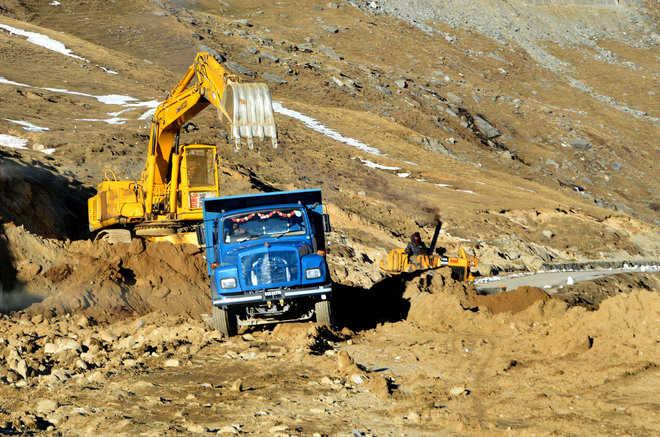
A ‘super review’ of the Border Roads Organisation’s (BRO) task force responsible for maintaining the strategic Manali-Sarchu road in Himachal Pradesh has revealed huge difference between targets and achievements, besides raising several other audit objects.The report says that the achievements in road surfacing and bridge construction were as low as 20.83 per cent and 13.05 per cent, respectively, in the past three years. In a particular year, despite targets no road re-surfacing was done.On the other hand, there have also been instances where the task force was able to deliver more than its stipulated target in bridge construction and road formation. The super review report, which has also raised some other audit issues, was finalised in August and covers three fiscals from 2013-14 to 2015-16. BRO’s Project Deepak is responsible for construction and maintenance of strategic roads in Himachal. The Manali-Sarchu road is part of the Manali-Leh highway that provides an alternate link to Ladakh. The part of the highway lying in Ladakh is looked after by a different BRO project.It has also been observed that works sanctioned in 1989 to upgrade a stretch of the road was to be completed in 1992, but 24 years later the progress of the job is 75 per cent. A permanent 100-metre bridge over Chandra river sanctioned in 2008 was supposed to be complete by 2012, but till March 2016, only 13.64 per cent work has been completed. Several other bridge and road construction works have been delayed by several years beyond their target dates.Expenditure to the tune of Rs 928.15 lakh has been rendered infructuous on account of five works being foreclosed due to various technical and administrative reasons. In 14 cases, the review has pointed out heavy mismatch between physical progress and financial expenditure.
Read more at http://www.tribuneindia.com/news/nation/bro-fails-to-meet-deadline-on-strategic-manali-leh-highway/308780.html#qOuyA9Gf1MM5zdTB.99


Cong, BJP in war of words over Army’s 2011 surgical strike

Cong, BJP in war of words over Army’s 2011 surgical strike
The strike was codenamed ”Operation Ginger”. — Repersentational photo

New Delhi, October 9

The Bharatiya Janata Party and the Congress on Sunday indulged in a war of words after it emerged that the Indian Army conducted a deadly surgical strike on Pakistan’s military outposts in 2011 as well.Codenamed ‘Operation Ginger’, the strike is said to be the deadliest cross-border operation in which at least eight Pakistani soldiers were killed and several others fatally injured by Indian commandos.(Follow The Tribune on Facebook; and Twitter @thetribunechd)


Congress spokesman Sanjay Jha said: “It is an insult to the army and the defence establishment to say that such surgical strikes (September 29) never happened before. It is only that the then Manmohan Singh government never publicised such strikes because it was not consistent with our policy.”He said it was the responsibility of the media, the Congress and everyone else to expose the “brazen lies propagated by the ruling party (BJP) for political advantage”. On the other hand, the BJP said no covert military operation of the magnitude of the September 29 strikes had been done before.”The surgical strike was done by the army. But Prime Minister Narendra Modi provided the leadership and comfort to the army to conduct a strike of this magnitude,” BJP spokesman Syed Zafar Islam said.He said the Congress was feeling insecure due to the rising popularity of the Modi government.Operation Ginger: When Indian Army killed 8 Pak soldiersAs per a new report published on Sunday, a deadly surgical strike by the Indian Army in Pakistani territory in 2011 left at least eight Pakistani soldiers dead, with three of them decapitated.Details regarding the tit-for-tat attack that took place in the summer of 2011 have come out amid heightened India-Pakistan tensions marked by an Indian surgical strike on September 29.The Hindu newspaper citing confidential official documents, video and photographic evidences said India and Pakistan carried out “two of the bloodiest cross-border surgical strikes” killing 13 soldiers.Five of the slain soldiers were decapitated. The Pakistani soldiers took away the heads of two Indian soldiers and left behind a third badly wounded who died in hospital, the daily said.In the revenge attack, Indian soldiers brought back heads of three Pakistani soldiers, the Hindu said.Major General SK Chakravorty (retired), who planned and executed the operation as the chief of Kupwara-based 28 Division, confirmed the Indian raid but refused to discuss details.According to the newspaper, Pakistani raiders struck a remote army post in Gugaldhar in Kupwara district in Jammu and Kashmir on July 30, 2011.The attackers returned with the heads of Havildar Jaipal Singh Adhikari and Lance Naik Devender Singh of 20 Kumaon. A soldier of the 19 Rajput, who reported the attack, died in a hospital.In revenge, the Indian Army planned “Operation Ginger” — which, the daily said, turned out to be one of the deadliest cross-border raids across the LoC.The Indian operation was planned to precision. Seven reconnaissance — physical and air surveillance mounted on UAV — missions were carried out to identify vulnerable Pakistani army posts.The mission was finalised to spring an ambush on Police Chowki to inflict maximum casualty.Finally, the Indian troops launched the covert operation on August 30, 2011.About 25 soldiers, mainly Para Commandos, crossed the LoC stealthily. They planted claymore mines around the strike area.Four Pakistani soldiers, led by a Junior Commissioned Officer, walked into the ambush. Mines were detonated, grenades lobbed and they were fired at.One Pakistani soldier fell into a stream that ran below. Indian soldiers chopped off the heads of the other three dead soldiers and also took away their rank insignias, weapons and other personal items.The commandos then planted pressure IED’s beneath one of the bodies, primed to explode when anyone attempted to lift it.Two more Pakistani soldiers rushed in after hearing the explosions. They were killed by a second Indian team waiting near the ambush site.Two other Pakistani army men tried to trap the second team. But a third Indian team covering them killed the Pakistanis, the daily said.While the Indian soldiers were retreating, another group of Pakistani soldiers were spotted moving towards the ambush site. Soon they heard loud blasts, indicating the concealed IEDs had exploded, the report said.According to Indian assessment, at least two to three more Pakistani soldiers were fatally injured in that blast.The operation lasted for about 45 minutes and the Indians headed back across the LoC, carrying the heads of Subedar Parvez, Havildar Aftab and Naik Imran.The severed heads were photographed and buried. Two days later, one of the senior most Generals in the command turned up and ordered the heads to be dug up, burnt and the ashes strewn into Kishenganga river.This was done to do away with all DNA traces, the daily said. — IANS


All communication channels with Indian military open: Pak army

All communication channels with Indian military open: Pak army
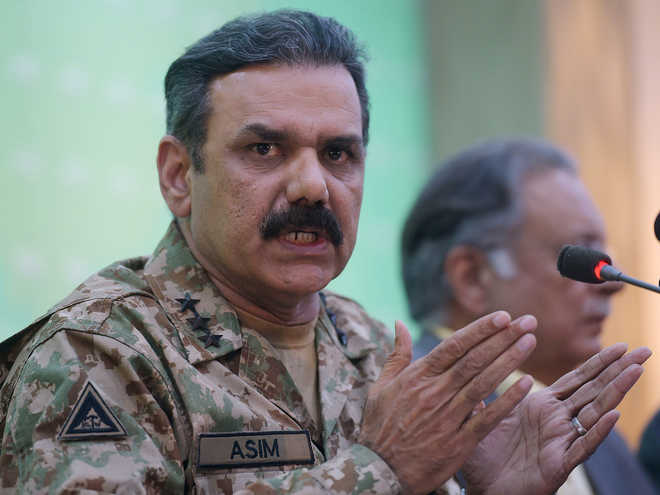
Lt Gen Asim Bajwa. AFP file

Islamabad, October 7

All communication channels with the Indian military, including the hotline, are open, the Pakistan army has said, even as it accused India of escalating tensions.“The Indian forces violated the Line of Control by fire and then a few hours later they made a false claim about surgical strikes across the Line of Control. We did check everything on ground and found that the claim was absolutely false,” Director-General of the Inter-Services Public Relations (ISPR) Lt Gen Asim Bajwa said.

(Follow The Tribune on Facebook; and Twitter @thetribunechd)

“What we see is that there is more intensified firing along the LoC, and of course, when there is more fire, the situation does escalate. The environment also escalates when there is more rhetoric and more statement and more pronouncements” by the Indian side, Bajwa told China’s state-run Xinhua news agency on Thursday.At least two Pakistani soldiers have been killed while nine others injured in the Indian firing over the past week, the general said.However, the army spokesman emphasised on the importance of resolving the current tension through dialogue.He said contacts between Pakistani and Indian armies are maintained, confirming that the Directors General of the Military Operations had talked over the phone after the “start of the cross-LoC firing”.“All communication channels, including the hotline, between the two militaries are open,” he said, adding that the UN Military Observer Group in Pakistan and India also monitored the situation and reported to its headquarters.India carried out surgical strikes on seven terror launch pads across the LoC on the intervening night of September 28 and 29, with the Army saying it had inflicted “significant casualties” on terrorists preparing to infiltrate from PoK.The strike came just days after the attack by Pakistan-based terror outfit Jaish-e-Mohammed on an Indian army camp in Uri in Kashmir that killed 19 soldiers. PTI


Punjab schools reopen Home Ministry caused needless panic

In Punjab’s border belt schools have reopened but people have not been officially told to return home. They are doing it at their own risk. The next time the Union Home Ministry tells the border residents to leave their homes for safer places, it would be taken less seriously. This is dangerous because the next time the threat of war may not be as unreal as it has turned out to be this time. It is amazing how casually an important order resulting in the displacement of lakhs of people in the states bordering Pakistan has been passed even though it has been possibly done in good faith. The BSF says it did not ask for such an order. There was no military deployment along the border. After Pakistan’s denial on the surgical strikes, chances of a conflict receded. Did the Home Ministry rely on unreliable intelligence and overreact? Was there a political motive?  For the people in the border villages leaving homes at such a short notice is a costly affair. Already their modest financial resources are overstretched in the struggle for survival. In addition, the sudden announcement inflicted on them emotional discomfort. A familiar fear gripped them — the fear of losing all that they had accumulated and built over the years. One order threatened their lifetime savings. None in the administration had a clue about what was going on. None of their elected representatives came to tell them where to go and for how long.When immediately after the surgical strikes Home Minister Rajnath Singh told Parkash Singh Badal to get the border villages vacated, the Punjab Chief Minister did not bother to ask questions. He simply followed the brief diktat. Badal spent the next few days listening to problems of the uprooted as if he had just arrived from another planet. Anyone of his age living in Punjab is familiar with the pain of dislocation and homelessness. Punjabis have suffered the pangs of Partition and experienced the scourge of war. At this hour people need concrete help, not politicians’ visits and questions about their well-being. Followed by photographers, Badal replayed his familiar “sangat darshan” political game.




Shadow wars Dinesh Kumar in Chandigarh

Shadow wars
Special forces across the world keep their operations secret. The euphoria over a ‘kill’ is never celebrated and there is no sense of complacency after an operation ends. National security is a larger concept not based on jingoism or revengeful actions.

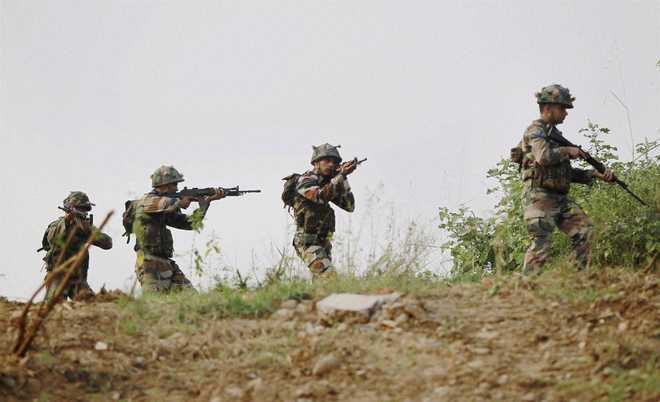
The Army’s Sept 28-29 surgical strikes inside Pakistan mark a watershed in our strategy to combat terrorists and their sponsors. Not that such strikes had never happened; this time, a convincing response was well acknowledged. Covert ops are seldom publicized and these have an in-built element of deterrence. Our larger and more significant strategy would be a deeper understanding of the enemy and an ever-vigilant security apparatus. Almost 17 years ago and just six months after the Kargil War, the Indian Army on January 22, 2000, killed 16 Pakistani soldiers after over-running a Pakistani post across the Line of Control (LoC) in the Chhamb sector. The bodies of five Pakistani soldiers were reportedly dragged back by Indian troops and later handed over to the Pakistani Army. This was one of many such attacks carried out from time-to-time by the Indian Army consequent to Islamabad’s continuing proxy war in Jammu and Kashmir. The Pakistani Army, too, has been carrying out similar attacks on Indian positions after crossing the LoC along with enjoying the advantage of having an army of terrorists to whom it routinely outsources terror attacks as it did most recently in Uri.These trans-LoC attacks by both armies stopped for a while after the November 2003 ceasefire came into effect along both the LoC and the Actual Ground Position Line (AGPL) with Pakistan Occupied Kashmir (PoK). But there have been occasions when, even during the current ‘ceasefire’, India has been conducting retaliatory attacks across the LoC such as, for example, in response to the decapitation of two Indian soldiers by the Pakistani Army in January 2013. Indian Army soldiers are reported to have then beheaded between five and ten Pakistani soldiers in response.So what is new about the shallow-distance ‘surgical’ strike carried out in the wee hours of September 29? One, that New Delhi has officially acknowledged what the Indian Army has been doing for many years now. Second, the Army carried out simultaneously coordinated surgical strikes across the LoC at seven launch pads located over an arc of 250 km spread across both the Jammu and the Valley sectors. Third, the attacks were directed specifically against terrorists in their launch pads rather than against the Pakistani Army. In doing so, India has made it publicly known that it has the resolve and capability of crossing the LoC to strike at terrorists who Pakistan officially denies supporting. 

Some questions

Last Thursday’s action gives rise to three questions. First and foremost, how qualitatively and quantitatively effective were the Army’s strikes against terrorists in PoK? The government has indicated it will furnish evidence and some details about the effectiveness of the strikes. Until then, we only have the government’s word for it. Sooner or later questions are bound to rise. Second, and most important, will this deter Islamabad from continuing to support terrorism in Jammu and Kashmir and other parts of the country? Third, will surgical strikes of high intensity and quality henceforth become state policy to be repeated as and when thus truly marking a paradigm shift in India’s response to Pakistan’s support to terrorism? Or, will this be a one-off strike aimed at quelling public anger over the terror attack on an Indian Army camp in Uri? Furthermore, will this action be milked for political gains by the ruling party, especially during campaigning in the forthcoming assembly elections in Uttar Pradesh and Punjab?Such strikes cannot and must not be an end in itself. The aim of such action has to be to make it expensive for Pakistan to support terrorists and also for the terrorists themselves if not altogether stop Islamabad from making terrorism an instrument of state policy. Leave aside ceasing to support terrorists, Pakistan is expected to become more hostile towards India in response to which New Delhi will need to be ever vigilant and prepared. The Army’s limited ‘surgical’ strike on is so far a reactive measure – a response to the September 18 terror attack in Uri. It was not, truly speaking, a pro-active measure initiated without an immediate provocation. Besides, a solitary military action of this nature is never enough. For, this cannot be a number game where the killing of 19 Indian soldiers must be matched by an equal or higher figure after which India waits for the next terror attack to occur before again responding. 

Draw a policy

Rather, New Delhi needs to consider making it a policy to conduct pre-emptive surgical strikes on Pakistani terror factories on a relentlessly continuous basis in order to truly making it expensive for the terrorists and its Pakistani patrons. Prevention, rather than cure, is ideally the answer. But for this, Indian intelligence agencies will need to develop an intelligence gathering network par excellence comprising human intelligence (HUMINT) and electronic intelligence (ELINT) sources to obtain real time actionable information; Well-equipped special forces will have to be on permanent stand-by and work in conjunction with intelligence agencies. The political executive irrespective of the political alliance in power will need to maintain a steely resolve and keep the nerve to ‘go for it’ each time. Both the Indian intelligence and military establishments will need to develop capabilities to overcome Pakistani measures to prevent such attacks; and India will have to be in a ‘state in being’, i.e. in a perpetual state of alertness and preparedness including for setbacks as does happen in this long drawn out game. Only then would India have truly ‘arrived’ such as like Israel, which some Indian commentators love to quote. 

Dangerous game

The question is whether India has the stomach, resolve and capability for this kind of a response? Then again, the September 29 strike was across a shallow distance of up to between 2 and 3 km. How deep will India be prepared to go should Pakistan relocate its launch pads well inside Occupied Jammu and Kashmir? Is India prepared for an escalation, and to what extent? Soon after the terror attacks in Mumbai on November 26, 2008, Air Chief Marshal Fali Homi Major told the government that the Indian Air Force was unable to conduct air strikes on terror camps in Pakistan since they did not have specific coordinates. In other words, there existed no actionable intelligence despite supposed reforms in intelligence gathering carried out after the May-July 1999 Kargil War. 

Covertly overt?

The Army’s trans-LoC action has been greeted with and commented on with much jingoism and chest thumping by some in India, especially by some sections of the ruling party, as had occurred when India exploded nuclear devices in May 1998. Covert operations and surgical strikes are more effective when not publicised. While overt announcements are good for the domestic audience and gives the ruling dispensation political mileage, it does not serve its true purpose; certainly not at such an early stage. Ideally, covert operations should strike hard and remain covert. It should be left on officers to refer to it in passing in their memoirs written well after their retirement. If at all it must be made public by the government, it is best done when Pakistan’s terror factory is sufficiently degraded. Until then maturity lies in silent but relentless continuous action. A tool in the boxDuring the height of militancy in Punjab when Rajiv Gandhi was Prime Minister, the Research and Analysis Wing (RAW) engaged in a series of covert operations in Pakistan which was partial cause for some dent in Islamabad’s support to terrorism in the state. In 1989 killings by terrorists declined to 1,188 from 1,949 in 1988 only to escalate after the VP Singh government came to power. With RAW’s operations then ceasing and the VP Singh government adopting a ‘liberal’ outlook, terrorism escalated and in just two years (1990 and 1991), terrorists killed 5,059 people in the state (2,467 in 1990 and 2,591 in 1991). This was equivalent to the figure of a total 5,070 people killed in the preceding 12 years (1978 to 1989) before terrorism in the Punjab began tapering off following a regime change in New Delhi and the formation of an elected government in Chandigarh.Strategy is the employment of all means for an end. Surgical strikes have to be viewed as a tool in the box. It cannot be the sole instrument. Equally important, the 29th September action must never be a one-off. It should mark the beginning of pro-active measures to end Pakistan’s long standing roguish game of using terror against India. The journey has just begun and India has a long way to go. It is for successive governments in New Delhi to complete this journey.

dkumar@tribunemail.com


Tension eases, villagers rush back home

Tension eases, villagers rush back home
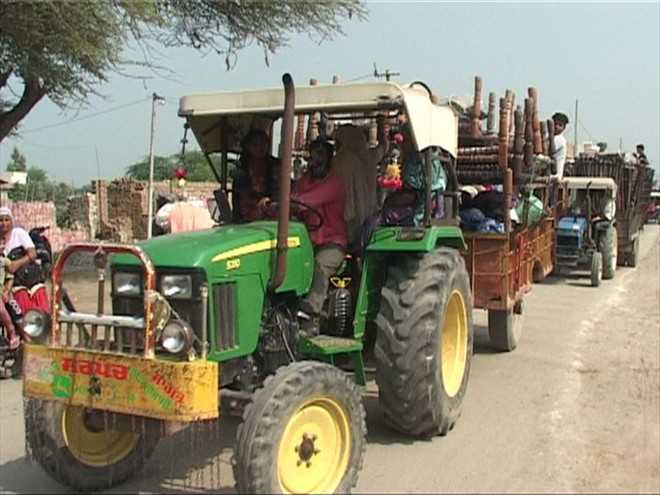
Villagers with their belongings loaded on tractor-trailers come out of the Sant Kabir Institute relief camp near Fazilka to return to their villages on Wednesday. Tribune photo

Praful Chander Nagpal

Fazilka, October 5

Six days after the Army carried out surgical strikes across the LoC, the border area residents today started returning home. They had been putting up in relief camps set up across the district.“There is no use of staying in relief camps as our ripe paddy crop will get damaged if not harvested soon,” said Zora Singh, a resident of Bakhushah village, who was staying in a relief camp at Sant Kabir Institute, near Fazilka.Manjit Singh of Ram Singh Bhaini village said since the government had ordered reopening of schools, he had brought his children back home to prevent the loss of studies.Some villagers have, however, complained that they are allegedly being forced by government officials to leave the camps and return to the respective villages.Harbans Singh of Bakhushah village, Ashok Singh of Mohammad Pira village, Dalip Singh of Retewali Bhain village and Manjit Singh of Wisakhawala village alleged that he had been told to return home.Official sources said as many as 4,471 residents were staying in 31 relief camps set up in various parts of the district. More than 1,000 have left the camps set up at Sant Kabir Institute, Government ITI, National College, Chuarianwali, Kheowali, Behak Khas, Kirianwali villages etc.Additional Deputy Commissioner Charandev Singh Maan refuted the allegation, but admitted that the villagers had starting leaving the camps and the administration was lending every possible help to those who wanted to return on their own. “In fact, the border villagers started returning home for the education to their wards, to take care of their livestock and to harvest the paddy crop,” he said.