Sanjha Morcha

IAF night drills spark panic

Samaan Lateef

Tribune News Service

Srinagar, October 7

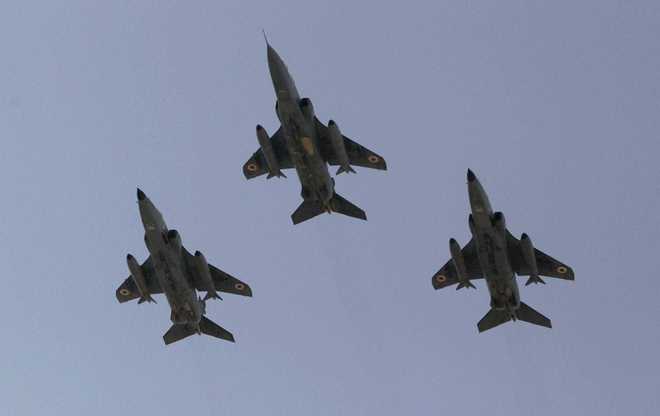
Amid heightened tension between India and Pakistan, the Indian Air Force (IAF) pilots are conducting mock drills during night for the past one week which have created a panic among the residents.Several IAF jets depart from the Srinagar airbase and conduct a drill late at night. The noise has been creating panic among the residents. “I could not sleep the whole night after I got up to the noise of jets hovering in the sky at 11:30 pm,” a resident of Bagh-e-Mehtab, Tasim Hussain told The Tribune. “It was very scary given the situation on the LoC and on TV channels,” Hussain said.Similar views were expressed by Natipora resident Abdul Rashid, who came out of his home to see the aircraft. “I could see jets hovering over but it gave the worrisome feeling of war,” Rashid said.After the fidayeen attack on Army’s 12th Brigade in frontier Uri town in which 19 soldiers were killed and 17 others wounded, India and Pakistan have intensified activities along the LoC.Defence spokesperson in Srinagar Col Rajesh Kalia said, “It is a routine exercise.”


The significance of the strikes:: KC Singh

Shift in strategy has many implications — for both India and Pakistan

The significance of the strikes
Now for some calm: It is time for de-escalation of tension.

THE ‘surgical strike’ by India on September 29, after the fidayeen Uri attack, generated public euphoria and initial support by opposition parties, albeit more fearing public opinion than impressed by claims of a government entangled in a web of its own making. Winning mandate by rabble-rousing the Indian electorate over corruption scandals in his predecessor’s second term and allegedly his pusillanimous Pakistan policy, PM Narendra Modi was cornered by his followers baying for disproportionate and immediate retribution. The monster of public expectation was seeking a cathartic response. The Economist recently analysed this phenomenon, afflicting leaders globally, as “post-truth” politics. Donald Trump to Brexit supporters in Britain and anti-globalisation and anti-refugee political leaders in the West are all feeding popular prejudices and exploiting public angst rather than shaping public opinion with responsible alternative policies. The Modi government, in addition, faces crucial state elections, particularly in UP which provided his party a quarter of its MPs. The ‘gau rakshaks’ have by blind evangelism alienated not only Muslims, but also Dalits — the two together constituting around 40 per cent of the electorate in UP. The unrest in the Valley since the mid-July killing of militant Burhan Wani and Pakistan’s blatant exploitation of the situation by alleging in international fora Indian breaches of human rights triggered a Pakistan policy review in New Delhi. The Indian riposte came via PM Modi’s Red Fort address in which he raised Pakistan’s own poor rights record in Gilgit-Baltistan, Pakistan-occupied Kashmir and Balochistan. The Uri attack, in which 19 brave soldiers lost their lives, hardly compared in its intensity with attacks in Mumbai in 1993, 2006 and 2008 (referred to as 26/11 attack). Nor did it equal the attack on Indian Parliament in December 2001, which could have decapitated India’s ruling elite. But Indian Government’s frustration with Pakistan’s civilian government’s ineffectiveness and assessment that they had succumbed to their army’s surmise that Kashmir was ripe for plucking, steeled the resolve to take the fight to Pakistan, literally and figuratively. Poking a finger in Pakistan’s eye over their brutal putting down of Baloch insurgency was only a beginning. Threats surfaced that India may grant asylum to descendants of Nawab Akbar Bugti killed by the Pakistan military in 2006. The Uri attack became a catalyst for changing strategy and tactics. On September 29, a high-level Ministry of External Affairs source briefed the writer and a dozen other strategic thinkers. Like Lt-Gen Ranbir Singh, Director General Military Operations, the action was described as a counter-terror operation to eliminate launch pads of militants who, according to Indian intelligence, had gathered to attempt infiltration into India. The exact phrase was ‘along the Line of Control’ and not across it. The aim appeared to be to contain international reaction and not give Pakistan army an excuse to retaliate. The message, after all, had already been conveyed that a new preventive intervention doctrine was now in place. However at the political level, first Minister of State RS Rathore baited Pakistan followed by his senior colleague Venkaiah Naidu. The NDA government’s diplomatic policy was in conflict with its domestic compulsions. Seeing the BJP’s political point-scoring, opposition parties became more vocal in questioning the government’s claims. Pakistan, in any case, denied that such a raid occurred in its territory. The government came under pressure to release the proof, if any. What then is the significance of the Indian action? Undoubtedly, it spelt a change of strategy as previous punitive raids had been conducted clandestinely and away from the prying eyes of the media. This was done to satisfy Indian public opinion and declare a new doctrine of preventive action. The implications are many. Firstly, the US has been unable to deter Pakistan and its army from collaborating with the Afghan Taliban or the Haqqani group, despite its drone attacks, hunting of Osama bin Laden and massive military and civilian assistance, and now, the killing of Mullah Mansour, the head of Taliban. Pakistan is already reported to be moving camps of jehadis away from the LoC and near, or even inside, military facilities. Secondly, the government is now locked into automatic and enhanced response if another attack of similar or higher intensity occurs. World War I was triggered by treaty obligations compelling a military response when space for diplomacy still existed. The initiative thus has passed to the jehadis to determine the trajectory of Indo-Pak relations. Post-1998 bombings of US embassies in East Africa, the US conducted missile attacks on suspected Al-Qaeda (AQ) camps in Afghanistan. Result was not the elimination of AQ, whose operatives fled the camps anticipating US retaliation, but the plotting of 9/11. The Indian strategy has to be broader than a military one, with politico-economic pressure points. On the positive side, Pakistan got insignificant international support for its rights abuses charge or India’s cross-LoC action. The Uri attack, in fact, enabled India to shift the focus to Pakistan’s abetment to terror. Pakistan’s nuclear flash-point argument also found little traction with the UN or the P-5. Pakistan can react in one of many ways. It can abet a major terror strike in India during the Dasehra/Diwali period to cause maximum pain and panic as markets are full of shoppers to test India’s escalatory resolve. It could target Indian assets in Afghanistan. Consensus in New York is that Pakistan would lose even more international credibility if this was to happen. Pakistan can also do a cross-LoC operation to either capture or damage a vulnerable army post or facility. It is least likely that it cuts its losses and does nothing. The release of the raid video footage may compromise Indian capabilities, provoke Pakistan as its army loses face and definitely set-off an action-reaction. PM Nawaz Sharif, again praising Wani as a freedom fighter in their Parliament, will harden Indian stand. It is unlikely that tension will start abating before the UP election. Nawaz may also be using the Kashmir bogey to outflank his army chief Gen Raheel Sharif who retires next month. Snow in the Valley and the passes, a healing touch and with domestic priorities of both prime ministers resolved space for normalisation may be available. At the moment,  the initiative has passed to hawks on both sides and militants. — The writer is a former Secretary, Ministry of External Affairs


Surgical strikes: Army gives video footage to govt amid debate over its release

Surgical strikes: Army gives video footage to govt amid debate over its release
There has been growing demand that the government release video footage of the cross-LoC raid. — AFP file

Tribune News Service

New Delhi, October 5

The Army has handed over to the government video clips of the cross-LoC surgical strikes as per laid down procedure, Union Minister Hansraj Ahir said on Wednesday, amid a growing chorus that evidence of the operation on terror launch pads in PoK be made public.Ahir, Minister of State for Home, said the video clips containing visuals of the surgical strikes on terror launch pads in the Pakistan Occupied Kashmir (PoK) have been handed by the Army.“Such issues are presented with a perspective and processes are followed,” he said, adding that both the Army and government have abided by them in letter and spirit.(Follow The Tribune on Facebook; and Twitter @thetribunechd)


“There was a time when written documents were submitted. Now the times have changed. Now clips are given and the clips have been given,” Ahir said.Separately, Kiren Rijiju, also a MoS for Home, said everyone should have faith in the government and allow the Army to take its own call.“The laid down procedure has been followed. The DGMO briefed (about the surgical strikes). It was not the Defence Minister nor the Prime Minister and not the Home Minister. It was the DGMO who briefed (the media). That was the right thing to do and they (Army) did it.The statements by Ahir and Rijiju came amid demands that government release the footage of Army’s recent surgical strikes on terror launch pads in Pakistan-occupied Kashmir.”Have faith in the government and leave it to the Army,” Rijiju told reporters here when asked about the demand for release of proof of the surgical strikes by the Army.A political slugfest erupted yesterday over the surgical strikes with Mumbai Congress chief Sanjay Nirupam calling it “fake”, provoking stinging criticism from BJP even as his own party said it “totally dissociates” from his remarks.As the government mulled options on the issue of release of the video footage of the surgical strikes, a debate raged with BJP leader Subramanian Swamy favouring putting out an edited version of the video on the operation while most experts spoke against it.Rejecting the demand, the BJP attacked some Congress leaders and AAP chief Arvind Kejriwal for raising questions over the strikes and accused them of giving a handle to Pakistan to advance its false propaganda.The Congress, on its part, insisted that it never questioned the authenticity of the strikes but steered clear of the demand, including from within its own ranks, for the release of evidence, saying it would give appropriate advice in the best interest of national security if consulted by the government.Swamy, a Rajya Sabha member, said anybody questioning the operation should prove prima facie evidence to support his allegation but added that a video should be released following a newspaper report today that gave details of the operation.”I think they should edit the video of the logistics value of it and show the other part, showing explosions, the dead body… they have got in the video. So all these parts can be released,” he said.Former army chief Gen VP Malik slammed those questioning the credibility of the strikes saying, “The video should not be released just because some stupid people have sought so.”He told PTI it was “utter nonsense” that people are asking the Army to prove the operation and wondered what is wrong with the political class. — With agency inputs


IAF’s Jaguar aircraft crashes in Rajasthan, both pilots safe

IAF’s Jaguar aircraft crashes in Rajasthan, both pilots safe
The aircraft was on a routine training sortie when the incident occurred. — File photo

Our Correspondent

Jaipur, October 3

A Jaguar aircraft of the Indian Air Force on Monday crashed in IAF’s Field Firing Range in the Lathi area of Jaisalmer district in Rajasthan. Both the pilots ejected safely.(Follow The Tribune on Facebook; and Twitter @thetribunechd)The aircraft was on a routine training sortie when the incident occurred at at Khardi-Dhani which is now IAF’s Field Firing Range near the Indo-Pak border, defence spokesperson Lt Col Manish Ojha said. It took off from Jaisalmer and crashed around 1.45 pm.A Court of Inquiry has been ordered, he said. The trainer aircraft crashed following a technical snag, IAF sources said.Jaguar aircraft, a deep strike fighter plane, is capable of carrying nuclear payload. Meanwhile, SHO of Lathi police station Mohan Lal said since the plane crashed on the barren land (sand dunes) no civilian was injured. The two pilots were immediately rushed to Jodhpur by a separate plane. On September 10, a MiG-21 T-69 trainer aircraft crashed near Barmer, while on June 13, a MiG -27 aircraft of the IAF had crashed in a residential area of Jodhpur city.This is the second Jaguar crash within a month. On September 13, a Jaguar trainer aircraft caught fire during a take-off in Haryana’s Ambala. Then too, the pilot made a quick exit and a CoI was ordered. The plane was scheduled to take part in a routine night flying mission.On June 16, 2015, a Jaguar fighter aircraft crashed near Allahabad in Uttar Pradesh, and both the pilots had managed to eject safely. The plane had taken off at 7.25 am from the Bamrauli air strip in Allahabad and was on a routine training sortie.The same year, another Jaguar aircraft had crashed near the Kurukshetra district of Haryana. Incidentally, this aircraft too had taken-off from Ambala Air Base. — With agencies


Terror strike at Army camp in J&K

1 BSF jawan killed, 1 hurt in militant attack on 46 RR battalion in Baramulla

Majid Jahangir & Ishfaq Tantary

Tribune News Service

Srinagar, October 2

A Border Security Force (BSF) guard was killed and another injured as militants attacked a battalion headquarters of Army’s 46 Rashtriya Rifles on the outskirts of Baramulla town in north Kashmir tonight.A BSF sentry was killed when a group of militants, whose number could not confirmed immediately, tried to storm the base at Janbazpora, Baramulla, around 60 km from Srinagar, around 10.30 pm. A BSF company is deployed at the RR battalion headquarters.Editorial: At daggers drawn“So far, one BSF sentry has been killed and another jawan is injured,” Baramulla Senior Superintendent of Police Imtiyaz Hussain told The Tribune.Defence sources said militants could not breach into the camp. They launched attack by lobbying grenades and opening indiscriminate fire. The exchange of fire is still on and the area around the base cordoned off. No militant has been killed so far.(Follow The Tribune on Facebook; and Twitter @thetribunechd)The 46RR battalion base which is under attack is located on the banks of the Jhelum between Azad Gunj and Janbazpora localities of Baramulla town. A number of important Army and police installations, including offices of the Deputy Inspector General of Police (north Kashmir) and the Senior Superintendent of Police (Baramulla), are situated on the other side of the river. Today’s strike comes exactly a fortnight after terrorists struck at the Army brigade headquarters at Uri, 102 km from here, killing 19 soldiers. Days after the Uri attack, India reacted by launching surgical strikes on militant launch pads in Pakistan-occupied-Kashmir.

‘Will take some days to bring back jawan’

  • Pune: Defence Minister Manohar Parrikar said on Sunday it would take “some days” to bring back Army jawan Chandu Babulal Chavan of 37 RR, who is in Pakistan’s custody after he inadvertently crossed over. He said a well-established mechanism through the DGMO had been activated to secure his release. “Since the situation is tense, it will take some days to bring the soldier back,” he said. PTI

Efforts on to secure release of Indian soldier: Parrikar

Efforts on to secure release of Indian soldier: Parrikar
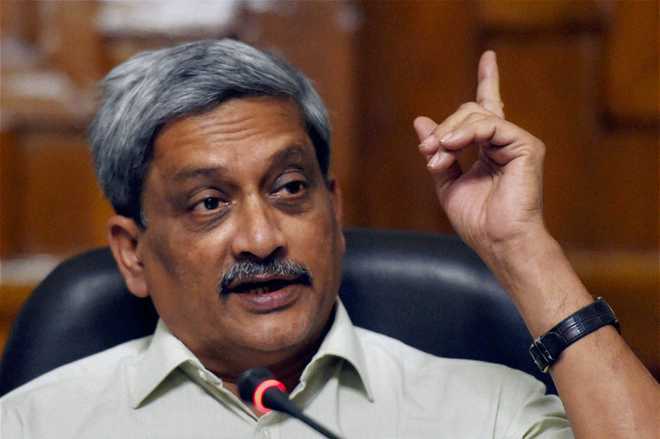
Defence Minister Manohar Parrikar. PTI

Pune, October 2

Defence Minister Manohar Parrikar on Sunday said it will take “some days” to bring back Army jawan Chandu Babulal Chavan, who inadvertently crossed over to Pakistan, but a well established mechanism through the DGMO has been activated to secure his release.“He had crossed over which happens in border areas. There is a well established mechanism through DGMO (Director-General of Military Operations) which has been activated,” he told reporters here.“Since the situation is tense right now, it will take some days to bring the soldier back,” the Minister, who was here to inaugurate a cleanliness drive in a cantonment area, said.(Follow The Tribune on Facebook; and Twitter @thetribunechd)The Defence Minister said there is no relation between the surgical strike carried out by the Army in PoK and the soldier crossing the border inadvertently.On September 30, Chavan from 37 RR had inadvertently crossed over to the other side of the Line of Control, following which Pakistan had been informed by the DGMO on the hotline.“Such inadvertent crossing by Army and civilians are not unusual on either side. They are returned through existing mechanisms,” the Army had said.On Friday, Home Minister Rajnath Singh had called up the family of the solider and assured them that efforts are being made to secure his release. Chavan’s grandmother had passed away after hearing the news of his crossing over to Pakistan.Parrikar also said that people should remain alert and report anything unusual to the police. — PTI


Surgical strikes: Uttar Pradesh on high alert, strict vigil on Indo-Nepal border

surgical strikes, uttar pradesh alert, pakistan threat, indo-nepal border security, india attacks paksitan, pakistan nuclear threat, pakistan plan india attack

A state of high alert was issued across Uttar Pradesh, following the surgical strike across the Line of Control (LoC), an official said on Friday.

Security was heightened in all districts, fearing retaliation from Pakistan.

The Seema Shashastra Bal (SSB) was also asked to step up vigil along the Indo-Nepal border.

Special focus was on security of historical monuments, tourist destinations, public places like railway and bus stations, malls, shopping complexes and film theatres, an official told IANS.

Additional police force was deployed in the peripheral parameters of cantonments in Lucknow, Agra, Kanpur and Meerut, and military installations and airports were put under close watch.

Special checking operations were initiated to screen vehicles on border and other sensitive areas like Maharajganj, Bahraich, Gonda and Gorakhpur.

“Other than scaling up the visible security, we have also sensitised the intelligence system and are keeping an eye on every activity,” an official said.


Nation on alert, extra vigil in metros

Nation on alert, extra vigil in metros
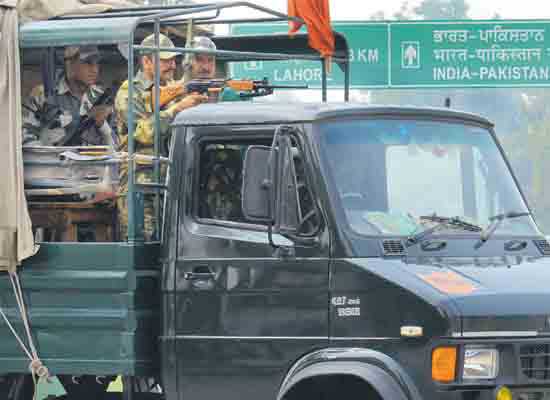
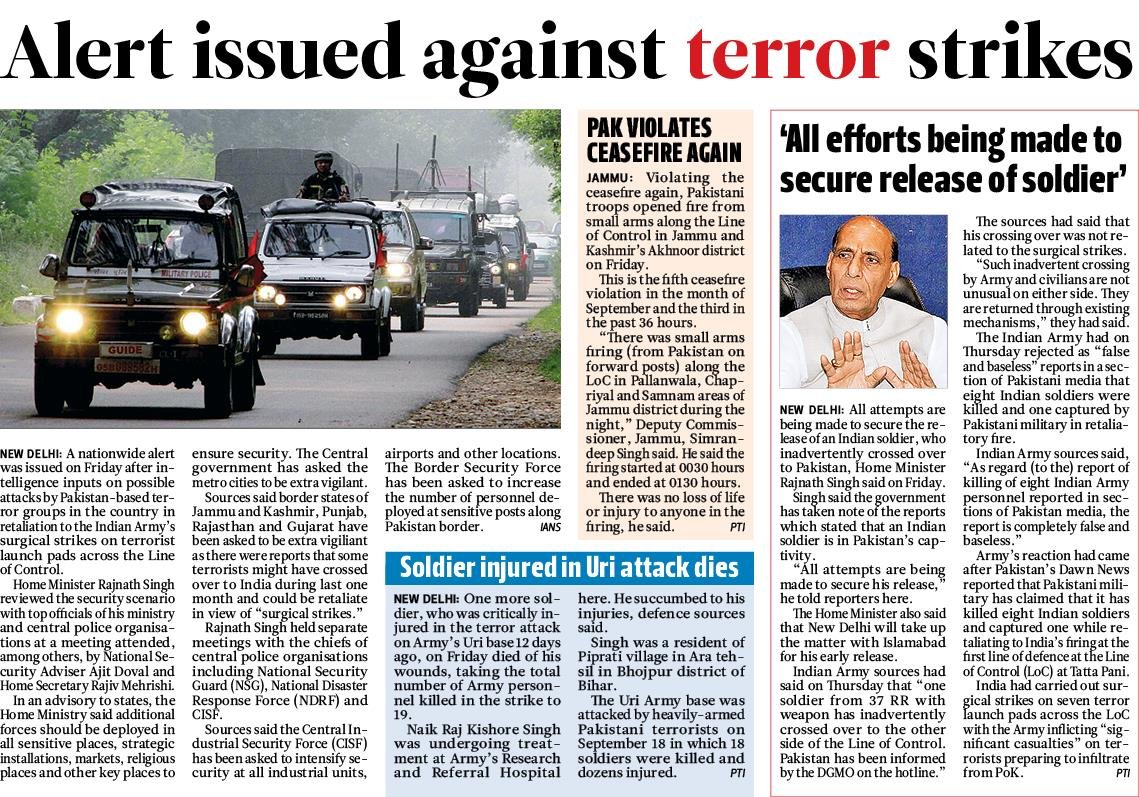
Army vehicles move towards the border area in Akhnoor sector, 35 km from Jammu, on Friday. PTI

Mukesh Ranjan

Tribune News Service

New Delhi, September 30

Home Minister Rajnath Singh today reviewed the security situation in the country, taking stock of the forces’ preparedness along the western border in view of yesterday’s surgical strikes by the Army on terror launch pads in Pakistan-occupied Kashmir.Edit: After the strikesDuring hour-long deliberations, the top security brass briefed Rajnath about the steps being taken to foil any Pakistani design to attack Border Security Force posts. They also elaborated on the measures taken to ensure the safety of civilians living in border areas. Sources said Rajnath directed officials to be on high alert. National Security Adviser Ajit Doval, Union Home Secretary Rajiv Mehrishi and top officials of security and Intelligence agencies attended the meeting. Meanwhile, the MHA has issued a countrywide alert, asking states to heighten vigil to foil any attempt by Pakistan-based terror groups to carry out attacks, especially in metropolitan cities. The border states of Jammu and Kashmir, Punjab, Rajasthan and Gujarat were also directed to remain vigilant.Rajnath told reporters that all attempts were being made to secure the release of an Indian soldier who had inadvertently crossed over to Pakistan. He said the government had taken note of the reports that stated that an Indian soldier was in Pakistan’s captivity.Sources in the MHA, however, said the minister had not spoken to anyone in Pakistan to secure the release of the soldier in captivity, but they went on to add that the ministry would soon make moves in that regard.Army sources yesterday said, “One soldier from 37 RR with a weapon has inadvertently crossed over to the other side of the Line of Control. Pakistan has been informed by the DGMO on the hotline.” Sources said the incident was not related to the surgical strikes in PoK.

IMG-20160910-WA0033 59162 59163 59165 59170 61604 62002 65216 65217 65331


Espionage case: Pakistan High Commission staffer told to leave; envoy protests

Pakistani High Commissioner Abdul Basit outside the Ministry of External Affairs in New Delhi on Thursday. PTI photo

Simran Sodhi and Mukesh Ranjan

Tribune News Service

New Delhi, October 27

The recent India-Pakistan straining of relations on Thursday took a nosedive with Foreign Secretary S Jaishankar summoning Pakistan High Commissioner Abdul Basit here.Delhi Police had detained an official of the Pakistan High Commission on charges of espionage. He has been identified as Mehmood Akhtar and was in possession of sensitive documents. But since he enjoys diplomatic immunity, the police released him.(Follow The Tribune on Facebook; and Twitter @thetribunechd)Meanwhile, Jaishankar told Basit that the staffer had been declared persona non grata. According to sources, Basit protested against the treatment meted out to the official saying his detention was in violation of the Vienna Convention. Sources said the High Commissioner rejected all allegations saying the Pakistan High Commission never engaged in any activity that is incompatible with its diplomatic status. Delhi Police had been tailing Akhtar for the past few months and arrested him from near the Delhi Zoo. Two Indian nationals, Maulana Ramzan and Subhash Jangir, have also been arrested. They were in possession of sensitive defence-related documents and information and allegedly handed them to the official.

A fourth person, Shoaib, who is a Jodhpur-based passport and visa agent, was detained by Rajasthan police this evening and was being brought to Delhi. Shoaib was present at the meeting at the Delhi Zoo yesterday but had managed to give a slip to police.

Sources in Delhi Police said they did not rule out possible involvement of some BSF troopers in the racket as they believethat Akhtar and his accomplices could not have got hold of deployment details unless somebody in BSF was leaking them.

Meanwhile, the Pakistan Ministry of Foreign Affairs has issued a statement in which they have alleged that this act by India reflected Indian actions to shrink diplomatic space for the working of Pakistan High Commission. It claimed that these were attempts by India to deflect international attention from the human rights violations being conducted by the Indian army in Jammu and Kashmir. Since the Uri attack last month, the bilateral relationship has gone from bad to worse. After India responded with surgical strikes against terrorist launch pads in Pakistan, Thursday’s busting of the spy racket being run from the Pakistan High Commission is expected to further strain the relations.

Meanwhile, according to sources in the security agencies, Mehmood Akhtar used to Rs 2,000 to Rs 2 lakh to identified agents who used to provide sensitive information and documents. These agents were identified and hired by Pakistan’s ISI, they said.

Sources said Akhtar’s favourite place for meeting the Indian agents was Delhi Zoo.A Delhi court remanded Jangir and Ramzan to 12 days in police custody.The Ministry of External Affairs has said that Mehmood Akhtar and his family have been given 48 hours’ time to return to Pakistan.

In a statement issued on Thursday evening, India also denied Pakistan’s accusations that they were India’s attempts to divert attention from rights abuses in Kashmir.

“Today morning Foreign Secretary S Jaishankar summoned the Pakistan High Commissioner Abdul Basit and informed him that India had intercepted an official of the Pakistan High Commission in the pursuit of espionage and that he was being declared persona non-grata,” Ministry of External Affairs spokesperson Vikas Swarup said.

“The Pakistan High Commission has been informed that Mehmood Akhtar and his family must return to Pakistan by October 29. The Foreign Secretary also strongly conveyed to the Pak High Commissioner that the Pak High Commission must ensure that none of its members indulge in activities inimical to India, or behave in a manner that is incompatible with their diplomatic status,” Swarup said.

He also rejected Pakistani allegations of “mishandling” Akhtar, saying he was treated with “utmost courtesy”. “When he was handed over to the Pakistan High Commission in the presence of a ministry official, Akhtar himself said he was treated well,” he added.

Swarup said Akhtar told the police that he had joined the Baloch Regiment of the Pakistan Army in 1997 and came on deputation to the Inter Service Intelligence (ISI) in 2013 and posted in September 2013 to the Pakistan High Commission where he is presently working as Assistant to Farukh Habib, Counsellor (Trade).

Recently, Akhtar provided details on the Indian Army unit movement in Kashmir to his masters in Pakistan. The details provided were so specific that it is feared that if ISI passed them on to Lashkar-e-Taiba and Hizbul terror groups, they could target Indian Army convoys and camps. (With inputs from PTI)



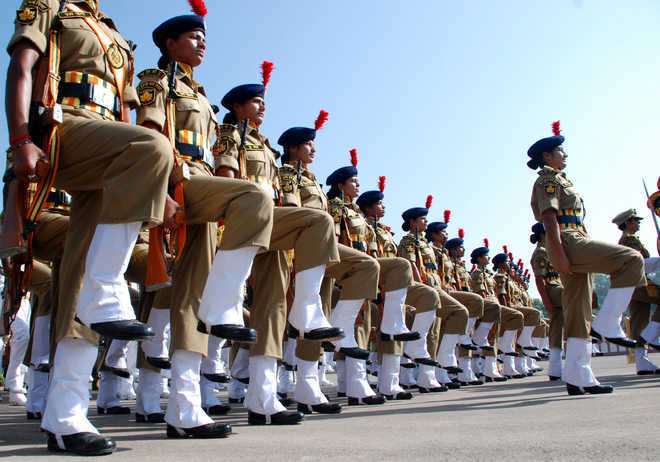
ITBP deploys women personnel at China border for first time

ITBP deploys women personnel at China border for first time
The force earlier this year commissioned 500 women troops. File photo

Greater Noida, October 24

At least 100 women ITBP personnel have been deployed at 15 border posts along the arduous Sino-India frontier, making it the first such posting of ‘mahila’ combatants in a forward area.The force has recently completed the full processes for deployment of the women personnel at select forward posts, ITBP Director General Krishna Chaudhary told reporters here.The women contingent, trained in war craft and and weapon firing, have been posted after the Border out Posts (BoPs) were made “gender neutral” and other facilities were created for them, he said.Officials said while the maximum of these women have been sent to Indo-Tibetan Border Police BoPs in the Ladakh frontier of Jammu and Kashmir, few have been posted at other locations in Himachal Pradesh, Uttarakhand, Sikkim and Arunachal Pradesh.The total numbers of the women personnel, who have been posted at BoPs, is about 100, they said, adding few more BoPs will have women personnel in the coming days.The force earlier this year commissioned 500 women troops for deployment at India-China border in its constabulary ranks after training them for 44-weeks in in battle craft and mountain survival.The posts where these women have been deployed are situated at heights of between 8,000 and 14,000 feet, including the ‘Mana pass’ border post, the last village on the Indian side in Uttarakhand.The force plans to have women personnel make up at least 40 per cent of its strength at these forward posts.This is the first time India has deployed women troops right at the front, at least on the one which is considered to be the most arduous and tricky given the harsh climatic conditions and extreme mountainous terrain along the India-China border.ITBP, which marks its 55th Raising Day today, was raised in the aftermath of the 1962 Chinese aggression.These women, who were recruited in the force in February last year, hail from various states with 97 of them, the highest, coming from the hill state of Uttarakhand.Women constables were first inducted in this 80,000 personnel strong force in 2008, but they were until now only deployed for rendering law and order duties in troubled areas and in a few instances at the Nathu La pass to facilitate traders and for frisking women.ITBP has a total of 1,661 women personnel in its various ranks and branches of work with the maximum number of 1,033 being in the constabulary ranks. — PTI