Sanjha Morcha

Will approach UN if India violates Indus Water Treaty: Pak

Will approach UN if India violates Indus Water Treaty: Pak
Says the revocation of the treaty could be taken as an ”act of war”

Islamabad, September 27

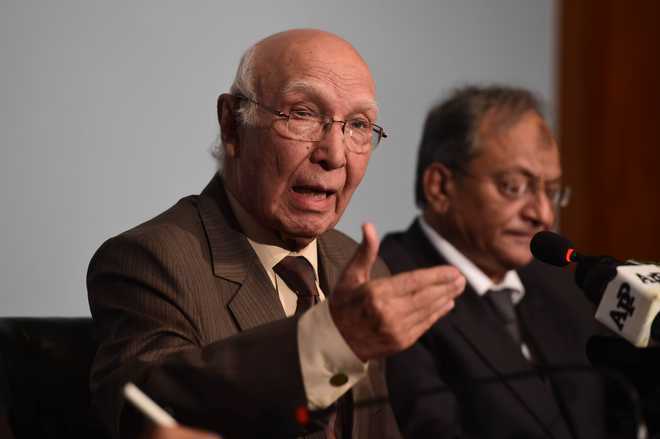
Pakistan will approach the UN and the International Court of Justice if India suspended the 58-year-old Indus Waters Treaty, the country’s top diplomat Sartaj Aziz said on Tuesday, insisting the revocation of the treaty could be taken as an “act of war”.“The international law states that India cannot unilaterally separate itself from the treaty,” Aziz, Adviser to Prime Minister Nawaz Sharif on Foreign Affairs, said while briefing the National Assembly on the issue.He said the unilateral revocation of the treaty could pose a threat to Pakistan and its economy. He said if India violated the treaty Pakistan could approach the International Court of Justice.“This Indian act can be taken as breach of international peace and hence giving Pakistan a good reason to approach the UN Security Council,” Aziz said.He said Pakistan is considering drawing the attention of the international community on the dangers of such an action if it is considered seriously.

(Follow The Tribune on Facebook; and Twitter @thetribunechd)

“Between the two countries, this act of revocation can be taken as an act of war,” he said.Prime Minister Narendra Modi on Monday chaired a review meeting of 56-year-old Indus Water Treaty during which it was decided that India will “exploit to the maximum” the waters of Pakistan-controlled rivers, including the Jhelum, as per the water-sharing pact.The meeting came as India weighed its options to hit back at Pakistan in the aftermath of the Uri attack that left 18 soldiers dead, triggering demands that the government scrap the water distribution pact to mount pressure on that country.Under the treaty, which was signed by Prime Minister Jawaharlal Nehru and Pakistan President Ayub Khan in September 1960, waters of six rivers—the Beas, Ravi, Sutlej, Indus, Chenab and Jhelum–were to be shared between the two countries.Pakistan has been complaining about not receiving enough water and has gone for international arbitration in a couple of cases.Commenting on the development, Ahmer Bilal Soofi, a former federal law minister, president, Research Society of International Law, and an advocate in the Supreme Court on the issue, said India had no legal competence under the treaty to revoke it per se on its own as Article 12(4) of the treaty entitles the termination of the treaty only if both India and Pakistan agreed in writing.He said there is an arbitration clause in the IWT that could be set in motion if India went to that extreme.“India cannot itself conclude that Pakistan has breached the treaty on any grounds, including mistrust. In case India ‘revokes’ the treaty, it literally means it has shunned it,” he said.Soofi said in case India tried to interrupt water flow into Pakistan as an upper riparian, it would set up a regional state practice which under international law could serve as a precedence and equip China with an argument to consider suspension of the waters of the Brahmaputra.“India may have already damaged itself by even considering the suspension of water flow as an upper riparian and the Chinese government must be watching Indian moves with interest,” he said. PTI


War is not an Xbox game

As India determines its next steps against Pakistan, we should all avoid loose talk on war, raids or cutting off the flow of the Indus

I f there was any containment of tensions possible after the terror attack on the Indian Army at Uri on September 18, Pakistan Prime Minister Nawaz Sharif shut the door on that with his speech at the United Nations . In perhaps the most inflammatory public comments of his current tenure – especially given the platform – Sharif remained silent on the attack, not even serving up a perfunctory condemnation. Instead, he hailed the Hizbul Mujahideen militant Burhan Wani as a victimhero. Given the gun-toting videos of Wani — who has come to represent a dangerous new phase of militancy in the Valley of local, educated boys picking up the gun – the attempts by Sharif to present him as some sort of peaceful protester was laughable.

PIBPrime Minister Narendra Modi (right) with his Pakistan counterpart Nawaz Sharif in Lahore, December 25, 2015

In a post 9/11 world haunted by the spectre of the Islamic State (IS) one has to carefully watch Wani’s videos to know that no global leader could support Sharif’s UN eulogy to him. Surrounded by half a dozen militants all brandishing automatic weapons, Wani calls for Kashmiri youth to join the jihad that will eventually usher in a ‘Caliphate’ — first in Kashmir and then globally. He warns the media to step in line or face the consequences. And he threatens those Kashmiris who join the police with death. In an age before the twin towers were brought down and al-Baghdadi became the world’s most wanted man, Sharif may have had some luck making a martyr out of Wani. But now all that foreign minister Sushma Swaraj needs to do when she speaks in New York next week is to play the Wani tapes. Wani’s choice of words — “Caliphate”, “Jihad” — are too close to the idiom of the IS and other global Islamists for the world to express empathy. Sharif scored a giant self-goal.

This is not to say — and some of us have been saying it for two months — that India does not have a genuine problem of alienation and rage in Kashmir. But that is our own problem to resolve, not Islamabad’s to lecture us on. The fatal mistake the government made was for Prime Minister Narendra Modi to invest all his political capital and imagination in Islamabad, instead of in Srinagar. One longed to see a domestic version of a flamboyant gesture like Modi’s unannounced visit to Lahore in the Valley with our own people — but that did happen.

The government wrongly calculated that the road to peace in Kashmir was via Pakistan. If anything, it’s the other way around. The best way to render Pakistan irrelevant is in fact to reach a settlement at home. Pakistan’s hold over the Kashmiri people has been exaggerated. During the recent unrest, I asked a young street protester who pointed my camera to a Pakistani flag flung over a street lamp, what its relevance was to them. He laughed and said, “None. We put these flags up to irritate you people.” But the crying need for a domestic Kashmir dialogue is a longer conversation for a different time; the Uri attacks have brought home the need for the Centre to find an authentic and consistent Pakistan policy.

So far there has been confusion and inconsistency in its approach to Islamabad — lurching wildly between romanticised notions of friendship (the hand-in-hand walk in Lahore), untenable red lines that had to be swiftly shifted (no dialogue if the Pakistanis met with the separatist Hurriyat Conference), wild leaps of faith (allowing Pakistani investigators, including the ISI, into the Pathankot airbase where its own Deep State had attacked us) and now a clear intent to sever ties in the short term at least. Some of this seeming confusion is understandably the malleability that is required of smart diplomacy. But some of it — a substantive part — reflects political confusion. The missteps betray a conflicted identity: Does the BJP want to be the tough-guy it promised it would be while in Opposition; the ‘Action Hero’ alternative to the Congress’s more chocolate-boy wimpish instincts; or, does it want to be Vajpayee-esque in its optimistic and statesman-like determination to keep looking for solutions while hardening stands when needed.

The government is right in gauging that Uri is a tipping point. As the single-largest such attack on security forces in years it has triggered seething rage among people. It is correct for the security forces to be given a free hand and autonomy in determining the appropriate response – covert, overt, localised at the Line of Control or otherwise.

But as India determines her next steps here’s what we should all avoid at all costs — loose talk — either of war or cutting off the flow of the Indus water or cross-border raids. This is no time for delusional talk of peace either, please. It’s a moment to hold our nerve and be cold and calculating instead of impetuous and hot-headed. War is too serious to be treated like an XBox game. Leave it to those who know better — our military — to make their own assessments. In the meantime, a range of other options exist: Postpone the Saarc summit and allow it a NAM-like slow fade into irrelevance; strengthen other regional forums such as Bimstec that keep Pakistan out and yes, while I would never support using water as a weapon, go ahead and scrap the most favoured nation status to Pakistan. If there is no response from Pakistan to the Uri evidence provided by India then think about recalling the Indian envoy or asking the Pakistani envoy to leave. In the meantime, please quit picking on Pakistani actors and artistes in the film industry. Threatening them is shameful. Action is about real ‘targets’, not fall guys.

And finally, a little silence won’t hurt any of us. The gladiatorial thirst and thrust is good for studios and social media warriors. Not for those who actually have to go to battle.


Afghanistan says Pakistan backing terrorists in ‘full-scale war’

UNITED NATIONS: Afghanistan has accused Pakistan of backing terrorists waging a “full-scale war” and warned that it reserves the right to do “whatever is necessary for the defence and protection” of its people. It called on the international community to eliminate terrorism safe havens.

Laying out a harsh indictment of its neighbor, Afghanistan’s Vice President Sarwar Danesh told the General Assembly summit, “We have repeatedly asked our neighbouring country Pakistan to destroy the known terrorist safe havens, but we unfortunately are yet to witness any change in the situation.”

He spoke of the spate of attacks by the Islamic State (IS) and the Taliban and said, “Based on existing evidence, these attacks were planned and organized from the other side of the Durand Line, inside Pakistani territory.”

He spoke before Pakistan Prime Minister Nawaz Sharif was scheduled to speak at the Assembly.

Turning to the world leaders in the Assembly chamber, Danesh asked, “Where were the previous leaders of the Taliban and Al-Qaeda residing, and where were they killed? At this very moment, where are the leaders of the Taliban and Haqqani network located? From where and how are terrorists being trained, equipped and financed during a full-scale war?”

Danesh asked countries to avoid “making a distinction between good and bad terrorists.”

More than ten terrorist groups which are sent from outside Afghanistan are waging the “undeclared war” against Afghanistan, he said.

Danesh asked the UN to appoint a Special Representative for the Safety of Journalists “focused on the protecting all journalists, including those serving in Afghanistan.”

“Special target of the foreign-backed terrorists” were democracy, freedom of expression and the independent media, he said.

“That is why our journalists are subject to serious threats while reporting from the battlefields, and also during terrorist attacks.”


Rafale will bridge two-decade gap and tech-divide Deal to be inked Sept 23

Rafale will bridge two-decade gap and tech-divide
The Cabinet Committee on Security (CCS) on Wednesday cleared the final draft of the inter-governmental agreement to be signed with France. Filel photo

Ajay Banerjee

Tribune News Service

New Delhi, September 21When India and France ink their much-awaited contract to buy 36 Rafale fighter jets on Friday, it will not only bridge a two-decade gap in procuring new fighter jets for the Indian Air Force (IAF) but will provide a technological-edge.The Cabinet Committee on Security (CCS) on Wednesday cleared the final draft of the inter-governmental agreement to be signed with France.

(Follow The Tribune on Facebook; and Twitter @thetribunechd)

The Indian Air Force has not procured any new fighter jets since the start of this century, the last one being the Sukhoi 30-MKI from Russia that was first ordered in mid-1990’s and since licence- produced in India by Hindustan Aeronautics Limited (HAL).On Friday, the two countries are set to sign a 7.878 billion euros (approximately Rs 58,828 crore) contract with Dassault Aviation of France for these 36 Rafale jet fighters. This means approximately Rs 1,634 crore for each plane that will add to teeth to the IAF’s fleet — presently operating at its lowest force levels in a decade.The first of the jet from France is to be delivered in 36 months that is September 2019 and the entire lot will be delivered over the following thirty months.The French company will make India-specific changes, such as next generation missiles like Meteor and Scalp, which will add capability much beyond India’s immediate adversaries. The Meteor, is a BVR (Beyond Visual Range) air-to-air missile with a range in excess of 150 km. It will allow IAF to hit targets inside both Pakistan and Tibet from within its own territory. The Scalp is a long-range air-to- cruise missile with a range of 300 km.The Ministry of Defence and the IAF team that negotiated the price have secured a concession of almost 722 million euros (approximately Rs 5,390 crore). In January this year, a day before French President François Hollande and Prime Minister Narendra Modi were to jointly issue a statement during the French President’s visit to India, the French team had quoted a price of 8.6 billion euros.The negotiations ended at a price of 7.898 billion euros, sources in the Ministry of Defence said. Of this, 3.42 billion euros is the cost of the bare planes; 1.8 billion euros is associate supplies for the infrastructure and support; 1.7 billion euros is India-specific changes to the plane; 710 million euros is the additional weapons package and 353 million euros is the cost of  ‘Performance-based Logistics Support’.Under this logistics support, Dassault will ensure that at least 75 per cent of the fleet remains operational or air worthy at any given time under what is called the existing frontline fighter, the Sukhoi 30-MKI has only 60 per cent availability.Other concessions include are free training for nine IAF personnel, additional guarantee for 60 hours of usage of training aircraft for Indian pilots and six months of free weapons storage without charge.Under the originally planned (and now scrapped) proposal to produce 126 planes in India, the first batch of 18 planes were to be manufactured in France and 108 were to be manufactured in India.  France cited that cost of man hours (labour) in India need to produce a plane was 2.7 times higher due to lack of automation. This along would have meant additional Rs 150 crore per plane.


Nod to 10,000 SPOs for J&K

Nod to 10,000  SPOs for J&K
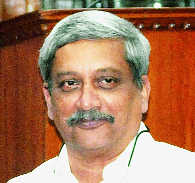
Manohar Parrikar, Defence Minister

Tribune News Service

New Delhi, September 21

To strengthen the Jammu and Kashmir Police, particularly in view of the unrest in the Kashmir valley, the Centre today approved the recruitment of an additional 10,000 Special Police Officers (SPOs) with immediate effect. There are 25,000 SPOs in the state already.The Centre had information suggesting that thousands of Kashmiri youths had opted for the job, despite a call by Hurriyat hardliner Syed Ali Shah Geelani to boycott recruitment rallies.(Follow The Tribune on Facebook; and Twitter @thetribunechd)The government issued a statement which read: “The additional SPOs will be utilised especially for security-related requirements. The reimbursement of expenditure to the state government by the Centre in respect of 10,000 SPOs will be as per the existing approved Security Related Expenditure (SRE) Guidelines.”An SPO initially draws a salary of Rs 5,000 per month, Rs 5,300 on completion of one year and Rs 6,000 on completion of three years. The Centre is in the process of providing employment opportunities to 1.40 lakh youths in the state through various means, including skill development. Official sources said one lakh youths, mostly under-graduates, would be given job-oriented training under the Himayat scheme in the next five years.


We’re serious about punishing: ParrikarNew Delhi: Defence Minister Manohar Parrikar on Wednesday said the government is “serious” about punishing those responsible for the Uri attack as it will “not sleep over” terror being pushed into India from across the border. He also dismissed reports about Pakistan’s threat of use of tactical nukes, saying that an “empty vessel makes bigger noise”. tns/pti


Uri attack: India gives Pak evidence of involvement of Pakistan-based terrorists

Uri attack: India gives Pak evidence of involvement of Pakistan-based terrorists
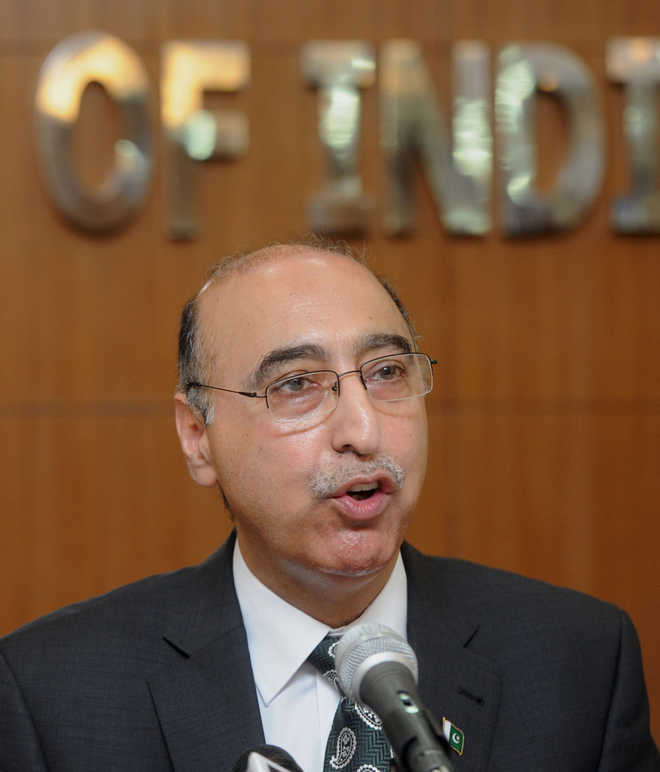
A file photo of Pakistan High Commissioner to India Abdul Basit. India blames the attack on the outlawed Jaish-e-Mohammed (JeM). Tribune fiile photo

New Delhi, September 21

India on Wednesday gave Pakistan evidence of involvement of Pakistan-based terrorists in the Uri attack and demanded that it refrain from supporting and sponsoring terrorism directed against it.

Foreign Secretary S Jaishankar summoned Pakistan High Commissioner Abdul Basit and told him that latest terrorist attack in Uri only underlined how terrorists remained active in Pakistan.Jaishankar provided Basit with the content of GPS recovered from the bodies of terrorists with coordinates that indicate the point and time of infiltration across the LoC and the subsequent route to the terror attack site and grenades with Pakistani markings as evidence of Pakistan’s role in Uri attack in which 18 jawans were killed.(Follow The Tribune on Facebook; and Twitter @thetribunechd)

“If the Government of Pakistan wishes to investigate these cross-border attacks, India is ready to provide fingerprints and DNA samples of terrorists killed in the Uri and Poonch incidents,” he told the Pakistan envoy.

Asserting that the latest terrorist attack in Uri only underlines that the infrastructure of terrorism in Pakistan remains active, Jaishankar demanded that Pakistan lives up to its public commitment to refrain from supporting and sponsoring terrorism against India.

He also reminded Basit that the Pakistan government had made a solemn commitment in January 2004 to not allow its soil or territory under its control to be used for terrorism against India. “The persistent and growing violation of this undertaking is a matter of very serious concern,” he told Basit.

In a release, External Affairs Ministry said this year, beginning with the Pathankot airbase attack, there have been continuous attempts by armed terrorists to cross the LoC and International Boundary in order to carry out attacks in India.

“Seventeen such attempts have been interdicted at or around the LoC, resulting in the elimination of thirty one terrorists and preventing their intended acts of terrorism.

Foreign Secretary also reminded him that even as he spoke two engagements at the LoC were ongoing,” it said.

Apart from GPS content, India has recovered a number of items that included communication matrix sheets and equipment, other made in Pakistan stuff like food, medicines and clothes, which were shown to Basit.

“We now expect a response from the Government of Pakistan,” Jaishankar told him.

Basit’s summons came a day after Jaishankar headed a high-level meeting, attended by senior Home Ministry officials and Director General of Military Operations (DGMO), during which the evidence recovered by Indian Army from the terrorists was shared with the MEA. — PTI


India’s response must not be to resort to a punitive counterattack

WHAT MODI AND RAJNATH NEED TO ASK THEMSELVES IS WHAT PAKISTAN’S OBJECTIVES MIGHT BE AND TAKE THE ACTION THAT IS NEEDED TO CHECKMATE IT

The fidayeen attack on its base at Uri is easily the worst setback that the Indian army has suffered in Kashmir in the past 26 years.

An attack by home-grown terrorists is unlikely for, since August 1999, all such attacks have come from Pakistani territory. The chosen, and politically far more effective, weapon of Kashmiri separatists has been stones. So assuming that these were Pakistanis, nurtured by the Lashkar-eTaiba, and sent to Kashmir by the ISI, what should India’s response be?

What it absolutely must not be is a punitive counterattack on Pakistan. For that will free Islamabad’s hands to send huge numbers of terrorists into Kashmir. Pakistan knows that, given the conditions that prevail in Kashmir today, they would be welcomed as saviours, something that has not happened in the past.

What Modi and Rajnath Singh need to ask themselves is what Pakistan’s objectives, in launching this attack now, might be and take the action that is needed to checkmate it. The obvious one is a desire to continue fuelling the curfew and lockdown conditions that have prevailed in Kashmir since the death of Burhan Wani.

Delhi must stop letting Pakistan play upon its ignorance of Kashmiri aspirations. Unlike Modi, Islamabad knows that very few Kashmiris want Kashmir to go to Pakistan. This was confirmed by the meticulously constructed Chatham House (Royal Institute of International Affairs, London) survey of opinion in both parts of Kashmir in 2009, which found that even in the hotbeds of separatism in the Valley only 2 to 7 percent of the people wanted to go to Pakistan.

As a group of journalists and human rights activists, of whom I was one, found out during a visit to Kashmir last month, this proportion has not changed by much despite all that the people of the Valley have suffered. What has changed is the intensity with which the 75% to 95% who wanted independence then, want it now.

However, except for teenagers who have not yet begun to think of their future, and the fringe of unemployed youth in their twenties who lead the revolt, almost no one wants to sever all relations with India. To them ‘azadi’ means political freedom without the sacrifice of Kashmir’s huge and profitable economic integration with India.

In short, what Kashmiris want is what Nobel Laureate Amartya Sen has written so eloquently about: it is not the negative concept of freedom from India but the positive concept of freedom, as the capacity to do things with India to improve their lives.

This duality has existed since Sheikh Abdullah was imprisoned in 1953, but has only grown stronger with the passing of the years. It gives the government, even now, a powerful yet simple way to end the intifada in Kashmir.

Modi has urged the Kashmiri opposition parties, and the separatists, to ask for anything within the framework of the Indian Constitution, and Rajnath Singh has gone even further. But no one is taking up their invitations to talk because no one in the Valley trusts any Indian government any longer not to renege upon its word.

The only way to bridge this trust deficit is to make a declaration that the government of India is willing to grant Kashmir full autonomy within the framework of the Instrument of Accession and the Delhi framework agreement of 1952 (which addressed their core need for economic integration) and also allow the newly-elected state government to decide which of the later 67 amendments to Kashmir’s constitution that have deepened this integration, they wish to retain.


Within Army, MoD, demand for fixing accountability

Jammu, September 18

After the Uri terror attack, the voices within the Army and the Ministry of Defence, who want accountability to be fixed for the security lapses, have gained strength. The Army and intelligence agencies reportedly had concrete inputs of a possible fidayeen attack in the state. A fidayeen attack in Poonch a few days ago confirmed the validity of these inputs. Despite this, fidayeens succeeded in carrying out their nefarious designs. “This is not going to be put under the carpet and hushed up like previous attacks where accountability was not fixed. Time has come to make people accountable, due to whose negligence soldiers lost their lives,” said a source in the Ministry of Defence. — TNS


The Challenges In Stabilising The Streets Of Kashmir:Syed Ata Hasnain

The Challenges In Stabilising The Streets Of Kashmir

SNAPSHOT

In sensitive times there will be mistakes and the Army too will make them. Its rank and file need to hold its horses and not resort to the newly found technique of placing everything in the public domain by use of social media.

The Army must continuously train and retrain its leadership and troops because they are all going to be involved in sensitive responsibilities.

After two months of strife in the Kashmir Valley, we may be just heading into better control of the situation which resulted from the response to the killing of Burhan Wani the young South Kashmir militant leader, on 8 July 2016. However, the time taken may not have been for want of trying. The Home Minister has been in one of the widest consultation in recent times which is proof of both the complexity of the situation and the seriousness of efforts to control the streets without the use of unfettered state violence. Many may respond very negatively to the above view, but an explanation is due and has been made later in this piece.

It would be incorrect to give certification to Pakistan that it is not involved in the instigation, enablement and support to the violence in the streets. The establishment in both Srinagar and Delhi has been extremely careful in response except that the pellet guns became the villains of the peace. Unfortunate that the pellet guns have become the symbol of the state response and that’s because of the inability to create the right doctrines for crowd control in the period between 2010 and 2016.

No need to lament for that now but the necessity to be seen having removed these from the inventory may be a good balm if nothing else. The kind of mindless violence by a defused invisible leadership would have probably invited a far greater response in many other nations. We had seen tanks at Tahrir Square in Cairo within a few days of the Arab Spring rising. It was the same case in Tiananmen Square which is a forgotten story for today’s generation. Democratic states are mindful that violence will occur as a form of dissent against state authority; it’s all within the ambit of governance under democracy.

However, it is the limit of tolerance for violence which differs from state to state. In India, at different times there are different reactions. It is contingent upon the security force involved, along with its level of training and its leadership. Sometimes forces have gone overboard as in the case of the recent response of the PAC to the cult violence in UP’s Mathura district. In the case of Haryana’s agitation early this year much property went up in flames without adequate force response.

But these cases were of law and order; no one was seeking secession from the Indian Union. The situation in Kashmir is more of public order where the Army needs to step in early if need be. Delhi was reluctant to do that and rightly so because there is adequate CRPF to support the J&K Police. Some reinforcements were also brought in.

The difference, this time, has been the far better strategy on the part of those involved in the guiding the violent street agitation; the diffused leadership so to say. I believe that the final guidance comes from Pakistan’s Deep State, so I continue to name it. The Deep State probably analysed that the 2008-10 agitation could not be as effective as desired because the rural areas were kept quiet in comparison, by the Indian Army which has its tentacles deep there. The Army’s very competent junior and middle leadership has long built stakes and networked with the populace. The curfew is easier to impose in urban areas but in widespread ‘qasbas’ and villages in the rural areas, it becomes difficult to implement. Since the Army was not called in, as in the past, and its attempts at informal control through networks could not be as effective, the agitation went out of control. Surprisingly, places such as Damal Hajipura and other villages hugging South Kashmir’s Pir Panjal area displayed extreme violence with targeting of police stations as the main tactics. The Deep State has been smart in thinking.

Perceiving J&K Police to be the main force multiplier in situations of street turbulence it went hammer and tongs after its personnel. From making the holding of police stations with little strength untenable, to targeting individual homes of personnel to create fear psychosis and paralysis in J&K Police ranks, the tactics employed succeeded beyond their expectation. This emboldened the mobs. The CRPF did its thankless task but with demoralised local police support any force will be less helpful. It could not regain control of the crucial areas of Pulwama, Shupian and Kulgam districts. Hence it was time for the Army to step in.

What is the Army’s role in such situations where public order is at stake? This same issue was debated even at the outset of street violence in 2008, the first year that the Separatists seriously changed tack due to inadequate terrorist strength. With the presence of AFSPA, there was never a need for a requisition. The Army continued to hold the periphery by persuading the rural populace against swarming onto the highways. The terrorist presence in ranks of the mobs in 2008-10 was marginal, unlike this time when there has been the use of hand grenades and the tactics in confronting the police has been virtually professional.

In the earlier years, Army came to the support of local authorities in some towns such as Baramulla and Sopore without a clear-cut mandate, merely showing the flag to keep the police forces bolstered and prevented spillage of the mobs beyond limits. In 2016 the same methodology appeared to have been attempted at most places. Having faced this situation many times I’m aware how much dilemma, this causes for local commanders in olive green. There is the inadequacy of clarity on the task, and they run the risk of troops coming in direct contact with mobs without having any non-lethal means to contain them.

This time, the terrorists have played a much more proactive role with even targeting of night convoys something unheard of in the last phase in 2008-10. To regain their significance they have also attempted ambushes of routine day convoys and have now upped the ante with repeated infiltration attempts at the LoC. In 2008-10 a phenomenon noticed was the attempt to intimidate the Army by surrounding small detachments of three vehicles; an ambulance was burnt in Pattan belonging to a Field Ambulance unit which was nodal to providing medical assistance to civilians. In 2016 an attempt to intimidate the Rashtriya Rifles (RR) Quick Reaction Team in Qazigund led to the RR opening fire resulting in the killing of three civilians. There was no further attempt to intimidate small convoys thereafter.

Now that the Army has been deployed in greater numbers in South Kashmir in the Pulwama-Shupian belt from where it had progressively withdrawn over the last few years, there is every possibility that it will be tested by the diffused leadership. It will run the risk of being accused of being overbearing or inadequately hard against those who deservingly need to be brought to book. The first thing is that the control over the police stations has to be restored, and the local police have to return to duty with the full backing of the Army to support it whenever intimidated. For the Army restoring confidence is one thing but the police officers who are locals from the same area (a principle in policing duties) may find it yet difficult to serve there. Some amount of temporary redeployment of its personnel by J&K Police may have to be done without prejudice to later returning to the core practice of local content for local policing.

The Army’s show of force is usually done through flag marches in law and order stricken areas. However, here the threats are higher demanding domination of the smaller townships through large size patrolling, both mobile and foot-borne. It was heartening to see that the Army has not forgotten the basics. Even as the area around Shupian was burning a medical and vet camp was underway near Balapur the HQ of a RR Sector. There is a vast silent majority of which the Chief Minister has often spoken; I too am aware that it is there, stricken by fear of the radicalised youth who are needed to be controlled and if not they need to be taken out systematically and sent for de-radicalisation outside the Valley. This is where firmness has to be displayed. The Army must continuously train and retrain its leadership and troops because they are all going to be involved in sensitive responsibilities. Some of these troops have come from outside the Valley and given the large scale turnover in the RR units there will be too many raw hands who may feel the pressure of the awkward situation they are in.

Given Kashmir’s inadequate holding facilities for detainees, the last thing acceptable is the clubbing of detainees with terrorists or other hardcore elements in Central Jail Srinagar. The Jail needs a thorough review as many a time even the DG police finds his control challenged. Sim cards, mobiles, etc. are common, as are daily visits by relatives with home cooked food. Detainees need to feel the pressure of detention and the authority of the state; they should largely be sent into detention facilities in Jammu or beyond.

Lastly, in sensitive times there will be mistakes and the Army too will make them. Its rank and file need to hold its horses and not resort to the newly found technique of placing everything in the public domain by use of social media. I also hope that staff of Media Branches at HQ Northern Command and HQ 15 Corps remains ever alert on the attempts of the adversaries to paint the Army Red all over. More than just the defensive side it is the ability to assist the outreach through information operations that will make the difference. This is the first real test of proactive information operations. Let us see how well the Army takes up the challenge. It should be reinforcing these branches for good measure.

Given its propensity to think out of the box, exercise adequate control and allow its commanders the flexibility they need to be empowered with I have no doubt the Indian Army will achieve its objectives very shortly. This will enable the return to full governance as deserved by the largely peace-loving majority of the people of the Valley.