Sanjha Morcha

URI TERROR ATTACK Bihar revises ex gratia to Rs11 lakh

Bihar revises ex gratia to Rs11 lakh
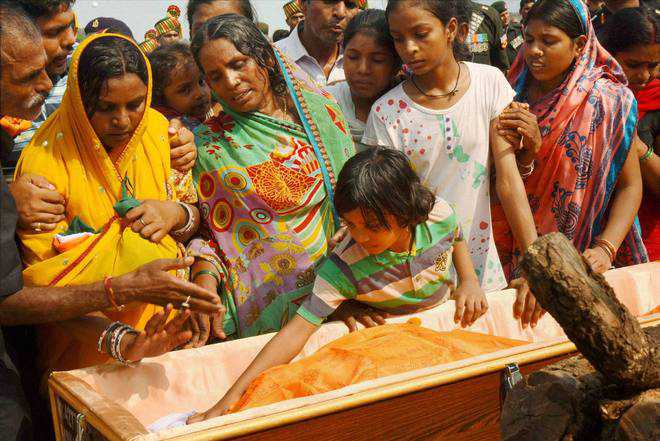
Relatives and children of martyr Naik Sunil Kumar Vidyarthi during his funeral in Gaya on Tuesday. PTI

Jitendra K Shrivastava

Patna, September 20

After facing criticism for announcing Rs5-lakh compensation for each of the bereaved families whose sons were killed in a terror attack in the Uri sector of Jammu and Kashmir, the Bihar Government today raised the amount to Rs11 lakh.Reacting to the state government’s offer of Rs5 lakh ex gratia, Sangeeta Devi, wife of martyr Havildar Ashok Kumar Singh from Bhojpur, said: “My husband has sacrificed his life for the nation. He has not died of consuming alcohol or falling in a ditch. We don’t need any compensation and we are not begging. If other state governments have offered Rs20 lakh, we will not accept Rs5 lakh.”“The earlier announcement of Rs5 lakh for martyrs has been increased to Rs11 lakh today. The compensation will be given to the next kin of each of bereaved families as three soldiers had lost their lives in Uri,” said Brijesh Mehrotra, principal secretary at the Public Relations Department.


Uri attack: 17 soldiers martyred, 24 injured. We’ve had enough!

An Indian army helicopter flies above the army base which was attacked by suspected rebels in the town of Uri, west of Srinagar, Kashmir, Sunday, Sept. 18, 2016. | AP

In one of the deadliest attacks ever on the Indian Army, 17 soldiers were killed and 24 others injured after four heavily-armed suicide attackers stormed into the Army’s administrative base in Uri on Sunday.The attack has further heightened the tension between India and Pakistan and also across the Kashmir Valley. The Uri base in Baramulla district is located close to the Line of Control. This is the highest casualty the Indian Army has suffered in a single attack in the last several years.

All the four suicide attackers, hailing from Pakistan, were killed in the ensuing gunbattle that lasted close to four hours. Search operations are continuing to ensure there are no more terrorists lurking in the area. An unmanned aerial vehicle has been pressed into service for this purpose.

According to preliminary reports, the attackers belong to the Jaish-e-Muhammed (JeM). The same group was responsible for the Pathankot air base attack in January this year.

The attack comes ahead of Pakistan Prime Minister Nawaz Sharif’s visit to New York to attend the UN General Assembly. Sharif is expected to raise the Kashmir unrest issue at the meeting. Responding to the attack, Prime Minister Narendra Modi said that the attackers would not be spared. Home Minister Rajnath Singh rushed to Srinagar on Sunday to review the situation.

At around 5:30 am, heavily-armed militants entered into the rear base camp of an infantry battalion while most of the Army personnel were asleep. They launched an attack which resulted in a fire. Several tents caught fire. A majority of the soldiers, who were sleeping, were trapped in the fire and died due to burns.

The terrorists were then challenged by the Army personnel. An hour later, special forces of the Army took control of the operations and eliminated all the four terrorists. A large number of weapons with Pakistani markings, including four AK 47 rifles and four Under Barrel Grenade Launchers, were recovered.

(click on image to enlarge)

“All four attackers were foreigners and belonged to Jaish-e-Muhammed,” Director General of Military Operations Lt Gen Ranveer Singh said. “About 14 of our men died in the fire that broke out in the shelters.” Of the 24 injured, nine are critical.

Though there were credible inputs of militants waiting to sneak over to the Indian side, security agencies are perplexed over how they managed to cross the border. “Lapses will come out once the Army completes its enquiry,” sources said.

They shall not go unpunished: PM Modi

NEW DELHI: The Union government, led by Prime Minister Narendra Modi and President Pranab Mukherjee, severely condemned the attack in Uri and promised that the prepetators would not go unpunished. “Those behind the despicable attack will not go unpunished,” the Prime Minister said.

“India will not be cowed down by such attacks. We will thwart the evil designs of terrorists and their backers,” President Pranab Mukherjee said.

The Union Home Minister Rajnath Singh held a high-level meeting to review the situation and directed the security forces to launch an all-out offensive against militants in the Valley. “Pakistan is a terrorist State. It should be identified and isolated as such. I am disappointed with Pakistan’s continued support for terrorism,” he said.

Rajnath also postponed his visit to Russia and the US in the wake of the attack and continuing unrest in Kashmir.


Bureaucrats Hold Military to Ransom, Service Chiefs Must Empower Soldiers

LT GENERAL P.C.KATOCH

Tuesday, September 13,2016

NEW DELHI: The military holds Pakistan to ransom but India is held ransom by the bureaucracy, indispensable to politicians no matter how unprofessional and unaccountable.

This is particularly relevant to the Ministry of Defence where a systematic degradation of military has been effected through past decades.

The Koshiyari Committee on One Rank One Pension (OROP) had lambasted the government for total “Bureaucratic Apathy” against military veterans. Yet this apathy is growing, a recent example being the military’s recommendations for the 7th Central Pay Commission being blocked at the defence secretary level.

The Armed Forces have rejected the salary and emoluments recommended by the 7th CPC on grounds that its implementation be put on hold in view of the “unresolved anomalies” that lowered the status of the forces vis-à-vis their counterparts in the police and the civil administration.

The Government doesn’t seem to realize this is a watershed in civil-military relations and wants to bulldoze their writ with the Defence Minister ordering the military to immediately implement 7th CPC.

Numerous unprecedented occurrences in the recent past have adversely affected rank and file of the military both serving and veterans, some being: one, baton charge on peacefully protesting veterans wearing medals (including gallantry awards) and regimental caps at Jantar Mantar;

two, post the despicable baton charge, representative of Delhi police sent to apologize instead of any MoD official;

three, government sanctioned OROP after 1973 but in half-cock manner despite clear definition given by the Koshiyari Committee that was approved by two Parliaments and defined in MoD communications during 2014, and;

four 7th CPC lowering status of the forces vis-à-vis their counterparts in the police and the civil administration. While no government would do this to its own military, it is for the government to examine how such decisions were taken – whether only due to prejudices or any politicians / bureaucrats are receiving foreign funds to do so, possibility of which is very much exists in asymmetric conflict.

The Service Chiefs sure are facing flak because of the above, particularly for not making any statement against the naked disrespect shown in baton charging veterans, watched by serving soldiers on social media. The Service Chiefs should have told the government what they have done is not good of the nation as it badly hurt the psyche of the military.

But now if the Service Chiefs have officially rejected the 7th CPC, the Modi government must realize that the tipping point has arrived.

Defence Minister Manohar Parrikar’s Chinese Checkers of ordering the military to implement the pay panel immediately and anomalies will be looked into is the usual cock-and-bull game played for decades.

Has he done anything about the anomalies of the 6th and earlier CPCs? OROP anomalies have been shoved aside with Reddy’s circus touring pan-India. One can count on the Reddy circus being extended into more such circuses organized to look into the anomalies of the 7th CPC till the 8th CPC overtakes it.

The Service Chiefs need to hold steadfast and tell Parrikar bluntly enough is enough, and that pushing the jaundiced recommendations down the throat of the military is adverse to the nation’s security as it affects morale of the military. This is the ‘battle royale’ with the bureaucracy that holds the politicos captive. But the Service Chiefs also need to do something else .

During 2007, army garrisons at Mathura, Allahabad and Kanpur notified civil authorities they would participate in the upcoming Uttar Pradesh State elections. The chain of events that followed included: one, RTIs to concerned MLAs and MPs querying details of help rendered to veterans, serving soldiers families in their areas during last five years and what development funds used to improve infrastructure in cantonments;

two, standing MLA of Mathura met the Station Commander offering Rupees 10 lakhs (with promise of more) requesting orders be issued for military garrison to vote for his party – money was returned and politico told soldiers are free to vote as per individual wishes;

three, at Allahabad, an illegal encroachment on cantonment land had just been removed after proper court order. The woman heading a political party (whose house was ransacked and burnt few years later by opponents) for garnering votes of the evicted rang up the party President in Delhi, who in turn rang up the Defence Minister. HQ Central Command was asked to order an inquiry into the evictions but when army informed the civil authorities they would participate in state elections at Allahabad, the woman in question dropped all and sought when it would be convenient for the Divisional Commander to have a meal with her;

four, a special cell was established in the office of the Deputy Commissioner, Mathura to look into grievances of serving soldiers, veterans and their next-of-kin;

five, political parties sought permission to hold election rallies inside cantonments which was denied but election posters allowed in the ‘civil’ market;

six, army garrisons voted in special booths under election commission set up within cantonments;

seven, MLA who won election from Mathura, came to Station HQ querying how he could assist in improving infrastructure of Mathura cantonment over the next five years. So on and so forth.

One of the reasons that the Koshiyari Committee refused to equate civilian officials with military personnel was because the fundamental rights of soldiers are drastically curbed. But not only the fundamental right to vote of soldier is safe, the Election Commission has authorized every soldier to vote in his place of posting if he has served for one day or more in that place – he can vote both in state and municipal elections.

By not ensuring every soldier exercises his franchise, Service Chiefs are actually curbing the soldier’s right to vote and contravening the Constitution. Hence, Service Chiefs must take conscious decision to ensure:
first, every soldier authorized to vote in forthcoming elections in Uttar Pradesh, Punjab, Uttrakhand, Himachal Pradesh, Goa and all elections beyond must exercise franchise;

second, voter identity cards must be obtained for every soldier on forthwith basis;

third, procuring individual voter cards must be institutionalized by all Regimental Centres for every young soldier on completion of recruit training;

fourth, official liaison with Election Commission for provision of election commission teams in ‘remote areas’ for military personnel – if Election Commission can send teams inside Gir forest for a single voter no reason they cannot send teams down to battalion / equivalent level in remote areas;

fifth, soldiers must participate in respective municipal elections also as authorized to every citizen;

sixth, casting franchise by every soldier should be treated as ‘Command Function’ and any commander down the line not ensuring same should be made answerable and viewed accordingly for promotion, and

seventh, if the news of Army appointing dedicated officers to liaise with veterans is correct, they should liaise with veterans and NOKs of all military (preceded by mutual agreement at Service HQ level) to address grievances and help them procure voter cards, where not made.

The Service Chiefs must acknowledge that this is the ‘only’ method to counter Nehru’s legacy of the military being called in at the drop of a hat and yet treated as a ‘necessary evil’ – that is being diligently followed till-date.

What will likely follow is Government telling the Service Chiefs they will be dismissed if the 7th CPC is not implemented immediately. Intelligence agencies will be deployed simultaneously to blackmail individual Chiefs and create a divide among them.

Need of the hour is to stay steadfast. Let them dismiss the three Chiefs but the next in-line should refuse to fill the vacated slots – the country anyway is headed by bureaucrats. This by no means is insubordination; it actually is loyalty to the nation at the higher plane which the mafia is incapable of comprehending.



Regaining Ladakh: The Zoji La challenge

A 14km tunnel project marred by political controversy has led to a delay in awarding the contract. The victims are the people of the region who get cut off in the winters. Strategically, Zoji-La holds vital importance: on the one hand is Pakistan and on the other, China. Will politicians back off?

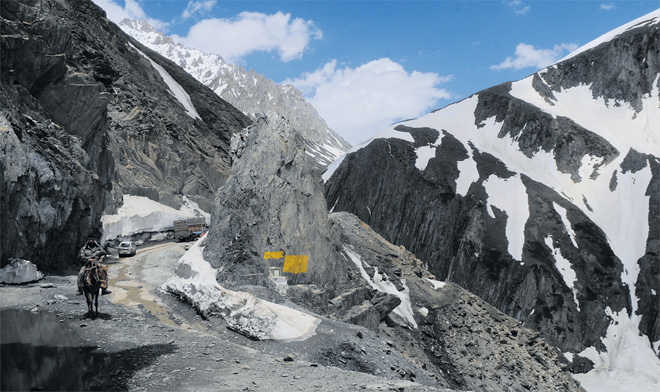
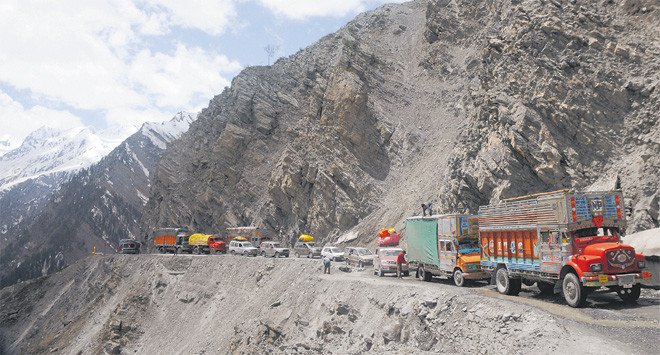
It is land-locked. Its high passes are smacked by bone-chilling cold winds, and when it snows, it is a dreadful whiteout, a blinding netherworld at 12,000 ft (3,530 meters). Zoji La is the fourth highest pass in the country. And it’s also a place where India feels being watched — on one hand is China, on the other, Pakistan. Beyond those passes lies Ladakh which remains cut off during winters. In the 30-km stretch from tourist resort of Sonamarg in Kashmir to Gumri near the Zojila Pass, it is the 10-km rocky passage that’s the toughest: there are steep ravines and vertical cliffs, prone to avalanches. Ladakh hasn’t had the comfort of road connectivity despite being a witness to murderous assaults of weather and India’s foes. A political row has denied it the title of South East Asia’s longest tunnel. Its strategic and socio-economic importance has failed to move our political bosses. Nearly two years after Centre’s clearance for the 14.08-km-long tunnel project in 2013, Congress leader Digvijaya Singh this year alleged corruption in Rs 10,050-crore Zojila tunnel contract. He alleged that there had been “violation of the established practices in the tendering procedures” as the contract was awarded to a single bidder. The Union Ministry of Road Transport and Highways, headed by Nitin Gadkari cancelled the contract awarded to IRB Infrastructure Developers and decided to rebid. To avoid further controversy, the Union Ministry has now entrusted the National Highways and Infrastructure Development Corporation (NHIDCL), its fully owned company, with the task of undertaking and completing the tendering process.”We have invited global bids for civil works under the project. The last date for submission bids is September 28. We are hopeful that the tendering process will be over in the next couple of months and work will start soon,” said a NHIDCL official. “Unfortunately, the project has become the victim of politics. Till now, tendering process has not been completed and it is a grave discrimination against the region,” says Mohammad Haneefa Jan, Chief Executive Councillor (CEC) of Kargil Council.P T Kunzang, vice president of Ladakh Buddhist Association (LBA) says once constructed, the tunnel will enable all-weather connectivity from Srinagar to Kargil and Leh. “Ladakhis are keen to see the tunnel becoming a reality.” Srinagar-Kargil-Leh road traverses through two major mountain ranges. It first crosses through great Himalayas at Zoji La and then Zanskar mountain range at Fatula to enter Ladakh. Apart from its tough geography and topography, the mighty Zoji La Pass witnesses a maximum snow of around 5-6 meters every year and the temperature sometimes plummets to minus 28 to minus 25 degree Celsius.The proposed tunnel will pass through Zozila Pass which serves as the gateway to Ladakh region. The tunnel can be constructed in seven years with an estimated cost of Rs 10,050 crores. The project is part of the Prime Minister Narendra Modi’s Rs 80,000-crore development package for J&K. The single tube bi-directional tunnel with a parallel egress tunnel will be built on Design-Build-Finance-Operate-Transfer (DBFOT) annuity basis. The all-weather road connectivity has always remained a major poll campaign issue in the Ladakh region as it severely faces the shortage of essential commodities and goods when the two highways to Ladakh remain closed in winters.

The tunnel facts

  • Length:14.08-km(Sonamarg &Gumri in Kargil)
  • Total cost:Rs 10,050 cr
  • Construction time:7 years

The project

  • The tunnel will be a single tube bi-directional passage with a parallel egress (to serve in emergency).
  • It will be built on design-build-finance-operate-transfer (DBFOT) annuity basis.

Don’t want to see Indo-Pak tensions lead to ‘some incident’: US

Don’t want to see Indo-Pak tensions lead to ‘some incident’: US
Calls for dialogue between the neighbours. Thinkstock

Washington, September 9

The US has called for dialogue between India and Pakistan to de-escalate tensions in security interests of the region, saying it does not want to see “tensions spiral out of control” and lead to “some kind of incident”.“We strongly encourage in all of our dealings with either India and/or Pakistan stronger relations between the two countries. It’s clearly in the security interests of the region that they work to de-escalate tensions and that they have dialogue,” State Department Deputy Spokesperson Mark Toner told reporters at his daily news conference on Thursday.

(Follow The Tribune on Facebook; and Twitter @thetribunechd)

“That’s something we constantly encourage for just that–or out of just that concern, which is that we don’t want to see tensions escalate, spiral out of control, and lead to some kind of incident,” he said.“It is important for the two countries, the two governments to maintain strong, cordial and productive relations,” Toner said in response to a question seeking his reaction on American senators’ remarks that the US should play the role of a mediator between Pakistan and India.The US, he said, wanted Pakistan to take more action against terrorist network.“Our discussions continue to focus on the fact that we’re urging the Government of Pakistan to take concerted action against safe havens and terrorist groups that threaten other countries in the region and we’ve been very clear about that,” he said.“And we have seen them attempt to address it. We want to see more action taken, but it continues to be a topic of conversation with them,” he added.Toner said America’s relationship with India and Pakistan is not a zero-sum game.“As we’ve said many times, there’s no zero-sum game here. We need to have a very strong and robust relationship with India and we do–the world’s largest democracy. And we also want to have a strong relationship with Pakistan. It’s in the interests of the region to do so,” he said.“The recent India and Bangladesh visit of the Secretary of State (John Kerry) and not going to Pakistan should not be treated otherwise,” Toner said.“It doesn’t clearly indicate anything about our relationship with Pakistan. The Secretary has a very intense travel schedule. He’s been to Pakistan recently; he speaks often to senior Pakistani leadership,” he said.“Specifically, he was in India for the Strategic and Commercial Dialogue and took the opportunity to also visit Bangladesh–I think the first time he’s been there,” he added. PTI


Job racket: Retd Col held

Nashik, August 31

A retired Army Colonel has been arrested in connection with the alleged bogus recruitment racket at the Artillery Centre here, police said today.Col Sukhpritsingh Arjunsingh Randhawa (retd), a resident of Noida in Uttar Pradesh, who is alleged to be the mastermind of the bogus Army recruitment racket, was arrested yesterday from Noida by a team of the city’s Upnagar police station.

The 59-year-old will be brought to Nashik for further probe in the case, Deputy Commissioner of Police Shrikant Dhivare said.Police had on July 11 arrested four men claiming to be Army recruits, all hailing from Rajasthan, for allegedly submitting fake documents for joining the Artillery Centre here.

They were held following a complaint lodged by an Artillery Centre official.During interrogation, the four men confessed that they paid Rs 6 lakh each to get entry into the Army by using fake documents, police said.Later, the Upnagar police arrested jawan Girirajsing Ghanshyamsingh Chouhan, of Rajputana Rifles regiment, posted in New Delhi, and agent Tekchand Meghawal, a resident of Alwar district, on August 23. — PTI


Their war, our heroes

As the world commemorates the centenary of World War I, it is time to remember Indians who fought someone else’s wa

Sarika Sharma

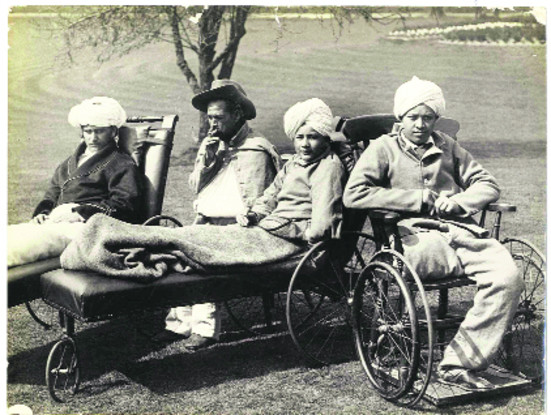
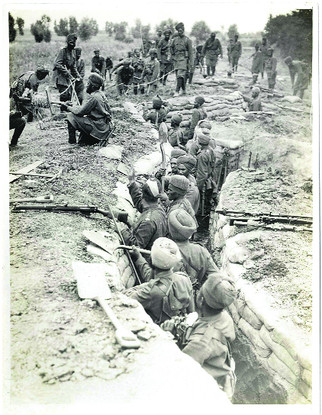
some brave men: Four Indian soldiers convalescing at Brighton hospital, which treated Indian troops, who had returned wounded from fighting in France; and Indian soldiers digging a trench, which is then reinforced with sandbags and protected by barbed wire at the front


Did you know, a hundred years ago there was a man named Manta Singh, whose valour during World War I inspires British schoolchildren even today?Heard of Mal Singh, who was taken Prisoner of War (PoW) by Germany and whose pain and anguish was among the first to be recorded on the then recently invented phonographic funnel? Today he stands immortalised in films like The Halfmoon Files and The Prisoner’s Song, but, never mind if you don’t know him. Do the names Badlu Ram, Lala ring a bell? The answer is most likely to be a no again. This ‘no’ is also a sorry answer to how India remembers its heroes.Two years ago, when Sachin Tendulkar asked Indians to remember their soldiers who fought in World War I, Commonwealth War Graves Commission (CWGC) noticed a 60 per cent increase in the traffic from India to their website. The cricketer seemed to have created awareness about the valiant fellow countrymen, who braved a hostile and cold land a century ago and also sacrificed their lives — all in a war that wasn’t theirs. As the world commemorates the centenary of the War (1914-1919), efforts are being made to help India remember these men.Delhi-based national security and defence services think tank United Service Institution of India and CWGC have launched a campaign to change the culture of remembrance in India. ‘India Remembers’ is now engaging communities within the country, while also highlighting India’s contribution to a global audience.Almost 15 lakh Indian soldiers took part in World War I, fighting in battles in faraway lands, and in conditions entirely alien to them. Even more fought in the World War II. Colin Kerr, director external relations with CWGC, says the ‘India Remembers’ resource pack aims at engaging the communities that these men came from. So, while Uttarakhand will revel in the bravery of Darwan Singh Negi, who was one of the earliest recipients of Victoria Cross, Punjab will finally come to know of Manta Singh from Jalandhar.Manta Singh of the 15th Ludhiana  Sikhs, an infantry regiment of the British Indian Army, was one of many Indian soldiers sent to France in 1914. In March 1915, during the Battle of Neuve-Chapelle, he rescued a seriously wounded comrade — Captain Henderson — by pushing him to safety in a wheelbarrow, but was himself severely injured. Manta Singh was sent to a hospital near Brighton in England, where he died of his wounds. His story is used as an educational tool online, in cemeteries in the UK and at the Neuve Chapelle Memorial in France. Bhanu Gahlot, project manager with the ‘India Remembers’ Project, says that the pilot project that was kicked off last month will focus on Delhi, Bangalore, West Bengal, Pune, Punjab and the Northeast. A special focus here is on the Northeast. “Usually left out of the national discourse, it is an important region because it has a vast World War I and World War II  military heritage. The Indian Labour Corps that went to France during the Great War largely consisted of men from the then primitive Northeast region. This contribution, however, remains largely untold and forgotten due to lack of awareness. We would like to highlight this heritage through the involvement of communities there,” he says.Community engagement is at the heart of the project. Gahlot says ‘India Remembers’ will invite groups from schools, universities and various other organisations to take part in the project. Besides, people are being encouraged to investigate their personal, regional and national military heritage from the two World Wars by using the resources available with the CWGC. “We would like the project to develop into a grassroots culture of remembrance in India. This will not only serve to educate people about the history and ethos of the Indian Armed Forces but will also help to bring people of our country together in a consolidated spirit of commemoration and remembrance,” he says. The project was launched on July 14 and will culminate on December 7, the proposed Day of Remembrance.


153 The number of Victoria Cross medals awarded to Indians 

Where they fought

Europe, the Mediterranean, Mesopotamia, North Africa and East AfricaA fair for their heroThis is probably the one-of -its-kind mela that commemorates a WW1 Victoria Cross winner and it is held in Uttarakhand. Gabbar Singh Negi was a Rifleman in the 2/39th Garhwal Rifles during WW1. During an attack on the German position, Rifleman  Negi was part of a bayonet party. He entered their main trench and was the first man to go around each traverse, driving back the enemy until they were eventually forced to surrender. He was killed during this engagement and was posthumously awarded the VC on March 10, 1915, at Neuve Chapelle, France. A fair in his memory is held in Chamba town of Tehri Garhwal every April.


Punjab & the Great WarPunjab has been a significant region for the recruitment of men in the army since 1914. During the course of the Great War, undivided Punjab, which included the present state of Haryana, Himachal and the Punjab province in Pakistan, made the highest contribution in terms of soldiers. More than 4,46,000 combatant and non-combatant soldiers were recruited from this province alone.


Putting Sikh soldiers on mapUnknown tales of Sikhs who fought in WW I are being captured for the first time using the latest in mapping technology and a crowd-sourcing initiative to preserve family stories that were at risk of being lost forever.A new website titled ‘Empire, Faith & War: The Sikhs and World War One’, funded by a grant of £4,48,500 (about Rs 3.9 cr) from the Heritage Lottery Fund, will put the remarkable contribution of Sikhs on the world map. It aims to bring focus on the wider narrative of how the first global conflict in history pulled in men, money and materials from around the world for the British Empire, from India, and in particular, the northern state of Punjab. Despite accounting for less than one per cent of the population of India at the time, Sikhs made up nearly 20 per cent of its armed forces at the outbreak of hostilities. “Indian troops overall comprised one in every six of Britain’s wartime forces. It’s not surprising, therefore, that many Sikh families in Britain have a war-time connection. However, their stories have mostly remained hidden and undocumented until now,” says Harbaksh Grewal, head of PR and communications at UK Punjab Heritage Association, which is behind this effort.At the heart of the website is a new database that will be used to collect and share the accounts of Sikh soldiers. The database will also include details of the families they left behind. The results will be displayed on an innovative interactive ‘Soldier Map’, created using Google Maps technology. Records are pinpointed to a soldier’s place of birth rather than to where he may have fought or died.So far, nearly 8,000 records of Sikhs killed in action taken from Commonwealth War Graves Commission’s casualty database have been pinned on the map.


Armed Forces Tribunal’s marathon judge retires

WITH 5,262 JUDGMENTS IN 287 DAYS FOR AN AVERAGE OF 18 JUDGMENTS A DAY, JUSTICE THAKUR’S LEGACY IS UNLIKELY TO BE MATCHED

CHANDIGARH: With 5,262 judgments in 287 working days at the Chandigarh bench of the Armed Forces Tribunal (AFT), the legacy of Justice Surinder Singh Thakur, who retired on Thursday, cannot be matched. On an average, he delivered 18 judgments a day.

SANT ARORA/HTJustice Surinder Singh Thakur interacting with lawyers in Chandigarh on Thursday.

With no judicial member appointed as his replacement, the AFT will close down till the arrival of the next judge, even as over 7,000 cases are still pending at the Chandigarh bench. After retiring from the Himachal Pradesh high court, he had joined AFT on March 9, 2015. He made the offices of central government and defence forces implement orders as he started attaching properties. In an interview with Hindustan Times, he spoke on a range of issues. With your retirement, the AFT is closing down as the government has failed to appoint any new judicial member. Your own appointment was delayed. Your thoughts on system of appointments here?

My appointment was delayed. There is no coordination between departments to expedite matters before a person retires. I have learnt that the selection committee had sent the files for appointment, but these have been pending at the top-level for 2-3 months. A person loses interest in appointment if matters are delayed. Then, no one will come to the AFT. You opinion on whether high courts must hear appeals against AFT orders?

If appeals are allowed to be filed before the HC, then orders will not get implemented. The Central government will get stay on orders. The HC will also be burdened and expeditious disposal may not be possible. What is your take on effectiveness of the AFT Act?

There are a lot of problems. Executing agencies are not defined. We do not have infrastructure to get our orders executed. Various departments, police, home do not respond to us in case of arrest of a person. There are no defined powers for proceeding under contempt. Non-bailable warrants are returned on flimsy grounds. You started attaching properties of defence institutions which increased the rate of implementation of orders and also passed directions that cost imposed on central government will be passed on to petitioners.

I don’t know why execution petitions were pending before me. When we have the power to pass orders, we can execute it. I resorted to provisions of Sections 19 and 20 of the AFT Act. There is also a HC judgment that says that a tribunal has the power to execute orders. Taking a cue, I invoked the provisions of Section 21 of the Civil Procedure Code to get the compliance of orders done by attaching the properties of the central government. When I joined, the cost imposed on defence authorities had accumulated at the registry. This was finally returned to the ministry of defence (MoD). It was like taking cost from one pocket and putting it in another pocket. I ordered that cost be returned to petitioner because he is harassed a lot. We also passed orders to recover cost from defaulting officers who fail to comply with Supreme Court orders. Why is the pendency of cases so high at the AFT?

After the formation of the AFT, intra-departmental orders passed under the Army Act have come under judicial review. Previously, very few matters were being agitated by any personnel in the HCs, where due to case load the matters used to be stuck. Army authorities did not fear that they were also to follow mandatory provisions. After the AFT, the number of cases filed have increased. The defence authorities must help the AFT decide matters. Orders passed should be disseminated to all to avoid procedural lapses.


No Light At The End of This Tunnel in Punjab———— LT. GENERAL J.S.DHALIWAL

Lt. GENERAL J.S.DHALIWAL(Retd)

photo2

Wednesday, September 21,2016

CHANDIGARH: In it’s long history, Punjab has seen many upheavals.

For centuries the invading armies ransacked the province and plundered its people. It’s women folk were subjected to all manner of indignities. Every time the people of Punjab, rose phoenix like. Finally they met the challenge from across the Hindukush Mountains and under Ranjit Singh turned the tide of invasions. Then the partition of the country took place which hit the Punjabis the hardest. Millions were rendered homeless and destitute and yet again the Punjabi spirit prevailed and within a decade they were back on their feet.

What Punjab is up against now is more sinister than anything experienced in the past.

The scale at which narcotics from across Punjab border which is well manned and equally well fenced, are being pushed for well over a decade, can only take place with a degree of involvement of border and local police.

To that has been added the indigenous effort from within the province, where locally manufactured drugs are freely available.

https://www.facebook.com/1626744910923373/videos/1648317238766140/

)

One newspaper report has indicated that 73 percent of youth of the province are addicted to drugs. Unemployment amongst the youth has driven many to drugs. Village after village is mourning the death of its young men killed by this scourge. Older men are using the MGNREGS money to buy poppy husk and are aging fast. Hence this curse is hitting at both ends of the population spectrum.

To add to these tragic developments, is the proliferation of ‘Thekas,’ (liquor vends ) which for the Punjab government has become a principal source of revenue! The state’s treasury is empty and the debt has been mounting. Punjab lost one generation to militancy and now is losing the second to drugs.

The drug addiction has spread right across the province and there appears to be a nexus between the police and the political class, else it could not have spread to such an extent. A senior retired police officer has named a number of important politicians who have had a direct link with the drug mafia. A key operator in the drug trade has named one minister in the present government as directly involved in this racket. Now instead of rounding up the drug smugglers and peddlers, drug addicts are being cornered.

It may be recalled that Sarabjit Singh, who died in a Pakistani prison and was given a state funeral and much else, had crossed over to Pakistan, and there has been no satisfactory explanation of the circumstances under which he had jumped the border. As per one report he was apprehended by the Pakistan police while smuggling liquor from India and that the FIR in the case so reads. Could it be that on his way back he used to smuggle narcotics into India!

This is not all. Both education and healthcare in the province have seen a new low. Fifth grade children are unable to read the script of second grade books. There are some schools who have distinguished by showcasing hundred percent failures in board examinations. The infrastructure of government schools is pathetic and to that one may add the poor standard of teaching staff, where large numbers have found entry by means other than merit. Large vacancies in the teaching staff are not being filled. Instead of focusing on improving standard of education, healthcare, infrastructure, etc, we are spending large sums in building memorials!

In the absence of industrialization there have been few jobs for the youth. While Information Technology swept through the country, creating millions of jobs, it bypassed Punjab because of a poor standard of education and lack of skill in the English language. With incentives offered to Himachal Pradesh and Jammu and Kashmir, and the difficulties faced by industrialists in Punjab, most of industry has moved out of the province.

Government hospitals are in a pathetic state. These are ill equipped and poorly staffed and that has led to the proliferation of private hospitals where medical bills can kill a patient more surely than his ailment. One serious illness in a lower middle class family can drive it to below poverty line.

Free electricity to farmers has resulted in lowering of the water table to dangerous levels and in Southern part of the province large areas are water logged. Paddy cultivation has resulted in a hard layer being formed a foot below the surface and affect soil fertility.

Suicide amongst farmers is a common occurrence. Water itself in most parts is no more portable. Contaminated water has led cerebral palsy amongst children. Lax implementation of laws, has led to release of industrial waste into rivers and into the ground where it mixes with underground water.

Toxic dust from coal fired powerhouses is resulting in respiratory problems. Excessive use of pesticides too has added to the pollution of ground water and rendered vegetable and fruit unhealthy for consumption. Instead of opting for high rise residential buildings, single/double story houses as part of ill planned growth of towns has led to loss of good agricultural land for ever.

Politicians , bureaucrats, wheeler dealers and some others buy land in certain areas which is then bought by the State Development Authority at an exorbitant price plus some freebees, to set­up residential cum commercial townships. In the draw for plots, bureaucrat’s and their drivers and cooks figure prominently! That’s how the Aero City came up and now the same game has come into play for the New Chandigarh township. Instead of raising high rise housing complexes these new colonies are eating up good agricultural land. The details of ownership of land at these two townships will lay open the game plan.

Approximately 1700 marriage palaces have been allowed to come up all over the state, where social compulsions place an unbearable burden on many girls parents and completely negates the ‘girl child project.’ To encourage drinking, VAT on liquor served at these marriage palaces has been eliminated. SGPC and religious teachers too are silent on this important social issue.

Those who, in the 1950’s, decided on the industrial policy for India, excluded Punjab from heavy industrialisation on the plea that it is a border state! With no heavy industry in place, no ancillary industry could come. Entry into the military was the principal avenue of employment for the youth of Punjab. Government brought in Male Recruit’able Population ( MRP ) formula thus reducing Punjab’s recruitment vacancies, proportionate to its population. While this MRP concept was applied to recruitment into the military, the same was not applied to plethora of Central Police Organisations (CPOs), railways and other central government jobs. MRP policy hit Punjab the maximum.

A climate of loot and plunder is all pervasive, and corruption in government offices is rampant. Certain political families have cornered most of the lucrative business in the province.

In its long and painful history, the province has never faced such a wide range of calamities, all at once. There appears to be no light at the end of this tunnel. Punjab continues to be heavily overcast and there appears to be no silver lining to this cloud!

(Lt General J.S Dhaliwal retired as Chief of Staff of Indian Army’s Northern Command).


Pak cancels flights to Gilgit-Baltistan

ISLAMABAD: Pakistan’s state-run airline cancelled all flights to Gilgit-Baltistan on Wednesday after airspace over the region was closed by the aviation regulator against the backdrop of a spike in tensions with India.

REUTERS PHOTOProtesters carry effigies of Pakistan PM Nawaz Sharif in Ahmedabad on Wednesday.

Pakistan International Airlines (PIA) spokesperson Danyal Gilani attributed the cancellations to “airspace restrictions”. He added, “As per directives of CAA (Civil Aviation Authority), the airspace over Northern Areas will remain closed on Wednesday, September 21. Inconvenience regretted.”

Gilani also tweeted that flights to Chitral, Gilgit and Skardu had been cancelled. Chitral is in Khyber-Pakhtunkhwa province and the other two cities are in Gilgit-Baltistan, which was earlier known as the Northern Areas and was part of the erstwhile Jammu and Kashmir state.

TV news channels and reports on social media speculated that the move was part of Pakistan’s preparations for possible hostilities in the aftermath of a terror attack on an Indian Army camp at Uri. India has blamed the Pakistanbased Jaish-e-Mohammed.

A report on Geo News channel on Wednesday morning suggested Pakistan’s armed forces were going on high alert as there were fears India might attack in response to the Uri strike. “We are told that the armed forces are on high alert and are ready for any eventualities,” the anchor said.

The Express Tribune reported on its website that the airspace over Gilgit-Baltistan was closed because Pakistani warplanes were engaged in take-off and landing rehearsals following tensions.