Sanjha Morcha

URI ATTACK Modi meets armed forces’ chiefs to discuss India’s ‘response’

Modi meets armed forces' chiefs to discuss India’s ‘response’
The Armed Forces chiefs leave after the meeting. ANI

New Delhi, September 24Prime Minister Narendra Modi on Saturday met the Army, Navy and Air Force Chiefs of Staff to discuss the prevailing security condition.Apart from Chief of Army Staff General Dalbir Singh Suhag, Chief of Naval Staff Admiral Sunil Lanba and Air Chief Marshall Arup Raha, National Security Advisor (NSA) Ajit Doval was also present for the meeting at the Prime Minister’s residence at 7 Lok Kalyan Marg here.

(Follow The Tribune on Facebook; and Twitter @thetribunechd)

Besides discussing the prevailing security situation, discussion was also held on India’s response to the Uri attack, for which New Delhi has held Islamabad responsible.Later in the day, the Prime Minister will fly to Kerala, where he will address party office-bearers in Kozhikode and is expected to break his silence on the government’s response to the terror attack on the Army base.Immediately after the Uri attack, the Prime Minister had vowed in a strongly worded tweet that he would not let the perpetrators go “unpunished”.Earlier, Defence Minister Manohar Parrikar had asserted that the Prime Minister’s promise to punish those behind the Uri terror attack would not remain just words.Last Sunday, a militant attack on an army base in Uri, Jammu and Kashmir, had claimed the lives of 18 soldiers.The armed militants lobbed grenades into their tents and barracks, while the soldiers were sleeping. The ensuing fire led to a large number of casualties. Twenty-eight injured soldiers are being treated at a military hospital. ANI


India says Pak a terrorist state run by war machine

Terror worst human rights violation,’ India replies to Sharif diatribe

WASHINGTON/NEW DELHI: India has called Pakistan a “terrorist state” that hosts “the Ivy League of terrorism” while responding to Prime Minister Nawaz Sharif ’s speech at the UN general assembly that raked up the Kashmir issue and sought a fact-finding mission into alleged brutalities.

The response marked the latest round in a war of words that has escalated after Sunday’s terror attack on an army camp in Uri that killed 18 soldiers. India also said the onus is now on Pakistan to act against terrorist groups engaging in cross-border attacks while threatening to withdraw or downgrade the most-favoured nation status granted in 1996.

During his nearly 20-minute speech on Wednesday, Sharif described the unrest in Kashmir as an “indigenous uprising” and an “intifada” (uprising) and accused India of “brutal suppression” and “gross and systematic violations of human rights”. He also referred to militant commander Burhan Wani, whose killing sparked the unrest, as a “young leader murdered by Indian forces”.

India hit back in a right-ofreply statement, delivered by Eenam Gambhir, first secretary in India’s permanent mission to the UN, who started by saying: “The worst violation of human rights is terrorism. When practiced as an instrument of state policy it is a war crime.

“What my country and our other neighbours are facing today is Pakistan’s long-standing policy of sponsoring terrorism, the consequences of which have spread well beyond our region.”

Recalling the US raid that killed Osama bin Laden in Abbottabad, she said, “The land of Taxila, one of the greatest learning centres of ancient times, is now host to the Ivy League of terrorism.” She added Pakistan is a “terrorist state” that channels billions of dollars to training and backing terror groups used as “militant proxies against it neighbours”.

Minister of state for external affairs MJ Akbar referred to Sharif ’s description of Wani and told reporters, “We heard the glorification of a terrorist. Wani is a declared commander of Hizbul (Mujahideen), widely acknowledged as a terror group. It is shocking that a leader of a nation can glorify a self-advertised terrorist at such a forum. This is self-incrimination by the Pakistan PM.”

Pakistan has been linked to some of the worst terrorists attacks, and attempts, in the US in recent years — the Times Square bombing attempt in 2010, the San Bernardino shootings in 2015, in which 14 people died, and one over the past weekend. Ahmad Khan Rahami, the New York-New Jersey bombings suspect, spent a lot of time in Pakistan, where he married a local woman.


Unwilling to learn from past————————– Anil Chowdhry

Unwilling to learn from past
STRATEGIC EDGE: India must formulate a concrete counter-terrorism policy.

AS someone who has tried to secure Jammu and Kashmir while serving in India’s internal security apparatus and handled the affairs of the State from Delhi for almost a decade, I was shocked and pained to learn from the electronic media that a fidayeen attack on our Army post in Uri before the crack of dawn had killed 18 of our jawans. More shocking because the incident has come so soon after a similar attack on a sensitive Air Force base in Pathankot, and after a pinpointed intelligence input that a group of seven armed terrorists had infiltrated from the Pakistan-occupied Kashmir and were hiding to launch an attack on a military base in Uri. Reactions to the attack on our Army post aired in the electronic media were to say the least, disappointing. Political leaders in one voice were blaming Pakistan, dubbing it a “terrorist state”, an act of “cowardice”, etc. and assuring us that “the culprits shall not be allowed to go unpunished”. Leaders of a few opposition parties began fishing in troubled waters and blaming Prime Minister Narendra Modi for the attack! Not very convincing.That Pakistan’s ISI will stop arming, training and infiltrating jihadi terrorists into our country is wishful thinking. That is not happening. The Pakistan army, which wields real power in its country, has a vested interest in keeping Kashmir on the boil. If peace returns to Jammu and Kashmir, the Pakistan army runs the risk of being ordered back to the barracks and lose all the perks it is enjoying at present. So let us be realistic in our objectives, and find solutions to our security needs ourselves.Speculations are rife today in the print and electronic media about retaliatory action to send out a clear message to Pakistan that enough is enough. We will not take this anymore. It brings along a feeling of déjà vu — similar meetings at the highest levels in the Ministry of Defence, the Ministry of Home Affairs and the Prime Minister’s Office were held after the Mumbai terrorist attacks, and no workable retaliatory action against Pakistan could be arrived at then, or is likely to emerge now.I have another question for our political leadership, when are we going to stop blaming our neighbour and exercise our right to defend our sovereignty with all our might? I am not suggesting a military attack against Pakistan. Knowing that the nuclear button across the border is in the hands of Pakistan army generals with fanatical and insane Islamic fanatics breathing down their necks, and not the democratically elected leaders — as is in India — could well cause a major catastrophe. But why not bleed them, the way that they are bleeding us? There are masters of the game — past and present — in our security establishment who know what needs to be done in this situation and how. Let the political leadership at the highest level give them the go-ahead without making public announcements. There is no time to lose. The time to act on this strategy has come. It is now.Another worrisome issue thrown up by the Uri attack is lack of adequate fortification of a sensitive defence post. A combination of high-technology barriers manned by a trained and alert manpower should have prevented the two-point intrusions by a heavily armed terrorist group at the border; and inside the Army camp for sure. The Uri Army base is a very commanding high-ground strategic location, with a bird’s-eye view of the contiguous Pakistan-occupied Kashmir. This strategic advantage to us came via the Simla Agreement after the India-Pakistan war of 1965. It was my favourite border post to visit while serving in the Kashmir Valley way back, because of the scenic drive in a Jonga along the winding hill road with the Jhelum flowing on one side and a wooden piped canal on the other — an engineering marvel built long ago in the times of Maharaja Hari Singh. My visits to Uri after meetings with the Army and other agencies’ representatives and our own Post I/C were always very satisfying. Appealing to the international community to declare Pakistan as a state sponsor of terrorism, as we are doing now, is also not going to help, as each country is riddled by its own set of problems, and may not have the time to take into account our problem. We can, at best, expect condemnations and moral support from the comity of nations, but little beyond that. Let us face the fact that we are one of the most highly threatened countries in terms of jihadi terrorism, and perhaps the least prepped or willing to learn from past attacks. It is time to change that truth.— The writer is a former Secretary (Internal Security), MHA

Guv briefed on Uri attack

Guv briefed on Uri attack
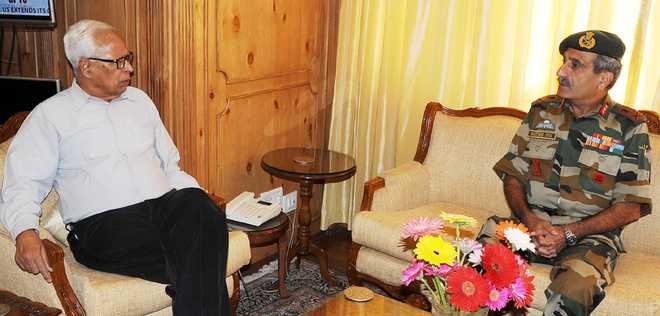
Governor NN Vohra with Lt Gen SK Dua, GOC of the 15 Corps, in Srinagar on Monday.

Srinagar, September 19

Lt Gen SK Dua, General Officer Commanding of the 15 Corps, met Governor NN Vohra at Raj Bhawan here today and briefed him about the Sunday terror attack on an Army base in Uri.An official statement said the Governor and the Corps Commander discussed various important issues relating to the internal security management and the need for stringent enforcement of counter-infiltration and counter-terrorism grids along the Line of Control.—TNS


Do we not owe troops fire-proof tents: Omar

Do we not owe troops fire-proof tents: Omar
“While we work out who is to blame for Uri and what an appropriate response will be, do we not owe our troops flame retardant tents and huts?” Omar Abdullah,former cm

Tribune News Service

Srinagar, September 18

National Conference working president Omar Abdullah on Sunday “strongly condemned” the attack on the Army base in Uri sector.In a statement, the former Chief Minister expressed solidarity with the families of the martyred jawans and extended his heartfelt condolences to them.“This is a highly condemnable and tragic incident. I extend my heartfelt condolences to the families of the martyred jawans who have lost their lives and pray for the speedy recovery of those who have sustained injuries in the attack,” Omar said.In a series of tweets, Omar also criticised the government saying it is a “crying shame that fire retardant tents aren’t the norm”.“While we work out who is to blame for Uri and what an appropriate response will be, do we not owe our troops flame retardant tents and huts?” he said. “If the reports are correct and 13 of the 17 fatalities are because of burns it’s a crying shame that fire retardant tents aren’t the norm,” he said.Omar said, “We owe it to our jawans to give them the best that we can because they are the first to lay down their lives and sacrifice everything for us.”“The mess will be made more fancy, the auditorium more modern, officers quarters more comfortable but the jawans will be taken for granted,” he said.


WWI Sikh heroes need to be remembered: Dr Atamjit

WWI Sikh heroes need to be remembered: Dr Atamjit
Dr Atamjit

Neha Saini

Tribune News Service

Amritsar, September 10

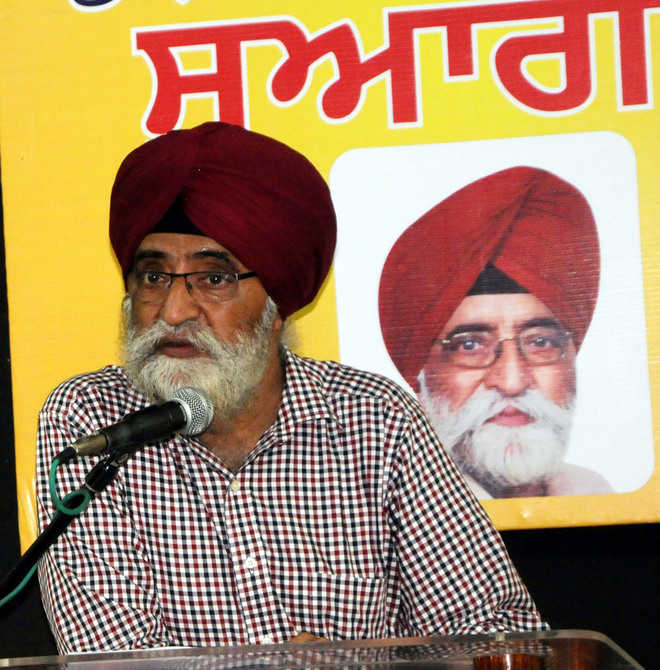
Noted Punjabi playwright and Sahitya Akademi award winner Dr Atamjit read out his unpublished play based on World War I at Virsa Vihar here today. The celebrated writer, who is known for his research work and acclaimed writings, agrees that World War I is the least documented event in the Sikh history and 13 lakh soldiers, who were a part of it, need to be owned. “My pain behind conceiving the project was that despite 70,000 Sikh soldiers sacrificing their lives and 13 lakh soldiers braving it out at the war front, we as a society have failed to remember them. The only memorial in their name is the one in Delhi and that, too, was established by the Britishers. My play is dedicated to the memory of all those soldiers.”The title of his play ‘’Ve Mur Aa Lama Ton’’ (loosely based on a song that has a woman calling on a loved one to return from war) is a result of two years’’ research on the subject. “Many people still believe that those soldiers didn’t fight for their country but for the Britishers when instead their participation in the WWI was backed by many nationalist leaders, including Rabindranath Tagore, Sarojini Naidu and Mahatma Gandhi. They thought that India will achieve independence after the Indian soldiers won a war for Britishers. When that didn’t happened, where was an ordinary soldier at fault?” questions Atamjit.His play somewhere also echoes his own opinion and his research, he says, has managed to back up with facts and description of events. “That war was an outcome of nationalist egos, parochial nationalism, if I may call it. The pretence of nationalism fuelled it.”The session will be attended by history students, historians, writers and eminent citizens and Atamjit says that the attempt is not to gain any headlines, but to remember the heroes of Sikh history and take responsibility for the years of disregard for their lives.

Jaguar catches fire in Ambala, pilot safe

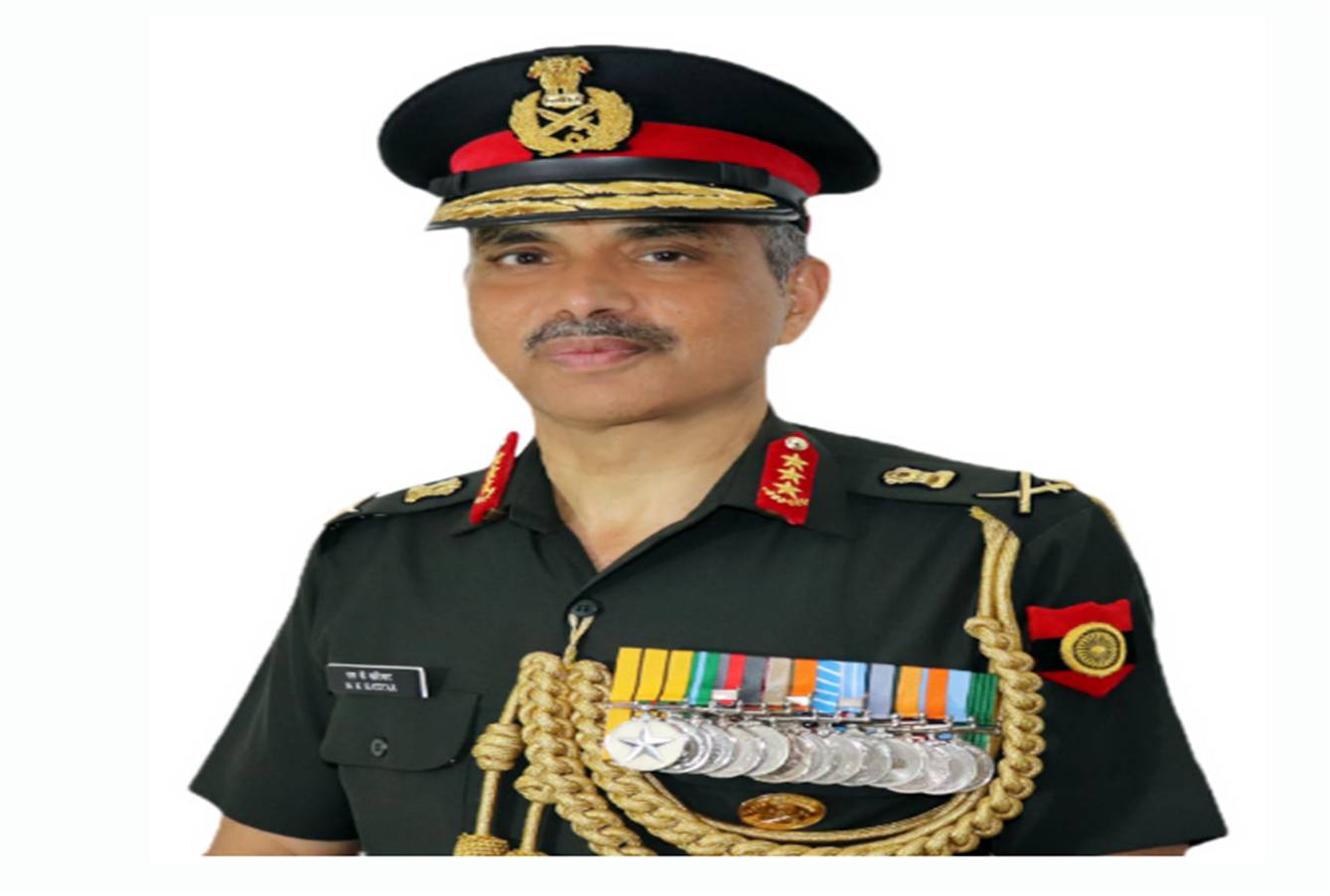
Chandigarh: A Jaguar fighter aircraft caught fire during takeoff roll at the Ambala Air Force Station late Tuesday evening. The pilot, a Squadron Leader,  was able to exit the aircraft while it was still on the ground.(Follow The Tribune on Facebook; and Twitter @thetribunechd)While the Air Force has ordered a court of inquiry to ascertain the cause of the incident, it is suspected that a technical snag may have led to the fire. “It could be an electrical short-circuit or ingestion of a foreign body into the engine,” an IAF officer said. Sources said the aircraft belonged to No.14 Squadron. TNS


Col Giri cremated with full state honours

Col Giri cremated with full state honours
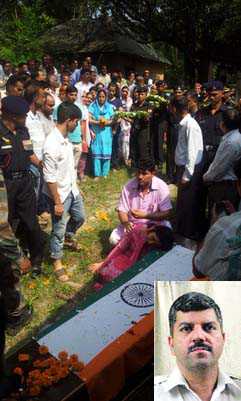
Sulekha Giri, wife of deceased Col Anil Giri (inset) grieves beside his coffin at Hamirpur. Tribune photo

Our Correspondent

Hamirpur, September 6

Col Anil Kumar Giri, who reportedly died of cardiac arrest during an Army operation in the Bhaderwah mountain ranges of Jammu and Kashmir was cremated with full state honours at Swahal, his native village today.From the Army Signals Corps, Giri was posted at the Corps Battle School (CBS). On Sunday, he complained chest pain. He could not be airlifted immediately as the helicopter reached late due to bad weather.At the wreath-laying ceremony, all officers paid tributes to him.He was decorated with the Vishisht Seva Medal (VSM). A tough and fearless soldier, he had many successful operations to his credit.He is survived by wife Sulekha and two sons Tushar (21) and Pranav (16).

Leaders offer condolences

Former Chief Minister Prem Kumar Dhumal, MP Anurag Thakur, Kangra Central Cooperative Bank Vice-Chairman Kuldeep Singh Pathania, KCCB Director Anil Verma, former CPS Anita Verma, Former Industries Minister Ranjit Singh Verma and many others offered condolences to the bereaved family.Dhumal said it was a huge loss for the country. He said the district was proud to have such brave men.


Ex-servicemen laud service chiefs’ move

Jalandhar, September 12

While applauding the three service chiefs for declining the recommendations of the 7th pay commission, the Ex- Servicemen Movement (Jantar Mantra), Punjab, today said the entire community of the ex-servicemen has supported their claim to be at par with their civilian counterparts.“The government is playing with the security of nation by demoralising the Army and its serving soldiers. The government should rectify its mistakes soon,” said Lt Col babir Singh,  Punjab. —TNS


My HQ Was At Uri, The Attack On It Has Thrown Up Institutional Defects We Have Grown To Live With

My HQ Was At Uri, The Attack On It Has Thrown Up Institutional Defects We Have Grown To Live With

SNAPSHOT

It is about time the Army stated unequivocally that the nation will get the security it pays for and no more. Don’t expect ‘jugaad’ to bail us out.

Uri was not the failure of those who managed its security on 18 September 2016 although many old timers will disagree with my statement. It was an institutional weakness which brought the situation on us and this is a harsh reality. Reality checks need to be brought into the open to allow the government, citizens and even many uniformed personnel to be better sensitized about national expectations versus national willingness to part with more resources for defence and security.

Intelligence alerts are fine. Such alerts exist for 300 out of 365 days in a year. This piece is not an attempt to bail out the defenders of Uri but rather to breathe reality and speak what is usually taken for granted. It is not for the lack of guts that people in the Army at all levels do not speak up. It is because they have grown used to a certain apathy which is just accepted as the way of life.

Will anyone in the Army speak up to say that the Uri base probably never had a single thermal imager (TI) to do surveillance of the route coming up from Salamabad Nala? If a senior commander was informed that the garrison had kept a few imagers for its protection it would have been considered an act of sacrilege as per our philosophy. It has to be the LoC which has to be fully secured; that is the gospel truth but the infirmity lies here too, at the administrative base. In other words a balanced deployment, one of the basics of defense, appears violated. Let me admit, I too am not a holy warrior and I would have done exactly what was done by the current breed of officers and men because I have been brought up on a diet that he who serves up in front needs it all.

The TI equipment acquired in 2001 has reached the end of its life and remains functional on life support systems through Indian ‘jugaad’. The local batteries sometimes hold life for two to three hours while a LoC ambush is deployed for eight to ten hours. This has been stated in every briefing of HQ 15 Corps but not forcefully enough because we have got so used to being ignored in response.

The LoC fence was strengthened extensively over the years, once again through the ingenious system of improvisation. However, any system has its limitations. The observation over the last season is clear that the adversary has found ways of neutralizing the LoC fence. To reach Uri base the fence had to be breached somewhere.

Is this why the pattern of terrorists killed is more often well inside our territory and not at the LoC fence itself? The contact pattern reveals maximum engagements with infiltrating terrorists well after they have breached the obstacle. The obstacle was always supposed to be a trip wire, something on which to base the alignment of our ambushes, with response from the flanks and depth if an encounter initiated. Systematically the dearth of thermal imagers, the erosion of their effectiveness and the counter-measures adopted by the terror groups has marginalized the effectiveness of our major force multiplier making infiltration easier.

The system of permanent assets in terms of habitat and fighting infrastructure, to include hardened bunkers, weapon emplacements, trenches with measures to prevent collapse, living structures, lighting conductors, toilets and cooking facilities, all come under the generic head of operational works. This is different to the works budget which is used for infrastructure in the hinterland and peace stations. The budget for operational works is so limited that it will take another fifty years before our defenses at the LoC are sufficiently hardened. The rate of construction is much slower than the rate of deterioration because climatic conditions and rugged usage have their effects. The state of toilets, cooking facilities and accommodation in general, at the LoC, remains at best pathetic. However, we have got so used to limited allocations that no one thinks of demanding more.

An issue that is for all to know is that in thirteen years of ceasefire we have lost an opportunity of hardening the permanent defenses. Given the kind of tinderbox environment the ceasefire could be a casualty very soon. Despite our limited infrastructure we always got the better of Pakistan in LoC exchanges. We also had the opportunity to construct protective infrastructure for the villagers. In 2003, I recall how Rs 2 crore from state government funds was allocated for community protective bunkers for civilians of the Uri salient. We had the design in place and would have completed construction in a year but the scheme was withdrawn as soon as the ceasefire was in place. Once again it was apathy and refusal to look at the future.

Let me illustrate the entire issue of mindsets with a humorous but true story. Many years ago when the Indian Army started subscribing to the UN missions one of our largest missions was in Somalia (UNOSOM). The MI Directorate started a system of franking of some of the mail coming in from the men and officers in the mission area to their families. The idea was to gauge morale and ascertain if there was any undesirable influence on the personnel in an international environment. The first few days after the franking commenced, one of the conclusions reached was that much against any compromise in their integrity our men were a little shell shocked by the quantum of supplies of everything including stationery. One such soldier wrote that he had exaggerated his demand for some items in the hope that he would get the bare minimum needed for office use. Instead he received double the quantum he demanded. So accustomed to being always treated with deficiencies, the men and many officers could not get over the surplus that was made available to them. That is the unfortunate case of our mindset. We are so used to being miserly in our approach and so niggard is the system which demands fullest security at the cheapest rate that it has seeped into the personality of our officers and men. They just accept it at face value and efforts towards garnering their rightful share are never even considered.

Uri had been warned. And I personally warned them too, Uri being my old headquarters. But they could have done sweet little with the kind of assets they held. In 2003, similar threats were received. I remember often remaining awake with the entire garrison at night for some days but that could not go on forever. It is easy to condemn and say that their alarm system and security posts were all negligent. There is a transitory man power at the base and the HQ has never pulled in more manpower from units for its own protection. What it desperately needed was a security wall which could have ensured that such a simple entry would not have been possible. I initiated the case for a security wall in 2003. I am sure the preceding commanders would also have similarly demanded and initiated one. In 2007 I returned to command Dagger Division and found that the wall had not materialized. We reinitiated it, only to return in 2010 to reinitiate it a third time. With a security wall, a couple of raised security bunkers towards the Salamabad side, thermal imagers and assured lighting, the possibility of such a raid could largely have been reduced.

I am quite certain that the nation, and many uniformed personnel too, are unaware of the kind of robustness needed to serve in such areas. I love to inform my stunned audiences in the corporate world that they may have heard of financial management, energy management and resource management but never of sleep management. Quite honestly a jawan in the LoC environment does not sleep at night almost continuously at least five or even six days a week. He catches a few winks by day but the kind of chores required at LoC posts and picquets hardly permits even this. The stress of possible enemy actions during patrolling, logistics movement and post protection is a constant baggage on the mind. The stress is palpable.

The system is not all bad. There are massive pluses brought on by the ethos of military camaraderie and concern for subordinates. Pilots of the Army Aviation Corps will fly under the most threatening conditions to evacuate a sick officer or jawan at severe risk. Caution will be thrown to the winds where a lifesaving effort has to be executed; whether it is a uniformed comrade or a civilian is immaterial. It is in the spirit of such camaraderie that people at the rear will sacrifice their bit for the people serving up in front and in more threatening conditions.

That the adversary found a chink in our armor is unfortunate but the armor is getting eroded for all the reasons just revealed. It is about time the Army stated unequivocally that the nation will get the security it pays for and no more. Don’t expect ‘jugaad’ to bail us out; the Army will always do it. It will work effectively nineteen times but the twentieth time when it fails do not find fault with our officers and our men who are paying the price of the nation’s niggardliness and inability to provide us the basics we need to keep the nation secure.

We may never have stated it because of the spirit of ‘we will fight with what we have’. The basic consciousness of being the last resort of the nation has driven a different kind of spirit. That spirit may just have seen the beginning of erosion after Uri.