



Sanjha Morcha

China once again snubs Pakistan on Kashmir issue

China once again snubs Pakistan on Kashmir issue
China says Pakistan and India should jointly work towards regional peace and stability. AP

Beijing, September 26

For the second time in less than a week, China on Monday snubbed Pakistan by declining to back reports in Pakistani media claiming Beijing’s support for the country in the event of any aggression and backing it on the Kashmir issue.As a “neighbour and friend”, China once again appealed to India and Pakistan to engage in dialogue to “properly” resolve disputes, including the Kashmir issue which, it said, was “left over from history”, and jointly work towards regional peace and stability.

(Follow The Tribune on Facebook; and Twitter @thetribunechd)

Asked about the reported remarks by the Consul General in Lahore that China will support Pakistan against any foreign aggression and backs Islamabad on the Kashmir issue, Chinese Foreign Ministry spokesperson Geng Shuang told a media briefing here that he was not aware of any such remarks made by the envoy.“I am not aware of the situation you mentioned. But China’s position on the relevant issue is consistent and clear,” he said.“As the neighbour and friend to both Pakistan and India, we hope the two countries will properly address their differences through dialogue and consultation, manage and control the situation and jointly work for the peace and stability of South Asia and the growth of the region.“With regard to the Kashmir issue, we believe it is an issue left over from history. We hope the relevant parties will peacefully and properly resolve the issue through dialogue and consultation,” he said.He was replying to a question about the remarks attributed to the envoy made during his meeting with Chief Minister of Pakistan’s Punjab province Shahbaz Sharif.“In case of any (foreign) aggression our country will extend its full support to Pakistan,” Consul General of China in Lahore Yu was quoted as saying in a press release by the Punjab Chief Minister’s Office, according to a report by Pakistani daily Dawn.“We are and will be siding with Pakistan on the Kashmir issue. There is no justification for atrocities on unarmed Kashmiris in (India)-held Kashmir and the Kashmir dispute should be solved in accordance with aspirations of the Kashmiris,” the report had quoted Yu as saying.China’s reaction on Monday is the second time since September 22 that it distanced itself from the Pakistani media attributing Beijing’s support to Pakistan on the Kashmir issue.China has declined to confirm Beijing’s backing to Islamabad on the issue during the meeting between Chinese Premier Li Keqiang and Pakistan Prime Minister Nawaz Sharif in New York on the sidelines of the UN General Assembly.The two leaders “exchanged views on bilateral relations as well as international and regional issues of common interest,” Chinese Foreign Ministry spokesperson Lu Kang had told PTI here when asked about reports that Li extended support to Pakistan’s stance on Kashmir.A report in Dawn said Li had assured Sharif that China would continue to support Pakistan’s stance on Kashmir. It had quoted Li telling Sharif that “we support Pakistan and we will speak for Pakistan at every forum”. PTI

China rejects comments of diplomat backing Pakistan

hina’s position on the issue is consistent and clear. As neighbour and friend to both Pakistan and India, we hope the two countries will properly address their differences through dialogue GENG SHUANG , MFA spokesperson

BEIJING: China denied on Monday any knowledge of a senior diplomat assuring Pakistan that Beijing will back the country in case of a war with India.

Last week, the consul general of China in Lahore, Yu Boren, was quoted as saying that China will extend support to Pakistan in case of “foreign aggression” and that his country was on Islamabad’s side in the Kashmir dispute. When asked about Yu’s categorical statement, the ministry of foreign affairs (MFA) brushed it aside. “I am not aware of the situation you mentioned,” MFA spokesperson Geng Shuang said at the regular presser on Monday. The newly appointed spokesperson then repeated China’s stock answers.

“China’s position on the relevant issue is consistent and clear. As neighbour and friend to both Pakistan and India we hope the two countries will properly address their differences through dialogue and manage and control the situation besides jointly work for the peace and stability of South Asia and the growth of the region,” Geng said.

On the Kashmir issue, he said: “With regard to the Kashmir issue, we believe it is an issue left over from history. We hope the relevant parties will peacefully resolve the issue through dialogue and consultation.

Yu was quoted as saying by the office of the chief minister of Punjab province of Pakistan that in case of any [foreign] aggression, Beijing “will extend its full support to Pakistan”. It further quoted Yu as saying: “We are and will be siding with Pakistan on Kashmir issue… There is no justification for atrocities on unarmed Kashmiris in…[India-] held Kashmir and the Kashmir dispute should be solved in accordance with aspirations of the Kashmiris.”

Pakistan’s Dawn newspaper reported the statement, linking it with the “…rising tensions at borders with India, China has assured in unequivocal terms its support in case of any foreign aggression and also supported Pakistan’s stance on the Kashmir dispute”. The statement was quoted widely in the Pakistani media and seen to be the latest and unequivocal evidence of China’s strong support of Pakistan. India has said terrorists from Pakistan were behind the Uri army camp attack earlier this month that left 18 soldiers dead.

At Monday’s briefing, Geng also commented on the recent allegations of incursions across the Line of Actual Control by soldiers of the People’s Liberation Army, saying that Chinese personnel had abided by bilateral agreements on the border.

“China’s position on the boundary question between India and China is consistent and clear. The boundary between the two sides is yet to be demarcated. We are engaged in dialogue and consultation to properly address differences in this regard,” he said.


MANN KI BAAT’ Uri attackers won’t go unpunished: Modi

Uri attackers won’t go unpunished: Modi
As calls for action against India’s neighbour rose, Modi on Sunday called the Uri attack an act of cowardice. File photo

Simran Sodhi

Tribune News Service

New Delhi, September 25 The most recent militant strike in north Kashmir’s Uri became the focus of Prime Minister Narendra Modi’s radio programme ‘Mann ki Baat’ on Sunday. A day after his diatribe against Pakistan for “exporting terrorism” at the BJP’s National Council Meeting in Kerala’s Kozhikode, Modi reiterated that the perpetrators of the Uri attack would not go unpunished.As calls for action against India’s neighbour rose, Modi on Sunday called the attack an act of cowardice.(Follow The Tribune on Facebook; and Twitter @thetribunechd)“Recently, 18 bravehearts laid down their lives in Uri. Such a cowardly attack was enough to stir the nation. I am sure that our soldiers would keep foiling such acts in the future,” Modi said in his monthly radio address. “While politicians speak, military shows bravery. “He mentioned young Harshvardhan, who wrote to him after the attacks saying he was troubled.Some gunmen attacked a military camp in Uri last Sunday, killing 18 soldiers. India blames the Jaish-e-Mohammed, an outlawed terrorist organisation based in Pakistan, for the attack.‘Kashmiris want normality restored’

He spoke about the recent unrest in Kashmir in which nearly 80 people were killed and thousands injured, but claimed people wanted the state to return to normal.Read: Mann ki Baat on, to Pak“Farmers who had grown fruits were also worried to get their crops to the market,” he said, adding that the state administration had taken measures to maintain law and order, but that local authorities should remain to stay cautious and exercise restraint.”They want their life to get back on track. All of us know that peace and unity is the only solution to our problems.” “Our resources are there to give a peaceful life to the Kashmiri people,” he said. “Peace, unity and goodwill are the keys to our problems and path to progress.”‘Proud of Paralympians’

He made a special mention of India’s paralympic contingent, which brought back two golds, a silver and a bronze in the recently concluded Paralympic Games in Rio. “Paralympians have made India proud,” he said, as he praised “their spirit and courage”.“I came to know that some of these paralympians equaled and sometimes broke the records held by normal athletes. I want to tell the country through the ‘Mann ki Baat’ that my government will empower these paralympians.”    Clean India

As the NDA government’s ‘Swachh Bharat’ mission completes two years, Modi announced a new helpline number’1969’ for feedback and to petition for starting new projects.Modi said 2.48 crore toilets have been built in the rural areas while 1.5 crore will be built in the next year. — (With inputs from agencies)


A war with no end in sight

The US is stuck in Afghanistan for the past 15 years because it’s reluctant to target terror groups in Pakistan, writes BRAHMA CHELLANEY

RESEARCH SHOWS THAT MILITANT GROUPS ARE GENERALLY RESILIENT TO THE LOSS OF A TOP LEADER, UNLESS THEIR CROSS­BORDER SANCTUARIES ARE SYSTEMATICALLY TARGETED

Despite the worsening Afghanistan quagmire, this month’s 15th anniversary of the longest war in American history attracted little attention. The raging battles highlight United States President Barack Obama’s failed strategy to wind down the war. The Afghanistan situation today is worse than at any time since 2001, when the US invasion helped oust the Taliban from power, forcing them to set up their command-and-control structure in Pakistan, their creator and steadfast sponsor.

REUTERSA US has not designated the Afghan Taliban as a terrorist organisation. The Obama White House has engaged in semantic jugglery as to why the group is missing from the US list of foreign terrorist organisations

Now the resurgent Taliban hold more Afghan territory than before, the civilian toll is at a record high, and Afghan military casualties are rising to a level that American commanders warn is unsustainable. From sanctuaries in Pakistan and from the Afghan areas they hold, the militants are carrying out increasingly daring attacks, including in the capital Kabul, as illustrated by the recent strikes on the American University and a site adjacent to the defence ministry and presidential palace.

In declaring war in Afghanistan on September 21, 2001, after the world’s worst terrorist attack in modern history 10 days earlier in the US, President George W Bush explained why 9/11 was a turning point for the country: “Americans have known wars — but for the past 136 years, they have been wars on foreign soil, except for one Sunday in 1941 [Pearl Harbour]. Americans have known the casualties of war — but not at the centre of a great city on a peaceful morning. Americans have known surprise attacks — but never before on thousands of civilians. All of this was brought upon us in a single day…”

Yet before he could accomplish his war objectives in Afghanistan, Bush invaded and occupied Iraq — one of the greatest and most-calamitous military misadventures in modern history that destabilised West Asia and fuelled Islamist terrorism.

Obama came to office with the pledge to end the Bush-era wars in Afghanistan and Iraq. In Iraq, he ended the Bush war, only to start a new war in the Syria-Iraq belt.

In Afghanistan, Obama thought he could end the war simply by declaring it over. This is what he did in December 2014, when he famously declared that the war “is coming to a responsible conclusion.” But the Afghan Taliban had little interest in peace, despite Washington allowing them to set up a de facto diplomatic mission in Qatar and then trading five senior Taliban leaders jailed at Guantánamo Bay for a captured US Army sergeant.

The result is that Obama repeatedly has had to change his plans in Afghanistan. In July 2011, he declared that by 2014 “the Afghan people will be responsible for their own security”, adding seven months later that, “By the end of next year, our war in Afghanistan will be over”. Just two months ago, however, he decided to keep 8,400 US troops in Afghanistan indefinitely and leave any withdrawal decision to his successor. Some 26,000 American military contractors also remain in Afghanistan.

Why is the US still stuck in the war? In large part, it is because it has fought the war on just one side of the Afghanistan-Pakistan divide and been reluctant to go after the Pakistan-based sanctuaries of the Afghan Taliban and its affiliate, the Haqqani network. The US assassination of Afghan Taliban chief Akhtar Mohammad Mansour in May by a drone strike inside Pakistani territory was a rare exception — a one-off decapitation attack that did little to change the military realities on the ground.

Research shows that militant groups are generally resilient to the loss of a top leader, unless their cross-border sanctuaries are systematically targeted. Indeed, decapitation can help a militant group to rally grassroots support in its favour and against the side that did the killing. No counterterrorism campaign has ever succeeded when the militants have enjoyed cross-border havens.

Although Obama hailed Mansour’s killing as “an important milestone”, the decapitation cast an unflattering light on US policy: America took nearly 15 years to carry out its first drone strike in Pakistan’s Balochistan province, the seat of the Afghan Taliban’s command-and-control structure. The US military has failed to disrupt the Haqqani network because Pakistan has moved the group’s leadership from FATA to safe houses in its major cities, while allowing the Afghan Taliban leadership to stay ensconced in Balochistan.

Tellingly, the US has not designated the Afghan Taliban as a terrorist organisation. The Obama White House indeed has engaged in semantic jugglery to explain why the group is missing from the US list of foreign terrorist organisations. In truth, the US is willing to accommodate the medieval Taliban in a power-sharing arrangement in Afghanistan. It assassinated Mansour because he defiantly refused to revive peace negotiations.

For almost eight years, Obama has pursued the same Afghanistan-related strategy, changing just the tactics. His strategy essentially has sought to use inducements to coax the Pakistani military and its rogue Inter-Services Intelligence agency to go after the Haqqani network and get the Afghan Taliban to agree to a peace deal. The inducements have ranged from billions of dollars in aid to the supply of lethal weapons that could eventually be used against India. The carrots-without-sticks approach has only emboldened the Pakistani military to run with the hare and hunt with the hounds.

With the Afghan government’s hold on many districts looking increasingly tenuous, Obama’s successor will have to make some difficult choices by facing up to a stark truth: The war in Afghanistan can only be won in Pakistan.


Uri, day after: PM sends ‘isolate Pakistan’ message

WEIGHING OPTIONS Modi takes stock of preparedness at high-level meeting with political and military brass; 18th soldier lays down life; Pakistan remains defiant

NEW DELHI/ISLAMABAD: India moved on Monday to diplomatically isolate Pakistan as part of retaliation to a militant attack on an army base in Kashmir, but the plan appeared set to run into a wall of resistance from a defiant Islamabad.

After a two-hour meeting Prime Minister Narendra Modi and some of his top ministers decided against any “knee-jerk reaction” and, instead, backed moves to present evidence of Pakistan’s “complicity” at global fora.

Foreign minister Sushma Swaraj was absent from the meeting to draft a response to Sunday’s attack that saw heavily armed militants sneak into the base in Uri and kill 18 soldiers before security forces shot them.

The head of military operations of the Indian army, Lieutenant General Ranbir Singh, said India had the desired capability to respond, without elaborating.

“We reserve the right to respond to any act of the adversary at a time and place of our own choosing,” Singh told reporters. While India weighed its options, Pakistan seemed readying to pre-empt the diplomatic offensive.

In signs of estrangement, Pakistan Prime Minister Nawaz Sharif wrote letters to the leaders of the five permanent members of the UN Security Council – China, France, Russia, the UK and the US – about “grave human rights violations” in Kashmir by Indian forces.

Islamabad made no offer of cooperation to investigate the Uri attack, as was done by it in the aftermath of a similar deadly raid on an air base in Punjab in January. The only civilian Pakistani leader to respond – foreign policy chief Sartaj Aziz – did not even condemn the attack.

Aziz dwelt more on the situation in Kashmir, especially the unrest triggered by the killing of militant commander Burhan Wani. Its army chief Raheel Sharif hit out at India’s “hostile narrative”, saying his country was “fully prepared to respond to entire spectrum of direct and indirect threat”.

At a session of the UN human rights council in Geneva on Monday, India asked Pakistan to stop supporting “violence and terrorism” and vacate its “illegal occupation of Pakistan-Occupied Kashmir. New Delhi also brought up alleged human rights violations in Balochistan the persecution of minorities, including Hindus.

As calls grew for a counterstrike against Pakistan and militant group Jaish-e-Mohammad, which India believes orchestrated the attack, New Delhi also decided to push for more “terror elements” based there to be brought under UN sanctions. Foreign minister Swaraj will also bring up the attack at United Nations general assembly later next week.

Although New Delhi’s options to hit back at nuclear-armed Pakistan appeared limited, government sources said a “strong message” to Pakistan could include surgical strikes against “inimical assets” along their de-facto border.

Granting political asylum to exiled Baloch leader Brahamdagh Bugti, who spearheads a campaign for independence from Pakistan, is also being considered.

“The action has to be taken without getting influenced by emotions, anger. It has to be taken coolly and with proper planning,” VK Singh, junior foreign minister said. Past attempts by India to bring Pakistani elements under the sanctions regime has so far been unsuccessful, because of opposition from China, among others.

China said on Monday it was “shocked” by the attack on the Uri base. It also expressed concern over the escalation of violence in Kashmir. France also referred to “the disputes in the region of Kashmir”. India bristles at any mention by other countries of its territorial dispute with Pakistan over Kashmir. (With agency inputs)


UN chief Ban condemns Uri terror attack

UN chief Ban condemns Uri terror attack
Ban Ki-moon

United Nations, September 19

Condemning the militant attack on an Army camp in North Kashmir’s Uri town that killed 17 soldiers, UN Secretary-General Ban Ki-moon hoped the perpetrators of the crime will be brought to justice and re-establishing stability and preventing any further loss of life will be the priority of “all involved”.

“The United Nations is following developments closely and shares the concerns of people living in the region for peace,” a statement issued by Ban’s spokesperson here said.

Ban expressed hope that the perpetrators of the attack will be brought to justice and all stakeholders will meet their responsibilities to maintain peace and stability.

(Follow The Tribune on Facebook; and Twitter @thetribunechd)

“The Secretary-General hopes that the perpetrators of this crime will be identified and brought to justice,” it said.
He “hopes that all involved will prioritise the re-establishment of stability and prevent any further loss of life. The Secretary-General encourages all stakeholders to meet their respective responsibilities to maintain peace and stability,” the statement said.

Condemning the “militant attack”, Ban expressed his “deepest sympathy and condolences” to the families of the soldiers who lost their lives and to the government of India and wished a speedy recovery to those injured in the attack.

Meanwhile, Venezuela President Nicolas Maduro, who succeeded Iranian President Hassan Rouhani as the head of the Non-Aligned Movement, also expressed solidarity with the people of India “who have suffered a terrorist attack.” “We are committed along with our brotherly people of the world to get into the depth of this problem that has generated proliferation of terrorist movements, which doesn’t respect life and the need for coexistence of people,” he said at a press conference after the summit in Margarita Island yesterday.

In one of the deadliest attacks on the Army in recent years, 17 soldiers were killed and 19 others injured as heavily armed militants stormed a battalion headquarters of the force in North Kashmir’s Uri town early yesterday.

Four militants involved in the terror strike were killed by the Army.

The attack comes two years after militants had carried out a similar type of attack at Mohra in the same area. Ten security personnel were killed in the attack that took place on December 5, 2014. — PTI


Fidayeen — the lethal discovery of militancy

Fidayeen — the lethal discovery of militancy
A soldier near the attack site.

Azhar Qadri

Tribune News Service

Srinagar, September 18

The small units of highly trained and heavily armed militants that storm into security installations like the one which stormed an Army base in north Kashmir’s Uri sector this morning are the most lethal discovery of Kashmir’s decades-old insurgency.These militants, known as fidayeen, carry an important advantage — the element of surprise, which allows them to choose the location, timing and inflict damage in the initial assault before they are detected and killed.The introduction of fidayeen in Kashmir insurgency came in the aftermath of the 1999 Kargil war and instantly changed the arithmetic of the conflict. Fewer militants who made up a fidayeen unit mounted heavy casualties on security forces. They attacked anywhere, almost everywhere.The first fidayeen attack was launched on a BSF camp in July 1999 and a Deputy Inspector General and four soldiers of the paramilitary force were killed. In August 1999, three fidayeen attacks were launched in which a Colonel, Major, two Junior Commissioned Officers and six soldiers were killed.In 1999, at least 11 fidayeen attacks shook the counter-insurgency grid as militant units stormed into fortified symbols like the Army’s Srinagar-based Headquarters and the main base of the Jammu and Kashmir Police’s Special Operations Group in which 12 personnel, including an officer, were killed.The Lashkar-e-Toiba, one of the few foreign groups to operate in Kashmir, was the pioneer in carrying out fidayeen attacks in the Valley. The Jaish-e-Mohammed soon followed and also introduced suicide bombers, the first among whom crashed an explosive-packed car into the gate of the Army’s Srinagar-based Corps Headquarters.As Pakistan banned the Lashkar-e-Toiba and the Jaish-e-Mohammed in the aftermath of the 9/11 attacks on the US, several fidayeen attacks were owned by the little-known outfits like the Shuhada Brigade, Medina Regiment, Al Mansoorian and the Al Nasireen. Most of the fidayeen militants are foreigners, mainly Pakistanis and at least one British, and a few have been from Kashmir. The fidayeen militants continued to attack security installations in Jammu and Kashmir through the early years of the last decade even as they launched several attacks outside the state, one unit targeting the Red Fort, another associated with the Jaish-e-Mohammed which attacked Parliament.A retired Army officer, who has served in Kashmir, described the fidayeen as part of a “hybrid war, where the whole intention is to cause exasperation”. “Fidayeen are small teams who want to do something and who have the initiative,” the officer said.


A threshold crossed in Uri::::::: Lt Gen Syed Ata Hasnain (retd)

A threshold crossed in Uri
WHAT NEXT? Army personnel at the brigade camp in Uri on Sunday. PTI

THE focus till a few days ago was on the move of the Army’s five battalions into South Kashmir to occupy what I had called the moral and physical space to stabilise the area most hit by the stone-throwing agitation, post the killing of Burhan Wani. However, in all such situations and without a direct connect to them, is a rogue space which exists in the hybrid conflict. Pakistan has chosen to exploit that space to attempt to counter the effectiveness of our Operation Calm Down in South Kashmir.Calming down the situation or stabilising it does not lie in Pakistan’s interest. Therefore, it had to choose a strategy on how to prevent this from happening and the Indian Army walking away with the accolades. It employed the theory of indirect approach. The need was for a couple of high-profile strikes against recognised targets, show the Indian Army in poor light and demoralise it just as it was attempting to gain the moral high ground in South Kashmir. To execute this it needed strength in the hinterland, which it lacked. Its two previous attempts in Baramula and Handwara to target the Army’s convoys resulted in marginal success, not large enough to draw the eyeballs of the world. Infiltrating a special group to achieve this on an objective in the hinterland is close to impossible, as planning, movement and execution would take the better part of three weeks with no degree of assurance for success. It chose the next best option: the proximity of the LoC itself. The operation had to be launched before the speech of the Pakistan Prime Minister in the UN General Assembly; that permitted a shallow infiltration and choice of objective even closer to the LoC. Pakistan’s Deep State, which plans and executes that nation’s rogue operations, has done this earlier too. Last year it targeted the HQ of the Tangdhar Brigade, which was thwarted by the Indian Army. Last week, it attempted a sneak attack on the HQ of the Poonch Brigade, which was foiled in time with some loss to us. The level of desperation was obviously very high as the Uri attack has come just a few days after the attempt at Poonch.Should we have expected it at Uri? Intelligence agencies gave a broad warning about the possibility of a spectacular action. That is usually done every year. Professional minds would have analysed it exactly as I have done. It had to be near the LoC and it had to be a high-profile target, preferably within the Valley. There is no other objective as starkly evident as Uri. Its garrison is not walled and civilian access is through and through. The access from the south is just 6 km, although robust counter-infiltration layers have to be crossed. So Uri it was.It is unfortunate that circumstances acted in favor of the terrorists as an entry was made into an area where there were freshly inducted troops accommodated in tents, which caught fire, resulting in greater casualties.All these years that Pakistan has relentlessly pursued its campaign in J&K, its position was never weaker than it was around June this year. Low terrorist strength and little excitement among the populace were not contributing towards any of its objectives. The killing of Burhan Wani and the unexpected energy of response by the youth and the public in general spurred Pakistan back to life, sensing great opportunity. However, in the Uri attack and its success beyond expectation it has erred in crossing the Rubicon, the threshold of India’s limit of tolerance. Social media is agog with public response. This response is not going to be informed or rational; it is of the knee-jerk variety, demanding instant action and retribution. No one can explain to the public that these events are to be seen as part of a campaign and not standalone. Since the perception prevails that India has been at the receiving end far too long without adequate response, the pressure on the government and the Army will be tremendous. The emotion may not be as intense as 13/12 or 26/11 but the cumulative effect of perceived inaction will be high.What options do we really have? Firstly, a hot pursuit kind of operation across the LoC has always been the favorite of the strategic community without identification of terrorist facilities. If it’s the Pakistan army that has to be targeted, then we need to be sure that there will be response and an escalation. Secondly, if it is just the abrogation of the ceasefire, then LoC duels can be played out by both, although we do have advantage at most places. Is it in our interest to escalate and draw attention of the international community to an issue which it is tending to largely ignore? That is a moot point for the consideration of the political authority. Thirdly, the public may not find the more prudent and smarter ways of retribution easily acceptable with consequent effect on the reputation of the government and the leadership. However, what Mr Modi commenced with his reference to Baluchistan in the Independence Day speech may just be the appropriate steps to ratchet up the response. In any case, the embers of the fires at Uri have yet to cool and decisions taken when passions dictate the mind are not always the best. Political leaders have made the right noises in terms of recommending shedding of restraint and Pakistan would have to be careful about a quid pro quo from India that is not rational and not in keeping with conventional Indian military thinking. Already online commentaries are examining options, including proactive strategy.Nawaz Sharif and the Deep State may have succeeded in drawing attention to Kashmir prior to a major annual international diplomatic event but have clearly not read the mood of the world. That mood looks upon nations such as Pakistan with deep suspicion and anything in the sub-conventional domain is unlikely to be supported. The Indian Army will do well not to get distracted from the main task of stabilising South Kashmir, although such a grievous loss of its soldiers is not easy to accept.



Commodore Commandant Walia visits 48 Squadron

Commodore Commandant Walia visits 48 Squadron
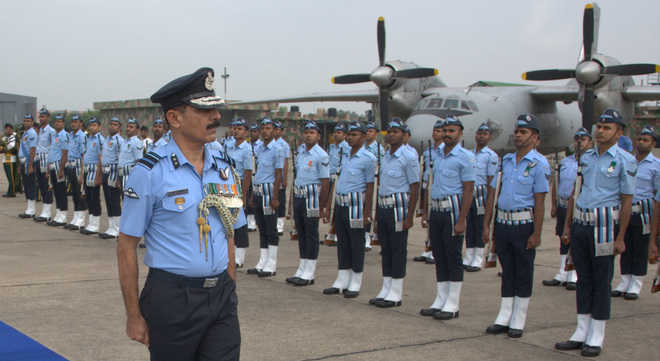
Air Vice-Marshal Harinder Jeet Walia inspects a guard of honour during his visit to the No. 48 Squadron in Chandigarh on Saturday. A Tribune photograph

Tribune News Service

Chandigarh, September 10

Air Vice-Marshal Harinder Jeet Walia, Additional Director General, NCC, and the Commodore Commandant of IAF’s No 48 Squadron, visited the squadron at its home base in Chandigarh today. This is his first official visit to the squadron as the Commodore Commandant.On his arrival, he was received by the Air Officer Commanding 12 Wing, Air Commodore Arun Saklani, as the Squadron’s Commanding Officer, Group Captain Khushpal Singh Lambha and was presented a ceremonial guard of honour.Later, addressing the squadron personnel, he asked them to keep themselves updated in all aspect of their profession. Emphasising on welfare, he said each individual should be aware of various government policies and schemes issued for service personnel.Walia was commissioned in the IAF’s transport stream in June 1981 and has over 5,000 hours of varied flying experience in the Eastern and Northern Sectors. An alumnus of the National Defence College, he had served with 48 Squadron in 1988.