Sanjha Morcha

Armed forces reject pay panel Army, Navy, IAF: Resolve ‘anomalies’

Ajay Banerjee

Tribune News Service

New Delhi, September 10

In an embarrassment to the Modi government, the armed forces have rejected the salary and emoluments recommended by the Seventh Central Pay Commission, pleading that its implementation be put on hold in view of the “unresolved anomalies” that lowered the status of the forces vis-à-vis their counterparts in the police and the civil administration.(Follow The Tribune on Facebook; and Twitter @thetribunechd)The Ministry of Defence had issued the notification on September 6 after taking into account a letter by the three services chiefs on the issue of pay parity, among other things. This notification was exclusively for the forces.In the past 24 hours, the Army, the Navy and the Air Force have issued separate letters to inform senior commanders and the troops about the decision of the top brass.The Chiefs of Staff Committee had met on September 7 to discuss the issue. Defence Minister Manohar Parrikar is expected to take a decision on the matter on Monday. Earlier, the notification for enhanced pay for the forces had been held up as the issues raised by the three services were being studied.The main “anomaly” is that the formula adopted for determining the basic pay for the armed forces is different from the one for other Central government employees. As a result, in each rank the service officers have been awarded lower pay scales.In March, the MoD had told an empowered panel that the status, pay and allowances of the armed forces be kept above the other “fighting” arms of the government.


China to launch second space lab

chiona-launch

Beijing: China’s second space lab Tiangong-2 will be put into space between September 15 and 20, the office of China’s manned space programme said on Friday.

The space lab was transferred with its carrier rocket to the launch pad at Jiuquan Satellite Launch Centre on Friday, Xinhua news agency said, quoting a statement from the office.

It took 90 minutes to complete the transfer from the assembling centre to the launch pad.

“The completion of the transfer signals that the space lab Tiangong-2 mission has entered its launching stage,” it said.

Technicians completed testing on the assembling of the lab and the rocket after they had been separately delivered to the launch centre in July. The centre will continue testing the rocket and inject the required propellent before the launch.

Tiangong-2 — which can enable two astronauts to live in space for 30 days, nearly double the national record for space stay — is capable of receiving manned and cargo spaceships and will be used for testing systems and processes for mid-term space stays and refuelling.

It will also be involved in experiments on aerospace medicine, space sciences, on-orbit maintenance and space station technologies.

China’s first space lab Tiangong-1, which was launched in September 2011, ended its data service earlier this year. It had docked with Shenzhou-8, Shenzhou-9 and Shenzhou-10 spacecraft and undertaken a series of experiments.


Capt Amarinder hails surgical strikes; cautions against creating panic along border

Capt Amarinder hails surgical strikes; cautions against creating panic along border
Capt Amarinder Singh. — File photo

Tribune News Service

Chandigarh, September 29

Punjab Pradesh Congress Committee president Capt Amarinder Singh on Thursday welcomed the surgical strikes by the Indian Army across the Line of Control in Pakistan-occupied Kashmir to smash terrorist training and launching camps there.In a statement issued here today, he said it was highly required since Pakistan had failed to take measures that would stop attacks on Indian soil and installations and was rather continuously in a denial mode.(Follow The Tribune on Facebook; and Twitter @thetribunechd)He also cautioned against evacuating people from the border areas without any proper arrangements. “Please don’t try to create war refugees without, or at least, before the actual war,” he warned.The former chief minister said India was left with no option but to resort to the surgical operations against the terrorists. “The strikes have proved India’s charge beyond any doubt that the terrorists were being trained in and launched from Pakistan or PoK with the help of the Pakistan army.Capt Amarinder congratulated the Indian Army for the cleanly executed strikes which have left many terrorists dead. More than that, he added, it has exposed Pakistan’s complicity which otherwise it has been denying so far.At the same time, the PCC president cautioned against creating panic along the border belt in Punjab by asking people living within 10 km of international border to move out.He said such measures are not really required at this stage. “Rather we did not evacuate people, up to 10 km of international border, during the 1965 War,” he said, adding this was absolutely uncalled for.Speaking from his personal experience in the 1965 War, Amarinder said he has seen people harvesting their crops while shelling was going on between two armies. He said asking people to move out was wrong as it will lead to their unnecessary harassment and misery.Besides, Capt Amarinder added, the harvesting season was already on as the paddy had ripened. He said, it is an ill-advised move on part of the government, whether the state or the Centre, to ask the villagers to vacate their places at this time and that too when there are no arrangements in place for their stay. “Where will they go, where will they live, what will they eat and what will happen to their crops,” he asked.


Attack may push Indo-Pak relations, already at their lowest, to a new low

WHILE THERE HAVE BEEN LARGER NUMBERS KILLED IN THE POSTKALUCHAK ERA, THIS IS LIKELY THE DEADLIEST ATTACK ON A FACILITY

Sunday’s devastating attack in Uri carries shadows of the 2002 Kaluchak massacre, when three Lashkare-Taiba militants killed three army personnel, 18 members of their family and 10 other civilians in Jammu. That attack came months after the assault on Parliament in New Delhi, and nearly transformed a troop buildup — Operation Parakram — into a full-blown war between India and Pakistan.

The Uri attack may have somewhat similar consequences. It will push India-Pakistan relations, already at their lowest ebb in years, to a new low. And it may signal the resurgence of old tactics in Kashmir, at a time when unarmed protesters have convincingly seized the mantle of armed terrorists.

The past decade has seen major terror attacks across India, though mass casualties have proven far easier to inflict on softer civilian targets in cities rather than military forces in their bases. The Pathankot attack in January killed seven security personnel, which was half the number killed in a market in the Assamese town of Kokrajhar last month. This is one reason why Uri’s 17 casualties are so shocking. While there have been larger numbers killed in the post-Kaluchak era, this is likely the deadliest attack on a facility.

More broadly, India has grown accustomed to steadily declining violence, both in Jammu and Kashmir and in the rest of India. Last year, the country saw the fewest civilians killed in terror attack and the second-fewest security personnel — both falls probably driven by trends within Kashmir, thanks to tighter control over the Line of Control.

Official statistics last year showed that local militants outnumbered non-Indian ones. According to the head of the Srinagar-based Chinar corps, cross-border infiltration was down to a “trickle”. Attacks in Gurdaspur last year and Pathankot in January pointed to weaknesses in border security, but the scale of the problem has significantly fallen. Large, anomalous attacks like Uri shatter this statistical calm.

The Pathankot attack offered a brief moment of hope that India and Pakistan might handle the fall-out of these incidents in mature, constructive ways. But the steady collapse in India-Pakistan relations in the months thereafter, marked by the most recent reciprocal sniping on Kashmir and Balochistan, has produced a completely different mood.

“Pakistan is a terrorist state and it should be identified and isolated as such,” tweeted home minister Rajnath Singh hours after Sunday’s attack in Uri. “Those behind this despicable attack will not go unpunished,” said Prime Minister Narendra Modi.

Ram Madhav, the BJP’s secretary general, suggests what this might mean in practice: “for one tooth, the complete jaw. Days of socalled strategic restraint are over”.

This echoes previous allusions to retaliation-in-kind, made by NSA Ajit Doval, defence minister Manohar Parrikar, and many other would-be covert warriors. In concert with the government’s new approach to Balochistan, there is every reason to believe that the Research & Analysis Wing (R&AW) will be given a freer hand to impose a cost on Pakistani terrorist groups, their patrons in the Pakistani intelligence services, and perhaps even on the Pakistani state more broadly.

Among the more publicly visible consequences will be a further hardening of the government’s approach to Kashmir. As counterterrorism operations widen, protests — already the worst in the Valley since the 1990s — will intensify. Another will be a ratcheting up of the diplomatic pressure on Pakistan. Sushma Swaraj’s speech for the UN General Assembly in New York on September 26 will go through a frenzy of editing in the coming days.

Uri is not a turning point. There will be no airstrikes or mass mobilisation. But it is a stepping towards what will be a more violent, unpredictable, and tumultuous period in IndiaPakistan relations.


’84 riots widows threaten self-immolation outside CM’s residence

’84 riots widows threaten self-immolation outside CM’s residence
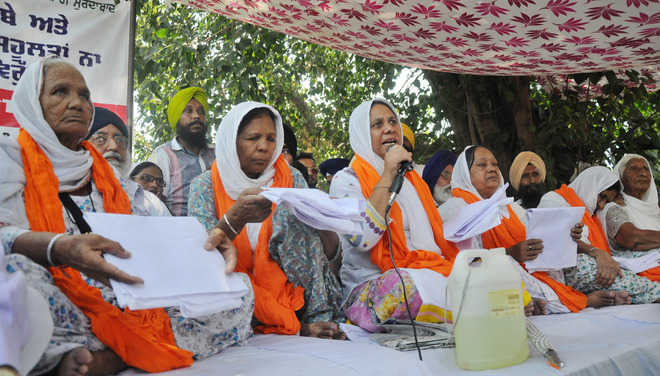
Gurdeep Kaur (with mike), president of the 1984 Sikh Katle-aam Welfare Society (women’s wing) addresses mediapersons near the Mini-Secretariat in Ludhiana on Thursday. Tribune Photo: Himanshu mahajan

Sanjay Bumbroo

Tribune News Service

Ludhiana, September 15

Concerned over the lackadaisical approach of the state government towards the victims of the 1984 riots, five woman members of the 1984 Sikh Katleaam Peerat Welfare Society have threatened to immolate themselves in front of the Chief Minister’s residence in Chandigarh on September 17.President of the women wing of the society Gurdeep Kaur said for the past 32 years, they had been hoping that the SAD government, which claims to be a Panthic government and well-wisher of the Sikh community, would fulfil their demands on preferential basis. However, it had failed to do, she rued.Lashing out the SAD government led by Parkash Singh Badal, Gurdeep said SAD had been ruling for 20 years since the 1984 riots, but it failed to resolve their problems. “I consider him (Prakash Singh Badal) as our father, but he has used us for his personal benefits during elections. Badal Sahib was not sensitive towards the problems of the five widows who had lost their family members in the 1984 riots.”Gurpreet added that SAD had been using the 1984 victims for their political ambitions during the past 32 years, but this time it would not be so as they had decided to urge the members of the society to vote as per their conscience. She also criticised the police action yesterday, when the police lathicharged the peaceful protesters.She said they had been on indefinite fast for the last four days, but no minister or senior officer of the government had cared to seek information about the problems being faced by them. Gurdeep added that she along with five widows would march towards Chandigarh and thousands of victims of the 1984 Sikh riots would also join them from across the state. If the Punjab Police tried to stop them on their way, they will take the extreme step on the site and the government will be responsible for any untoward incident thereafter, she warned.

VIctimspeak

  • For the past 32 years, we had been hoping that the SAD government, which claims to be a Panthic government and well-wisher of the Sikh community, would fulfil our demands on preferential basis. However, it had failed to do so. The SAD had been ruling for 20 years since the 1984 riots, but it failed to resolve our problems. I consider Parkash Singh Badal as our father, but he has used us for his personal benefits during elections. Badal Sahib was not sensitive towards the problems of the five widows who had lost their family members in the 1984 riots.— Gurdeep Kaur, president, Women Wing, 1984 Sikh Katle-aam Peerat Welfare Society

India to take more water from Indus, squeeze Pak

Blood and water cannot flow together, says PM Modi

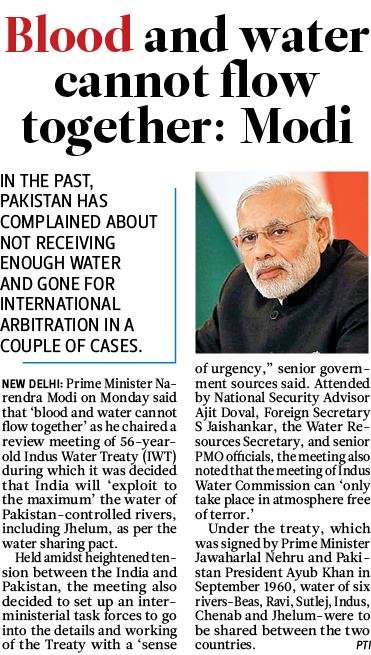
NEW DELHI: India will explore all options to use as much water as it can within the limitations of a 56-year-old pact with Pakistan over rivers flowing into the neighbouring country, a meeting chaired by Prime Minister Narendra Modi decided on Monday.

The World Bank-brokered Indus water treaty of 1960 is considered among the most liberal water-sharing pacts in the world and has survived three wars and much bilateral bickering.

The agreement gives control of the three eastern rivers — Beas, Ravi and Sutlej — to India and Indus, Chenab and Jhelum to Pakistan. The pact is seen as generous to Islamabad as it gives lower riparian Pakistan 80% of the water of the western rivers: Indus, Chenab and Jhelum.

But repeated cross-border terrorist attacks and the Pakistani establishment’s refusal to acknowledge such strikes originating from its soil could force India to use the water treaty as a bargaining chip to compel its hostile neighbour to mend its ways. “Blood and water cannot flow together,” Modi said when he met his top officials to review the pact that took a decade to negotiate and sign.

His remarks reflected India’s anger after Pakistan-based militants killed 18 soldiers at the Uri army base on September 18.

After Monday’s meeting, a message was sent out that New Delhi has options to hurt Pakistan within its legal rights under the water treaty as all political parties in Jammu and Kashmir, from where these rivers originate or pass through, had supported such a move in the past. But the government didn’t state specifically if the pact would be abrogated or suspended.


The meeting decided the Indus water commissioners from each country will not meet under an atmosphere of terrorism. They have so far met 112 times, at an average of twice a year.

New Delhi will restart its work on the Tulbul navigation project, which Pakistan calls Wullar barrage on the Jhelum, at the mouth of Wullar lake. Pakistan opposes the project, saying it would choke the water flow. “We will wait for Pakistan’s response before going ahead with other plans discussed at today’s meeting,” a source said.

Besides, the meeting discussed ways to make use of its rights in the three western rivers for agriculture, storage and hydro-electric power generation. That means India plans to increase the capacity to use its share of water permitted by the treaty. The pact permits India to use water for 13.4 lakh hectares, but only 8 lakh hectares are in use because of lack of infrastructure. Similarly, these rivers have the potential to produce 18,600MW of electricity, but total planned projects amount to 11,406MW.If India builds infrastructure such as hydel power projects and irrigation canals to optimise its use of the rivers, even within the treaty’s framework, the water flow to Pakistan will reduce from its current position

58763 61452 61565 61566 65062 65066 download


INSTEAD OF BABUS,STAND BY DEFENCE FORCES:AMARINDER

A LETTER TO DEFENCE MINISTER PARRIKAR

As Recd on Face Book and stated by Capt Amrinder Singh MP ( who defeated Finance Minister Arun Jaitley at Amritsar  in the last election)

Mr Parikar, once again you have shown your inability to understand the services. You can order them in operational matters and they will do as ordered. On what grounds can you order them to accept the 7th pay commision? Is this Nazi Germany and are you Hitler to issue such a dictatorial order? The three Chiefs are reflecting the views of each and every soldier in uniform or out of it. Instead of you standing by your defence services you are toeing the line set by your Babus. Do you realize the implications of your attitude? You have a highly disciplined force, perhaps the only pillar in our democracy that works without ever commenting. Do you want a disgruntled service? If the services are to loose their standing by placing them below your Babus and police, that is exactly what you will have, and then God help our country with a beligerant China and Pakistan. Will you then lead your Babus into battle? Have you heard of a word called morale? If so, you are in the process of demolishing it. Put your act together Parikar and put your self above party, politics and Babus and stand by your forces. Demoralising them will effect the security of our nation. Either stand by your services or quit. Perhaps the PM can find another defence ministers out of the multitude he has on parliament. You too Mr Prime Minister look beyond those who lack foresight and personally intervene. This is a matter of national security and beyond that of the comprehension of Parikar. The three Chiefs are absolutely correct in their stand.Their officers and men expect nothing less from them. They have my complete admiration and total support.

SHARE IF YOU CARE  !!

Displaying IMG-20160913-WA0055.jpg


Wounded, yet no wiser

Dinesh Kumar in Chandigarh
At least half-a-dozen attacks on defence installations in about a year have bruised us. Our response: Angry outbursts and diplomatic claims to isolating Pakistan. Our covert capabilities aren’t in evidence and overtly, our stance is that of a crying baby. That’s about a country with third largest military in the world. What’s wrong with us? The Tribune analyses
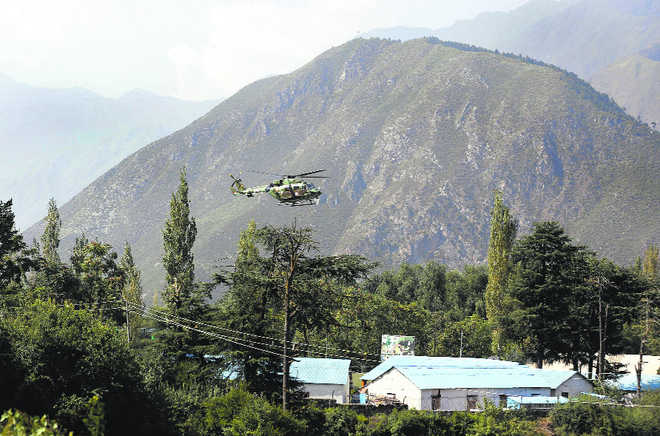
Wounded, yet no wiser
ATTACKED: An Army helicopter hovers over the Brigade HQ which was attacked by militants in Uri in North Kashmir’s Baramulla district. Photo: Mohammad Amin War

Another surprise attack, more precious lives lost, another humiliation, some strong condemnatory statements followed high-level visits to Srinagar and a flurry of high-level meetings in New Delhi, only to culminate in a return to ‘business as usual’. This sums up the standard sequence of events starting with security lapse and intelligence failure that gets repeated with monotonous regularity in a country that prides itself on being the world’s third largest military. History undoubtedly is replete with examples of intelligence failure and of countries being caught by surprise to attacks from adversaries. There is nothing unusual about that and there are library full of books to explain why it happens and why intelligence failures are difficult to prevent. But it takes only a few expressions to describe why in India it has become a habit to be caught unawares and to suffer attrition at the hands of a country one-third its size that brazenly resorts to terrorism as an instrument of state policy and unhesitatingly resorts to nuclear blackmail. And that is incompetence and repeated failure and inability to learn its lessons by the country’s security establishment that often finds it difficult to protect even itself leave aside its citizens.

Remember Haji Pir?

Uri, located close to the Line of Control (LoC), is a virtual gateway to the Kashmir Valley located not far from the 8,652-ft Haji Pir Pass, a dominating feature situated on the western fringe of the formidable Pir Panjal range that divides the Kashmir Valley from Jammu region. Most significantly, the Haji Pir bulge provides a direct ingress to both these regions of the state. It is through this militarily fortified Pass that was infamously returned to Pakistan after its capture by the Indian Army following a tough fight against all odds on August 28, 1965 that Islamabad has been infiltrating terrorists into the Jammu and Kashmir for over a quarter of a century. Again, it was this Pass through which prior to the start of the 1965 India-Pakistan War that the Pakistani Army, as part of its dubious Operation Gibraltar, had surreptitiously launched the main influx of its infiltration campaign into the Kashmir Valley.The Indian Army is heavily deployed all along the jagged and militarily illogical 740-km long LoC that runs along mountain ranges starting from gentle heights of 3,000 feet near Naushera in Jammu region to hostile high altitudes of over 20,000 feet in barren and mountainous Ladakh. Harsh terrain and severe weather are the two biggest enemies for soldiers which on many occasions renders ineffective the high technology wiring and sensors positioned at many places along the LoC. A hundred percent prevention of infiltration is impossible considering that the Berlin Wall built by the Soviets and the East Germans during the Cold War as also the wall built by a highly security conscious Israel at its Palestinian border could not deter 100 per cent infiltration.

What goes wrong?

But how would one explain the Army’s inability to secure its own establishments and repeatedly suffer attrition from small groups of young illiterate terrorists armed with rifles and grenades? From the terrorist point of view, it makes sense to attack the very instrument entrusted with securing the state, especially along the LoC. But the fact that four terrorists could so easily breach the Army’s security reflects poorly on the men in olive green. It reflects adversely on the Army’s state of alertness and awareness to its immediate ‘environment’ (such as movement of people) in the vicinity of the cantonment. To top it all, the outrageous incident occurred when there is continuing violent unrest in the Valley and at a time when relations between India and a Kashmir-obsessed Pakistan are at a low. In fact this is the time when the Army and all security agencies ought to be in a heightened state of security. As was the case prior to the May-June 1999 Kargil War, the Army yet again was caught shamefully unawares.Terrorists from Pakistan have been consciously targeting military installations along the LoC and the International Border – the attack on Pathankot airbase starting from last New Year eve being the last such major attack on a military establishment. Like Uri, Pathankot is located close to the border with Pakistan and was (and continues to be) both a target for Pakistan and a front-line fighter airbase for India during wars between the two countries. Only six months earlier, in July last year, terrorists from Pakistan had attacked a police station in Dinanagar, not far from Pathankot. 

Where it hurts most

Within a period of six months between December 2014 and May 2015, the security forces, mainly the Army, have been attacked by terrorists in their locations. Less than two years earlier (December 5, 2014), a group of heavily armed terrorists stormed the Army’s 31 Field Ordnance Depot (a major depot where ammunition for Army units in the area is stored), located at Mohra, near Uri, killing nine Army men including a Lieutenant Colonel and three policemen. Six terrorists were also killed. Three months later, on March 20, 2015, a group of terrorists stormed into Kathua police station killing five including three security force personnel and wounding 12. Yet, the very next day an Army Major and a soldier were injured in another terrorist attack on an Army camp located not far from Kathua on the Jammu-Pathankot highway. Another two months later (on May 31, 2015), an attack on the Army’s Brigade headquarters in Tangdhar, a bulge ahead of Kupwara that juts into PoK, was foiled. In all there have been over 20 attacks on security force installations in Jammu and Kashmir in the last two years.

Get to the basics

India, which is engaged in purchasing big-ticket items such as aircraft carriers, submarines and fighter aircraft, needs to very critically also ‘sweat the small stuff’ comprising equipment such as thermal imagers and other night fighting equipment, direction finding sensors, better close-quarter battle weapons, high-security perimeter fencing around cantonments etc considering that India has and will continue to be engaged in fighting Pakistan’s low-cost proxy war in a state on which it is not expected to give up until either a decisive and long-lasting action is taken or there is change of heart. 

Deficient — overtly, covertly

What is obvious is that for many years now, India’s huge defence and security establishment and a current defence budget of a staggering Rs 3.5 lakh crore has failed to deter Pakistan. Despite the huge monetary budget, the armed forces are lacking in equipment, War Wastage reserves are restricted, and even the operational readiness of a significant percentage of existing military equipment is suspect. There are issues pertaining to the quality of leadership and training as also the fact that the Army has ceased to attract the best and the brightest among the youth for many years now made no better by grievous anomalies in successive Central Pay Commission awards. India’s covert operations capability is severely restricted while serious qualitative and quantitative deficiencies continue in the country’s operational intelligence gathering capability. The country’s higher defence organization remains structured in a manner whereby the armed forces remain ‘integrated’ with the Ministry of Defence only on paper while in reality remain outside the decision-making process on issues of national security. This leaves India with non-military options which are slower and time-consuming and, some would argue, a wiser approach.More money and equipment apart, the question is whether India’s political executive is taking active interest in and ensuring qualitative supervision of India’s defence and security institutions. But then how could they when they themselves are militarily illiterate and disinterested, focused as they are on vote bank politics, political manipulations and making money and on seeking to secure themselves for the next election. Until then, Pathankot, Uri and the like will recur and the country continue to slowly bleed to which the response in all probability is likely to remain the passive application of bandages to a thousand cuts with statements only getting louder and shriller.



Kashmir Valley shut for 62nd consecutive day

20Curfew

Srinagar: Authorities made heavy deployment of security forces in Srinagar and other areas of the Kashmir Valley on Thursday as life remained paralysed for the 62nd consecutive day, officials said.

A senior police officer said deployment of security forces in sufficient strength have been made in old city and uptown areas of Srinagar and other parts of the valley.

“Curfew has not been imposed anywhere in the valley on Thursday,” the officer said. The militants attacked Pulwama police station in the early hours of Thursday. Police said there were exchange of fire between the militants and security forces for around 15 minutes after which the militants escaped.

The militants also snatched and decamped with four weapons from the residential guards of a regional National Conference (NC) block president in D.H. Pora village of Kulgam district. For the last 62 days, educational institutions, main markets, public transport and other businesses have remained closed in Kashmir Valley.

Seventy-six people including 73 civilians and three policemen have been killed during the ongoing cycle of violence that started on July 9. Separatists have been issuing weekly protest calendars during this period asking people to continue the protest shutdown.

They have issued a fresh protest calendar extending the shutdown and protests till September 16. They have asked people to march to the office of the United Nations Military Observers Group in India and Pakistan (UNMOGIP) in Srinagar city on September 13, the day Muslims would be celebrating the holy festival of Eid-ul-Azha. –IANS