
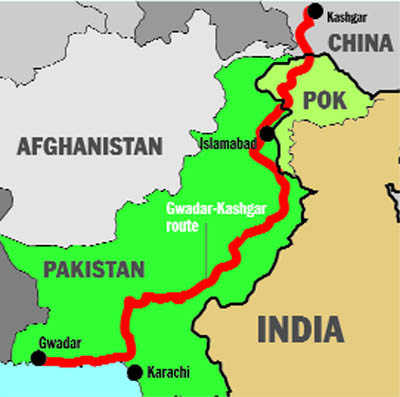
Map showing the China Pakistan Economic Corridor
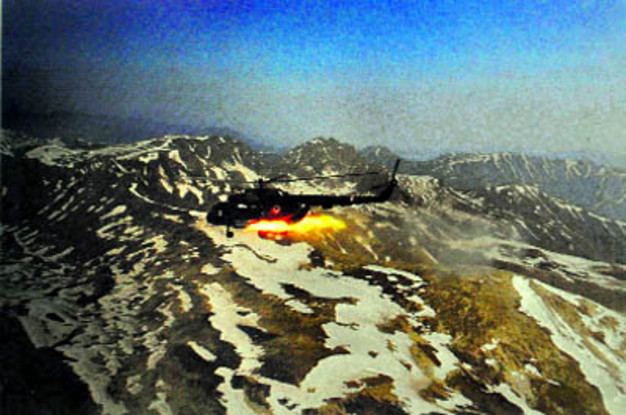








Three Armed Forces veterans deserve a special salute today. One for being a Kargil war hero, the second for bringing public attention to him, and the third for sharing their story widely on social media.
Naik Deep Chand, who lost both legs and his right arm in the 1999 Kargil War, was flying Indigo Airlines recently. As soon as the pilot of the aircraft, Harish Nayani, an ex-IAF fighter pilot himself, learned about this, he made an announcement to the passengers that they had a war hero aboard.

Next, another former Indian Air Force pilot, Rajiv Tyagi, shared this incident on Facebook through a status update that went viral and was picked up by the media. This is what he wrote:
“Harish Nayani, 62nd course, Kilo Squadron, NDA, erstwhile IAF fighter pilot, now a Captain flying for Indigo Airlines, had a war-hero passenger on his flight the other day. Naik Deep Chand, who lost both legs and his right arm in the 1999 Kargil War, was flying Indigo. Harish announced the presence of the war hero on the flight, to the delighted applause of 180 passengers. This is all the recognition war heroes need, for acts no nation can repay them for.”
Our armed forces men and women, and war veterans, do not get enough recognition for their brave and selfless service to the country. In giving Naik Deep Chand, a hero who lost both legs and an arm in the Kargil war, his due recognition, Rajiv Tyagi and Harish Nayani have again reminded us that it is our duty to respect, honour and share stories of their valour with a larger audience.

Tribune News Service
Srinagar, May 6
An Army jawan was killed in a gunfight in north Kashmir’s Kupwara district while foiling an infiltration bid today.The Army said an encounter erupted this morning when a group of militants was intercepted near the Line of Control (LoC) in the Kwaja Behak Gujjardori area of the Keran sector, 120 km from Srinagar. “A group of terrorists was intercepted close to the LoC this morning by alert troops. In the ensuing encounter, one soldier was injured. He later succumbed to his injuries,” said an Army spokesman. The slain soldier was identified as Sepoy Ramesh Chand Yadav, a resident of Alwar in Rajasthan.The Army said the operation was underway to track the militants in the dense forest close to the LoC. There was intermittent exchange of fire in the Keran sector during the day.This is the second infiltration attempt foiled by the Army in the Valley this year.The Union Government recently informed Parliament that 18 successful infiltration attempts had taken place in J&K in the first three months of 2016. The government said 24 infiltration attempts had taken place in the first three month, of which 18 turned out to be successful.In 2015, there were 33 successful infiltration attempts.
BEIJING: China has dispatched a well-known military singer to entertain construction workers and military personnel deployed on man-made islands in a disputed area of the South China Sea, showing off new assertiveness in a region riddled with territorial claims and counter-claims.
It also announced on Wednesday that several of its warships have embarked on a naval drill that will be carried out in the SCS, the east Indian Ocean and the West Pacific.
State media published photographs of Song Zuying, a f amous sing er of patriotic songs, performing while dressed in traditional finery on the man-made islands along the Nansha (Spratly) islands.
Skits and magic shows were also on the entertainment menu besides songs, reports said.
The photographs revealed the extent of construction that China has carried out in the region.
“Photos of the performances that spread across state media on Wednesday offered a rare glimpse of the extensive work China has been carrying out in the area, showing lighthouses, harbours and buildings all built atop coral reefs covered in sand and concrete,” a report by the Associated Press said.
“In the background…can be seen one of the navy’s massive Type 071 amphibious dock ships capable of carrying four helicopters and as many as 800 troops,” it said.
“Several of the photos were accompanied by captions, saying they had been taken Tuesday on Cuarteron Reef that is also claimed by the Philippines,” the report added.
Besides the Philippines, China is embroiled in disputes in the region with Vietnam, Malaysia, Brunei and Taiwan.
The photos and news of the performance came as China announced that it would carry out fresh naval drills in the South China Sea.
CJI breaks down into tears due to lack of Judges …
wants to deliver quick justice…
JUDICIARY me nafri kam hone aur Bhayankar pendency ke bawazood bhi
………
SUMMER vacation 45 days aur WINTER vacation 30 days
aur DRUGA Puja vacation 20 days aur DIWALI/CHHATT vacation 10 days ;; In addn
Saturday/ Sunday vacation 104 days aur anya chutti 20 days aur upar se….
CL 12 days & EL 30 days….
Total kewal 297 Days ki hi leave lete hain hum…..
Baki bache hue Saal mein 68 days AIR CONDITIONED COURT mein kadi mehnat kar DESH SEWA dete hai.
Jai ho!! Great Indian Judiciary
Tribune News Service
Chandigarh, May 31
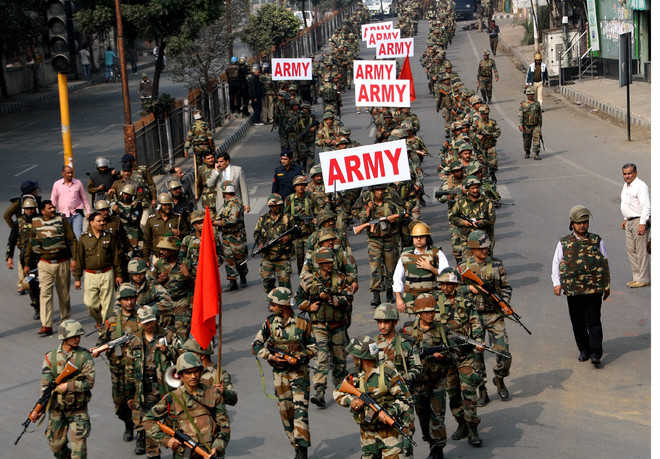
Calling the Army for internal security is not a wise decision for any state government, observes the Prakash Singh Committee report.“The deployment of the Army helped the Haryana Government bring the situation under control, but calling armed forces for matters of internal security should always be used as a last resort,” it said.The report pointed out the Army was utilised in a big way in Haryana. There were a maximum of 74 columns on a particular day.The presence of the Army did make an impact. The situation was thereafter gradually brought under control.“However, there have been disturbing whispers that the rioters were not particularly scared of the Army. The Additional Chief Secretary (Home) of the state had no hesitation in saying that the agitators were not daunted by the presence of the Army. This is not a happy situation and should cause us concern,” the report said.The committee said that one reason could be that the Army is getting over-exposed.“If this continues to happen, it will be good neither for the Army nor for the internal security of the country. Every force has a defined role and they should be able to perform that under normal circumstances. If there are any difficulties or constraints in the performance of the police, those difficulties need to be addressed and the constraints removed. The Army should be called as a last resort only when all other efforts have failed,” the report added.The state government, as told by the then DGP, placed a demand for 100 companies of the Central Armed Polie Force and 200 columns of the Army.It was a fantastic, if not absurd, demand, the report observed.
Tribune News Service
New Delhi/Mumbai, May 31
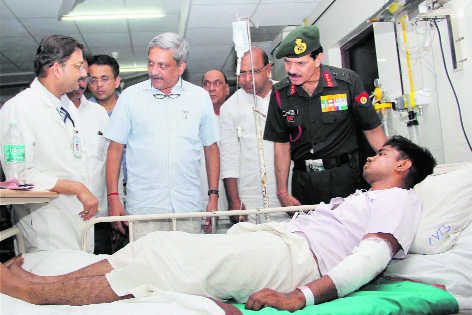
Sixteen persons, including two officers, Lt Col RS Pawar and Maj K Manoj, were killed in a massive fire that broke out at the Central Ammunition Depot in Pulgaon (Wardha) near Nagpur in Maharashtra at 1.30 am today. The fire led to multiple explosions.Director General of Military Operations (DGMO) Lt Gen Ranbir Singh said besides the two Army officers, an Army jawan and 13 civilian firefighters had died in the fire that started in a shed that held “highly sensitive ammunition.” Two officers, nine Army jawans and six fire fighting personnel were hospitalised even as the Army had rushed its own teams of medical specialists from Pune, the DGMO said. The depot stores artillery ammunition, which is deadly. Small arms and mortars are also stored there.(Follow The Tribune on Facebook; and Twitter@thetribunechd)Defence Minister Manohar Parrikar and Army Chief General Dalbir Singh Suhag rushed to Pulgaon for spot assessment of the damage caused by the explosions. Even as the fire at Pulgaon is under control, ‘cooling operations’ will continue till tomorrow.Meanwhile, district officials in Maharashtra said more than 1,000 people living in villages in the vicinity of the ammunition depot had been evacuated. “The people will be allowed to return to their homes after the defence authorities complete the cooling operations,” a district official said. The military authorities anticipate secondary explosions. Reports said the ammunition stored here includes those for rifles used by Army personnel and missiles such as the BrahMos.Parrikar was in Pune where residents of localities around another ammunition depot at Pimpri-Chinchwad were demanding that they be allowed to construct houses in part of the sanitised area around the facility.In May last year, the Comptroller and Auditor General in its report titled ‘Ammunition Management in Army’ had pointed out the risks. It said “the depots were functioning with risk of fire accident as the fire fighting equipments were not held as per requirement/authorisation. “The movement of ammunition within various echelons in the Army suffered from inadequacies such as delays in issue of ammunition, non-accounting of ammunition by depots, transportation of ammunition by other than specified explosive vans”, it had said, adding that even banned ammunition was lying around in the depots.
Tribune News Service
jammu, May 30
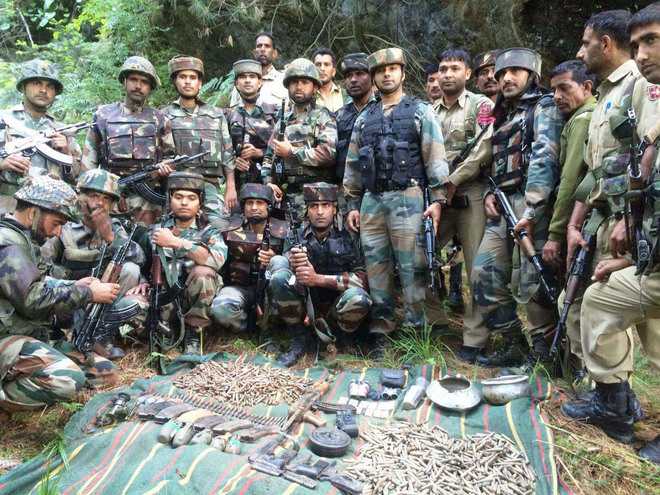
Seucrity forces today busted a militants’ hideout in Doda district and recovered a big haul of arms and ammunition from it.“Acting on specific information, the Army and Special Operations Group (SOG) of police launched a search operation in Sunarthau forest near Jantron Top in the Gosti Bowl of Doda district and busted a hideout,” said a defence spokesperson.The teams recovered four weapons including one AK 56 rifle, two 9 mm pistols, one countrymade pistol, seven AK magazines, four 9 mm pistol magazines, one Pika magazine, four UBGL grenades, five Pak hand grenades, 1,696 rounds of 7.62 mm AK 47 rifle, 1,340 rounds of 7.62 mm CTN, 40 belted rounds of Pika, two binoculars, one telescopic night sight and other sustenance stores from a cave in Sunarthau forest.Notably, accurate intelligence helped the Army in recovery of war-like stores in an operation with SOG in the dense forest, said the spokesperson. The recovered arms and ammunition were handed over to Thatri police station where an FIR also has been lodged.
Army seizes war-like stores of arms in J&K


Map showing the China Pakistan Economic Corridor

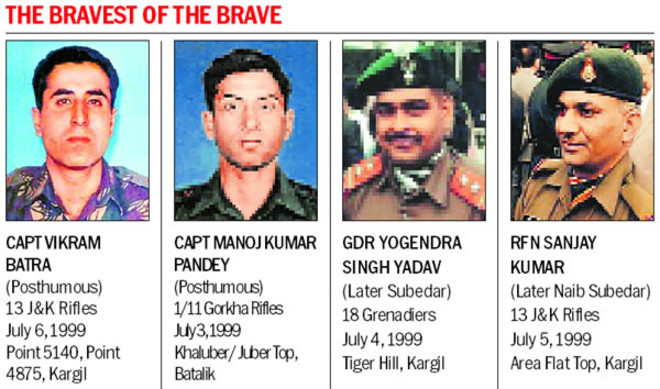
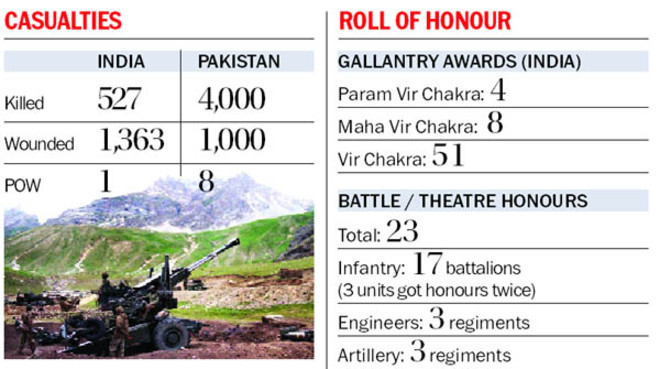
A significant Chinese military presence in Pakistan Occupied Kashmir (PoK) has raised the geo-strategic stakes. Pakistan has also adopted a policy of using low-yield tactical nuclear weapons to counter a convectional Indian assault. PoK comprises the Gilgit-Baltistan region lying to the north of the LoC and the so-called Azad Kashmir on the LoC’s west. This provides China a strategic land link across the Karakoram to the warm waters of the Arabian Sea and is known to have significant rare earth deposits. The land link from Gwadar, a deep sea port in Pakistan’s Baluchistan province, to Kashgar in Xingjian province in Western China through the Khunjerab Pass in PoK is known as the China Pakistan Economic Corridor (CPEC). For China, it provides an alternative route for energy supplies from the Middle-East and trade, without having to traverse the maritime route through in South East Asia, which is longer and prone to interdiction. The 2,450 km long, $46 billion CPEC is a central point in Sino-Pak relations and has been included in China’s 13th five-year development plan.Complementing the supposedly all-weather highway, a rail link and oil and natural gas pipelines are proposed to be part of this corridor. The northern axis of this corridor, known as the Karakoram Highway, however has been closed to traffic since January 2010 following a massive landslide along the Hunza river that resulted in about 30 km of the road being submerged. China, also making forays into Afghanistan and Central Asia, has gained access to Pakistani naval bases in its endeavour to protect its oil supplies as it currently lacks a true blue water capability to secure its trade routes.While Chinese workers may have been deployed in PoK in some numbers for a long time, China significantly increased its military presence in the middle of the last decade, ostensibly to carry out development works such as building dams, power projects, roads and communication networks. Varying reports have assessed the number of Chinese troops in PoK to be up to 5,000. They have also been spotted along the LoC. Since some of these projects are sponsored by the Chinese, their presence in PoK is expected to be a long-term or permanent affair. The Chinese posture along the Line of Actual Control (LAC) has, over the past decade or so, has become increasingly dominating. Transgressions across Indian claim lines have increased manifold. Chinese troops have on some instances come several kilometers inside India forcing a stand-off for days.A recent report by the Pentagon warns that China has increased defence capabilities and deployed more troops along the Indian border. The report also talks of increased Chinese military presence, including bases, in various parts of the world, particularly Pakistan. At the same time, Pakistani too has ramped up military deployment along the LoC in the Kargil sector.The Indian Army is in the process of raising a mountain strike corps. Though based in the north-east, it could be deployed in the north-western sector also. Last year, Pakistan declared its intention of using low-yield or tactical nuclear weapons with a relatively lesser area of impact, to hold back an Indian offensive. It has claimed that requisite infrastructure is in place for launching tactical nukes. This has added a new dimension to the whole scenario.The border issue with China and Pakistan remains a tricky affair. So, it leaves open the possibilities of a conflict or attempts to grab territory. The 1999 Kargil war saw little involvement from China, but since then, the China has grown economically, modernised its military, developed border infrastructure and adopted an aggressive posture. There has been a talk in the Indian security establishment of a “two-front war”, implying that India may have to militarily confront Pakistan and China simultaneously. Some also speak of a “two-and-a-half front war” by adding the jihadi or terrorist element present in the hinterland to the Sino-Pak collusion.As Chinese economic and security interests in the region grow, a future conflict with Pakistan along the LoC, or elsewhere, could see greater Chinese involvement or collusion with Pakistan, which has to be factored into Indian military planning. It could be more so in terms of moral, diplomatic, military and logistic support though the possibility of direct Sino-Indian confrontation on the LoC remains slim unless China, for its own self interest instigates a conflict. An increasing probability of China getting embroiled in an Indo-Pak conflict situation or having Chinese troops present in PoK providing a psychological buoyancy could embolden Pakistan to play mischief again.The war zoneTheatre: About 160 km along the LoC through Mushkoh, Dras, Kaksar, Kargil and Batalik in J&K, at heights up to 18,000 feet
Duration: May-July 1999
Operational names
Indian Army: Op Vijay
Indian Air Force: Op Safed Sagar
Indian Navy: Op Talwar
Pakistan: Op Badr
Cause: Pakistani troops occupied about 130 vacated posts on the Indian side of the LoC.Significance: Pakistan’s aim was to interdict the critically important National Highway 1-A, thereby cutting off Ladakh from Kashmir.
Outcome: Pakistani troops evicted.
Tactical and diplomatic victory for India.HOW THE WAR UNFOLDEDMay 3, 1999: Pakistani intrusion in Kargil reported by local shepherdsMay 5: Army patrols sent up; Five Indian soldier captured and tortured to death.May 9: Heavy shelling by Pakistan damages ammunition dump in KargilMay 10: Infiltrations first noticed in Dras, Kaksar and Mushkoh sectorsMid-May: Army moves in more troops from Kashmir Valley to Kargil SectorMay 26: IAF launches air strikes against infiltratorsMay 27: IAF looses two fighters — MiG-21 and MiG-29;. Flt Lt Nachiketa taken POW (Prisioner of War)May 28: IAF MI-17 shot down by Pakistan; four air crew deadJune 1: Pakistan steps up attacks; bombs NH-1-AJune 5: Indian Army releases documents recovered from three Pakistani soldiers indicating Pakistan’s involvement.June 6: Indian Army launches major offensive in KargilJune 9: Indian Army re-captures two key positions in the Batalic sectorJune 11: India releases intercepts of conversation between Pakistani Army Chief Gen Pervez Musharraf, while on a visit to China and Chief of General Staff Lt Gen Aziz Khan in Rawalpindi, as proof of Pakistani Army’s involvement.June 13: Indian Army secures Tololing in DrasJune 15: US President Bill Clinton, in a telephonic conversation, asks Pakistani Prime Minister Nawaz Sharif to pull out from KargilJune 29: Indian Army captures two vital posts — Point 5060 and Point 5100 near Tiger HillJuly 2: Indian Army launches three-pronged attack in KargilJuly 4: Indian Army recaptures Tiger Hill after an 11-hour battleJuly 5: Indian Army takes control of Dras. Sharif announces Pakistani army’s withdrawal from Kargil following his meeting with Clinton.July 7: India recaptures Jubar Heights in BatalikJuly 11: Pakistan begins pullout; India captures key peaks in BatalikJuly 14: PM Vajpayee declares operation Vijay a success. Government sets condition for talks with PakistanJuly 26: Kargil conflict officially comes to an end. Army announces complete eviction of Pak intruders