



Sanjha Morcha

Old route from Nelong valley not opened after 1962 war

Old route from Nelong valley not opened after 1962 war
The Gartang Galion bridge in the Nelong valley in Uttarkashi that Bhotia tribesmen used to go to Tibet for trade. Photo courtesy: Tilak Soni

Ajay Ramola

Tribune News Service

Mussoorie, May 22

Uttarkashi district, besides being a famous centre of religious learning of the Hindus since ancient times, was also known for the trade route to Tibet. The first big market ‘Bada Haat’ used by Indian traders for selling Chinese goods was established here. The trade from the district  was completely stopped after the war with China in 1962 and was not resumed in 1992 when it was restarted from the Lipulekh pass.A big trade market fair was held at ‘Bada Haat’ every year where Bhotia tribesmen from the district brought different kinds of goods from Tibet to be sold during the fair held in January. The Bhotia tribes lived in villages of the Jadung and Nelong valleys. They used to trade at ‘Bada Haat’ in Uttarkashi and exchange goods according to their requirements. The festival is still held in Uttarkashi but the trade with Tibet has discontinued since the Chinese aggression in 1962.The remnants of the border trade can be seen in the expansive Nelong valley, a cold desert like landscape similar to Ladakh situated at an altitude of around 11,000 feet. It falls under the Gangotri National Park in Uttarkashi district. Many structures related to the old trade route, including a wooden bridge known as Gartang Galion and the Lal Devta temple, where the trading Bhotia tribe used to offer prayers before crossing over to Tibet, still exist in the area.The infrastructure that was developed in those days suggests that the trade with Tibet was the mainstay of the local economy, say old residents of Uttarkashi.Sheep and goats and products made out of their skins such as socks and warm clothes were an essential part of the trade.Agricultural implements, tobacco, snuff, blankets, tea, coffee, barely, rice, spices, copper products, indigenous medicines, salt etc were traded by Bhotia traders on the basis of the barter system. The women of this tribe were good weavers of carpets, blankets and woollen clothes and were known to sell clothes made of yak wool and skins.The Bhotias with Mongoloid features are good climbers and can reach high altitudes with ease. Their keen sense of direction helps them in the trade considering the difficult Himalayan terrain. The Bhotias are found in the districts of Almora, Chamoli, Pithoragarh and Uttarkashi and the trade with China flourished through the routes in these districts. Rang Bhotias are subdivided into Byanse, Darmi and Chaudensi. Rang and Johari Bhotias belong to Pithoragarh district while Tolcha and Marcha Bhotias are from Chamoli district. Jad Bhotias, who mostly lived in Uttarkashi district, used to go to Tibet for the trade through passes in the Jadung and Nelong valleys. Besides trade, they had cultural and religious links with Tibet.Jad Bhotias involved in the trade followed the main Jad river upstream passing through two camping spots of grazers, namely Hilding and then Do-Sumdo. They then reached the Thaga pass that forms one of the important corners of the Bhot Pradesh triangle. The traders following the path right from Do-Sumdo via Tirpani reached the Himalayan border at the Jelu Khaga pass. From here, they crossed into Tibet and reached Chhabrang Zong, which was the first Tibetan trading centre on the route. Another centre Tholing is 10 km northeast and serves as an important trade junction from where several other trade routes lead to western Tibet.The places such as Nelong, Naga, Neela Pani and Sonam in the district developed into flourishing trading stopovers. The ban on the trade with Tibet had badly affected the local economy, especially of the Bhotia community. The trade with China from Uttarkashi completely stopped though it is continuing from Pithoragarh in the Kumaon region.Uttarkashi residents say neither the state government nor the Union government has made any efforts to resume the trade with China from the district. On the contrary, the government has restricted the movement of Indian and foreign tourists by introducing an inner line permit clause. Indian tourists have to seek several permissions to enter the Nelong Valley while foreign tourists cannot go there.Ajai Puri, president of the Uttarkashi Hotel Association, says it is preposterous that while we are inviting Chinese entrepreneurs to invest under the Make in India programme, the Central government has not worked towards resuming the trade with China through the district and not allowed the movement of people. He says the trading community demands opening of trade routes to Tibet and mainland China so that the nation and local people could benefit.


Restricted area clause affects tourism in Uttarkashi district

Ajay Ramola

Tribune News Service

Mussoorie, May 22

The archaic Inner Line and restricted areas clause that was imposed in the region above Harsil and Nelong Valley in Uttarkashi district following the Chinese aggression in 1962 is affecting Uttarakhand tourism. At the same time, it is benefiting neighbouring Himachal Pradesh, say local businessmen.The restricted area clause does not define clearly as where the tourists, especially foreigners, can venture into leading a lot of inconvenience to the administration and the tourists.The Inner Line permit is required above the Harsil region but there is no check post established to stop tourists, especially foreigners, going to the region right up to Gangotri. Foreigners are seen staying overnight at Dharali, Bharon Ghati and other destinations right up to Gangotri.Indian tourists have to obtain a permit for the Nelong valley, which is completely out of bounds for foreign tourists. Foreigners due to such an ambiguity prefer Himachal Pradesh instead which allows an easy access to its tourist spots on the border with China.An Inner Line Border Permit required for trekking is easily provided in Himachal Pradesh to trekkers who want to walk through from Chitkul village in Himachal to Harsil while they find it difficult to obtain the permit from Uttarkashi for the same trek, said Tilak Soni, an adventure tour operator running a firm Where Eagles Dare.The presence of Gangotri National Park means the Indian tourists have to apply for special wildlife permit apart from inner line security permit to visit Nelong Valley. Gangotri National Park officials do provide access to the area till 23 km beyond the first recognised check post in the Nelong valley, which does not serve the purpose as they are asked to return the same day which is not possible in such a terrain.Lokendar Bisht, BJP state member of the working committee, said he had met the Union State Minister for Home Kiran Rijjiu during his visit to Uttarkashi and raised the issue.Rijiju had asked the district administration to send a proposal in this regard via state government. Uttarkashi District Magistrate Ashok Kumar Pandey said the process of seeking an inner line permit for the Nelong valley should be streamlined and converted into a single-window system as tourists have to seek permission from various departments.Pandey recommended the removal of the inner line permit clause from Harsil Market and 50 km area around it right up to Wilson Cottage.

Tibet border trade lifeline of tribal economy

British developed nomadic business through high Niti and Mana passes to keep an eye on expanding Russian influence
Tibet border trade lifeline of tribal economy
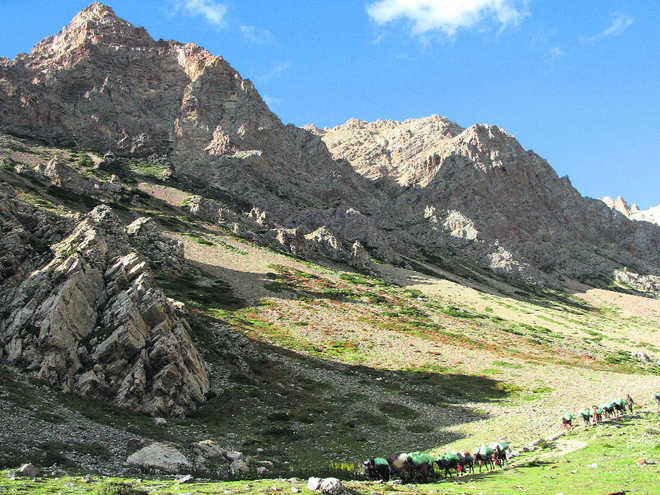
Indian traders along with mules carrying goods coming from Taklakot in Tibet after taking part in the trade. Photo courtesy: Keshav Bhatt

BD Kasniyal

Pithoragarh, May 22

The British in the Kumaon region became aware of the traditional trade between people living in Indian border villages and those in Tibet through several high Himalayan passes after a Jesuit missionary, Father Antonio de Andrade, visited the Tibetan mart of Tsaprang through the Niti pass in Garhwal in 1624. Father Andrade mentioned that the Niti and Mana passes were well-known trade routes to Tibet in those days.Another British settlement officer of Garhwal in 1896 also mentioned that the trade with Tibet was an important source of income and local employment in the border districts of the Kumaon and Garhwal regions in those days. According to him, the trade also provided a market for local produce of the region as well. The British, considering the significance of the border trade,  later secured the easiest way to Tibet through these regions so that the trade could prosper.According to experts, the Tibet border trade was in vogue even in the third century BC. Edwin T. Atkinson in his gazetteer has mentioned that there was an ancient route from Patliputra to Taxila via Kalsi in the third century BC. According to the historian, borax for the use of goldsmiths of northern India was imported from Tibet in the 6th century AD. Borax was used in making ink to write on birch bark or locally made hand paper. “Pearls, corals and glass beads were exported to Tibet in exchange for borax import in those days,” says Dr Lalit Pant, researcher on the border trade.The British were fully convinced that it was only through these passes to Tibet from the Kumaon and Garhwal regions that they could keep an eye on  advancing Russians. They decided to develop the trade with Tibet via these passes and sent Francis Young Husband with five other officers and 100 troops to Tibet in 1903 to facilitate mobility of Indian traders to the neighbouring country for the trade. “Even a survey was done for laying a railway line from Pilibhit to Tanakpur that was to be further connected with the Lipulekh pass via a road,” says Pant. The border trade with Tibet through high Himalayan valleys in Uttarakhand used to commence through the Byans, Chaundas, Garbyang, Darma and Johar passes in Pithoragarh district and the Niti pass and Mana pass in Chamoli district. “The significant passes of Lipulekh (16,500 ft), Darma (18,550 ft), Limpia (18,150 ft), Kungri Bingri (18,300 ft), Unta Dhura (17,950 ft), Mana (17,590 ft) and Niti (16,600 ft) were used for the trade with Tibet,” say experts.Dr RS Tolia, former Chief Secretary and a local from the Johar valley in Pithoragarh district, says the British in the early nineteenth century were fully convinced that the trade with Tibet sustained agriculture, animal husbandry, cottage and pharmacology industry in the lower valleys of Kumaon and Garhwal and generated employment for thousands of people. He adds cereals and grains of coarse varieties were the main exports to Tibet while salt, borax, wool, valuable stones and herbs were the main imports before the trade closed in 1962 following the war with China. “Charles W Sherring, the British commissioner in 1906, has mentioned that a trade worth 67,000 British pounds was commissioned from the Kumaon region alone,” says Tolia.Goods worth Rs 86,000, including raw wool Pasham, yak tail, sheep and goats and borax, were imported from Tibet in the first year of the resumption of the trade in 1992 while Indian traders exported Rs 12.06 lakh worth of textile, coffee, vegetables, jaggery, mishri (sugar candy) and Phaphar flour to Tibet, says HC Semwal, District Magistrate, Pithoragarh.Tea sipping, broken stone pieces matter of mutual trustThe traditional trade between Indian traders and their counterparts in Tibet was done on the basis of the ‘Gamgya’ system that was based on mutual faith. The system was established when the traders from both countries met during a small ceremony called ‘Suljimulji’ where a small cup of tea or wine was brought in. The first sip of tea or wine was taken by a Tibetan trader called ‘Mushye’ while the Indian trader called ‘Mitra’ had the second sip. After the tea-sipping ceremony, a few precious gifts were exchanged between the two. Later, an ordinary stone was broken into two parts. While the Tibetan trader kept the one part of the broken stone, the other part remained with his Indian partner,” says Dr Lalit Pant, an expert on the border trade.Pant says in later years, the representatives of the two traders or their generations were recognised by these stone parts. If the two parts fitted well, the identity of the representatives was established and the two would begin trading with each other. “The trading on the basis of this system between tribal Sauka and Rang traders and their counterparts in Tibet continued for centuries till 1962,” he adds.Pant says besides the ‘Mushye’ traders in Tibet, Dokpa nomads were the other important participants in the trade before 1962. The Dokpa nomads lived in the interior parts of Tibet with their herds of animals and visited the Taklakot mart for the trade. “These Dokpas used to exchange their raw material, including wool, with grains brought by Indian traders during the trading season. As the Dokpa traders would come with herds of animals, they were not allowed entry into the Indian mart at Gunji.  A mart was set up at Gunji in the Indian side after the trade resumed in 1992,” says Pant.HC Semwal, District Magistrate, Pithoragarh, says the activities for the border trade begins in May when trade passes are sought from the Indian Ministry of External Affairs and issued to the traders. The traders are provided space in a mart where they store their goods and bank facilities at Gunji till the trade concludes in the last week of October. The ITBP provides them security till they cross over to Tibet from the Lipulekh pass.


IAF choppers douse forest fire near Vaishno Devi

short by Bhavika Bhuwalka / 10:08 am on 19 May 2016,Thursday
A “massive” forest fire broke out close to the Mata Vaishno Devi shrine on Trikuta hills, near Jammu on Wednesday, following which the Indian Air Force pressed into service two MI-17 helicopters to douse the blaze. Around 15,000 to 20,000 litres of water were reportedly used to control the fire. Notably, no loss of life or property was reported.

Site for Army ammo depot identified

Kuldeep Chauhan

Tribune News Service

Shimla, May 20

The protracted dispute over the relocation of the Army’s ammunition depot at Powari in Kinnaur between Himachal Power Corporation Ltd (HPCL) and the Army seems to have ended as the Kinnaur district administration has selected about 300 acres near Sasho in Pooh subdivision for the purpose.“We have selected the land near Sasho in Pooh, upstream from the Powari site. The joint inspection of the land was carried out by the district administration and the Army recently,” Kinnaur Deputy Commissioner Naresh Lath told The Tribune. “The Army authorities have expressed satisfaction over the site and we hope that the site will fit the bill,” he added.The Army had demanded about 600 acres to relocate its ammunition depot from Powari, which faces eviction due to the 450 MW Karcham-Wangtoo power project coming up on the left bank of the Satluj. “But the Army will have to narrow down its demand to 300 acres or so as the plain land measuring 600 acres is not possible in mountainous region of Himachal,” said officials.Earlier, the Army had agreed to shift its ammunition depot from Powari to Jhangi. But the Jhangi site was opposed by local tribals on the ground that it was home to the rare chilgoza forest which will have to be axed to clear the site for the depot.The Army had stalled the project work last year, but the Ministry of Defence later allowed HPCL to carry out “non-hazardous activities at the site after the state government took up the matter with the ministry last year.HPCL started the work on the project in 2012 after the Ministry of Environment and Forests (MoEF) gave its clearance to the project. But HPCL has not got the clearance or NOC from the Ministry of Defence to use the site to move its machineries, sources said.HPCL managing director DK Sharma said the issue had been resolved for the time being as they were working in coordination with the Army. The project posed no hazard to the Army depot and was not acquiring any land there, but the district administration had identified the land for the Army, he added.The Army had cited the strategic importance of the Powari ammunition depot functioning there since decades. But the Army has yet to take a final call on the new site as it has to get all clearances from the state and Central governments that may take years together, revealed the Army sources.However, the district administration has offered all assistance. “We will assist the Army and will allot them as much land as they want,” Lath added.


PAGES FROM HISTORY::‘ALMOST EVERYONE ON THE TRAIN FROM PAK WAS KILLED’

Through photos, art, documents and personal stories, an exhibition on Partition evokes poignant memories of 1947

We assure you with the utmost sincerity that distance has not made the slightest difference in our love and affection for you; that we remember you, and remember you very often, with the same brotherly feeling that for so long characterised our relations.”

The words are from a letter (above right) written to Amar Kapur, by his friend, Asif Khwaja on April 6, 1949, after the Kapurs left Lahore after Partition. The Kapurs lived at 7, Egerton Street in Lahore and had stayed on after Partition until they finally left their home on September 5, 1947. The pain of leaving his home is still etched in Amar’s memory, he even remembers the exact time when they left, 4.30 pm.

Many of us have heard such stories in our families or from others, of suffering and of longing. The memories were hardly chronicled, let alone documented in a Partition museum. Last year, journalist Kuldip Nayar had written about how he wanted to establish a museum on Partition soon after August 1947, but he found that the wounds were too raw.

This fear, of losing a part of our history, led to the start of the Partition Museum Project last year. The project plans to establish a museum, a ‘people’s museum’, in Amritsar, Punjab, by the year end, to commemorate the 70th year of the largest mass migration in history in 2017.

“We don’t have any documentation and we don’t know about the trauma of the people who went through Partition. It is part of our heritage,” says Kishwar Desai, chair of the trust that is helming the museum project. Desai’s parents also came from Lahore. “The stories are important. We are witnessing large scale migration even today where people go through the trauma of displacement.”

The museum will have oral histories, photographs, documents, objects that people brought with them, among other material. It’s a work in progress but they already have more than 2,000 recorded histories. An exhibition, ‘Rising From the Dust: Hidden Tales from India’s 1947 Refugee Camps’, at New Delhi’s India Habitat Centre will be showcasing selected items over the next few days.

Khwaja’s letter is also a part of the exhibition. The project’s primary objective is to document the stories of people who migrated to India. Like SP Rawal’s story, who was just seven during Partition (see box below) or the story of Leelavati Khanna’s favourite book, about a Muslim artist Abdur Rahman Chughtai, the one thing that remained with her family as a marker of their home. ‘Then how real was this division of culture into Hindu and Muslim?’, reads the placard above the box that displays the dilapidated book at the exhibition.

Oral histories will be recorded during the exhibition too. So if you have a story to share, an item that you want to share, head to the venue.

SP Rawal, 75, recounts how he walked to India with his family, amid turmoil of Partition almost 7 decades ago

We all came to the railway platform and there was no fixed timing of the train and there was no surety whether the train will come on that day or not. There were a huge number of people on the platform, I mean, countless…We also joined the crowd… My bua, father’s elder sister, said to my father, “It is fate that has brought us here. My daughter is engaged and the boy’s side is present here, why don’t we get them married right now?” And my father agreed. We looked for a pandit. We made a small, makeshift altar. And the girl was married there on the platform. After a while, the train arrived. Everyone boarded the train… There were no reservations. People sat wherever they could, inside the compartment or the roof. After we got in, my elder sister said: “Amma, main nai jawangi. (I’ll not leave)” “Kyun nai jawangi? (Why will you not leave?)” “Woh aap (her husband)

nahi aaye. (Because he hasn’t come)”

Her husband had not come from the village… My sister got down, and the moment my sister got down, my mother got down too. My father said, “If you will not go, neither will I. Let’s all get off the train.” The whole extended family, everybody came down. Unfortunately [we discovered later that] the train was completely butchered…

Then we thought, let’s go along with the caravan. We needed a cart…We bought one cart and two bullocks.

The caravan began to move. There were around 400 to 500 families in the caravan. I was seven, my younger brother was five and my younger sister was three. For them, we made arrangements to sit in the bullock cart. Everybody else, including me, walked.


Tejas ready for IAF ops: Raha Air Chief takes maiden flight in jet I First squadron to come up by July

Tribune News Service

New Delhi, May 17

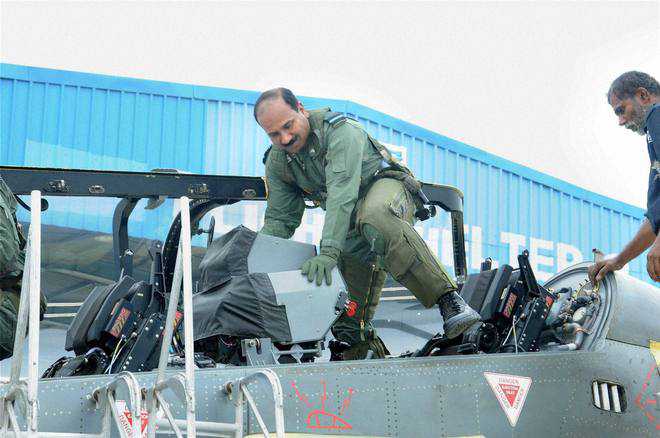
IAF Chief Marshal Arup Raha today took his maiden flight in India’s homegrown Light Combat Aircraft Tejas, calling it “good” for induction. It seems to be a signal that the Indian Air Force will welcome the planes and instil confidence in the local product even as it awaits a final operational clearance.“It is my first sortie in Tejas. It is a good aircraft for induction into IAF operations,” Raha was quoted as saying by the Bangalore-based Hindustan Aeronautics Limited (HAL). The HAL is developing the plane, which has flown over 3,000 test flights since the first prototype flew in 2001. The IAF Chief flew the plane for about 30 minutes at HAL airport in Bangalore around noon today. Group Captain M Rangachari accompanied him in the twin-seater trainer aircraft.“It is a moral boosting gesture from the IAF Chief and reposes great confidence of our valuable customer in our abilities,” said T Suvarna Raju, Chairman and Managing Director of HAL.The IAF Chief carried out simulated air-to-air and air-to-ground attacks. He also assessed the advanced modes of the radar and Helmet Mounted Display Sight (HMDs). The IAF Chief, who in his younger days commanded a MiG 29 squadron, congratulated the entire team of HAL and others involved in getting the LCA programme to this stage.The IAF has 120 Tejas fighters on order. The series production of the jets has already commenced at HAL plant in Bangalore and the first squadron of the LCA is expected to be formed by July. The four aircraft will make up for the first squadron of the IAF, which will be used for training and familarisation.The IAF had decided to go in with an upgraded version of the existing Tejas with 43 modifications, 106 of these Tejas will come with modifications such as Actively Electrically Scanned Array Radar, Unified Electronic Warfare Suite, mid-air refueling capacity and beyond the visual range of missiles. The Ministry of Defence has set 2018 as deadline for the first aircraft to be ready with a target to complete its production by 2022-2023. 


China may seek base in Pakistan, other countries :: Pentagon report

China is likely to consider establishing additional naval logistics hubs in countries with which it has a long-standing friendly relationship and similar strategic interests, “such as Pakistan”, according to a Pentagon report.

In its annual report to Congress on “Military and Security Developments in China”, the US Department of Defence claimed that China is looking for countries that have “a precedent for hosting foreign militaries.”

But the report also noted that “China’s overseas naval logistics aspiration may be constrained by the willingness of countries to support a (Chinese military) presence in one of their ports.”

The report pointed out that Pakistan remains China’s “primary customer” for conventional weapons and China engages in both arms sales and defence industrial cooperation with Pakistan.

This includes joint production of LY-80 surface-to-air missile systems, F-22P frigates with helicopters, main battle tanks, air-to-air missiles, and anti-ship cruise missiles. In June 2014, Pakistan started co-producing the first two of 50 Block 2 JF-17s, which is an upgraded version of the Block I JF-17, the report adds.

“We have noticed an increase in capability and force posture by the Chinese military in areas close to the border with India,” Deputy Assistant Secretary of Defence for East Asia Abraham M Denmark told reporters after submitting the report to Congress.

“It is difficult to say how much of this is driven by internal considerations to maintain internal stability, and how much of it is an external consideration,” he added.

The Pentagon report also highlights tensions between China and India as a cause of concern. “Tensions remain along disputed portions of the Sino-Indian border, where both sides patrol with armed forces,” it warns.

In October 2013, Chinese and Indian officials signed the Border Defence Cooperation Agreement, which supplements existing procedures managing the interaction of forces along the Line of Actual Control (LAC).


US backs India’s entry into NSG Move despite opposition from China, Pak

US backs India’s entry into NSG

Simran Sodhi

Tribune News Service

New Delhi, May 14

A day after India met opposition from China, the US today supported New Delhi’s entry into the elite Nuclear Suppliers Group (NSG), saying it conformed to the “missile technology control regime requirements” that were a must for the membership.China had issued a statement yesterday saying several NSG members felt that signing the Non-Proliferation Treaty (NPT) was a “cornerstone for gaining the NSG membership”. Before Beijing, Islamabad had tried to block India’s entry into the exclusive club. Last month, Sartaj Aziz, foreign affairs adviser to Pakistan Prime Minister Nawaz Sharif, went to the extent of saying that “China had helped Pakistan stall India’s bid to get NSG membership”. India has not signed the NPT as it claims the treaty is discriminatory but given its super-clean record in non-proliferation, it is eager to join the NSG.In Washington, State Department spokesman John Kirby said last night: “I’d point you back to what the President said during his visit to India in 2015, where he reaffirmed that the US view was that India meets missile technology control regime requirements and is ready for NSG membership.”Chinese Foreign Ministry spokesman Lu Kang said that not only China, several other NSG members too were of the view that “NPT was the cornerstone for safeguarding the international nuclear non-proliferation regime”. The US support is welcome news but since the NSG membership is based on consensus, India still may have a long way to go before it finally enters the group.

About the elite club

  • Nuclear Suppliers Group is an international body concerned with reducing nuclear proliferation by controlling the export andre-transfer of materials that may be used for developing nuclear weapons
  • India along with Pakistan, Israel and South Sudan are the only nations that have not signed the NPT, a pact that aims to control spread of nuclear weapons
  • India, however, has been pushing for a berth in the NSG on the basis of its clean track record but if India is granted this waiver, Pakistan’s argument is that it too should be given the membership

I never met Sonia, Manmohan or Antony: Agusta ‘middleman’

I never met Sonia, Manmohan or Antony: Agusta ‘middleman’
File photo of AW101 helicopter

New Delhi, May 11

Chirstian Michel, a suspected middleman in the Rs 3,600 crore AgustaWestland helicopter deal, on Wednesday said that he had never met Congress President Sonia Gandhi or the then Prime Minister Manmohan Singh to push for the purchase of VVIP choppers.

“No, never,” was the prompt reply of Michel when he was asked whether he had ever met Gandhi, Singh or then Defence Minister AK Antony for pushing the deal.

“I have never met any of these,” he said in an interview to ‘TV Today’ news channel in Abu Dhabi.

Michel sought to clear his name from the kickbacks scam claiming that he had “once” shaken hands with the then IAF Chief SP Tyagi in Delhi but “avoided him” for his links with Italian businessman Guido Haschke and another middleman.

“I probably met him (SP Tyagi) at Gymkhana club and I think I shook his hand there. But because of his association with Haschke, I really avoided him,” he said.

He also said that BJP Parliamentarian Subramanian Swamy has not lied about the deal but it seems he has been misled.

“He has authenticated (documents) what was given in the CAG report. The CAG report was prepared in great hurry as the deal was always blowing away.

“They (CAG) are not aviation experts and they are bureaucrats asked to put together document way beyond their expertise. So he was misled by his own documentation,” he said.

The VVIP choppers deal probe has shed light on the involvement of three suspected middlemen — Carlo Gerosa, Guido Haschke and Michel — in swinging the deal in favour of UK-based AgustaWestland, a subsidiary of Italian firm Finmeccanica.

Investigating agencies are inquiring into their role in payment of bribes and extension of favours by the company to clinch the multi-million dollar deal.

On January 1, 2014, India cancelled the contract with the company over alleged breach of contractual obligations and charges of paying kickbacks of Rs 423 crore by it for securing the deal. — Agencies


NGT eases Rohtang curbs with riders Tribunal okays four snow-scooters at Beas Nullah, paragliding at Solang and Marhi

NGT eases Rohtang curbs with riders

Vijay Arora

Shimla, May 9

Giving respite to Manali residents, the National Green Tribunal (NGT) today relaxed some of its conditions imposed on commercial activities in the eco-sensitive Rohtang Pass.Now, 800 petrol vehicles can enter Rohtang every day. Earlier, the number was 600. The tribunal, however, refused to increase the number of diesel vehicles from 400 per day.After considering the assurance given by the state in its affidavit and reports, the NGT, headed by Justice Swatanter Kumar, also allowed limited activities for a limited period (subject to filing of the report by local commissioners appointed by it for the inspection of the area).The NGT has allowed only four stroke snow-scooters to operate at the Beas Nullah to Sagu Fall and at Gulaba with a rider that not more than 50 scooters would be permitted to operate at both the sites collectively.It further allowed paragliding at Solang and Marhi with a clear direction that at both the places the paragliding would take place within the identified areas and it would be ensured that the persons organising paragliding and tourists did not generate any municipal solid waste at the take-off and landing points.Giving relief to photographers of the area, the Green Tribunal has permitted them to carry out their activity at Rohtang, Gulaba, Solang and Marhi (subject to terms and conditions of the licence to be provided by the concerned state authority).While passing the order, the NGT clarified that ‘no activity of any kind would be permitted at the Rohtang Pass, except the provision of local dresses and photography’. It will consider permitting other activities at Rohtang only after receiving the report of the commissioners appointed under the order.“We make it absolutely clear that no other activity or business, snow-scooters, ATVs and horses, except the ones specifically permitted above, and visiting of the tourists will be carried on at the Rohtang Pass and its surrounding areas.”The NGT observed: “The state has prayed for relaxation in certain directions issued by the tribunal, more particularly related to paragliding, snow-scooters and other activities, which according to them are non-polluting, as well as the number of vehicles. We do not find merit in all contentions raised on behalf of the state, but some of them can be permitted to be started in the restricted areas with an objective to examine if the government and its authorities are able to maintain a check and strike a balance without causing any pollution in the area. As far as Rohtang is concerned, we are completely unsatisfied with the proposals made as it is an extremely eco-sensitive area and cannot be subjected to further degradation on the mere assurance that the government will take appropriate steps. It will be appropriate to permit some activities to the state administration at lower levels and observe the consequences on the environment and the ecology.”It directed the state authorities to provide at least 30 eco-friendly toilets, submit a comprehensive status/compliance report regarding a ropeway, operation of CNG and electric buses and status with regard to establishment of eco-friendly market at Marhi. It also directed the state that in consultation with NEERI submit complete and comprehensive status report on the carrying capacity of the Rohtang Pass, Marhi, Solang, Gulaba and other tourist spots.With a view to check the impact on environment and ecology of Rohtang, the NGT also appointed six advocates as the local commissioners and directed them to file their report within three weeks. It asked them to file the report on establishment of barriers, including technical support systems, regular checking of pollution of vehicles, whether all vehicles going to Rohtang possessed requisite permissions, establishment of toilets, sanitary facilities, relief and rehabilitation plan for house owners, taxi drivers, particularly those having diesel cars, partial rehabilitation and incentive programme for the people involved in tourism activities in the areas.

Respite for Manali residents

  • Now, 800 petrol vehicles can enter Rohtang every day
  • Earlier, the number was 600
  • There is no change in the number of diesel vehicles
  • At the Beas Nullah to Sagu Fall and at Gulaba, not more than 50 scooters will be permitted to operate
  • Photographers can operate in Rohtang, Gulaba, Solang and Marhi (subject to terms and conditions of the licence to be provided by the concerned state authority)
  • The NGT has clarified that ‘no activity of any kind will be permitted at the Rohtang Pass, except the provision of local dresses and photography’
  • It will consider permitting other activities at Rohtang only after receiving the report of the commissioners appointed under the order
  • No other activity or business, snow-scooters, ATVs and horses, except the ones specifically permitted above, and visiting of the tourists will be carried out at the Rohtang Pass


New local recruits keeping militancy alive in Valley

New local recruits keeping militancy alive in Valley
Army men near an encounter site in Kupwara. Tribune file photo

Azhar Qadri

Tribune News Service

Srinagar, May 8

Despite dying in regular encounters with security forces in recent years, militants in Kashmir have managed to keep insurgency alive by successfully recruiting new members – most of them young and educated.The number of militants operating in the region over the past few years has remained roughly static even as 435 of them died in the last five years, according to the data shared by the Union Home Ministry in its annual report last month.The militant count in Kashmir has fluctuated in the range of 100 and 200 in recent years even as stricter surveillance along the Line of Control has partly contained the flow of foreign elements.The figures indicate that the region’s long insurgency has made a slow resurgence in recent years, relying mostly on local recruits, despite being battered by a swift counter-insurgency campaign which caused its ranks to shrink to double-digits in 2012, the lowest in its history that now spans into the third decade.At present, there are 130 named militants active in the Kashmir valley while the total number is believed to be anywhere around 150 to 170, said Inspector General of Police, Kashmir, SJM Gilani.“The number of people who are infiltrating and the number of people who are (locally) joining is around the same figure (as those dying),” Gilani told The Tribune, referring to the local recruitment of militants and infiltration of foreign militants as reason for the steady number of militants in the region.Gilani said militants are “putting all their efforts” at local recruitment. Last year, when 108 militants were killed in various gunfights along the Line of Control and in the interiors of the Valley, 72 local youth had joined militant ranks and provided it the sufficient manpower to keep it going.The maximum militant recruits have come from five police districts that constitute south Kashmir, the ground zero of new-age militants and the electoral stronghold of the ruling Peoples Democratic Party. In 2015, 59 of the 72 new recruits had come from south Kashmir.In a pattern that has emerged in south Kashmir districts, new recruits quickly substitute for the dead militants. In February 2015, Shabir Ahmad Mir and Idrees Shah were killed in a gun battle in the picturesque Tral sub-district of south Kashmir and a fortnight later Ishaq Parray, a meritorious student, and Saleh Mohammad joined the militant ranks.In April that year, a militant was killed in a forest near Tral and the next day Sabzar Ahmad and Shakir Ahmad joined the militant underground.The trend even dates back to summer of 2013 when a militant commander Shabir Ahmad Bhat and his associates Shahnawaz Mir and Aijaz Ahmad were killed in a fierce gunfight in south Kashmir. Bhat and his two associates were among the 67 militants killed in various gunfights with the security forces in the region that year.Within days of the encounter, a new set of recruits — among them Aqib Bhat, a resident of the slain commander’s village, and engineering student Zakir Rashid — had left their homes and joined the underground network in a trend that has become a signature style of militant recruitment.

Tracking terror

  • The number of militants operating in the region over the past few years has remained roughly static even as 435 of them died in the last five years
  • The militant count in Kashmir has fluctuated between 100 and 200 in recent years. At present, there are 130 named militants active in Kashmir while the total
  • umber is anywhere around 150 to 170
  • Last year, 108 militants were killed in gunfights in the Valley, while 72 local youths joined militancy, providing it sufficient manpower to keep it going