




Sanjha Morcha

Now is the right time to settle Siachen Col D.S Cheema (Retd)

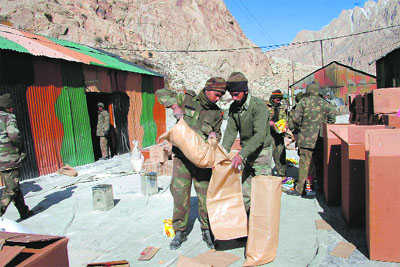
Siachen can only be lived to be understood. The “hellish” conditions a soldier has to go through can never be appreciated by a politician or a babu sitting in the cosy environment of their offices. Mere sustenance of forces in this non-polar region battlefield poses unique challenges.
Now is the right time to settle Siachen
The responsibility of making Siachen a history lies with the BJP Government at the Centre. It must arrive at a sensible solution at the earliest. Tribune photo: Manoj Mahajan

WHEN Pandit Nehru made the historic but infamous statement about Chushul in 1964, “Not even a blade of grass grows,” it agitated the consciousness of an average Indian. He couldn’t have imagined that 20 years later Pakistani soldiers would occupy Indian territory in a glacier named Siachen, making it the world’s highest and the coldest desert battlefield where temperatures plummet to minus 50 degrees. Siachen is also the most treacherous and most expensive in terms of lives of Indian (and Pakistani) soldiers lost, without considering the huge financial burden both neighbours have to bear at the cost of feeding their poor. India has lost almost 1,000 soldiers to the inhospitable battleground without fighting any pitched battle and many more have been disabled. The recent loss of 10 soldiers of Madras Regiment, has once again brought the focus on Siachen. Pakistan too has suffered many causalities. It lost 140 soldiers in 2012 to an avalanche which swept away the entire military camp. It is surprising that considering the extreme hardships faced by troops deployed by both adversaries, regular frost-bite and snow-blindness causalities, human loss and colossal wastage of financial resources in maintaining the forces, both sides have yet to find a solution to this mad war in the past 32 years. Troops of both the countries continue to suffer in inhuman conditions, losing limbs and eyes every day, while politicians look for their own face-saving methods. Mere sustenance of forces in this non-polar region battlefield poses unique challenges. Siachen can only be lived to be understood, the “hellish” conditions a soldier has to go through can never be appreciated by a politician or a babu sitting in the cosy environment of Delhi offices. They can never understand what a soldier goes through when they visit troops for 15 minutes, wearing snow- clothing, have hot tea with pakoras and go through the ritual of a photo-shoot of their sojourn — before taking the special/earliest flight back. There is a need to go in to the genesis of the problem to find a solution rather than look for “quick-fixes”. The whole issue came to light after the American and Chinese mountaineering expeditions, attracted by the challenge of the virgin Himalayan peaks started visiting the area. India, as a policy refused permission to foreign expeditions. However, Pakistan not only encouraged them but also provided logistic support and even sponsored some of them. Having been armed with enough data on terrain and topography, Pakistan declared the glacier as their own territory. It is unfortunate that India took some time to react to the unholy design but fortunately, it was not too late and we responded in a more-than-befitting manner. The area, which has gained notoriety as Siachen remained undemarcated as no troops had been deployed there. However, on April 13, 1984, a Company of 4 Kumaon was moved by the Indian Army to counter the evil designs of Pakistan which had occupied strategic heights and Operation Meghdoot was born. Since then all efforts have been made by India to settle the dispute, then Prime Minister Manmohan Singh who visited the glacier in 2005, even talked of making it “a mountain of peace”. Several rounds of bilateral talks to settle the issue once for all have been stalled by Pakistan on one ground or the other. Both nations fully understand that continuation of deadlock or stalemate is not in the interest of either of the countries, since neither side can dislodge the other militarily in the prevailing situation.Perhaps, the best time to settle the Siachen dispute is now. Given the equation our Prime Minister has with Pakistan premier Nawaz Sharif and the rapport enjoyed by our NSA Ajit Doval and other functionaries with their Pakistani counterparts, the common man in both the countries sees a ray of hope. Of course, we have to tread very carefully in the backdrop of our adversary’s past history of mistrust and stabbing in the back every time a genuine effort was made to sort out any issue. It has been seen that every significant breakthrough in any status-quo situation is possible only when the sides involved first break with tradition, with old ways of thinking, with old paradigms.A positive shift in the mindset of both the nations is the need of the hour. India and Pakistan both have yet to experience the rewards of being truly free. Both are suffering from poverty, disease, oppression and inequality. Can they afford to continue a senseless enmity when they need resources for improving the plight of their teeming millions?  The intelligentsia, the media and ordinary citizens of both the countries must pressurise the decision-makers to come to a sensible solution at the earliest. The responsibility of making Siachen a history lies with the BJP Government at the Centre; it is one of their best chances.The writer, a veteran, commanded an EME batallion at Leh and spent 10 days at Base camp.

Army presents cheques to mine blast victims

Tribune News Service

Jammu, March 27

As a humanitarian gesture, the Nangi Tekri Battalion has presented cheques for Rs 1.5 lakh each to two victims of landmine explosions at a ceremony at Jhallas village in Poonch.The victims, Muhammad Aziz and Hakam Bi of Salotri village, were injured in a mine blast.Village sarpanch Manzur Hussain thanked the Krishna Ghati Brigade for the assistance and lauded safety measures initiated by the battalion in the region.The Army has been offering all required assistance, including compensation, to mine blast victims and pursuing their cases seeking relief from the Centre and the state government.


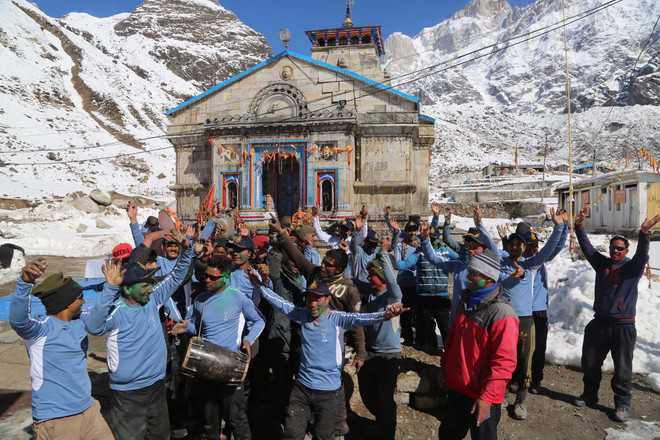
IMA cadets celebrate Holi at Kedarnath

IMA cadets celebrate Holi at Kedarnath
Students of Indian Military Academy and workers of NIM celebrate Holi at Kedarnath shrine on Thursday. Tribune photo

Tribune News Service

Mussoorie, March 25

A group of cadets from the Indian Military Academy (IMA), Dehradun, and employees of the Nehru Institute of Mountaineering (NIM) celebrated Holi at the Kedarnath shrine yesterday.The students, who arrived at Kedaranath on March 20, are on a trekking tour around the region. For the IMA cadets, celebrating Holi at the shrine was a memorable experience.Colonel Ajay Kothiyal, principal of NIM, extended Holi greetings to the IMA cadets and NIM workers who have been working relentlessly to restore the area devastated in the 2013 flash floods.


BATHINDA DISTRIBUTARY OF SIRHIND CANAL Remove net or face action, admn tells Army

Nikhila Pant Dhawan
Tribune News Service
Bathinda, March 21
Acting on the demand of panchayats of Gehri Buttar, Jodhpur Romana, Gehri Bhagi, Mehta, Shergarh, Bhagwangarh, Gurusar Sainewala, Phullomitthi, Sangat Kalan, Jassi Bagh Wali, Kishanpura, Naruana, Jai Singh Wala, Baho Sivian and Meeya villages, the district administration today asked the Army to remove the net which it had cast in the Bathinda distributary of the Sirhind canal that passes through the Bathinda cantonment.
The district administration issued the orders here today taking cognisance of the fact that the casting of the net was affecting the crop in the villages and might also affect sowing of the cotton crop which was to be done within the next 20 days. The Irrigation Department had also announced uninterrupted water supply to the field starting April 16 to aid cotton crop sowing.
As per information, the Irrigation Department has even threatened police action against the Army for casting the net and disrupting water supply to the villages.
Meanwhile, the Deputy Commissioner Basant Garg had called Army personnel for a meeting on March 22 as well.
Following the Pathankot incident, the Army had cast a net into the Bathinda distributory following which the water supply to various villages was severely affected. Village residents had then brought the issue to the notice of the DC and the DC had assured swift action in the matter.
Elaborating on the issue, sarpanch of Jai Singh Wala Hamir Singh said following the irections by the DC, the Army had removed the net from the distributary but cast it again after a few days. Farmers approached the DC again on March 18 and followed up the matter today as well. Phullomitthi farmer Ajaib Singh said not only the irrigation was affected but the water supply to the households in the village was also disrupted.
District general secretary of the Jamhoori Kisan Sabha, Darsha Singh said if the district administration failed to take action in the matter, the union would assemble farmers from the affected villages and would start staging protests outside the Army Cantonment from March 31.
Meanwhile, Upkaran Singh, XEN, Department of Irrigation, confirmed that the department had already issued a notice to the Army for the removal of the net and in case the Army fails to abide by the notice by March 31, the department would be left with no option but to resort to police action against the Army under the Canal Act.


Army aspirants regret poor facilities in Doda

Army aspirants regret poor facilities in Doda
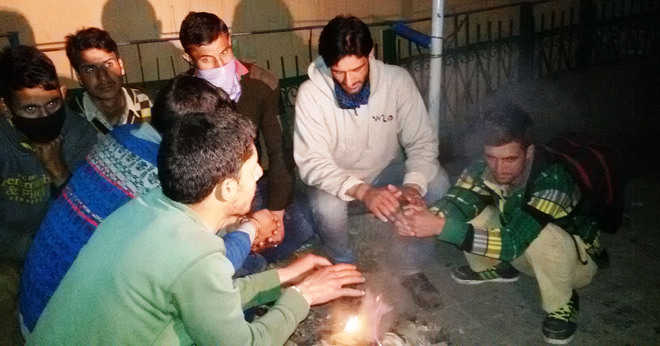
Cadidates sit around a bonfire to keep themselves warm at night in Doda district. Tribune photo

Our Correspondent

Doda, March 17

Army aspirants, who are staying here to participate in a recruitment drive, are spending sleepless nights on footpaths, outside shops, inside vehicles and in other public places in the hill district of Doda.The 159 Infantry Battalion, Territorial Army, is organising a recruitment drive from March 15 to 25 for unemployed educated youth of Udhampur, Kishtwar, Doda and Ramban districts at a sports stadium Doda. But the authorities made no accommodation arrangements for the candidates despite knowing full well about cold-wave conditions prevalent in the region for the past few days after rain and snow in upper reaches.A majority of the youths, who are from rural areas and cannot afford accommodation in hotels and lodges, have been forced to spend nights in the open (as at least two days in the city to complete the recruitment process).“We were greatly inconvenienced at night (Tuesday) as we were sleeping outside a shop when it started raining. We had to shift to another place in the middle of the night. Moreover, the authorities were not allowing us to take shelter inside the stadium. Some of my friends were not feeling well and could not perform during the physical test,” said Rahul, an aspirant.Mushtaq Ahmed Wani, another aspirant, said, “We hired a cab by spending Rs 2,000 to reach here for recruitment, but we are disheartened to see the kind of treatment given to us by the authorities. Hundreds of aspirants are without food and shelter. Now, it is very difficult for us to complete a race on an empty stomach.”Babur Ram, father of an aspirant from Dachhan, Kishtwar, said, “It was very disheartening to see the youths sleeping in unhygienic conditions and without blankets. They are also unable to find drinking water, food, toilet and other facilities. It is the responsibility of the administration and the recruitment agency to provide facilities to the aspirants if they have arranged such a big recruitment drive for them.”Doda Deputy Commissioner Bhupinder Kumar said, “It’s a serious issue, but whatever facilities are available with us, we are providing to them. We had already apprised the recruiting authorities that we had no accommodation available and also advised them to conduct the recruitment drive on a district basis.”


Revised pensions under OROP disbursed: Government

orop

New Delhi, March 14: Revised pensions under the ‘One Rank One Pension’ (OROP) scheme have been given to over two lakh defence pensioners along with the first installment of arrears, the government said on Monday, March 14. It said “revised pensionary benefits” were released to 221,224 pensioners drawing service and disability pensions from the Defence Pension Disbursing Offices, functioning under the Controller General of Defence Accounts. “The amount along with the first instalment of arrears had been released and credited by the defence ministry to the accounts of these pensioners on March 1,” the statement said. In the case of the remaining 146,335 family pensioners drawing pension from the Defence Pension Drawing Officers, payment along with arrears was expected to be released by March-end. The ministry said the additional annual financial increase in grants for OROP came to Rs.7,488.70 crore.

The total arrears to be paid from July 1, 2014 to December 31, 2015 was Rs.10,925.11 crore. The increase in pensions will cost the defence ministry an additional Rs.4,721.34 crore, with the defence pension liability coming to Rs.64,959.34 crore for 2015-16. IANS

https://youtu.be/HDiSKQ1_T3U

http://

Read more at: http://www.oneindia.com/india/revised-pensions-under-orop-disbursed-government-2040693.html?utm_source=spikeD&utm_medium=LT&utm_campaign=adgebra


Chinese troops spotted along LoC PLA ‘building infra’; Army tightlipped

Tribune News Service
Jammu/Srinagar, March 13
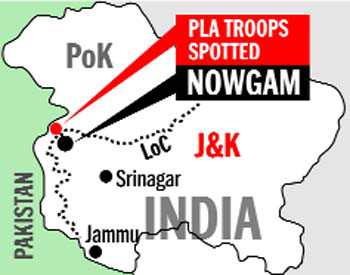
After frequent Chinese incursions in the Ladakh region, the Army is learnt to have spotted People’s Liberation Army (PLA) troops at forward posts along the Line of Control (LoC) on the Pakistan side of north Kashmir, sending alarm bells ringing among security agencies.
Intelligence agencies say “intercepts” of some Pakistan Army officers suggested that the Chinese troops were in the area to create some infrastructure along the LoC.
The Army authorities are tightlipped, but sources say higher-ups are constantly being updated about the presence of Chinese troops opposite Indian forward posts along the LoC in the Nowgam sector.
SD Goswami, defence spokesperson, Northern Command, said he was not “fully aware” of the development, while Col NN Joshi, defence spokesperson, 15 Corps, said there was no information about the presence of PLA troops.
Fresh inputs on Chinese troops have corroborated reports of a leading US newspaper that Pakistan had handed over de-facto control of the strategic Gilgit-Baltistan region in Pakistan-occupied Kashmir (PoK) to China, where it had been witnessing simmering rebellion against Islamabad.
In August 2010, The New York Times had reported that there were two important developments in Gilgit-Baltistan: “A simmering rebellion against the Pakistan rule and the influx of an estimated 7,000 to 11,000 soldiers of the PLA in the area, which is closed to the world.”
“China wants a grip on the strategic area to assure unfettered road and rail access to the Gulf through Pakistan… It is building high-speed rail and road links,” the newspaper had said. On March 27, 2011, former Northern Command Chief Lt General KT Parnaik had said Chinese troops were present in the PoK, posing a military challenge to India.
“China has gained considerable foothold in Gilgit and Baltistan by way of infrastructure development and helped Pakistan in exploiting the resources in the region. It has made numerous roads, bridges and power projects in Gilgit and Baltisan. It (Chinese presence) poses military challenges to India and not only along the Sino-Indian border but also along the Line of Control,” he had said.
The PLA troops were first spotted in the latter part of last year. They have since been seen opposite the Tangdhar sector as well. In this area, Chinese government-owned China Gezhouba Group Company Ltd has been building a Jhelum-Neelum 970 MW Hydel power project in response to India’s Kishanganga power project in Bandipore of north Kashmir.
Intercepts also suggest the PLA is planning to dig tunnels in Leepa Valley in the PoK to build an all-weather road that will serve as an alternative route to reach Karakoram Highway.
In recent years, Chinese troops have occasionally transgressed into the Indian side of the Line of Actual Control (LAC) in the Ladakh region where the boundary between the two countries is not properly demarcated.
(With agency inputs)

Along Nowgam posts

  • PLA troops have been spotted in Pakistan-occupied Kashmir, opposite Indian forward posts along the Line of Control in the Nowgam sector
  • Intelligence agencies say “intercepts” of Pak Army officers suggest the Chinese troops are creating infrastructure in PoK

‘Why Kashmiri leaders silent’

  • “How is it that Kashmiri leaders who have so much to say about Indian troops in J&K have nothing to say about Chinese troops across LoC?”— Omar Abdullah, Former J-K CM


CHINESE TROOPS SEEN ALONG LINE OF CONTROL IN PAKISTAN-OCCUPIED KASHMIR

SRINAGAR: After frequent incursions in Ladakh area, Chinese People’s Liberation Army (PLA) troops have been spotted at forward posts along the Line of Control (LoC) on the Pakistani side of Kashmir, ringing alarm bells in the security grid.

The Army has spotted the presence of senior PLA officials at the forward posts opposite Nowgam sector in North Kashmir, after which some intercepts of Pakistani army officers suggested the Chinese troops had come to create some infrastructure along the LoC, sources said on Sunday.

The Army has officially maintained complete silence on the issue but has been constantly updating various intelligence agencies about the presence of PLA troops along the LoC.

The PLA troops were first spotted in the later part of the last year and ever since their presence was witnessed opposite Tangdhar sector as well. In this area, Chinese governmentowned China Gezhouba Group Company Limited has been building a Jhelum-Neelum 970 MW Hydel power project. The hydel project is being built in response to India’s Kishanganga power project in Bandipore of North Kashmir.

The intercepts also suggested that Chinese PLA would be digging some tunnels in Leepa Valley, located in Pakistan-occupied Kashmir (PoK), to build an all-weather road that will serve as an alternate route to reach Karakoram Highway.

37092dcb-b17d-4c44-89d7-9a6d47a158ff


In the militancy plagued valley, joining Indian Army is a new craze

For those who raise alarm over the radicalisation of youth and home grown militancy, this should come as a good news. Shunning taboos, hundreds of Kashmiri youth thronged the army recruitment rallies to become the proud soldiers in order to serve the country.

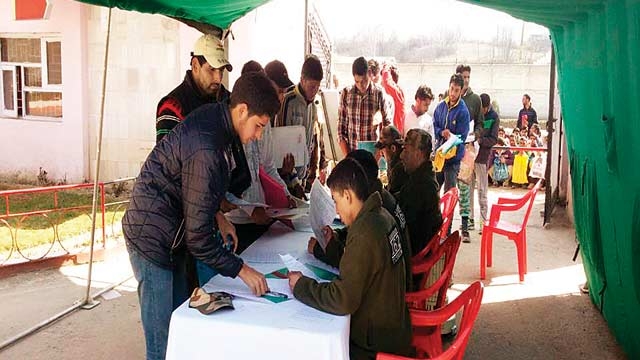
Such was the enthusiasm that more than 2,300 Kashmiri youth applied for less than 50 posts in different branches of the Indian Army. Over 1,500 candidates turned up for the 30 vacancies of soldiers at Jammu and Kashmir Light Infantry (JAKLI) Regimental Centre in the first phase of recruitment rally for Shopian and Srinagar districts.

In the second phase of recruitment to fill two vacancies of tradesmen, over 700 candidates appeared in the rally from almost all districts of Jammu and Kashmir with maximum representation from Baramulla, Bandipora and Anantnag districts.

“The army offers a lifetime opportunity of adventure, education, progression besides dignity and self-esteem to a soldier, as also to his family. The overwhelming response to the rally is but a reaffirmation of the Kashmiri youth’s growing aspirations to embrace the noble profession of soldering for the nation,” said Colonel NN Joshi, defence spokesman at Srinagar.

Given the huge craving among the youth to join the forces, Indian Army has planned several recruitment rallies across Jammu and Kashmir in coming months.

“Army is sensitive to the growing desire of Kashmiri youth and has started conducting recruitment in a phased manner. The rallies for recruitment into all categories of the army will be held in Sunjuwan in Jammu, Bandipora in Kashmir and Drass in Ladakh in the coming months,” said Colonel Joshi.

The huge response to army recruitment rallies comes in the backdrop of the reports of rising radicalisation of youth and home grown militancy in the valley. Figures reveal that over 60 local and highly educated youth joined the militancy in the last year alone sparking fears about the new breed of radicalised ultras overtaking the foreign counterparts in the valley.

In contrast, 242 young soldiers of the state passed out from JAKLI centre on Saturday after grueling training of eleven months. What was icing on the cake was the huge rush of people thronging the JAKLI centre on Saturday to watch the parade by the young soldiers.

Over 3,000 spectators including proud parents and relatives of the soldiers, veterans and other guests watched the parade of the young recruits turned soldiers.

Lieutenant General Satish Dua, General officer Commanding (GOC), in his address praised their contribution in encouraging more youth from J&K to come forward to join security forces. “He even highlighted the vital role played by their parents in motivating their children and wards to join this noble profession,” said Colonel Joshi.


Army to act against ‘encounter protesters’

Tribune News Service

Srinagar, March 10

With an increase in incidents of violence around gunfight sites, the Army today warned of “appropriate action” against protesters who took the law in their hands.The warning came a day after a large number of protesters in south Kashmir’s Pulwama district threw stones on security men during a major counter-insurgency operation that left two foreign militants dead.The police said stone throwers helped over half a dozen trapped militants, including a self-styled commander of the Lashkar-e-Toiba, to escape from the encounter site.Two civilians were injured in Army firing in the Aishmuqam area of Anantnag during a cordon and search operation on Tuesday.“In case a crowd takes the law in its hands and threatens life and property, security forces will initiate appropriate action to counter it,” said an Army spokesman. The spokesman said security forces were “forced to open cautionary fire” in Aishmuqam.“The Aishmuqam incident was investigated and it was established that security forces were forced to open cautionary fire to prevent any further injury, loss or damage to personnel, weapon equipment and other government property, in which two persons resorting to stone throwing were injured,” he said.Of late, there has been a trend, mostly in districts of south Kashmir, of locals throwing stones near encounter sites to ensure that holed up militants manage to escape the cordon.


Jammu Kashmir Trans-border tunnel in Jammu spurs quest for detection tools

Trans-border tunnel in Jammu spurs quest for detection tools
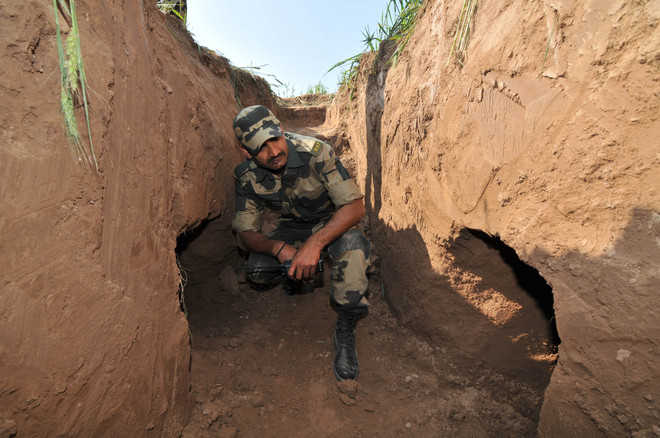
A tran-sborder tunnel originating from Pakistan that opened 30m inside Zero Line on the Indo-Pak border in RS Pura sector of Jammu district.

Shaurya Karanbir Gurung

Tribune News Service

New Delhi, March 9

The discovery of a 30-foot-long and 10-foot-deep tunnel running through the international border (IB) in the RS Pura sector of Jammu district has highlighted the need for a tunnel-detection technology.India has been finding it difficult to fulfil its plan to equip the new anti-infiltration system with a tunnel-detection technology. It has sought information on the tunnel-detection system from Israel, which claims to have used such technology to guard its borders and prevent cross-border attacks.“The possibility of more tunnels being found along the IB cannot be ruled out. The BSF discovered the tunnel in the RS Pura sector only after a portion of the tunnel had caved in. But what if there is a tunnel made of concrete? India needs technologies to detect such tunnels,” said a government official.“The Israelis claim to have seismic technology and ground-penetrating radars. But these tools can only work up to a certain depth. They are useful for Israel which has a shorter border with the West Bank and Gaza strip as compared to our border (IB). It is yet to see how to use the radar technology along the Indian borders,” said a security official.A 2012 BSF committee, constituted to submit a report on patches along the IB where the water level is low and the soil is conducive to digging tunnels, said there were areas vulnerable to tunnelling in Jammu and Punjab.The committee report said the radar technology would not be able to detect deep tunnels like the one found in Jammu in 2012 which was 30-foot-deep.At present, the BSF has been using counter-measures such as driving tractors over areas vulnerable to tunnelling and second-tier deployment along the IB in Jammu. But even these measures cannot pinpoint the exact location of a tunnel.Besides, the BSF believes persons (from Pakistan) may use underwater and aerial means to infiltrate into the country. “This could be done using machines to move under the surface of a river meandering between India and Pakistan,” said the official.

Anti-infiltration system

The anti-infiltration system with the tunnel-detection technology, which India plans to procure, is called the Comprehensive Integrated Border Management Solution (CIBMS). It integrates sensors, communication, infrastructure, response, and command and control. It will be set up along the IB with Pakistan, including the unfenced gap. The CIBMS system has also been planned to counter infiltration with the use of technologies such as SONAR.