
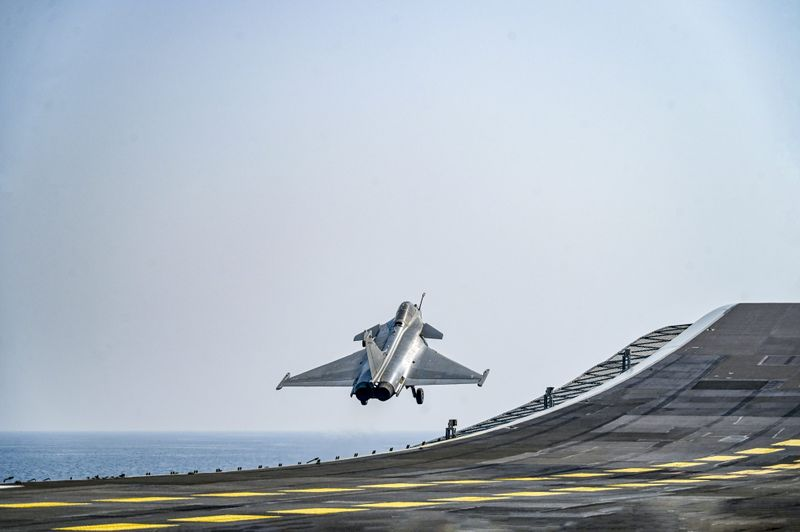
The Indian Navy is conducting trials of the marine version of the Rafale fighter jets; the landing on the carrier was part of the trials to assess various parameters
The ‘Rafale-Marine’ fighter aircraft has successfully landed aboard the indigenous aircraft carrier INS Vikrant on its maiden attempt, the Indian Navy said on Friday.
“The ongoing trials mark the first step towards operationalisation of the aircraft in the Indian Navy,” the Navy said in a post on social media platform X.
The Indian Navy is conducting trials of the marine version of the Rafale fighter jets. The landing on the carrier was part of the trials to assess various parameters. The trial was witnessed by the Navy’s Western Command Chief, Vice Admiral Sanjay Vatsayan.
In April this year, the Navy placed an order for 26 such jets, which will be capable of taking off from and landing on the decks of either of the country’s two aircraft carriers.
Two weeks ago, trials of the aircraft and its various systems commenced at the Shore-Based Test Facility (SBTF) in Goa. The SBTF replicates the take-off ramp of an aircraft carrier. The Indian Navy operates two aircraft carriers, INS Vikramaditya and INS Vikrant, both of which have a ‘ski-jump’ take-off ramp. During landing, the aircraft is brought to a halt using a set of special steel wires installed on the carrier’s deck.
In April, India and France signed an inter-governmental agreement (IGA) for the procurement of 26 Rafale-Marine naval fighter jets. Under the Rs 64,000-crore deal, deliveries of the jets will commence in 2028 and conclude in 2030.
The deal goes beyond the conventional buyer-seller arrangement for military hardware and seeks to expand bilateral cooperation. It includes provisions for the transfer of technology to integrate India-made missiles.
Additionally, the aircraft manufacturer, Dassault Aviation, will establish a production facility in India to manufacture parts of the aircraft’s fuselage. A maintenance hub for engines, sensors and other systems will also be set up, giving a boost to India’s aviation ambitions.
Operationally, the jets will expand India’s offensive capabilities at sea. The Rafale-M represents a significant upgrade for the country’s naval aviation fleet since the Russian-origin MiG-29K fighters joined the fleet in 2011. Around 40 of these Russian-made jets operate from the Navy’s two aircraft carriers — INS Vikramaditya and INS Vikrant.
What are the new capabilities?
The Rafale-Marine will have a combat radius of around 1,000 km. Since it will take off from and land on an aircraft carrier, its operational range will be measured from the carrier’s position at sea.
The aircraft is equipped with specialised sensors and can carry a range of weapons, including the long-range Meteor air-to-air missile, the MICA air-to-air missile, which enables beyond-visual-range (BVR) interception, and combat and self-defence missiles.
The jet can also carry precision-guided weapons such as the HAMMER, besides the SCALP long-range stand-off missile.
Like other naval fighter aircraft, the Rafale-M has reinforced landing gear. An aircraft landing on an aircraft carrier in the middle of the sea does not have the luxury of a long runway to slow down and come to a halt. Therefore, it uses a tailhook to engage with specialised arresting wires installed on the ship’s deck, bringing the aircraft to a stop.
The Rafale-Marine shares significant commonality with the Rafale aircraft operated by the Indian Air Force (IAF). Its procurement will streamline training and logistics, as the two variants share several systems and components.
The deal includes weapons, simulators, spares, associated ancillary equipment, crew training and logistical support. The IGA also provides for the transfer of technology to integrate indigenous weapons into the aircraft.
It includes the establishment of a production facility for Rafale fuselage components, along with maintenance, repair and overhaul (MRO) facilities in India for aircraft engines, sensors and weapons.
The transfer of technology for integrating Indian weapons will include the country’s indigenous Astra missile. This will also enable sourcing components from local suppliers and contribute to India’s efforts towards self-reliance in defence manufacturing. The Astra missile has already been integrated with the IAF’s Sukhoi Su-30MKI fighter aircraft.