
The IBGs are being raised in the two northeastern states of Sikkim and Arunachal Pradesh, both of which share borders with China
Ajay Banerjee Tribune News Service
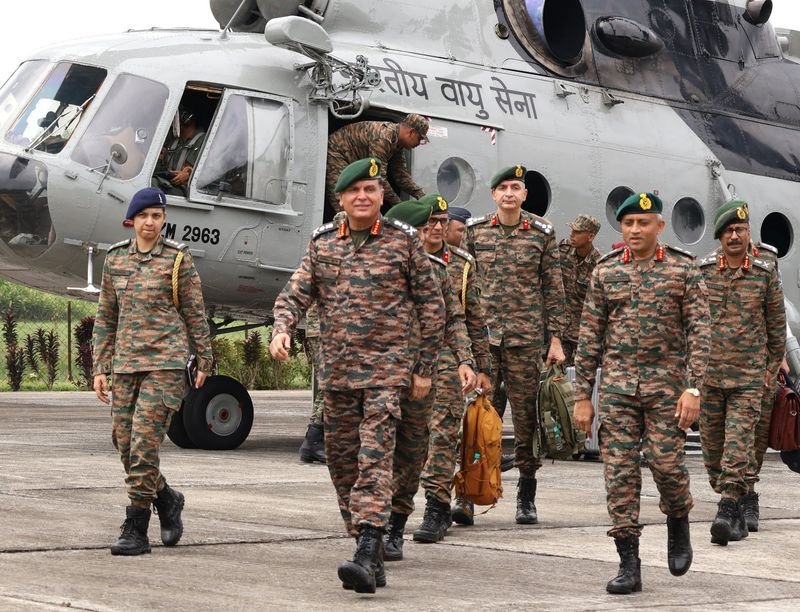
Two weeks after the Army raised five integrated battle groups (IBGs) in the eastern sector along the front with China, Army Chief Gen Dhiraj Seth carried out a review of operational preparedness and combat readiness in the region.
The Army Chief on Thursday visited the area under the 4 Corps in western Arunachal Pradesh, covering the Tawang-Kameng sector. Over the past two days, he also visited the 33 Corps, responsible for the Sikkim sector, and the 3 Corps, which is tasked with operations along the China front in far-eastern part of Arunachal Pradesh as well as the Myanmar border.
The IBGs are being raised in the two northeastern states of Sikkim and Arunachal Pradesh, both of which share borders with China. A fire support group equipped with long-range artillery guns and other firepower assets will provide backing to these agile formations.
The government’s sanction letter for raising the IBGs under the Mountain Strike Corps was issued on July 1, formally initiating the raising process, postings and other administrative measures. The formations are expected to become fully operational by mid-2027.
The Army Chief’s visit is aimed at assessing the prevailing security situation and the operational preparedness of formations deployed in the region.
He was briefed on the prevailing security situation, operational readiness and capability development initiatives by units and formations of the Eastern Command in the area. He also reviewed the measures undertaken by the formation to maintain peace, stability and a secure environment in the region.
The Chief was briefed about the 4 Corps approach and effective adoption of emerging technologies to enhance operational capability. He asked the commanders to maintain operational preparedness to effectively address emerging security challenges in the multi-domain environment.
Yesterday, Gen Seth reviewed the level of technology absorption, capability enhancement and force modernisation being undertaken in other parts of the eastern sector.
In Sikkim, Gen Seth was briefed on the operational situation in the Eastern Command. The Commander of the 33 Corps apprised him of operational deployments, surveillance architecture and current security dynamics.
In the 3 Corps, Gen Seth was briefed on the evolving operational environment, inter-agency coordination and measures being undertaken to further enhance combat readiness.
SouthAsians & Diaspora
The General also reviewed community outreach initiatives aimed at promoting peace, stability and development across the North-East.
Interacting with commanders and troops, the Army Chief outlined his vision of “VIJAY”, founded on vigilance, innovation, jointness, Aatmanirbharta and Yodha First. He emphasised that these principles would enable the Army to remain agile, adaptive and future-ready while contributing to the Viksit Bharat vision 2047.
An IBG integrates combat formation to make the forces faster, more flexible and self-sufficient. An IBG is designed to be a compact, unit with infantry, armour, artillery, engineers, signals, air defence and logistics support under one commander. It is meant to react quickly to threats and operate with less dependence on larger formations.
Each IBG will have a strength of around 5,000 personnel, which would be larger than a brigade (3,000-3,500 troops) but smaller than a division (10,000-12,000 troops).
Creation of IBGs is part of a series of steps to restructure the Army to make it leaner and more agile.