
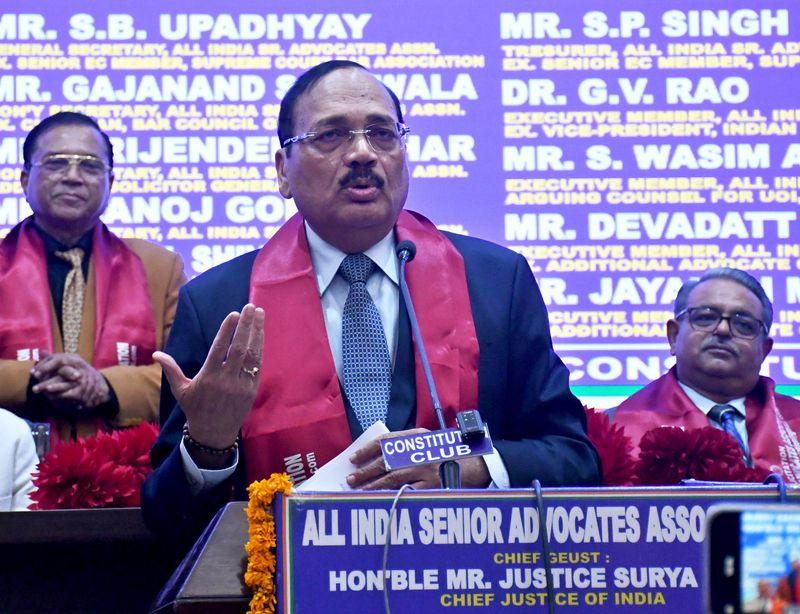
It is a dialogue between students and me,” Chief Justice of India (CJI) Surya Kant said on Friday as he sharply pulled up the Bar Council of India (BCI) for its order that the 2026 graduates of Hyderabad’s NALSAR University of Law not be enrolled as advocates following their objections to his proposed campus visit.“Students have a right to protest,” the CJI-led Bench said a day after the BCI directed all state Bar councils not to enrol any 2026 graduate of the university until further orders. The order was reversed within hours after an uproar on social media.
“It is a dialogue between students and me. Who are they (the BCI) to interfere? This is totally uncalled for,” the Chief Justice said after a plea challenging the BCI’s circular was mentioned before it for urgent hearing.
“When I was a student, I was also actively involved in student activities,” he added.
The Bench — which also included Justices Joymalya Bagchi and V Mohana — asked NALSAR to tell its students to get enrolled as advocates at the earliest. “We will empanel them for legal aid cases,” said the Bench.
A section of students of the premier law institute had written to the vice-chancellor, registrar and professors of the institution, opposing any proposal to invite the CJI as chief guest to the varsity’s convocation, the date of which is yet to be announced.
“Assuming even if they (students) are wrong, they have a right to protest. The BCI does not have any business in this,” the Bench said, terming the BCI’s action “absolutely unnecessary”.
Observing that students have the right to protest peacefully and nobody can stop them from doing so, the apex court asked the BCI’s counsel whether a meeting of the council was convened to take a resolution like that. The matter was posted for hearing after two weeks.
The court has also issued a notice to the BCI, seeking its response within two weeks on the plea challenging the circular issued by the apex Bar body.
“Issue notice. In the meantime, no punitive action shall be taken against the students or faculty of the NALSAR University of Law at the instance of the BCI or any state Bar council,” the Bench said.
The counsel appearing for the BCI told the Bench that the circular had been withdrawn. Senior advocate K Parameshwar, who mentioned the matter, told the Bench that the BCI had issued orders taking action against the students of NALSAR.
A BCI member from Kerala had opposed such a circular being issued.
The apex statutory body for lawyers said a final decision in the matter would be taken on August 19 after considering the material placed before it. The BCI then modified its decision after the uproar on social media and allowed state bar councils to enrol 2026 graduates of NALSAR University of Law as advocates.
Meanwhile, the Opposition on Friday slammed the Bar Council of India over its handling of the NALSAR dissent row, accusing the regulatory body of threatening students for exercising their right to disagree.
Opposition leaders alleged that the episode, along with action and threats against students involved in protests over the NEET-UG paper leak, reflected a wider trend of institutional overreach and attempts to discourage criticism.
Congress leader Gaurav Gogoi said, “The cost of dissent –NALSAR students exercise their constitutional right to dissent, the BCI Chairperson threatens to deny them enrolment as advocates.”
Gogoi also referred to students from Delhi University, Jawaharlal Nehru University and Jamia Millia Islamia who participated in protests at Jantar Mantar over the NEET-UG paper leak. He alleged that students were threatened with legal consequences and disciplinary action.
Describing the developments as part of a “disturbing trend”, Gogoi alleged that regulatory bodies and administrations were increasingly willing to overstep their mandates and penalise criticism. “It is an attempt to suppress critical thinking and create a culture of silence in public institutions,” he added.
“The freedom to disagree with the government is not a privilege bestowed by people in positions of authority. It is a fundamental right protected by the Constitution,” Gogoi said.
He further said that disagreement with those in positions of authority could not become grounds for professional retaliation and stressed that due process, academic freedom and institutional autonomy must be protected.
RJD leader Manoj Jha also criticised the BCI’s decision, accusing the council of making a swift reversal in an apparent bid to appease those in power. “The U-turn happened in the time it takes just to write the letter U,” Jha said, alleging that the episode had, in the process, “torn our democratic system to shreds”.
TMC leader Sagarika Ghosh also condemned the alleged targeting of students who voiced dissent. Describing such conduct as unbecoming of those entrusted with safeguarding institutional integrity and the dignity of office, she said, “Targeting students who voice their dissent is vicious and cruel