The Union Cabinet on Wednesday made a ‘course correction’ on the Agnipath scheme. The decision corrects some of the inherent operational and social flaws created by the scheme.
Though the announcement stops well short of an ‘admission of failure’, it does address the core concerns. Upcoming assembly elections in Punjab, Uttar Pradesh and Uttarakhand seem to have forced the decision at hand. There have been protests in Uttarakhand.
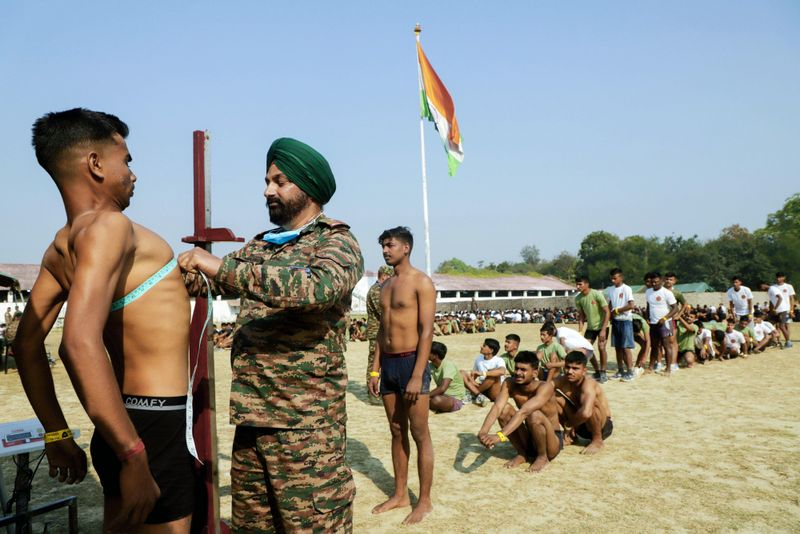
The Agnipath scheme, which uses the nomenclature Agniveers for soldiers, envisages a four-year contract for recruits. It was launched in June 2022. The announcement to tweak the scheme was made by Chief of Defence Staff (CDS) NS Raja Subramani in New Delhi and impacts almost 3 lakh soldiers who have been recruited under the scheme in the past four years. The four-year tenure of about 20,000 recruits who were in the first batch under the scheme was to end in December.
What is the change
As per the original policy, Agniveers were to serve for four years. Post that, 25 per cent were to be retained and the remaining 75 per cent were to exit and look for jobs in the civilian world, state police and para military forces, among others.
The Union Cabinet has now approved that the 75 per cent recruits, who were supposed to exit, will serve for an additional two years. After the two years, all soldiers will be retained. However, the main criterion behind it is the ‘willingness’ of the recruit to be retained as a full-time soldier.
In the announcement, the CDS made it clear that “all those exiting will be absorbed for two more years and will be retained as regular soldiers after the two-year period, subject to their willingness.”
Former Navy Chief Admiral Arun Prakash called the extension a good step. “It is good step but I had hoped the scheme would be abolished,” he said. The Agnipath scheme is devoid of logic and is damaging the combat readiness of the forces, he added.
Former Director General Military Operations (DGMO) Lt Gen Vinod Bhatia (retired), once an ardent critic of the scheme, says he is elated with the decision. “I see it as excellent modification as it meets the needs of organisation and has congruence with the needs of the soldiers,” he said.
The changes mean the soldiers will be on an extended ‘probation period’ of two years before being absorbed into the force altogether. During this two year period, emoluments will be increased, insurance benefits will be better and their seniority will be protected as per the original batch.
“This will mitigate the needs of the forces that now carry out multi-domain operations. An individual has the option to leave after six years while the organisation has a choice to retain the recruits,” Gen Bhatia added.
Issues in original plan
The scheme’s core idea was that a quarter of recruits of each batch would be retained as regular soldiers while the rest would leave with a corpus and a skills certificate. With thousands of trained young men and women about to be released, it became an immediate administrative and political problem.
An Army, Navy or Air Force had spent four years training someone, only to discard three in four of them. It was a wasted investment.
Admiral Arun Prakash said, “The two-year extension creates a separate class of soldiers. Perhaps it’s a face-saving measure for the government.” The 25 per cent retention rate was always contentious in military and political circles.
The Agniveers were also facing issues socially. They were not allowed to marry for the four-year term of service, meaning that by the time they got a chance to be a regular soldier, eligible girls in rural India would already be married off.