
Over a century after World War I ended, 34 Punjab Registers found in the Lahore Museum have been instrumental in finally honouring the sacrifice of previously unrecorded Indian servicemen
More than a century after the guns of World War I fell silent, nearly 10,000 Indian soldiers whose deaths slipped from the official historical record are finally to receive the recognition they were denied.
The Commonwealth War Graves Commission (CWGC) has announced that 9,909 previously unrecorded Indian servicemen will now be commemorated after a decade-long research project centred on a remarkable archive in Pakistan: 34 handwritten Punjab Registers containing the names of some 3,20,000 men recruited into the Indian army during the war.
It is one of the largest single additions ever made to the Commission’s casualty records, and represents far more than an administrative correction. It restores identities, acknowledges forgotten sacrifice and shines a light on one of the last major gaps in the history of India’s contribution to the Great War.
More than 13 lakh Indians served during World War I, making the Indian army one of the largest volunteer forces in history, with soldiers fighting from Flanders and Gallipoli to East Africa and Mesopotamia.
Behind the announcement lies an extraordinary story of historical detective work that began not in London or Delhi, but in the Lahore Museum.
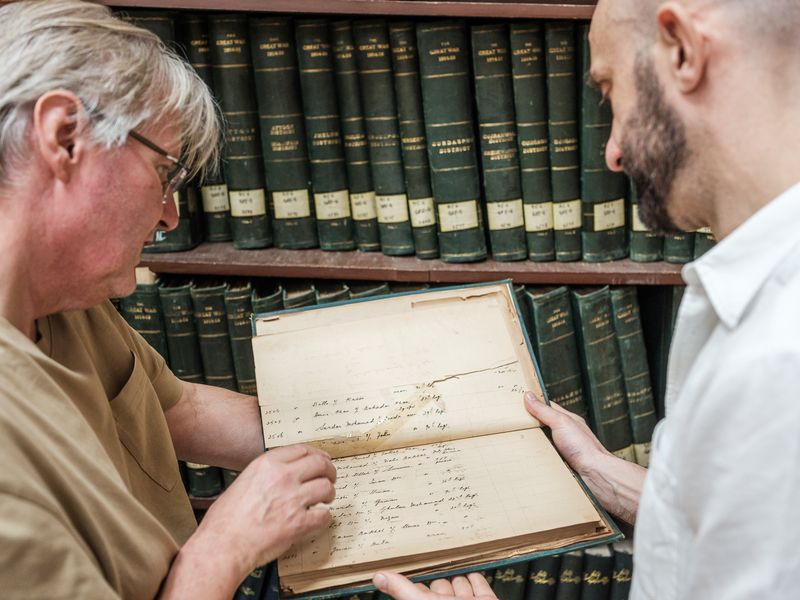
The 34 Punjab Registers found in the Lahore Museum by Amandeep Madra, co-founder of the UK Punjab Heritage Association, in 2014. He worked with British and Punjabi scholars, Pakistan archivists, and transcribers in India and Pakistan for over 10 years to convert thousands of handwritten pages into searchable data. Photo courtesy: CWGC
“I found them in 2014 during research for our Empire, Faith & War project,” recalls Amandeep Madra, co-founder of the UK Punjab Heritage Association, whose discovery set the entire process in motion.
War& Conflict
“Military historians knew the registers existed in principle, but no one had gone to look. It seemed unlikely: an art museum holding 34 handwritten volumes of military records. But they were there: a systematic record of every Punjabi man who served in the Indian army during the First World War. I knew straightaway it was significant.”
The significance became deeply personal. One of the first registers photographed was from Ambala district, the home of Madra’s own family.
“My father’s Chacha (paternal uncle), Bishen Singh, had served,” he says. “My dad remembered being taken to collect his pension as a boy and that he’d been blinded by sandstorms during the war. That was all we knew. Then I found him in the register. He was the only man from our village to serve. If it could do that for my family, I knew it could do it for thousands of others.”
What followed was more than 10 years of painstaking work.
The 26,000 pages had first to be photographed, digitised, indexed and transcribed. The project later became a collaboration between the UK Punjab Heritage Association, the University of Greenwich and the Commonwealth War Graves Commission.
Prof Gavin Rand of the University of Greenwich recognised the scholarly importance of the archive and secured funding for its transcription. The CWGC then undertook the laborious task of comparing the information with its own casualty database.
That comparison proved anything but straightforward.
Names had often been spelled differently by different clerks. Villages appeared under several spellings. Regimental records varied. Punjabi naming customs created further complications.
As Madra explains, researchers had to learn to think like Edwardian record keepers. ‘Roor Singh’ and ‘Rood Singh’ could be the same man. ‘Dulla’ might turn out to be Abdullah Khan, “but only if every other detail — father’s name, village and regiment — matched”.
During the Covid lockdown, volunteers began checking a sample of soldiers listed in the registers as having died during the war against CWGC records. They immediately discovered dozens whose names simply did not exist in the Commission’s database.
As the work expanded, the omissions kept growing. Ultimately, researchers examined almost 16,000 recorded deaths against some 74,000 existing Indian army casualty records. Supported by computer-assisted analysis and multiple layers of verification, they identified 9,909 men who had never previously been commemorated.
Why had they disappeared from history? According to Dr George Hay, Official Historian at the Commonwealth War Graves Commission, the reasons were both administrative and political.
“The British Indian Government made a conscious decision not to extend full war graves status to Indian army soldiers who died at home and away from operational zones,” he explains.
Many of those men had survived the battlefields only to die later from wounds or disease after returning to India. Unlike British soldiers who died in comparable circumstances, their names were never passed on to the Commission’s predecessors for permanent commemoration.
Administrative failures compounded the problem, meaning that some operational casualties also disappeared from the historical record.
The findings reinforce the conclusions reached by the CWGC’s Special Committee on Historical Inequalities in Commemoration, established in 2021, that entrenched racial prejudice and discriminatory colonial attitudes had contributed to unequal commemoration.
For Madra, who served on that committee alongside Professor Rand, the present announcement demonstrates that history can sometimes be corrected rather than merely debated. “This is one of the rare cases in Britain’s colonial history where we can actually correct a wrong rather than just argue about it,” he says.
The Punjab Registers reveal far more than military service. Taken together, the registers amount to an unparalleled census of rural Punjab on the eve of modern history, recording not simply soldiers but families, villages, religions, castes and communities that would later be divided by Partition.
A close up of the Punjab Registers shows the handwritten entries. There were 26,000 pages of detailed entries which had to be photographed, digitised, indexed and transcribed. Photo courtesy: CWGC
MilitaryHistory
Each entry records a soldier’s religion, caste, father’s name, village and district, creating an extraordinarily detailed portrait of rural Punjab between 1914 and 1918.
The newly identified casualties themselves reflect the diversity of that society: approximately 41 per cent were Muslim, 26 per cent Hindu, 25 per cent Sikh and less than 1 per cent Christian.
“It gives us Punjab from the village up,” Madra says. “You begin to see how communities were organised and how people identified themselves. It tells the social history of Punjab as much as its military history.”
That Punjab no longer exists. The villages recorded in the registers now lie across India and Pakistan, reminding us that the soldiers belonged to an undivided province long before Partition divided families, communities and memories.
“It isn’t an Indian story or a Pakistani story,” Madra says. “It’s a shared Punjabi story.” The research itself crossed modern borders. British and Punjabi scholars worked alongside archivists in Pakistan, while transcribers in both India and Pakistan painstakingly converted thousands of handwritten pages into searchable data.
For many families, the project has already transformed fragments of family legend into documented history.
Among those newly recognised is Jagat Singh of the 34th Reserve Mountain Battery, who died in Mesopotamia in January 1918. His great-granddaughter, Manjinder Nagra, became the first Sikh woman to play rugby for England.
Another descendant, Leicester dentist Dr Inder Singh Palahey, spent years searching for information about his great-grandfather, Kesar Singh.
“From just hearsay to now discovering the facts about my great-grandfather’s ultimate military sacrifice has been incredibly poignant,” he says. “The fact that he will now be remembered in perpetuity simply means everything to us.”
Madra has experienced that same emotion himself. Finding his own relative, Bishen Singh, in the registers remains his most powerful memory of the project.
“It’s probably the only surviving record where both his name and his father’s name still exist,” he says.
The work, however, is far from complete. The 9,909 names represent only those who died and were omitted from commemoration. The registers themselves contain details of around 3,20,000 soldiers and promise to become one of the richest resources ever assembled on the Indian army during World War I.
Researchers hope eventually to create a public, searchable database allowing descendants across the world to trace relatives, add family histories and photographs, and piece together stories that have lain buried for generations. The CWGC also believes similar archives may survive elsewhere in the former British Empire, raising the possibility that more forgotten soldiers may yet be found.
For Madra, however, the work will not be complete until the names exist not only in a digital database, but on permanent memorials where descendants can stand before them. He believes the men should ultimately be commemorated physically, with their names carved in stone, just like those of other Commonwealth war dead.
For thousands of families, the project has transformed fading memories and family folklore into documented history.
After more than a century, the forgotten soldiers of undivided Punjab have begun their journey back into history.
— Shyam Bhatia is the London correspondent of The Tribune