
The July 20 student protests became a catalyst for an unhinged ingenuity waiting to spill forth
Siddharth Pandey
July 20 holds a special place in my heart. Seven years ago on this date, I received my PhD in literary and interdisciplinary studies from UK’s University of Cambridge. It’s a day that is firmly entrenched in my memory as one of the finest of my life, for it marked the conclusion of my formal academic training that had begun way back in 2005 as an undergraduate student at the University of Delhi. Anyone who has pursued a PhD is aware of the exponentially taxing nature of the degree, that holds the power to recalibrate one’s personhood in fundamental ways. Mine was no different, and the shifting bouts of doubt, dilemma and discovery that accompanied the process of research altered my understanding of myself and the world at large in a deeply visceral, permanent manner.
But this rollercoaster ride across a thousand emotions felt worth the struggle when I stood inside the grand precincts of Senate House, the University’s designated space for graduation ceremonies, along with my cohort in front of the Deputy Vice Chancellor that July day. Critics have often disapproved of the event’s archaic nature, steeped as it is in traditions going back to many centuries. I, however, found the rituals rather moving, especially when we were summoned forward in rows of four and were instructed to grasp a finger each of our praelector’s right hand. A praelector is a college member chosen for presenting students to the authority at such events. As our names were called out one by one, we released our grips on his finger and further offered our folded hands to the Vice Chancellor (or their representative), who then clasped them within his own hands, spoke a few words of award in Latin, and gestured us to take leave. The physical degree was finally handed by a third person standing at the exit-door.
Along with the ceremony’s profundity bordering on the regal, it’s the symbolism of those hand gestures that makes me revisit that July day in fond terms every now and then. While the holding of the praelector’s fingers marked the last formal moment of allegiance to one’s college as a student, the clasping of the VC’s folded hands indexed the final formal moment of adherence to the University. But I also treated the tradition as an expression of care, for there are few universal symbols more powerful than the coming together of hands, a cipher that at once articulates the ideas of devotedness, protection, safety, and mutual responsibility. And it is in these terms too that I like to remember my overall experience of living and studying at one of the world’s premier universities.
Even before I had returned to India for good, I was routinely asked by friends and acquaintances to relay my impressions of studying at Cambridge. They were aware of how much I had loved my time at Delhi University, and some were curious about the supposed ‘higher’ intelligence of staff and students overseas. However, right from my first year in the UK, it was evident to me that back home, I had already partaken one of the most inspiring intellectual milieus anywhere on the planet, with teachers and friends in the capital fueling a rigorous regard for creative and critical thinking on an almost daily basis. The pedagogy that came my way while being an undergraduate student of English Literature at Ramjas College could rival any other institution’s, no matter the rank or fame.
But once I was overseas, what did come into telling relief was the extraordinary effectiveness of the larger ecosystem. Despite the multipronged crises that was rapidly affecting higher education in the Anglo-American world, there was still a surety of resources and a smoothness to everyday life that is required for the healthy growth of ideas. Unlike India, one didn’t have to run to countless authorities to request for the scholarship stipend that was already yours to begin with. Rather, respectful intimations arrived before time over email, asking us to collect the cheques on certain dates. Libraries were well-stocked, numerous and gorgeous to simply look at, and ran round-the-clock, where you were strongly advised to request librarians to buy an unavailable book instead of shelling out your own money. Living on campus had its own privileges too, and every time I felt the urge to practice music, I had four pianos at my disposal, with my ID Card serving as the key to all music rooms. Trust, dignity and well-being went hand in hand, almost as a rule of thumb.
The biggest lessons however lay in a different understanding of hierarchy. Institutions like Cambridge and the likes routinely come under the scanner for their alleged fidelity to elitism, and there is much that is true to that effect. Yet, being part of Cambridge’s youngest college, Homerton, also introduced me to what democracy really meant, as even Masters level students were actively encouraged to become parts of committees that appointed new lecturers, heads of department and even college principals. Further, it was hard to find ‘clerks’ or ‘lower staff’ who were ‘meant’ to arrange tables and chairs during functions, and everyone from faculty heads to principals and students involved themselves in acts of ordinary labour. Coming from a country that thrives on a mindboggling number of social pyramids, this was both a shock and an immense pleasure to witness. I do wonder when we’ll be able to truly break down those ‘narrow domestic walls’ (to use Rabindranath Tagore’s phrase) that continue to plague our society.
Returning home and finding myself in the thick of an authoritarian dispensation, I was pained to see what had become of our public institutions over the last decade. To be sure, their decimation had already begun under the previous, Congress regime, and the subsequent governments cashed upon that while also giving everything imaginable a saffron turn. One shouldn’t be under any illusion either that the entire youth of the country was ‘naturally’ or necessarily critical of the changes. For there is much in our recent past – from the Galgotia University protest-fiasco where students had no idea what they were protesting against, to young hooligans channelizing the violence of right-wing regime – that proves otherwise.
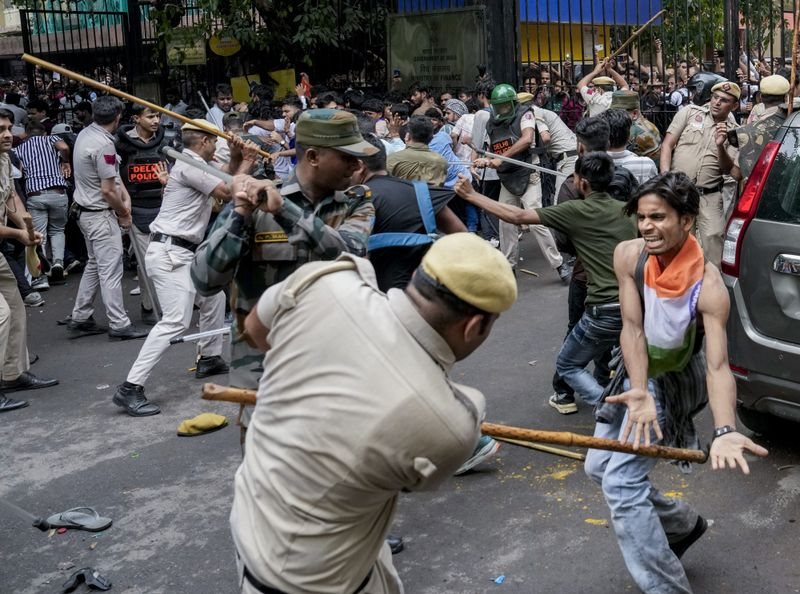
And yet, there is an unbridled and incomparable truth, honesty and courage about the demonstrations that have unfolded in the wake of July 20, 2026. That date, while going down in history as a black day for Indian students and society in general, shall also be remembered as the catalyst for an unhinged ingenuity waiting to spill forth. While ‘Educate, Organize and Agitate’ has been a staple call at many historical protests, this one also unambiguously added another verb to the rulebook: ‘Create.’ Powered by the miracle that is digital media and fired equally by a zeal that lies at the heart of all true art, the turn that the protest took July 20 onwards reminded me of all the ideals that my best days at Delhi and Cambridge had acquainted me with: that dignity and well-being can never be compromised, and that common hands, once drawn together, have the power to shake the mightiest of establishments.