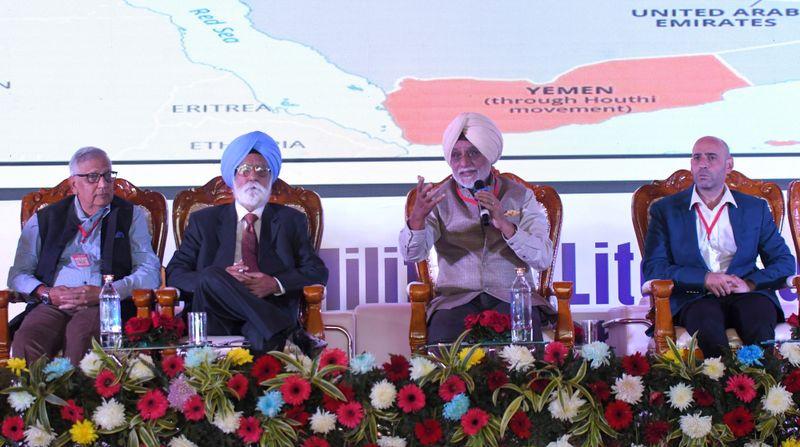
Lt Gen (Retd) KJ Singh, Brig (Retd) Arun Sehgal, Shay Gal and Ambassador Manbir Singh during a session on ‘Iran-Israel Conflict’ at the 10th Military Literature Festival in Chandigarh on Friday. Tribune
Stating that the Iran-Israel conflict presents a demanding test of national power and raises questions about whether military superiority can give a country lasting control over its security, Shay Gal, an Israeli expert, said that a state may possess extraordinary intelligence capabilities, strike targets at great distances and intercept incoming missiles, yet remain vulnerable because its hospitals are inadequately protected, replacement supplies arrive too slowly or its strongest partner defines an acceptable outcome differently.
Speaking during a session on the ‘Iran-Israel Conflict’ at the 10th edition of the Military Literature Festival in Chandigarh on November 13, Gal, Principal of the Line of State think tank and a former Vice President of Israel Aerospace Industries, said that Israel’s objectives against the Iranian regime must address the full spectrum of threats, including nuclear weapons capabilities, long-range attacks, and the financing and military capabilities of organisations that wage wars across national borders.
This, he said, requires a clear political objective before the use of force, along with sufficient national endurance to pursue an arrangement that remains effective even when promises are broken.
He added that the distinction between the Israeli government and the Iranian people is equally important, emphasising that Israel’s conflict is with a regime that has built its power through hostility and repression.
Gal said that India’s experience in integrating indigenous and foreign systems, adapting under pressure and confronting Turkish-origin weapons deserved Israel’s attention.
Israel must draw on Indian operational experience and indigenous engineering capabilities, he stressed.
Pointing out that paying for a weapon does not give any nation control over its manufacturers, production schedules or export permissions, Gal said that India understands this reality through Washington’s historical ties with Pakistan.
Former General Officer Commanding-in-Chief, Western Command, Lt Gen KJ Singh, said that Israel and Iran had not started out as enemies. Iran was the second Muslim-majority country, after Turkey, to recognise Israel.
From 1948 to 1979, the two countries enjoyed very good relations until the regime change brought about by the 1979 Islamic Revolution.
He said that the two countries had enjoyed close cooperation, including an oil pipeline from Eilat to Ashkelon. In return, Israel provided considerable technology and know-how in weapons and missile manufacturing.
Therefore, some of the weapons Israel faces today are based on technology that initially came from Israel itself.
Relations deteriorated due to Arab nationalism, while the conflict between Iran and Israel was also shaped by fears of Arab and Sunni nationalism and the influence of Soviet communism, he said.
Ambassador PS Hayer presented an assessment of Iran’s political and strategic outlook, discussing the country’s inward-looking political structure, religious influence, economic dependencies and nuclear enrichment trajectory.
He also examined the implications of American domestic politics, including the US midterm elections, for Washington’s approach towards Israel.
Brig Arun Sehgal (retd), a strategic analyst, identified four critical dimensions of the conflict: Iran’s nuclear capabilities, its capacity for retaliation, the expanding role of drones and the involvement of non-state actors such as Hamas and the Houthis.
He also discussed the importance and strategic relevance of the Strait of Hormuz, strategic shelters and the implications of a possible escalation involving tactical nuclear weapons.