
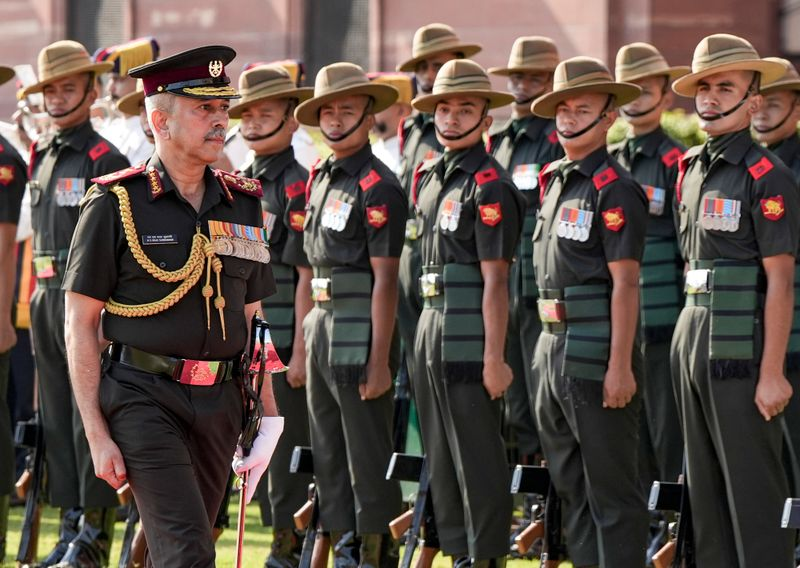
General NS Raja Subramani took charge as the new Chief of Defence Staff (CDS) on Sunday while Admiral Krishna Swaminathan assumed office as the new Navy Chief, marking a change at the top of the military hierarchy.
The Army is expected to get a new Chief as General Upendra Dwivedi is set to superannuate on June 30. General Subramani succeeds General Anil Chauhan, who completed his tenure as the country’s senior-most military officer on Saturday. Admiral Swaminathan succeeds Admiral DK Tripathi, who superannuated today.
The appointment of the new CDS comes weeks after outgoing CDS General Chauhan, submitted a formal proposal to the Ministry of Defence on having geographically defined areas designated as ‘theatre commands’ – with a military commander heading it and controlling all war-fighting assets like planes, copter, guns, tanks, equipment and manpower.
General Subramani faces the task of converting the theatre command blueprint into an operational reality and ensuring it shortens the decision-making loop for a simultaneous two-front scenario with Pakistan and China.
Soon after taking charge, General Subramani laid down his targets saying “strengthening the transformation of the armed forces and carrying out organisational reforms to improve tri-services integration and coordination would be among his top priorities”.
The new CDS said he aimed to accelerate the development, induction and integration of indigenous weapons in the armed forces.
Meanwhile, Admiral Swaminathan said: “It shall be my highest priority to ensure that the Navy maintains the highest level of operational readiness and combat effectiveness so that it can protect the nation’s security and economic interests”.
The Navy stands vigilant to protect national interests wherever they are and is very actively deployed in a regional security environment that continues to remain challenging, complex, unpredictable, and uncertain, he added.
General Subramani is the third Army officer to serve as CDS, after General Bipin Rawat and General Chauhan.
A graduate of the National Defence Academy in Khadakwasla and the Indian Military Academy in Dehradun, he was commissioned into the 8th Battalion of the Garhwal Rifles on December 14, 1985.
General Subramani’s tenure is three years and it overlaps with the recent urgency in efforts by India-China to work out a solution for their disputed boundary. The military will be advising the government on contours of the boundary along the Himalayas, if that is to be demarcated.
He is one-year junior to Army Chief General Upendra Dwivedi and Indian Air Force Chief Air Chief Marshal AP Singh, who are due to retire in June and October, respectively. But with his appointment to four-star rank, he is ‘first among equals’ vis-a-vis the three service chiefs.
Admiral Swaminathan is an alumnus of the National Defence Academy, the Joint Services Command and Staff College in Shrivenham, United Kingdom, the College of Naval Warfare in Karanja, and the US Naval War College in Rhode Island.
His tenure starts as India moves towards finalising a deal to build next-generation conventional submarines in collaboration with Germany.