
PART I : Macaulay to Vivekananda: The curse of the single door and the cruel arithmetic
Lt Gen SS Mehta Retd
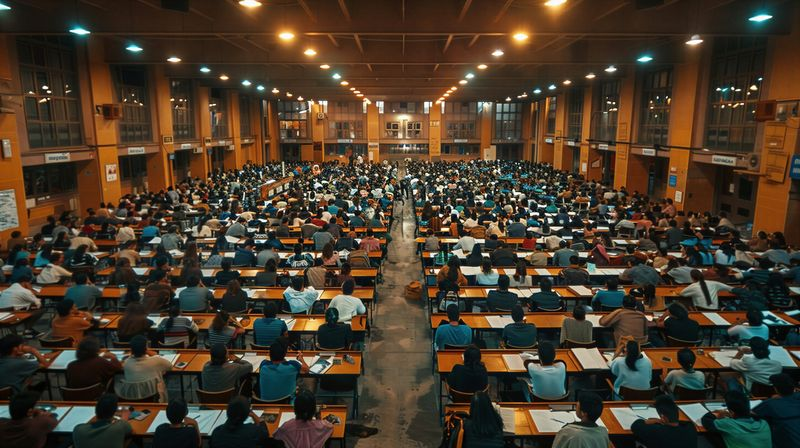
FOR a fortnight, Parliament debated education with unusual seriousness. The trigger was a young generation’s anguish over the integrity of its examinations, and that anguish was just. An examination is the Republic’s promise that talent will be weighed and birth will not. When a paper leaks or a seat is sold, the promise breaks, and faith in the Republic breaks with it.
The anger was earned. But anger is diagnosis, not design. Parliament supplied the feeling. The Republic now owes the architecture.
Say the position plainly. An honest examination is necessary, but it is not enough. It guards one door where a nation needs a house. The task before the Republic is not a fairer door. It is a second way in.
Begin with the harder question. Suppose every examination became honest tomorrow. Every leak stopped, every corrupt official gone, every result pure merit. Would opportunity then be equal?
It would not. For even a perfectly honest examination guards a single narrow door. Consider the one that provoked this debate. In 2024, more than 23 lakh young Indians appeared for the medical entrance examination. Over 13 lakh crossed the qualifying threshold. Against them stood roughly 1,15,000 MBBS seats. An honest examination would still have denied an MBBS seat to more than nine out of every ten candidates it had declared qualified. Nor is medicine an exception.
In two recent Railway recruitment examinations alone, some 2.37 crore candidates competed for approximately 1.31 lakh eventual recruitments. The same young person may, of course, appear in several examinations; that duplication is itself evidence of repeated attempts to enter the same narrow passage.
Parliament debated the young who were cheated, and rightly. But it never counted the far larger number who were not cheated at all, who sat a fair examination and found that fairness had no seat to give them. The arithmetic is not corrupt. It is merely cruel. We have mistaken uniformity for fairness, and scarcity for merit.
This is not an administrative fault. It is a philosophical inheritance, and it has two fathers and a date apiece. In 1835, Thomas Macaulay wrote his Minute on Indian education and sought to create a class of persons, Indian in blood and colour but English in taste, who would serve as interpreters between the colonial administration and the millions it governed. The individual mattered because the system needed him. In 1893, from a platform in Chicago, Vivekananda presented a different conception of man to the world. He would define education as “the manifestation of the perfection already in man.” One design begins with the requirements of the system. The other begins with the person. India kept Macaulay and quoted Vivekananda, which is the most Indian compromise of all.
We built Macaulay into the machinery, the schools, the services, the whole apparatus that turns a person into a qualification, and we kept Vivekananda for the convocation address. One we obey every working day. The other we quote on ceremonial occasions and forget by the afternoon. The credential runs the country. The perfection within is left on the platform in Chicago.
A philosophy of education never stays in the classroom. It becomes a mindset, and the mindset becomes the social order, deciding what a people honours and whom it rewards. Macaulay’s order made the credential the measure of a man, and the effect reaches all the way into the home.
Consider a boy born into a welder’s family. His father knows the trade to its depth, and knows too what it has earned him, which is skill without standing, which is another way of saying skill without a decent wage. So the father spends every rupee he has to lift the boy off the welding floor and set him at the foot of the only staircase that carries respect. He is not choosing medicine. He is fleeing welding. Now change one thing. Let the trade have a summit. Let a certified welder be able to end his working life as a professor of practice, teaching the craft and then certifying it. Two things shift at that kitchen table. The boy who would make a fine welder may never be pushed toward a doctor’s gown at all, and the boy who would make a poor one now has a second staircase to climb rather than a single desperate bet. Ascent does not merely reward the craftsman. It rescues the household’s judgment.
This is why an argument about examinations is really an argument about survival. While we guard the one door, the crafts behind the others are dying, one anxious father at a time. The official censuses differ in definition, but their direction is unmistakable: India’s handloom workforce has contracted, aged and become increasingly precarious. In Varanasi, hand weaving has steadily surrendered ground to the power loom. Across craft clusters, children are turning away because inherited mastery offers neither predictable income nor social ascent. This is not modernisation. It is amputation. Skill that took three generations of hands to build, and that no syllabus can hold, is being lost not for want of demand but for want of standing.
And the craft dies for a reason more curable than fashion. The weaver’s poverty is not written into his loom. It is taken from him on the way to the market. Between the hands that make and the buyer who pays stands a line of intermediaries, each taking his cut of a margin the maker never sees, so that the man of skill ends poor while the man of access grows rich.
Standing, then, is not honour alone. It is the wage the work would earn if it reached the market whole. This is where the new instruments earn their keep. The platform and the phone have begun to do to the middleman what no policy ever could, letting the weaver in Varanasi and the potter in Khurja sell to the world directly and keep what the sale is worth. That disintermediation is not a convenience to be admired. It is a lever to be seized, by deliberate policy and steady advocacy, until it is the maker the market pays, and not the man in between.
A developed India cannot keep losing its capability to a mindset, and the loss cannot be repaired by improving the ladder alone. Better schools, fairer papers, cleaner admissions — each have value, and none of them builds a second way up. The remedy is not a kinder examination. It is a second instrument.
We have given the fortnight to the lock. The room is the harder question, and the more important one. What that second instrument is, and how a country already owns the tools to build it, is where this essay turns next.