The memoir contains unusually candid details about Maneka Gandhi and her relationship with other members of the family
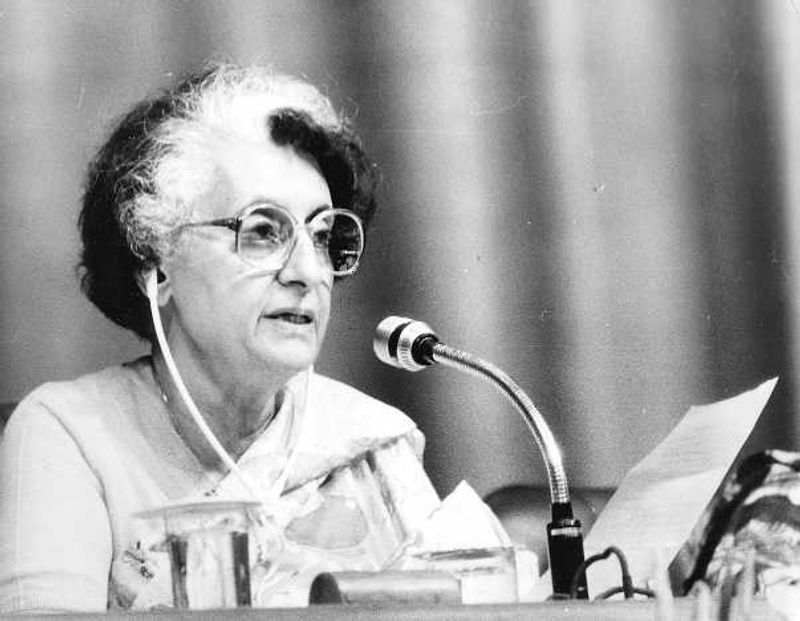
Former Prime Minister Indira Gandhi feared that resigning in 1975 would split the Congress and allow the RSS to gain political ground, even as her elder son Rajiv Gandhi advised her to step down following the Allahabad High Court verdict against her, Sonia Gandhi has revealed in her memoir Belonging: A Journey of Love, released on Tuesday.
The memoir offers a candid account of the events leading to the Emergency, Sanjay Gandhi’s growing influence over his mother, the excesses of forced sterilisation and slum demolitions, and tensions within the Gandhi family involving Maneka Gandhi.
“If I resign, the party will split and scatter, and the RSS will have its way,” Indira told Rajiv, Sonia recalls in the book.
Sonia writes that Indira was convinced the RSS was using Jayaprakash Narayan’s movement to weaken the Congress. She also feared that political forces hostile to her government were determined to dismantle the party.
Indira’s distrust of the RSS, according to Sonia, went back to the freedom struggle. The memoir refers to an earlier letter in which Indira compared the organisation’s growth to that of the Brown Shirts in Nazi Germany and expressed concern about its financial backing and political ambitions.
Sonia also makes allegations concerning the RSS’s ideological history, VD Savarkar’s dealings with the British authorities and the views of some of its ideologues on Hitler. She presents these as part of Indira’s long-standing opposition to the organisation.
Recalling the political crisis of June 1975, Sonia writes that Indira was deeply troubled after the Allahabad High Court invalidated her election on June 12. Rajiv immediately went to his mother’s study, where Sonia joined them shortly afterwards.
“What should I do? “What should I do, Rajiv? Do you think I should resign?” Indira asked repeatedly, according to Sonia.
Rajiv advised her to step down, arguing that elections were only months away and a fresh mandate would settle the political uncertainty. Indira initially agreed with him.
The situation changed as opposition parties intensified their campaign. On June 22, the Supreme Court granted Indira a conditional stay. Three days later, Jayaprakash Narayan addressed a massive rally at Delhi’s Ramlila Maidan and urged government servants, the police and the armed forces not to obey orders they considered wrong.
Sonia writes that Indira regarded the appeal to the armed forces as treasonous. Senior colleagues, including Siddhartha Shankar Ray and HR Gokhale, favoured firm action, while Sanjay insisted that the opposition had to be stopped.
The Emergency was proclaimed under Article 352, and on June 26, 1975, the country woke up to arrests of opposition leaders, restrictions on protests and press censorship.
The memoir also revisits the political unrest preceding the Emergency, including the 1974 railway strike led by George Fernandes and the Nav Nirman movement in Gujarat. Sonia writes that nearly 100 people died and about 1,000 were injured during the Gujarat agitation, which was followed by the dissolution of the state Assembly.
Student protests subsequently spread to Bihar, where Jayaprakash Narayan emerged as the principal opposition figure. A substantial part of the memoir deals with Sanjay Gandhi’s political influence during the Emergency, including the consequences of his Five Point Programme.
Sonia acknowledges that Sanjay played a major role in political decision-making despite lacking constitutional authority. His programme included family planning, literacy, opposition to dowry and caste discrimination, tree planting and urban renewal.
The family planning drive, however, became associated with coercion as government officials competed to meet sterilisation targets. Sonia describes the programme as poorly conceived and implemented without sufficient regard for its consequences.
The book also details the demolition and resettlement drive around Turkman Gate in Old Delhi, where refugee families were shifted to sites beyond the Yamuna. Police firing during protests resulted in several deaths and numerous injuries.
Sonia recalls that a family elder questioned why displaced families had been moved during the monsoon when their allotted plots were flooded.
“That’s not so! You can go and see for yourself,” Sanjay responded, according to the memoir.
Indira subsequently visited the resettlement area and returned with her sari soaked in mud up to her knees, Sonia writes, exposing the difference between official assurances and conditions on the ground.
The memoir also recounts an episode involving the Kashi Vishwanath temple in Varanasi. Sonia writes that in August 1975, Pupul Jayakar informed Indira of a proposal to beautify the narrow lane leading to the temple, which was lined with centuries-old houses and shrines.
Indira immediately stopped the project after learning that it formed part of Sanjay’s urban beautification programme. Sonia alleges that the heritage Indira sought to protect was later affected by redevelopment under Prime Minister Narendra Modi in 2018.
Sanjay’s conduct also caused growing concern within the family. In July 1976, he gave an interview criticising the Soviet Union, the Communist Party of India and some of his mother’s policies, embarrassing Indira at a time when Moscow remained an important ally.
“He doesn’t listen to me,” Indira told Rajiv and Sonia. “I don’t know what to do.”
Sonia writes that Indira asked her principal secretary, PN Dhar, to undertake damage control. Sanjay’s growing political prominence was also resented by some senior Congress leaders, particularly after he was acclaimed as the undisputed Youth Congress leader at the party’s Guwahati session in November 1976.
The memoir contains unusually candid details about Maneka Gandhi and her relationship with other members of the family.
Sonia recalls initially enjoying Maneka’s company and describes her as lively and talkative. Young Priyanka often spent time listening to stories in her aunt’s room. However, relations gradually deteriorated.
Sonia writes that household staff addressed her as Bahurani and Maneka as Choti Bahu. Although she regarded the distinction as a traditional form of address, she believed Maneka saw it as a slight.
Sonia says she usually avoided responding when Maneka spoke rudely, but occasionally answered when she felt matters had gone too far. She also recalls heated exchanges between Sanjay and Maneka, including the use of expletives in Indira’s presence.
Indira was concerned about Maneka’s influence over Sanjay and believed that she was encouraging his political activities rather than restraining him.
“Uske abhi se par nikalne lage hain,” Indira remarked to Cabinet Secretary PN Dhar about Maneka, according to the memoir.
The growing tensions also affected Rajiv and Sanjay, who had previously been almost inseparable. Sonia writes that Rajiv was hurt after a mutual friend told him Maneka had suggested he was jealous of Sanjay’s political position.
Rajiv, who enjoyed his career as a pilot and preferred family life to politics, became more cautious in dealing with his brother. Nevertheless, he continued to convey complaints and warnings about the government’s conduct to Indira.
Follow PoliticsOn one occasion, Indira rebuked Rajiv for believing reports about public resentment. Rajiv insisted that although some complaints might be exaggerated, many were genuine. Sonia recalls that he left the room visibly hurt, with tears in his eyes. Indira later approached him and kissed his forehead.
The memoir also reveals Sonia’s involvement in Sanjay’s controversial Maruti car project. Sanjay had trained at Rolls-Royce in Britain but did not complete the five-year course that Indira wanted him to finish. After returning to India, he applied in December 1968 for permission to manufacture a small car and received a letter of intent towards the end of 1970.
He began working on a prototype at Gulabi Bagh in Delhi and asked Sonia to join the company’s board because she was the only family member without a government job.
The allocation of land to Maruti Ltd and the involvement of business shareholders led to allegations of favouritism. The car received a roadworthiness certificate in 1974, but legal challenges and other difficulties prevented the project from taking off.
Maruti was wound up by a court order in 1978, revived by Indira’s government in 1981 as a joint venture with Suzuki, and began production in 1983.
Sonia also recalls an uncomfortable experience during Indira’s testimony before the Allahabad High Court in March 1975. When a question concerning Sanjay’s Maruti project was raised, Sonia was asked to leave the courtroom because Indira feared she might be summoned in connection with the company.
The memoir concludes its account of the Emergency with Indira’s growing unease over the consequences of her government’s actions. By late 1976, Sonia writes, Indira had become increasingly disturbed by reports of coercion, public anger and the growing distance between the government and the people.
After Christmas that year, Indira discussed her doubts with Rajiv, who encouraged her to hold elections even if the Congress risked defeat. He specifically referred to the resentment caused by the sterilisation programme.
“Your instinct is right, Rajiv,” Indira told him, according to Sonia’s account. Sanjay opposed lifting the Emergency and warned that the Congress could lose. Cabinet Secretary PN Dhar estimated that the party might secure only 230 seats, short of a majority.
Indira nevertheless decided to proceed. On January 18, 1977, she announced the release of political prisoners and fresh elections, bringing the Emergency towards its end.